Last updated 15.10.2026
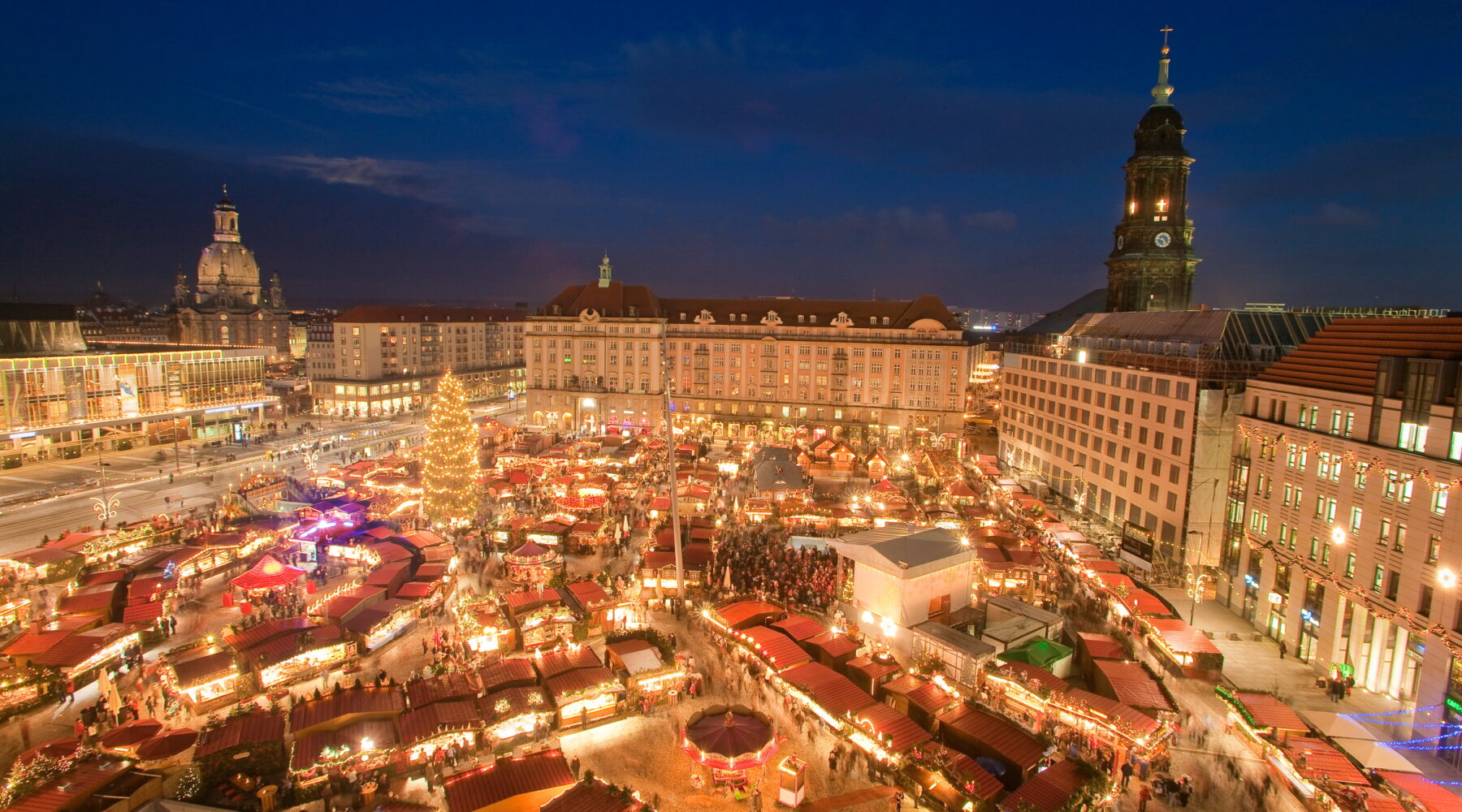
If you only see one German Christmas market, make it the Dresden Christmas market, and it is honestly one of our own favourites. Dresden is easy to reach: it has its own airport, it is about two and a quarter hours by direct train from Prague and roughly two hours from Berlin, so it fits neatly into a city break in Central Europe. Waiting for you is the oldest documented Christmas market in Germany, a giant Ore Mountain pyramid, a Christmas cake (Stollen) with its own festival and around ten more markets scattered across the centre. In 2026 the Striezelmarkt on the Altmarkt square runs from 25 November to 24 December, its 592nd edition. Squeezing it all into one day is hard work, though, so the markets are at their best as a long weekend with one or two nights in the centre. Below you will find hotels within walking distance of the stalls, a three-day itinerary, dates and opening times for every market, how to get there from the airport, Prague or Berlin, and ten ideas for what to do in Dresden in winter.
Dresden Christmas market at a glance
- Dates 2026: Striezelmarkt 25 November – 24 December 2026. Most of the other markets open on the same day and some stay open into early January 2027.
- Main location: the Altmarkt square in the historic old town (Altstadt), with more markets on the Neumarkt by the Frauenkirche, in Münzgasse, in the Stallhof, on Prager Straße and across the river on Hauptstraße.
- Striezelmarkt opening hours: daily 10:00–21:00, from 16:00 on opening day and only until 14:00 on Christmas Eve.
- Entry: free. The one exception is the medieval market in the Stallhof on Advent weekends (€5 adults, about £4; €3 children).
- Ice rink: yes, on Prager Straße at the Dresdner Winterlichter market (with skate hire) and at the Christmas Garden in Pillnitz.
- Stollen Festival (Stollenfest): Saturday 5 December 2026.
- Best for: a long weekend from Friday to Sunday. As a day trip from Prague or Berlin it is a rush (itinerary below).
- Where to stay: in the old town around the Altmarkt and the Frauenkirche, or for less money and more quiet in the Neustadt across the Elbe (our hotel picks).
Where to stay for the Dresden Christmas markets
You can do Dresden in a day, but you will spend much of it on trains and the best part of the day comes last: the markets only really light up after four in the afternoon and the Striezelmarkt closes at 21:00. We recommend turning the markets into a long weekend and staying at least one night. The evening atmosphere under the floodlit Frauenkirche is the finest thing Dresden has to offer in Advent, and after a mug or two of Glühwein you will not want to be watching the clock for the last train. Staying over also lets you dodge the worst of the crowds: on Saturday afternoon you shuffle across the Altmarkt at walking pace, while on Friday evening and Sunday morning there is far more room.
We have picked six hotels at different price levels, all within walking distance of the markets:
- Hotel Taschenbergpalais Kempinski (Taschenberg 3): a five-star hotel in a Baroque palace right next to the Royal Palace (Residenzschloss). The Stallhof and the Romantic Christmas Market are round the corner and the Altmarkt is five minutes on foot. For couples who want Advent in Dresden to be a present in itself. Bonus: the hotel was renovated in 2024 and has a pool and sauna, which you will appreciate after a day out in the cold.
- Hotel Suitess (An der Frauenkirche 13): the luxury choice right by the Frauenkirche, a few steps from the market on the Neumarkt. For anyone who wants the prettiest backdrop in Dresden outside their window. Guests rate it 9.2 on Booking.com.
- Hyperion Hotel Dresden am Schloss (Schloßstraße 16): opposite the Royal Palace, between the Altmarkt and the Stallhof, so four of the main markets are under five minutes away. A good balance of location and price, rated 8.9.
- Motel One Dresden am Zwinger (Postplatz 5): mid-range and close to the Zwinger, about ten minutes’ walk from the Altmarkt. Bonus: the Postplatz tram hub is right outside, which makes it easy to head out beyond the centre too. Rated 8.5.
- Hotel Martha Dresden (Neustadt): a quieter hotel on the other bank of the Elbe, about five minutes’ walk from Dresden-Neustadt station. The Augustusmarkt is close by and the Altmarkt is roughly twenty minutes away over the Augustus Bridge. For those who want to spend their evenings in the Neustadt’s pubs. Bonus: breakfast is served in a dining room with a winter garden. It is also a handy base if you arrive from the airport, as the S-Bahn stops at Dresden-Neustadt first.
- ibis Dresden Zentrum (Prager Straße 5): the budget option, right on the Winterlichter market, a few minutes from the main station with a suitcase and walking distance from the Altmarkt. For those arriving by train who mainly want cheap and close. Rated 7.7.
Which area is best? The old town (Altstadt) around the Altmarkt and the Neumarkt is the most convenient, as everything is on foot, but it is pricier and livelier at night. The Neustadt across the Elbe tends to be cheaper, has plenty of bars and restaurants, and the markets are a fifteen to twenty-minute walk over the bridge. For more options and live prices for your dates, see all accommodation in Dresden.
Tip: book early. Advent weekends in Dresden fill up, above all the weekend of the Stollen Festival (5 December this year). If you want a room in the centre at a sensible price, aim to have it booked by October at the latest.
A long weekend at the Dresden Christmas market: 3-day itinerary
This is how we would plan three days of Advent in Dresden. We do the Altmarkt on Friday evening and Sunday morning, when it is at its emptiest, and keep Saturday for museums and the smaller markets.
- Friday: arrive in the morning (by plane, or by train from Prague or Berlin), drop your bags at the hotel and spend the afternoon at the Striezelmarkt before the Saturday crush. As it gets dark, walk over to the Frauenkirche for the Neumarkt and Münzgasse markets, which stay open until 22:00 on Fridays, then take an evening stroll along the Brühl Terrace. For dinner, try one of the places near the markets.
- Saturday: in the morning, before the centre fills up, visit the Green Vault or the Old Masters in the Zwinger. In the afternoon, the medieval market in the Stallhof (there is an entry fee at weekends), then over the Augustus Bridge to the Augustusmarkt and Pfunds Molkerei. In the evening, the Christmas Garden in Pillnitz or a concert in the Kreuzkirche. If you come on the weekend of 5 December, keep the morning free for the Stollen Festival.
- Sunday: a quiet Altmarkt in the morning and a Stollen to take home. Shops are shut on Sundays in Germany, but the markets are not. Then a trip out: either the Cinderella exhibition at Moritzburg Castle, returning to Dresden-Neustadt station, where trains leave for the airport, Berlin and Prague, or the Bastei on the way out (S1 to Rathen; if you are heading on to Prague, the EuroCity stops in Bad Schandau).
Got four days? Arrive on Thursday evening, climb the Frauenkirche dome on Friday morning and spread the rest of the programme out at a gentler pace.
Is the Dresden Christmas market worth it?
Dresden in Advent has one big advantage over Vienna or Nuremberg: you can walk round all the main markets in a single afternoon. From the main station, Prager Straße leads straight to the Altmarkt; from there it is a few minutes to the Frauenkirche, the Stallhof and the palace, and if your legs still have something left, you cross the Augustus Bridge to the Augustusmarkt on the other bank. And each market feels different: a big traditional fair with a pyramid on the Altmarkt, a backdrop straight out of 1900 on the Neumarkt, the Middle Ages without loudspeakers in the Stallhof, and white pagodas and food from half of Europe in the Neustadt.
How to get to the Dresden Christmas markets: airport, Prague and Berlin
From Dresden Airport (DRS). The airport is about 9 km north of the centre and has its own S-Bahn station. Line S2 runs every half-hour and takes around 13 minutes to Dresden-Neustadt and around 23 minutes to Dresden Hauptbahnhof (main station). Depending on where you fly from, it may be easier to land in Prague (PRG) or Berlin (BER) and continue by train, so check the current routes from your home airport before you book.
By train from Prague. Direct EuroCity trains leave Prague roughly every two hours and run along the Elbe via Ústí nad Labem, Děčín and Bad Schandau. The journey takes about two and a quarter hours. Get off at Dresden Hauptbahnhof, from where Prager Straße takes you to the Altmarkt in about 15 minutes on foot. Tickets are sold by both Czech Railways (České dráhy) and Deutsche Bahn, and prices can differ between the two, so compare both and buy in advance. If you are flying into Prague, buses link the airport with the main station (Praha hlavní nádraží), where the trains to Dresden depart.
Cheaper along the Elbe. If you are already in northern Bohemia, say in Ústí nad Labem or Děčín, you can use the Elbe-Labe day ticket. From 1 April 2026 it costs CZK 420 (about €17) for one adult plus up to two children under 15, or CZK 590 (about €24) for the family version. It is also valid on Dresden’s trams, but not on EuroCity trains, so you travel on regional services with a change.
By coach. FlixBus and RegioJet run from Prague to Dresden several times a day, and the trip takes around two hours. Booked in advance, the coach is usually the cheapest option. From Berlin there are regular trains to Dresden too; check times and fares on the Deutsche Bahn website.
By car. From Prague it is about 150 km and two hours’ drive via the Czech D8 motorway and the German A17. On the D8 you need a Czech electronic motorway vignette (if you hire a car in the Czech Republic, check whether it is included), while German motorways are free for cars. Dresden has no low-emission zone (Umweltzone), so you do not need a green environmental sticker.
Where to park in Dresden during Advent
We would not drive into the very centre on an Advent weekend. There are often diversions around the Altmarkt because of the markets, the multi-storey car parks fill up by mid-morning, and since the Carola Bridge (Carolabrücke) collapsed in September 2024, traffic across the Elbe in the centre has been heavier. The most relaxed option is to leave the car at a Park & Ride on the edge of the city and take the tram in. The regional transport authority VVO runs dozens of them (for example Kaditz, Prohlis or Pennrich). The current list is on the VVO Park & Ride page.
If you want to park closer, there are multi-storey car parks at the Altmarkt-Galerie and Centrum Galerie shopping centres and at the main station. The city’s parking guidance system shows prices and free spaces in real time on its website. If you are staying the night, ask about hotel parking when you book.
Dresden Christmas market 2026 dates and locations
The main Striezelmarkt traditionally opens on the Wednesday before the first Sunday of Advent. Advent 2026 begins on Sunday 29 November, so the markets open on Wednesday 25 November 2026 and close on Christmas Eve, which falls on a Thursday this year. Most of the smaller markets start on the same day. The dates in the table come from the city of Dresden’s overview of the markets and the websites of the individual organisers.
| Market | Location | Dates 2026 | Opening hours |
| Striezelmarkt | Altmarkt | 25 Nov – 24 Dec | daily 10:00–21:00 (25 Nov from 16:00, 24 Dec until 14:00) |
| Weihnachtsmarkt an der Frauenkirche | Münzgasse | 25 Nov – 24 Dec | Sun–Thu 10:00–21:00, Fri–Sat 10:00–22:00 |
| Advent auf dem Neumarkt | Neumarkt in front of the Frauenkirche | 25 Nov – 23 Dec, then 27–30 Dec, 31 Dec and 2–3 Jan 2027 | New Year’s Eve 13:00–0:30, other hours to be added |
| Mittelalter-Weihnacht (medieval market) | Stallhof by the Royal Palace | 25 Nov – 23 Dec, Rauhnächte 27–30 Dec and 2–6 Jan 2027 | daily 11:00–21:30 (in January until 20:00, 6 Jan until 18:00) |
| Dresdner Winterlichter | Prager Straße | 25 Nov – 23 Dec | Sun–Thu 11:00–20:00, Fri–Sat 10:00–21:00 |
| Romantischer Weihnachtsmarkt | Taschenberg, south of the palace | 27 Nov – 24 Dec | to be added |
| Augustusmarkt | Hauptstraße (Neustadt) | 25 Nov 2026 – 3 Jan 2027 (closed 24–26 Dec and 1 Jan) | Mon–Thu 11:00–21:00, Fri 11:00–22:00, Sat 10:00–22:00, Sun 10:00–21:00; New Year’s Eve until 2:00 |
| Finn Village (Finnish Christmas village) | Dr.-Külz-Ring | 26 Nov – 22 Dec | to be added |
| Dresdner Hüttenzauber | Ostra-Allee 18 (Haus der Presse) | 13 Nov 2026 – 2 Jan 2027 (with some closing days) | 18:00–24:00 |
| Elbhangfest-Weihnachtsmarkt | Körnerplatz, Loschwitz | 5–20 Dec | to be added |
| Christmas Garden (light trail) | Pillnitz Palace and Park | 19 Nov 2026 – 10 Jan 2027 | from dusk, tickets online |
Where the table says “to be added”, the organiser has not yet published its opening hours for 2026. As soon as they do, we will add them here.
Striezelmarkt opening hours
The Striezelmarkt keeps a simple timetable, with no difference between weekdays and weekends:
- Wednesday 25 November (opening day): 16:00–21:00
- 26 November – 23 December: daily 10:00–21:00
- Thursday 24 December: 10:00–14:00
At 21:00 the stalls on the Altmarkt really do close. If you want to stay out longer, move on to the Neumarkt or Münzgasse, which are open until 22:00 on Fridays and Saturdays, or to the Augustusmarkt, which also stays open until 22:00 at weekends.
Opening ceremony and the Christmas tree
The Striezelmarkt opens on Wednesday 25 November 2026 at 16:00. By tradition the mayor opens it by cutting the first Stollen, and the Christmas tree is lit from the very first evening. The city chooses the tree each year from trees offered by donors, and it has to be at least 23 metres tall. Over on Prager Straße, the 15-metre tree of the Winterlichter market is ceremonially lit every evening.
Dresden Christmas market 2026: programme and the best markets
The city has not yet published the detailed 2026 stage programme. As soon as it is out, we will add it here. What is already fixed are the highlights of the season and what makes each market different.
Striezelmarkt on the Altmarkt
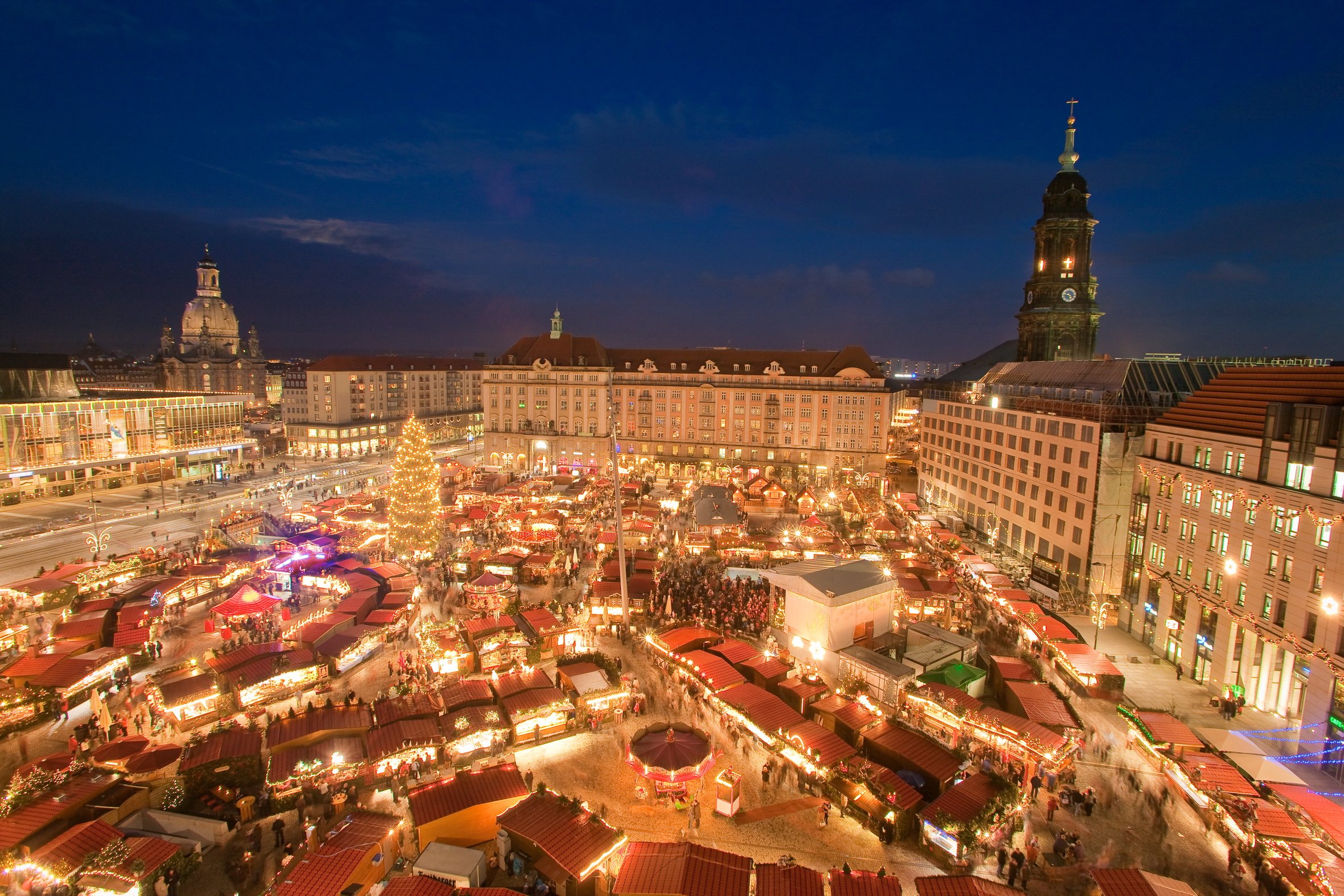
The heart of Advent in Dresden and the reason coaches roll in from all over Europe. According to the city, it draws more than 2.5 million visitors every year. The Altmarkt holds over 200 stalls, and in the middle of them stands the world’s largest Ore Mountain step pyramid, more than 14.6 metres tall, which made it into the Guinness Book of Records in 1999. You will also find the largest walk-through candle arch (Schwibbogen), a big nativity scene under the Christmas tree and a historic Ferris wheel with a view over the stall roofs.
The Striezelmarkt prides itself on craftsmanship. It sells Ore Mountain folk art, meaning nutcrackers, incense smokers (Räuchermännchen), pyramids and candle arches, and in the show workshops you can watch woodcarvers and Stollen bakers at work. The classic Dresden souvenir is the Pflaumentoffel, a little edible chimney sweep made of dried plums that is meant to bring good luck. On the daytime stage, choirs, carol singers and children’s fairy tales take turns.
The information pavilion on Wilsdruffer Straße houses a tourist information point and a Christmas post office with special stamps and Christmas cards. There is free Wi-Fi at the market (network “striezelmarkt-2026”, no password). Advent here traditionally also includes a gingerbread festival and a pyramid festival.
Dresden Stollen Festival on 5 December 2026
The biggest day of Advent in Dresden. The Dresdner Stollenfest takes place on Saturday 5 December 2026, the Saturday before the second Sunday of Advent, and it will be the 31st festival (the first was held in 1994). According to the Dresden Stollen Protection Association, the day runs roughly like this:
- 10:00 opening at the festival stage by the Kulturpalast
- around 11:00 the procession with the giant Stollen sets off past the Royal Palace and the Procession of Princes (Fürstenzug) to the Frauenkirche, returning to the stage around midday
- shortly after 12:00 the giant Stollen is cut with the great Dresden Stollen knife
- from 12:15 slices of Stollen go on sale, with music, until around 15:30
The festival harks back to 1730, when Augustus the Strong had a Stollen weighing about 1.8 tonnes baked for his military camp at Zeithain. The money raised from selling today’s giant Stollen goes to charity. Bear in mind that this Saturday is the busiest day of the whole season. We would watch the procession somewhere along the route near the Fürstenzug, where there is usually a little more room than right by the stage.
Frauenkirche Christmas market and Advent on the Neumarkt
Around the Frauenkirche there are really two markets side by side. The Weihnachtsmarkt an der Frauenkirche in Münzgasse, the lane leading from the church to the Brühl Terrace, sells ceramics, glass, lace from the Vogtland, Ore Mountain carvings and even French nougat. Its symbol is an eight-metre walk-in pyramid with hand-carved figures, and every day from 16:00 Father Christmas comes to see the children.
Advent auf dem Neumarkt, right in front of the church, is styled on the years around 1900. The stalls are built to historical designs and only handmade goods are sold. Craftspeople show how things were made a hundred years ago, and in the evening the Baroque Frauenkirche glows above the stalls. For us, the most beautiful setting in Dresden.
Medieval Christmas market in the Stallhof
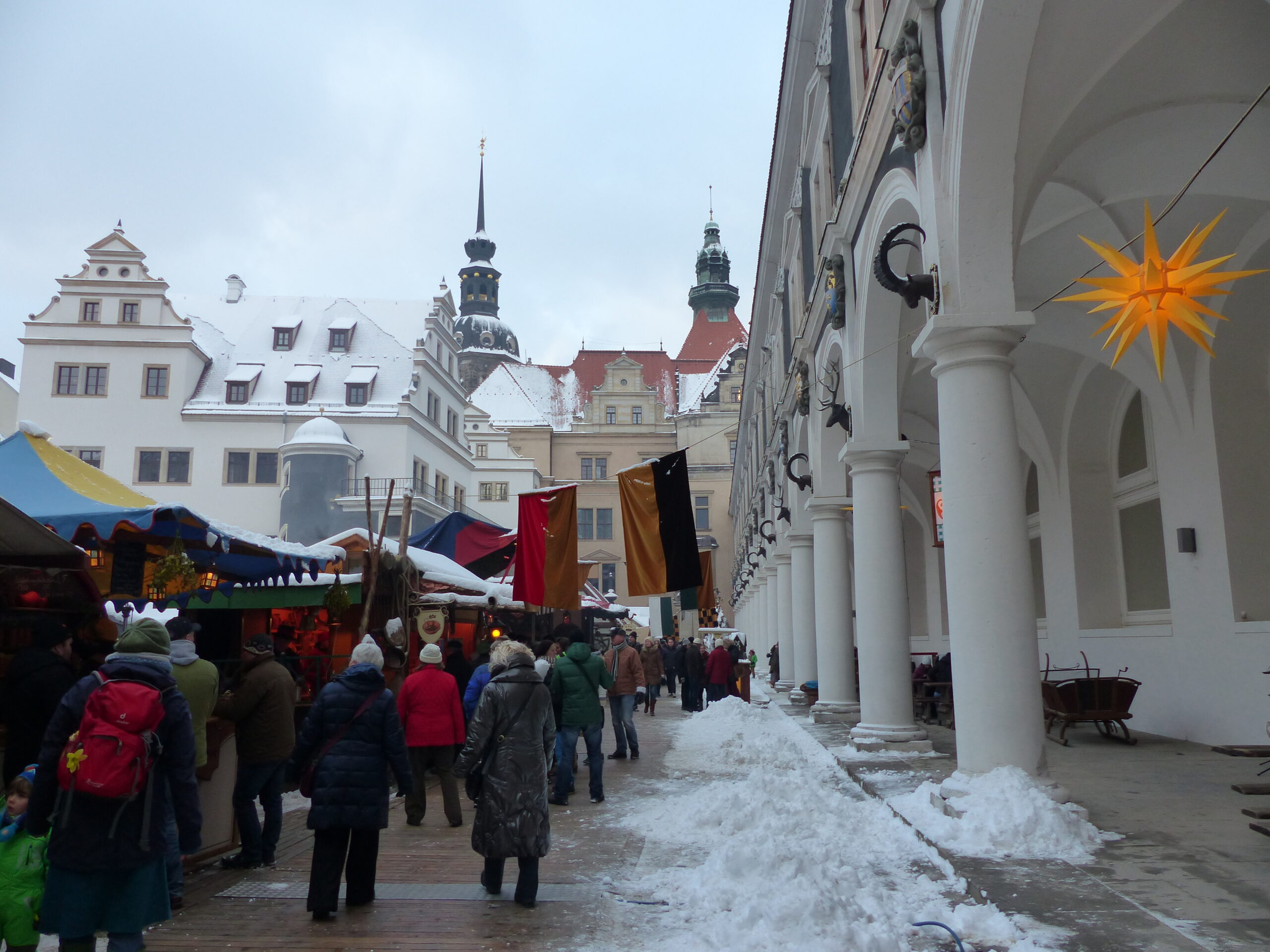
Our personal favourite. The Stallhof is the courtyard of the Royal Palace behind the famous Fürstenzug mural. It was completed in 1591 and is one of the few surviving tournament grounds in the world. At the Mittelalter-Weihnacht there is no music from loudspeakers, electric light is kept to a minimum and you will not find any plastic. Instead there are around 50 traders with historical wares, blacksmiths, rope makers and wood turners at work, live music every day, jugglers and an archery contest.
The attraction everyone talks about is a wooden tub of hot water high above the visitors’ heads, big enough for up to six people. Slots for this “bath above the crowd” are booked in advance (for 2026 from 1 October) and go quickly. An entry fee applies only on Advent weekends, from Friday afternoon to Sunday, and on 27–30 December: €5 adults (about £4), €3 children, under-school-age children free. On weekdays entry is free. After Christmas the market turns into the “Dresdner Rauhnächte”, with fortune tellers and the spirits of the twelve magical nights.
Augustusmarkt in the Neustadt
Across the Augustus Bridge, on the other bank of the Elbe, the Augustusmarkt stretches along Hauptstraße from the Golden Rider statue (Goldener Reiter) to Gomondai-Platz. Its white pagodas, lit in gold, recall Augustus the Strong’s famous military camp at Zeithain in 1730, and a blue Christmas tree shines in the middle. It is an international market: alongside Saxon crafts you can try Danish glögg, Finnish piparkakut gingerbread, Swedish Christmas ham, Italian pandoro, Alsatian biscuits, Belgian pralines or Swiss chocolate. According to the organisers there are even Czech wafers among the stalls.
The Augustusmarkt has the longest season of them all: it runs until 3 January 2027 and stays open until two in the morning on New Year’s Eve. When the cold gets to you, you can slip into a concert at the Dreikönigskirche (Church of the Three Kings), which stands right on the market’s route.
Ice rink and Ferris wheel on Prager Straße
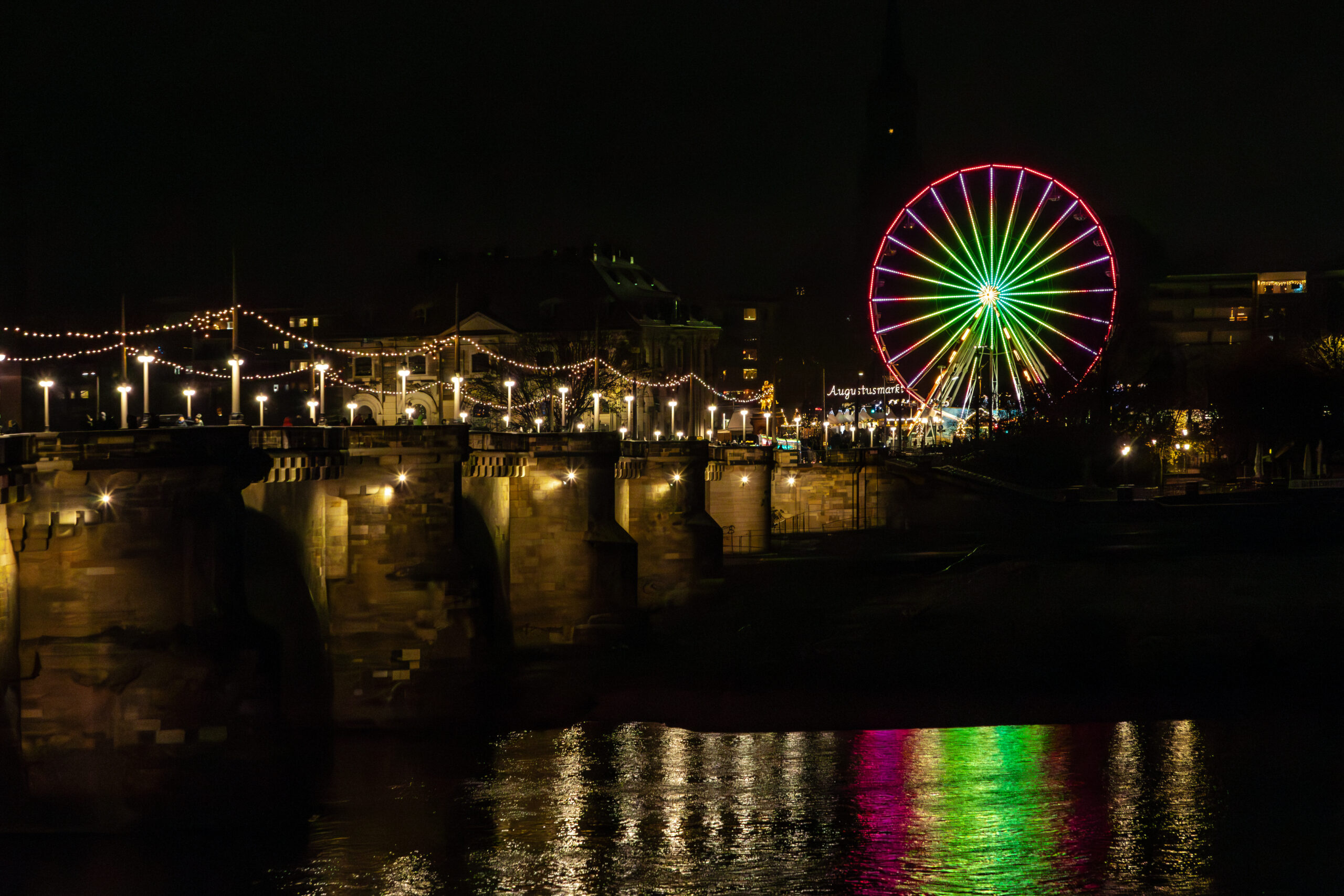
The first market you reach when you walk in from the station. Dresdner Winterlichter spreads along the main shopping street between the Barceló hotel and the Centrum Galerie. It is more modern and more about shopping than the markets in the old town, but it has things the others lack: an ice rink with skate hire, a Ferris wheel, Father Christmas’s hut and two children’s carousels.
According to the organiser, the rink sells all-day tickets, so you can leave during the day and come back. Adults pay €8 (about £7), children under 14 €6 and a family with two children €20. In the evening from 19:00 (from 20:00 on Fridays and Saturdays) there are half-price tickets for the last hour. Skate hire costs €5 and a skating aid for little ones €3.
Romantic market by the palace, Finnish village, après-ski and Loschwitz
- Romantischer Weihnachtsmarkt (27 Nov – 24 Dec): a small market on the little square south of the Royal Palace by the Taschenbergpalais. Historically styled stalls with Stollen, gingerbread, Glühwein, wooden goods, candles and ceramics, plus a children’s carousel. A good stop when the Altmarkt gets too crowded.
- Finn Village (26 Nov – 22 Dec): a Finnish Christmas village on Dr.-Külz-Ring, a short walk from the Altmarkt. Finnish crafts, food specialities and gifts.
- Dresdner Hüttenzauber (13 Nov 2026 – 2 Jan 2027): for anyone who has had enough of carols. An après-ski party outside the Haus der Presse on Ostra-Allee with huts, a bar, a dance floor and an ice stock sport lane (Eisstockschießen, a German cousin of curling). Open from 18:00 to midnight, but with a number of closing days, mainly in November, early December and over Christmas. The list is on the organiser’s website.
- Elbhangfest-Weihnachtsmarkt (5–20 Dec): a small market in the half-timbered village quarter of Loschwitz by the Blaues Wunder bridge, about 6 km from the centre. Locals see it as a tip for anyone who wants Advent without the crowds.
After Christmas and on New Year’s Eve
The Striezelmarkt ends at 14:00 on Christmas Eve, but Dresden does not empty out. Advent auf dem Neumarkt comes back on 27–30 December, opens from 13:00 to 0:30 on New Year’s Eve and then again on 2 and 3 January 2027. The Augustusmarkt runs until 3 January and stays open until 2:00 on New Year’s Eve. In the Stallhof, the Rauhnächte continue on 27–30 December and 2–6 January. So if you travel between Christmas and New Year, you will still find markets, just without the crush on the Altmarkt.
Best food at the Dresden Christmas market
The Striezelmarkt takes its name from Stollen. “Striezel” is an old Dresden word for the Christmas Stollen, and Dresdner Christstollen is a must here: a heavy buttery dough with raisins, candied lemon and orange peel and almonds, dusted with icing sugar. Dresdner Stollen has protected geographical indication status, so it has to be baked in Dresden and the surrounding area, and you can recognise Stollen from the bakers of the protection association by its golden seal. A small slice is enough with your Glühwein; a whole loaf is more of a thing to take home.
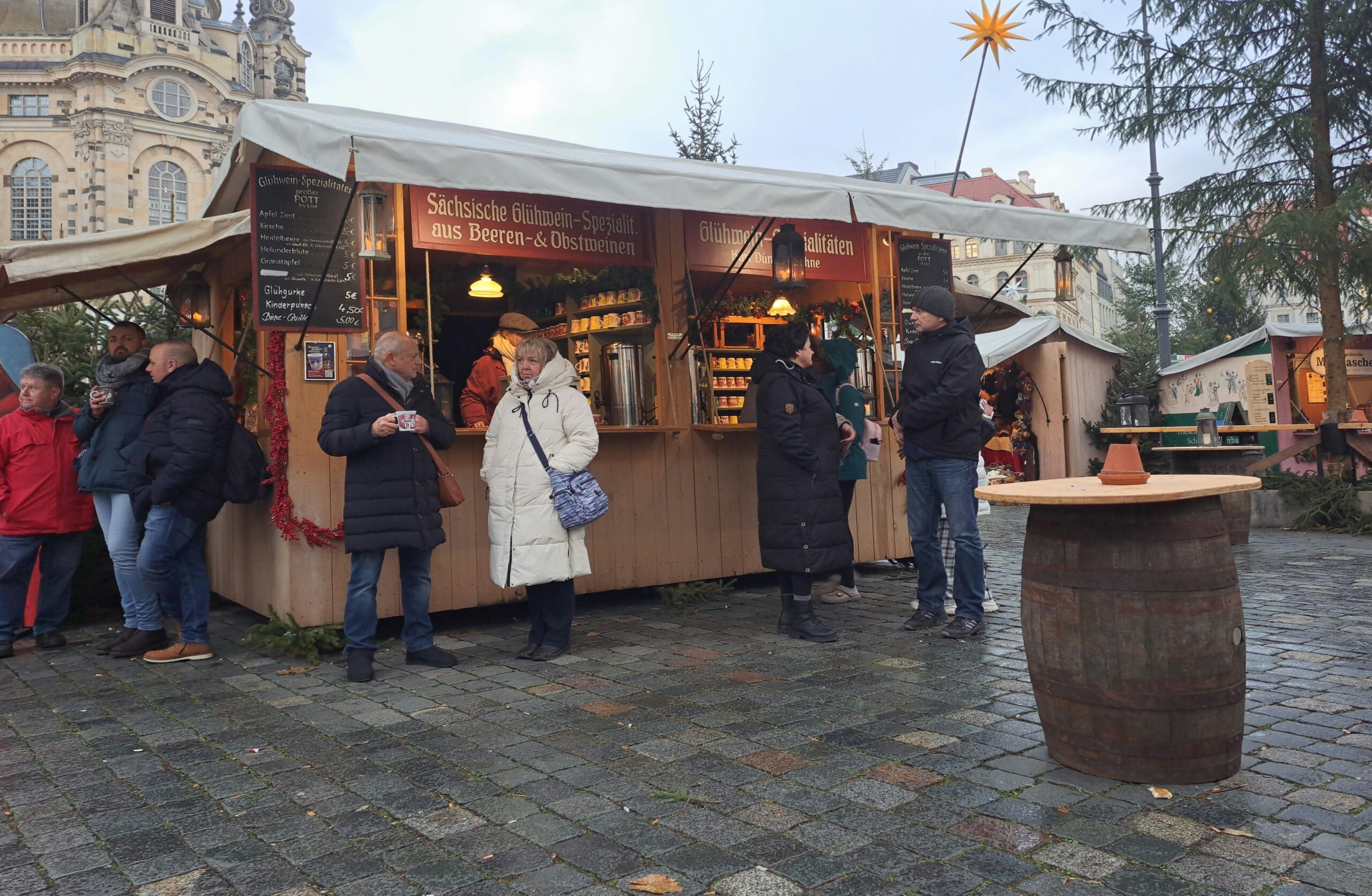
Also look out for Pulsnitz gingerbread (Pulsnitzer Pfefferkuchen), glazed apples, small fried doughnuts called Kräppelchen, roasted almonds and roast chestnuts. On the savoury side there is bratwurst in a roll with mustard, potato pancakes (Reibekuchen), which Germans eat with apple sauce, and lángos. At the Frauenkirche market, Saxon mulled wines made from berries and fruit wines are worth a try; at the Augustusmarkt it is Danish glögg.
Prices for Glühwein and food at the markets in 2026 have not been published yet; we will add them here as soon as they are known. At the Striezelmarkt, Glühwein is served in a ceramic mug with a deposit. The mug has a different design every year, and many people keep it as a souvenir instead of taking the deposit back.
A little history: the Striezelmarkt since 1434
The first Dresden Striezelmarkt lasted a single day. In 1434 Elector Frederick II of Saxony, known as Frederick the Gentle, and his brother Duke Sigismund granted traders a free market on the Altmarkt “on the day before Christmas Eve”. Over the centuries the one-day market grew into a great Christmas fair, and by around 1800 it ranked alongside Nuremberg’s Christkindlesmarkt and the markets of Berlin and Frankfurt as one of the most important in Germany. That is why it is called the oldest Christmas market in Germany with a documented tradition today.
The Altmarkt has not always been its home, though. From 1864 the market had to leave the square and the surrounding streets, because it got in the way of growing traffic and of a city that wanted department stores in its centre. After the bombing of 1945 the “Christmas fair” was held in a hall in the Albertstadt in the north of the city, in 1954 on the cleared Theaterplatz with a Christmas tree on the balcony of the ruined Semper Opera, and in 1955 it returned to the Altmarkt. It has stood there permanently since 1977.
The Pflaumentoffel has its own place in history too. In 1853 the painter Ludwig Richter made a woodcut of poor children selling chimney-sweep figures made of dried plums at the market. That little figure later became the symbol of the whole Striezelmarkt. The Stollen Festival is younger than you might think: the first one took place in 1994, inspired by the giant Stollen that Augustus the Strong had baked in 1730.
Where to warm up near the Christmas markets
After two hours on the cobbles, a warm room and a chair are very welcome. These places are a few minutes from the markets, and we have checked that they are open for business:
- Café Kreutzkamm (Altmarkt 25, in the Altmarkt-Galerie): a family-run patisserie baking since 1825. It is right by the Striezelmarkt, so ideal for a coffee and a slice of Stollen or Baumkuchen sitting down.
- Coselpalais (An der Frauenkirche 12): a grand café and restaurant in the palace named after Countess Cosel, right next to the Frauenkirche. The more elegant choice for cake and tea.
- Pulverturm (An der Frauenkirche 12): a themed restaurant at the same address as the Coselpalais, styled on the age of Augustus the Strong. A good spot when you want a proper meal after the Glühwein.
- Dresden 1900 (An der Frauenkirche 20): a restaurant on the Neumarkt themed on Dresden around 1900, with an old tram called Helene from 1898 standing inside.
- Sophienkeller (Taschenberg 3): a historic cellar under the Taschenbergpalais, close to the Romantic market by the palace and the Stallhof.
- Watzke am Ring (Dr.-Külz-Ring 9) and Watzke am Goldenen Reiter (Hauptstraße 1): taprooms of the Dresden brewery Watzke, the first a few steps from the Altmarkt, the second right at the start of the Augustusmarkt. For a beer instead of yet another Glühwein.
On Advent weekends restaurants in the centre tend to be full in the evening, so for dinner in a group we would book a table in advance.
Dresden Christmas market tips: what to watch out for
- Weekends and the Stollenfest. On Saturday afternoon you move across the Altmarkt at walking pace, and on 5 December, the day of the Stollen Festival, the centre is at its busiest of the whole year. Go to the Altmarkt on Friday evening or Sunday morning.
- Pickpockets. In the thick crowds around the pyramid and at the Glühwein stalls, keep an eye on your wallet and phone and wear your backpack on your front. During the market the police have a post on the Altmarkt, at the Haus Altmarkt building next to the market supervision office.
- Lost children. If your child wanders off in the crowd, go to the market supervision office (Marktaufsicht) at the Haus Altmarkt. It is worth showing children where it is beforehand.
- Mug deposit. The stalls at the Striezelmarkt share a deposit system, so you can return your mug at any of them. The other markets often have their own mugs, so take those back where you got them.
- Cash. Most food and drink stalls now take cards, but smaller craft stalls do not always. Carry a few tens of euros in cash. At the Striezelmarkt you can also pay with the market’s own coins (Striezeltaler), sold at the tourist information points.
- Sundays and public holidays. Shops in Germany are closed on Sundays, but the markets run as normal. If you want to combine the markets with shopping, go on a Saturday. On Christmas Eve the Striezelmarkt closes at 14:00, and on 25 and 26 December most markets are closed.
- Cold feet. On the squares you stand on cobbles for hours, and even when the thermometer shows around zero, you will be chilled to the bone within two hours. Warm boots and a hat are a better investment than a third Glühwein.
10 things to do in Dresden in winter
When you cannot face another stall, here are ten ideas for Dresden in winter. Prices and opening times are taken from the official websites as of October 2026.
1. Climb the Frauenkirche dome
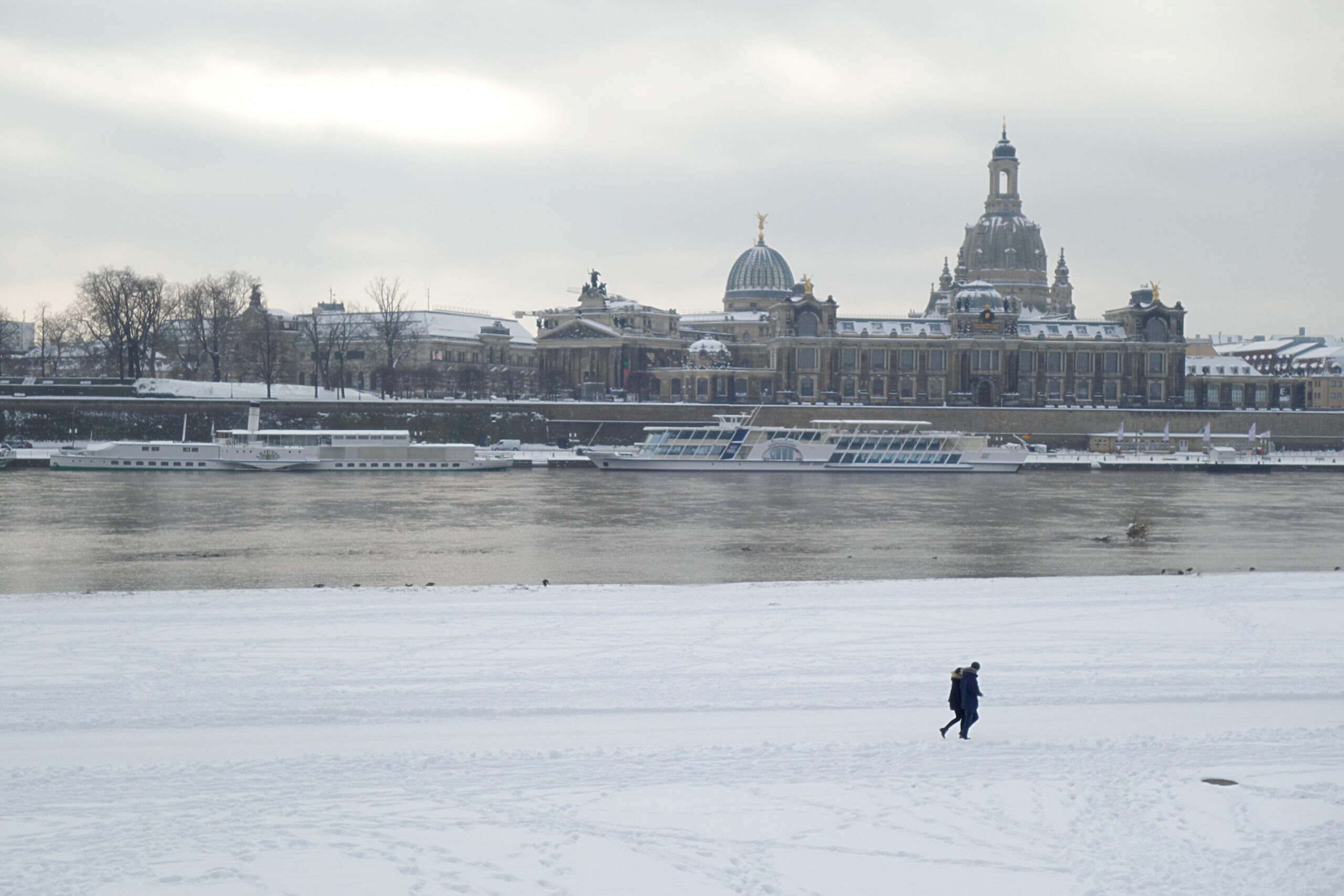
From the gallery around the dome you can see all the Advent bustle below you and the Elbe with its bridges. The climb costs €12 (about £10), reduced €7. From November to February it opens Monday to Saturday from 10:00 and on Sunday from 13:00, and only until 16:00, so go up after lunch rather than in the evening. The church itself is free. More on the Frauenkirche website.
2. Kreuzkirche: the tower above the Striezelmarkt and the Kreuzchor
The Kreuzkirche stands in a corner of the Altmarkt, so from its tower you look straight down onto the stalls and the pyramid. 259 steps lead up to the viewing platform at 54 metres, and admission is €7 for adults, €5 reduced and €15 for a family (no reductions apply during the Striezelmarkt). Above all, though, the church is home to the famous boys’ choir, the Dresdner Kreuzchor. In Advent 2026 it sings Bach’s Christmas Oratorio (cantatas 1–3) on 11, 12 and 13 December and Christmas carols on 19 and 20 December, with tickets at €14–74. The programme is on the Kreuzkirche website.
3. The Old Masters in the Zwinger
The perfect plan for a rainy day. The Old Masters Picture Gallery (Gemäldegalerie Alte Meister) in the Zwinger includes Raphael’s Sistine Madonna among much else. It is open daily 10:00–17:00 except Mondays, and a Zwinger ticket costs €18 (about £15); under-20s in education pay €2. The Baroque courtyard of the Zwinger is free to enter and makes a lovely walk in the winter twilight even without the museum. Current exhibitions are on the Dresden State Art Collections website.
4. The treasures of the Green Vault
The treasury of the Saxon electors in the Royal Palace is one of the richest in Europe. The palace is open daily 10:00–17:00 except Tuesdays, with the Green Vault open until 19:00 on Fridays. The standard €18 ticket includes the New Green Vault; for the Historic Green Vault you need a separate timed ticket (€18), and a combined ticket for both costs €28 (about £24). In Advent we would book the Historic Green Vault online, as time slots sell out fast. The palace is right next to the Stallhof, so you can combine it with the medieval market.
5. A tour of the Semper Opera
Tickets for performances in Advent are hard to come by: the ballet The Nutcracker (Der Nussknacker) is already sold out for every December date, and your only hope is returns at the evening box office. You can still get inside without them, though. The opera house tour lasts 45 minutes, runs almost every day and costs €16 (family ticket €40). Dates are on the Semperoper Erleben website.
6. A Christmas concert at the Kulturpalast
The Kulturpalast is just across the street from the Striezelmarkt and is home to the Dresden Philharmonic. In December 2026 its programme includes “A Christmas Carol” (10 and 11 December), the Christmas Oratorio for children with the Kreuzchor (13 December), Christmas concerts on 25 and 26 December and a New Year’s Eve gala show on 31 December. Tickets go during the autumn, so if you want to combine the markets with a concert, check the Philharmonic’s calendar as soon as you can.
7. Christmas Garden light trail in Pillnitz
After dark, Pillnitz Palace and Park on the banks of the Elbe turn into a light trail with an ice rink and stalls. The Christmas Garden runs from 19 November 2026 to 10 January 2027, usually 16:30–21:00 (until 21:30 on Fridays, Saturdays and between 18 December and 3 January), with last entry at 19:30. It is closed on some days, including 24 and 31 December. Tickets are sold for a specific half-hour slot: adults pay from €15.90 on weekdays to €24.90 over the holidays (roughly £14–21), and €2 more at the box office on the night. From the centre, take bus 63 or 83. Details on the Christmas Garden website.
8. The Three Wishes for Cinderella exhibition at Moritzburg Castle
Famous scenes from the 1973 Czech-German fairy tale film Three Wishes for Cinderella (Drei Haselnüsse für Aschenbrödel), a Christmas TV classic across Central Europe, were shot at the moated Moritzburg Castle, and every winter the castle hosts an exhibition about the film. The 2026/27 season starts on 20 November 2026 and runs until 28 February 2027, daily 9:30–17:30 (last entry 16:15), closed on 24 and 31 December among other days. Admission is €12 for adults (about £10) and €4.50 for children aged 6 to 16, and timed tickets are sold online only. Allow about an hour for the visit. From Dresden, bus 477 leaves from Dresden-Neustadt station, but the prettier way is the Lößnitzgrundbahn narrow-gauge railway from Radebeul Ost.
9. A winter trip to the Bastei
Saxon Switzerland is a short hop from Dresden, and in winter the rocks are far quieter than in summer. Take the S1 train to Kurort Rathen, cross the Elbe on the ferry (€1.50 one way, €3 return; VVO tickets are not valid on it) and climb up to the Bastei Bridge. The Bastei viewpoint is free and open around the clock, and according to the local tourist information the path from Rathen over the bridge is open. The Neurathen rock castle, however, is closed for safety reasons. Bear in mind that paths are not maintained in winter, so wear sturdy boots for the ice and ideally take microspikes.
10. Pfunds Molkerei in the Neustadt
A historic dairy shop with hand-painted tiles from floor to ceiling. It is a short stop, but a good fit in the Neustadt, where the Augustusmarkt is too. Open Monday to Saturday 10:00–18:00, free entry. It still sells cheese and dairy specialities. The address is Bautzner Straße 79.
What we would do differently
Dresden tempts you to make a list of all eleven markets and tick them off. Don’t. In one day you can realistically enjoy about three markets, and only if you actually stop at each of them for a while. That is exactly why we would not come for a day but for a weekend: the Altmarkt and the Neumarkt on Friday evening, the Stallhof and the Augustusmarkt on Saturday, and the rest happily saved for next time.
The best moments are often not at the markets but between them. Walk along the Brühl Terrace after dark, go down to the Elbe or turn off Hauptstraße into the lanes of the Baroque quarter, where there are no stalls and you can hear your own footsteps. Try something you do not have at home, such as mulled berry wine or wine from the Elbe vineyards around Radebeul, rather than buying the same things you know from the Christmas markets back home.
Dresden Christmas market FAQ
When does the Dresden Christmas market 2026 start?
The main Striezelmarkt on the Altmarkt opens on Wednesday 25 November 2026 at 16:00 and closes on Christmas Eve, 24 December, at 14:00. The Frauenkirche market, Advent on the Neumarkt, the medieval market in the Stallhof, Winterlichter on Prager Straße and the Augustusmarkt all open on the same day. The Romantic market by the palace starts on 27 November.
What are the Dresden Christmas markets opening hours?
The Striezelmarkt is open daily from 10:00 to 21:00, from 16:00 on opening day (25 November) and only until 14:00 on Christmas Eve. The Frauenkirche market in Münzgasse stays open until 22:00 on Fridays and Saturdays, the medieval market in the Stallhof is open daily 11:00–21:30, and the Augustusmarkt in the Neustadt opens Monday to Thursday 11:00–21:00, Friday until 22:00, Saturday 10:00–22:00 and Sunday 10:00–21:00.
Where is the Christmas market in Dresden?
All the main markets are in the centre and you can walk between them. The Striezelmarkt is on the Altmarkt square, and you will find more markets on the Neumarkt and in Münzgasse by the Frauenkirche, in the Stallhof by the Royal Palace, on Prager Straße between the main station and the Altmarkt, and across the Elbe on Hauptstraße in the Neustadt (Augustusmarkt).
Where can I park for the Dresden Christmas markets?
The easiest option is to leave the car at a Park & Ride on the edge of the city (for example Kaditz, Prohlis or Pennrich) and take the tram into the centre. If you want to park closer, there are multi-storey car parks at the Altmarkt-Galerie, the Centrum Galerie and the main station. If you are staying the night, ask your hotel about parking.
How much is mulled wine at the Dresden Christmas market?
Prices at the markets for 2026 have not been published yet, and we will add them as soon as they are known. At the Striezelmarkt, Glühwein is served in a ceramic mug with a deposit, which you can return at any stall or keep as a souvenir.
How do I get from Prague to the Dresden Christmas markets?
The most comfortable way is the direct EuroCity train, which runs roughly every two hours and reaches Dresden in about two and a quarter hours. FlixBus and RegioJet coaches also run from Prague. By car it is about 150 km via the D8 and A17; on the D8 you need a Czech motorway vignette, while German motorways are free for cars. If you fly into Dresden instead, the S2 S-Bahn takes about 23 minutes from the airport to the main station.
When is the Dresden Stollen Festival 2026?
The Dresdner Stollenfest takes place on Saturday 5 December 2026. It opens at 10:00 by the Kulturpalast, the procession with the giant Stollen sets off through the old town around 11:00, and shortly after noon the Stollen is cut on stage and goes on sale.
Is the Dresden Christmas market worth a day trip?
A day trip works if you do not want to deal with logistics, but it is a rush: the markets only light up after dark and the Striezelmarkt closes at 21:00. It is better to make a long weekend of it and stay in the centre. You can enjoy the evening atmosphere without hurrying for a train and visit the Altmarkt on Friday evening or Sunday morning, when it is less crowded. Book hotels for Advent weekends well in advance.
Where next
Dresden is only the start of the Advent season. If German markets win you over, take a look at the Nuremberg Christmas market with its famous Christkindlesmarkt, or head to Poland for the Christmas market in Wrocław and in Kraków. Vienna is another classic stop on a Central European Advent trip.
And since Prague is just two hours away, you can easily add the Czech Republic to your trip: pick from our guide to the best Christmas markets in the Czech Republic. Prague, Brno and Olomouc have big Advent markets of their own too. For Advent combined with spas and hot springs, try the Christmas market in Karlovy Vary.
Potřebujete pomoct s cestováním?
-
Ubytování 🏨
Vyberte si to nejlepší ubytování, ať už jste kdekoliv, přes Booking.com. -
Půjčení auta 🚗
Auto si snadno najdete přes Booking.com, kde máte často slevu díky ubytování, nebo Rentalcars.com, kde porovnáte nabídky většiny půjčoven. -
Zážitky 🎟️
Přes GetYourGuide.com si vyberete z nejrůznějších výletů i zážitků po celém světě, navíc se zrušením zdarma do 24 h předem.