
Last updated 13.10.2026
Almost every trip to Colombia starts with a landing in Bogota. Most travellers come for the rainforest, the coffee country and the Caribbean, and treat the capital as a place to sleep off the long-haul flight. That is a shame, because if you can spare a few days, the list of things to do in Bogota is surprisingly long. The city won us over so completely that we stayed nine days, together with local friends who took us to corners of the surrounding countryside we would never have found on our own. Below you will find 13 places worth seeing in Bogota and around it, plus everything practical you need before you go.
Before you go: what to know when planning a trip to Bogota
Let’s start with the basics, because Bogota is not quite what most people picture when they think of a city a few degrees from the equator. It sits high in the Andes, at roughly 2,640 metres above sea level, and around eight million people live here. Expect cool weather rather than tropical heat, and a sprawling city where the neighbourhood you choose to stay in makes a real difference to your trip.
Entry rules, money and the time difference
British passport holders do not need a visa for a tourist trip to Colombia; on arrival you get a stamp for a stay of up to 90 days (the immigration officer has the final say, and you may be asked to show an onward or return ticket). Among the steps before arrival, Migración Colombia lists the online Check-MIG form, which you fill in no earlier than 72 hours and no later than one hour before your flight. The currency is the Colombian peso (COP); 1,000 COP is currently worth roughly €0.27, or about £0.23. Use ATMs inside banks or shopping centres rather than on the street. Colombia does not change its clocks, so Bogota is 5 hours behind the UK in winter and 6 hours behind during British Summer Time. We cover visas, vaccinations, money and SIM cards in detail in our guide Colombia holidays: the best places to visit and practical tips.
Is Bogota safe for tourists?
Safety is the first thing almost everyone asks about before a trip to Colombia. The honest answer is that it varies a lot from region to region, but as a rule the big cities are riskier than the countryside, and city centres are often where crime is highest. Ask the staff at your hostel or hotel which areas to avoid, and unless you are with someone local, don’t wander around at night. A few simple habits go a long way:
- don’t carry large amounts of cash,
- split your money and cards between several places,
- leave expensive jewellery, watches and cameras that draw attention at home,
- stay in busy places where there are plenty of people around,
- don’t use street ATMs (withdraw cash inside buildings and shopping centres),
- keep a close eye on your backpack,
- try to blend in with the locals.
The UK Foreign Office (FCDO) warns mainly about pickpocketing, muggings and the drug scopolamine, which criminals slip into drinks or food, so never accept anything to eat or drink from strangers and don’t leave your glass unattended. Keep your phone out of sight on the street and tucked away in the crush of a TransMilenio bus. Don’t hail taxis on the street; book them through an app (Uber, DiDi, Cabify) or ask your hotel. La Candelaria is packed during the day but empties out after dark, so take a taxi there in the evening. Chapinero Alto with Zona G, Zona T, the area around Parque de la 93 and Usaquén in the north are considered the safer neighbourhoods.
TIP: Is Colombia safe? 6 tips on what to do (and what not to do) in Colombia

Best time to visit Bogota
Bogota probably won’t be the only stop on your Colombia itinerary, but it helps to know what to expect. Because of the altitude, the weather in Bogota is changeable despite the tropical latitude, and you will barely notice any seasons. Daytime temperatures hover around 17 to 19 °C all year, while at night and early in the morning they drop to 7 to 10 °C. The city has two rainy seasons: the wettest months are April and May, and then October and November. The driest periods are December to February and June to August, which in our view are the best months to visit. Whatever the season, pack a waterproof jacket and a warm fleece; even in the dry months the weather can turn several times a day.
TIP: Why not add Medellín, once infamous for its drug cartels, or the colonial city of Cartagena de Indias on the Caribbean coast?
Getting around Bogota
Fair warning: the traffic in Bogota, and in Colombia generally, is hard to believe until you see it. We would not recommend hiring a car here. The quickest way across the city is the TransMilenio bus network, which runs on its own dedicated lanes, and you will be grateful for them, because everywhere else the roads are jammed at almost any hour. (We once sat in a traffic jam for an hour at three in the morning and missed our flight.)
A TransMilenio ride currently costs a flat 3,550 COP (around £0.80 or €0.95), however far you go. You pay with a rechargeable TuLlave card, sold at ticket offices in the larger stations, and you can now also tap in with a contactless bank card or your phone (though without the discounted transfers that only a personalised TuLlave card gets). At rush hour, roughly 6 to 9 am and 5 to 8 pm, the buses are packed and pickpockets know it. In the evening, or with luggage, an app taxi is the more comfortable choice. Long-distance buses, for example to Villa de Leyva, leave from the main Salitre terminal and from Terminal del Norte.
Bogota airport to the city centre
Flights from London to Bogota land at El Dorado International Airport (BOG), the country’s main hub, either direct or with a change in Europe or the US depending on the airline and season, so check what is on sale for your dates. The airport lies about 15 km west of the centre. The easiest option is a taxi from the official rank outside arrivals, where you are handed a slip with an estimated fare. To La Candelaria or Chapinero expect to pay roughly 35,000 to 50,000 COP (about £8 to £12, or €10 to €14) plus an airport surcharge, more at night and on public holidays. Uber, DiDi and Cabify work just as well. The ride takes around 30 minutes, easily an hour at rush hour. The cheapest way is the free TransMilenio feeder bus (route 16-14) to Portal El Dorado, where you change onto lines into the centre, although with a big backpack on a crowded bus it is no fun.
Bogota altitude and altitude sickness
At 2,640 metres, mild altitude sickness, known locally as soroche, can hit you if you arrive straight from sea level: a headache, getting breathless on stairs, poor sleep. So don’t plan the hike up Monserrate (another 500 metres higher) for your first day, drink plenty of water, go easy on alcohol and give yourself time. Most people adjust within a day or two. Locals swear by coca leaf tea (aromática de coca), which is sold legally in Colombia, but don’t bring any home with you.
TIP: Already packing for Colombia? We spent over a month backpacking across the whole country and picked out the most beautiful places to visit in Colombia.
13 things to do in Bogota and around the capital of Colombia
Only have a few days in Bogota and want to make the most of them? We hope our tips will give you some ideas. Two days are enough for the city itself, in my opinion, but the surrounding area has a huge amount to offer. Waterfalls, nature reserves, pretty colonial villages and even the legacy of the drug cartels: there is something for every kind of traveller. Our favourites in the city were the climb up Monserrate and the historic La Candelaria district. Outside the city, we loved Villa de Leyva, Laguna de Guatavita and Nimaima.

1. La Candelaria, the historic heart of Bogota
Sooner or later, every visitor ends up in the old town, and if you are wondering where to begin exploring Bogota, La Candelaria is the obvious starting point. Right in the centre of the city, this district is a genuine slice of Colombian history and culture. Narrow cobbled lanes, old houses with wooden balconies and brightly painted façades give it an atmosphere that draws you in from the first few steps.
Start at the tiny square of Chorro de Quevedo, where tradition says the city was founded, and then let yourself drift through the lanes, such as Callejón del Embudo with its cafés and stalls selling chicha, a fermented corn drink. On the edge of La Candelaria, opposite the Gold Museum, stands the Iglesia de San Francisco, built in the 16th and 17th centuries. It is the oldest surviving church in Bogota and has a gilded altar. La Candelaria is also where most graffiti tours start. Bogota has one of the most interesting street art scenes in Latin America, and without a guide you would walk straight past many of the big murals. Tip-based walking tours (free walking tours) also leave from the centre and are an ideal introduction to the city on your first day.
2. Plaza de Bolívar
Bogota’s main square, Plaza de Bolívar, is also in La Candelaria. It is surrounded by handsome colonial and government buildings, and you can have your photo taken with a llama, feed the pigeons and grab a snack from the vendors. The square was originally called Plaza Mayor, and from 1821 it was known as Plaza de la Constitución.
The north side of the square is taken up by the Palace of Justice, while the south side is framed by the National Capitol, the seat of the Colombian Congress. The mayor’s office, Palacio Liévano, built between 1902 and 1905, stands on the west side. The east side is dominated by the Catedral Primada de Colombia, built in the early 19th century, and just behind the Capitol is the presidential palace, Casa de Nariño, where you may catch the changing of the guard.
3. Botero Museum: wonderfully strange art
Do you have a soft spot for the quirky? Art comes in many forms, and I am convinced you have never seen anything quite like this. The Botero Museum shows the work of the famous Colombian painter Fernando Botero, known for his distinctive style, “boterismo”, with its exaggeratedly round, voluminous figures and shapes. Alongside his own pieces you will find works by international masters such as Picasso, Dalí and Monet. And admission is free, so it is worth popping in even if you only have half an hour.
The museum is run by Colombia’s central bank, Banco de la República, and displays 208 works, 123 of them by Botero himself, who donated the collection to the city. It is open on Mondays and from Wednesday to Saturday from 9 am to 7 pm, and on Sundays and public holidays from 10 am to 5 pm; it is closed on Tuesdays. Last entry is one hour before closing. The same complex gives you access to the neighbouring art collection and to the Casa de Moneda, the old mint, so you can easily spend a whole morning here.

4. Parque Metropolitano Simón Bolívar
Parque Metropolitano Simón Bolívar is one of the largest and most important public parks in Bogota, covering more than 400 hectares in the middle of the city. It is often compared to New York’s Central Park and works as the “green lungs” of the Colombian capital. On its western edge you will also find the José Celestino Mutis Botanical Garden. If you need a break from traffic and concrete, this is the place for a picnic or a long walk.
TIP: Love the outdoors? Then head north to explore Caribbean beaches and rainforest in Tayrona National Park.
5. Cerro de Monserrate viewpoint (3,152 m)
Our absolute favourite in Bogota was the short hike up to the viewpoint on Monserrate, a mountain in the Eastern Cordillera that you can comfortably reach on foot from the city. Because Bogota already sits so high, even this modest climb left us properly out of breath, but it is nothing a reasonably fit person can’t manage. At the top you will see hummingbirds, a chapel, a basilica and stunning views over the whole city. Go during the day so that you are back down in daylight and not stumbling around the hillside in the dark.
The footpath is free and open for the ascent daily from 5 am to 1 pm, except on Tuesdays when it is closed for maintenance; when it gets very busy, the management may close access earlier. The climb, with roughly 500 metres of elevation gain, takes an hour to an hour and a half. If you would rather not walk, ride up on the cable car (teleférico) or the funicular. A return ticket from Monday to Saturday costs roughly 35,000 COP (around £8 or €10), and a single 21,000 COP (about £5). Sundays are cheaper, but the queues are long. The cable car and funicular usually run from the morning until 10 pm, and until 6 pm on Sundays. The views are best in the morning, before the clouds roll in over the city.

6. Gold Museum in Bogota
The Gold Museum (Museo del Oro) is one of the most visited sights in all of Colombia. Gold is woven deep into the history of this region, so if you have a spare couple of hours, it is well worth a visit. The collections cover pre-Columbian gold artefacts and various metal alloys, including tumbaga, which were sacred to the indigenous cultures.
Tens of thousands of objects are on display, and the most famous is the Balsa Muisca, a golden raft that depicts the very ceremony that gave rise to the legend of El Dorado (more on that under Laguna de Guatavita below). The Gold Museum is closed on Mondays; from Tuesday to Saturday it is open from 9 am to 7 pm, on Sundays from 10 am to 5 pm, and entry is free on Sundays. Standard admission is 10,000 COP (about £2.30 or €2.70); children under 12 and visitors over 62 get in free, and no booking is needed. Allow at least an hour and a half. During renovations some galleries may be temporarily closed, so check the current situation on the Banco de la República website.
Other museums in Bogota worth visiting
Like most capital cities, Bogota has plenty of museums covering all sorts of subjects. A few more ideas:
- Museo Santa Clara, with its Baroque art,
- Museo Histórico de la Policía (the Police History Museum),
- Museo Nacional (the National Museum of Colombia),
- Maloka, the interactive science museum.
If you have time to spare: Usaquén, Ciclovía and Paloquemao market
- Usaquén is a former village in the north of the city, now swallowed up by Bogota, with a colonial square, cafés and restaurants. On Sundays its streets fill with a big craft and food market (Mercado de las Pulgas de Usaquén).
- Ciclovía takes place every Sunday and public holiday from about 7 am to 2 pm, when more than 120 km of main roads close to cars and are handed over to cyclists, runners and skaters. You can hire a bike or join a guided cycling tour.
- Paloquemao market is the city’s largest market and at its liveliest early in the morning. Expect mountains of fruit you have never heard of and a whole hall of flowers. It is also a good place to try ajiaco, Bogota’s chicken soup made with three kinds of potato, corn and capers.
- Cerro de Guadalupe is Monserrate’s neighbour, topped by a giant statue of the Virgin Mary. It is less touristy and the views are just as good, but the church is mainly open on Sundays and there is no cable car. Go by taxi and don’t hike up on your own.
7. Villa de Leyva: a picture-perfect colonial town
Around three to four hours’ drive from Bogota lies Villa de Leyva, one of the best-preserved colonial towns in Colombia. With its cobbled streets, whitewashed houses and Plaza Mayor, the largest square in the country, it feels like stepping back into the 16th century. Don’t miss Casa Terracota, an extraordinary building made entirely of fired clay that looks like a giant pottery palace.
We recommend staying the night, so that you can enjoy the calm of the town after sunset and explore the countryside around it, such as El Fósil, where you can see well-preserved fossils of prehistoric creatures.
Buses leave from Bogota’s Salitre terminal or from Terminal del Norte, sometimes with a change in Tunja, and the journey takes roughly three and a half to four hours depending on traffic. The town lies in the Boyacá department at around 2,100 metres, so it tends to be a little warmer and drier than Bogota. At weekends it fills up with day-trippers from the capital; on weekdays it is much quieter. You will find accommodation tips below in the section on where to stay.
8. Laguna de Guatavita: the legendary lake of El Dorado
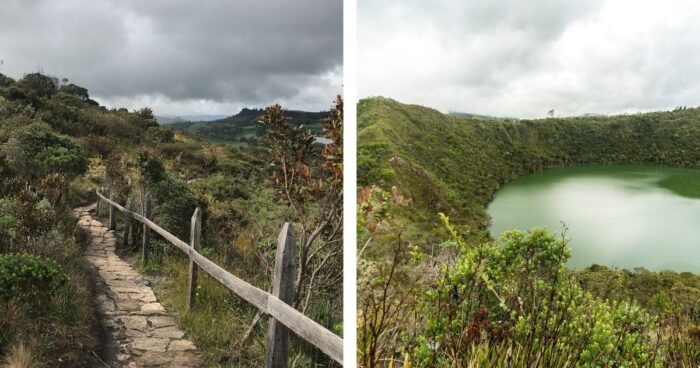
If you want to swap the big city for nature for a day, one of the best day trips from Bogota is the nature reserve around Laguna de Guatavita, the lake considered the birthplace of the El Dorado legend. Hidden among green hills, this almost perfectly round lake is where indigenous chiefs once held golden ceremonies and threw treasure into the water as offerings to the gods.
The drive from Bogota takes about an hour and a half. The entrance fee includes a guided tour (in Spanish only, but still worth it), which takes you through the history and legends of the place. We really enjoyed the visit and are glad we went, even though we didn’t understand much of what the guide said, because otherwise we would never have got to see a place like this.
The reserve is managed by the regional authority CAR Cundinamarca. You can only enter with a guide, in groups that set off throughout the day, usually from Tuesday to Sunday between about 9 am and 4 pm (it is closed on Mondays unless it is a public holiday). The entrance fee for foreigners is roughly 28,000 COP (about £6.50 or €7.60). The circuit to the viewpoint above the lake is a few kilometres long and climbs to over 3,000 metres, so bring layers. Swimming and even touching the water are forbidden, as the lake is still sacred to the Muisca. Without a car, the easiest way to get here is on an organised tour, often combined with the Salt Cathedral.
The legend of El Dorado
The legend of El Dorado tells of a city of gold hidden somewhere in the mountains of South America. In the original version told by the Muisca people, a ritual took place on Lake Guatavita whenever a new ruler was crowned: he covered his body in gold dust, was rowed out on a raft to the middle of the lake and offered gold and precious stones to the gods. The Spanish conquistadors took the story as proof that a fabulously rich city full of gold existed. That sparked a feverish hunt lasting centuries, but the mythical city was never found.
9. Salt Cathedral of Zipaquirá: a church carved into a salt mine
An hour’s drive from Bogota, in the town of Zipaquirá, is the Catedral de Sal, a cathedral built inside a salt mine. It was carved into the tunnels of a former mine 180 metres underground, where it began as a place of prayer for miners seeking protection from the dangers of their work.
It covers more than 8,500 m² in total. Everything has been cut out of huge walls and tunnels of rock salt: several chapels, statues and altars. Visitors walk along the Stations of the Cross, 14 scenes from the Passion of Christ, before reaching the main nave of the cathedral with its huge salt cross, one of the largest of its kind in the world.
It is the sort of unusual place you might not think of visiting, but we loved it. At the entrance you get an audio guide (thankfully available in English too) and explore the whole mine at your own pace.
Buses to Zipaquirá leave from the TransMilenio terminal at Portal del Norte; the ride takes about an hour, longer at rush hour. Tickets come in packages depending on what is included (audio guide, museums, light show), and foreigners pay more than Colombians, roughly 110,000 to 118,000 COP (about £25 to £27, or €30 to €32) for the basic package. You can buy them on the cathedral’s official website or at the ticket office at the entrance. It is cold underground, and the visit takes two to three hours.
TIP: Curious about Colombian food? Here are 22 traditional dishes to try in Colombia
The emerald exhibition
A visit to the Salt Cathedral also includes an exhibition of emeralds, which indigenous peoples were already mining long before colonisation. Colombia is still one of the world’s largest emerald producers, and its three main mining areas are Muzo, Coscuez and Chivor. We were completely captivated by the exhibition, because some of the stones on display are truly one of a kind.
10. Pacho and the legacy of the drug cartels
Interested in the history of the drug cartels? Then the village of Pacho, about 80 km from Bogota, may surprise you. In the 1980s it was the base of operations for José Gonzalo Rodríguez Gacha, one of the most powerful bosses of the Medellín Cartel. You may know him by his nickname, “El Mexicano”. He owned farms and ranches around Pacho, which he used to produce and distribute cocaine. The town and the land around it were under his control, and thanks to his influence they became a key hub of the drug trade in the region.

What you can see there today
We went to Pacho with a Colombian friend. We walked around the whole ranch, the farms and part of the village, and it felt a little like a ghost town. We got talking to local people, who told us how they had helped out on the ranch as children, and we picked up plenty of stories about the place. Everyone knows Pablo Escobar, but he was far from the only drug lord in Colombia. In Pacho you get to see the backdrop of the drug trade without the tourist industry that has grown up around it in Medellín.
11. Parque Natural Chicaque
If you love nature and hiking, visit Chicaque Nature Park, about 30 km from Bogota. It has more than 20 km of trails that lead you through dense cloud forest, past waterfalls and up to rocky viewpoints. Besides the scenery you will see plenty of wildlife, and there is also an organic farm inside the park.
12. Nimaima: adventure sports in the countryside
If, like us, you are adventurers at heart, you are going to love Nimaima! It is a beautiful spot surrounded by nature, where adrenaline activities are part of everyday life. Leave the noise of the city behind and set off along wild trails through lush jungle and deep canyons. The Río Negro is perfect for anyone brave enough to take on its currents on a rafting trip or to plunge into it while canyoning. There is plenty to choose from.
Rafting on the Río Negro
Our friend had a surprise for us: rafting. We both paddle rivers back home in Czechia, so we loved the idea. The Río Negro really is a “black river”. Because of the unusual bedrock, minerals wash into the water and give the river an eerie black colour. The river was pretty wild on the day we went, and nobody told us that the point was not to get through the rapids, but to end up in the water, because that is where the fun is.
So I tipped out right after the first set of rapids and couldn’t scramble back into the raft. Had I known, I would have taken out extra insurance for extreme sports, because I swallowed so much of that murky water that I was worried it would make me ill. Still, it was a brilliant day out, and I am sure adrenaline lovers will find what they are looking for here.
TIP: Did you know that Colombia also has the tallest palm trees in the world, superb coffee and hummingbirds everywhere? You can see all of it in the colourful mountain village of Salento, which has a wonderful atmosphere.
13. La Chorrera: the highest waterfall in Colombia
Love nature and waterfalls? Then head for La Chorrera, the highest waterfall in the whole of Colombia. It is only a 45-minute bus ride to the start of the trail. From there, a walk of roughly three hours takes you through beautiful countryside of cloud forest, pastures and narrow paths, and at the end you are rewarded with water plunging from a height of almost 600 metres. On the way back you can detour to the smaller El Chiflón waterfall, where the path leads right behind the curtain of water.

Where to stay in Bogota
Bogota is enormous, and the traffic makes distances feel even longer, so it pays to stay where you will spend most of your time. For a short, sightseeing-focused stay we recommend La Candelaria, from where you can walk to the museums, Plaza de Bolívar and the Monserrate cable car. If you prefer a quieter, safer area with restaurants and nightlife, head north to Chapinero and Zona G, Zona T, Parque de la 93 or Usaquén. From there, a taxi to the centre takes 20 minutes to an hour depending on traffic.
La Candelaria and the historic centre
Staying in the centre is cheaper and everything is on your doorstep, but the streets empty out after dark, so take a taxi back in the evening.
- The Cranky Croc Hostel: a budget option in La Candelaria with a garden, terrace and bar. There is a shared kitchen and a 24-hour front desk, an American breakfast is served in the morning, and airport transfers can be arranged on request. As well as dorms, it has private rooms.
- Hotel Casa Deco: mid-range, between the Museo del Oro and Las Aguas TransMilenio stations. The hotel has a restaurant, a bar and a terrace with views of the hills, reception is open around the clock, and guests rave about the breakfasts.
- Hotel De La Opera: upmarket, right next to the Teatro Colón and opposite the San Carlos Palace. It has an indoor pool, a spa, two restaurants and a buffet breakfast, and some rooms have a balcony overlooking the rooftops of La Candelaria.
The north: Chapinero, Zona T, Parque de la 93 and Usaquén
The northern neighbourhoods are more expensive, but you can walk out to dinner at night without worrying. Zona G is known for its restaurants, Zona T and Parque de la 93 for bars and shops, and Usaquén for its Sunday market.
- Hotel Estelar Parque de la 93: mid-range to upmarket, three blocks from Parque de la 93. Pool, sauna, gym, restaurant and bar, air-conditioned rooms and free parking.
- The Click Clack Hotel Bogotá: a two-minute walk from Parque de la 93 and ten minutes from Zona T. It has a restaurant and room service, and you can have breakfast brought up to your room.
- Four Seasons Hotel Casa Medina Bogota: luxury in a historic building right in Zona G, the city’s food district. Rooms have beamed ceilings, handcrafted floors and marble bathrooms, and both reception and room service run 24 hours a day.
- W Bogota: a modern luxury hotel in Usaquén with an indoor pool, a spa and two restaurants and bars, including the BBC Cervecería brewpub.
Villa de Leyva
If you decide to spend the night in Villa de Leyva, and we recommend it, stay within walking distance of Plaza Mayor.
- Hotel La Posada de San Antonio: mid-range, in a colonial house about 100 metres from the historic centre. Rooms with tiled floors and balconies, a pool with sun loungers, a restaurant, a café, breakfast and free parking.
- Hotel Hospedería Duruelo: upmarket, in colonial style, with a garden, a heated outdoor pool and an indoor pool, a spa, a gym and a tennis court. Parking is free.
A short history of Bogota
The capital of Colombia has a fascinating history that goes back to pre-Columbian times. The high plateau around today’s city was home to the Muisca, farmers and skilled goldsmiths who controlled the trade in salt from Zipaquirá and Nemocón and in emeralds. Their settlement was called Bacatá, and that is where the city’s present name comes from. In 1538 the Spanish conquistador Gonzalo Jiménez de Quesada arrived in the area and founded the city of Santa Fe de Bogotá.
During the colonial era Bogota became one of the key cultural and political centres of the Spanish Empire in South America, and in the 18th century it was the capital of the Viceroyalty of New Granada. Most of the churches and houses in La Candelaria date from that period. On 20 July 1810 a revolt against Spanish rule broke out here, sparked, according to legend, by a quarrel over a borrowed flower vase, and Colombians still celebrate the date as Independence Day. Independence was only secured for good by Simón Bolívar at the Battle of Boyacá in August 1819 (the main square is named after him).
The 20th century brought violence to Bogota. After the assassination of the popular politician Jorge Eliécer Gaitán on 9 April 1948, riots known as the Bogotazo broke out and burned down much of the centre, and a decade of civil war known as La Violencia began. In 1985 guerrillas from the M-19 movement seized the Palace of Justice on Plaza de Bolívar, and the army’s assault to retake it cost nearly a hundred lives, which is why the building looks so new. Since the turn of the millennium, though, the city has changed enormously: TransMilenio, a network of cycle lanes and the Sunday Ciclovía arrived, and the once-feared capital has become a cultural hub with a lively food scene and street art.
How many days in Bogota, and what we would do differently
Most people see Bogota only as a stopover, and we ended up spending nine days here. What stuck with us most was the stuff no guidebook mentions: Pacho, where our friend took us, and the locals’ stories of what life was like there in the cartel days, or the rafting on the Río Negro, where nobody warned us that falling out of the raft was the main event. If we went again, we would leave more empty space in our plans and spend less time chasing a checklist.
Don’t try to cram the Gold Museum, the Botero Museum, Monserrate and a graffiti tour into a single day. At over 2,600 metres you tire faster than you expect, and after the second museum it all starts to blur anyway. Instead, have a long breakfast in La Candelaria with hot chocolate and cheese, taste fruit whose names you don’t know at Paloquemao market, and let someone take you to a place where locals, not tourists, go for ajiaco. And every now and then, put your phone away and just watch the clouds rolling over Monserrate.
We would also worry less about how many day trips we could squeeze in. It is better to go to Villa de Leyva and stay the night than to rush around Guatavita, Zipaquirá and Chicaque in a single weekend.
Other places we loved
Another adventure that took us halfway around the world on a one-way ticket was Sri Lanka, which completely won us over. We spent a month exploring the beaches of Sri Lanka, trying the local food, getting out into nature and travelling inland to the tea plantations and the Sigiriya Lion Rock. So if you are not sure where to go next, we recommend it wholeheartedly!
Things to do in Bogota: frequently asked questions (FAQ)
Is Bogota safe for tourists?
Bogota is fine to visit if you take sensible precautions, especially after dark. Avoid travelling by car or bus at night. Crime is higher in the big cities, so don’t wander around at night and always find out (from your accommodation or online) which parts of the city are safe and which are not. Book taxis through an app or your hotel, never accept food or drinks from strangers (the UK Foreign Office warns about the drug scopolamine) and keep your phone out of sight on the street.
When is the best time to visit Bogota and Colombia?
For the best chance of good weather on a Colombia holiday, go between December and February, the driest period. October, November, March and April are also a good choice because there are fewer tourists. Bear in mind that the climate varies hugely from region to region: while Bogota can be pleasantly cool, the Caribbean coast is tropically hot. In Bogota itself, the wettest months are April and May and October and November, and the driest are December to February and June to August.
What is Bogota known for?
Bogota is the capital of Colombia, in South America, and one of the highest capitals in the world at 2,640 metres above sea level. It was founded in 1538 by the Spanish conquistador Gonzalo Jiménez de Quesada. The heart of the old town is La Candelaria, with beautiful colonial and Baroque buildings, museums, pretty colourful houses, street art and lots of charming corners.
What are the best things to do in Bogota?
Start in the historic La Candelaria district, with its colonial buildings, many museums, Plaza de Bolívar and lots of lovely corners. Monserrate is another favourite: you can hike up (the path is free and open every day except Tuesday) or take the cable car or funicular and enjoy views over the whole city. Don’t miss the Gold Museum either; entry is free on Sundays.
What are the best day trips from Bogota?
There are lots of places around Bogota that are well worth a visit. Our favourites were the Salt Cathedral inside the mine at Zipaquirá, the trip to Laguna de Guatavita, Villa de Leyva and the Nimaima area, where you can try adrenaline sports.
How many days in Bogota is enough?
Two to three days are enough for the city itself: one for La Candelaria with the Gold Museum and the Botero Museum, one for Monserrate and a graffiti tour, and ideally a Sunday for the Ciclovía and the market in Usaquén. If you want to see the surrounding area too, add a day for the Salt Cathedral in Zipaquirá and Laguna de Guatavita, and ideally two days for Villa de Leyva with an overnight stay.
What is the time difference between Bogota and the UK?
Colombia does not change its clocks, so Bogota is 6 hours behind the UK during British Summer Time and 5 hours behind in winter. When it is noon in London in summer, it is 6 am in Bogota.
How do I get from Bogota airport to the city centre?
El Dorado Airport is about 15 km from the centre. The most comfortable option is a taxi from the official rank outside arrivals, roughly 35,000 to 50,000 COP (about £8 to £12) plus an airport surcharge, or a ride booked through Uber, DiDi or Cabify. The journey takes around 30 minutes, up to an hour at rush hour. The cheapest option is the free TransMilenio feeder bus to Portal El Dorado, then a TransMilenio line into the centre for 3,550 COP.
Potřebujete pomoct s cestováním?
-
Ubytování 🏨
Vyberte si to nejlepší ubytování, ať už jste kdekoliv, přes Booking.com. -
Půjčení auta 🚗
Auto si snadno najdete přes Booking.com, kde máte často slevu díky ubytování, nebo Rentalcars.com, kde porovnáte nabídky většiny půjčoven. -
Zážitky 🎟️
Přes GetYourGuide.com si vyberete z nejrůznějších výletů i zážitků po celém světě, navíc se zrušením zdarma do 24 h předem.