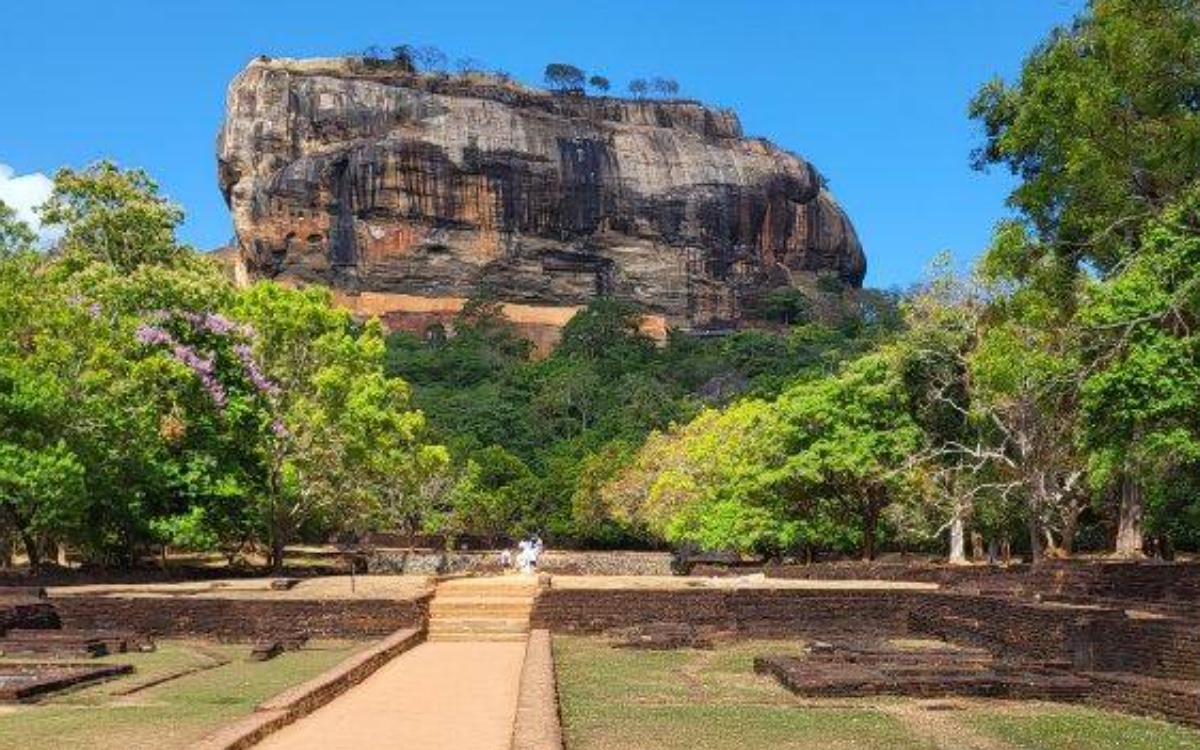
Last updated 9.10.2026
Where else can you watch blue whales in the morning and sip tea among misty hills by the afternoon? Sri Lanka packs beaches, mountains, safari parks and two thousand years of temples into one compact island. We spent a whole month travelling around it and it won us over with its variety and energy. Whether you are after surf in the south or forgotten temples in the jungle, there is something for everyone. Below is our pick of what to see in Sri Lanka, together with what the entrance fees cost, how to get from place to place, how many days you need and where to stay.
When to go: Sri Lanka’s weather and the two monsoons
Sri Lanka has two monsoons, but you can visit all year round, because the rain only ever hits one part of the island at a time. The southwest monsoon brings rain to the southwest coast and the hill country roughly from May to September, while the northeast monsoon soaks the north and east from about November to February. The wettest months tend to be October and November, the changeover period when it can rain almost anywhere. In practice it is usually kinder than it sounds: short showers during the day, the occasional proper downpour, and sunshine the rest of the time.
The short version: in the European winter (December to March) head for the south, the southwest coast and the Cultural Triangle; in the European summer (May to September) the east coast around Trincomalee and Arugam Bay is your best bet. We go through it month by month in our guide to the weather in Sri Lanka.
We went in July and stayed for a full month. Even though it was supposed to be the rainy season, we only got caught by the monsoon once, on our very first day, as a sort of welcome. There were a few short showers after that, but honestly it was no problem at all.

Why Sri Lanka?
To be honest, we first went because we found cheap flights and because it was one of the few long-haul places that works during the summer months back home. Since then it has become one of our favourite places we have ever travelled. There is untouched nature, beautiful beaches and a rich culture shaped by Buddhism and Hinduism, which blend together here. On the road you will come across wild elephants, ride in tuk-tuks and hike in the mountains, often all in the same week.
A short history of Sri Lanka
Sri Lanka has more than two thousand years of written history. According to the ancient chronicle Mahavamsa, Buddhism arrived in the 3rd century BC with the monk Mahinda, son of the Indian emperor Ashoka. The island’s first great centre was Anuradhapura, the capital for more than a thousand years. When the South Indian Cholas conquered it at the beginning of the 11th century, the kings moved to Polonnaruwa, which reached its golden age in the 12th century. Sigiriya is a story of its own: in the 5th century King Kashyapa built a palace on top of the rock, and after his fall the site went back to Buddhist monks.
From the 16th century onwards, European powers fought over the island. First came the Portuguese, then in the mid-17th century the Dutch pushed them off the coast (you can see their legacy best in Galle Fort), and around the turn of the 19th century the British took over. In 1815 they also conquered the last independent kingdom, Kandy, and turned the island, then called Ceylon, into a colony of coffee and later tea plantations. To work them they brought Tamil labourers from southern India, whose descendants still live in the hill country today.
Independence came in 1948 and the name Sri Lanka in 1972. Two chapters of recent history are still visible as you travel: the civil war between the government and Tamil separatists (1983–2009), which kept the north and east off the tourist trail for decades, and the tsunami of December 2004, which devastated much of the southern and eastern coast.
16 best places to visit in Sri Lanka
Most visitors follow a classic loop that starts in Colombo on the west coast, swings inland through the Cultural Triangle and the hills, and finishes on the beaches of the south. We did it the other way round. We landed with no return ticket, just a room booked for the first night and no plans at all, and since the weather in the south was lovely, that is where we started.
To see Sri Lanka properly you need at least three to four weeks, so if you have less, pick the places that match what you enjoy most, whether that is beaches, mountains, wildlife or ancient cities. We managed to see pretty much everything. The tips below follow roughly the order we travelled in: from the southern beaches through the hill country and the Cultural Triangle all the way to Colombo.
1. Mirissa: surf, sunsets and whale watching
After a long journey, final exams at university and a stressful few months, the first thing we did was spend a few lazy days on the beach. Mirissa is a small fishing village, but it has some of the most beautiful beaches in Sri Lanka. Surfers, sunbathers and nature lovers all get their money’s worth here, because from November to April you can go whale watching. On top of that, an air-conditioned bus runs straight from Colombo, which you will appreciate after a few rides on local transport.
Whale-watching boats leave early in the morning and the trips usually take several hours. The cheapest boats tend to be overcrowded and get far too close to the whales, so it is worth paying a bit more for an operator that keeps a proper distance from the animals. The sea off the south coast can be rough, so take a seasickness tablet before you set off. For sunset, everyone walks up Coconut Tree Hill, a little palm-covered headland at the end of the beach. We compare the other beaches in the south and east in our guide to Sri Lanka’s beaches.
TIP: Animal rescue station: where does tourists’ money go and how does sea turtle conservation actually work?

2. Unawatuna: a sheltered beach bay
Not far from Mirissa is another beach escape, Unawatuna, with long sandy beaches, palm trees and gorgeous sunsets. Snorkelling and diving are popular here, and you can also sign up for a diving or surf course. The beaches used to be much wider, but the 2004 tsunami changed the coastline and today the sea comes right up to some of the hotels. The bay is sheltered, so the waves are usually smaller than on the open coast, and just down the road is quieter Dalawella beach with the palm-tree swing you have probably seen on Instagram.
3. Galle Fort: a Dutch fortress above the ocean (UNESCO)
Just a few kilometres from Unawatuna lies Galle, the best-preserved European fortress in South Asia and a UNESCO World Heritage Site. The Portuguese built the first fortifications, but it was the Dutch who gave it its present shape with massive bastions in the 17th century. Inside the ramparts is a small town of narrow lanes, colonial houses, churches, cafés and little shops. Entry to the fort is free.
The nicest thing to do is walk the walls in the late afternoon, once the sun has lost its sting, and wait for sunset by the white lighthouse. Half a day to a full day is enough for Galle. If you want to experience the fort in the evening after the day-trippers have gone, you can also stay inside the walls (see our hotel tips in the accommodation section below).
4. Yala National Park
If you are drawn to the wild, Yala National Park is hard to skip, even though in this part of Sri Lanka you can easily bump into animals on the road outside the park too. Yala is one of the largest and oldest national parks in Sri Lanka and home to many species, including elephants, leopards and crocodiles (you will probably see those outside the park as well), plus snakes such as cobras.
That said, if you have already been on safari in Africa, it may not blow you away. And there is no guarantee you will actually see much.
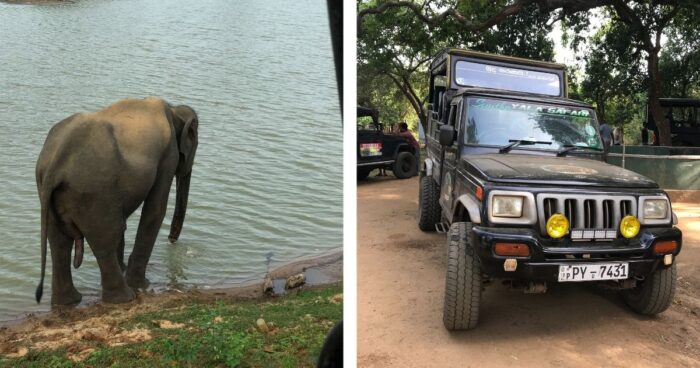
On safari for elephants, leopards and cobras
A safari in Yala can be the experience of a lifetime. Picture yourself in an open jeep crossing the savannah, scanning for tracks, when suddenly a herd of elephants or even a leopard appears in its natural habitat. There are not many places in the world where that can happen.
Reality can look a bit different, though: as soon as one jeep spots an elephant, every other jeep in the park races over, so be prepared for a crowd. And if you are lucky enough to see a leopard, it will most likely be a long way off. Either way, you get to drive through unspoilt nature and see things like the wild beaches inside the park, which really impressed me.
The practical side: you arrange a jeep with a driver in Tissamaharama or through your accommodation, and trips leave at dawn or in the afternoon. The park entrance fee is paid separately from the jeep and for foreigners comes to roughly 40 to 45 USD per person including charges and tax. Most jeeps head to Block 1, where your chances of a leopard are highest. Because of the drought, the park is usually partly or fully closed from around September to mid-October, so check the dates in advance if you are travelling then.
A quieter alternative: Udawalawe
If elephants are your main goal and you would rather share them with fewer jeeps, choose Udawalawe National Park instead of Yala. It sits on the way between the hill country and the south coast. You will see elephants on almost every safari here and the entrance fee is similar to Yala. Right next to the park is the Elephant Transit Home, which raises orphaned baby elephants and then releases them back into the wild. You can watch feeding time from a viewing platform. In our view it is a much better choice than the elephant “orphanage” in Pinnawala, where the animals stay in captivity for life.
5. Tangalle
Another popular seaside town is Tangalle. Fewer people make it this far, because it is not that close to Colombo (around 200 km). You can see sea turtles here, visit the Hummanaya blowhole, do yoga or visit an elephant sanctuary. Night trips to watch baby turtles hatch are also popular, for example on Rekawa beach east of town. The beaches are long and empty, but the surf is strong, so swimming is not safe everywhere.
6. Ella: tea plantations and the most famous bridge on the island
Ella is a small mountain town surrounded by tea plantations, waterfalls and Buddhist temples. It is also home to another Sri Lankan icon, the Nine Arch Bridge, which every traveller seems to be heading for. We loved the cooler weather (in Yala it was regularly over 40 °C) and, above all, being back in the mountains we love so much, so we ended up staying five days.
From Ella you can join tours of tea plantations and tea factories (we bought a mountain of tea, which we then had to lug through three more countries), and waterfalls and lots of great hills are all within easy reach. Favourite hikes and trips include Ella Rock, Little Adam’s Peak and Ravana Falls, among many others. The Nine Arch Bridge is free to visit and is quietest early in the morning.
The train to Ella: the mountain line through the tea estates is one of the highlights of the island, but at the end of November 2025 it was badly damaged by Cyclone Ditwah. The Nanu Oya – Ella – Badulla section is running again, but the direct train from Kandy to Ella is not, because the track between Kandy and Nanu Oya is still being repaired (as of early October). In practice people travel from Kandy to Nuwara Eliya by car or bus, then hop over to Nanu Oya station and ride the most scenic stretch by train. Check the current situation and timetables on the Sri Lanka Railways website (railway.gov.lk) or with your accommodation.
TIP: Ella, Sri Lanka: tea plantations, mountains and waterfalls
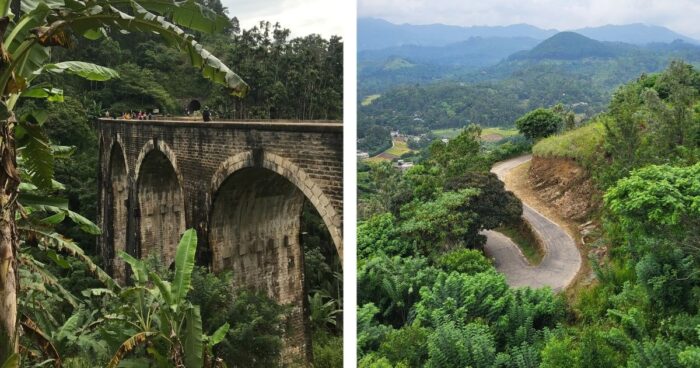
7. Nuwara Eliya: Sri Lanka’s “Little England”
Nuwara Eliya, nicknamed Little England, still has much of its colonial charm today (Sri Lanka was a British colony for a long time). After weeks of temples where Buddhism and Hinduism mingle, it feels strange to suddenly walk through a colonial town that looks as if you were back in Europe.
The town sits at almost 1,900 metres, so pack a jumper: the days are pleasant, but the temperature drops a lot at night and smaller guesthouses often have no heating. Around town there are tea factories that show you how tea is processed and let you taste it. Nuwara Eliya is also the closest base for Horton Plains National Park.
8. Horton Plains and World’s End
Horton Plains National Park is a high plateau at more than 2,000 metres where, instead of jungle, you find grassland, cloud forest and Baker’s Falls. The main goal is World’s End, a sheer drop of about 870 metres into the valley below. The full loop is around 9 km and takes a comfortable three to four hours.
Set off as early as you can, because after about ten o’clock the valley below World’s End often fills with cloud and instead of the view you get a white wall. The entrance fee for foreigners is roughly 35 USD including tax, and staff check bags for plastic at the gate, so single-use packaging may be confiscated. You get to the park by car or tuk-tuk from Nuwara Eliya, or from Ohiya station.
9. Adam’s Peak (Sri Pada): a night climb up the sacred mountain
Adam’s Peak, known locally as Sri Pada, is a 2,243-metre mountain and one of the holiest places on the island. On the summit is a rock formation shaped like a footprint: Buddhists believe it is the Buddha’s, Hindus say it belongs to Shiva, and Muslims and Christians see it as Adam’s. That is why pilgrims of every faith make the climb.
You climb at night from the village of Dalhousie (Nallathanniya), up thousands of steps, to reach the top for sunrise. Allow three to four hours to get up and be ready for the cold at the summit. The pilgrimage season runs roughly from the December full moon to May, when the path is lit and tea stalls are open along the way. Outside the season you can still climb, but without lights, often in the rain and with leeches. Entry is free; pilgrims leave a voluntary donation.
10. Sigiriya Rock Fortress: Lion Rock (UNESCO)
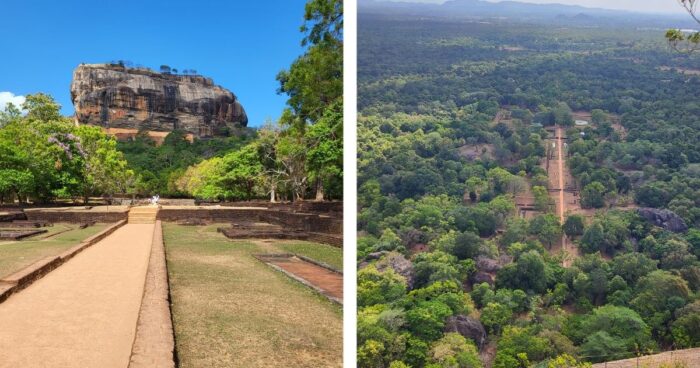
One of the best-known symbols of Sri Lanka is the ancient rock fortress of Sigiriya, also called Lion Rock. It reminds me of Machu Picchu in Peru, because here too the remains of an ancient city sit right on top of the rock. This huge rock rises 200 metres above the surrounding plain and was once a royal fortress and palace. Up there you will find the ruins of the rock city, caves with frescoes and a fantastic view in every direction.
Today Sigiriya is a UNESCO World Heritage Site, and the ticket alone cost us as much as several nights’ accommodation. We went anyway and it was definitely one of the best things to see in Sri Lanka for us.
The entrance fee for foreigners is currently around 35 USD (about 11,500 LKR, roughly €30 / £26). There are more than a thousand steps to the top, so go as soon as it opens, before the heat and the queues on the narrow staircases build up. You are not allowed to photograph the famous frescoes of the “celestial maidens”. If the ticket feels too steep, or you want to see Lion Rock in its full glory, climb neighbouring Pidurangala rock instead. It costs a fraction of the price (around 1,000 LKR, roughly €2.60 / £2.20), the climb takes about 40 minutes with a short scramble over boulders at the end, and the summit gives you the best view of Sigiriya, especially at sunrise.
11. Polonnaruwa: the ancient royal city
Polonnaruwa is one of the most important archaeological sites in Sri Lanka and was the island’s capital in the 11th and 12th centuries. Today it is a UNESCO World Heritage Site, full of temples, statues and palace ruins from its golden age. Its best-known landmark is the Gal Vihara, four Buddha statues carved into the rock. If you enjoy wandering around ruins, you will love it.
The site is large but flat and best explored by bike, which you can rent in town or at your guesthouse. The entrance fee for foreigners is roughly 30 USD. If you travel in summer, combine Polonnaruwa with a safari in nearby Minneriya or Kaudulla. In the dry season, roughly July to September, big herds of elephants gather around the reservoirs here, a spectacle known as “The Gathering”.
12. Dambulla cave temples
Right in the middle of Sri Lanka (literally, as Dambulla lies roughly at the centre of the island) is a town full of cave temples, which are also a UNESCO World Heritage Site. The highlight is the popular royal cave temple on the edge of town, with five caves and 150 images of the Buddha. The walls and ceilings are covered in paintings that preserve scenes from royal life.
The caves are up on a hill and you reach them by a short climb up steps, often with monkeys for company. The entrance fee is about 2,000 LKR (roughly €5 / £4.50). The Golden Temple with the big Buddha statue down by the road is just the gateway; the real treasures are in the caves above. Sigiriya is about half an hour’s drive from Dambulla, so you can easily combine both in one day.
13. Anuradhapura: the cradle of Buddhism
Anuradhapura is a former royal capital and is regarded as the very cradle of Buddhism. That is why it is now a pilgrimage site, visited not only by tourists but by many Sri Lankans too. It is full of beautiful Buddhist temples steeped in history. The holiest of all is the Jaya Sri Maha Bodhi tree, which according to tradition grew from a cutting of the tree under which the Buddha attained enlightenment. Around it rise the huge white and brick stupas of Ruwanwelisaya and Jetavanaramaya. The archaeological site costs foreigners about 30 USD and, just like in Polonnaruwa, a bike is the way to go.
We recommend hiring a local guide, whom you will easily find at the entrances to the temples. For a few euros they will not only show you around, but turn a simple walk into a story full of details that make these important places much more meaningful.
Shoes are not allowed inside temple grounds, so bring a pair of socks (ideally not white ones like ours), because the stone can get really hot and walking barefoot across it on a sunny day may roast your soles.
TIP: 13 things to take on a plane for a long-haul flight, so you enjoy it rather than just survive it
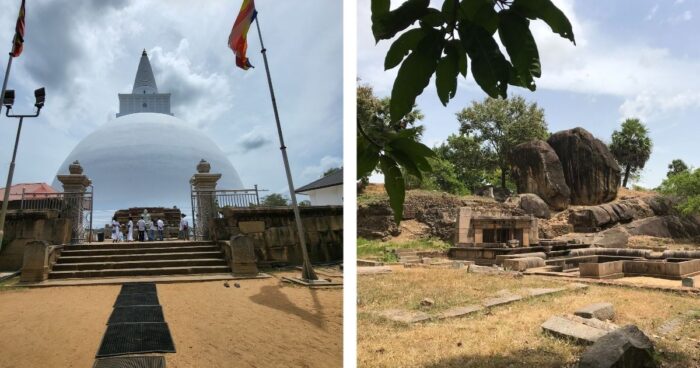
14. Kandy and the Temple of the Tooth
Kandy is a bigger city and one of the holiest places in Sri Lanka. The Temple of the Sacred Tooth Relic, said to hold a tooth of the Buddha himself, is a major pilgrimage site for Buddhists from all over the world. We recommend going in the early evening, when it is not completely packed. From the temple you can take a lovely walk around the lake, and the city also has a beautiful botanical garden. One night in Kandy is enough.
The temple entrance fee for foreigners is about 2,000 LKR (roughly €5 / £4.50). Several times a day there are ceremonies accompanied by drums, when the temple is at its busiest but also at its most atmospheric. The botanical garden we mean is the Royal Botanic Gardens in Peradeniya, just outside the city, with palm avenues and an enormous colony of fruit bats. If you are in Kandy in July or August, find out the dates of the Esala Perahera festival with its processions of elephants, dancers and drummers. Accommodation gets more expensive and sells out fast during the festival, though.
15. The east coast: Trincomalee and Arugam Bay
If, like us, you travel in the European summer, the east coast is the one place where you can count on calm seas and sunshine at that time of year. The season here runs roughly from May to September. Around Trincomalee you will find Uppuveli and Nilaveli beaches with calm water, and boats leave from here for snorkelling around Pigeon Island, which is protected as a national park. In the southeast is Arugam Bay, a laid-back surf town with surf schools and waves for both beginners and experienced surfers. The north around Jaffna, with its Tamil culture and Hindu temples, is a good tip for those who already know the south of the island.
16. Colombo and Negombo
We deliberately left Colombo until last, even though it is probably where you will arrive. We came to Sri Lanka mainly for the nature and history, so Colombo did not really win us over. If you do spend time there, take a walk along Galle Road, see the Fort district and wander through the spice and tea market in Pettah. In the evening, locals gather on the Galle Face Green seafront, and Gangaramaya Temple is also worth a visit. Just be ready for the hustle and bustle of a big city.
Close by is Negombo, which lies 6 km from Bandaranaike airport and 35 km from Colombo, and many people mix the two up. It mostly attracts visitors who do not want to travel around the island much, which is why it is one of the busiest resorts. It used to be a fishing village and trading port, and it still has huge markets today. It does not feel very Sri Lankan, though, because so much of the town is made up of buildings from the colonial era.
TIP: Looking for another big adventure? Try Colombia, from the coffee plantations around Salento to Medellín, Cartagena and the capital, Bogotá.
Sri Lanka entrance fees for the main sights
Food, transport and accommodation are cheap in Sri Lanka, but tickets to the big sights and national parks are not. Foreigners pay far more than locals, and with the Cultural Triangle and a couple of safaris the total quickly climbs into the hundreds of euros per person. Prices are often quoted in US dollars, but on the spot you usually pay in rupees at the current exchange rate. The figures below are approximate prices for one foreign adult, converted at 1 USD ≈ 330 LKR and 100 LKR ≈ €0.26 (about 22p).
| Sight | Entrance fee (approx.) | In € / £ |
|---|---|---|
| Sigiriya | 35 USD | about €30 / £26 |
| Pidurangala | 1,000 LKR | about €2.60 / £2.20 |
| Polonnaruwa | 30 USD | about €26 / £22 |
| Anuradhapura | 30 USD | about €26 / £22 |
| Dambulla cave temples | 2,000 LKR | about €5 / £4.50 |
| Temple of the Tooth, Kandy | 2,000 LKR | about €5 / £4.50 |
| Yala, Udawalawe, Minneriya (excluding jeep) | 40–45 USD incl. charges and tax | about €36–40 / £31–34 |
| Horton Plains | 35 USD incl. tax | about €30 / £26 |
| Galle Fort, Nine Arch Bridge, Adam’s Peak | free (voluntary donation on Adam’s Peak) | €0 / £0 |
Entrance fees in Sri Lanka change often and different sources quote different amounts, so treat the table as a budgeting guide and leave yourself some margin. For safaris, add the cost of hiring a jeep with a driver, which is split between everyone riding in it.
How to get around Sri Lanka
Distances look short on the map, but the roads wind through mountains and villages, so travel is slow. Reckon on an average of 30 to 40 km/h and do not plan more than one long transfer a day. Avoid driving after dark: on unlit roads you can even run into a wild elephant.
- Train: cheap and with wonderful views, especially on the mountain line to Ella and along the coast from Colombo to Galle. Reserved seats in first and second class on the mountain line sell out, so book ahead. Which sections are running after the cyclone is explained above in the Ella section.
- Bus: the cheapest option, and buses go almost everywhere. Local buses are packed and the drivers are, let’s say, enthusiastic, but between the big towns there are also air-conditioned express services, for example on the expressway from Colombo to the south.
- Tuk-tuk: for shorter distances. In bigger towns you can book one through the PickMe or Uber apps with a fixed price upfront; otherwise agree the fare before you get in.
- Car with driver: the most comfortable option and, for two to four people, the most sensible way to do the whole loop. The driver knows the roads, can recommend places to eat and stay, and you do not have to deal with the local driving style (traffic drives on the left, as in the UK).
How many days in Sri Lanka? A 2-week and 3-week itinerary
For the main loop you need at least two weeks, three if you want to take it easy. For two weeks in the European winter, this route works well: Negombo (1 night) → Sigiriya or Dambulla with a day trip to Polonnaruwa (3 nights) → Kandy (1 night) → Nuwara Eliya with Horton Plains (1–2 nights) → train to Ella (2–3 nights) → safari in Yala or Udawalawe (1 night) → beaches in Mirissa or Unawatuna (3–4 nights) → Galle and back to the airport.
With three weeks, add Anuradhapura, the night climb up Adam’s Peak (in season) and more days by the sea, for example in Tangalle. If you are travelling in summer like we did, move the beach part to the east coast, to Trincomalee or Arugam Bay. You can read how our own month on the island went in our Sri Lanka travelogue.
Flights, visa, money and temple etiquette
Flights: international flights land at Bandaranaike International Airport (CMB) near Negombo, about 35 km north of Colombo. From the UK you can fly from London either nonstop or with one change, typically at one of the Gulf hubs or in Istanbul. Routes and schedules change from season to season, so check the current options directly with the airlines before you book.
Visa (ETA): since 25 May, Sri Lanka has offered a free 30-day tourist ETA to citizens of 40 countries, including the United Kingdom, the USA, Canada, Australia and much of Western Europe (Germany, France, Spain, Italy, the Netherlands and others). Ireland is not on the list, so Irish passport holders should check the current ETA fee on the same website. You still have to apply in advance, on the official website eta.gov.lk. Look-alike agency websites charge their own fees. Your passport should be valid for at least six months from the day you arrive.
Money: the currency is the Sri Lankan rupee (LKR). Based on central bank rates in early October, 1 USD is around 330 LKR and 100 LKR is about €0.26 (roughly 22p). Hotels, bigger restaurants and shops take cards; tuk-tuks, buses, street stalls and smaller guesthouses want cash. There are ATMs in all larger towns, and withdrawal fees vary from bank to bank.
Temples and etiquette: cover your shoulders and knees, take off your shoes and remove any hat before entering a temple. Never pose for a photo with your back to a Buddha statue, which locals see as disrespectful. A visible Buddha tattoo can get you into serious trouble in Sri Lanka, including deportation, so keep it covered. Do not touch monks, and use your right hand when handing things over.
Food: the staple is rice and curry, a mound of rice with several small bowls of vegetable, lentil or fish curries. Try hoppers (bowl-shaped pancakes made from rice batter, often with an egg in the middle), kottu roti (chopped flatbread stir-fried with vegetables and spices; you will recognise it by the rhythmic clatter of blades on the griddle), coconut sambol and fresh king coconut. Food is often spicy, and “not spicy” here means something rather different from at home. Do not drink tap water.
Where to stay in Sri Lanka
Sri Lanka has accommodation in every price range, from family-run guesthouses to resorts with their own beach. Below are the hotels we picked for each base along the usual route around the island. We checked that they all exist and what they offer, but prices vary with the season, so compare them for your own dates.
Negombo: first and last night near the airport
For the first night after a long flight or the last one before flying home, Negombo makes sense: it is close to the airport and you avoid fighting your way through Colombo.
- Hotel J Negombo →: a simple hotel right on the beach with an outdoor pool and air-conditioned rooms, about 20 minutes by car from Bandaranaike airport.
- Sentido Heritance Negombo →: a larger hotel about 100 m from the beach with an outdoor pool and gym; every room looks out over the Indian Ocean.
Sigiriya and Dambulla: your base for the Cultural Triangle
From here you can do Sigiriya, Pidurangala, Dambulla and a trip to Polonnaruwa or a safari in Minneriya, so it is worth staying at least two or three nights.
- Hotel Sigiriya →: a long-established hotel with views of Lion Rock, an outdoor pool, an Ayurvedic spa and three bars.
- Jetwing Vil Uyana →: a luxury resort set in man-made wetlands about 5 km from Sigiriya, with villas with balconies, a spa and a pool.
Kandy
We think one or two nights in Kandy are enough. Hotels by the lake are close to the temple; those on the hills above town are quieter, but you will need a tuk-tuk to get anywhere.
- Hotel Suisse Kandy →: a colonial building opposite Kandy Lake with an outdoor pool, an Ayurveda centre and rooms with classic wooden furniture.
- The Elephant Stables →: a small hotel in a colonial bungalow about 2 km from the Temple of the Tooth, with a pool, a library and a restaurant serving Sri Lankan food.
- Earl’s Regency Hotel →: a five-star hotel about 5 km from the station with mountain views, an outdoor pool and a spa with a sauna.
Nuwara Eliya
Nights here get cold, and since many cheaper guesthouses have no heating, check whether your room has it before you book.
- The Grand Hotel →: a colonial hotel right next to the golf course, with heated rooms and two restaurants, one of them Indian.
- Jetwing St Andrew’s →: a five-star Tudor-style mansion about 5 km from the centre, with fireplaces and heating in the rooms.
Ella
We spent five days in Ella and next time we would choose our room for the view again. Places on the slopes above town are quiet, but it is an uphill walk back from the centre.
- Zion View Ella Green Retreat →: a three-star hotel with an infinity pool and mountain views; guests especially praise the location and breakfast.
- 98 Acres Resort & Spa →: chalets in the middle of a tea plantation, close to the Nine Arch Bridge and Little Adam’s Peak, with a spa and a pool with a view.
Tissamaharama and around Yala
Safaris leave early in the morning, so it is practical to sleep as close to the park as possible, in Tissamaharama or Kirinda.
- Kithala Resort →: a resort in Tissamaharama with an outdoor pool, a restaurant and packed lunches for your safari on request.
- Cinnamon Wild Yala →: chalets with balconies in Kirinda, about five minutes’ drive from the national park, with a pool and views of the beach or the bush.
- Jetwing Yala →: a larger beachfront hotel right on the edge of the national park, with a pool, a spa and several restaurants.
Mirissa
Mirissa is small, so it does not really matter whether you stay at the southern or northern end of the beach. The real question is whether you want peace and quiet or bars on your doorstep.
- Paradise Beach Club →: a hotel at the southern end of Mirissa with a palm-fringed pool overlooking the beach and rooms with a terrace or balcony.
- Lantern Boutique Hotel by Reveal →: a boutique hotel by a white sandy beach in the south of Mirissa, with a pool and rooms and suites with balconies.
Galle and Unawatuna
Sleeping inside the walls of Galle Fort is an experience in itself. If you want the sea right outside your door, choose Unawatuna instead, about 5 km from Galle.
- Galle Fort Hotel →: an 18th-century Dutch mansion on Church Street inside the fort, with just 11 suites and one of the few pools within the walls.
- Fort Bazaar →: a boutique hotel in a former 16th-century merchant’s house inside the fort, with the Church Street Social restaurant, breakfast and afternoon tea.
- Thaproban Pavilion Resort and Spa →: a resort a few steps from the beach in Unawatuna, with a pool, a spa and sea-view rooms.
Tangalle
Around Tangalle, places to stay are spread out along long beaches, so expect to take a tuk-tuk into town.
- Mangrove Beach Chalets →: simple cabanas on their own beach between the lagoon and the sea, with a restaurant and bike hire.
- Buckingham Place →: a hotel on Rekawa beach between the ocean and a lagoon, with a 33-metre infinity pool overlooking the sea.
- Anantara Peace Haven Tangalle Resort →: a luxury resort on a rocky headland above the ocean in the middle of a coconut plantation, with two pools and a spa.
What we would do differently
Maybe you know the feeling after every trip: “next time we’d do that differently.” In Sri Lanka’s case, we would spend more time in nature and on the beaches, because they really are magical, and I would skip some of the bigger towns and spend those days in a national park or in the mountains instead, because that is where we were happiest.
We would not try to tick off every ruin in the Cultural Triangle. Sigiriya, Polonnaruwa, Anuradhapura and Dambulla in one week start to blur into one after a while. Next time we would pick two and spend the rest of the time cycling slowly through the villages and around the reservoirs near Sigiriya.
We would eat where the locals eat more often. In our experience the best rice and curry is not served in tourist restaurants but in the small canteens where drivers and workers go for lunch. Try everything, even the things you cannot identify.
And on the train to Ella we would put the phone away more. Everyone hangs out of the doors for that one photo, when the best part is simply sitting by an open window, watching the tea plantations go by and letting the carriage rock you along.
If we had to choose just a handful of places to see in Sri Lanka, it would definitely be:
- Ella and its tea plantations
- Sigiriya and its stunning views
- The sunny beaches of Mirissa
- National parks with leopards, elephants and crocodiles
Sri Lanka travel FAQ
What to wear in Sri Lanka?
Light summer clothes are all you need in most of Sri Lanka. Remember, though, that you must cover your knees and shoulders to enter temples, so it is handy to carry a large scarf or sarong. For the hill country around Nuwara Eliya and Horton Plains, pack a jumper or a light jacket, as the nights there get cold.
What vaccinations do I need for Sri Lanka?
No vaccinations are compulsory unless you are arriving from a country with yellow fever (in that case you need proof of yellow fever vaccination). Commonly recommended are hepatitis A, typhoid and a tetanus booster, and for longer trips also hepatitis B and possibly rabies. Dengue fever occurs on the island, so protection against mosquitoes is important. Discuss your personal plan with your GP or a travel clinic (in the UK, the NHS Fit for Travel website is a good starting point).
Do people speak English in Sri Lanka?
Since Sri Lanka is a former British colony, most people speak at least basic English. And if you do meet someone who doesn’t, you can always get by with gestures and a smile.
How to get around Sri Lanka?
If you don’t mind a bit of discomfort, local buses are the cheapest way to travel around Sri Lanka. A slightly pricier but more fun option is ordering a tuk-tuk through the PickMe or Uber app on your phone. The train offers beautiful views, especially on the mountain line to Ella. The most expensive but also the most comfortable option is hiring a car with a driver.
Do I need a visa for Sri Lanka from the UK?
Yes, you need an electronic travel authorisation (ETA). Since 25 May, British citizens get it free of charge for 30 days, but you must apply in advance on the official website eta.gov.lk. Your passport should be valid for at least six months from the day you arrive.
Is the Kandy to Ella train running?
Not yet as a direct service. After the damage caused by Cyclone Ditwah, the direct train from Kandy to Ella is not running (as of early October). The Nanu Oya – Ella – Badulla section is open, so people travel from Kandy to Nuwara Eliya by car or bus and continue by train from Nanu Oya station. Check the latest situation on the Sri Lanka Railways website.
How many days in Sri Lanka is enough?
For the main loop through the Cultural Triangle, the hill country and the southern beaches you need at least two weeks. With three weeks you can add Anuradhapura, Adam’s Peak or more time by the sea without rushing. In one week you can only really cover one region, for example the Cultural Triangle with Kandy, or the hills and the south.
Potřebujete pomoct s cestováním?
-
Ubytování 🏨
Vyberte si to nejlepší ubytování, ať už jste kdekoliv, přes Booking.com. -
Půjčení auta 🚗
Auto si snadno najdete přes Booking.com, kde máte často slevu díky ubytování, nebo Rentalcars.com, kde porovnáte nabídky většiny půjčoven. -
Zážitky 🎟️
Přes GetYourGuide.com si vyberete z nejrůznějších výletů i zážitků po celém světě, navíc se zrušením zdarma do 24 h předem.