Last updated 8.10.2026
Few places on the island won us over as quickly as Ella, Sri Lanka, a small town tucked away beyond endless hills and even more endless tea gardens. After weeks of sticky lowland heat, the cool mountain air and a proper cup of tea felt so good that we ended up staying almost a week. Around the town you will find waterfalls, tea plantations wherever you look and, above all, mountains. Below we cover the best things to do in Ella, where to stay and how to actually get there while the hill country railway is still being repaired.
Why Ella, Sri Lanka is worth the trip
The town sits in a bowl of green hills, so the climate is noticeably cooler than on the coast, and the wild countryside starts right behind the last guesthouse. Ella’s story is tied to the British colonial era, when the area became a centre of the tea industry. People here used to live from farming; today almost every family works on the tea estates in one way or another.
TIP: 12 best places to see in Sri Lanka
A short history of Ella
In Sinhala, “ella” means waterfall, and one look at the surrounding slopes tells you why. The oldest layer of local history is a legend, though. According to the Ramayana epic, the demon king Ravana kidnapped Princess Sita and hid her in the caves around today’s Ella. That is why both Ravana Falls and Ravana Cave above the town carry his name.
The recorded history was written by the British. In the 19th century the hills of Uva Province were planted with coffee, but from the 1870s a fungal disease (coffee leaf rust) wiped out the plantations and growers switched to tea. It did so well here that in 1890 the Scottish grocer Thomas Lipton bought the nearby Dambatenne estate near Haputale, and the viewpoint above it is known today as Lipton’s Seat.
All that tea had to reach the port, so a railway was pushed up into the mountains. The hill country line reached Badulla in 1924, and shortly before that the stone Nine Arch Bridge was built between Ella and Demodara. For decades Ella was a quiet village by a station; now it is one of the busiest stops on the island, full of cafés and guesthouses. At the end of November 2025 Cyclone Ditwah hit the region, damaging roads, houses and the railway across Badulla District, and the area is still recovering.
How to get to Ella
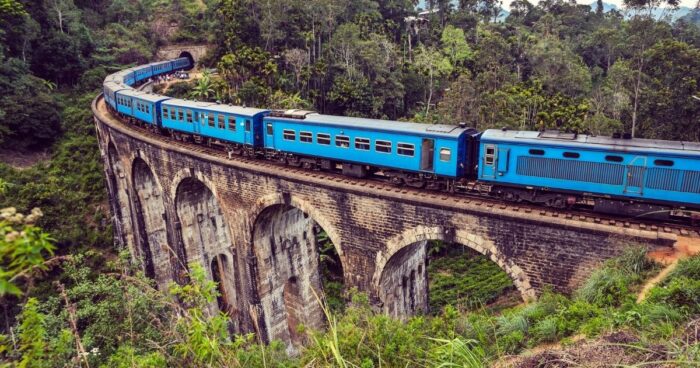
Getting to Ella is easy by bus (from almost anywhere) or by train, which is what most travellers choose, because the ride itself is half the point. The line winds past endless tea estates, through thick forest and along valleys where time seems to have stopped. In normal times trains run to Ella from Colombo, Kandy, Peradeniya and Nanu Oya, the station for Nuwara Eliya.
Right now, though, expect disruption. Cyclone Ditwah damaged the hill country line in many places and there is currently no direct train from Kandy to Ella. Repaired sections are reopening one by one: since June the stretch from Nanu Oya (the station near Nuwara Eliya) through Ella to Badulla is running again, while work continues between Kandy and Peradeniya, between Gampola and Nawalapitiya, and between Hatton and Nanu Oya. The usual workaround is to go from Kandy to Nuwara Eliya by car or bus (around 3 to 4 hours) and take the train from Nanu Oya to Ella, which takes about 2.5 hours. Before you plan the trip, check the latest status on the Sri Lanka Railways website.
When the whole line is open, the Kandy to Ella train takes 6 to 7 hours. Seats in reserved carriages go on sale 30 days ahead through the official booking system, and the popular morning departures sell out fast. A reserved seat for the full Kandy to Ella journey cost roughly 2,500 LKR in 1st class (about £5.50 / €6.50), 1,700 LKR in 2nd class (about £3.75) and 1,200 LKR in 3rd class (about £2.70), but fares may change once the full line reopens. Unreserved 2nd and 3rd class tickets are sold at the station on the day.
The bus is the cheapest option, but there is no direct service from Kandy, and with a change in Nuwara Eliya or Badulla you will spend about 7 hours on the road. From the south coast (Mirissa, Tangalle) buses run via Wellawaya. The most comfortable choice is a car with a driver: from the south it takes about 4 hours and costs roughly 22,000 to 25,000 LKR (about £50 to £55, or €58 to €66) for the whole car. Your guesthouse can arrange a driver, or you can book through PickMe, Sri Lanka’s answer to Uber. On the way up from the south you can break the journey with a safari in Udawalawe National Park.
TIP: Timetables from these towns are HERE.
Best budget places to stay in Ella
Because we decided to stay longer in Ella than planned, we had to find several rooms at the last minute. And since we travel on a budget, we did not want to spend much on a bed when we were out all day anyway. So where to stay in Ella, Sri Lanka without overpaying? These are the places we can recommend:
- Ella Country House: a small guesthouse a short walk from the centre on the road towards Wellawaya, with balconies facing the mountains and breakfast served on the terrace.
- Misty Heaven: a guesthouse on Temple Road in the liveliest part of Ella, with breakfast, free parking and bikes to rent.
- Brisk Ella Retreat: a simple hotel with a restaurant, a 24-hour front desk and terraces looking out over the town and the hills.
Where to stay in Ella for more comfort
The main street stays loud until late, so if you want a quiet night, look for a place on the slopes around the centre, for example along Passara Road towards Little Adam’s Peak. The station and the cafés are still only a few minutes away on foot or by tuk-tuk.
- Zion View Ella Green Retreat: a three-star hotel on Waterfall Road with an outdoor pool, a restaurant and a buffet breakfast; guests mostly praise the location and the view.
- 98 Acres Resort & Spa: a luxury resort on a working tea estate off Passara Road, with stone and timber chalets, an infinity pool above the valley and a spa. Little Adam’s Peak and Nine Arch Bridge are both within walking distance.
Compare current prices and availability in our overview of places to stay in Ella.
Tea plantations in Sri Lanka: why Ella is the place to see them
Tea bushes need altitude to grow well (from about 600 metres up), and that is exactly what the centre of Sri Lanka offers: tea estates large and small spread over rolling hills wedged between higher mountains. You will see tea plantations all over the hill country, but in Ella, where every traveller ends up sooner or later, you get the chance not only to walk through the estates but also to look inside a working tea factory.
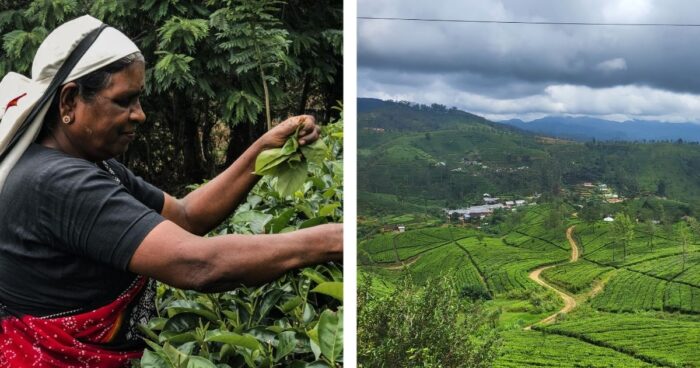
Our tea plantation tour turned out to be one of the highlights of our whole time in Sri Lanka. We were shown around by an older lady who had once been one of the best tea pluckers on the estate, and along the way we got to try picking the leaves ourselves.
What you might not know about growing tea
Ceylon tea ranks among the finest black teas in the world. It is made only from the top shoots of the bush, the “two leaves and a bud” that hold the most of the good stuff (antioxidants, caffeine and polyphenols), and they are picked by hand. The pluckers are mostly women, since the men do the heavier work, and their daily target is around 20 kg of leaves. The basic daily wage on the estates has recently been between 1,350 and 1,700 LKR (roughly £3 to £3.75), and raising it has been the subject of long disputes between the unions, the government and the plantation companies.
Sri Lanka is one of the world’s largest tea exporters, and Uva, the region Ella belongs to, is one of its seven official tea-growing districts. Uva tea picked in the dry season from July to September has a subtle, slightly spicy flavour that tea connoisseurs value most.
Ella tea factory tour: where to go
We can recommend the Halpewatte tea factory, where they walk you through the whole factory and every stage of production, take you out into the tea gardens, explain what happens and why, and finish the tour with a tea tasting. What I liked most was that you can touch and try everything, the guides are happy to answer any question (we had plenty), and by the time you get to the tasting you know exactly what you are drinking, how the different black teas differ and why.
Uva Halpewatte offers a factory tour and a plantation tour with leaf plucking, each for 3,000 LKR (about £7 / €8) and both including a tasting. If you want more, there is a two-hour handmade tea workshop for 9,000 LKR (about £20 / €24), where you blend your own tea and take it home. Tours start daily between 8:00 and 16:30 and you can book them through the factory’s WhatsApp.
We suggest going in the morning so you catch the factory while the tea is being processed. Plan on the whole morning; small children will manage it easily.
Lipton’s Seat and other tea factories nearby
About an hour and a half’s drive from Ella, above the town of Haputale, lies the Dambatenne tea estate that once belonged to Thomas Lipton. From his favourite lookout, Lipton’s Seat (just under 2,000 metres), you can see on a clear morning across the tea terraces far down to the lowlands. Entry to the viewpoint costs roughly 500 LKR (about £1.20), payable in cash. Go as early as you can, because by midday the tops are usually wrapped in cloud. You can stop at the Dambatenne factory on the way. If you prefer green tea, visit the Newburgh factory near Ella, which specialises in it.
The most beautiful tea plantations in Sri Lanka are around Nuwara Eliya and Ella, but you will also see tea in the Ratnapura and Kandy areas.
TIP: More of a coffee person? Come with us to Colombia for some of the best coffee in the world. Here are 15 places to see in Colombia, including its most beautiful coffee farms.
Nine Arch Bridge: Sri Lanka’s most photographed bridge
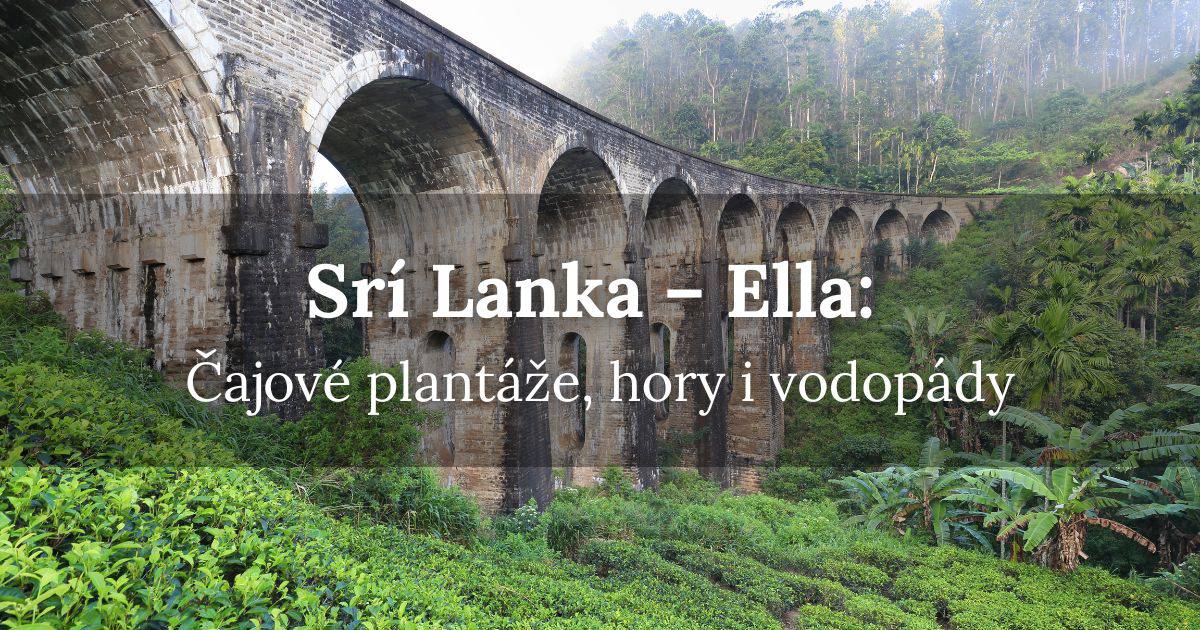
In recent years the Nine Arch Bridge, a nine-arched stone railway viaduct between Ella and Demodara stations, has become the image of Sri Lanka, and everyone wants a photo of a train crossing it. It was built in the colonial era without steel, as a purely masonry structure. Below it, tea bushes spread out, framed by mountains and jungle.
The bridge is about 91 metres long and roughly 24 metres high, built of stone, brick and cement. It was completed around 1920 (sources vary between 1919 and 1921). A local story says the steel meant for it was sent to the front during the First World War, so a local builder, P. K. Appuhami, put it up from stone alone. It is a nice tale, but there is no evidence for it.
Come early in the morning or in the evening to avoid the biggest crowds. It is a lovely sight, but watch out: wild wasps nest in the arches of the bridge!
From the centre of Ella the walk to the bridge takes about 40 minutes, or a tuk-tuk will drop you at the footpath above it. On the slope above the bridge there are cafés with a view where you can wait for the train over coffee or breakfast, though prices are higher than elsewhere in Ella. People walk along the tracks and across the bridge all the time; the train moves slowly and sounds its horn well in advance. When you hear it, step off the tracks in good time.
Nine Arch Bridge train times
Want your own shot of a train rolling across the bridge? The fixed times that used to circulate online no longer apply since the cyclone, and fewer trains are running at the moment. The bridge lies between Ella and Demodara, so a train heading to Badulla crosses it about 10 to 15 minutes after leaving Ella, and a train from Badulla crosses roughly the same time before it reaches Ella. Under the temporary timetable in force since services resumed in June, trains from Nanu Oya arrive in Ella at around 11:30 and 17:00, and trains from Badulla leave Ella at around 9:50 and 15:50. Current departures are posted at Ella station, and delays of half an hour or more are common, so leave yourself a margin at the bridge.
Walking route from Ella to the Nine Arch Bridge viewpoint
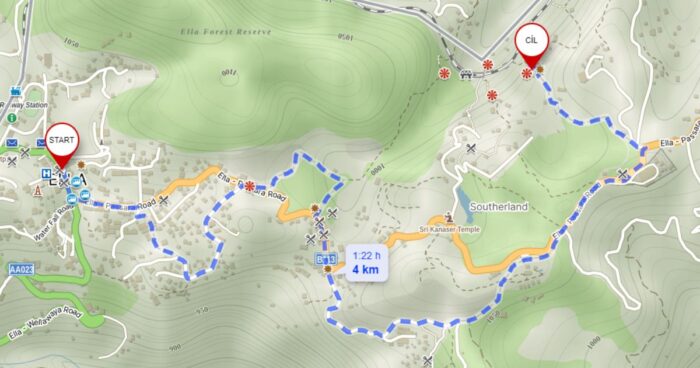
Little Adam’s Peak hike (1,141 m)
One of the most popular walks from Ella is Little Adam’s Peak (not to be confused with Adam’s Peak, a different and much higher mountain), which you can reach comfortably on foot from Ella along the road towards Passara. The summit is free to visit, and at the top you get great views of the waterfalls and the surrounding mountains, including Ella Rock. Children manage it without trouble, but the path is not suitable for pushchairs and there is no cable car. The trailhead is HERE:

If you are an early riser, go up for sunrise, or come back for sunset. The path is well marked the whole way, and just below the summit there is a large resort where you can try a zip line. The route is safe, so you can easily go on your own, and I think children will walk it without any problem. For us it was simply a pleasant stroll.
The trailhead is about 2 km from the centre, and a tuk-tuk there costs roughly 1,000 LKR (about £2.20). From the start you reach the top in about 45 minutes, mostly up steps between the tea bushes. On the way down there is a signposted turn-off to Nine Arch Bridge, so you can combine both in one morning. The Flying Ravana zip line below the summit runs over a tea plantation. The price depends on where you book, roughly 20 to 40 USD.
TIP: While you are in Sri Lanka, do not miss the Sigiriya rock fortress!
Ella Rock hike
If you want a bigger challenge, Ella Rock is the one. The hike is harder, but the reward is worth every step. The trail is not always clearly marked, so bring a map or go with a local guide. You can start and finish at Ella station, and the whole loop is about 10 km.
Ella Rock route from the station
From Ella station, walk along the tracks for about 40 minutes to Kithalella station. Carry on along the tracks for another 5 to 10 minutes until you reach a rock marked with a blue arrow and the words “Ella Rock”. Turn left at this junction. Cross the small footbridge, keep left at the fork after it and head uphill alongside a tea plantation. You will probably walk through tall grass that the locals deliberately leave uncut. Then the views open up.
Allow 3 to 4 hours for the whole hike and set off early, because in the afternoon the summit is often lost in cloud and in the rainy season the path turns to mud. The last stretch through the forest is steep, so wear sturdy shoes, take plenty of water and download an offline map to your phone. On the way, locals may offer to lead you up by a “shortcut” and then ask for money at the end. If you want a guide, arrange one in advance through your guesthouse.
TIP: 13 things to take on a long-haul flight, so you enjoy it rather than just survive it
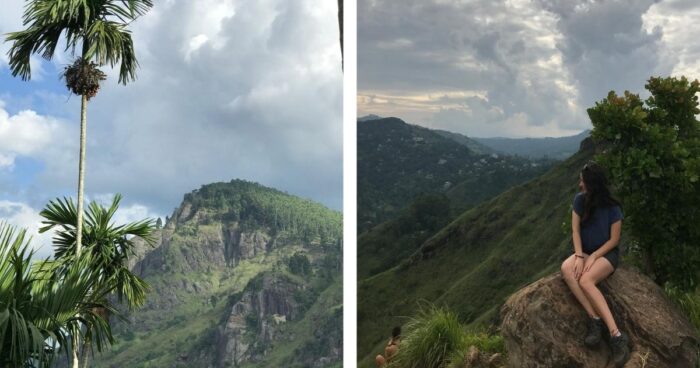
Ravana Falls near Ella
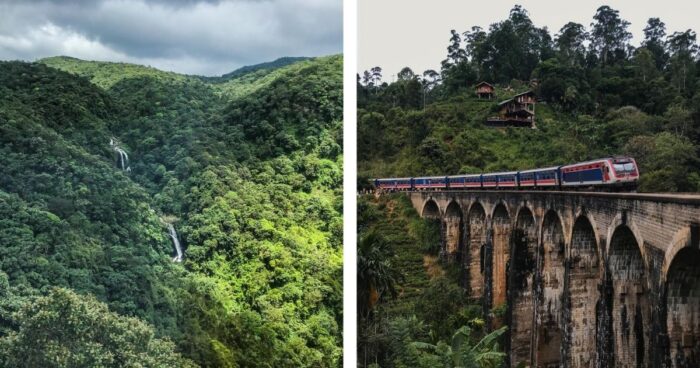
About 6 km south of Ella village, right beside the road, you will find the popular Ravana Falls. At around 25 metres they are far from the tallest on the island, but they are wide and in the rainy season very powerful. They are named after the legendary king Ravana. The falls are beautiful, but because they are so easy to reach, expect souvenir sellers, monkeys and plenty of people. Still, if you have a spare hour in Ella, they are worth a look.
The waterfall sits right on the Ella to Wellawaya road, so you can get there by tuk-tuk or local bus. Swimming below the falls is not a good idea: the rocks are slippery and after heavy rain the authorities close access to the water. Keep your snacks in your bag, as the monkeys here are bold. Above Ella you can also visit Ravana Cave, reached by a steep flight of steps.
More day trips from Ella
Diyaluma Falls
At 220 metres, Diyaluma is the second-highest waterfall in Sri Lanka. It is about 35 to 40 km from Ella, so an hour to an hour and a half by car or tuk-tuk. The lower viewpoint is right by the road near Koslanda, but the real draw is up top: a short hike from Poonagala leads to a series of natural rock pools above the drop where you can swim. Only get into the pools when the water is calm, and never go near the edge of the cliff.
By train to Badulla and Dunhinda Falls
The stretch from Ella to Badulla, the last station on the hill country line, is less famous, but the scenery is just as beautiful and the trains are often half empty. The ride takes about 1.5 hours and you can buy a ticket at the station without a reservation. From Badulla it is about 6 km to Dunhinda Falls, reached by a path of roughly one kilometre from the entrance (uphill on the way back). Entry is roughly 1,000 LKR (about £2.20). You can fit the trip in between two trains.
Safari and a Sri Lankan cooking class
Udawalawe (elephants) and Yala (leopards) national parks are both doable as a day trip from Ella, and they work even better as a stop on your way down to the south coast. In Ella itself, plenty of guesthouses and restaurants run cooking classes where in a few hours you learn rice and curry with several kinds of curry, coconut sambol or roti.
Nuwara Eliya, a slice of England among the tea
Fancy a bit of time travel? Head to Nuwara Eliya, where British colonial manners meet the wild beauty of the tea estates. This little piece of England takes you straight back to colonial days. Expect narrow lanes lined with stone houses and flower gardens, a golf course and a damp, grey mountain climate that will feel very familiar if you are British.
From Ella it is about 2 hours to Nuwara Eliya by car; by train you go to Nanu Oya station, about 8 km from the town. It lies higher than Ella, so bring a jumper: evenings get properly cold.
TIP: Animal rescue station: where does tourists’ money go and how does sea turtle conservation really work?
How many days in Ella and when to go
One full day is enough for Little Adam’s Peak, Nine Arch Bridge and a tea factory. If you want to add Ella Rock, Lipton’s Seat or Diyaluma, allow two to three days. We stayed almost a week and do not regret it; Ella is a place where it is easy to rest between trips.
Ella sits at roughly 1,000 metres above sea level, so days are pleasantly warm and in the evening you will want long sleeves. It rains most in October and November, while January to March tends to be the driest and clearest time. Mornings usually have the best visibility; in the afternoon clouds gather over the hills. We go through it month by month in our article on the weather in Sri Lanka.
What we would do differently in Ella
Ella tempts you to race up Little Adam’s Peak, photograph the train on Nine Arch Bridge, tour a factory and still squeeze in Ravana Falls before dark, all in one day. It can be done, but we enjoyed Ella most on the days with no plan at all: a slow breakfast on a terrace facing Ella Rock, an aimless walk along the tracks, and then rice and curry in a small canteen off the main street where tour groups never go.
Next time we would not chase the train-on-the-bridge photo so hard. Plenty of people wait at the bridge for that exact moment with phones raised, and yet it is at its loveliest when no train is coming and there is nothing but silence and tea bushes. Try enjoying the train from the inside instead, legs dangling out of the open door, with your phone tucked away in your bag for a while. And if a lady on the plantation offers to let you try plucking tea, say yes. That is the memory of Ella we treasure most.
Ella, Sri Lanka: frequently asked questions (FAQ)
Where is the best place to buy tea in Sri Lanka?
You can buy tea in Sri Lanka on practically every corner. For a wide choice and genuinely good quality, though, go to markets or straight to the tea factories where it is processed, such as the Uva Halpewatte Tea Factory in Ella.
What is there to see in Ella, Sri Lanka?
Ella is a mountain village surrounded by tea plantations and beautiful hills. The top things to see in Ella are a tea plantation, the short hike up Little Adam’s Peak, the longer Ella Rock hike, Ravana Falls and the spectacular Nine Arch Bridge.
What are you not allowed to take out of Sri Lanka?
Be careful: you may not take precious metals (gold, silver), gemstones, ivory, weapons, narcotics, animals or plants out of Sri Lanka.
How long is the train from Kandy to Ella?
When the whole line is running, the Kandy to Ella train takes about 6 to 7 hours. Since Cyclone Ditwah, however, there is no direct train from Kandy. The section from Nanu Oya (near Nuwara Eliya) through Ella to Badulla is open, and the train from Nanu Oya to Ella takes about 2.5 hours. From Kandy to Nuwara Eliya you travel by car or bus. Reserved seats go on sale 30 days ahead through the Sri Lanka Railways booking system, and snacks are sold on board.
How many days in Ella is enough?
One full day is enough for Little Adam’s Peak, Nine Arch Bridge and a tea factory. If you want to add Ella Rock, Lipton’s Seat or Diyaluma Falls, allow two to three days.
What time does the train cross Nine Arch Bridge?
There is no fixed crossing time, and since Cyclone Ditwah fewer trains are running. The bridge lies between Ella and Demodara, so a train heading to Badulla crosses it about 10 to 15 minutes after leaving Ella, and a train from Badulla roughly the same time before it reaches Ella. Current departures are posted at Ella station, and trains are often half an hour or more late.
How much is a tea factory tour in Ella?
At the Uva Halpewatte factory, both the factory tour and the plantation tour with leaf plucking cost 3,000 LKR (about £7 / €8), each including a tasting. The two-hour workshop where you blend your own tea costs 9,000 LKR (about £20 / €24).
Potřebujete pomoct s cestováním?
-
Ubytování 🏨
Vyberte si to nejlepší ubytování, ať už jste kdekoliv, přes Booking.com. -
Půjčení auta 🚗
Auto si snadno najdete přes Booking.com, kde máte často slevu díky ubytování, nebo Rentalcars.com, kde porovnáte nabídky většiny půjčoven. -
Zážitky 🎟️
Přes GetYourGuide.com si vyberete z nejrůznějších výletů i zážitků po celém světě, navíc se zrušením zdarma do 24 h předem.