Last updated 22.10.2026
If you love Christmas, the Vienna Christmas market season is something you have to see at least once. In November the city switches on thousands of lights, and every corner smells of cinnamon, punch, vanilla and roasted almonds. Vienna has around twenty Christmas markets, a mix of imperial backdrops, old traditions and good food that brings many visitors back year after year. The first markets on Stephansplatz and at Schönbrunn Palace open on 6 November 2026, the big Christkindlmarkt in front of the City Hall follows on 13 November, and Schönbrunn, the Prater and the City Hall ice rink stay open longest, until 6 January 2027. Below you will find dates and opening hours for all the main markets, where to stay, how to plan a long weekend, how to get in from the airport, what to eat and 12 ideas for things to do in Vienna in winter.
Vienna Christmas market 2026 at a glance
- Main market: Wiener Christkindlmarkt on Rathausplatz, from Friday 13 November to 26 December 2026, daily 10:00 to 22:00, on Christmas Eve until 18:30 (according to the organiser)
- First to open: Stephansplatz and Schönbrunn on 6 November 2026; the last to open are Belvedere and Maria-Theresien-Platz on 20 November
- Last to close: Schönbrunn, the Prater winter market and the City Hall ice rink on 6 January 2027, Belvedere on 31 December; most smaller markets close on 23 December
- Entry: free at every market, you only pay for food, drinks, rides and skating
- Ice skating: Eistraum by the City Hall from 13 November 2026 to 6 January 2027, closed on New Year’s Eve; another rink at Schönbrunn
- Where to stay: in the 1st district near St. Stephen’s Cathedral and the Opera, or for less in the 7th and 8th districts around Spittelberg and the City Hall (hotel tips below)
- Getting there: fly into Vienna Airport (VIE), then take a direct ÖBB train to Wien Hauptbahnhof or the CAT to Wien Mitte; by car you need an Austrian motorway vignette and a P+R car park by the U-Bahn
- Currency: euro, a mug of punch costs roughly €5 to €7 (about £4.30 to £6) plus a deposit on the mug
- Best for: a long weekend from Friday to Sunday, markets in the evening, Schönbrunn, Belvedere, coffee houses and concerts during the day
Where to stay for the Vienna Christmas markets
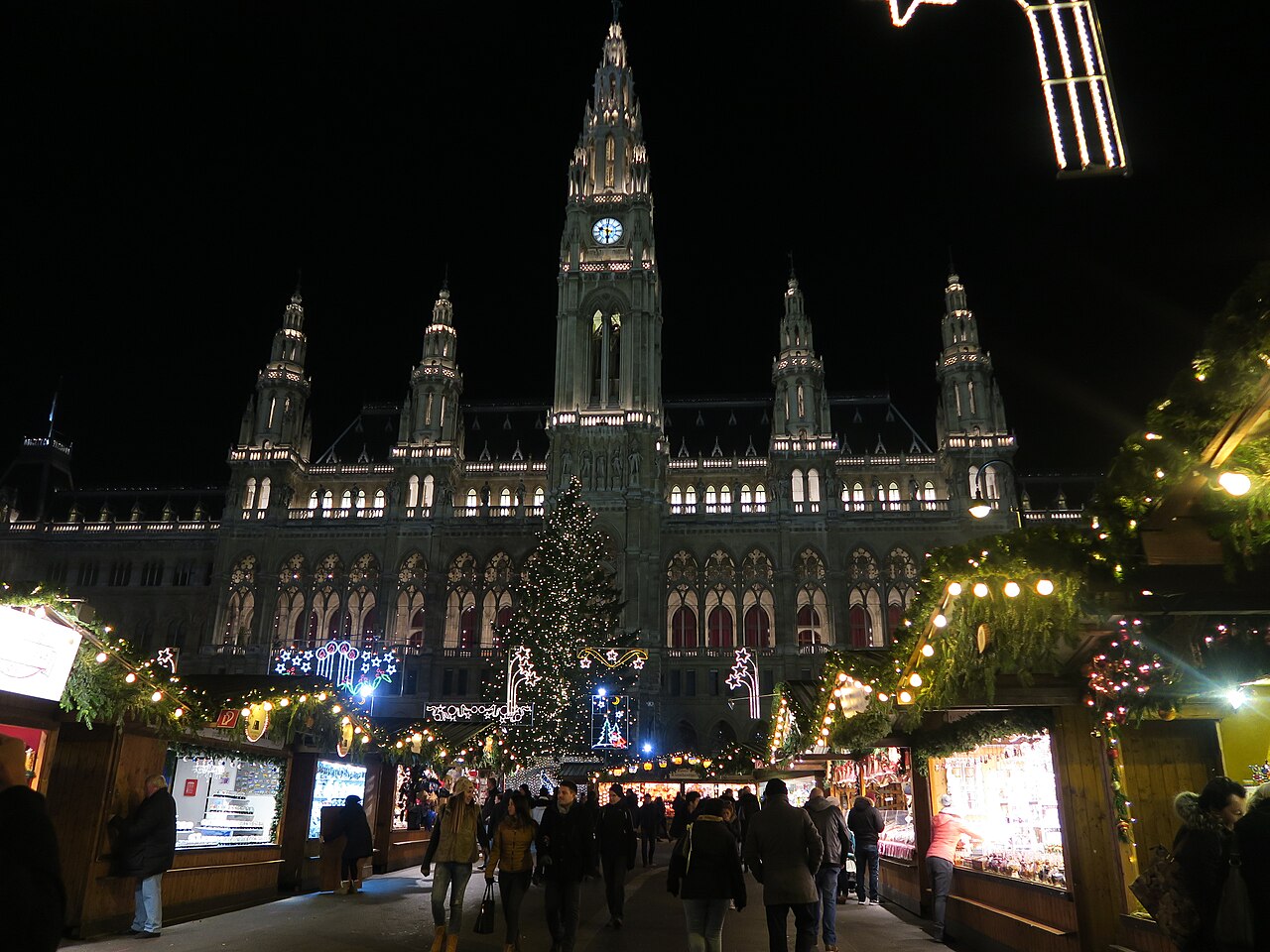
In theory you could tick off most of the big markets in a single day. The catch is that Vienna looks its best after dark, when the City Hall, the trees in Rathauspark and the chandeliers above the Graben light up, and by then a day-tripper is usually heading back. We would turn Advent in Vienna into a long weekend. You walk back to your hotel in the evening, nobody has to worry about driving after a glass of punch, and above all you can visit the markets on Friday evening and Sunday morning, when you can actually move between the stalls. On Saturday evening the area around the City Hall is shoulder to shoulder.
The most practical base is the 1st district (Innere Stadt) between St. Stephen’s Cathedral, the Opera and the City Hall: Stephansplatz, Am Hof, Freyung and Rathausplatz are all within walking distance. Slightly cheaper and still close are the 7th district around Spittelberg and Mariahilfer Straße and the 8th district, Josefstadt, right behind the City Hall. If you arrive by train from the airport, you can also sleep next to the main station, which is a walk from the Belvedere and a few minutes by U-Bahn from the centre. We checked these hotels on Booking.com:
- Hotel Sacher Wien: the legendary hotel from 1876, opposite the State Opera and next to Kärntner Straße; according to Booking.com, Karlsplatz station is a two-minute walk away. For couples who want to do Advent in style. Plus: Café Sacher with the original Sachertorte on the ground floor, and antiques and paintings throughout the hotel.
- Boutiquehotel Das Tyrol: a four-star boutique hotel right on Mariahilfer Straße opposite the MuseumsQuartier, with the Spittelberg market around the corner. For anyone who wants a design hotel and Christmas shopping on Vienna’s longest shopping street. Plus: a free sauna and steam bath, perfect after an evening outdoors.
- Hotel Rathaus – Wein & Design: a historic building in the 8th district, a few minutes’ walk behind the City Hall. For wine lovers. Plus: every room is dedicated to one Austrian winemaker and the hotel stocks more than 450 Austrian wines.
- Hotel Zipser: a family-run three-star hotel in an Art Nouveau building in Josefstadt, according to Booking.com just 100 metres from the City Hall and Rathaus U-Bahn station. For those who want the Christkindlmarkt and the ice rink around the corner at a sensible price. Plus: Spittelberg is about a ten-minute walk.
- Motel One Wien-Hauptbahnhof: right next to the main station, where direct trains from the airport and international trains arrive. For anyone travelling by rail who does not want to drag a suitcase across town. Plus: the Belvedere and its Christmas market are a ten-minute walk away, the centre about five minutes by U-Bahn.
- Wombat’s City Hostel Vienna Naschmarkt: a hostel behind a historic façade, five minutes on foot from the Naschmarkt and Kettenbrückengasse U-Bahn station (U4). For groups of friends, students and anyone who would rather spend the money on punch. Plus: its own bar, and Karlsplatz with Art Advent is one U-Bahn stop away.
You can compare more hotels, guesthouses and apartments in our list of places to stay in Vienna.
💡 Tip: Advent weekends are high season in Vienna, and central hotels are noticeably more expensive at weekends than midweek. Book early, ideally in October, and if you can, try a Sunday to Wednesday stay. The busiest days are the weekends just before Christmas and 8 December, an Austrian public holiday when the shops and markets are packed.
A long weekend at the Vienna Christmas markets
This is how we would put together an Advent weekend in Vienna. The big markets are saved for the evening, when they are lit up, the smaller ones and the palace markets for the morning, which leaves time in between for a coffee house and a museum.
- Friday: a morning or midday flight to Vienna, train into town, check in and head straight to Rathausplatz once it is dark. The tree, the glowing hearts in Rathauspark and an hour on the ice (tip 1). Walk to Spittelberg for dinner, where the stalls in the lanes are full of locals (where to warm up).
- Saturday: in the morning take the U4 to Schönbrunn: the market in the main courtyard, a palace tour or the zoo (tip 5, tip 9). In the afternoon, Klimt’s The Kiss at the Belvedere and the market in front of the palace (tip 6). At dusk, a walk through the centre: Stephansplatz, the lights on the Graben (tip 2), Am Hof and Freyung. In the evening an Advent concert (tip 4) or the Imperial Lights trail in the palace gardens.
- Sunday: in the morning climb the tower of St. Stephen’s (tip 3) or visit the Hofburg (tip 8), then Art Advent on Karlsplatz and coffee and cake in a café. If you still have the energy, spend the afternoon at the thermal baths (tip 10). Book an evening flight home.
Can you do it in one day? If you are already in Bratislava, Linz or Graz, yes: the train gets you to Vienna within a few hours and you can return the same evening. A day trip on a flight from the UK or further afield is not realistic. A short city break with one night is possible: Stephansplatz, Am Hof and Freyung in the afternoon, Rathausplatz after dark and an early flight the next morning. It works, but you will miss Schönbrunn, the Belvedere and a relaxed evening in the city. If you have an extra day, you can add a trip to Bratislava (tip 12).
Why visit the Christmas markets in Vienna
How many Christmas markets are there in Vienna? Around twenty, and each one has its own character. In front of the neo-Gothic City Hall it is a big show with a tree, a carousel and an ice rink in the park; at Spittelberg it is romantic lanes and crafts; at Schönbrunn and the Belvedere it is the imperial backdrop of Baroque palaces; and on Karlsplatz it is artists and organic food beneath the dome of St. Charles’ Church. If you have been to Christmas markets in Germany or Prague, Vienna is a step up in scale and elegance, and you can easily combine it with Bratislava, an hour away by train.
The second reason is everything around the markets. Coffee houses where you can sit over one coffee for an hour without anyone hurrying you, Advent concerts, a ball season that starts on New Year’s Eve, and streets in the centre hung with giant chandeliers of light. The markets are really an excuse to come. The best part of Vienna is often what you find walking between them.
How to get to Vienna and where to park
By plane. Vienna International Airport (VIE) in Schwechat has direct flights from London and most European cities. Several options take you into town: direct ÖBB long-distance trains (Railjet) run from the airport to Wien Hauptbahnhof, from where the U1 goes straight to Stephansplatz. The City Airport Train (CAT) normally runs non-stop to Wien Mitte in 21 minutes, but because of a main line closure it has been running as a premium bus to the centre since 7 September 2026, every 12 minutes according to cityairporttrain.com. The S7 commuter train currently runs only between the airport and Wien St. Marx. Check the current situation on the airport website before you travel and buy train tickets in the ÖBB or WienMobil apps.
By train or coach. If you are touring Central Europe, Vienna is well connected: Railjets and Nightjets run to Wien Hauptbahnhof from Germany, Switzerland, the Czech Republic, Hungary and Italy, and FlixBus and RegioJet coaches serve the city from many European capitals. Book seats in advance, Advent Saturdays are busy. Before buying a coach ticket, check which stop the bus ends at in Vienna, not all services stop at the main station. We look up connections and buy tickets in the ÖBB and WienMobil apps, where you can also buy a ticket for Vienna’s public transport straight away.
By car. If you are on a road trip or hire a car, you will need a vignette for Austrian motorways: for a car, the one-day vignette costs €9.60 and the ten-day vignette €12.80 (according to the ASFINAG 2026 price list). The one-day vignette is only valid for one calendar day, so for a weekend with an overnight stay the ten-day one is better value. Cars rented in Austria usually come with a vignette already, cars from abroad often do not. Short-term parking is charged throughout Vienna, on working days mostly from 9:00 to 22:00 and for a maximum of two hours, paid with the HandyParken app or with parking vouchers from a tobacconist (Trafik). Do not drive into the centre. The cheapest option is a park-and-ride car park at the end of a U-Bahn line, for example P+R Leopoldau on the U1 if you arrive from the north (roughly €4.60 a day) or P+R Hütteldorf on the U4 if you arrive from the west, and continue by U-Bahn. Even easier is a hotel with a garage.
Getting around Vienna is easiest by U-Bahn and tram. A single ticket costs €3 in the app, for a weekend a 24-hour ticket (around €10, about £8.50) or a weekly ticket is better value. Wiener Linien no longer sells 48- and 72-hour tickets from 2026. For the City Hall take the U2 (Rathaus) or trams 1, 71 and D (Rathausplatz/Burgtheater), for St. Stephen’s the U1 and U3 (Stephansplatz), for Schönbrunn the U4 (Schönbrunn), and for Karlsplatz the U1, U2 and U4.
Vienna Christmas market 2026 dates and locations
The 2026 season starts on Friday 6 November, when the markets on Stephansplatz and at Schönbrunn open. A week later, on Friday 13 November, the Christkindlmarkt in front of the City Hall and most of the other markets join in, and the last two big ones (Belvedere and Maria-Theresien-Platz) open on 20 November. Advent 2026 begins on 29 November, so by the first Advent weekend absolutely everything will be open. How long do the Christmas markets last in Vienna? Most markets in the centre close on 23 December, Rathausplatz, Stephansplatz and Maria-Theresien-Platz on 26 December, and if you are travelling between Christmas and New Year you still have the Belvedere until New Year’s Eve and Schönbrunn and the Prater until Epiphany. Here is the overview based on what the organisers and the Vienna Tourist Board had published by mid-October 2026:
| Market | Dates 2026 | Opening hours | What it is known for |
| Rathausplatz (Wiener Christkindlmarkt) | 13 Nov to 26 Dec | daily 10:00–22:00 | the biggest market, tree, hearts in the park, ice rink |
| Schönbrunn | 6 Nov 2026 to 6 Jan 2027 | daily 10:00–21:00, from 25 Dec until 19:00 | palace setting, ice rink, New Year market |
| Stephansplatz | 6 Nov to 26 Dec | daily 11:00–21:00 | small market below the cathedral |
| Belvedere (K&K Weihnachtsmarkt) | 20 Nov to 31 Dec | Mon–Fri 11:00–21:00, Sat–Sun 10:00–21:00 | Baroque palace, jazz and swing in the evening |
| Maria-Theresien-Platz | 20 Nov to 26 Dec | Mon–Fri 11:00–21:00, Sat–Sun 10:00–21:00 | between two museums, crafts |
| Schwarzenbergplatz (new) | 13 Nov to 26 Dec | Mon–Fri 11:00–21:00, Sat–Sun 10:00–21:00 | light installations by the fountain |
| Spittelberg | 13 Nov to 23 Dec | Mon–Fri 14:00–21:30, Sat–Sun 11:00–21:30 | stalls in narrow lanes |
| Freyung (Altwiener Christkindlmarkt) | 14 Nov to 23 Dec | daily 10:00–21:00 | oldest tradition, nativity scenes, glass |
| Am Hof | 13 Nov to 23 Dec | Mon–Thu 11:00–21:00, Fri–Sun 10:00–21:00 | handmade gifts, food and drink until 22:00 |
| Karlsplatz (Art Advent) | 13 Nov to 23 Dec | daily 12:00–20:00 | artists, organic food |
| Uni Campus (Altes AKH) | 13 Nov to 23 Dec | Mon–Thu 14:00–22:00, Fri 14:00–23:00, Sat 11:00–23:00, Sun 11:00–21:00 | students, curling, rides for kids |
| Prater (Wintermarkt Riesenradplatz) | 20 Nov 2026 to 6 Jan 2027 | Mon–Fri 12:00–22:00, Sat–Sun 11:00–22:00 | concerts, rides, Giant Ferris Wheel |
| Türkenschanzpark | 13 Nov to 23 Dec | Mon–Fri 15:00–22:00, Sat–Sun 12:00–22:00 | a park market for locals |
| Hirschstetten | 12 Nov to 20 Dec | Thu–Sun 10:00–20:00 | Christmas exhibition in the gardens |
The dates come from the individual organisers’ websites and the Vienna Tourist Board overview. For Türkenschanzpark, wien.info gives 14 November as the start, while the organiser’s own website says 13 November; the table uses the organiser’s date.
Vienna Christmas market opening hours over the holidays
Normally the markets are open from late morning until nine or ten in the evening, see the table for details. Watch out for the holidays. On Christmas Eve (Thursday 24 December 2026) Rathausplatz closes at 18:30, Schönbrunn and Stephansplatz at 16:00, Maria-Theresien-Platz and Schwarzenbergplatz are open only from 11:00 to 16:00 on 24 to 26 December, the Belvedere from 11:00 to 17:00 on 24 and 31 December and the Prater from 11:00 to 17:00 on 24 December. Türkenschanzpark is closed on Christmas Eve. From 25 December, Schönbrunn and Stephansplatz are open until 19:00. The markets at Freyung, Am Hof, Spittelberg and Karlsplatz finish on 23 December. Food and drink stalls usually stay open a little longer than the gift stalls (until 22:00 at Am Hof, until 21:00 at Karlsplatz).
Vienna Christmas tree lighting 2026
Every year the big tree in front of the City Hall is a gift to Vienna from one of the Austrian federal states, and the ceremonial lighting is part of the opening of the Christkindlmarkt, traditionally in the first few days after the market opens. Where the 2026 tree will come from and exactly when it will be lit has not yet been announced by the city; we will add it here as soon as it is published. The lighting is one of the busiest evenings of the whole of Advent, so if you have the choice, see the tree on another day. It is lit every evening afterwards.
Vienna Christmas markets 2026: what’s on
So far only some organisers have published their detailed 2026 programme (Freyung, Türkenschanzpark and the Prater winter market); the others usually release it in November, and we will add it here once it is out. What each market is known for, though, we can tell you now:
Rathausplatz: the biggest Christmas market in Vienna, hearts and an ice rink
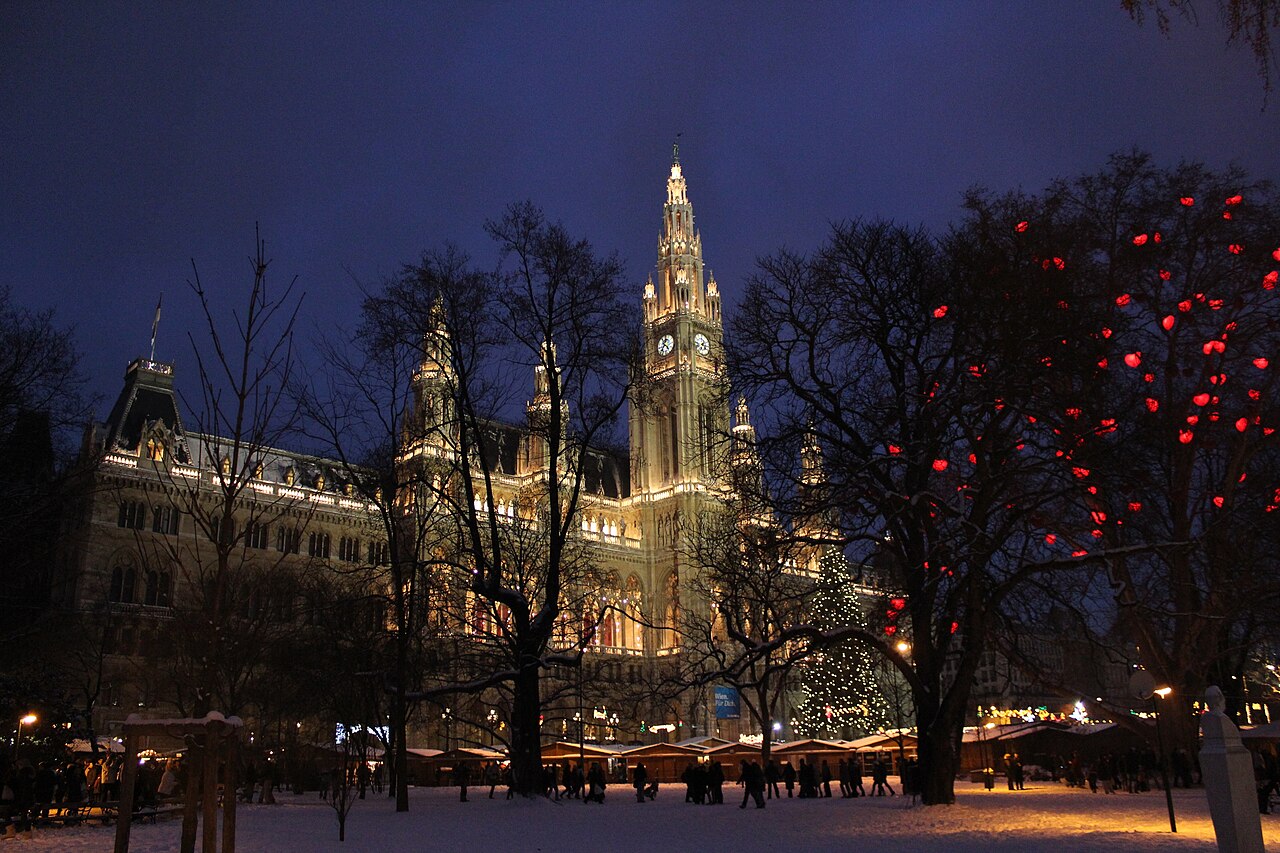
The Wiener Christkindlmarkt in front of the City Hall is the symbol of Advent in Vienna and one of the largest Christmas markets in Europe. At the entrance you walk under an arch of candles several metres high, behind it are dozens of stalls selling decorations, toys, crafts, sweets and punch, and above it all rises the illuminated neo-Gothic City Hall. All the trees in Rathauspark are lit up, and one of them, the Herzerlbaum hung with glowing red hearts, is a favourite photo spot for couples. For children there is a twelve-metre double-decker carousel, and in the park a Christmas world with a reindeer train, a nativity trail, a children’s hut and their own ice rink (according to wien.info).
Right next to the market you can skate through the park on the Eistraum rink, more on that in tip 1. Inside the City Hall there is choir singing on all four Advent weekends (tip 4). On weekend evenings the market fills with visitors from all over Europe, so for a relaxed stroll choose a weekday or a Friday shortly after dark. Take the U2 to Rathaus, trams 1, 71 and D, or the U3 to Volkstheater.
Schönbrunn Christmas market in the palace courtyard
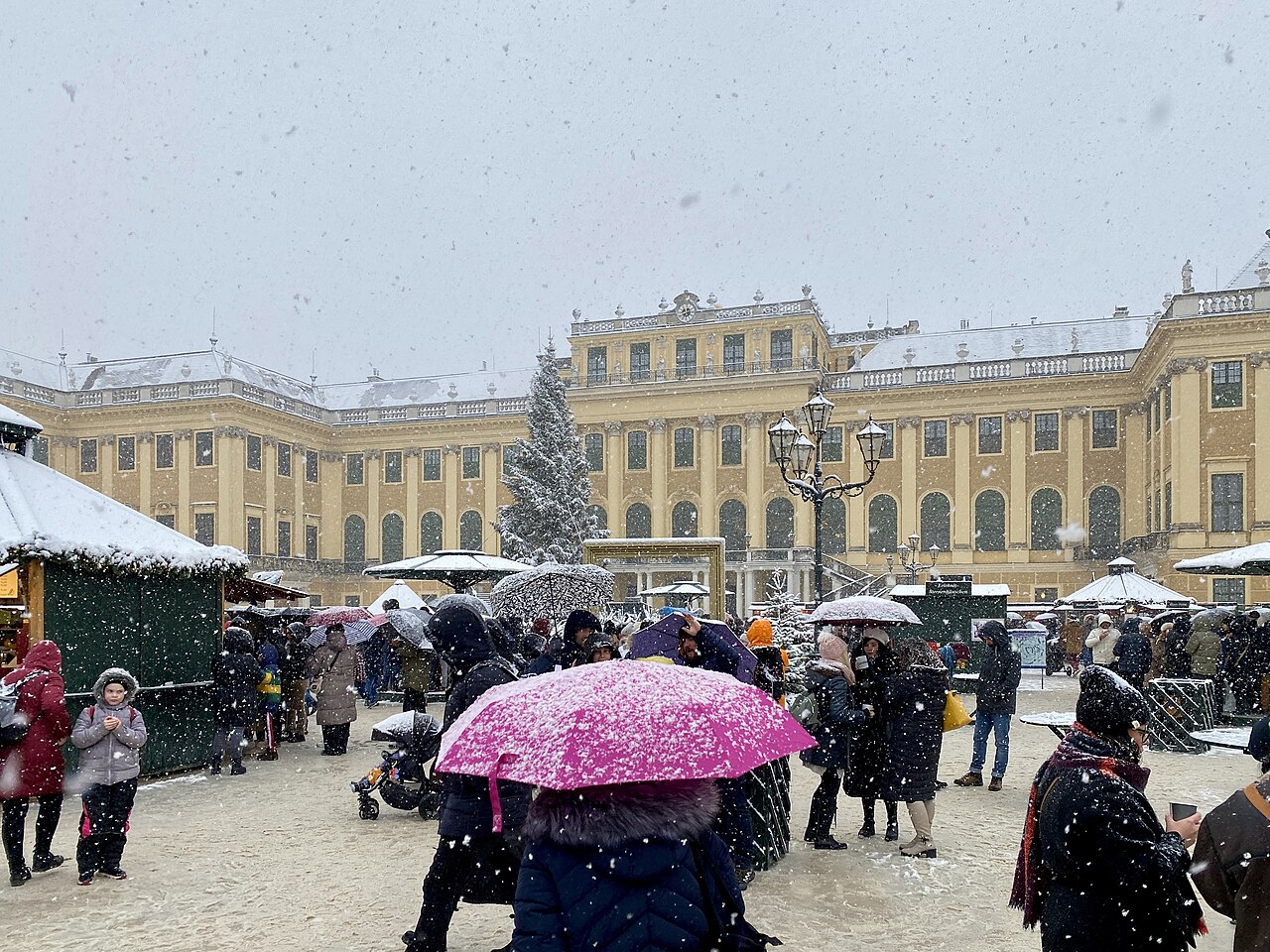
The market in front of the Habsburgs’ summer residence is the first to open and the last to close: from 6 November 2026 to 6 January 2027, after Christmas as a New Year market. The stalls stand right in the main courtyard (Ehrenhof) and sell traditional crafts, handmade decorations and regional food. There is an ice rink, lanes for Austrian curling (Eisstockschießen), and for children a carousel, a small Ferris wheel, a children’s railway and Christmas workshops. The atmosphere is a little calmer and more elegant than at the City Hall, and the courtyard is big enough that you are not squeezed. Entry to the market is free; the palace tour and the Imperial Lights trail in the palace gardens are paid separately (tip 5). Take the U4 to Schönbrunn.
Belvedere and the new market on Schwarzenbergplatz
From 20 November to 31 December 2026, a Christmas village with a Baroque backdrop, the K&K Weihnachtsmarkt, sets up in front of the Upper Belvedere. It is at its prettiest in the evening, when the lights of the stalls are reflected in the pond in front of the palace. The market is smaller, with a well-chosen mix of crafts and food, and according to the organiser there is lounge music, jazz and electro swing from 18:00. It is a good place to take a break from the biggest crowds in the centre. Just note that dogs are not allowed in the palace gardens.
New for 2026 is the Weihnachtszauber on Schwarzenbergplatz, between the Belvedere and the Ring. From 13 November to 26 December the market surrounds the Hochstrahlbrunnen fountain, which, together with the park in front of Palais Schwarzenberg, will be lit with light installations. There will be a stage programme for children and adults, and the organiser also promises an illuminated “ballroom” with live music. Nobody knows yet what it will look like in real life, but it is only a few minutes’ walk from the Belvedere, so you can easily combine the two.
Spittelberg Christmas market in romantic lanes
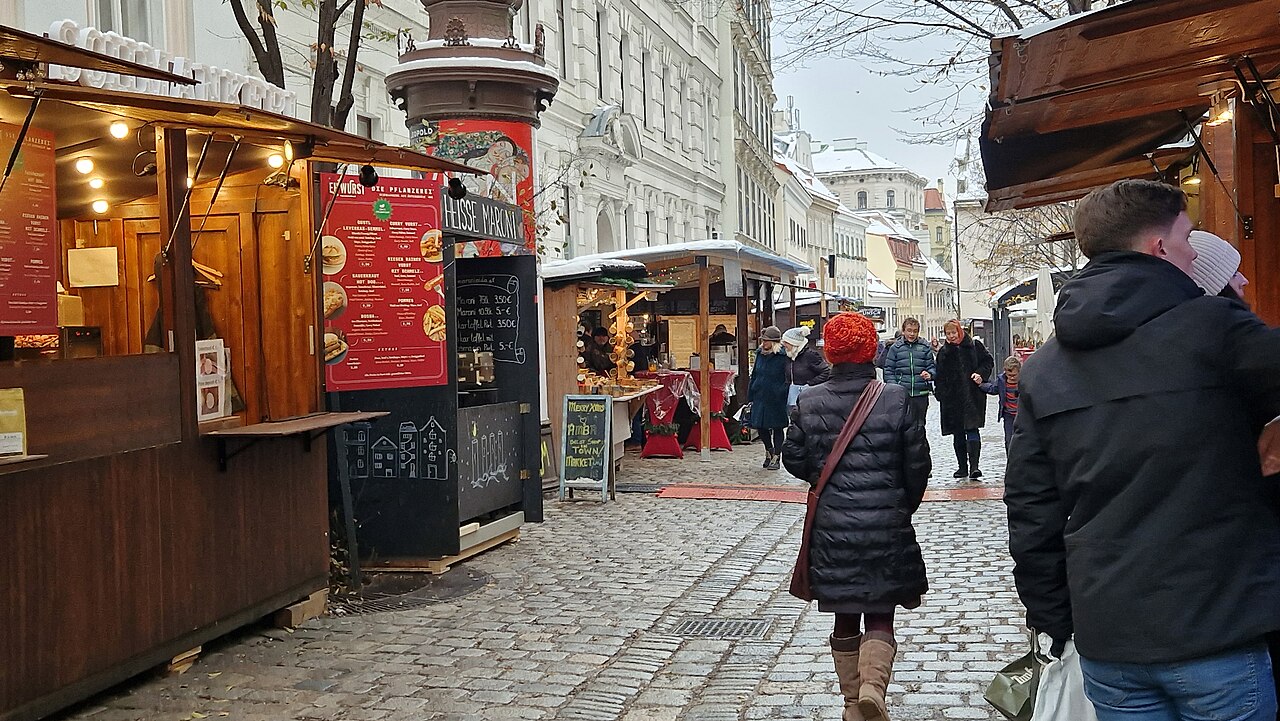
The Spittelberg quarter in the 7th district, just behind the MuseumsQuartier, is made for anyone who loves narrow cobbled lanes, Biedermeier houses and fairy lights overhead. The stalls are not on a square but spread along Spittelberggasse, Stiftgasse, Schrankgasse and Gutenberggasse, so you wander rather than queue. The market is run as an eco event with an emphasis on local, fair-trade and organic products, reusable crockery and plenty of vegetarian and vegan food. For us it is one of the best Christmas markets in Vienna, especially after dark. On weekdays it only opens at 14:00, at weekends at 11:00. Take the U2 to MuseumsQuartier or the U3 to Volkstheater.
Freyung, Am Hof and Stephansplatz: three markets in the historic centre
These three markets are close together and can be covered in one walk across the Graben. On Freyung square you will find the Old Viennese Christmas Market (Altwiener Christkindlmarkt); according to the Vienna Tourist Board, a Christmas market was first held here as early as 1772. It sells nativity scenes, glass decorations, ceramics and arts and crafts, and every day from 16:00 Advent music plays on the square. The organiser has already published the 2026 programme: the official opening on Saturday 14 November at 17:00, wood-turning and candle-making demonstrations, folk dancing, Advent brass bands, and on Saturday 28 November Advent wreath making and an Advent service with cathedral priest Toni Faber (more at altwiener-markt.at).
On neighbouring Am Hof the atmosphere is calmer than at the City Hall, yet you are still in the very heart of Vienna. Besides quality handmade gifts there is usually a music programme with choirs and live bands, and the food stalls stay open until 22:00. Ideal when you want a punch in relative peace. Stephansplatz, directly below St. Stephen’s Cathedral, has about 40 stalls with products from all over Austria and opens as early as 6 November. It is a smaller market right in the shopping zone, so it tends to be very crowded. Stop by, but have your mulled wine somewhere else.
Karlsplatz: Art Advent for art lovers
On Karlsplatz, in front of the Baroque St. Charles’ Church (Karlskirche), there is a Christmas market with an artistic and slightly alternative feel. It mainly sells art and design pieces, original jewellery, ceramics and glass, often directly from the makers. All the food and drink is certified organic, the programme includes installations, demonstration workshops and live bands, and there is usually a play area for children. It is open from 13 November to 23 December, daily 12:00 to 20:00, food and drink until 21:00. If you are looking for a gift you will not find at every other market, this is the place.
Maria-Theresien-Platz and the Christmas village on the university campus
The Christmas village on Maria-Theresien-Platz, between the Kunsthistorisches Museum and the Natural History Museum, returns this year after a one-year break with a new concept, for the twentieth time. It has around 70 stalls with arts and crafts and handmade decorations, and both museums run a children’s programme while the market is on. From the City Hall it is a pleasant walk along the Ring.
Since 1999 the grounds of the old general hospital (Altes AKH) in the 9th district, now the University of Vienna campus, have turned into the Weihnachtsdorf Uni Campus. It is mostly locals and students who come here, so there are fewer tourists. Children will enjoy the fairy-tale forest, the rides and, at weekends, a puppet theatre and Christmas workshop; adults get curling lanes and food stalls among the trees. This market stays open later than any other, until 23:00 on Fridays and Saturdays, and every Tuesday from 19:00 to 22:00 a DJ plays and students with ID get cheaper punch.
The Prater, Türkenschanzpark and Hirschstetten
From 20 November 2026 to 6 January 2027, the winter market by the Giant Ferris Wheel in the Prater runs under the motto “Der Prater rockt”, and according to the organiser it will host 37 live concerts, from gospel and soul to pop, usually Wednesday to Sunday between 19:00 and 20:30, with free entry. The season opens on 20 November at 19:00 with the lighting of the Ferris wheel and an opening concert; on Christmas Eve the music plays from 13:00 to 15:00, and on New Year’s Eve the programme starts at 18:00 (full programme on wintermarkt.at). Around Pratermuseumsplatz there is a winter village with stalls, some rides keep running in winter (the Winterzug train, the ghost train, the dodgems), and the Luftburg garden restaurant has a winter family zone with a free bouncy castle. On New Year’s Eve the market stays open until two in the morning. More in tip 7.
The large market in Türkenschanzpark in the 18th district is popular mainly with locals. Expect stalls with punch, chestnuts, lángos and raclette, glassblowers and other crafts, a carousel for children and a programme on Advent Sundays: a giant bubble show, gypsy jazz, hunting horns and, on Saturday 5 December from 15:00, St. Nicholas handing out sweets (according to the organiser). On weekdays it only opens at 15:00. In the Hirschstetten flower gardens in the 22nd district, a Christmas exhibition combined with a market selling regional treats and decorations runs from 12 November to 20 December, Thursday to Sunday.
What to eat at the Vienna Christmas market
At every turn there is Glühwein (mulled wine) and above all punch, which Vienna makes in dozens of versions: orange, apple, with rum, with amaretto, or the alcohol-free Kinderpunsch for children and drivers. To eat, there are roasted chestnuts (Maroni), fried and baked potatoes (Bratkartoffeln and Ofenkartoffeln), potato pancakes, sausages such as Bratwurst or Käsekrainer with cheese inside, and the sweet Kaiserschmarrn, shredded pancake with plum jam or apple compote. We recommend goulash in a bread bowl, which you will find at many markets, and we are hooked on the roasted almonds you can smell from a distance. For a snack, try gingerbread (Lebkuchen), waffles, strudel or a chocolate-coated apple. You will occasionally spot chimney cake (Trdelník), but Austrian treats take centre stage.
Hot drinks are served in ceramic mugs with a deposit (Pfand), usually €4 to €5. Return the mug and you get your money back, or keep it as a souvenir. Every market has its own design, and you should return the mug where you bought it. At the Stephansplatz, Maria-Theresien-Platz, Schwarzenbergplatz and university campus markets, the popular boot-shaped red mugs are made of glass for the first time this year.
The organisers do not publish prices for 2026, and they vary from market to market. As a rough guide, budget for the following (at around 0.85 pounds to the euro):
| What | Approximate price | In pounds |
| Mulled wine or punch (0.25 l) | €5–7 | £4.30–6 |
| Mug deposit | €4–5 | £3.40–4.30 |
| Hot chocolate, tea | around €5 | around £4.30 |
| Roasted chestnuts, roasted almonds | around €5 | around £4.30 |
| Sausage, roast potatoes | around €7–8 | £6–7 |
| Kaiserschmarrn | around €8 | around £7 |
| Small decorations and gifts | often under €15 | under £13 |
At the big markets the larger stalls usually take cards, but smaller vendors and smaller markets often want cash. It is always handy to have a few euros in change.
A short history of the Vienna Christmas markets
The ancestor of Vienna’s Christmas markets is often said to be the “Dezembermarkt”, a December market that Duke Albert I is believed to have granted to Viennese merchants as early as 1296. Back then it had nothing to do with romance and punch: people went there to stock up for the winter. Historians are cautious about a direct line to today’s Christkindlmarkt. What is certain is that the market gradually turned into a pre-Christmas one, and by the 18th century it was known as the “Nikolo- und Weihnachtsmarkt”, the St. Nicholas and Christmas market. The Old Viennese market on Freyung traces its tradition back to 1772.
For a long time the Viennese Christmas market had no permanent home and moved between Freyung, Am Hof and other squares. It only reached Rathausplatz in 1975, originally as a temporary solution while an underground car park was being built in front of the Messepalast (today’s MuseumsQuartier). As temporary solutions in Austria tend to do, it stayed for good, and in front of the City Hall grew a Christmas town that is now one of the most visited in Europe. The tradition also includes the tree that one of the federal states gives to Vienna every year. The younger markets have only appeared in recent decades: the village on the university campus in 1999, Maria-Theresien-Platz in 2008, Stephansplatz in 2013 and Schwarzenbergplatz in 2026.
Christmas traditions in Austria
An Austrian Christmas differs from a British one in more ways than you might expect:
- Presents are brought not by Santa Claus but by the Christkind, the Christ Child, on the evening of 24 December, which is when Austrians celebrate. Children are only allowed into the room with the tree once a little bell rings.
- On Christmas Eve the table usually has carp, Wiener schnitzel, duck or turkey; families bake Christmas biscuits (vanilla crescents, the jam-filled “Linzer Augen”), and a typical sweet is Kletzenbrot, a bread with dried pears.
- In early December the Krampus comes out, a horned devil with a wooden mask and bells, and in the regions there are noisy devil parades called Krampuslauf. They are far from fairy-tale devils. On 6 December, Nikolo then brings sweets to the good children.
- The world’s best-known carol, Silent Night (Stille Nacht, heilige Nacht), comes from Austria and was first sung on 24 December 1818 in Oberndorf near Salzburg.
Where to warm up after the markets
After an hour between the stalls comes the moment when you no longer want another punch in a mug, but a chair, warmth and a proper coffee. In Vienna that means only one thing: a coffee house. Here are a few places close to the markets:
- Café Landtmann (Universitätsring 4): a classic Viennese coffee house next to the Burgtheater, directly opposite the City Hall market and ice rink. Ideal for a Melange and strudel between skating and the stalls.
- Café Central (Herrengasse 14, Palais Ferstel): the famous café with vaulted ceilings, a few steps from Freyung. Expect a queue at the door; it moves faster in the morning.
- Demel (Kohlmarkt 14): the former imperial confectioner between the Graben and the Hofburg. In Advent, the shop windows full of sugar creations are an attraction in themselves.
- Café Sacher (at Hotel Sacher, behind the Opera): the original Sachertorte where it was invented. Queues are the rule, but it is worth doing once in your life.
- Café Sperl (Gumpendorfer Straße 11): an old Viennese coffee house with billiard tables and no tourist bustle, a few minutes’ walk from both Spittelberg and Karlsplatz.
- Glacis Beisl (Breite Gasse 4): a Viennese tavern in the MuseumsQuartier right by Spittelberg, for when you want a hot meal and a glass of wine sitting down after the market.
- Figlmüller (Bäckerstraße 6, a few minutes from St. Stephen’s): famous Wiener schnitzels bigger than the plate. During Advent it is best to book a table.
What to watch out for
- Pickpockets. At the big, crowded markets, especially Rathausplatz and Stephansplatz, pickpockets are about. Keep your wallet and phone in an inside pocket or in a closed bag in front of you.
- Weekends and 8 December. Friday evening to Sunday is extremely busy, and 8 December is a public holiday in Austria. If you can, plan Vienna from Sunday to Thursday. You will enjoy the markets more, be less crowded, and accommodation is usually cheaper.
- Mug deposits. Return your mug at the same market, ideally at the same stall where you bought it. Another market will not refund the deposit.
- Cash. Large stalls accept cards, small ones often only cash. Keep a few euros on you.
- Parking. Short-term parking is charged throughout Vienna, and fines are also sent to foreign-registered cars. Leave the car at a P+R or in a hotel garage (how to get there and where to park).
- Holidays. On Christmas Eve the markets close in the afternoon, and most smaller markets in the centre already finish on 23 December. Between Christmas and New Year you still have Schönbrunn, the Belvedere and the Prater.
- The cold. You spend a long time standing outside at the markets, so wear warm layers, proper shoes, a hat, a scarf and gloves.
12 things to do in Vienna in winter
You could come to the Vienna Christmas markets just for the punch, but it would be a shame to miss everything else going on in Advent and winter. Here are twelve things we would combine with the markets. Prices and opening hours come from the operators’ websites, are approximate and correct as of mid-October 2026.
1. Ice skating at Eistraum in front of the City Hall
The rink in Rathauspark is not just an oval of ice: you skate along icy paths between illuminated trees, with the City Hall on one side and the Burgtheater on the other. During Advent, Eistraum am Christkindlmarkt runs from 13 November 2026 to 6 January 2027, daily 10:00 to 22:00, on Christmas Eve until 18:30, and is closed on New Year’s Eve (according to christkindlmarkt.at). From 22 January to 7 March 2027, the big Wiener Eistraum then takes over Rathausplatz with more than 10,000 m² of ice. You can hire skates on site; admission prices for the 2026 season have not been published yet, and we will add them. It is quietest on weekday mornings and late in the evening.
2. Christmas lights on the Graben and Kärntner Straße
The prettiest Christmas decorations in Vienna are not at the markets but in the streets. Giant chandeliers of light hang above the Graben, and Kärntner Straße, Kohlmarkt and Rotenturmstraße have more garlands and ornaments. It is free and looks best after dark, when the shops are still open and the street is full of people carrying bags of presents. Walk through on your way between Stephansplatz and Am Hof; from St. Stephen’s Square via the Graben and Kohlmarkt it takes ten minutes.
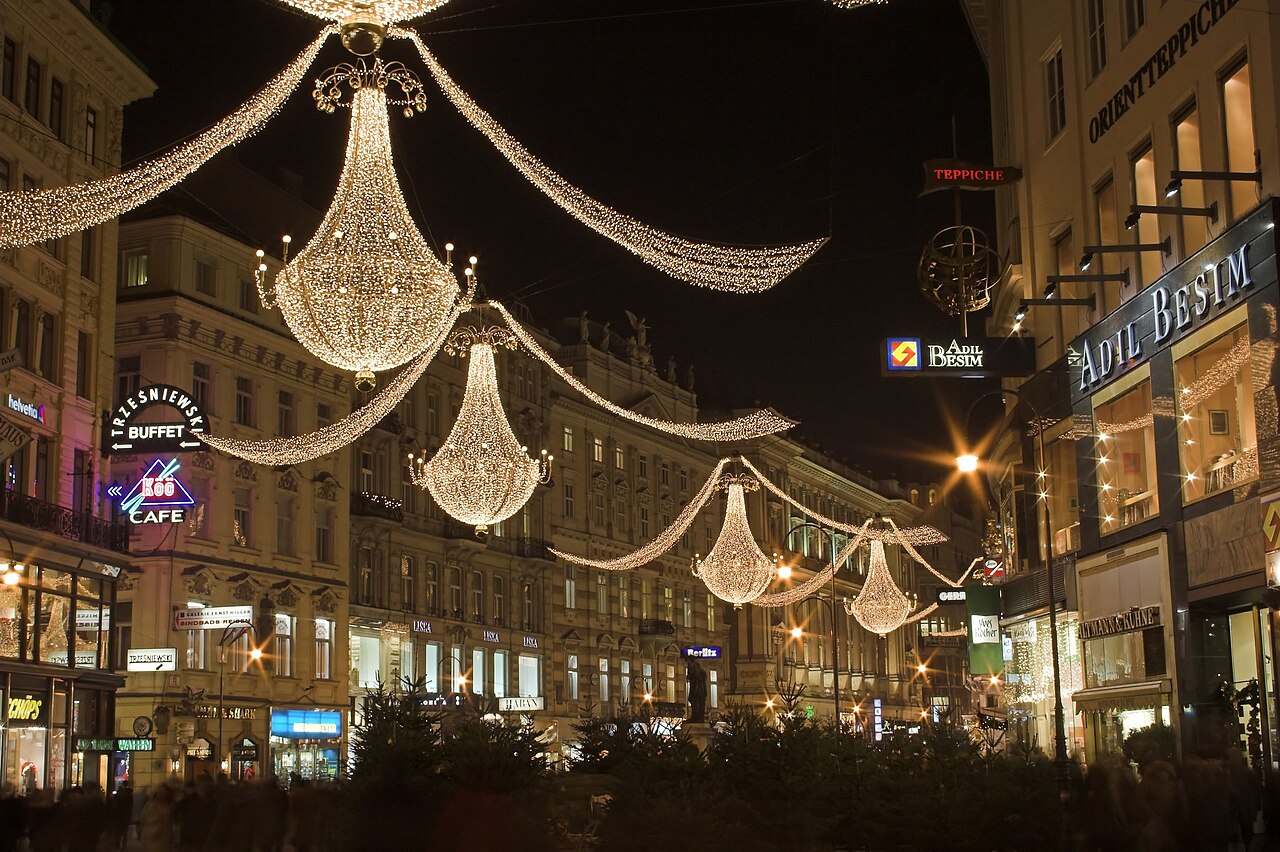
3. St. Stephen’s Cathedral: the tower and catacombs
Stephansdom is open Monday to Saturday from 6:00 to 22:00, on Sundays and public holidays from 7:00, and you can look into the rear of the nave for free. Tourist visits are possible Monday to Saturday from 9:00 to 11:30 and 13:00 to 16:30, on Sundays only in the afternoon, and may change because of services (according to stephanskirche.at). You climb 343 steps up the south tower, a lift goes up the north tower with the giant Pummerin bell, and below the cathedral you can visit the catacombs with a guide. The towers and catacombs are paid separately; current prices are on the cathedral’s website. From the south tower you can see the roof of coloured tiles familiar from postcards, and the whole illuminated centre below.
4. Advent singing in the City Hall and concerts
The ceremonial hall of the Vienna City Hall hosts the 44th Internationales Adventsingen: more than 85 choirs from Austria and abroad sing here on all four Advent weekends, always Friday to Sunday between 15:30 and 19:00. The organiser will publish the 2026 programme in November on christkindlmarkt.at; we will add it here once it is out. It is a great way to warm up between the stalls.
Vienna is the capital of classical music, so there are plenty of concerts in Advent. Vivaldi’s Four Seasons is played regularly in St. Charles’ Church on Karlsplatz, St. Stephen’s hosts Advent choir concerts, the Kursalon has waltzes and operetta, and world-class orchestras play at the Musikverein and the Konzerthaus. For the latter, get tickets weeks in advance. The Vienna Boys’ Choir (Wiener Sängerknaben) sings at Sunday Mass in the Hofburgkapelle.
5. Schönbrunn Palace and the Imperial Lights trail
Since you are already at the market in front of the palace, do not skip the interiors. The palace is open daily from 8:30 to 17:30; the tour of the whole piano nobile with an audio guide (Palace Ticket) takes about 75 minutes and costs €42 (about £36), the shorter State Apartments tour about 40 minutes for €30 (according to schoenbrunn.at). Buy tickets only on the official website; the palace itself warns about fraudulent resellers.
After dark the palace gardens turn into the Imperial Lights light garden: a roughly one-hour trail with Baroque light installations, from 6 November 2026 to 6 January 2027, daily from 16:30 to 22:00, last entry at 20:30. Tickets cost from €24 for adults and from €13 for children aged 6 to 14; the entrance is via the Meidlinger Tor. This year Schönbrunn celebrates 30 years on the UNESCO World Heritage List.
6. Klimt’s The Kiss at the Belvedere
The Upper Belvedere is home to Vienna’s most famous painting, Klimt’s The Kiss, surrounded by the world’s largest Klimt collection, plus Schiele and Kokoschka. Combine it with the Christmas market right in front of the palace: the gallery in the afternoon, mulled wine with a view of the illuminated façade after dark. Timed-entry tickets are sold online at belvedere.at, where you will also find current prices and exhibitions. If you are staying near the main station, it is a ten-minute walk.
7. The Giant Ferris Wheel and the Prater in winter
The Vienna Giant Ferris Wheel (Wiener Riesenrad) has been turning since 1897, and according to its operator it is the oldest Ferris wheel in the world. From a cabin almost 65 metres up you can see the whole city; it is most beautiful at dusk, when Vienna lights up. Below the wheel is the winter market with concerts (see the programme above), and around it the Wurstelprater amusement park, which celebrates its 260th anniversary in 2026. Current prices and winter opening hours for the wheel are on wienerriesenrad.com. Take the U1 or U2 to Praterstern.
8. The Hofburg and the Sisi Museum
The former winter residence of the Habsburgs is a few minutes from the Am Hof and Freyung markets. In the Imperial Apartments and the Sisi Museum you will see how Empress Elisabeth lived, the empress many people know from the 1950s films starring Romy Schneider. If you also want to see Schönbrunn, save money with the Sisi Ticket: one ticket for Schönbrunn, the Sisi Museum with the Imperial Apartments in the Hofburg and the Imperial Furniture Collection costs €60 for adults and €38 for children (according to schoenbrunn.at). Ideal for a rainy afternoon.
9. Schönbrunn Zoo
Tiergarten Schönbrunn in the palace park is the oldest zoo in the world, founded in 1752, and it stays open in winter. With children it makes a good morning before the market in the courtyard; many animals have indoor houses, so it works even in the cold. The zoo is included in the Classic Pass Plus (€81 for adults, €58 for children, valid for the palace, zoo, gardens and glasshouses), and for families there is a combined ticket for the children’s museum, the maze and the zoo for €39. Standalone admission prices are on zoovienna.at.
10. Therme Wien thermal baths
After two days on your feet in the cold, nothing warms you up like thermal water. Therme Wien in Oberlaa in the south of the city is one of the largest urban thermal spa complexes in Europe, and you get there on the U1 to the terminus at Oberlaa. It is open daily from 9:00 to 22:00, except on 24 and 31 December. A day ticket costs from €34, with sauna and a locker cabin €59 (according to thermewien.at). The perfect Sunday afternoon before your flight home.
11. New Year’s Eve in Vienna
On New Year’s Eve the historic centre becomes one big party, the Silvesterpfad (New Year’s Eve trail). On the squares from Rathausplatz via Freyung, Am Hof, the Graben and Stephansplatz to Neuer Markt there are stages with music and stalls; the celebrations traditionally run from the afternoon until two in the morning, and at midnight everyone waltzes to The Blue Danube. The city has not yet published the programme for New Year’s Eve 2026; we will add it here once it is out. The Prater winter market also stays open into the early hours. The Vienna Philharmonic’s New Year’s Concert in the Musikverein is more of a TV experience: tickets are allocated by lottery a year in advance.
12. A day trip to Bratislava
Bratislava is about an hour from Vienna by train, so on a longer stay you can add a half-day trip to another set of Christmas markets. The Bratislava markets on Hlavné námestie and Františkánske námestie are smaller, cheaper and serve Slovak specialities such as lokše potato pancakes, cigánska pečienka and mead. You will find dates and tips in our guide to the Bratislava Christmas markets. Bratislava also has its own airport (BTS), so you can fly into one city and out of the other.
What we would do differently
If we were planning Advent in Vienna again, we would not chase ten markets in one weekend. Vienna makes it tempting, there are markets on every corner and each one is slightly different, but after the third mug of punch and the fifth stall of decorations they start to blur together. Our best moments have always been away from the main flow: in a side lane at Spittelberg, where the music no longer reaches and all you hear is the clinking of mugs, or at Am Hof on a Thursday afternoon, when there are more Viennese than tourists.
We would try more things. Instead of another Kaiserschmarrn at a stall, we would walk into a coffee house nobody has written about, order Tafelspitz or goulash soup in an ordinary Beisl, and taste a punch whose name we cannot pronounce. Half of our best Vienna experiences were not on any list.
And we would leave the phone in our pocket. The heart tree in Rathauspark has already been photographed by a few million people; your picture will not change the world. It is far more worthwhile to sit in a coffee house for an hour, order a Melange, read the paper on its wooden holder and watch the snow fall outside. The Viennese have always known how to do this, and Advent is the best time to learn it from them.
Vienna Christmas market FAQ
When do the Vienna Christmas markets 2026 start?
The first markets on Stephansplatz and at Schönbrunn Palace open on 6 November 2026. The main Christkindlmarkt on Rathausplatz and most other markets (Spittelberg, Am Hof, Karlsplatz, the university campus, Schwarzenbergplatz) open on Friday 13 November, Freyung on 14 November, and the Belvedere, Maria-Theresien-Platz and the Prater winter market on 20 November 2026.
When do the Christmas markets in Vienna end?
Most markets in the centre (Freyung, Am Hof, Spittelberg, Karlsplatz) close on 23 December. Rathausplatz, Stephansplatz, Maria-Theresien-Platz and Schwarzenbergplatz are open until 26 December, the Belvedere until 31 December, and Schönbrunn, the Prater winter market and the City Hall ice rink until 6 January 2027.
What are the Vienna Christmas market opening hours?
The Christkindlmarkt on Rathausplatz is open daily from 10:00 to 22:00, on Christmas Eve until 18:30. Schönbrunn is open daily 10:00 to 21:00, Stephansplatz 11:00 to 21:00, Freyung 10:00 to 21:00, and Spittelberg from 14:00 on weekdays and from 11:00 at weekends, until 21:30. On Christmas Eve the markets close in the afternoon.
What is the best Christmas market in Vienna?
The biggest and best known is the Christkindlmarkt in front of the City Hall, with its tree, the hearts in the park and the ice rink. The markets at Schönbrunn and the Belvedere have the most beautiful palace backdrops, and in our view the most romantic is Spittelberg, with stalls in narrow lanes. For original gifts, Art Advent on Karlsplatz is the best.
How much is punch at the Vienna Christmas markets?
The organisers do not publish 2026 prices. As a rough guide, expect to pay €5 to €7 (about £4.30 to £6) for punch or mulled wine, plus a mug deposit of €4 to €5, which you get back when you return the mug. Roasted chestnuts or almonds cost around €5, a sausage or potatoes around €7 to €8.
How do I get from Vienna Airport to the Christmas markets?
Direct ÖBB trains run from Vienna Airport (VIE) to Wien Hauptbahnhof, where the U1 takes you straight to Stephansplatz; for the City Hall, change to the U2 or a tram. Because of a main line closure, the City Airport Train has been running as a premium bus to the city centre since 7 September 2026. Check the current situation on the airport website before you fly.
Where can I park for the Vienna Christmas markets?
Do not drive into the centre, short-term parking is charged throughout Vienna. The cheapest option is a P+R car park at the end of a U-Bahn line, for example Leopoldau on the U1 if you arrive from the north or Hütteldorf on the U4 if you arrive from the west, and continue by U-Bahn. On Austrian motorways you need a vignette; the ten-day one costs €12.80.
Is the City Hall ice rink open after Christmas?
Yes. The Eistraum rink in Rathauspark is open from 13 November 2026 to 6 January 2027, daily 10:00 to 22:00, on Christmas Eve until 18:30, and closed on New Year’s Eve. From 22 January to 7 March 2027 you can skate on the big Wiener Eistraum on Rathausplatz.
Where next
Vienna is wonderful in Advent, but it is not the only option. If you want to explore further, we have more ideas:
- Bratislava Christmas markets, Linz Christmas market and Salzburg Christmas market, if one Austrian city is not enough
- Brno Christmas markets, Olomouc Christmas markets and Uherské Hradiště Christmas markets, a short train ride north into the Czech Republic
- Prague Christmas markets and our overview of the best Christmas markets in the Czech Republic
- Dresden Christmas markets, Nuremberg and our full guide to Christmas markets in Germany
- Kraków Christmas market, Wrocław and the best Christmas markets in Poland
- Ideas for a long weekend away, when one trip to the Christmas markets is not enough
Potřebujete pomoct s cestováním?
-
Ubytování 🏨
Vyberte si to nejlepší ubytování, ať už jste kdekoliv, přes Booking.com. -
Půjčení auta 🚗
Auto si snadno najdete přes Booking.com, kde máte často slevu díky ubytování, nebo Rentalcars.com, kde porovnáte nabídky většiny půjčoven. -
Zážitky 🎟️
Přes GetYourGuide.com si vyberete z nejrůznějších výletů i zážitků po celém světě, navíc se zrušením zdarma do 24 h předem.