Last updated 22.10.2026
For us, the Christmas markets in Germany are still the benchmark every other Advent market gets measured against. Dresden’s Striezelmarkt first appears in the records in 1434, Nuremberg’s Christkindlesmarkt is probably the most photographed Christmas market in the world, and up in the Ore Mountains (Erzgebirge) Advent is celebrated with miners’ parades you will not see anywhere else in Europe. The good news if you are flying in: many of the best Christmas markets in Germany sit in Saxony and Bavaria, close together and close to the Czech border, so Dresden, Pirna and Seiffen are all within about two hours of Prague Airport, and Nuremberg, Regensburg and Munich are linked by fast trains. We picked the 15 best Christmas markets in Germany with a focus on the east and south of the country, where you can see several markets on one trip. For each one you will find the 2026 dates (where they have been announced), what makes it special, how to get there from the nearest airport and where to stay. And because almost every market is worth at least one night, we start with hotels and weekend plans.
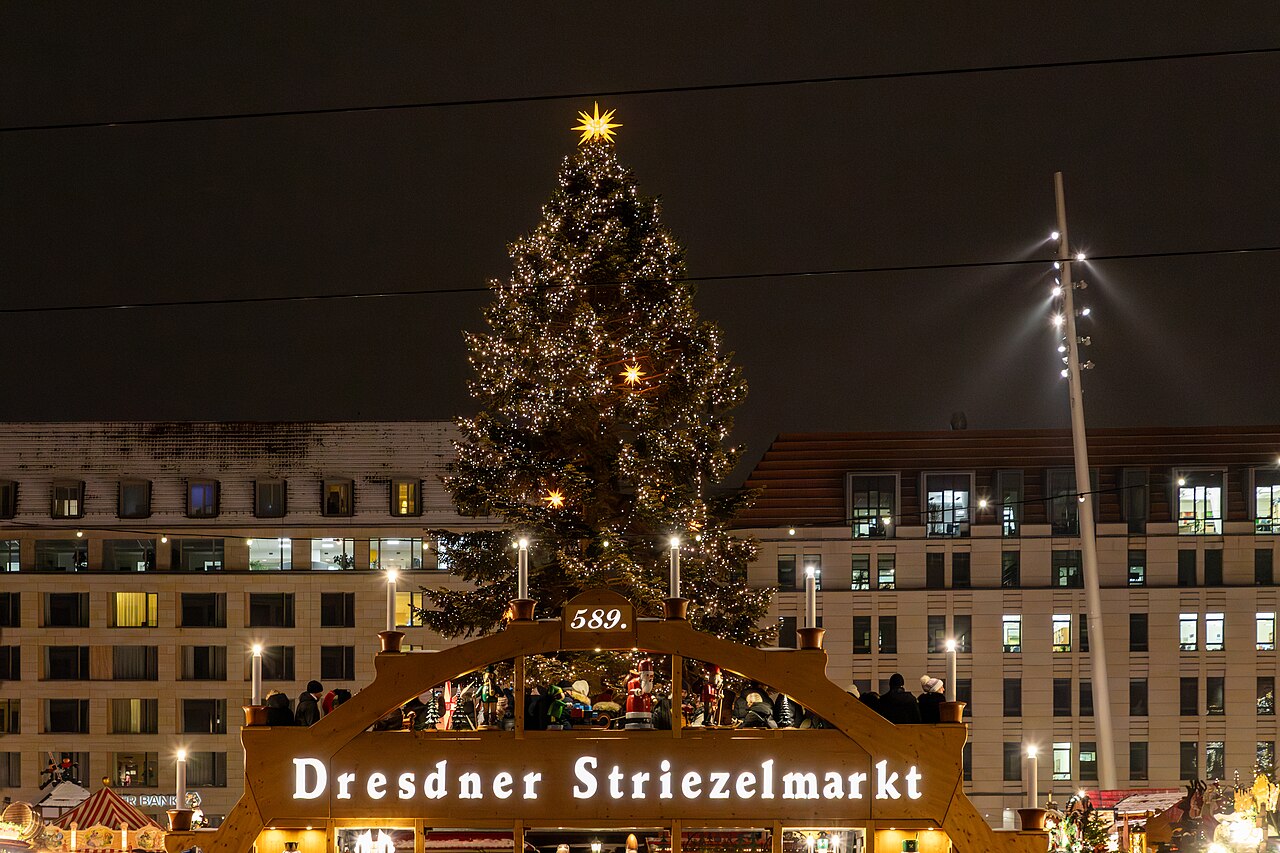
Christmas markets in Germany at a glance
- When: Cologne opens first (16 November). Munich, Regensburg, Rothenburg and Aachen open on 20 November and most of the others in the week before the first Sunday of Advent, which falls on 29 November in 2026 (Leipzig, Pirna and Freiberg 24 November, Dresden 25 November, Nuremberg 27 November). Most close between 22 and 24 December, while Pirna and some markets in the big cities carry on between Christmas and New Year.
- The most famous: Dresden, Nuremberg, Regensburg, Leipzig, Munich and Cologne. The full list of 15 markets is further down.
- Closest to each other: Dresden, Pirna, Meissen, Seiffen, Annaberg-Buchholz, Freiberg, Bautzen and Görlitz all lie in Saxony, within roughly two hours of Dresden Airport. In Bavaria, Nuremberg, Regensburg, Rothenburg, Munich and Passau form a second cluster.
- Entry: free almost everywhere. The exceptions are the Thurn und Taxis castle market in Regensburg and some medieval markets at weekends.
- Currency: euro (€1 is roughly £0.85). Carry cash for the mug deposit and small stalls.
- Where to stay: the best bases are Dresden, Nuremberg, Leipzig and Regensburg, plus the Ore Mountains if you want the miners’ Christmas. Our hotel tips follow right below.
- Day trips: from Dresden to Pirna, Meissen, Bautzen, Freiberg or Seiffen, from Nuremberg to Rothenburg or Regensburg, from Munich to Regensburg or Passau. From Prague, Dresden and Pirna work as a day trip too. For Nuremberg, Leipzig, Munich and Cologne we recommend at least one night.
Where to stay for the Christmas markets in Germany
German Christmas markets light up at around 4.30pm and most close at 8pm or 9pm. If you try to squeeze a market into a day between flights or long train rides, you end up spending more time in transit than among the stalls, and by the time it gets dark, which is when the markets look their best, you are already rushing back. That is why we recommend turning the markets into a long weekend and staying the night. You can walk back to your hotel after the last mulled wine, nobody has to drive, and above all you can pick the quiet times: on a Saturday afternoon the crowds on the Altmarkt or the Hauptmarkt move at a shuffle, while Friday evening and Sunday morning are much calmer.
We would choose one of four cities or one mountain area as a base. Dresden has an airport, the most markets, and easy trips to Pirna, Meissen and Bautzen; stay in the old town around the Altmarkt. Nuremberg is ideal for Franconia and the Upper Palatinate (Regensburg, Bamberg, Rothenburg); book inside the old town walls or near the main station. Leipzig has one of the biggest and oldest markets in the country and suits anyone travelling by train. Regensburg is the best choice for romantics who want a castle market, and it is just over an hour from Munich Airport. And the Ore Mountains (Seiffen, Annaberg, Freiberg) are for those who want the miners’ parades and a village Advent. We checked these hotels on Booking.com (October 2026):
- Hotel Taschenbergpalais Kempinski, Dresden: a five-star hotel in a baroque palace right next to the Royal Palace (Residenzschloss). The Frauenkirche is five minutes on foot and the Striezelmarkt a little further. For couples who want Advent as a present. Bonus: since its 2024 renovation it has a new pool and sauna.
- ibis budget Dresden City, Dresden: the cheapest sensible option in the centre. The hotel is inside the Altmarkt-Galerie shopping centre, so the Striezelmarkt is literally on your doorstep. For travellers who only need a bed. Bonus: the main station is a 12-minute walk away and the tram stops 50 metres from the entrance.
- Hotel VICTORIA Nürnberg, Nuremberg: a four-star hotel by the Handwerkerhof craft courtyard, a hundred metres from the main station and five hundred metres from St Lorenz church, from where Königstraße leads you to the Hauptmarkt. For travellers arriving by train, by coach or on the underground from the airport. Bonus: a café with homemade cakes and a winter garden.
- Steigenberger Icon Grandhotel Handelshof, Leipzig: a luxury hotel on the little Naschmarkt square just behind the Old Town Hall, exactly where the historic craft market stands. For those who want the market below their window. Bonus: a large spa with saunas on two floors and soundproofed rooms.
- Hotel Orphée Andreasstadel, Regensburg: a stylish hotel on the island between the Danube and the Regen in the Stadtamhof district, which also has the Advent market in the Spitalgarten. Across the Stone Bridge it is 600 metres to the cathedral. For couples who want peace and a view of the old town. Note that the restaurant belongs to the sister hotel, a ten-minute walk away.
- Panorama Berghotel Wettiner Höhe, Seiffen: a mountain hotel above the village with views over the Ore Mountains, and you can walk down to the centre of Seiffen. For families and for anyone who wants to combine markets with a bit of wellness. Bonus: the sauna and steam room are free for guests, plus a heated pool and buffet dinners.
💡 Book early, ideally with free cancellation. In Dresden, Nuremberg and above all in tiny Seiffen, the Advent Fridays and Saturdays fill up first, and on the weekends of the big miners’ parades there are very few free rooms left in the Ore Mountains. You will find more hotels with current prices in our accommodation search for Dresden, Nuremberg, Leipzig and Regensburg. Each market in the list below also comes with one hotel tip right in that town. If you are driving a hire car, ask about parking in advance: the historic centres are pedestrian zones and the hotel garage is usually charged separately.
Christmas markets in Germany as a long weekend: three itineraries
To be honest, some German markets work as a day trip once you are in the country. From Dresden you are in Pirna in about 20 minutes by S-Bahn and in Meissen in about 40, from Prague you reach Dresden or Seiffen in under two hours, and from Munich Airport it is just over an hour by car to Regensburg. But a day trip means only a few hours at the market and a journey back in the dark, often on icy roads over the hills. Combining Nuremberg, Leipzig, Munich or Cologne with anything else in one day is hard work. This is how we would plan three different weekends:
Saxon Elbe Valley: Dresden, Meissen and Pirna (Fri–Sun)
- Friday: fly into Dresden (the S2 S-Bahn runs from the airport to the main station), or come from Prague: just under two hours by car or roughly two and a quarter hours on the EuroCity train. Check in in Dresden and take your first evening stroll around the Striezelmarkt and the market by the Frauenkirche before the Saturday crowds arrive.
- Saturday: in the morning take the S1 suburban train to Meissen, where the town hall becomes a giant Advent calendar, and add the porcelain manufactory or Albrechtsburg Castle. Back in Dresden for the afternoon. If you come on the weekend of 4–6 December, on Saturday 5 December you will see the Stollenfest, a parade with a giant Stollen through the old town.
- Sunday: a stop in Pirna, where the Canalettomarkt is open 11am–8pm on Sundays. After dark a light show is projected onto the town hall. From Pirna it is about 20 minutes back to Dresden by S-Bahn and the same train line continues to Prague, so it works whichever airport you fly home from.
Miners’ Christmas in the Ore Mountains (18–20 December 2026)
- Friday: pick up a hire car at Dresden or Prague Airport (both are around 100 km from Seiffen, roughly an hour and a half to two hours), check in and take an evening walk through the illuminated toy village.
- Saturday: in the morning the Toy Museum and the workshops where the figures are turned on the lathe, in the afternoon the market on Hauptstraße. On the evening of 19 December a lantern procession with Father Christmas (Weihnachtsmann) winds through Seiffen.
- Sunday: drive over to Annaberg-Buchholz for the grand miners’ parade (Große Bergparade), which crosses the market square at 1.30pm on 20 December 2026 with more than a thousand people in miners’ uniforms. Annaberg is about two hours by car from both Dresden and Prague airports, so you can still catch an evening flight. If you would rather see a torchlight parade, choose the weekend of 4–6 December and head to Freiberg on Saturday 5 December at 5pm.
Regensburg and Nuremberg (Fri–Sun)
- Friday: fly into Munich and continue to Regensburg, just over an hour by car. In the evening, the Thurn und Taxis castle market with its fires and lanterns, open until 10pm on Fridays.
- Saturday: in the morning the Stone Bridge and the Christkindlmarkt on Neupfarrplatz, then about an hour by train or car to Nuremberg. In the afternoon the Hauptmarkt, the Sister Cities Market and, with children, the Kinderweihnacht, and in the evening Feuerzangenbowle.
- Sunday: in the morning the Kaiserburg castle and a quiet Hauptmarkt before the crowds arrive. Nuremberg Airport is only about 15 minutes from the centre by underground, so you can fly home from there. If you have time to spare, add the medieval town of Rothenburg, about an hour and twenty minutes by car from Nuremberg Airport, but plan for a late flight or one more night.
Why visit the Christmas markets in Germany
First, for the tradition. Christmas markets are a German invention, and the oldest of them, Bautzen, Dresden and Leipzig, appear in the chronicles from the 14th and 15th centuries. Plenty of what you now find at Christmas markets from Prague to Birmingham started here: mulled wine in a deposit mug, gingerbread, Christmas pyramids and even the Advent wreath. Second, for the variety. Nuremberg is about gingerbread and the Christkind, Regensburg about a castle lit by open fires, the Ore Mountains about miners and wooden toys, Görlitz about a Silesian Christmas on the Polish border, and Cologne about what it looks like when one city runs several big markets at once.
And third, for how easy it is to combine them. The Saxon markets are close enough to each other that you can see three or four in a long weekend, many of them by regional train without changing, and the Bavarian ones are linked by fast ICE trains. If you go to Christmas markets every year, Germany will keep you busy for a decade, and you still will not have seen Bamberg, Erfurt or Aachen.
How to get to the Christmas markets in Germany
By plane and train. For the Saxon markets fly into Dresden (DRS), where the S2 S-Bahn takes you to the main station, or Leipzig/Halle (LEJ). Prague (PRG) is a good alternative with more flights: EuroCity trains run from Prague via Ústí nad Labem and Děčín to Dresden in roughly two and a quarter hours, and some continue to Berlin. Pirna is on the same line, about 20 minutes from Dresden on the S-Bahn, and the S1 goes to Meissen. For Bavaria fly into Nuremberg (NUE), where the U2 underground reaches the main station in about a quarter of an hour, or Munich (MUC), which is connected to the city centre by S-Bahn. Direct trains also run between Prague and Munich via Plzeň, Furth im Wald and Regensburg, taking about five and a half hours. Look up connections on bahn.com or in the DB Navigator app; the new timetable starts on 13 December 2026.
By coach. FlixBus links Dresden, Leipzig, Nuremberg and Munich with each other and with Prague, Berlin and many other cities, and booked in advance it is usually the cheapest option. You will not get comfortably to the Ore Mountains or to smaller towns such as Seiffen or Annaberg by public transport, though; that is where a car pays off.
By car. German motorways are free for cars. If you pick up a hire car in Prague, you need the Czech electronic motorway vignette for the Czech section (hire companies usually include it, but ask). Some large cities have a low-emission zone (Umweltzone) that you may only enter with a green sticker (Umweltplakette) on the windscreen, for example Munich, Cologne and Berlin. Dresden and Nuremberg have no zone, Regensburg does. Cars hired in Germany normally have the sticker already; for your own car, order it well in advance, it is not sold at the border. In the Ore Mountains expect snow, and remember that winter tyres are compulsory in Germany in wintry conditions. In the cities park in garages or at P+R car parks and take the tram into the centre, as the historic cores are packed in Advent.
Money and paying
Germany uses the euro; €1 is roughly £0.85. At the big markets more and more stalls take cards, but small craftspeople and the markets in the Ore Mountains are often cash only, and the mug deposit (Pfand) is usually paid in cash. Keep at least €50 (around £43) in small notes and coins. If you pay by card with a non-euro account, always choose to be charged in euros, not in your home currency, because the merchant’s conversion rate is usually worse than your bank’s.
German Christmas markets 2026: dates
German markets do not all open at once. Cologne starts as early as 16 November, Munich, Regensburg, Rothenburg and Aachen four days later, and most of the Saxon markets in the week before the first Sunday of Advent. Watch out for Sunday 22 November 2026: it is Totensonntag, the Protestant day of remembrance for the dead, and many markets in Bavaria and the Rhineland are closed that day. Here is what the organisers had published by 14 October 2026:
| Market | Location | Dates 2026 |
|---|---|---|
| Cologne | Roncalliplatz by the cathedral | 16 Nov – 23 Dec |
| Munich | Marienplatz | 20 Nov – 24 Dec |
| Regensburg (Thurn und Taxis Castle) | St Emmeram Castle | 20 Nov – 23 Dec |
| Rothenburg ob der Tauber | Marktplatz | 20 Nov – 23 Dec |
| Regensburg (Christkindlmarkt) | Neupfarrplatz | 23 Nov – 23 Dec |
| Meissen | Markt | 23 Nov – 24 Dec |
| Pirna | Marktplatz | 24 Nov – 23 Dec and 27–30 Dec |
| Leipzig | Markt, Augustusplatz and surrounding streets | 24 Nov – 23 Dec |
| Freiberg | Obermarkt | 24 Nov – 22 Dec |
| Passau | Domplatz | 24 Nov – 22 Dec |
| Dresden (Striezelmarkt) | Altmarkt | 25 Nov – 24 Dec |
| Nuremberg | Hauptmarkt | 27 Nov – 24 Dec |
| Seiffen | Hauptstraße by the church | 27 Nov – 20 Dec |
| Bautzen (Wenzelsmarkt) | Hauptmarkt, Kornmarkt | 27 Nov – 22 Dec |
| Annaberg-Buchholz | Markt | 27 Nov – 23 Dec |
| Görlitz | Untermarkt | 4 Dec – 20 Dec |
What time do German Christmas markets open?
The big city markets are open roughly from 10am or 11am until 8–9pm, on Fridays and Saturdays often until 10pm. The small markets in the Ore Mountains close earlier: Seiffen at 5pm on weekdays, Annaberg at 7pm. On Christmas Eve only the markets that run until 24 December are open, and only in the morning (Dresden, Nuremberg and Munich until 2pm). The Regensburg castle market opens only at 3pm on weekdays, and Görlitz at 2pm from Monday to Friday. You will find the exact hours for each market below; where the organisers have not published them yet, we will add them.
Opening ceremonies and tree lighting 2026
In Germany the tree is lit at the official opening of the market, usually in the late afternoon of the first day. Confirmed dates for 2026: Freiberg on 24 November at 3pm with a fairy-tale parade, Pirna on 24 November at 4.30pm, Leipzig on 24 November at 5pm on the Marktplatz, Dresden on the afternoon of 25 November (the Striezelmarkt opens at 4pm), Nuremberg on Friday 27 November at 5.30pm with the Christkind’s prologue from the balcony of the Frauenkirche, and Munich’s medieval market on Wittelsbacherplatz on 20 November at 6pm. On Munich’s Marienplatz the tree is lit on 20 November at 5pm, Cologne opens its stalls on 16 November but holds the official opening only on Tuesday 17 November at 7pm, and Annaberg and Rothenburg both open officially on Friday 27 November at 5pm (in Rothenburg the market has already been running since 20 November). Opening times for Passau, Bautzen and Görlitz have not been published yet; we will add them here as soon as they are.
The 15 best Christmas markets in Germany
The order is not a quality ranking but a mix of atmosphere, tradition and how easily you can combine the markets on one trip. That is why the Saxon and Bavarian markets come first and Cologne comes last. For cities we have covered in separate guides, we give only the essentials here and link to the full article.
1. Dresden: the oldest Striezelmarkt and a giant pyramid
Where and when: the Striezelmarkt on the Altmarkt, 25 November – 24 December 2026. Opening day 4pm–9pm, then daily 10am–9pm, Christmas Eve 10am–2pm (official website). Further markets are on the Neumarkt by the Frauenkirche, in the Stallhof, on Prager Straße and across the river on Hauptstraße.
What makes it special: this year is the 592nd edition. More than 200 stalls surround the world’s largest Erzgebirge step pyramid (14.61 metres) and the stalls smell of genuine Dresden Stollen. On Saturday 5 December 2026 it is the Stollenfest: at around 11am a parade with a giant Stollen passes through the old town, and the cake is cut shortly after noon. For us it is the safe bet, the market to choose for a first visit: big, beautiful and easy to reach.
Getting there: from Dresden Airport (DRS) about 17 km, by S2 S-Bahn straight to the main station. From Prague about 150 km, around two hours by car or train. Berlin also has direct train connections to Dresden.
Where to stay: Motel One Dresden am Zwinger, a reasonably priced design hotel in the historic centre with soundproofed rooms and a bar that never closes. Dates of all the markets, parking and winter tips are in our guide to the Dresden Christmas market.
2. Nuremberg: the Christkind, gingerbread and little sausages
Where and when: the Christkindlesmarkt on the Hauptmarkt, 27 November – 24 December 2026, daily 10am–9pm, Christmas Eve 10am–2pm. Opening ceremony on Friday 27 November at 5.30pm (official website). Next to it you will find the Sister Cities Market and the children’s Kinderweihnacht on Hans-Sachs-Platz.
What makes it special: up to 180 stalls under red-and-white striped canvas roofs, the Christkind in a white and gold gown who opens the market with a prologue from the balcony of the Frauenkirche, plus Nuremberg Lebkuchen gingerbread and the little Nürnberger Rostbratwurst sausages, three to a bread roll. The first written records of the market date from the 17th century and more than two million people come every year. For families with children it is the best big market in Germany.
Getting there: Nuremberg Airport (NUE) is only about 7 km from the Hauptmarkt; the U2 underground takes around a quarter of an hour to the main station. Fast ICE trains run from Munich and Frankfurt, and from Prague about 300 km, around three and a half hours by car or coach.
Where to stay: Hotel Agneshof Nürnberg, a three-star hotel in a quiet side street of the old town, five minutes on foot from the Hauptmarkt, with castle views from some rooms. More on the programme and Nuremberg in winter in our guide to the Nuremberg Christmas market.
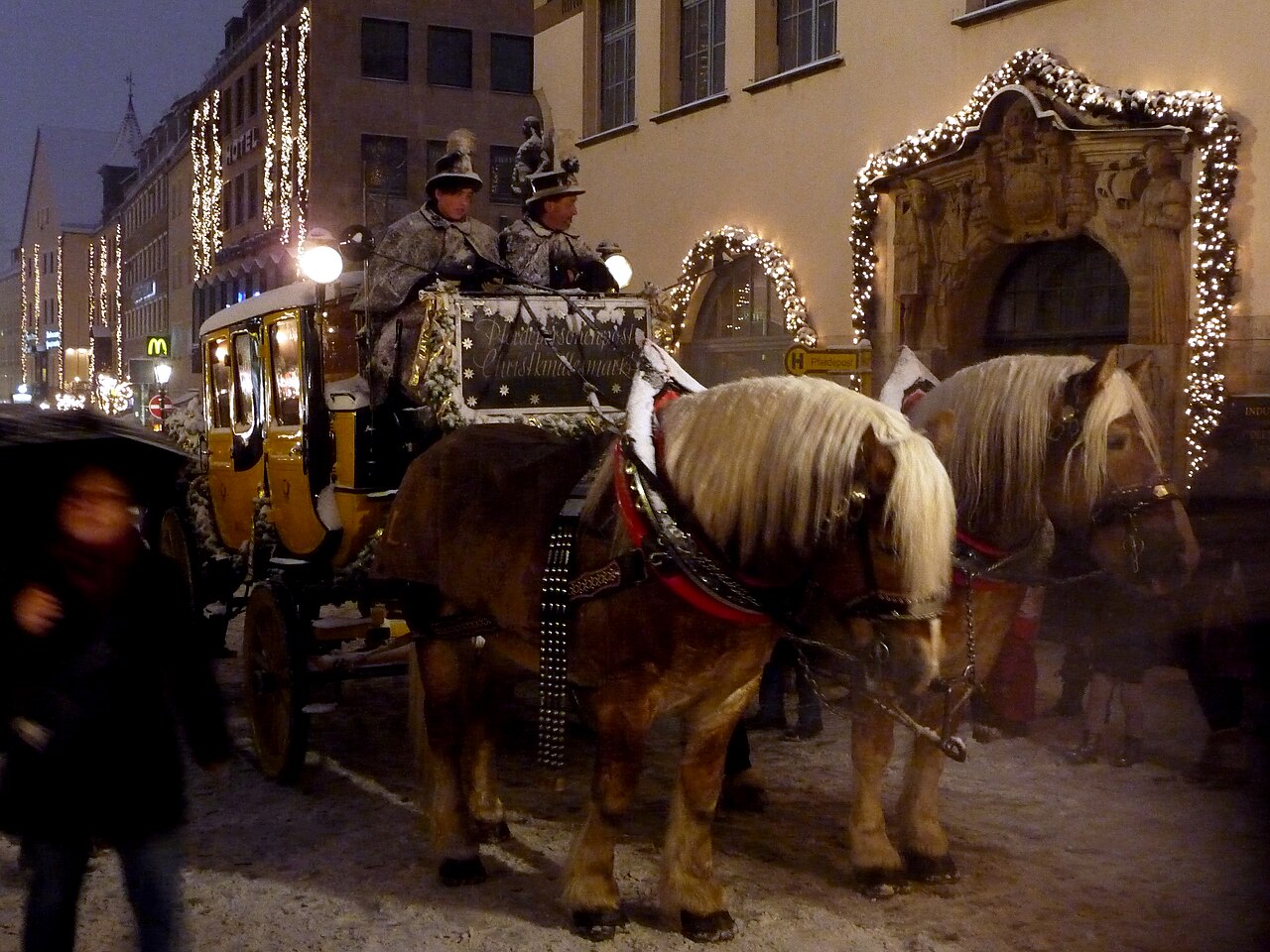
3. Regensburg: a castle market with fires and lanterns
Where and when: the Romantischer Weihnachtsmarkt at Thurn und Taxis Castle, 20 November – 23 December 2026 (closed 22 November), Mon–Thu 3pm–9pm, Fri 3pm–10pm, Sat 2pm–10pm, Sun 2pm–9pm. Adult tickets €6.50–13.50 depending on the day (about £5.50–11.50), children under 6 free (organiser’s website). The city’s Christkindlmarkt on Neupfarrplatz runs 23 November – 23 December 2026 and is free, and there is also the Lucrezia craft market and the market in the Spitalgarten across the Stone Bridge.
What makes it special: open fires burn in the courtyards of the princely palace, blacksmiths and hatters work in front of you, and between the stalls people eat soup served in a bread bowl and roast wild boar. For the price of a ticket, it is a market you will remember. And the UNESCO-listed old town is a reason to come in itself.
Getting there: from Munich Airport (MUC) about 105 km, roughly an hour and ten minutes by car, and there is a direct regional train from the airport too. From Nuremberg it is about an hour, from Prague about three hours by car or on the direct Prague–Munich train via Plzeň.
Where to stay: Hotel Goliath am Dom, a five-star hotel right next to the cathedral and the Stone Bridge, with a sauna. All the markets, opening times and winter tips are in our guide to the Regensburg Christmas market.
4. Seiffen: the toy village in the Ore Mountains
Where and when: Hauptstraße and the area around the church in Kurort Seiffen, 27 November – 20 December 2026, Mon–Fri 11am–5pm, Sat 10am–8pm, Sun 11am–6pm. Grand miners’ parade on Saturday 12 December, a procession of lights on 5 December and a lantern procession on 19 December.
What makes it special: Seiffen is where the nutcrackers, incense smokers and pyramids you see at every market in Germany are made. Here you buy them straight from the makers, you can watch them being turned in the workshops, and in the evening a candle arch glows in every window. The market itself is small, but the whole village is one big Christmas shop window. It looks best after dark, but on weekdays the stalls close at five.
Getting there: from Dresden Airport or Prague Airport about 100 km, an hour and a half to just under two hours by car. From Prague the route goes via Most, Litvínov and the Mníšek/Deutscheinsiedel border crossing. In winter expect snow on the mountain roads.
Where to stay: Hotel Erbgericht Buntes Haus, a hotel with five hundred years of history right next to the church; the stalls are on your doorstep and the toy museum is within walking distance. Details in our guide to the Seiffen Christmas market.
5. Pirna: the Canalettomarkt at the gateway to Saxon Switzerland
Where and when: the Marktplatz around the town hall, 24 November – 23 December 2026 and again 27–30 December (closed 24–26 December). Mon–Thu 11am–7pm, Fri–Sat 11am–9pm, Sun 11am–8pm, opening ceremony on 24 November at 4.30pm (official website).
What makes it special: the market is named after the painter Canaletto (Bernardo Bellotto), who painted Pirna in the 18th century, and the square still looks almost exactly as it does in his paintings. In the evening a light show is projected onto the town hall, the tree has ten thousand LED lights, and it is one of the few Saxon markets that also opens between Christmas and New Year. An ideal stop on the way between Prague and Dresden.
Getting there: from Dresden about 20 minutes by S-Bahn; from Dresden Airport about 50 km by car. From Prague about 140 km, an hour and three quarters by car, or by train via Děčín.
Where to stay: Pirnscher Hof, a small B&B hotel (garni) in Pirna, 11 km from Königstein Fortress and 14 km from Saxon Switzerland National Park. More in our guide to the Pirna Christmas market.
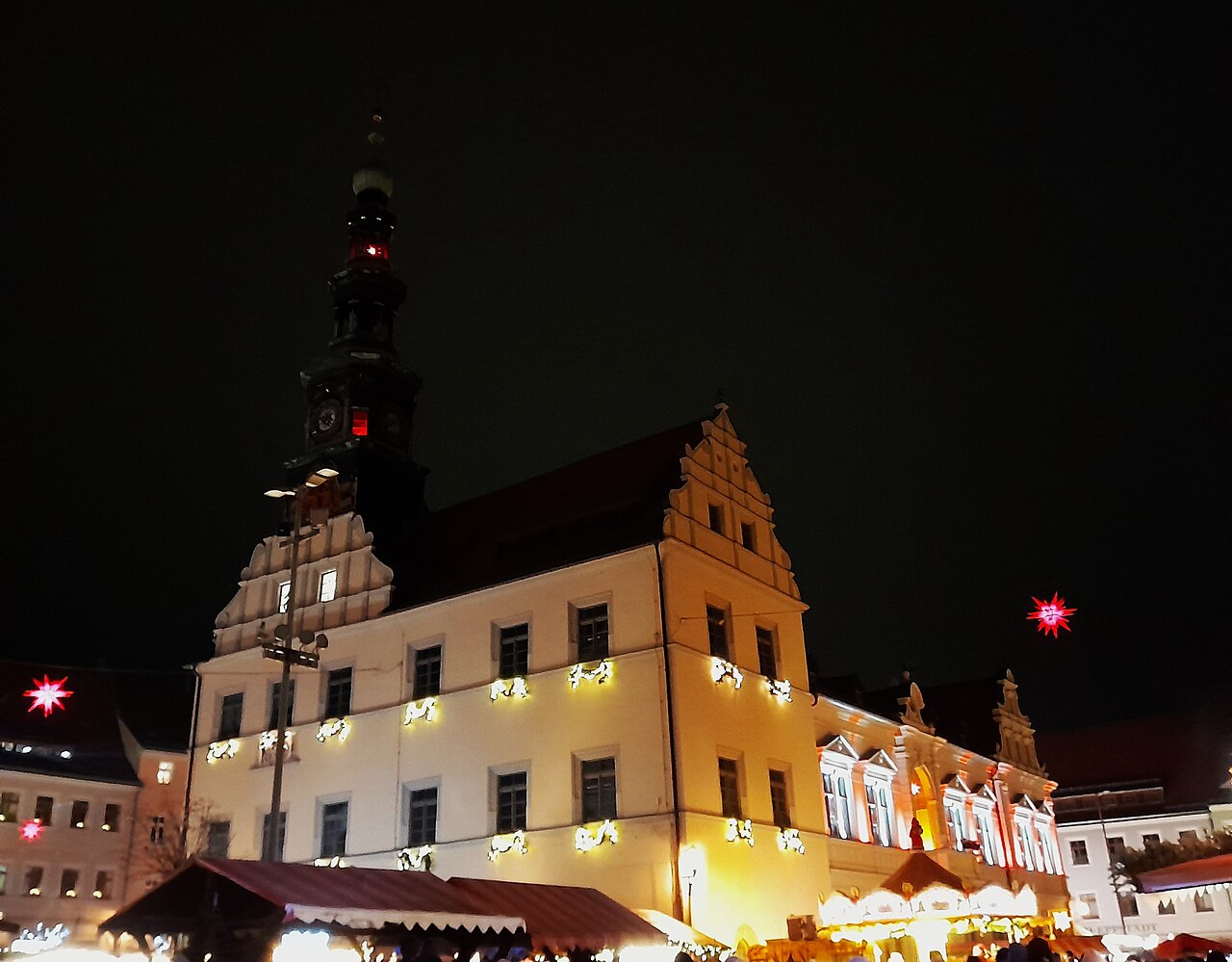
6. Leipzig: a Finnish village and the historic Naschmarkt
Where and when: the Markt, Augustusplatz, Naschmarkt, Nikolaikirchhof and the streets in between, 24 November – 23 December 2026. Sun–Thu 11am–9pm, Fri–Sat 11am–10pm, 22 and 23 December until 8pm (on 23 December only on the Markt). Opening ceremony on 24 November at 5pm (Leipzig Travel).
What makes it special: around 300 stalls and a history going back to 1458; Leipzig claims to have the second oldest Christmas market in Germany. Every square has a different mood: the Naschmarkt hosts a historic market with craftspeople, Augustusplatz has a Finnish village and a South Tyrolean one, a fairy-tale forest and a Ferris wheel. If you travel by train and want a big city with a market on every corner, Leipzig is for you.
Getting there: Leipzig/Halle Airport (LEJ) is about 20 km from the centre, with S-Bahn trains to the main station. From Dresden it is about an hour and a half by car and there are regular trains; Berlin is linked by ICE. From Prague about 250 km, roughly two and three quarter hours by car.
Where to stay: Motel One Leipzig-Nikolaikirche, a design hotel directly opposite St Nicholas Church, five minutes on foot from the main station.
7. Meissen: the town hall as an Advent calendar
Where and when: Meißner Weihnacht on the Markt square, 23 November – 24 December 2026 according to the town of Meissen. The organiser has not yet published the opening hours and programme for 2026; we will add them here as soon as they are out.
What makes it special: an intimate market with about forty stalls below Albrechtsburg Castle. In Advent the town hall turns into a giant Advent calendar: every day from 1 to 24 December one window opens, with a programme on the stage. A carillon made of Meissen porcelain plays from the tower of the Frauenkirche, and Meissen as a whole makes a good combination of market, porcelain manufactory and castle for an afternoon out of Dresden.
Getting there: from Dresden about 40 minutes on the S1 suburban train; from Dresden Airport about 30 km by car. From Prague about 175 km, around two hours by car.
Where to stay: Hotel Goldener Löwe, a hotel in a 17th-century house a minute’s walk from the square, with a restaurant that has an open fire and regional wines.
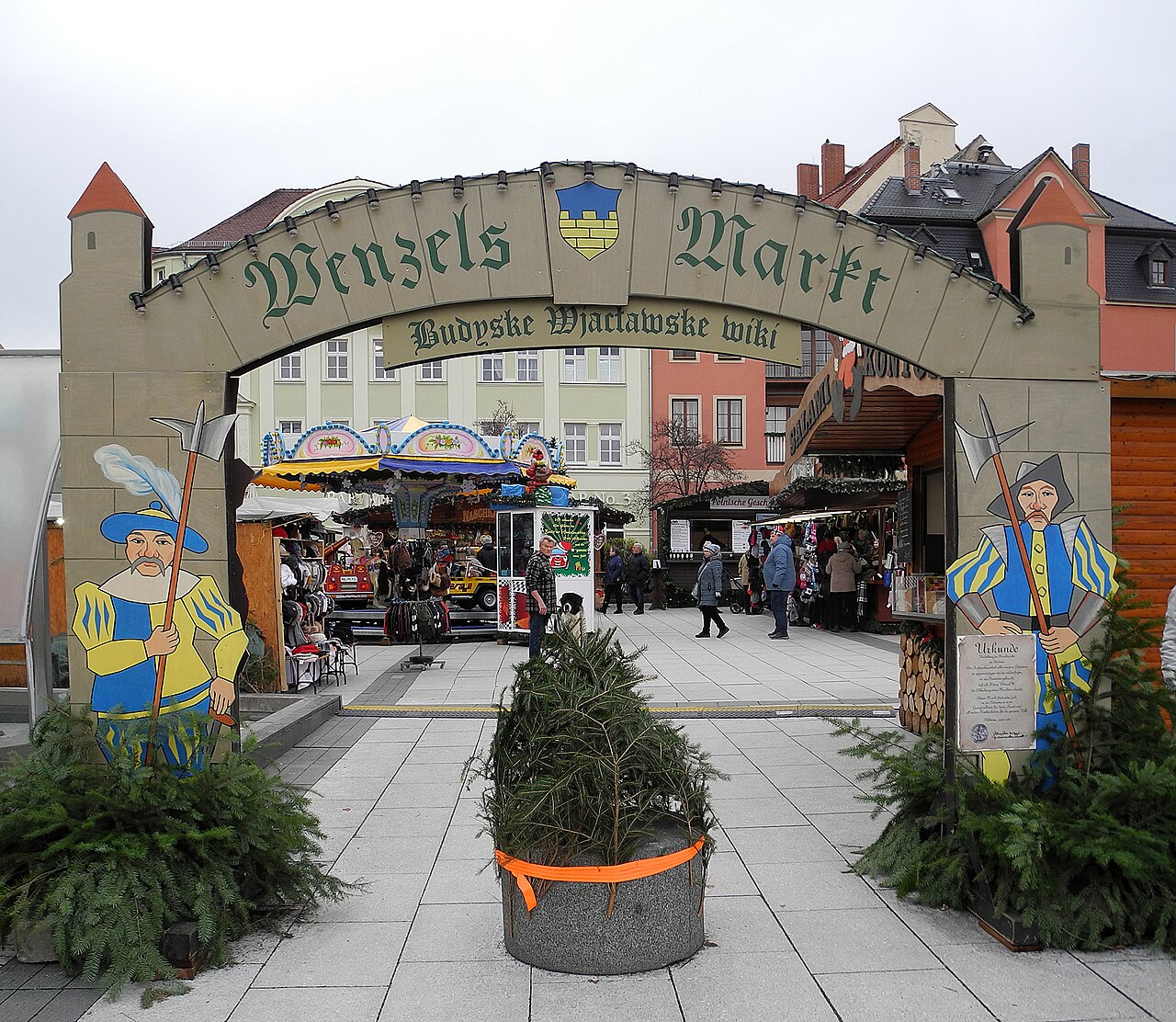
8. Bautzen: the Wenzelsmarkt, a tradition since 1384
Where and when: the 643rd Wenzelsmarkt, from the Hauptmarkt along Reichenstraße to the Kornmarkt, 27 November – 22 December 2026. Sun–Wed 11am–8pm, Thu 11am–8pm (some stalls until 9pm), Fri–Sat 11am–9pm (some until 10pm). The programme has not been published yet; we will add it (market website).
What makes it special: the market is named after the Bohemian king Wenceslas IV, who granted Bautzen market rights in 1384, and according to the organisers it is the oldest Christmas market in Germany documented in a chronicle. There are about eighty stalls, and every day Father Christmas opens a window of the Advent calendar together with the children. Bautzen is also the centre of the Sorbs, a Slavic minority, so you will notice bilingual signs everywhere, even on the market gate.
Getting there: from Dresden Airport about 60 km, under an hour by car; from Dresden there are regional trains too. From Prague about 200 km, two and a half hours via Dresden or on the shorter route through northern Bohemia via Rumburk.
Where to stay: Hotel Goldener Adler, a four-star hotel in the centre with views over the town and free parking.
9. Görlitz: a Silesian market on the Polish border
Where and when: the Schlesischer Christkindelmarkt on the Untermarkt and in the surrounding lanes, 4–20 December 2026. Mon–Thu 2pm–8pm, Fri 2pm–9pm, Sat 11am–9pm, Sun 11am–8pm. On the weekend of 11–13 December the market spreads across the bridge into Polish Zgorzelec (market website). The ice rink is open from 20 November 2026 to 3 January 2027.
What makes it special: Görlitz came through the war almost undamaged and its old town has served as the backdrop for Hollywood films. The market among the Renaissance houses has Silesian specialities, a live nativity scene and a Bethlehem courtyard with a bakery and a stable, and it has twice won the Christmas market test run by the regional broadcaster MDR. It opens the latest of all the markets on our list, on 4 December, so it suits the second or third weekend of Advent.
Getting there: from Dresden Airport about 105 km, an hour and a half by car; trains run from Dresden too. From Prague about 175 km, roughly two and a half hours. Wrocław is also within reach if you want to add a Polish market to the trip.
Where to stay: Hotel Börse, a hotel with town views in the old town by the Untermarkt, 200 metres from the Church of St Peter and St Paul.
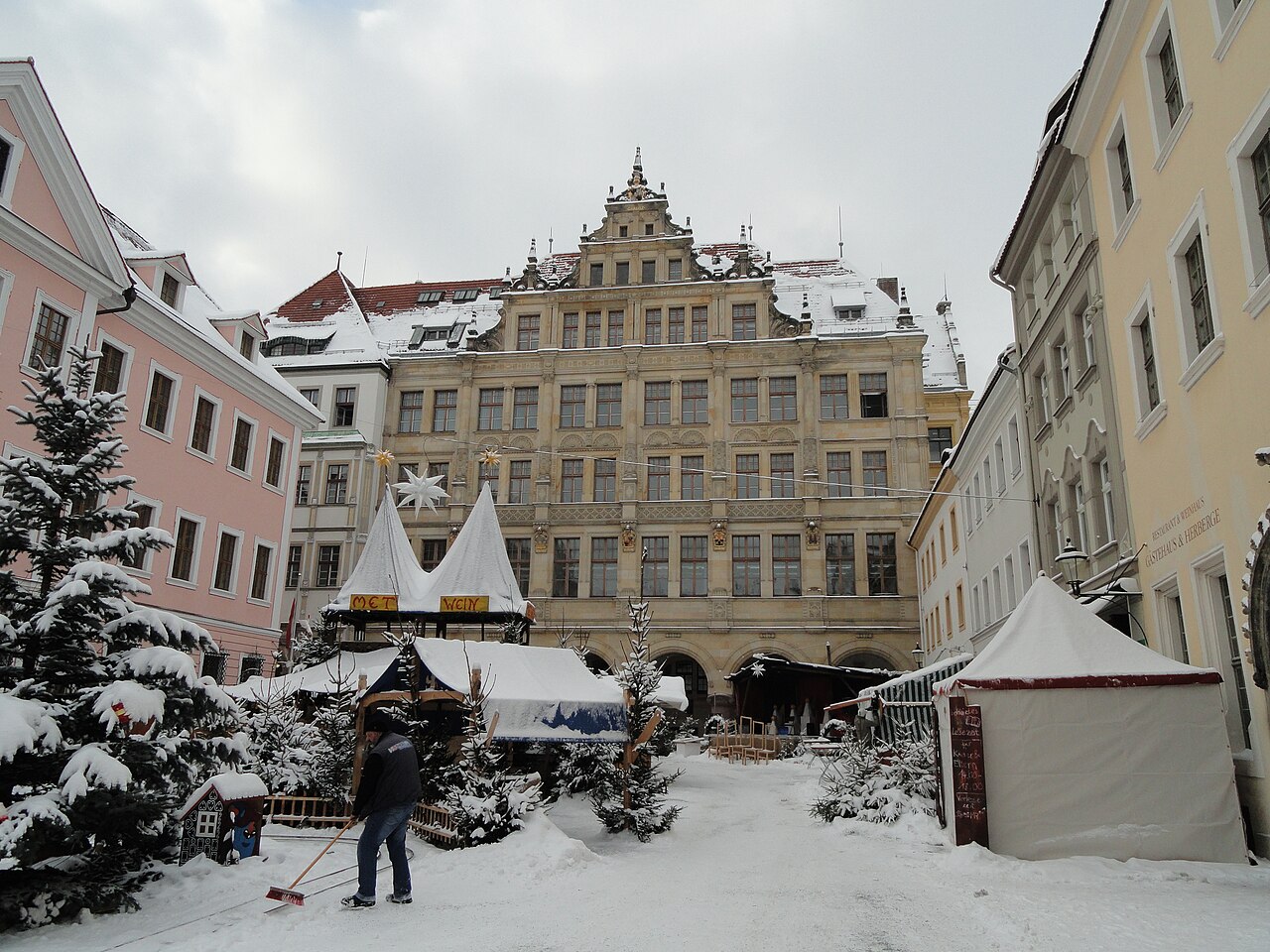
10. Annaberg-Buchholz: a thousand miners on the fourth Sunday of Advent
Where and when: the sloping Markt square below St Anne’s Church, 27 November – 23 December 2026, Sun–Thu 10am–7pm, Fri–Sat 10am–8pm. Große Bergparade on Sunday 20 December 2026 at 1.30pm (market website). The opening is on Friday 27 November at 5pm, when the figures of the carved market pyramid come to life, step down from their base and the pyramid is set turning. On Sunday 29 November at 1pm an extra-long butter stollen is cut on the stage (2026 programme).
What makes it special: on the fourth Sunday of Advent more than a thousand people in historic miners’ uniforms march through the town with brass bands, and the parade ends with a concert in front of St Anne’s Church. A 10.5-metre pyramid turns above stalls built like Ore Mountain cottages, and the Church of Our Lady has a miners’ nativity scene. If you want to see how Christmas is celebrated in mining country, this is the strongest experience on our whole list.
Getting there: from Prague Airport about 125 km, around an hour and three quarters by car via Chomutov and Vejprty. From Dresden Airport about 135 km, just under two hours. Karlovy Vary is even closer, via Boží Dar.
Where to stay: Hotel Wilder Mann Annaberg-Buchholz, a traditional hotel in one of the oldest houses in town, right on the square. The restaurant next door is known for the nine-course Ore Mountain Christmas Eve platter (Neinerlaa).
11. Freiberg: a torchlight miners’ parade
Where and when: the 35th Christmarkt on the Obermarkt, 24 November – 22 December 2026, Mon–Thu 10am–8pm, Fri–Sat 10am–10pm, Sun 10.30am–8pm. Opening on 24 November at 3pm, Stollenfest on Sunday 29 November at noon and the torchlight miners’ parade on Saturday 5 December 2026 at 5pm (market website).
What makes it special: Freiberg is a silver town with more than eight hundred years of mining tradition, and you can feel it at the market. The evening parade of miners carrying torches across the square is a different experience from the daytime parades elsewhere, and on 13 December the town also celebrates the miners’ feast day. The market is much smaller and calmer than Dresden’s, which can be an advantage.
Getting there: from Dresden about half an hour by train; from Dresden Airport about 60 km, an hour by car. From Prague about 185 km, around two hours by car.
Where to stay: Hotel Am Obermarkt, a hotel in the historic centre, five minutes on foot from the cathedral and three minutes from Freudenstein Castle with its mineral collection.
12. Passau: a market below the world’s largest cathedral organ
Where and when: the Domplatz in front of St Stephen’s Cathedral, 24 November – 22 December 2026, Mon–Thu 10am–8pm, Fri–Sat 10am–9pm, Sun 11am–8pm (market website). The stage programme is already out (programme), but the time of the official opening has not been announced yet; we will add it.
What makes it special: the market is run by the city, which chooses stallholders by the quality of their goods, so you will hardly find any cheap trinkets. From Wednesday to Saturday at noon there are organ recitals in the cathedral on the largest cathedral organ in the world. Try Sengzelten, a thin flatbread from the oven, and after the market walk down to the confluence of three rivers. Passau is also a short hop from Austria, so it combines well with Linz or Salzburg.
Getting there: from Munich Airport about 160 km, an hour and three quarters by car; trains run from Munich and Regensburg. From Prague about 230 km, three to three and a half hours via southern Bohemia; there is no direct train from Czechia.
Where to stay: Hotel Wilder Mann, a historic hotel in the same building as the Glass Museum, with views of the Danube and breakfast in a hall overlooking the cathedral. You can even sleep in the original wedding bed of King Ludwig II of Bavaria.
13. Munich: Marienplatz, nativity scenes and Krampus devils
Where and when: the Christkindlmarkt on Marienplatz and Rindermarkt, 20 November – 24 December 2026 (closed 22 November), Mon–Sat 10am–9pm, Sun 10am–8pm, Christmas Eve 10am–2pm (official website). Over the same period the Kripperlmarkt by St Peter’s Church is open, the medieval market on Wittelsbacherplatz runs until 23 December and the Tollwood festival takes over the Theresienwiese from 24 November to 23 December.
What makes it special: 137 stalls in front of the neo-Gothic town hall, from whose balcony Advent music plays from Sunday to Thursday. Nativity scenes have been sold at the Kripperlmarkt since 1757, and according to the city it is the largest market of its kind in Germany. On Sunday 13 December 2026 the Krampuslauf brings around three hundred Alpine devils through the centre. And if you have had enough of sausage stalls, head to Tollwood with its organic food and art tents.
Getting there: Munich Airport (MUC) is about 40 km from Marienplatz and linked to the city centre by S-Bahn. Direct trains also run from Prague via Plzeň and Regensburg, taking about five and a half hours. Munich has a low-emission zone, so leave a car in a garage or at a P+R car park.
Where to stay: Hotel Torbräu, a family-run four-star hotel by the Isartor gate, five minutes on foot from Marienplatz.
14. Rothenburg ob der Tauber: the Reiterlesmarkt inside the walls
Where and when: Marktplatz, Grüner Markt, Kirchplatz and the town hall courtyard, 20 November – 23 December 2026 (closed 22 November), Sun–Thu 11am–7pm, Fri–Sat 11am–8pm (town of Rothenburg). The official opening is only on Friday 27 November at 5pm, when the Reiterle rides into the Marktplatz and the big Christmas tree is lit after the mayor’s welcome (2026 programme).
What makes it special: Rothenburg is a medieval town completely enclosed by walls, and in Advent it looks like a fairy-tale film set. The market has only 61 stalls, but the Reiterle figure rides in on horseback for the opening and an Advent window opens on the town hall every evening. The 2026 mug has been made in a limited edition. Away from the market, walk along the town walls and visit the year-round Christmas museum.
Getting there: from Nuremberg about an hour by car (from Nuremberg Airport about 80 km), from Frankfurt Airport about 190 km, roughly two hours. Ideal as a trip from a Nuremberg base.
Where to stay: Hotel Eisenhut, a hotel in the heart of the old town with a garden, a terrace and a restaurant serving German and French cuisine.
15. Cologne: a market below the cathedral and angels on the Neumarkt
Where and when: the cathedral market on Roncalliplatz, 16 November – 23 December 2026 (closed 22 November), Sun–Wed 11am–9pm, Thu–Fri 11am–10pm, Sat 10am–10pm (market website). Heinzels Wintermärchen in the old town runs until 23 December on the Alter Markt and until 10 January 2027 on the Heumarkt, and the Markt der Engel on the Neumarkt from 16 November to 23 December.
What makes it special: around 130 stalls below the Gothic cathedral, a 25-metre tree and a canopy of lights with around fifty thousand LEDs; according to the organiser around four million people come every year. The old town has a market themed on the Heinzelmännchen elves with an ice rink, and on the Neumarkt angels stroll between the stalls. Cologne is far from the cluster in Saxony and Bavaria, but if you combine the markets with a weekend in the Rhineland, you will not regret it.
Getting there: Cologne Bonn Airport (CGN) is about 18 km from the cathedral, with S-Bahn trains to the main station right next to the market. From Frankfurt Airport about two hours by car, and the airport has its own long-distance station with ICE trains to Cologne. Cologne has a low-emission zone. From Prague it is about 690 km, so plan at least two nights.
Where to stay: Hotel Mondial am Dom Cologne MGallery, a hotel with a spa a few steps from the cathedral; the restaurant looks out onto it.
Where next if fifteen markets are not enough? Berlin has dozens of markets; the most elegant is the WeihnachtsZauber on the Gendarmenmarkt (23 November – 31 December 2026, entry €2, free for children under 12 and on weekdays 11am–2pm) and the most romantic is the one in front of Charlottenburg Palace (23 November – 27 December, free). Bamberg opens on 24 November and is known for the nativity scenes placed all over the old town, Erfurt has the biggest market in Thuringia on the Domplatz (24 November – 22 December), and Aachen (20 November – 23 December) has Printen gingerbread and, new this year, the Excellent European Christmas Market label. Near Görlitz there is also Zittau, and in the Ore Mountains Marienberg and Chemnitz; we will add the dates of these markets.
German Christmas market food: what to try
- Glühwein: mulled wine, red or white, and in Nuremberg and Regensburg often blueberry too (Heidelbeerglühwein). Roughly €4–5 (about £3.50–4.50) plus the mug deposit.
- Feuerzangenbowle: mulled wine with a rum-soaked sugar loaf burning above it. At the market you watch the sugar drip into the cauldron; in the mug it is sweet and fairly strong.
- Dresdner Christstollen: Dresden Stollen with raisins, almonds and candied peel; you can tell the real thing by its golden seal. Together with Pulsnitzer Pfefferkuchen, gingerbread from nearby Pulsnitz, it is the best gift to take home from Saxony.
- Nürnberger Lebkuchen and Rostbratwurst: soft Nuremberg gingerbread on a wafer base and the little sausages sold three to a roll (Drei im Weggla).
- Bratwurst and the half-metre sausage: the classic at every market; a sausage in a roll costs roughly €5–7 (about £4.50–6).
- Gebrannte Mandeln and roasted chestnuts: caramelised roasted almonds, the smell of every market, and chestnuts in a paper cone, roughly €3–5 each.
- Kartoffelpuffer and Reibekuchen: potato pancakes with apple sauce; in Cologne and Aachen with Printen gingerbread on the side.
- Glögi and elk sausages: at the Finnish village in Leipzig, for when you cannot face another mulled wine.
Almost everywhere in Germany mulled wine is served in ceramic mugs with a deposit (Pfand) of roughly €3–5. You can return the mug and get the deposit back, or keep it as a souvenir. Every market, and in Regensburg every single market in town, has its own mug, so return it where you got it. The markets have not yet published exact prices for the 2026 season, so treat the figures above as a guide.
A short history of the Christmas markets in Germany
Christmas markets grew out of medieval winter fairs where people stocked up on meat, candles and warm clothes for the winter. In Bautzen, King Wenceslas IV granted the town market rights in 1384, Dresden’s Striezelmarkt is first mentioned in 1434 and takes its name from Striezel, the old word for Stollen. The Leipzig market is documented from 1458 and Nuremberg’s Christkindlesmarkt in writing from the 17th century.
The Christkind, a figure every child in southern Germany knows today, goes back to the Reformation. Martin Luther wanted to draw attention away from the veneration of St Nicholas, so gifts were now to be brought by the “holy Christ”. Ironically, the Christkind survived mainly in the Catholic regions, while in the Protestant north presents are brought by the Weihnachtsmann, Father Christmas. In the 19th century Christmas trees appeared on town squares, and in 1839 the Advent wreath was invented in Hamburg. The Ore Mountains added traditions of their own: miners who did not see daylight for days in winter carved pyramids, nutcrackers and candle arches that imitate the mouth of a mine shaft. Today every market from Dresden to Cologne is full of them.
Where to warm up after the markets
After two hours on the cobbles, a warm room and a chair are very welcome. A few tried-and-tested addresses right by the markets:
- Café Kreutzkamm, Dresden (Altmarkt 25): a patisserie baking since 1825, right by the Striezelmarkt. For coffee and a slice of Stollen sitting down.
- Pulverturm, Dresden (An der Frauenkirche 12): a themed restaurant in the style of Augustus the Strong’s era, right by the Frauenkirche, for when you want a proper meal after the mulled wine.
- Historische Bratwurstküche Zum Gulden Stern, Nuremberg (Zirkelschmiedsgasse 26): an old kitchen where the sausages are grilled over beech wood.
- Bratwursthäusle, Nuremberg (Rathausplatz 1): right next to the Sister Cities Market by St Sebald’s Church.
- Historische Wurstkuchl, Regensburg: a small eatery by the Stone Bridge that calls itself the oldest sausage kitchen in the world. Charcoal-grilled sausages with sweet mustard.
- Café Prinzess, Regensburg: a café by the Old Town Hall that traces itself back to 1686 as the first coffee house in Germany. Handmade chocolates.
- Auerbachs Keller, Leipzig (Grimmaische Straße 2–4, in the Mädlerpassage arcade): the historic cellar made famous by Goethe in Faust, a few steps from the Markt.
- Buntes Haus, Seiffen (Hauptstraße 94): a traditional inn by the church with Ore Mountain cooking; in winter it has its own mulled wine stall outside.
On Advent weekends the restaurants in the centres are full in the evenings, so if you are dining as a group we would book a table in advance.
Tips for German Christmas markets: what to watch out for
- Saturdays and big events. On Advent Saturday afternoons you shuffle between the stalls, and in Dresden during the Stollenfest or in Seiffen and Annaberg on parade days the centre is at its busiest of the whole year. Visit the big markets on Friday evening, Sunday morning or on a weekday.
- Totensonntag, 22 November 2026. On the Sunday before Advent many markets are closed, for example Munich, Cologne, Rothenburg and the Regensburg castle market. If you are coming on the very first weekend, check the dates.
- Security measures. After the attacks on markets in Berlin (2016) and Magdeburg (2024), the big markets have concrete barriers, more police and in some places bag checks. Expect not to be able to drive into the centre, and leave large backpacks at the hotel.
- Pickpockets. In the crush around the pyramids and the mulled wine stalls, just like anywhere else. Keep your wallet and phone in an inside pocket and wear your backpack on your front.
- Cash and mugs. Small stalls often do not take cards and the mug deposit is paid in cash. Return the mug where you got it.
- Sundays and holidays. Shops and supermarkets in Germany are closed on Sundays, but the markets are open. On Christmas Eve they open only in the morning, and on 25 and 26 December almost everything is closed.
- Green sticker and mountain roads. Low-emission zones (Munich, Cologne, Regensburg, Berlin) can only be entered with a sticker, which you need to order in advance if your car does not have one. Drive over the Ore Mountains with winter tyres and plenty of time to spare, as snow is nothing unusual here in December.
What we would do differently
What we enjoyed least at the German markets was trying to fit in too much. Dresden, Meissen, Pirna and Seiffen in one weekend is doable, but on Sunday evening what you remember most are multi-storey car parks and queues for mulled wine. Better one city for two nights and one smaller market on the way back.
We would also try more and stick less to lists. The best food we had was not at the half-metre sausage stall but in small pubs away from the main square, places no guidebook would have sent us to. In the Ore Mountains it is worth turning off into a village with no market at all and seeing how people light candle arches in every window. And try something you cannot get at home: Feuerzangenbowle, Finnish glögi in Leipzig or Sengzelten in Passau.
And you do not have to see everything. The pyramid, the Ferris wheel and the Christkind will wait. Our best moments came when we stood at the edge of the square with a mug in hand, left the phone in a pocket and just watched the windows light up one after another as darkness fell.
Christmas markets in Germany: FAQ
When do German Christmas markets open in 2026?
Cologne opens first, on 16 November 2026. Munich, the Regensburg castle market, Rothenburg and Aachen start on 20 November, Leipzig, Pirna, Freiberg and Passau on 24 November, the Dresden Striezelmarkt on 25 November, and Nuremberg, Seiffen and Bautzen on 27 November. Görlitz is the last to open, on 4 December. Most markets close between 22 and 24 December.
What are the best Christmas markets in Germany?
The most famous are the Striezelmarkt in Dresden and the Christkindlesmarkt in Nuremberg. For atmosphere, the Thurn und Taxis castle market in Regensburg, Leipzig, Munich and Cologne below the cathedral stand out. For miners’ traditions head to the Ore Mountains (Seiffen, Annaberg-Buchholz, Freiberg), and for a medieval setting to Rothenburg or Görlitz.
Which German Christmas markets can you visit from Prague?
The closest are Pirna, Dresden and Meissen (around two hours from Prague), in the Ore Mountains Seiffen, Annaberg-Buchholz and Freiberg, and in Upper Lusatia Görlitz, Bautzen and Zittau. Regensburg is about three hours away and Passau three to three and a half.
What is the oldest Christmas market in Germany?
Two towns compete for the title: Bautzen, where King Wenceslas IV granted market rights in 1384, and Dresden, whose Striezelmarkt is first mentioned in 1434 and holds its 592nd edition in 2026. The Leipzig market is documented from 1458.
Which German Christmas markets work as a day trip?
From Dresden you can easily do Pirna, Meissen, Freiberg, Bautzen or Seiffen, from Nuremberg Rothenburg or Regensburg, and from Munich Regensburg or Passau. From Prague, Pirna, Dresden and Seiffen are within about two hours. For Nuremberg, Leipzig, Munich or Cologne we recommend at least one night.
When are the miners’ parades in the Ore Mountains in 2026?
Seiffen holds its grand miners’ parade on Saturday 12 December 2026, Freiberg its torchlight parade on Saturday 5 December at 5pm, and Annaberg-Buchholz the Große Bergparade on Sunday 20 December at 1.30pm.
Can you pay by card at German Christmas markets?
At the big markets more and more stalls take cards, but small craftspeople and the markets in the Ore Mountains are often cash only. The mug deposit (roughly €3–5) is usually paid in cash, so carry at least €50 in small notes and coins.
When does Advent start in 2026?
The first Sunday of Advent falls on 29 November 2026 and Christmas Eve, 24 December, is a Thursday. Most German Christmas markets open in the week before the first Sunday of Advent, some a week earlier.
Where next
We have detailed guides to the German markets in Dresden, Nuremberg, Regensburg, Seiffen and Pirna. Further south, the Christmas markets in Vienna, Linz and Salzburg are worth a trip, and to the north-east our overview of the Christmas markets in Poland. And if you are flying into Prague anyway, pick from the best Christmas markets in the Czech Republic, for example in Prague, Brno or Liberec.
Potřebujete pomoct s cestováním?
-
Ubytování 🏨
Vyberte si to nejlepší ubytování, ať už jste kdekoliv, přes Booking.com. -
Půjčení auta 🚗
Auto si snadno najdete přes Booking.com, kde máte často slevu díky ubytování, nebo Rentalcars.com, kde porovnáte nabídky většiny půjčoven. -
Zážitky 🎟️
Přes GetYourGuide.com si vyberete z nejrůznějších výletů i zážitků po celém světě, navíc se zrušením zdarma do 24 h předem.