
Last updated 13.10.2026
Some places leave you standing still, staring, not quite convinced you are really there. Tayrona National Park was one of those for us. Tayrona National Park lies on Colombia’s Caribbean coast in the far north of the country, and it packs in everything: white-sand beaches, rainforest, wildlife and, on a clear day, a view of Colombia’s highest peaks. Below you’ll find how to get there from Santa Marta, what the entrance fee is, when the park is closed, where to stay and which beaches and hikes are worth your time.
Why visit Tayrona National Park
Picture a dense, humid jungle that runs straight down to the Caribbean. That is Tayrona. You can spend the day hiking muddy jungle trails and the evening in a hammock listening to the waves, or skip the hiking entirely and just lie on the sand. It works for adrenaline seekers and for people who simply want quiet.
Tayrona National Park: history and the Indigenous peoples
Almost every corner of Tayrona has a story. Tayrona National Park takes its name from the Tairona, a civilisation that lived here until the Spanish conquistadors arrived. They were skilled farmers and traders, and many of their settlements stood on the land the park covers today.
The Tairona built stone terraces, stairways and paved paths, irrigated the hillsides and traded gold, cotton and salt. Their gold jewellery is now among the most prized collections of the Museo del Oro in Bogotá. In the 1520s the Spanish founded Santa Marta nearby, and over the following century Tairona resistance collapsed. Some of the people retreated higher into the Sierra Nevada de Santa Marta, where their descendants still live today: the Kogi, Arhuaco (Ika), Wiwa and Kankuamo peoples.
The national park was established in 1969 and covers about 225 km², roughly a fifth of it sea. For the Indigenous peoples this coast is sacred land, which is why the park shuts for two weeks several times a year. These closures are not about maintenance: under an agreement with the Indigenous spiritual leaders (the mamos), nature gets a “rest” and traditional ceremonies take place. So as you walk through the park, keep in mind that you are not only in a nature reserve but also somewhere that is sacred to other people.

Colombia’s own Machu Picchu
The most remarkable site in the region is Ciudad Perdida, the Lost City of the Tairona, built on the slopes of the Sierra Nevada. Walking among what is left of these old settlements feels like stepping back in time. The stone terraces, paths and temple foundations tell you how people lived here more than a thousand years ago. Think of it as a smaller, Colombian Machu Picchu.
TIP: You can only visit Ciudad Perdida with a guide, and the trek takes several days. To secure a place, you can book it online through GetYourGuide (that’s how we book), which also gives you free cancellation up to 24 hours before.
Wildlife and plants in Tayrona National Park
Tayrona is a proper tropical paradise where mountains, jungle and the Caribbean meet. The heart of the park is thick jungle full of exotic plants and animals: monkeys, toucans, parrots, jaguars and plenty more besides, including snakes and spiders (which is why there are first-aid posts along the way in case of bites).
TIP: The most beautiful places in Colombia you shouldn’t miss
How to get to Tayrona National Park from Santa Marta
Getting to Tayrona is fairly straightforward. The cheapest and easiest way is the local bus from nearby Santa Marta, though you can also take a taxi, a boat or drive (driving works out a good deal more expensive). The quickest way to reach Santa Marta is to fly: Simón Bolívar airport lies south of the city and there are several flights a day from Bogotá and Medellín. Coming from the UK, there are no direct flights to Santa Marta, so you will be connecting, usually in Bogotá after a long-haul flight from London. From Cartagena it’s around 5 to 6 hours by bus or shared minibus.
The park has four land entrances:
- El Zaino: the main entrance, about 32 km from Santa Marta (roughly 45 minutes by car). A paved road runs from here to the car park at Cañaveral, where the trails to the best-known beaches begin. Most visitors come in this way.
- Calabazo: at kilometre 20 of the Troncal del Caribe highway. This is the start of the tougher jungle trek to Cabo San Juan.
- Palangana: closer to Santa Marta. A dirt road leads from here to Neguanje beach, where boats leave for Playa Cristal.
- Bahía Concha: a separate sector on the western edge of the park, about 15 minutes from Santa Marta along an unpaved road. It has its own, cheaper entrance fee.
- Bus: Green Cootransoriente buses run regularly on the Santa Marta to Palomino route, roughly every 20 to 30 minutes from morning until early evening. In town they leave from the market (Calle 11 and Carrera 11) and also stop by the Buenavista shopping centre. The ride to the main El Zaino entrance takes about an hour and costs roughly 8,000 to 10,000 COP (around £2 or €2–3). Ask the driver to drop you at El Zaino or Calabazo. The same bus also runs from Palomino.
- Taxi: the most comfortable option from Santa Marta, especially with big backpacks. Agree the fare before you set off, ideally through your accommodation.
- Boat: arriving by sea is an experience in itself. Boats run to Tayrona from Taganga (and also from Santa Marta and El Rodadero). The trip to Cabo San Juan takes about 40 to 45 minutes and costs roughly 100,000 COP (around £23 or €27) per person each way. Boats leave in the morning, because in the afternoon the sea gets rough and the crossing becomes very bumpy. Always agree the price, the return trip and other details with the boatmen beforehand. You still pay the park entrance fee when you arrive by sea.
From the El Zaino entrance, minibuses run to the Cañaveral car park for a small fee; on foot it’s about 4 km along the road. From there on you get around only on foot or on horseback. There is no cash machine inside the park and very few places take cards, so bring enough cash for the entrance fee, insurance, food and accommodation.
Best time to visit Tayrona National Park
The best time to visit is the dry season from December to March (often April too), when the weather is settled, it rarely rains and temperatures sit around 28 to 30 °C. The wettest stretch runs roughly from September to November, when the trails get slippery and parts of the park can be cut off. There’s usually a shorter wet spell in May and June as well. In January and February strong winds are common and red flags go up on some beaches.
Expect crowds at certain times, too. Colombians head to Tayrona mainly over the Christmas holidays (December to the end of January), at Easter (Semana Santa), in June and July and on long weekends. That’s when the higher entrance fee applies, and the campsites at Cabo San Juan fill up by the afternoon.
We went in August and it was fine on the whole. Most days were overcast, the sun came out now and then, but we also got thoroughly soaked a few times and some trails were very muddy.
WARNING: Tayrona National Park closes completely three times a year for two weeks. According to the park authority, the closures run from 1 to 15 February, 1 to 15 June and 19 October to 2 November, when nature is left to rest and the Indigenous peoples of the Sierra Nevada hold their ceremonies. On top of that, the park can close at short notice, for example because of road blockades on the Santa Marta to Palomino highway, the security situation or damage after heavy rains. This has happened several times in recent years, so check the current status on the website or social media of Parques Nacionales Naturales de Colombia just before you travel.

TIP: Heading to Cartagena as well? Here are the best things to do in the city and around it.
Tayrona National Park entrance fee and tickets
The entrance fee for foreign visitors is currently 81,000 COP (around £19 or €22) in low season and 96,500 COP (around £22 or €26) in high season. According to the park authority, high season covers December and January, June and July, Easter and long weekends. The separate Bahía Concha sector costs foreigners 43,500 COP (around £10 or €12) all year round. Prices are adjusted every January, so treat them as a guide. We recommend arriving early in the morning, ideally as soon as the ticket offices open, when the queues are shorter. If you are staying inside the park, the afternoon works too (though in Colombia you can’t always plan your timing to the minute).
On top of the ticket you have to buy compulsory accident insurance. It’s sold right at the ticket office and costs roughly 7,000 COP (under £2) per person per day. The ticket office asks for your original passport (a copy won’t do), and payment is mostly in cash.
Tayrona has no booking system: tickets are sold on the spot on the day of your visit, and the park has a daily visitor cap. In high season, get there as early in the morning as you can. The park authority does offer payment through an online payment link, but that doesn’t guarantee you a place. If you plan to stay overnight, your ticket should be valid until you leave the park, but in our case they asked for a higher fee based on the number of days we spent inside. If you leave the park and want to come back, you pay again.
WARNING: Last entry is between 2 and 3 pm depending on the season and the current situation (at Calabazo as early as 1 pm), and most of the accommodation is still a fair walk inside the park. That’s why we recommend taking one of the jeeps from the main gate, and then a horse if you like (a popular option), so you reach your accommodation in daylight. It gets dark around 6:30 pm, and many trails run through the jungle, which is not where you want to be after dark.
You’ll find the official Tayrona National Park website, with ticket prices and opening hours, HERE.
Park rules and what to pack for Tayrona
Security staff check your bag at the entrance. Single-use plastics are not allowed in the park (bags, plastic bottles, cups, cutlery, straws, polystyrene), and neither are bottles of alcohol, speakers, drones without a permit or pets. Fill a reusable bottle with water and pack your food in boxes. You can buy beer at the restaurants inside the park.
- In your daypack: passport, cash, insect repellent, sun cream, a hat, at least a litre of water for the walk, a head torch, swimwear, a quick-dry towel, sturdy shoes or sandals that can handle mud, and a power bank. Campsites only have electricity at certain hours and the phone signal is weak.
- Leave your big backpack in Santa Marta. Most hostels and hotels will store it for a few days, so you can walk through the jungle with just a small pack for two or three nights.
- Yellow fever: because of an ongoing yellow fever outbreak in Colombia, it’s worth considering the vaccine. The UK’s TravelHealthPro (NaTHNaC) recommends it for travellers going to areas below 2,300 m, which includes Tayrona, and notes that vaccination records may be checked when travelling within the country. Some national parks may ask for proof of vaccination. At Tayrona the checks are only occasional, but carry your international certificate of vaccination anyway. You need to be vaccinated at least 10 days before you travel.
Only swim where the signs explicitly allow it. Most beaches (Arrecifes, Cañaveral, Castilletes, Seven Waves) have strong rip currents, and a number of people have drowned here over the years. La Piscina, Arenilla and Cabo San Juan tend to be safer, but even there, stay out of the water when the red flag is up.
The park itself is safe for tourists, but armed groups are active in parts of the wider Sierra Nevada, and from time to time there are road blockades or unplanned park closures. Keep an eye on the news before you go, and check the FCDO’s travel advice for Colombia on gov.uk. You’ll find more on getting around the country safely in our article on safety in Colombia.
Where to stay in Tayrona National Park
The best part of our whole Tayrona trip was staying inside the park. There are plenty of ways to spend the night in the jungle here. Whether you’ll actually sleep is another question, because the jungle is pretty loud at night, but for me it was pure balm for the soul. So where can you stay in Tayrona?
- Camping and eco cabins: the favourite option for adventurous travellers is camping right inside the park (we skipped it because of the rain). One of the most popular campsites sits right on the beach at Cabo San Juan. You can sleep in a cabin, a tent or simply a hammock.
- More comfortable stays: if you don’t fancy camping or you’re visiting out of season, there are hotels and eco-resorts around the El Zaino entrance.
- Family-run hostels: if you’re after genuine Colombian hospitality, look for one of the small family-run places. That’s what we did, and it was probably the best place we’ve ever stayed. We slept in a small open shelter, with a little kitchen and outdoor bathrooms in the middle of the plot.
To give you an idea of prices: a hammock at Cabo San Juan costs roughly 40,000 COP (around £9 or €11) per person, a hammock in the lookout hut above the beach about 60,000 COP, and a tent for two around 140,000 COP (around £32 or €38) a night. A cabin without its own bathroom runs to 250,000 to 400,000 COP. The campsites near Arrecifes tend to be cheaper and quieter. The hammocks hang under a shared roof, not by the sea, and in high season it’s best to reach the campsite by midday. We recommend bringing some supplies, because food and drink inside the park are more expensive (there are also small shops before the entrance where you can stock up).
Best places to stay inside Tayrona National Park
When we were looking for accommodation in Tayrona National Park, we wanted to stay right inside so we could make the most of the nature. These are the places we can recommend:
Hotels near the El Zaino entrance and in Los Naranjos
If sleeping in a hammock isn’t for you, the most practical base is the area around the main El Zaino entrance and the small village of Los Naranjos. In the morning you’re among the first at the ticket office, and in the evening you can return to a bed with a fan and a shower. We’ve picked places across different price ranges:
- Ecohabs Tequendama – Parque Tayrona: right inside the park near Cañaveral, about 100 metres from the beach. Cabins with private bathrooms, a restaurant, and sea views from some of them. The most comfortable way to spend a night in Tayrona, and also the priciest.
- The Journey Hostel: a budget option in Los Naranjos, a short way from the main El Zaino entrance. Outdoor pool, a restaurant (with vegetarian and vegan dishes), pool table and table tennis, and private rooms as well as dorms.
- Senda Casa Tayrona Los Naranjos: mid-range, about a 5-minute drive from the main entrance. Outdoor pool open all year, a sun terrace, a restaurant and breakfast included.
- Senda Watapuy Boutique Hotel Tayrona: a pricier boutique hotel near El Zaino with a pool, restaurant, bar and room service. Some rooms have a kitchenette.
- Tayrona Tented Lodge: a small hotel with rustic bungalows, each with a balcony and sea view, about 7 km from the park. A good choice if you want peace and your own stretch of coast after a day in the jungle.
TIP: Most travellers leave Bogotá as soon as they land, but with local friends we found plenty of great places in and around the city. What to see in and around Bogotá?

Things to do in Tayrona National Park: beaches, hikes and day trips
Tayrona is one of the most popular national parks in Colombia. Beyond the beaches, it offers jungle hiking, wildlife spotting and camping in a spectacular setting. If you’re heading this way, I’d recommend staying a few days so you can enjoy the beaches and everything else at a relaxed pace. So what is there to see inside the park?
Day trip and hike from the main El Zaino entrance
From the main El Zaino entrance, a paved road runs towards the beaches and the trailheads for the rest of the park. Jeeps and shuttle buses use this road if you want to save your legs. Otherwise, it’s about 4 km to the coast: an easy four-kilometre walk along the road to Cañaveral. It’s not the most exciting stretch, but it’s shaded by dense vegetation and makes a gentle warm-up for the hike ahead.
Look out for the turn-off to Castilletes beach, a quiet spot for a rest. Be careful though, this beach has dangerous currents. From there you can carry on past two more beaches to Arrecifes, La Piscina and Playa Cabo San Juan del Guía.
How long it takes: from the Cañaveral car park to Arrecifes is about an hour on foot, then another 45 minutes to an hour past Arenilla and La Piscina to Cabo San Juan. Allow 1.5 to 2.5 hours in total, depending on your pace, the mud and how often you stop. The trail is marked, partly on wooden boardwalks and partly over roots and rocks. On a day trip you can make it to Cabo San Juan and back, but you won’t have much time left for swimming.
The park’s most famous spot: Cabo San Juan del Guía beach
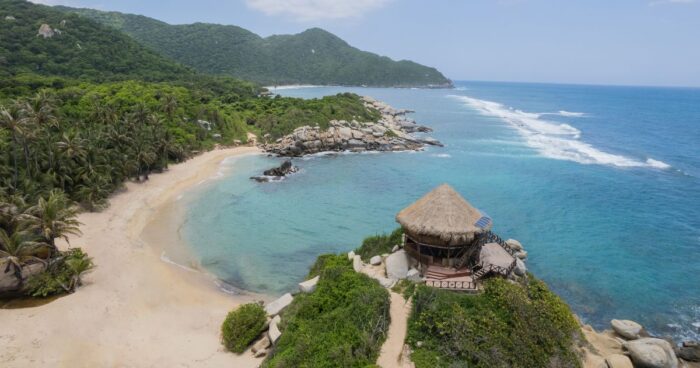
This beach is often counted among the most beautiful not just in Colombia but anywhere. Expect white sand, giant boulders, a palm-covered headland and a brilliant blue sea. Two beaches meet here, joined by a small rocky lookout that has become the symbol of the place. A river also flows out of the forest here, and there may be crocodiles in it.
At Cabo San Juan there are campsites and cabins, popular with travellers and locals alike (a friend of ours spent a few months here). You can reach Cabo San Juan on foot from Cañaveral or Calabazo, or by boat from Taganga, but I’d definitely recommend doing the whole thing on foot.
Hike to Cabo San Juan from Calabazo
If you want more of an adventure and would rather avoid the crowds, take the trail from the village of Calabazo. Far fewer people use this entrance. After a few hundred metres you’re in the jungle. The route climbs 450 m, is more than 8 km long and takes three to four and a half hours. In places you scramble over rocks, and the waymarking gets worse towards the end, so set off in the morning (the Calabazo entrance opens at 6 am). The archaeological settlement of Pueblito (Chairama), which the trail used to pass through, has been closed to tourists since 2019, and the path now goes around it.
The heart of Tayrona: Playa Arrecifes
Arrecifes beach lies in the very heart of Tayrona National Park and is known for its huge waves. The currents are strong, so it’s not a beach for swimming. What it does have is pale sand and lush greenery all around. It’s about 3 km from Cañaveral and you reach it on foot from the main trail.
TIP: Colombia isn’t only about nature. Take Medellín, which not long ago ranked among the most dangerous cities on Earth and today is full of tourists and reminders of Pablo Escobar. What to see in Medellín?

Hidden Playa Arenilla
This small, tucked-away beach is perfect if you want to be alone and soak up the calm in the middle of the tropical jungle. You’ll find it on the trail from Cañaveral towards Cabo San Juan. Not many people know about it, so you may well have it to yourself, just like we did (one of the most beautiful moments of my life).
Caribbean paradise at Playa La Piscina
Playa La Piscina lives up to its name (“the swimming pool”): the water is calm and ideal for snorkelling. Huge boulders and palm trees surround the beach and form a natural pool where you can swim in peace. La Piscina is less than 30 minutes’ walk from Cabo San Juan along the coastal trail, which makes it a good place for a break on the way to the more distant Cabo San Juan.
Ciudad Perdida trek to the Lost City
One of Colombia’s biggest draws is the trek to Ciudad Perdida, the “Lost City” and the great archaeological treasure of the Tairona. Here you’ll find the ruins of an ancient city, often called Colombia’s Machu Picchu. This Indigenous city dates from the 9th century, lies deep in the jungle, and the fact that no easy route leads there only adds to its magic.
You get there on a multi-day jungle hike that starts in the village of Mamey (El Machete). The Lost City is not actually inside Tayrona National Park but higher up in the Sierra Nevada de Santa Marta, and it is managed by Colombia’s anthropology institute, ICANH. The route crosses mountains and jungle, covers about 45 km there and back and takes 4 to 6 days, with around 1,200 stone steps waiting at the end. You’ll need the right kit and a guide, and it’s best done in the drier months (in the wettest months the rivers run high and are hard to ford). For a few weeks a year, usually in September, the site closes for Indigenous ceremonies, so check the dates with your tour operator. The Ciudad Perdida trek currently costs roughly 1.9 to 2.2 million COP per person (around £425–510 or €500–600), usually including the guide, meals, camp accommodation and transport from Santa Marta.
Sadly we had to skip the Ciudad Perdida trek, because the rainy season was starting and other travellers told us they had been fording rivers with their backpacks over their heads and water up to their necks, which doesn’t sound particularly safe. Hopefully next time.

Bahía Cinto
If you have some spare time, Bahía Cinto is another bay worth seeing. It’s quiet, and as everywhere in the park, the scenery is stunning. You get there by boat from nearby beaches such as Cabo San Juan.
Seven Waves Beach
Another of Tayrona’s beautiful beaches is Seven Waves, named after the number of waves that roll in to the shore one after another. The currents here are strong, so swimming is not allowed. Seven Waves is close to the trail from Cañaveral towards Cabo San Juan.
Secluded Neguanje beach
This beach is tucked away deep in Tayrona National Park, surrounded by forest and palms, with lovely views out to sea. Neguanje is popular with locals, who come here for the peace and quiet. You can’t get here from Cañaveral: access is through the separate Palangana entrance, from where a dirt road of about 12 km leads to the beach (by car, taxi or on a tour from Santa Marta), or you can come by boat. There can be strong currents at Neguanje too, so follow the flags. Small boats run from the beach to Playa Cristal.
Bahía Gayraca
Bahía Gayraca is one of the most beautiful bays in Tayrona. It’s known for its emerald-green water and sandy beaches where you can swim or go diving. You can reach Bahía Gayraca by boat or on foot along the trails.
Bahía Chengue
Bahía Chengue is one of the park’s lesser-known but lovely spots, with mangroves and salt lagoons. Note, however, that the park authority banned tourist activities here in 2019 (as it did at Los Naranjos beach, the eastern part of Bahía Concha and the Pueblito settlement), and there are no official trips here. If someone offers you one, check first that access is currently permitted.
Bahía Concha
Bahía Concha is a gorgeous bay with white sand and crystal-clear water, good for a proper swim. Locals and tourists alike love it. It’s the part of the park closest to Santa Marta (around 15 minutes along a dirt road, then a 20-minute walk to the beach) and it has its own, cheaper entrance fee (43,500 COP for foreigners). A good choice if you only have half a day or are travelling with children.
The beach at the end of the world: Playa Brava
If you have more time and want a real adventure, consider Playa Brava. This remote beach is hidden deep in the park and you can only reach it on foot: from the Calabazo entrance it’s several hours of walking through the jungle. If you’re up for a multi-day trek, you can do the Calabazo – Playa Brava – Cabo San Juan – El Zaino route (the Pueblito settlement is closed to tourists and the trail goes around it). The path takes you through jungle where you’ll feel you’ve reached the end of the world.
Playa Brava is calm and fringed with palms, and at night you can stay in bungalows on the beach, order dinner and take in the surroundings. If you still have energy for more, there’s an hour-long jungle walk to a waterfall.

Snorkelling near Tayrona
If you love the water, don’t miss a trip to Taganga, one of the best snorkelling spots around Tayrona. Boats from Taganga take you to a beach where you can snorkel in clear water among corals and shoals of colourful fish. The beaches inside the park aren’t really known for snorkelling, but Taganga won’t disappoint.
Playa Cristal and swimming with dolphins
Tayrona National Park is also home to dolphins, and Playa Cristal is the place to go looking for them. The dolphins like to move among the corals and rocks here, so with a bit of luck you might see them alongside sea turtles. Don’t expect an organised commercial tour, though. You get here by boat from the village of Taganga and the rest is up to what you arrange. The shortest route is through the Palangana entrance to Neguanje beach, from where a small boat takes about 10 minutes to Playa Cristal.
Mountain hikes and treks in the Sierra Nevada de Santa Marta
From Tayrona you can see all the way to Colombia’s highest mountains, the Sierra Nevada de Santa Marta. Local guides and tour operators offer all sorts of treks and trips into the mountains, and most of them start from the village of Mamey.
TIP: Our next adventure took us to wild Sri Lanka, with its tea plantations, stunning beaches and historic sites such as Sigiriya.
What we would do differently in Tayrona
If we went to Tayrona again, we wouldn’t rush straight to Cabo San Juan. It’s the most photographed spot in the park, and at midday there’s a queue for the lookout. Instead we’d spend two nights in the park, head to Arenilla or La Piscina first thing in the morning while they’re still empty, and only reach Cabo in the afternoon, when the day-trippers are walking back to the bus.
You don’t have to see every beach on the list above. To us, Tayrona isn’t a place for ticking things off. The best moments come when you’re in no hurry, sit on a rock above the sea and just listen to the jungle behind you. Leave your phone in your bag; there’s hardly any signal anyway.
And try what’s sold along the trails. Locals carry baskets of freshly baked chocolate bread, the beach restaurants serve fried fish with patacones and coconut rice, and stalls along the path squeeze fresh juices. We write more about what to try in Colombia in our article on Colombian food.
Tayrona National Park FAQ
How do I get to Tayrona National Park from Santa Marta?
The easiest way to get to Tayrona National Park is the bus from Santa Marta. Green Cootransoriente buses leave from the market (Calle 11 and Carrera 11) and also stop by the Buenavista shopping centre. The ride to the main El Zaino entrance takes about an hour and costs roughly 8,000 to 10,000 COP (around £2). You can also take a taxi, drive, or catch a boat from Taganga or Santa Marta to Cabo San Juan.
Where is the best place to stay in Tayrona National Park?
There are plenty of options. Inside the park you can sleep in a hammock or tent at the campsites at Cabo San Juan and near Arrecifes, or in the Ecohabs cabins near Cañaveral. Hotels and hostels in every price range are around the main El Zaino entrance and in the village of Los Naranjos.
What are the best beaches in Tayrona National Park?
The most popular beaches in Tayrona are Cabo San Juan, La Piscina and Playa Brava. Only a few are safe for swimming, such as La Piscina and Cabo San Juan; Arrecifes and Cañaveral have dangerous currents.
Can you buy Tayrona tickets online?
No, Tayrona tickets are bought on the day at the ticket office of the entrance you use (El Zaino, Calabazo, Palangana or Bahía Concha). The park has no booking system and a limited daily capacity, so in high season arrive first thing in the morning. You need your original passport and cash, and compulsory accident insurance is bought together with the ticket.
How much is the Tayrona entrance fee?
Foreign visitors currently pay 81,000 COP (around £19) in low season and 96,500 COP (around £22) in high season. The Bahía Concha sector costs 43,500 COP all year. On top of that there is compulsory insurance of roughly 7,000 COP per person per day.
When is Tayrona National Park closed?
The park closes three times a year: from 1 to 15 February, from 1 to 15 June and from 19 October to 2 November. It can also close at short notice, for example because of road blockades or the security situation, so check its status on the Parques Nacionales Naturales de Colombia website before you travel.
Do I need a yellow fever vaccine for Tayrona?
It isn’t compulsory across the board, but because of an ongoing yellow fever outbreak in Colombia, the UK’s TravelHealthPro recommends the vaccine for areas below 2,300 m, and some national parks may ask for proof. Get vaccinated at least 10 days before you travel and carry your international certificate of vaccination with you.
Potřebujete pomoct s cestováním?
-
Ubytování 🏨
Vyberte si to nejlepší ubytování, ať už jste kdekoliv, přes Booking.com. -
Půjčení auta 🚗
Auto si snadno najdete přes Booking.com, kde máte často slevu díky ubytování, nebo Rentalcars.com, kde porovnáte nabídky většiny půjčoven. -
Zážitky 🎟️
Přes GetYourGuide.com si vyberete z nejrůznějších výletů i zážitků po celém světě, navíc se zrušením zdarma do 24 h předem.