Last updated 29.8.2026
We love volcanoes. We had our first date on one, hiked a fair few together, and eventually even got married at the foot of another. They’re our thing — equal parts thrill and pure natural magic. The good news is that you don’t have to travel far to stand on one: Italy is packed with them. In this guide we’ll show you 8 volcanoes in Italy worth visiting — where they are, whether you can climb them and how much it costs.
You’ll save the most by driving your own car, using the lower (free) sections of the volcanoes and staying close to the trailheads. An apartment with a kitchen near Catania or Naples will cut your food costs considerably.
Volcanoes in Italy at a glance
- The big three: Vesuvius near Naples (1,281 m), Etna in Sicily (~3,320 m) and the ever-active Stromboli (924 m).
- Easiest: Vesuvius — just ~30 minutes from the car park to the crater. Entry around €11–12, timed booking compulsory.
- Most spectacular: Etna — return cable car ~€50, above 2,900 m only with a guide.
- Lava show: Stromboli — eruptions every 15–20 minutes, ascent only with a guide (~€30) up to 400 m, ideally at dusk.
- When to go: May–June and September–October; summer is hot and crowded, winter brings snow and wind on Etna.
- Heads-up: access changes with each volcano’s activity — always check dates and prices right before you travel.
Where to find volcanoes in Italy
Italy’s volcanoes aren’t scattered at random — they sit along the line where the African tectonic plate slides beneath the Eurasian one. You’ll find them in two main areas, and both slot neatly into an ordinary holiday.- Around Naples (Campania) — home to Vesuvius, the only active volcano on mainland Europe, and right next door the Campi Flegrei volcanic field with its sulphurous Solfatara. As a bonus you have Pompeii and Herculaneum, which Vesuvius buried in AD 79.
- Sicily and the Aeolian Islands — ruled by Etna, the highest active volcano in Europe. North of Sicily lie the volcanic Aeolian Islands with the tireless Stromboli, sulphurous Vulcano and the green island of Salina. The north has a volcanic past too: in Tuscany rises the extinct massif of Monte Amiata.
The 8 best-known volcanoes in Italy
We’ve ordered Italy’s volcanoes the way you’re most likely to plan them — from mainland Campania out to the Sicilian islands. For each one you’ll find where it is, whether you can climb it, what it costs, how demanding it is and one practical tip.1. Vesuvius — the icon above Naples
The most famous volcano in the world rises about 9 km from the centre of Naples to a height of 1,281 metres. It earned its fame with the eruption of AD 79, which buried Pompeii and Herculaneum; its last major awakening came in 1944. Today it’s “only” dormant, with volcanic gases seeping from the crater here and there — which is exactly what you’ll see from the viewpoint.- Where: Vesuvius National Park, near Naples (Campania). You can reach the Quota 1000 car park by car or bus (for example EAV / Vesuvio Express from Ercolano or Pompeii).
- Can you climb it: Yes, and easily. From the car park a gravel path leads up the Gran Cono to the crater in roughly 30 minutes.
- Entry / prices: A ticket for the crater path is around €11–12, cheaper for children and students. A timed booking is compulsory and must be bought online in advance.
- Difficulty: Easy to moderate — a short but dusty climb that gets steeper near the top on an unpaved track. Children manage it fine.
💡 Tip: You can do Vesuvius and Pompeii in a single day from Naples. Set off early to Pompeii, then head up Vesuvius around midday — in the afternoon cloud often rolls in off the sea and you lose the view over the bay. Find accommodation in Naples here →
2. Etna — the queen of Sicily
Etna, in south-eastern Sicily between Catania and Messina, stands around 3,320 metres tall, making it the highest active volcano in Europe — and one of the most active on the planet. The summit is made up of several craters (Bocca Nuova, Voragine and two eastern ones) surrounded by more than two hundred smaller side cones. There’s snow up here in winter, so you can even ski.- Where: From Catania it’s a 50–60 minute drive (about 35 km) to the lower cable-car station at Rifugio Sapienza (~1,900 m), or you can take the AST bus straight from Catania.
- Can you climb it: Yes, in several ways. The lower area up to ~2,000 m is free to walk. Higher up, the Funivia dell’Etna cable car carries you to a station at ~2,500 m, from where 4×4 vehicles continue.
- Entry / prices: The return cable car costs around €50, and cable car + off-road bus roughly €70–90. Above 2,900 m you’re officially only allowed with a licensed guide — a full-day climb with one comes to about €85–120 per person (a helmet is usually included).
- Difficulty: From easy (cable car and a stroll) to demanding (walking up to the summit craters with a guide). The paths are wide and well kept, but it’s windy and cold at altitude, even in summer.
💡 Tip: The cable car runs roughly from 8:30 to 16:00, with the last ascent around 15:50 — though service depends on the weather. Go first thing in the morning before cloud covers the summit. We’d only tackle the summit craters with a guide; you can book Etna tours and climbs through GetYourGuide →
3. Stromboli — the lighthouse of the Mediterranean
This small island north of Sicily is a single volcano from top to bottom — and it has been erupting non-stop for thousands of years. Glowing rocks fly from the 924-metre summit on average every 15–20 minutes, which is how Stromboli earned its nickname, “the lighthouse of the Mediterranean”. The eruptions show best after dark, so the climb is timed for late afternoon.- Where: The Aeolian Islands in the Tyrrhenian Sea. You get here by ferry or hydrofoil (Liberty Lines, Siremar) from Milazzo, Messina or the other Aeolian Islands.
- Can you climb it: Only partly. After a fatal accident in 2019 the summit is closed. Without a guide you can reach the Osservatorio viewpoint (~290 m); with a licensed guide you can go higher, to a viewpoint at ~400 m on the ridge above the Sciara del Fuoco.
- Entry / prices: A guided ascent (with an agency such as Magmatrek) costs around €30 and usually includes a helmet. Anyone who heads higher alone risks a fine and even being ordered off the island.
- Difficulty: Moderate — the climb to the viewpoint takes roughly 1.5–2.5 hours, the ground is stony and you descend in the dark. A head torch, sturdy boots and a warm jacket for the top are essential.
💡 Tip: Don’t fancy the climb? You can also watch the eruptions from the water on an evening boat trip around Sciara del Fuoco, where the glowing rocks tumble straight into the sea. There are no hostels on Stromboli and beds sell out fast — sort your accommodation, and any boat trip, well ahead.
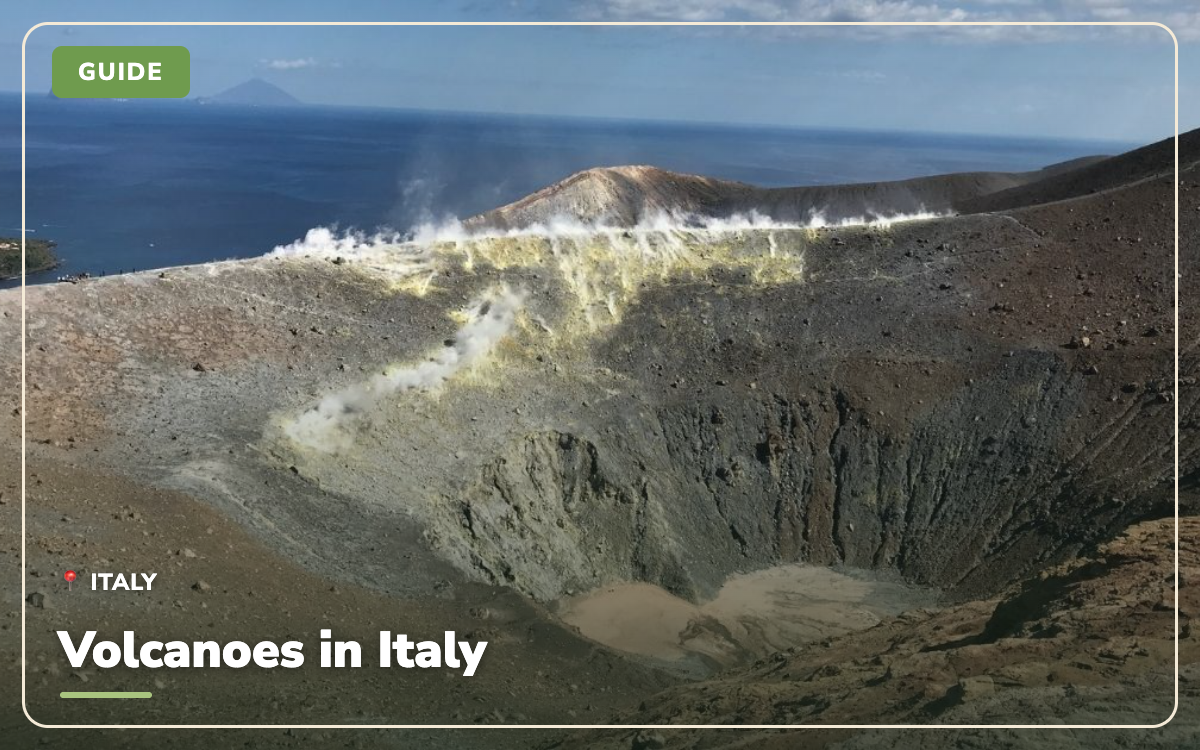
4. Vulcano — the volcano with healing mud
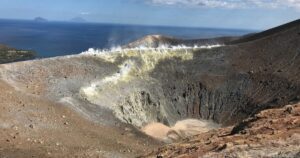
Right beside Stromboli, at the other end of the Aeolian Islands, lies Vulcano — the volcano that gave the word “volcano” to the world. It last erupted in 1890 but still “breathes”: sulphurous gases seep from the Gran Cratere (around 390 m) and, by the harbour, a pool of warm sulphurous mud bubbles away, once a popular spot for a soak.- Where: The southernmost of the Aeolian Islands, just a few minutes by hydrofoil from Lipari or Milazzo.
- Can you climb it: A path leads up to the rim of the Gran Cratere, but because of raised levels of sulphurous gas the trail is repeatedly closed for long spells (treat this as a rough guide, as the situation changes). Always check current access right before you travel.
- Entry / prices: When the path is open, a small entry fee is charged for the climb (a few euros as a rough guide). Bring sturdy boots — the trail is loose underfoot and smells of sulphur.
- Difficulty: Moderate — the climb to the crater takes about an hour, over loose ground that reeks of sulphur. The reward is a view over the whole archipelago and smoking Stromboli in the distance.
5. Salina — the greenest of the Aeolian Islands
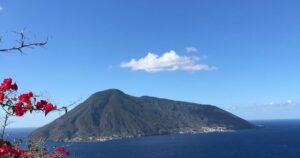
Salina is the second largest of the Aeolian Islands after Lipari, and it stands apart from its neighbours at first glance: instead of bare slopes it’s covered in lush greenery, vineyards and caper bushes. The island is made up of two extinct volcanoes, and its highest point, Monte Fossa delle Felci (962 m), is also the highest peak in the whole archipelago. The craters have long been extinct, so there’s no risk of an eruption, but in good weather you get views of smoking Stromboli and Sicily’s Etna.- Where: The Aeolian Islands, by hydrofoil or ferry from Lipari, Vulcano or Milazzo on Sicily.
- Can you climb it: Yes. A waymarked trail leads up Monte Fossa delle Felci, most often from the pilgrimage church of Madonna del Terzito in the Valdichiesa saddle. The summit sits in a nature reserve and the path climbs through shady chestnut and fern woodland.
- Entry / prices: The climb to the summit is free; you only pay to get to the island (ferries from around €15–20 one way as a rough guide).
- Difficulty: Moderate: the climb from Valdichiesa to the top takes about 2 hours and it’s a decent pull, but the trail is well marked and mostly shaded.
💡 Tip: Salina is famous for its sweet Malvasia wine and the capers that grow almost everywhere. Combine a tasting with the climb: sample the local specialities down below, then savour the view over the whole archipelago from the top.
6. Campi Flegrei and Solfatara — the supervolcano near Naples
West of Naples, around Pozzuoli, lies Campi Flegrei (the Phlegraean Fields) — a vast volcanic field that experts nickname a supervolcano. It isn’t a classic mountain with a crater but a whole network of craters, lakes and fumaroles. At its heart is Solfatara, a shallow crater around 770 metres across where steam hisses and hot mud bubbles.- Where: Pozzuoli, about 15 km west of Naples, easily reached by suburban train.
- Can you visit it: There’s no real “climbing” here — you walk through a lunar, sulphurous landscape instead. The Solfatara site is repeatedly closed for safety because of raised seismic activity, so check access in advance.
- Entry / prices: If Solfatara is open, a token entry fee applies; the area’s activity changes, though, so treat this as a rough guide only.
- Difficulty: Easy — it’s a flat walk. Just watch out for the fumes and stick to the marked paths.
💡 Tip: Campi Flegrei is under constant watch by volcanologists and the area is often shaken by minor earthquakes. If you’re planning a visit, follow the latest news and the park’s official pages — things can change from one day to the next.
7. Ischia — the volcanic island with thermal spas
The popular island of Ischia in the Bay of Naples is volcanic too. Its highest point, Monte Epomeo (789 m), is a volcanic massif that last spewed lava in the 14th century. These days Ischia is more about relaxing than lava — thanks to the volcanic activity, hot mineral water rises from dozens of springs, and the island is famous for its thermal spas and parks.- Where: An island in the Bay of Naples, by ferry or hydrofoil from Naples or Pozzuoli.
- Can you climb it: Yes, a waymarked walking trail leads up Monte Epomeo — no smoking craters, but a glorious panorama over the bay.
- Entry / prices: The climb is free; you only pay to enter the thermal parks (tens of euros a day as a rough guide).
- Difficulty: An easy to moderate walk; you’ll reach the top in 1–1.5 hours from the village of Fontana.
8. Monte Amiata — a volcano in the heart of Tuscany
Southern Italy doesn’t have all the volcanoes. About two hours’ drive south of Siena rises Monte Amiata (1,738 m), an extinct volcanic massif, Italy’s second highest volcano and the highest point in Tuscany. It last erupted around 180,000 years ago, so today it’s a forested mountain with views across virtually the whole of Tuscany. Thanks to its volcanic past, thermal springs rise from underground and you’ll find sulphur spas nearby, such as the much-loved Bagni San Filippo.- Where: Southern Tuscany, on the border of the Siena and Grosseto provinces, best reached by car from around the Val d’Orcia.
- Can you climb it: Yes, and easily. A network of waymarked trails and forest tracks leads to the top. Don’t expect any smoking craters, though — this is a peaceful mountain hike through woodland.
- Entry / prices: The climb is free. In winter a small ski resort operates on the slopes (snow lingers here a long time), and entry to the thermal spas nearby is charged separately (a few to tens of euros as a rough guide).
- Difficulty: An easy to moderate walk on well-maintained paths, suitable for families with children too.
💡 Tip: Monte Amiata is a great add-on to a classic Tuscan tour of the Val d’Orcia and Siena. After your woodland walk, go for a soak in the warm sulphur cascades at Bagni San Filippo, which are freely accessible and free of charge.
How to climb safely and with a guide
Volcanoes are beautiful precisely because they’re alive — and that means a degree of unpredictability. A few rules worth sticking to:- Respect closures and zones. On both Stromboli and Etna the summit areas are accessible only with a guide, or not at all. It’s not red tape — after accidents and eruptions, lives are at stake. Fines for entering a restricted zone run into hundreds of euros.
- Take a licensed guide for summit climbs. Local volcano guides know the current state of the volcano, carry a helmet and usually include safety gear in the price. A guide is compulsory above 2,900 m on Etna and for the higher Stromboli viewpoint.
- Keep an eye on weather and visibility. On Etna the summit often clouds over within an hour, and the cable car doesn’t run in high wind. Mornings give you the best chance of a view.
- Wear the right footwear and layers. Volcanic gravel is sharp and slides underfoot; forget sandals. Above 2,500 m it’s cold and windy even in summer.
💡 Tip: Guided experiences on Etna and tours around Catania are well worth booking ahead, especially in season — the good slots (particularly sunset) go quickly. Climbs and volcano trips in Sicily →
When to go and what to pack
The best time for Italy’s volcanoes is spring (May–June) and autumn (September–October). The weather is more settled, it’s not so hot and there are fewer tourists than in July and August. In summer it’s stifling down below and the car parks are heaving; in winter there’s snow on Etna — the cable car still runs, but expect frost and wind, and the lower volcanoes tend to be windy and wet.Whatever you’re heading for, here’s what to pack:- Sturdy boots with a proper sole — volcanic gravel is sharp and slippery.
- Layers and a windproof jacket — the summit of Etna hovers around freezing even in summer.
- A head torch for Stromboli, where you descend in the dark.
- Water, sun cream and a hat — the sun is fierce up top and there’s no shade.
- A scarf over your nose at Solfatara and Vulcano, because of the sulphurous gases.
How much it costs (budget)
Volcanoes themselves aren’t expensive — you mainly pay to get up them and for a guide. For a rough idea, here are approximate prices per person (2025/2026 season; always check before you travel):| Item | Approximate price |
|---|---|
| Vesuvius — crater entry | ~€11–12 |
| Etna — return cable car | ~€50 |
| Etna — cable car + off-road bus | ~€70–90 |
| Etna — full-day guided climb | ~€85–120 |
| Stromboli — guided climb | ~€30 |
| Vulcano — crater entry | a few € |
| Ferry / hydrofoil to the Aeolian Islands | from ~€20 one way |
| Accommodation (guesthouse / apartment, 2 people) | from ~€60–90 / night |
💡 Tip: For Sicily with Etna it pays to base yourself in Catania — it’s an hour from the cable car and you can head into town in the evening. Accommodation in Catania below Etna →
Where to stay near the Italian volcanoes
The volcanoes are scattered across southern Italy, so pick your base by target. For Etna stay in Catania, for Vesuvius in Naples or Sorrento, and for Stromboli and Vulcano on the Aeolian Islands themselves.
- Budget: a hostel bed in Catania or Naples roughly €25 to €45 per person per night.
- Mid-range: a double room in a guesthouse €80 to €130 with breakfast.
- On the Aeolian Islands: beds are few and sell out months ahead in summer, especially on Stromboli.
- Worth knowing: you only see the night eruptions of Stromboli if you sleep on the island. A day trip will not do it.
Compare current prices and availability through accommodation near the volcanoes.
Where to next
- Which Aeolian Islands have volcanoes and which are active?
- What to see in Sicily: 30 of the most beautiful places
- Lakes in Italy: the most beautiful and what to do there (2026)
- Camping in Italy: a practical guide (2026)
Frequently asked questions about volcanoes in Italy
Experiences and tickets at Italy’s volcanoes
traveller-verified · GetYourGuide
★ Our pick


Prices and ratings are indicative (source: GetYourGuide); you’ll see the latest after clicking.
How many active volcanoes are there in Italy?
Italy has three main active volcanoes worth visiting: Vesuvius near Naples, Etna in Sicily and Stromboli in the Aeolian Islands. Add to those Vulcano and the vast Campi Flegrei volcanic field (a supervolcano) near Pozzuoli. Vesuvius, meanwhile, is the only active volcano on mainland Europe.Which Italian volcano is the highest?
The highest is Etna in Sicily, at around 3,320 metres — and it’s also the highest active volcano in all of Europe. For comparison, Vesuvius stands at 1,281 metres and Stromboli at 924 metres.Can you climb Vesuvius?
Yes, and it’s easy. From the upper car park a gravel path leads to the crater in about 30 minutes. Entry is around €11–12 and a timed booking is required, which you buy online in advance.How much does it cost to climb Etna?
The return Funivia dell’Etna cable car costs around €50, and combined with an off-road bus roughly €70–90. You can walk the lower slopes up to about 2,000 m for free. Above 2,900 m you’re only allowed with a licensed guide — a full-day climb comes to about €85–120 per person.Can you climb to the summit of Stromboli?
Not to the very top — it’s been closed since a fatal accident in 2019. Without a guide you can reach the Osservatorio viewpoint (~290 m); with a licensed guide you can go higher, to a viewpoint at about 400 metres above sea level. A guided climb costs around €30.When is the best time to visit Italy’s volcanoes?
Spring (May–June) and autumn (September–October) are best — bearable temperatures, more settled weather and fewer people. Summer is hot and crowded, while in winter there’s snow and wind on Etna.Are Italy’s volcanoes dangerous for tourists?
As long as you follow the rules, visits are safe. The key is to respect closed zones, take a licensed guide for summit climbs and keep track of the volcano’s current state. Access changes with activity — Solfatara and the Stromboli summit are often closed.Which volcano is best for watching lava and eruptions?
Stromboli, without a doubt — it erupts on average every 15–20 minutes, so you’re almost certain to see glowing eruptions. They show best at dusk and after dark, which is why climbs set off late in the afternoon. You can also watch them from a boat on a trip around the Sciara del Fuoco.What should you take on a volcano climb?
Sturdy boots for rough ground, layers and a windproof jacket (Etna is cold even in summer), a head torch for Stromboli, plenty of water, sun cream and a hat. A scarf over your nose is handy at Solfatara and Vulcano because of the sulphurous gases.Can you see both Vesuvius and Pompeii in one day?
Yes. From Naples you can do Pompeii in the morning and climb Vesuvius in the afternoon — suburban trains and shuttle buses link the two. Aim for Vesuvius around midday, though, as cloud often rolls in over the bay in the afternoon and you’ll lose the view.
Potřebujete pomoct s cestováním?
-
Ubytování 🏨
Vyberte si to nejlepší ubytování, ať už jste kdekoliv, přes Booking.com. -
Půjčení auta 🚗
Auto si snadno najdete přes Booking.com, kde máte často slevu díky ubytování, nebo Rentalcars.com, kde porovnáte nabídky většiny půjčoven. -
Zážitky 🎟️
Přes GetYourGuide.com si vyberete z nejrůznějších výletů i zážitků po celém světě, navíc se zrušením zdarma do 24 h předem.