What to See in Venice: 30 Best Things to Do (2026 Guide)
Last updated 30.8.2026
Venice is one of those cities where you get hopelessly lost on your very first day, and honestly, that is the best thing you can do. Around the corner of every narrow lane there is something worth stopping for, so our advice is simply to wander. You can cover the city over a long weekend or in a single packed day, depending on how many hidden corners you want to squeeze in. So, what to see in Venice, and how do you make the most of this improbable city built on water?
What to see in Venice at a glance
What to see in Venice: St Mark’s Square and Basilica, the Doge’s Palace, the Bridge of Sighs, the Grand Canal and the Rialto Bridge.
Day trips from the centre: Murano (glass), Burano (colourful houses), Torcello and the cemetery island of San Michele.
How many days: ideally 2–3 — one for the historic core, one for the lagoon islands, one for the quieter neighbourhoods.
Getting around: on foot in the centre, by vaporetto (water bus) out to the islands — single ticket €9.50, day pass €25.
Entry fee: on selected spring and summer days in 2026, day trippers pay €5–10 (anyone staying overnight in the city is exempt).
Budget: backpackers can do a day from around €70; for a comfortable trip, reckon on €100–150 per person.
Getting to Venice and getting around (vaporetto, entry fee)
The historic centre of Venice is completely car-free — you leave the car on the mainland (the Tronchetto or Piazzale Roma car parks, roughly €25–35 a day) and walk into the city, or arrive by train right at Santa Lucia station. If you fly in, you’ll land at Marco Polo Airport, from where a bus or the Alilaguna boat service will take you into town.Around the city itself you get about on foot, which is the best way to get to know Venice and, more often than not, the quickest. For longer hops and especially for the lagoon islands, there’s the vaporetto, the water bus run by ACTV:
Single ticket: €9.50, valid for 75 minutes including transfers.
Day pass (24 h): €25 — it pays for itself after just three rides.
Multi-day: 48 h for €35, 72 h for €45, 7 days for €65.
💡 Tip: Lines 1 and 2 run the full length of the Grand Canal past the finest palazzi — so for the price of a ticket you get a sightseeing cruise through the city. Grab a seat at the back on the open deck and you’ve got yourself a “poor man’s gondola” for a fraction of the cost.
The Venice entry fee (contributo di accesso). Since 2024 the city has charged an access fee to day visitors on selected days. In the 2026 season it applies on selected days from April to 26 July, always between 8:30 and 16:00. The fee is €5 if you book and pay in advance (up to four days ahead), or €10 at the last minute. You register and pay online on the official portal, where you’ll receive a QR code for the checks.
💡 Tip: Anyone staying overnight in Venice is exempt from the fee (you pay the accommodation tourist tax instead) — you just need to register for the exemption. Children under 14 are also free. Check the current list of chargeable days before you travel, as it changes every year.
We’ve roughly ordered them from the best-known sights, the ones everyone comes to see in Venice, down to the quieter, hidden corners. If you’ve only got one day, walk points 1 to 9; with more time on your hands, work your way through the rest too.
1. St Mark’s Square (Piazza San Marco)
The only true “square” (piazza) in Venice and the heart of the city — Napoleon supposedly called it the most beautiful drawing room in Europe. It’s ringed by arcades, cafés with live music and the city’s headline landmarks. Come early in the morning, when it’s half-empty and the light on the basilica is at its loveliest. Watch out for the high water (acqua alta) in autumn and winter — the square is one of the first places to flood.
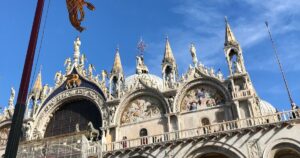
2. St Mark’s Basilica (Basilica di San Marco)
The finest example of Byzantine architecture in Europe — the façade and interior alike blaze with golden mosaics, which is how it earned the nickname “Church of Gold”. Entry to the basilica itself is cheap (around €3), with extra charges for the Pala d’Oro golden altarpiece (about €5), the museum and the terrace overlooking the square. The queues can be long.
💡 Tip: Book a timed-entry ticket online — you can easily save an hour of queuing. Large rucksacks aren’t allowed inside (there’s a left-luggage point just around the corner), and you’ll need to cover your shoulders and knees.
3. St Mark’s Campanile (Campanile)
A brick bell tower nearly 99 metres tall, whose viewing gallery gives you the best view over the whole of Venice and the lagoon — and there’s a lift to the top, so no stairs to worry about. Entry costs around €10. First thing after opening is when you’ll find the fewest people and the clearest air.
4. The Doge’s Palace (Palazzo Ducale)
The former seat of the Venetian doges and the centre of the republic’s power — a Gothic masterpiece of vast halls, Tintoretto canvases and old prison cells. Entry is around €30, often combined with the Correr Museum. The Secret Itineraries tour through the hidden passages and cells is well worth it too.
5. The Bridge of Sighs (Ponte dei Sospiri)
This covered stone bridge from 1614 links the Doge’s Palace interrogation rooms with the prison. It got its name from the sighs of prisoners who caught their last glimpse of freedom as they crossed it. The best spot to photograph it from the outside is the Ponte della Paglia — though expect a crowd.
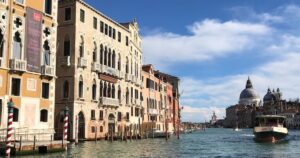
6. The Grand Canal (Canal Grande)
The near-4 km main “avenue” of Venice, curving through the city like a reversed S from the station all the way to St Mark’s Square, lined with hundreds of palazzi. The cheapest way to travel its full length is vaporetto line 1 — a €9.50 ride that’s an experience in its own right.
7. The Rialto Bridge (Ponte di Rialto)
The oldest and most famous bridge across the Grand Canal, completed in 1591. It stands at the geographical heart of the city and, as well as the view, has little shops right on the bridge itself. Photograph it at dawn before the crowds arrive — by day thousands of people pass over it.
8. The Rialto Market (Mercato di Rialto)
Right by the bridge, a fish and vegetable market has been going for centuries — locals still come here for fresh fish and seasonal produce. It’s open in the mornings (the fish market is usually closed on Mondays). A brilliant spot for photos and for putting together a picnic. There are also plenty of bacari serving cicchetti around the market (more on those below).
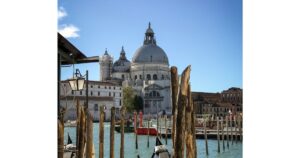
9. Basilica di Santa Maria della Salute
A mighty Baroque church with a white dome at the tip of the Dorsoduro district — built in thanks for the end of a 17th-century plague. Entry to the main nave is free, with a few euros extra for the sacristy and its Titian and Tintoretto works. From its steps there’s a beautiful view across the canal to St Mark’s Square.
10. Basilica di Santa Maria Gloriosa dei Frari
An enormous brick Gothic church that is, quite literally, a gallery of Venetian art — home to Titian’s Assumption of the Virgin, and his tomb too. Entry is around €5. It’s far calmer than St Mark’s Basilica, yet crammed to bursting with art.
11. Scuola Grande di San Rocco
Nicknamed the “Venetian Sistine Chapel” — its walls and ceilings are covered with more than 60 canvases by Tintoretto, who worked on them for over 20 years. Entry is around €10. Borrow one of the mirrors they hand out at the door so you don’t wreck your neck studying the ceilings.
12. Gallerie dell’Accademia
Venice’s main art gallery, with a collection of Venetian painting from the 14th to the 18th century — Titian, Tintoretto, Veronese, Bellini, Carpaccio. A must for art lovers. Entry is around €12, and on certain days it’s reduced or free.
13. The Peggy Guggenheim Collection
The complete opposite of the old masters — modern art (Picasso, Pollock, Dalí, Ernst) in an unfinished palazzo right on the Grand Canal, where the collector Peggy Guggenheim once lived. Entry is around €16. The lovely sculpture garden and the terrace over the canal are a bonus.
14. Ca’ d’Oro (the Golden House)
One of the most beautiful Gothic palazzi on the Grand Canal, once famous for its gilded façade. Today it houses the Franchetti Gallery. Even if you don’t go inside, it’s worth photographing from the water — best of all from the market opposite or from the vaporetto.
15. Ca’ Rezzonico
A grand Baroque palazzo on the Grand Canal, now a museum of 18th-century Venice (Museo del Settecento Veneziano) — period interiors, furniture and frescoes by Tiepolo. Entry is around €10. A calm, underrated stop in Dorsoduro.
16. Palazzo Contarini del Bovolo
A hidden gem tucked away in the lanes just off Rialto — a palazzo with a gorgeous external spiral staircase (bovolo means “snail” in Venetian dialect). From the top there’s a pretty view over the rooftops. Entry is around €9. Hardly anyone finds their way here, and that’s exactly its charm.
17. Teatro La Fenice
One of the most famous opera houses in the world, which literally rose from the ashes (fenice = phoenix) after several fires. An audio-guided tour of the interior costs around €12, more with a live guide. Better still, of course, is catching a performance here.
18. San Giorgio Maggiore
Palladio’s white church on its own little island across from St Mark’s Square. Entry to the church is free, and the lift up the bell tower (around €8) takes you to one of the loveliest views of Venice — with no queue, unlike the Campanile by St Mark’s. You get here on vaporetto line 2.
19. The Jewish Ghetto (Ghetto Ebraico)
The very first ghetto in the world (the word itself comes from here) in the Cannaregio district — a quiet square, several synagogues and the Jewish Museum. With so little space, houses were built upwards here, making them the tallest in Venice. A peaceful neighbourhood off the tourist trail, full of good bacari.
20. Libreria Acqua Alta
The most photogenic bookshop in the world — the books are stacked in gondolas, bathtubs and boats to keep them safe from the high water. At the back there’s a “staircase of books” with a view over the canal, plus resident cats. Entry is free, but take it with a pinch of salt — these days it’s a very touristy spot.
21. Squero San Trovaso (gondola boatyard)
One of the last working yards where gondolas are still built and repaired by hand. You can’t usually go in, but from the opposite bank in Dorsoduro you get a lovely view and a real sense of how much work goes into a single gondola. And, by the by, a celebrated gelateria and a couple of wine bars are just next door.
22. A gondola ride
A cliché? Perhaps. But a gondola ride is part of the Venice experience. The official rate is €80 for 30 minutes by day (from 19:00, roughly €100) for the whole boat — not per person, so with four of you it works out far more reasonably. Agree the route and price beforehand.
💡 Tip: A cheap alternative is the traghetto — a public gondola that ferries people across the Grand Canal for a few euros at points without a bridge. You cross standing up in a few minutes, but it’s an authentic gondola for a fraction of the price.
23. The Dorsoduro district
A studenty, quieter neighbourhood full of galleries (Accademia, Guggenheim), churches and the Zattere waterfront, where locals head for an evening spritz by the water. This is where you’ll feel how Venice lives once the day trippers have gone.
24. Lido di Venezia
A long sandy island between the lagoon and the sea — Venice’s beach and the home of the film festival. In summer the Venetians come here to swim, there are both free and paid beaches, and it’s a pleasant place for a bike ride. It’s roughly 15–20 minutes from the centre by vaporetto.
25. The Clock Tower (Torre dell’Orologio)
A Renaissance tower from the late 15th century right on St Mark’s Square, where two bronze Moors strike the hours on a great bell at the top. Below them glows a blue-and-gold clock face with the phases of the moon and the signs of the zodiac. You can only go inside on a pre-booked guided tour (roughly €15, €11 reduced), which usually includes entry to the neighbouring Museo Correr.
26. Museo Correr
The civic museum, in the Napoleonic Wing of St Mark’s Square, traces the history and art of the Venetian republic, from Canova’s sculptures to a gallery of old masters. It’s usually part of a combined ticket with the Doge’s Palace (around €30 together), so if you’re visiting the palace, the Correr is practically on your way. The calm and the views over the square from its windows are a welcome bonus.
27. Basilica dei Santi Giovanni e Paolo (San Zanipolo)
An enormous Dominican Gothic church in Castello, known to locals as San Zanipolo, and the burial place of more than twenty Venetian doges — hence its nickname, the Venetian pantheon. In front of it stands Verrocchio’s famous equestrian statue of the condottiere Colleoni. Entry is cheap (roughly €3.50) and the crowds are a fraction of those at St Mark’s.
28. The Venetian Arsenal (Arsenale)
A sprawling historic shipyard, once the largest industrial complex in pre-industrial Europe, from which the republic’s mighty fleet set sail. The Porta Magna gateway is guarded by ancient stone lions. Today part of it hosts the Venice Biennale, and the Naval History Museum is right next door. Even just a stroll along the walls in quiet Castello is worth it.
29. Il Redentore and the island of Giudecca
Palladio’s white Church of the Most Holy Redeemer (Il Redentore) on the island of Giudecca was built in thanks for the end of a 16th-century plague. Giudecca is a short vaporetto hop from the centre and offers one of the loveliest views back across the water to the Venice skyline. On the third Sunday of July the Festa del Redentore is held here, with a huge fireworks display over the lagoon.
30. The Venice Biennale and the Giardini
The green Giardini gardens on the eastern edge of the city hide dozens of national pavilions, where the art and architecture Biennales alternate every other year — one of the most prestigious showcases in the world. Even outside the exhibition it’s a pleasant park in which to escape the pavements and the crowds. Entry to the Biennale is roughly €30.
The lagoon islands (Murano, Burano)
If you’ve got at least two days in Venice, give one of them over to the lagoon islands — the atmosphere is a world away from the crowded centre, and they’re among the loveliest things to see in Venice and its surroundings.
Murano — the island famed for its glassblowing. You can watch a glassworks at work (some demonstrations are free, others paid) and buy genuine Murano glass. Beware of imitations — the real thing carries the Vetro Artistico Murano mark.
Burano — fairy-tale colourful fishermen’s houses and a lace-making tradition. The most photogenic island in the lagoon; you could easily spend half a day here just strolling and taking photos. Try the local bussolà biscuits.
Torcello — one of the oldest inhabited islands, now almost deserted. The main draw is the Cathedral of Santa Maria Assunta, with Byzantine mosaics of the Last Judgement, reckoned to be among the finest in Italy.
San Michele — the island cemetery, walled in brick and dotted with cypresses; among those buried here are Igor Stravinsky and Ezra Pound. A quiet, unusual place on the way to Murano.
💡 Tip: For the islands it’s worth getting a vaporetto day pass (€25) — single tickets would cost you far more once you start hopping between Murano, Burano and Torcello. Set off first thing in the morning, as the crowds don’t reach Burano until around midday.
The Venetian classic isn’t a tourist set menu by the square, but cicchetti — little bites and snacks washed down with a glass of wine. You eat them standing up in a bacaro (a Venetian wine bar), often during the afternoon ombra, as a glass of wine is known here.
Cicchetti — a slice of bread topped with cod (baccalà mantecato), sardines, cheese or meat; usually €1.50–3 a piece. Three or four make a cheap, authentic lunch.
Spritz — Aperol or Select with soda, the local afternoon ritual; around €3–4 in a bacaro (on St Mark’s Square, easily three times that).
Sarde in saor — sardines marinated with onion, raisins and pine nuts, a Venetian speciality.
Risotto al nero di seppia — risotto in a black cuttlefish sauce, or perhaps fritto misto (fried seafood).
💡 Tip: Eat where the locals do — typically around the Rialto Market and in the Cannaregio and Dorsoduro districts. Steer clear of places with menus displayed in four languages near the main attractions. And watch out for the coperto (cover charge) and service — check the price list before you sit down.
How much it costs (budget)
Venice is one of Europe’s pricier cities, but with a bit of sense it can be done on a shoestring too. A rough daily budget per person:
Item
Backpacker
Comfortable
Accommodation (hostel bed / guesthouse per person)
€30–45
€60–110
Food (cicchetti, pizza, self-catered breakfast)
€15–25
€35–60
Transport (vaporetto / day pass)
€0–10 (on foot)
€25 (day pass)
Entry (1–2 sights)
€10–20
€30–50
Entry fee (selected days only)
€5
€5–10
Total per day
approx. €60–100
approx. €155–255
Where you can save the most: walk instead of taking the vaporetto, eat cicchetti rather than restaurant meals, make the most of the free churches (Salute, San Giorgio, the Frari for a few euros), and sleep on the mainland in Mestre, a few minutes from the centre by train — where accommodation is markedly cheaper.
Where to stay in Venice
The choice is simple: on the island or on the mainland. The historic centre, especially Cannaregio and Dorsoduro, costs more, but early morning and evening you get the city almost to yourself. Mestre on the mainland is about half the price and ten minutes by train from Santa Lucia.
Budget: a hostel bed in Mestre roughly €30 to €50 per person per night.
Mid-range: a double room on the island €140 to €220 in season, about half that in Mestre.
If you only stay one night: sleep on the island. Venice at dawn and after dark is the reason to come.
Worth knowing: you will drag your suitcase over bridge steps and water taxis are expensive. Pick a place near a vaporetto stop.
Prices and ratings are indicative (source: GetYourGuide); you’ll see the current figures once you click through.
What to see in Venice in one day?
You can cover the heart of the city: St Mark’s Square and Basilica, the Doge’s Palace, the Bridge of Sighs, a walk across the Rialto Bridge and a vaporetto ride along the Grand Canal. Start early in the morning at St Mark’s, before the crowds arrive, and book your basilica and palace tickets in advance.How many days should you set aside for Venice?
Two to three days is ideal. Day one for the historic core, day two for the lagoon islands (Murano, Burano, perhaps Torcello), day three for quieter neighbourhoods like Dorsoduro and Cannaregio. One day works too, but you’ll only see the best-known sights, and in the crowds.Is there an entry fee for Venice?
Yes, on selected days from April to 26 July 2026, day visitors pay a fee of €5 (booked in advance) or €10 (last minute), always between 8:30 and 16:00. Anyone staying overnight in Venice is exempt, but has to register for the exemption. Children under 14 are free.How much does the vaporetto cost in Venice?
A single ticket costs €9.50 and is valid for 75 minutes. A day pass (24 h) is €25, 48-hour €35, 72-hour €45 and a weekly pass €65. If you plan on going out to the islands, the day pass pays for itself after just three rides.How much does a gondola ride cost?
The official rate is €80 for 30 minutes by day and around €100 in the evening (from 19:00) — and that’s for the whole boat, not per person, so with more people it works out more reasonably. A cheap alternative is the public traghetto gondola, which ferries you across the Grand Canal for a few euros.Is it worth booking St Mark’s Basilica tickets in advance?
Absolutely. Queues for the basilica can run to an hour or more. An online timed-entry ticket lets you skip ahead. Remember that you can’t take large rucksacks inside, and you’ll need to cover your shoulders and knees.When is the best time to visit Venice?
The most pleasant months are April–June and September–October, when it’s neither as hot nor as crowded as in summer. Summer is hot and packed with tourists; winter tends to be quiet and cheap, though autumn and winter bring the risk of high water (acqua alta). The Carnival in February is an experience, but prices and crowds climb.Is Venice expensive?
It’s one of Europe’s pricier cities, especially for accommodation and food near the main attractions. As a backpacker, though, you can manage a day from around €60–100 per person if you walk, eat cicchetti and sleep outside the tourist core. A more comfortable option works out at €155–255 a day.Are the islands of Murano and Burano worth a trip?
Yes, without a doubt. Murano is famed for its glassblowing, Burano for its fairy-tale colourful houses and lace. The atmosphere is calmer than in the centre. Get a vaporetto day pass and set off in the morning, before the crowds reach Burano.How do you get from Marco Polo Airport to the centre of Venice?
The cheapest way is the bus to Piazzale Roma (around €10, roughly 20–25 minutes), from where you continue on foot or by vaporetto. More romantic and pricier is the Alilaguna boat service straight into the centre. A water taxi is the fastest, but costs considerably more.Where can you eat cheaply in Venice?
In the bacari, on cicchetti — small open sandwiches at €1.50–3 a piece, typically around the Rialto Market and in the Cannaregio and Dorsoduro districts. Avoid restaurants with multilingual menus near the main attractions, and keep an eye on the cover charge (coperto).
Potřebujete pomoct s cestováním?
Ubytování 🏨
Vyberte si to nejlepší ubytování, ať už jste kdekoliv, přes Booking.com.
Půjčení auta 🚗
Auto si snadno najdete přes Booking.com, kde máte často slevu díky ubytování, nebo Rentalcars.com, kde porovnáte nabídky většiny půjčoven.
Zážitky 🎟️
Přes GetYourGuide.com si vyberete z nejrůznějších výletů i zážitků po celém světě, navíc se zrušením zdarma do 24 h předem.
Abychom poskytli co nejlepší služby, používáme k ukládání a/nebo přístupu k informacím o zařízení, technologie jako jsou soubory cookies. Souhlas s těmito technologiemi nám umožní zpracovávat údaje, jako je chování při procházení nebo jedinečná ID na tomto webu. Nesouhlas nebo odvolání souhlasu může nepříznivě ovlivnit určité vlastnosti a funkce.
Funkční
Always active
Technické uložení nebo přístup je nezbytně nutný pro legitimní účel umožnění použití konkrétní služby, kterou si odběratel nebo uživatel výslovně vyžádal, nebo pouze za účelem provedení přenosu sdělení prostřednictvím sítě elektronických komunikací.
Předvolby
Technické uložení nebo přístup je nezbytný pro legitimní účel ukládání preferencí, které nejsou požadovány odběratelem nebo uživatelem.
Statistiky
Technické uložení nebo přístup, který se používá výhradně pro statistické účely.Technické uložení nebo přístup, který se používá výhradně pro anonymní statistické účely. Bez předvolání, dobrovolného plnění ze strany vašeho Poskytovatele internetových služeb nebo dalších záznamů od třetí strany nelze informace, uložené nebo získané pouze pro tento účel, obvykle použít k vaší identifikaci.
Marketing
Technické uložení nebo přístup je nutný k vytvoření uživatelských profilů za účelem zasílání reklamy nebo sledování uživatele na webových stránkách nebo několika webových stránkách pro podobné marketingové účely.