Last updated 30.8.2026
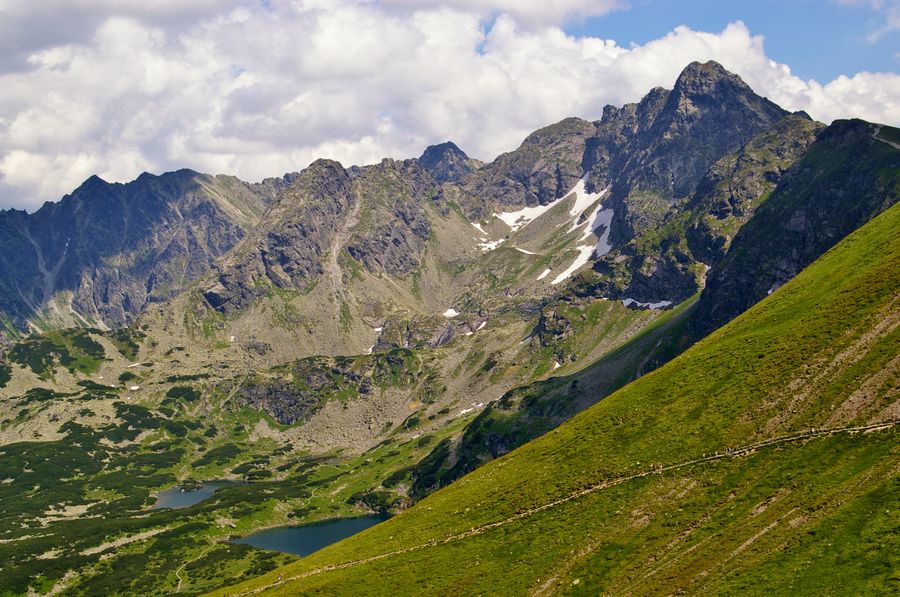
The High Tatras are the smallest alpine range on Earth, and also the most tightly guarded piece of nature in Slovakia. First, the thing nobody tells you: the Tatras are shared by two countries. The range sits on the Slovak-Polish border, and this guide is about the Slovak side, which is the larger one and the one with the cable cars, the mountain huts and the little electric railway that links every trailhead. Slovakia uses the euro, not the Polish złoty. Distances here are short, the rules are strict, and the weather can move faster than you do. Below is what actually works for hiking in the High Tatras, and one date most articles online still get wrong.
In short: hiking the High Tatras in Slovakia
- The seasonal closure of high-mountain trails in the Tatra National Park runs from 1 November to 31 May. Not to mid-June, as half the internet still repeats.
- Easy walks exist, but they are in the valleys and around the lakes, never over the saddles. Štrbské pleso, the Skok waterfall, Popradské pleso and Hrebienok are all fine for an inexperienced walker.
- Cable cars save you hundreds of metres of climbing: the Hrebienok funicular from Starý Smokovec, the gondola from Tatranská Lomnica to Skalnaté pleso, the aerial cableway on to Lomnický štít, and Solisko Express at Štrbské Pleso.
- Swimming is banned in every mountain lake in the park, and enforcement was tightened in August 2026.
- The Tatra Electric Railway (TEŽ) connects all the resorts, so you can walk one way and ride back rather than looping.
- Wild camping is allowed at exactly one spot in the whole park, and even there under strict conditions.
- Mountain rescue in Slovakia is chargeable. Get insurance before you go and save the number 18 300.
The Tatra Mountains: Slovakia or Poland?
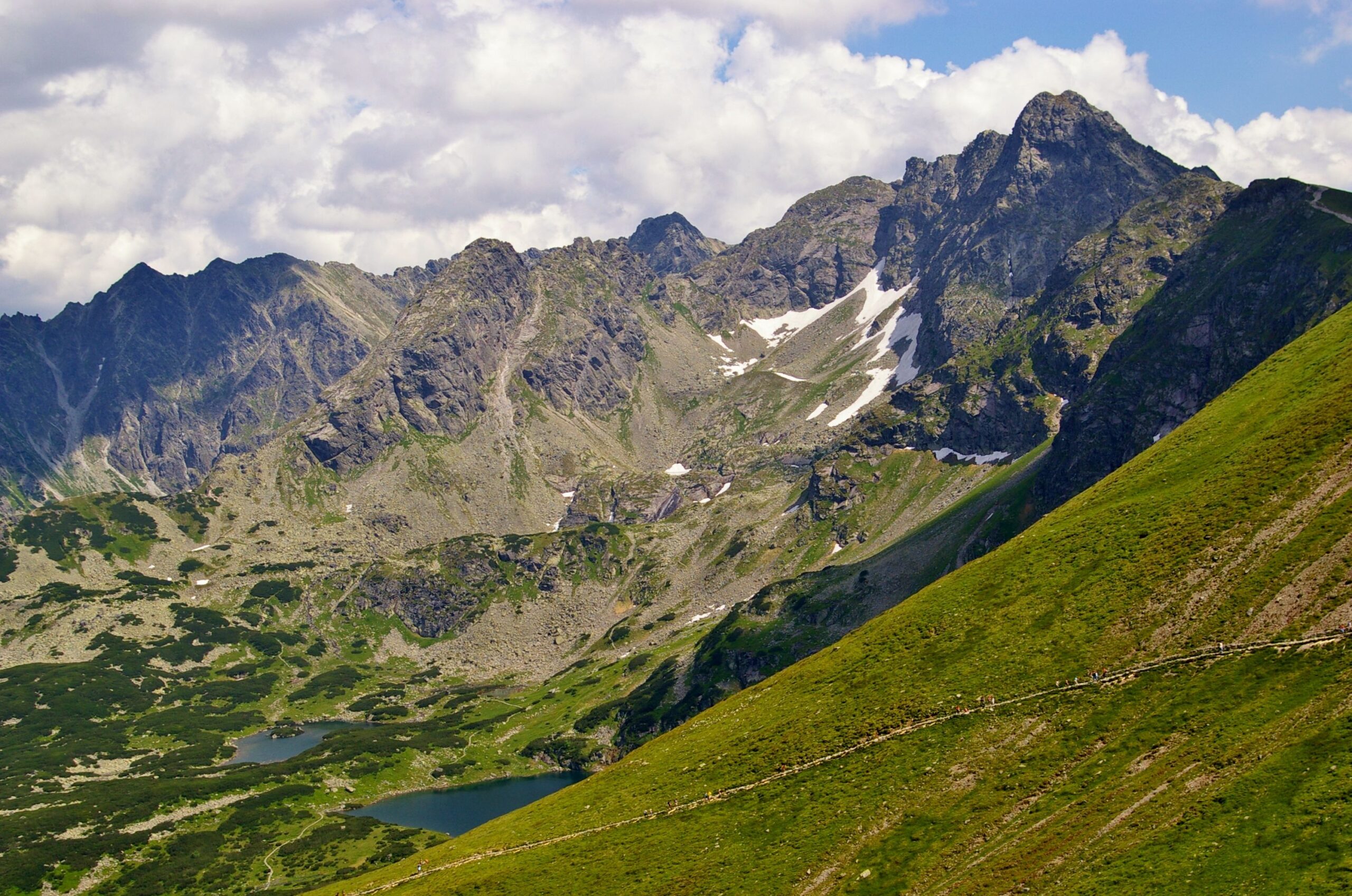
Both, and the difference matters more than it sounds. The Tatras straddle the border, and the national park is split in two: the Slovak side is administered by TANAP, the Tatra National Park of Slovakia, while the Polish side is a separate park with its own rules, its own fees and its own famous honeypot at Morskie Oko above Zakopane.
The Slovak side is the bigger half and holds the highest summits in the whole range, including Lomnický štít at 2,634 m, which you can reach without climbing a single metre if you are willing to queue for a cable car. For a British walker, that number is worth sitting with for a second: it is close to twice the height of Ben Nevis, and the terrain above the huts behaves accordingly.
Practical bits that catch people out. Slovakia is in the EU and in Schengen, so crossing from Poland is a non-event, but Slovakia uses the euro (roughly £0.84 to the euro at the time of writing) while Poland does not. The local word for a mountain lake is pleso, so Štrbské pleso means the lake at Štrba. The local word for a cable car is lanovka, which is worth knowing because it appears on every timetable and signpost you will read.
How to get to the High Tatras
Everything on the Slovak side funnels through one town, and once you understand that, the logistics stop being complicated.
Poprad, the gateway
Poprad is the town at the foot of the mountains and the place almost everyone arrives at. It has a small airport, and Poprad-Tatry station sits on the main railway line that runs across Slovakia. From that same station the narrow-gauge Tatra Electric Railway climbs into the resorts: line 183 runs Poprad-Tatry to Starý Smokovec and on to Štrbské Pleso, 29.11 km in total. You do not need a car to reach any trailhead in this guide.
From Bratislava and Košice
Poprad lies on the main east-west railway corridor between Bratislava and Košice, which makes both cities straightforward starting points by train. Košice is the closer of the two and has the larger international airport of the pair in the east of the country. If you are driving from either, note that Slovak motorways require a vignette, which we cover further down.
From Kraków and Budapest
Kraków is the obvious approach for anyone already in southern Poland, but be clear about where you are heading: the usual Kraków route drops you at Zakopane on the Polish side of the range, and you still have to cross the border to reach Štrbské Pleso, Starý Smokovec and the Slovak cable cars. Budapest works too and is a popular approach from the south. Either way, aim for Poprad rather than for “the Tatras” in general, because Poprad is where the railway into the mountains actually starts.
The trick locals use. Leave the car parked at your accommodation for the whole stay and travel by the electric railway instead. Because the line links every resort, you can start a walk at one village and finish at another, which opens up routes that anyone driving is forced to turn into a loop.
High Tatras hiking season: when to go
The short answer is June to October, because that is when the high-mountain trails are legally open. Inside that window, though, the four months are not interchangeable.
June is green and gloriously empty, but firn snow often lingers in the gullies and under the saddles well into the month, and hard old snow on a steep slope is not a beginner’s problem to solve. July and August are the safest bet for weather and the worst for crowds: mornings at Štrbské pleso and Hrebienok can feel more like a promenade than a mountain range. September is the best compromise of the lot, with steadier weather, long views and noticeably fewer people. October still works low down, but daylight shortens fast and the first snow can arrive at any point.
The thing to respect here is how quickly the weather turns. A blue morning can become horizontal rain by early afternoon, and in mountains of this scale an afternoon thunderstorm is the normal pattern rather than bad luck. If your plan involves a saddle, start around six in the morning and be back down in the valley by early afternoon. That is not caution, it is the local default.
A storm on the ridge is not just rain. If cloud starts building while you are on a saddle or a ridge, go down immediately by the shortest route. Underestimating the afternoon storm is the single most common reason for rescue call-outs in the High Tatras.
If the weather turns
There is a decent wet-weather programme at the foot of the mountains: the aquapark and thermal pools around Poprad and further west in the Liptov region, the TANAP museum in Tatranská Lomnica, which explains rather well why the rules here are so strict, and the historic centres of Poprad and Kežmarok. Riding the electric railway from Poprad up to Štrbské Pleso in the mist sounds like a consolation prize and is genuinely atmospheric. A light shower in the forest around Hrebienok or Štrbské pleso is perfectly walkable in a waterproof. A saddle in the rain is not, because wet granite is as slippery as ice.
High Tatras winter closure: 1 November to 31 May
This is the paragraph that decides whether your trip works, so read it twice. In the High Tatras, high-mountain hiking trails are seasonally closed from 1 November to 31 May. The closure comes from the TANAP visitor regulations, where the affected sections are listed individually in an annex. On 1 June the trails reopen, and from that moment the saddles and the walkable summits are legally accessible again.
Beware of a very widespread error. A large number of articles, blogs and older materials state that the closure runs “until 14 or 15 June”. That figure comes from a mountain rescue service announcement made back in 2022 and it no longer applies. The TANAP administration itself announced on 27 May 2026 that the seasonal closure would end on Monday 1 June. So if you are planning the first weekend of June up in the saddles, you are planning it correctly.
Two exceptions to the general dates are worth remembering. Juráňova dolina is closed from 1 November to 30 April, so it opens earlier than the rest. And the path to the Symbolický cintorín, the symbolic cemetery below Ostrva, has its own regime from 15 December to 30 April.
Trails closed right now
On top of the seasonal closure there are always repairs and emergency closures after landslides. This overview is correct as of August 2026, and it is exactly the part of this article you should re-check on tanap.sk before you travel, because it changes within weeks.
- Kriváň from Tri studničky is closed. According to the TANAP administration the work should finish around the turn of September and October 2026. That approach to Kriváň is off the table for now, and it is probably the most painful closure of the season.
- Sedielko is walkable again as of 13 July 2026 after lengthy repairs. It is the highest hikeable saddle in the High Tatras, at 2,376 m.
- Hrebienok to Rainerova útulňa along the red-marked Tatranská magistrála reopened on 1 August 2026 after being secured with a steel barrier. Older text about a detour via Bilíkova chata still lingers on the TANAP website, so check the information boards on the spot as well.
- Bilíkova chata to the Cold Stream waterfalls along the green route is closed until further notice.
- Monková dolina to Široké sedlo runs on a temporary detour; the original path is out of service.
- The Studené doliny valleys and Rainerova útulňa can also be reached the long way round: on the yellow route from Tatranská Lesná or the blue route from Tatranská Lomnica.
Easy hikes in the High Tatras, Slovakia
The question we hear most often about the Tatras is whether you can walk here without real fitness or alpine experience. The answer is yes, as long as you stay in the valleys, around the lakes and on the Tatranská magistrála, the long traversing trail that links the resorts. Easy walks in the High Tatras are almost always the ones that cross no saddle at all. The moment the word sedlo (saddle) or štít (peak) appears in a route description, you are in a different category, however modest the distance looks on paper.
For calibration: easy here means up to roughly 400 m of ascent, a wide path and under three hours. Moderate starts around 600 m of ascent and chains bolted into rock. Hard is anything above 2,000 m or anything needing a rope. British hillwalking experience translates well to the first two categories and not at all to the third, because the exposure and the rockfall risk are of a different order.
The circuit around Štrbské pleso
Difficulty: very easy. About an hour on the flat around the lake shore, surfaced path, no ascent to speak of. The best target for arrival day or for an afternoon when cloud is pouring off the peaks. People genuinely walk it in town shoes. The one drawback is predictable: between ten and four this is the busiest place in the Tatras.
The Skok waterfall
Difficulty: easy to moderate. From Štrbské pleso up through Mlynická dolina, roughly three hours of walking there and back, with a persistent but steady climb. The payoff is obvious the moment you arrive: a waterfall dropping over a step in the valley. The final stretch below the falls is rocky and slippery after rain, so leave time for it. Continuing to Pleso nad Skokom above means hauling yourself up fixed chains, which is a different sport.
Štrbské pleso to Popradské pleso
Difficulty: easy. This is the classic first proper mountain walk of the trip, and one of the best-known routes in the range. From the Popradské Pleso stop on the electric railway a broad track climbs for about an hour and a half, one sustained ascent, ending at a mountain hut beside a lake ringed by peaks. Nothing on the way exposes you to serious terrain, which is precisely why it works so well as a confidence-builder.
Symbolický cintorín below Ostrva
Difficulty: easy. A short detour from Popradské pleso, twenty minutes of extra walking. It is a memorial to those who died in these mountains, with plaques set among the stone pines. Treat it as the second half of a Popradské pleso day rather than an outing in its own right. The path is closed from 15 December to 30 April.
Hrebienok and the Cold Stream waterfalls
Difficulty: easy. Up from Starý Smokovec by funicular or on foot, then along the magistrála to the Hrebienok waterfalls, known in Slovak as Vodopády Studeného potoka. This is the most accessible mountain walk in the Tatras and the obvious answer when you have half a day. Given the closures around Bilíkova chata, check the current routing when you get to Hrebienok itself.
Zelené pleso
Difficulty: moderate. A longer but technically undemanding march up Dolina Zeleného plesa to the hut above the water. Budget a full day and around five hours of walking there and back. It is not a beginner’s route, but there is no scrambling anywhere on it. The wall of Malý Kežmarský štít above the lake is one of those views people come back to the Tatras for.
Do not go by the name alone. There is more than one Zelené pleso in the High Tatras, spread across different valleys. The one the classic route from Biela voda leads to is the Zelené pleso in Dolina Zeleného plesa, with the Chata pri Zelenom plese hut standing beside it.
Walking with children
Family days here work on one principle: give up on summits and a surprisingly rich programme remains, because there is always something to watch. Chamois above Skalnaté pleso, waterfalls, cable cars, the little electric train. The formula that works is a short valley walk in the morning, a train ride to a different village in the afternoon and an ice cream, which gives children two experiences a day for half the mileage of one long route.
The circuit around Štrbské pleso is the safest opener. Hrebienok plus the Cold Stream waterfalls saves 250 m of climbing thanks to the funicular. Skalnaté pleso by gondola is minimal walking and maximum impression. Popradské pleso suits children from around eight who can manage an hour and a half uphill, and the Skok waterfall is the upper limit of what an average school-age child will enjoy.
A pushchair works in exactly three places: the circuit around Štrbské pleso, the surfaced track from Starý Smokovec up to Hrebienok (or better, funicular up and walk down), and the promenades between the Tatra villages. Everywhere else you meet rocks and steps. An off-road buggy buys you a little more, not a whole valley. For the valleys, a carrier is the only realistic answer.
Best day hikes in the High Tatras, Slovakia: how to choose
Put next to each other, the walks above sort themselves out quickly. The useful thing to notice is that the difference between them is almost never distance. It is whether the route crosses a saddle and how rocky the last half hour is.
| Day hike | Difficulty | Time | Starts from |
|---|---|---|---|
| Circuit around Štrbské pleso | Very easy | About 1 hour | Štrbské Pleso |
| Hrebienok and the Cold Stream waterfalls | Easy | Half a day | Starý Smokovec |
| Popradské pleso | Easy | About 1.5 hours up | Popradské Pleso railway stop |
| Skok waterfall | Easy to moderate | About 3 hours return | Štrbské Pleso |
| Zelené pleso | Moderate | About 5 hours return | Biela voda |
| Skalnaté pleso by gondola | Minimal walking | Half a day | Tatranská Lomnica |
Cable cars: Lomnický štít, Skalnaté pleso and the Hrebienok funicular
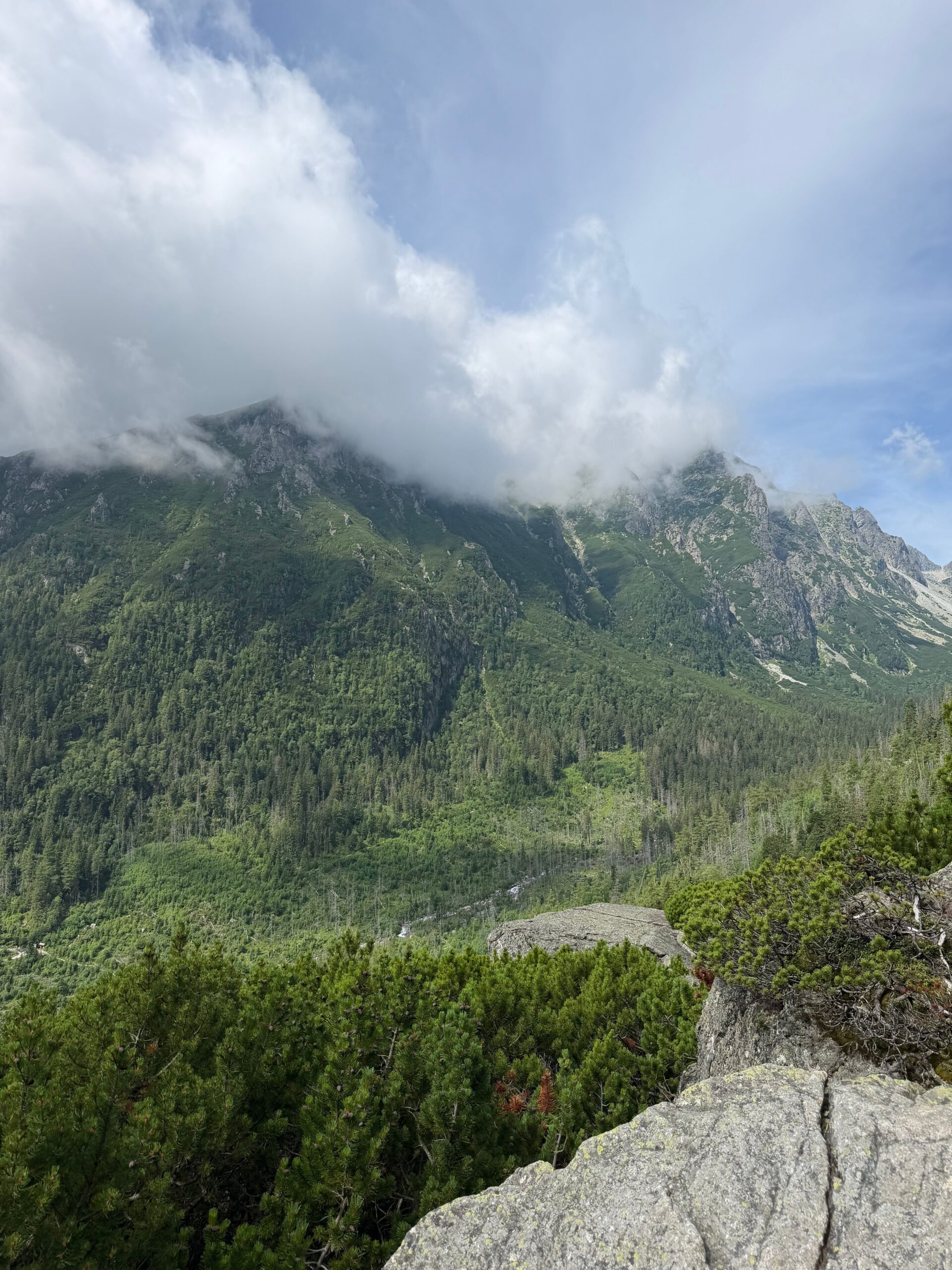
Taking the lift here is a legitimate part of a plan, not cheating. It puts you at an altitude you could not reach in a day with children or with average fitness, and it leaves your legs for the good part at the top. There are five lifts worth knowing, and it pays to learn them by name, because that is how the timetables, the ticket system and the signposts refer to them.
| Lift | Where it takes you | Operating hours (approximate) |
|---|---|---|
| Starý Smokovec, funicular | Hrebienok, the trailhead for the waterfalls and the magistrála | 7:00 to 19:00 |
| Tatranská Lomnica, gondola | Skalnaté pleso, the observatory and the view | 8:30 to 18:30 up, 19:30 down |
| Skalnaté pleso, two-seat chairlift | Lomnické sedlo | 9:00 to 17:45 up |
| Skalnaté pleso, aerial cableway | Lomnický štít, 2,634 m | 9:00 to 18:00 up |
| Štrbské Pleso, Solisko Express | Predné Solisko, the ridge above Mlynická dolina | Down until 17:45 |
Lomnický štít: book a time slot
The ride to Lomnický štít works on timed slots, and your stay on the summit platform is usually limited too. The aerial cableway has small capacity, so in peak season slots sell out days ahead. This is not a trip you can decide on at ten in the morning. Either book, or be at the ticket window very early.
What it costs
We are deliberately not quoting figures, and there is a good reason: the operator states that online prices are flexible and change dynamically. The same ticket to Lomnický štít costs one thing on a Tuesday in September and another on a Saturday in August. The current price list for Hrebienok, Skalnaté pleso, Lomnický štít and Solisko exists in exactly one reliable place, which is the official website of the Tatra lifts and their booking system. Two things are verifiably true whatever the day: buying online three or more days ahead saves up to €10 (about £8.40) on a return ticket, and the contactless season card does not work on the turnstiles for pedestrian tickets, where you need the QR code from your booking confirmation.
Up by cable car, down on foot. The best ratio of experience to effort is a one-way ticket upwards. Walking down from Skalnaté pleso to Tatranská Lomnica, or from Hrebienok to Starý Smokovec, is a comfortable hour or two downhill and halves what you pay.
Getting around: the Tatra Electric Railway
The Tatranská elektrická železnica, TEŽ for short, is the single best thing a walker in the High Tatras can use. It is a narrow-gauge line with a 1,000 mm gauge linking all the Tatra villages, and it has been running continuously since 20 December 1908.
- Line 183: Poprad-Tatry, Starý Smokovec, Štrbské Pleso, 29.11 km in total.
- Line 184: Starý Smokovec to Tatranská Lomnica, just under 6 km.
- The network connects to the rack railway from Štrba up to Štrbské Pleso, which is the most comfortable way in if you are arriving by main-line train.
The practical consequence is the important one: you do not have to come back to where you started. You can get off at Štrbské Pleso, cross the valleys and walk down to Tatranská Polianka or Starý Smokovec, then ride back. That opens up linear routes instead of the loops anyone travelling by car is stuck with.
We were not able to verify fares and exact timetables, because the operator’s website has been unstable for a long time. Check them before you travel, at the station or with the operator directly.
Mountain lakes: look, do not swim
The glacial lakes are the reason a lot of people come to the High Tatras at all. Štrbské, Popradské, Skalnaté, Zelené, Velické. They make a day’s objective almost by themselves, because a straightforward path leads to a lake from most valleys, and there is something to look at when you arrive. In English these little glacier-carved lakes are sometimes called tarns; in Slovak they are all plesá, which is the word you will see on maps.
Swimming is banned in every one of them. This is not a recommendation or a local custom. On 5 August 2026 the Slovak Ministry of the Environment, together with the national park administrations and the State Nature Conservancy, issued a statement that there is no swimming in the lakes, that information panels have been added at the lakesides, and that enforcement has been stepped up. The water is oligotrophic and extremely sensitive: sun cream and soap from a single swimmer affect the whole ecosystem.
If you want to cool off, do it elsewhere: in Poprad, in the thermal pools below the mountains, or at the very least with your feet in a stream away from any lake. Swimming in a lake carries a fine, and in high season the rangers really do come and look.
Hiking with a dog
The answer is neither yes nor no. The TANAP visitor regulations ban dogs in areas with marmot colonies, with resident chamois herds and in places where large carnivores and endangered species occur. Those zones are marked on boards at the start of the trails, so you find out on the spot rather than from a map. In practice the high valleys and ridges are exactly the sections a dog may not enter, while the promenades between the villages, the paths around Štrbské pleso and the lower parts of the valleys are usually fine. Dogs are allowed on the lifts from Tatranská Lomnica and Starý Smokovec except the chairlift to Lomnické sedlo and the aerial cableway to Lomnický štít; from Štrbské Pleso they travel on everything. Larger dogs pay a supplement.
What to do in the High Tatras in winter
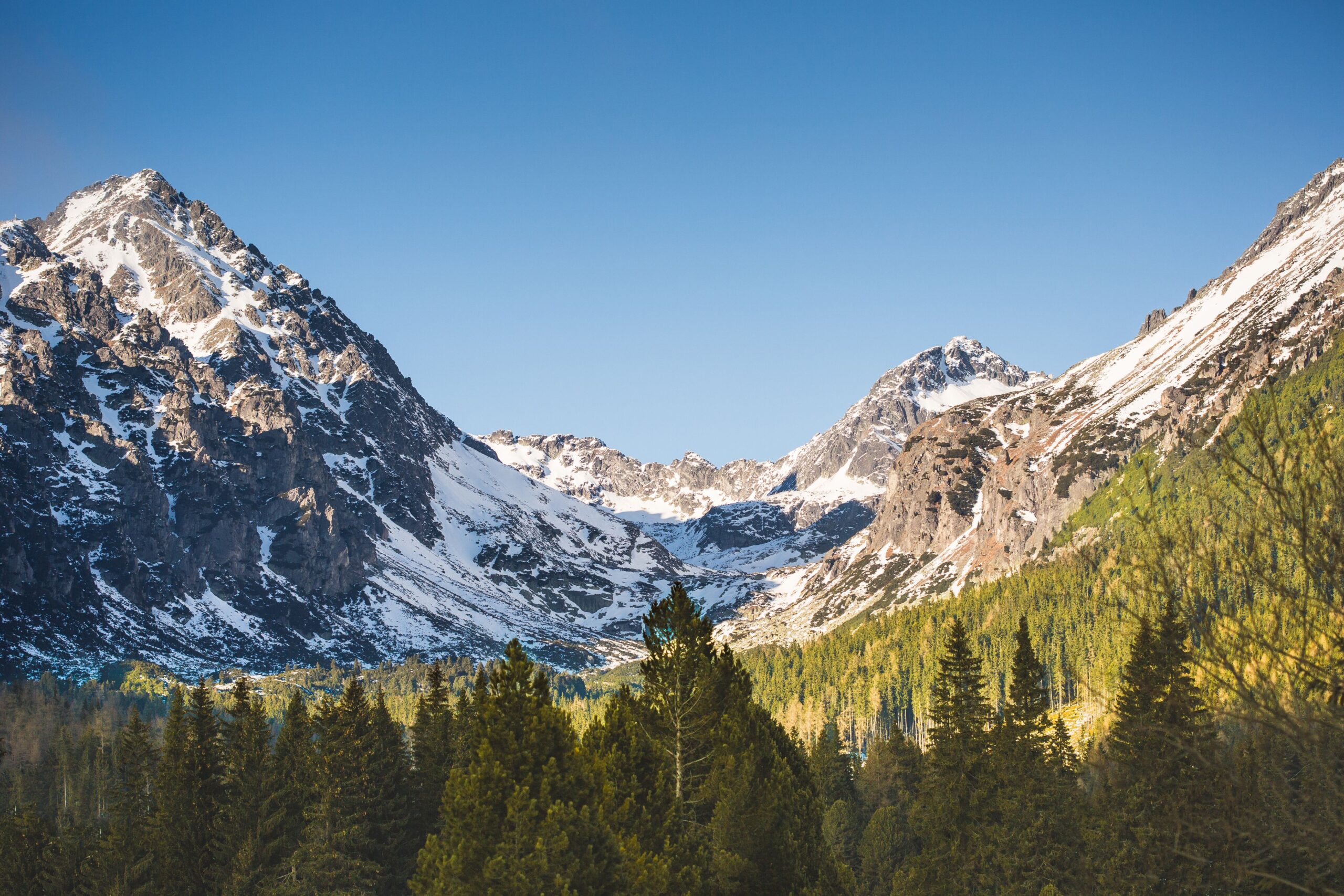
Winter walking is where most visitors go wrong. From 1 November to 31 May the high-mountain trails are shut, and this is not a formality. The avalanche slopes above the valleys slide repeatedly, and rescue teams reach them with difficulty.
What does work in winter, legally and sensibly:
- The magistrála at lower levels and the promenades between the villages. Maintained, waymarked and passable all winter.
- Starý Smokovec up to Hrebienok and the area around it. The busiest winter destination in the Tatras, and the funicular runs through the season. The ice dome at Hrebienok is the classic family outing.
- Skalnaté pleso by gondola. A view out over the inversion cloud with no walking at all.
- Popradské pleso from the railway stop. In good conditions and with gaiters, the path is lower down and usually well trodden in winter. Check conditions first.
- Cross-country skiing at Štrbské Pleso, plus the beginners’ ski areas there and at Tatranská Lomnica.
What does not work in winter: saddles, summits and high traverses without a mountain guide and winter kit. Snowshoes and crampons are not a substitute for a trail that is open.
High Tatras: where to stay
Base yourself in one of the villages strung along the electric railway and the whole range becomes commutable. Štrbské Pleso sits highest and puts the easiest lake walks on your doorstep. Starý Smokovec is the most central and the base for the Hrebienok funicular. Tatranská Lomnica is the one for the gondola, the observatory and Lomnický štít. Poprad down in the valley is cheaper and better connected by train, at the cost of a daily commute up the hill. Find places to stay in the High Tatras →
Mountain huts
The High Tatras have a dense network of mountain huts, open year-round, and they are what makes a multi-day plan possible at all. If you want more than day walks, the hubs are Chata pri Zelenom plese, Zbojnícka chata in Veľká Studená dolina, Téryho chata in Malá Studená dolina, Chata pod Rysmi and Popradské pleso. Lower down, Bilíkova chata and Rainerova útulňa above Hrebienok fill the gap.
Two things to know in advance. First, book a long way ahead, months for the higher huts, because capacity is small and summer fills up. Second, supplies to most huts are carried up on porters’ backs, which shows in both the prices and the menu. Do not expect a restaurant. Expect soup, tea and lentils.
Camping: exactly one spot
This surprises everyone used to other mountains. In the whole of the Tatra National Park you may pitch a tent or bivouac in one single place: Táborisko pod Vysokou in Bielovodská dolina. Even there the conditions are strict:
- only between 1 June and 31 October and 15 December and 15 April,
- only as part of a multi-day climbing or ski-mountaineering trip,
- only on the wooden platforms,
- open fires are banned; only a camping stove is permitted.
Nowhere else in the park do you camp or sleep out. If you are planning a multi-day route, plan it hut to hut, not with a tent in your rucksack. Campsites exist only below the mountains, in the villages on the edge of the park.
Driving in Slovakia: the highway vignette
If you are driving to the Tatras from Vienna, Budapest or Kraków, you need a Slovak motorway vignette for vehicles up to 3.5 tonnes. It is fully electronic. There is no sticker to put in the windscreen, the vignette is registered against your number plate, and it can be bought online, in the official app or at petrol stations near the borders. Several validity periods are sold, including a one-day option introduced in 2024.
Buy it from the official channel at eznamka.sk rather than from the resellers that rank well in search results and add a markup for nothing. Do it before you join the motorway, because enforcement is camera-based and the fine arrives whether or not you noticed the sign. Hire cars from Slovak companies usually come with a valid vignette; hire cars picked up in Poland, Hungary or Austria usually do not.
Mountain rescue in Slovakia is not free
This is the part British and American visitors least expect, so we are giving it its own heading. Under Slovak law, a person rescued in the mountains is obliged to pay the mountain rescue service for the costs of the rescue or search operation. The obligation dates from the mountain rescue act in force since 1 July 2006, and it does not apply to minors or to people without legal capacity. Everyone else pays.
A European health insurance card does not cover this. It covers state medical treatment, not the cost of getting you off a mountain, and helicopter time in this terrain is not cheap. Take travel insurance that explicitly includes mountain rescue and hiking above a stated altitude, or buy one of the Slovak mountain rescue policies sold by local insurers for a few euros per trip.
Save both numbers before you set off. Mountain rescue in Slovakia is 18 300. The general European emergency number 112 works everywhere and will connect you too. Mobile coverage in the valleys is patchy, so tell someone your route and your expected return time.
Where to go next
The High Tatras combine well with the ranges around them, and it helps to have a fallback when the tops are closed or it rains all week.
If you want more than day walks, the natural follow-up is a hut to hut route across the High Tatras, linking Popradské pleso, Zbojnícka chata, Téryho chata and Chata pri Zelenom plese over several days. It is the one multi-day format in Slovakia that genuinely works, and it needs booking months ahead.
On the Polish side of the same massif lie the Polish Tatras, with Morskie Oko and Zakopane. Different rules, different infrastructure, the same mountains. For gentler hills with a similar feel, look at the Malá Fatra and Veľká Fatra ranges further west. Jánošíkove diery, the best-known gorge system in Slovakia, is a good rainy-day objective because it runs through forest along the water the whole way.
Frequently asked questions
When does the seasonal trail closure in the High Tatras end?High-mountain hiking trails in the Tatra National Park are closed from 1 November to 31 May and reopen on 1 June. The widely repeated claim that the closure lasts “until 15 June” comes from an older announcement made in 2022 and no longer applies. Juráňova dolina opens earlier, on 1 May.
What are the easiest hikes in the High Tatras, Slovakia?The circuit around Štrbské pleso, the path to the Skok waterfall, the walk up to Popradské pleso, the Symbolický cintorín below Ostrva, and Hrebienok with the Cold Stream waterfalls. What they have in common is that none of them crosses a saddle.
How do you get to the High Tatras?Through Poprad. The town has a small airport and sits on the main railway line between Bratislava and Košice, and the narrow-gauge Tatra Electric Railway runs from Poprad-Tatry station up to Starý Smokovec and Štrbské Pleso. Arriving from Kraków or Budapest works too, but note that the usual Kraków route ends at Zakopane on the Polish side of the range.
Are the Tatra Mountains in Slovakia or Poland?Both. The range straddles the border and the national park is split between the two countries, each with its own rules. The Slovak side is the larger one and has the highest summits, the cable cars and the electric railway; the Polish side is the one with Zakopane and Morskie Oko.
Can you swim in the mountain lakes in the High Tatras?No, swimming is banned in every lake in the park. Since August 2026 enforcement has been tightened and information panels have been added at the lakesides. Swimming carries a fine.
How much does the cable car to Lomnický štít cost?No fixed price can be quoted, because the operator states that online prices are flexible and change dynamically with the date and occupancy. Buying online three or more days ahead saves up to €10 on a return ticket. The current price list is on the official website of the Tatra lifts.
Do you have to pay for mountain rescue in Slovakia?Yes. Slovak law obliges a rescued person to pay the mountain rescue service for the costs of the rescue or search operation, with an exemption for minors and people without legal capacity. Take insurance that explicitly covers mountain rescue. The rescue number is 18 300 and 112 works as well.
Can you wild camp in the High Tatras?Only at one place in the whole park, Táborisko pod Vysokou in Bielovodská dolina, between 1 June and 31 October and between 15 December and 15 April, only on the wooden platforms and only as part of a multi-day climbing or ski-mountaineering trip. Open fires are banned.
Potřebujete pomoct s cestováním?
-
Ubytování 🏨
Vyberte si to nejlepší ubytování, ať už jste kdekoliv, přes Booking.com. -
Půjčení auta 🚗
Auto si snadno najdete přes Booking.com, kde máte často slevu díky ubytování, nebo Rentalcars.com, kde porovnáte nabídky většiny půjčoven. -
Zážitky 🎟️
Přes GetYourGuide.com si vyberete z nejrůznějších výletů i zážitků po celém světě, navíc se zrušením zdarma do 24 h předem.