Last updated 17.11.2026
Zante is known as a summer island you can rely on, and the numbers back that up. In July it rains on average less than one day in the month and the sky stays almost permanently clear. What fewer people realise is that in summer Zante runs hotter than both Corfu and Crete, and that its winters look more like Corfu’s than Crete’s: between October and January more rain falls here than Athens gets in a whole year.
This guide goes through the Zante weather by month: daytime highs and night-time lows, sea temperature, rainfall, clear days, heatwaves and the summer wind locals call the maestro. We worked the numbers out ourselves from measured climate data rather than copying them from a brochure. Near the end you’ll find a comparison with Corfu and Crete and a packing list for each season. Getting there, where to stay and what it costs are covered in our Zante holiday guide. And if you’re wondering about the name: Zakynthos is the Greek name, Zante the old Venetian one that UK tour operators and airlines still use. It’s the same island, so the Zakynthos weather by month below is exactly what you’ll get on a Zante holiday.
Zante weather by month at a glance
- July and August are the hottest months, with average highs of 32.6 °C and 32.5 °C and nights that on average stay above 24 °C.
- The sea is warmest in August, around 27.6 °C off the south coast. September still has 26.3 °C and October 23.8 °C, which is warmer than the first half of June.
- The swimming season runs from mid-June to mid-October. In the second half of May the sea is around 20 °C, fine for a quick dip.
- Summer is almost completely dry. July and August both get just 6 mm of rain, with 29 and 27 clear days out of 31 respectively.
- Heatwaves are more frequent than on Corfu or Crete. July averages nine days above 35 °C, compared with four on Corfu and three in Heraklion.
- November is the wettest month, with 184 mm and thirteen rainy days. The annual total is around 880 mm, roughly double that of Crete.
- In summer the maestro blows, a north-westerly wind that roughly doubles in strength after midday. That’s why boat trips leave in the morning.
- Out of season, come for the green countryside, not the sea. From November to March the resorts are shut and direct flights from the UK are mostly a summer-season thing.
Zante weather by month: the full table
We built this table from the ERA5 reanalysis via the open Open-Meteo interface, for the east coast between Zakynthos Town and Dionysios Solomos airport (grid point 37.79° N, 20.84° E), covering the ten years from 2015 to 2024. ERA5 is a model reconstructed from real observations by weather stations, balloons and satellites, so it describes the weather that actually happened over those ten years rather than an estimate. We calculated the Corfu weather by month the same way, so the two islands can be compared directly.
Sea temperatures come from satellite measurements of the surface temperature in Laganas Bay. For that spot the interface only has a continuous series for 2023 and 2024, which we’ll come back to below.
| Month | Day | Night | Sea | Rainfall | Rainy days | Clear days |
|---|---|---|---|---|---|---|
| January | 13.9 °C | 9.5 °C | 17.5 °C | 155 mm | 14 | 5 |
| February | 14.9 °C | 10.0 °C | 16.7 °C | 84 mm | 9 | 7 |
| March | 16.2 °C | 10.6 °C | 16.5 °C | 75 mm | 12 | 7 |
| April | 19.6 °C | 12.9 °C | 17.3 °C | 30 mm | 6 | 9 |
| May | 23.8 °C | 16.4 °C | 19.3 °C | 31 mm | 6 | 10 |
| June | 29.3 °C | 21.1 °C | 24.0 °C | 24 mm | 3 | 19 |
| July | 32.6 °C | 24.1 °C | 26.9 °C | 6 mm | less than 1 | 29 |
| August | 32.5 °C | 24.5 °C | 27.6 °C | 6 mm | 2 | 27 |
| September | 28.0 °C | 21.7 °C | 26.3 °C | 69 mm | 6 | 15 |
| October | 23.6 °C | 18.3 °C | 23.8 °C | 99 mm | 8 | 11 |
| November | 19.5 °C | 14.9 °C | 21.8 °C | 184 mm | 13 | 6 |
| December | 15.7 °C | 11.5 °C | 18.6 °C | 118 mm | 12 | 6 |
💡 How to read the table. “Day” is the average daily high, so roughly the temperature at 3 pm, not the average for the whole day. “Night” is the average overnight low. “Rainy days” counts days with at least 1 mm of rain. “Clear days” are days when cloud cover averaged no more than a fifth of the sky. The model works with grid squares of about 25 × 25 km that reach out over the sea, so its nights come out slightly warmer than a thermometer at the inland airport would show. Summer nights in the island’s interior tend to be cooler; on the coast the figures are spot on.
An average is not a forecast: how much the years vary
A climate average is good for choosing a month, not for predicting your particular week. On Zante that matters more than in many places, because autumn and winter rain tends to arrive in big bursts. From the same ten years we pulled out the driest and the wettest year for each month where it makes a difference to a holiday.
| Month | Average | Driest year | Wettest year | Days with a downpour over 20 mm |
|---|---|---|---|---|
| May | 31 mm | 7 mm | 97 mm | less than 1 |
| June | 24 mm | 0 mm | 113 mm | less than 1 |
| September | 69 mm | 13 mm | 193 mm | 1 |
| October | 99 mm | 20 mm | 283 mm | 1 |
| November | 184 mm | 49 mm | 325 mm | 3 |
What this means in practice: a September averaging 69 mm can be bone dry, or a single stormy front can dump more rain in two days than the whole summer put together. The “six rainy days” in the average usually turn out to be two properly wet days and four short showers. June is similar: most years are almost dry, but in ten years there was one June with 113 mm.
Check the forecast about three days before you fly. We wouldn’t put much faith in the long-range outlooks that pop up most often for Zante: they tell you whether a low is building over the Ionian Sea, not whether it will rain on Tuesday. What works for us is comparing two sources, for example the Norwegian yr.no and Windy, where you can switch between several models. If the models disagree about the same day, that tells you something too: the weather is uncertain and it’s worth having a dry-land plan up your sleeve.
Zante sea temperature by month
The sea around Zante warms up slowly and cools down even more slowly. It’s coldest in March (16.5 °C), two months after the coldest air, and warmest in August. We’ve split it into half-months, because at the start and end of the season it changes most within just a few weeks.
| Period | Laganas Bay (south) | Open sea off the west coast |
|---|---|---|
| Early May | 18.4 °C | 18.3 °C |
| Late May | 20.1 °C | 20.0 °C |
| Early June | 23.4 °C | 22.9 °C |
| Late June | 24.7 °C | 23.6 °C |
| Early July | 26.0 °C | 25.2 °C |
| Late July | 27.7 °C | 26.8 °C |
| Early August | 27.2 °C | 26.5 °C |
| Late August | 28.0 °C | 27.2 °C |
| Early September | 27.1 °C | 26.8 °C |
| Late September | 25.4 °C | 25.3 °C |
| Early October | 24.1 °C | 24.0 °C |
| Late October | 23.5 °C | 23.5 °C |
| Early November | 23.1 °C | 22.8 °C |
One important caveat. The interface only has a continuous satellite series for this spot for 2023 and 2024, and both were among the warmest years the Mediterranean has ever recorded. So treat these figures as the upper end of the range. In a cooler year expect the sea to be one or two degrees colder, which is also why older long-term averages on other weather websites tend to put August at around 25 to 26 °C. The order of the months and the gaps between them still hold.
The south is warmer than the west. Laganas Bay is shallow and sheltered, so in summer it warms up about three quarters of a degree more than the open sea off the western cliffs. In autumn the difference disappears.
The first half of September is warmer than the whole of June. In the first days of September the sea is still above 27 °C, the same as in mid-July. For swimming, we think this is the best time of the whole year.
October is the surprise. In the second half of October the sea is 23.5 °C, warmer than in the first half of June. Families heading out for October half term will find the water fine. The catch isn’t the sea but the fact that beach bars and some hotels close during October and the rain picks up.
Best time to visit Zante for swimming, and for lower prices
If the sea is the main reason you’re going, pick a date between the second half of June and the first half of October. Before that the water is below 23 °C; after that the weather goes downhill. Within that window there are two sensible choices:
- Second half of June: sea around 24 to 25 °C, air 29 °C, the longest days of the year (over 14 and a half hours of daylight) and not yet fully packed. If you struggle in the heat, go in June rather than July.
- The first fortnight of September: water still above 27 °C, air around 29 °C and slightly fewer people than in August. The risk of the first autumn storm is small, but not zero.
The cheapest time to go to Zante is the shoulder season: May, early June, late September and October, when the summer flights from the UK are still running but hotels are not yet, or no longer, full. July and August are the most expensive, because that’s when school holidays across Europe all overlap. We compare package and hotel prices in our Zante holiday guide; here just one rule of thumb: if you can choose, move your dates two weeks away from August and you’ll save more than you lose on the weather.
Zante weather month by month: what to expect
The questions people type into Google most often are about September, October and May, so those months get the most space here.
January to March
Wet and windy, but not winter as we know it at home. Daytime highs stay between 13.9 and 16.2 °C, with nights around ten degrees. January, with 155 mm and fourteen rainy days, is the second-wettest month of the year, and on average you get five clear days. February tends to be drier, but you can’t count on it: over the ten years it swung between 4 and 315 mm. It’s windier than in summer, and in January about nine days see wind above 25 km/h. This is when the island is at its greenest; the resorts are closed and life carries on mainly in Zakynthos Town.
April
The turning point. Rainfall drops from 75 mm in March to 30 mm, and there are only six rainy days. Days reach 19.6 °C, nights 12.9 °C, and the sea is 17.3 °C, so swimming is for the hardy only. In our view April is the best month for walking around the island: everything is in flower, it’s green and the sun isn’t yet fierce. Most hotels, though, only open with the main season, and many of the direct summer flights from the UK don’t start until later, so in April you may well end up connecting via Athens.
Zante weather in May
Days of 23.8 °C, nights of 16.4 °C and a sea averaging 19.3 °C over the month, already around 20 °C in the second half. Rainfall is 31 mm over six days, mostly short showers. There are only ten fully clear days, with the sky often partly cloudy. It’s chilly for swimming, but ideal for sitting by the sea, day trips and evenings outdoors. May is exactly why we love the Ionian islands: warm, still green and still quiet. If you’re going over May half term with children, keep sea swims short and let the hotel pool handle the longer sessions.
June
The jump into summer. Days of 29.3 °C, nights of 21.1 °C, a sea at 24 °C and on average only three days with rain. The days are the longest of the year. The first hot spells arrive now: on average three days in the month go above 35 °C. For us it’s the best compromise in the first half of the year, especially the second half of June.
July
The driest and sunniest month: 6 mm of rain, less than one rainy day and 29 clear days out of 31. Days reach 32.6 °C, nights 24.1 °C. July is also the hottest month. On average nine days top 35 °C, and the highest value in the data is 41.9 °C on 23 July 2023. In the second half of the month the sea goes above 27 °C and stops being refreshing. A July beach day is done in the morning and late afternoon; the middle of the day belongs to the shade.
August
Practically the same temperatures as July, 32.5 °C by day and 24.5 °C at night, but the sea is the warmest of the year. Rainfall is 6 mm, usually as a quick thunderstorm. On average six days go above 35 °C. August is the busiest month and the landscape is at its most parched. On the nesting beaches this is when the turtles hatch, so there is a night-time ban on entry (more on that below).
Zante weather in September
A month of two halves. The first half is still summer: highs around 29 °C, sea above 27 °C and settled weather. In the second half the sea cools to 25 °C and the weather starts to break. September as a whole averages 69 mm and six rainy days, two thirds of which fall in the second half of the month. The first fortnight has on average only two days with rain. In our data there wasn’t a single September day above 35 °C. If you’re asking what the Zante weather is like at the end of September: still good for swimming, just expect one or two fronts and evenings when you’ll want a hoodie.
Zante weather in October
Days of 23.6 °C, nights of 18.3 °C, sea 23.8 °C. Rainfall, however, climbs to 99 mm over eight days, and October is the least predictable month of all: over ten years it ranged from 20 to 283 mm. The first half of October is usually still beach weather; the second half is better for exploring, with a swim as a bonus. The season winds down during the month: the direct summer flights from the UK gradually stop and some hotels and beach bars close.
November and December
The wettest part of the year. November gets 184 mm and thirteen rainy days, including on average three days with a downpour of over 20 mm. December gets 118 mm over twelve days. Temperatures aren’t low, though: November has daytime highs of 19.5 °C and a sea around 22 °C. It’s warm rain, not winter. A beach holiday makes no sense now; a few days in town and an island without tourists, yes.
How hot is Zante? Days above 35 °C
This is something most weather pages about Zante barely mention, yet for planning a trip with children or for older travellers it’s probably the most important point. Zante is noticeably hotter than Corfu and in summer even hotter than Crete. We counted how many days a month go above 35 °C on average:
| Place | June | July | August | Highest value 2015–2024 |
|---|---|---|---|---|
| Zante | 3 days | 9 days | 6 days | 41.9 °C (23 July 2023) |
| Corfu | less than 1 | 4 days | 2–3 days | 40.5 °C (June 2021) |
| Crete (Heraklion) | 1–2 days | 3 days | 1 day | 44.6 °C (June 2024) |
Crete holds the highest one-off record, but a normal summer there is cooler and windier. On Zante the heat is regular. In practice that means an air-conditioned room isn’t a luxury but a necessity, and a hotel with a pool and shade will help you more than a front-row beach spot. If you don’t cope well with heat, go in June or September.
Is Zante windy? The maestro and how to plan around it
Zante doesn’t get the summer meltemi that can wipe out swimming for a whole week in the Cyclades. Instead, in summer the maestro blows (maistros in Greek), a north-westerly wind coming in off the open Ionian Sea. It’s weaker and, above all, it follows a regular daily rhythm.
Using hourly data for 2020 to 2024, we looked at July and August on the west coast. The wind comes from the north-west in roughly half of all hours, with every other direction far behind. Mornings are almost still, around 7 km/h on average. From midday it picks up, peaking at about double, around 14 km/h, between 3 and 5 pm, and dies down again after dark. The average daily maximum in summer stays between 16 and 17 km/h, and in July there are about four days with wind above 25 km/h.
What that means in practice:
- Do boat trips along the west coast in the morning. The west is open to the sea, and the afternoon swell rolls in there even on a sunny day. In stronger wind, trips can be cancelled or moved, so don’t leave yours until the last day.
- When the wind is from the north-west, Laganas Bay in the south is the calmest spot, because there the wind blows from land out to sea. With a southerly wind, more common in autumn and winter, it’s the other way round and the north-east coast is calmer.
- In summer the wind is your friend. The afternoon maestro is the reason 32 °C on the beach is bearable at all. The worst days tend to be the still ones.
- It’s windiest in winter, from November to March, when the average daily maximum is 18 to 21 km/h and January has about nine days with wind above 25 km/h.
Weather by area: north, south and the coasts
Zante is small, about forty kilometres from north to south, so don’t expect big differences. Two of them are noticeable, though, and both show up in the data as well as on the map.
The hilly north-west is cooler. For the mountainous north of the island (the grid point sits in the hills south-east of Volimes, about 400 m above sea level) the July high comes out at 28.0 °C instead of 32.6 °C on the coast, with nights around 21 °C. That’s down to altitude, not a different climate. If you’re going in July and want to sleep at night without air conditioning, look for a place to stay in the hill villages, not on the flat land around the airport. Annual rainfall up there is similar (821 mm against 878 mm).
The south is the warmest, especially in the water. Laganas Bay sees daytime highs of around 33 °C in July, and its shallow sea warms up the most, about three quarters of a degree more than off the western cliffs. The north-east coast around Tsilivi and Zakynthos Town has practically the same temperatures as the table above.
Overall, you don’t need to choose your resort based on the weather. Air and water temperatures differ between resorts by tenths of a degree; what matters more is whether you want peace and quiet or a lively scene. We cover the resorts in detail in our guides to Laganas and Tsilivi and Planos.
Where to stay in Zante by season
You’ll find specific hotels for different kinds of holiday in our guide to Zante hotels. As far as the weather goes, three rules are enough:
- July and August: air conditioning, shade and a pool matter more than the view. With children, pick a resort where the hotel is a short walk from the beach so you can easily retreat at midday, for example places to stay in Tsilivi on the north-east coast. Only the hill villages have cooler nights.
- June and September: the best time for the quieter south, for example accommodation in Vasilikos or in Kalamaki, where the sea is shallow and at its warmest.
- From late October to April: only accommodation in Zakynthos Town. The resorts are shut, and the town keeps running everything that runs all year.
Turtles and the weather: when the nesting season is
Loggerhead sea turtles (Caretta caretta) nest on the southern beaches of Laganas Bay. According to ARCHELON, the organisation that has been monitoring them here since the 1980s, the six nesting beaches see an average of 1,200 nests a year. When planning a holiday, it helps to know how the nesting season fits the calendar:
- May to August: females lay their eggs. The first nests appear in May.
- July to October: the hatchlings emerge. Eggs incubate in the sand for seven to ten weeks, depending on how warm the sand is. The last hatchlings emerge in September and early October.
- Throughout the season the nesting beaches are open from 7 am until sunset; at night entry is banned and patrolled. During the day you stay within a five-metre strip from the water, and sunbeds are cleared away at night. Sekania beach, which has the most nests, is closed completely.
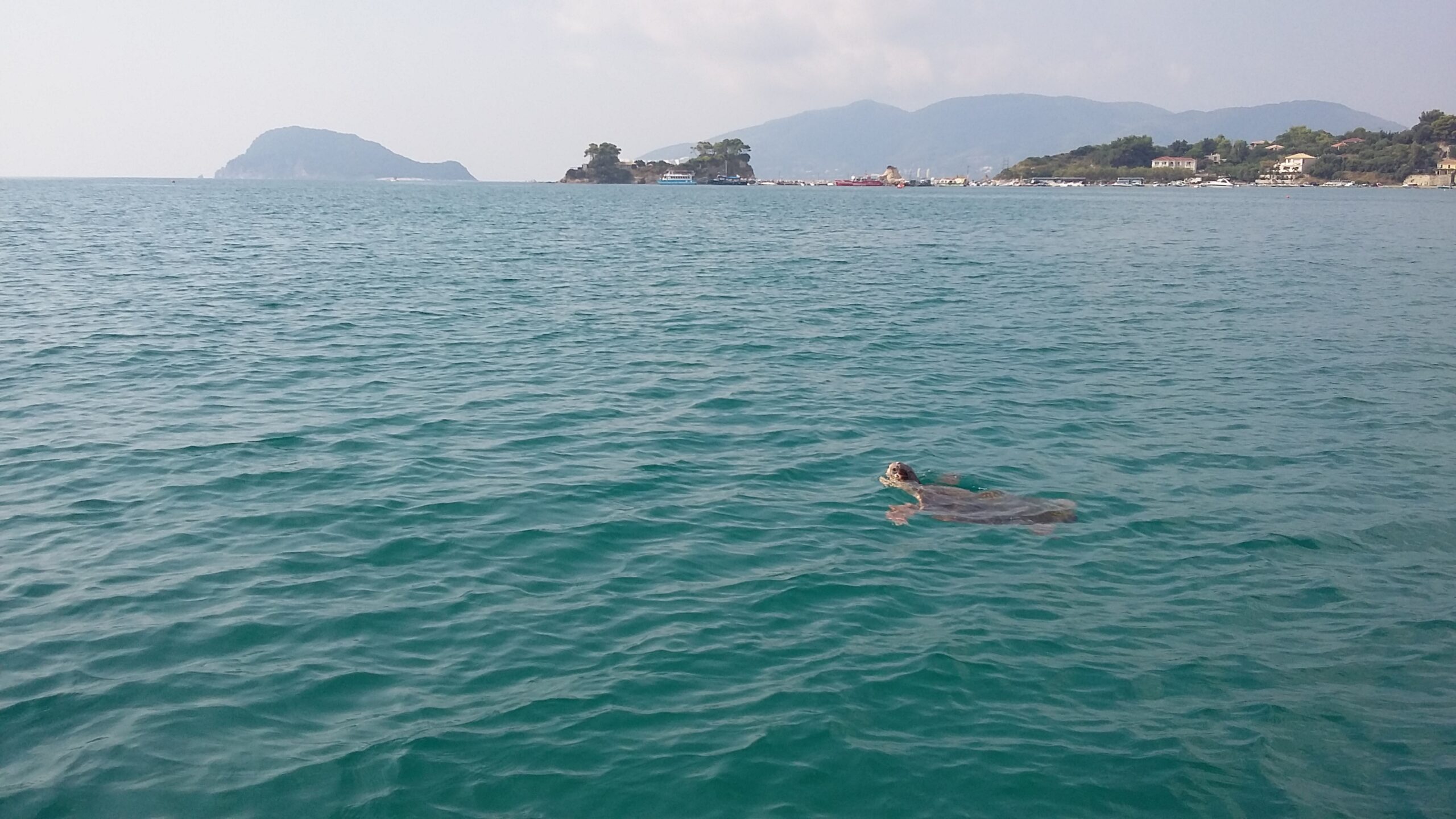
You can also see turtles in the bay from a boat, most often from May to September. We cover the rules for boats and the ethics of turtle-spotting trips in our guide to Laganas. Just one thing here: don’t feed the turtles and don’t touch them.
Zante in winter and out of season: what’s open and what isn’t
Off-season Zante is a different island. Green, empty and cheap, but with limitations you should know about before you buy a ticket.
Flights. Direct flights from the UK to Zante are largely seasonal, run by holiday airlines and low-cost carriers over the summer; check the current schedule for your airport. Out of season you’ll usually have to connect, most often via Athens. From Athens you continue by KTEL bus to the port of Kyllini in the Peloponnese and from there by ferry to Zakynthos Town. Levante Ferries link Kyllini with Zante daily, but the timetable differs between summer and winter. There’s more on getting there in our Zante holiday guide.
What’s closed. From late October to April there are no beach sunbeds or bars, and most resort hotels, boat hire places and organised boat trips are shut. Resorts such as Laganas or Tsilivi are practically deserted in winter.
What’s open. Zakynthos Town lives all year round, with tavernas, cafés, shops and museums, and the inland villages carry on with their normal lives too. Off-season Zante makes sense if you want to walk, drive around the interior and eat in tavernas where only locals sit. Not for a beach holiday.
April, May and October are the compromise. The island is already, or still, open, it’s warm without being hot. Of the three, we’d pick May: it’s drier than October, greener, and the days are three hours longer.
Zante, Corfu or Crete: weather compared
These are three of the Greek islands people most often weigh up against each other when booking from the UK. All the figures were calculated with the same method over the same years, so you can compare them directly.
| Measure | Zante | Corfu | Crete (Heraklion) |
|---|---|---|---|
| Annual rainfall | 878 mm | 1,467 mm | 451 mm |
| July, daily high | 32.6 °C | 31.1 °C | 30.8 °C |
| Days above 35 °C in July | 9 | 4 | 3 |
| Sea in August (2023–2024) | 27.6 °C | 27.3 °C | 27.8 °C |
| September, rainy days | 6 | 10 | 5 |
| October, rainfall | 99 mm | 176 mm | 29 mm |
| Sea in October (2023–2024) | 23.8 °C | 23.7 °C | 24.2 °C |
| November, rainfall | 184 mm | 308 mm | 43 mm |
| January, daily high | 13.9 °C | 12.8 °C | 15.1 °C |
The sea temperatures here come from the same short 2023–2024 satellite series for all three islands, which is why the Corfu figures differ from those in our Corfu weather guide, which are based on a different period. For comparing the islands with each other that doesn’t matter.
How to read it: Zante sits in the middle. It’s drier than Corfu, so September and early October are more reliable here, but in autumn it can’t match the certainty of Crete, where it hardly rains in October. In summer it’s the hottest of the three. The sea is practically the same everywhere in summer. If you want a warm sea in the second half of October with no risk of rain, go to Crete. If you want a green island in September with a lower chance of rain than on Corfu, Zante is a good choice. And if you can’t stand the heat, pick Corfu for July and August, or go to Zante in June.
What to pack for Zante, month by month
- April and May: a hoodie and a light jacket for the evenings, when the temperature drops by seven degrees. Sturdy shoes for walks and a rain mac for showers.
- June to August: a hat, high-factor sun cream, light long-sleeved clothing for the hottest part of the day and a water bottle. Water shoes are handy on the rockier beaches. In June, pack one hoodie for the evenings.
- September: your summer kit, plus a hoodie and a thin waterproof jacket for the second half of the month.
- October: swimwear still yes, but also long trousers, a rain jacket and shoes that can cope with the wet.
- November to March: a waterproof jacket with a hood and a warmer layer. An umbrella is useless in the wind. Bear in mind that in December there are under ten hours of daylight a day.
A bit of history: why the “Flower of the Levant”
From 1484 to 1797 Zakynthos belonged to Venice, and the Venetians gave it the nickname Fior di Levante, the Flower of the Levant (or of the East). It wasn’t just a flattering name. For merchants sailing in from the rocky islands of the Aegean, Zakynthos came as a shock: green, with olive groves, vineyards and gardens. The reason is the same one you can see in the rainfall table above. The winter rain that westerly winds bring to the Ionian islands largely misses the Cyclades. Zakynthos gets it, and that’s why it stays green while the rest of southern Greece turns yellow.
The Venetian era mostly left behind an Italian-style town with arcades and slender bell towers. Almost all of it, however, disappeared on 12 August 1953, when a strong earthquake hit the island and destroyed most of its buildings. The island was then rebuilt, with new buildings designed to withstand future tremors. When you walk across Solomos Square in Zakynthos Town today, you’re looking at a town restored after that disaster.
The square is named after the island’s most famous son. Dionysios Solomos was born here in 1798 and wrote the Hymn to Liberty, whose first verses became the Greek national anthem in 1865. He’s regarded as Greece’s national poet, and the airport you’ll land at bears his name. The Italian poet Ugo Foscolo also came from Zakynthos and dedicated the sonnet A Zacinto to the island.
After the Venetians the island passed in turn to the French, the Russians with the Ottomans, and the British. Zakynthos joined Greece together with the other Ionian islands in 1864. Venetian traces can still be seen today, for example in the Italian-sounding surnames.
Zante weather FAQ
What is the weather like in Zante in September?
Daytime highs around 28 °C, nights of 21.7 °C and a sea averaging 26.3 °C over the month, still above 27 °C in the first half of September. Rainfall averages 69 mm over six rainy days, but two thirds of them fall in the second half of the month. For swimming, we think the first half of September is the best time of the whole year.
What is the sea temperature in Zante by month?
The sea is warmest in August, around 27.6 °C off the south coast; September has 26.3 °C and October 23.8 °C. In June it’s 24 °C, in May 19.3 °C. It’s coldest in March, around 16.5 °C. The figures come from satellite measurements for 2023 and 2024, which were warmer than average, so in a cooler year expect the sea to be one or two degrees colder.
What is the Zante weather like at the end of September?
Still good for swimming: in the second half of September the sea is around 25.4 °C and daytime air temperatures are about 27 °C. Rain does pick up, though: the second half of the month averages four rainy days, often coming in one or two fronts. Pack a hoodie for the evenings and have a plan B for a rainy day.
Is Zante hot in October?
Warm rather than hot: 23.6 °C by day, 18.3 °C at night and a sea at 23.8 °C, which is warmer than in the first half of June. Rainfall, however, rises to 99 mm over eight days, and October is the least predictable month of the year: over ten years it ranged from 20 to 283 mm. The first half of October is usually still beach weather; in the second half hotels close and the direct summer flights come to an end.
Can you swim in Zante in May?
Yes, but it’s chilly. The sea is around 18.4 °C in the first half of May and around 20 °C in the second, with daytime air at 23.8 °C. That’s fine for a quick dip, less so for a full day on the beach with children. Warm sea above 23 °C only starts in June.
When is the best time to visit Zante for weather?
For swimming, from the second half of June to mid-September, with the best balance in the first half of September. For day trips and walking around the island, April, May and October. July and August are the driest, but also the hottest: on average six to nine days a month go above 35 °C.
How hot is Zante in August?
Average daytime highs of 32.5 °C and nights around 24.5 °C. About six days in the month go above 35 °C, and in the 2015–2024 data the highest August value is 41.0 °C. The sea is around 27.6 °C and it hardly ever rains. Air conditioning is a must in August, and the hottest part of the day is best spent in the shade.
Is Zante windy?
In summer, regularly but gently. The maestro blows, a north-westerly wind that is light in the morning (around 7 km/h) and roughly doubles in strength in the afternoon. That’s why boat trips to the west coast leave in the morning. With a north-westerly wind, the calmest sea is in Laganas Bay in the south. It’s windiest in winter, from November to March.
Where next
- Zante holiday guide: planning the whole trip. How to get to the island, which part suits whom, what it costs and whether to hire a car.
- Zante hotels: an overview of places to stay by area and type of holiday.
- Laganas: the island’s liveliest resort, the turtle beach and the marine park rules.
- Tsilivi and Planos: the family resort on the north-east coast and trips to the north of the island.
- Corfu weather by month: the same analysis for Greece’s greenest and wettest island.
Potřebujete pomoct s cestováním?
-
Ubytování 🏨
Vyberte si to nejlepší ubytování, ať už jste kdekoliv, přes Booking.com. -
Půjčení auta 🚗
Auto si snadno najdete přes Booking.com, kde máte často slevu díky ubytování, nebo Rentalcars.com, kde porovnáte nabídky většiny půjčoven. -
Zážitky 🎟️
Přes GetYourGuide.com si vyberete z nejrůznějších výletů i zážitků po celém světě, navíc se zrušením zdarma do 24 h předem.