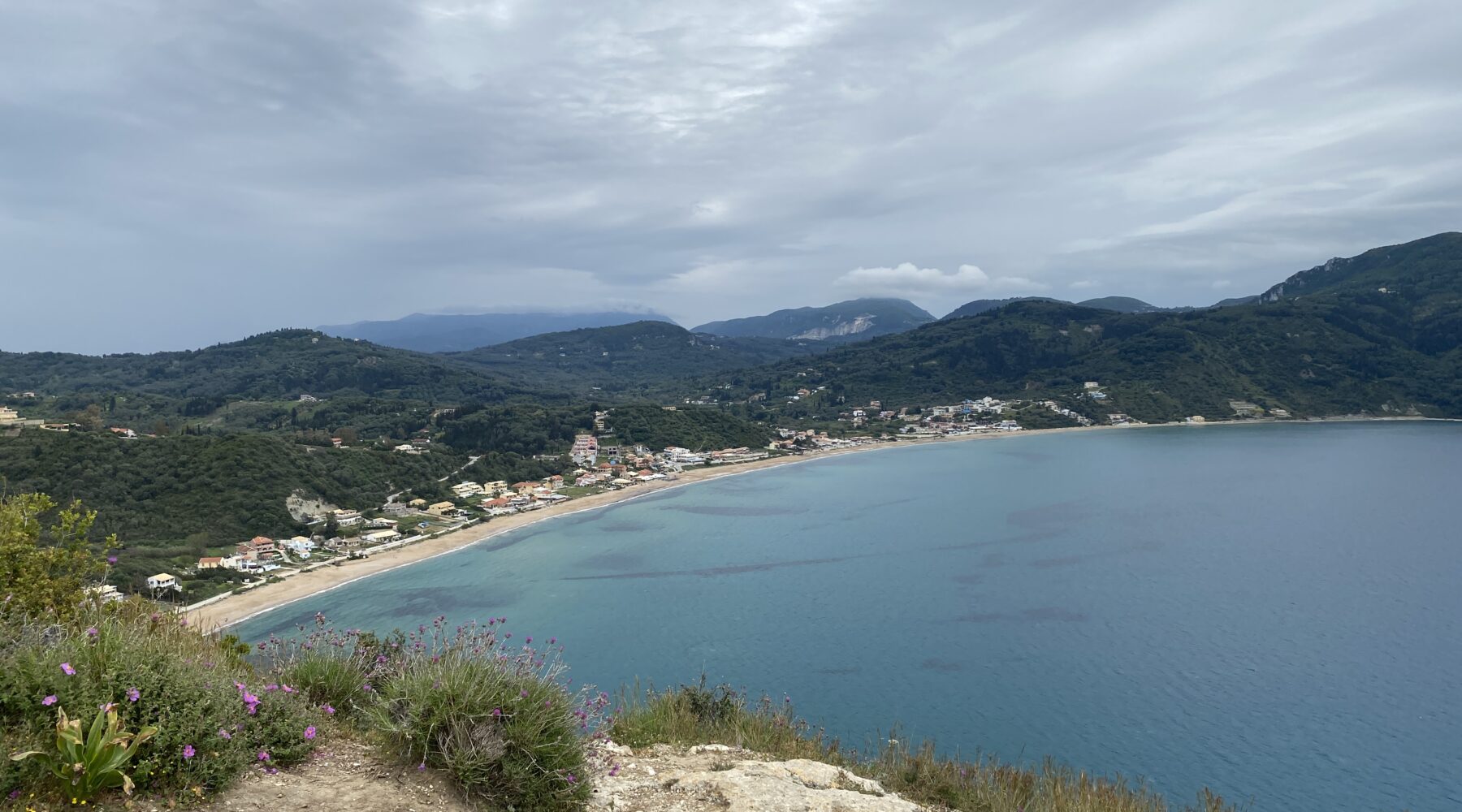
Last updated 26.10.2026
Every guide calls Corfu green, yet hardly any of them explain why. The reason matters as soon as you look at the Corfu weather by month and start planning a holiday: Corfu gets more rain than any other part of Greece people usually go to for a beach break. Measured data puts the north of the island at roughly 1,470 mm of rain a year. That is three times as much as Rhodes or Crete and five times as much as Santorini.
You will not notice any of this in July or August, when Corfu is as dry as the rest of Greece. You notice it at the edges of the season, mainly from mid-September onwards, and it is the only reason the island looks like Tuscany rather than a rocky steppe.
Below we go through the Corfu weather by month: daytime highs and night-time lows, sea temperature, rainfall and wind. Every figure comes from measured climate data, not from tour operator brochures. Where to stay, how to get there and what it costs is covered in our Corfu holiday planner, and the sights are in our list of things to do in Corfu.
Corfu weather by month at a glance
- July and August are the hottest months. Both have an average daytime high of 31 °C, and nights do not drop below 24 °C.
- The sea is warmest in August and September, and almost identically so: 26.4 °C and 26.3 °C. For swimming, September is every bit as good as August.
- The swimming season runs from June to October. The sea is 22.8 °C in June and still 23.6 °C in October. In May it is 19.3 °C, which is doable but bracing.
- July is the driest month, with 8 mm of rain and only two days when it rains at all. August has 29 mm and four such days.
- November is the wettest month with 308 mm, more than Santorini gets in an entire year.
- The season turns in the second half of September. The month averages 101 mm of rain, but it is unevenly spread and most of it falls towards the end.
- Wind is not a big issue. Unlike the Aegean, Corfu has no meltemi, and the average daily maximum wind speed in summer stays around 15 to 16 km/h.
- Out of season, go for the town, not the beach. From November to March the beach services are shut and most direct flights stop.
Corfu weather by month: the full table
We calculated the table below ourselves from measured climate data for the area around Corfu airport (39.62° N, 19.92° E) for the years 2015 to 2024. Sea temperatures come from satellite measurements of the surface of the Ionian Sea just west of the island. The source is the open Open-Meteo API, which is built on the ERA5 reanalysis: a model reconstructed from real observations, not a set of estimates. We downloaded the data and worked out the averages on 13 September 2026.
Why we make a point of this: the Corfu weather figures doing the rounds online often contradict each other, and on one page we even found different numbers in the text than in the table underneath it. You can check ours against the same source yourself.
| Month | Day | Night | Sea | Rainfall | Rainy days |
|---|---|---|---|---|---|
| January | 12.7 °C | 8.5 °C | 16.9 °C | 196 mm | 14 |
| February | 14.1 °C | 9.4 °C | 15.8 °C | 137 mm | 11 |
| March | 15.2 °C | 10.2 °C | 15.8 °C | 131 mm | 12 |
| April | 18.3 °C | 12.7 °C | 16.8 °C | 74 mm | 8 |
| May | 22.1 °C | 16.4 °C | 19.3 °C | 67 mm | 9 |
| June | 27.4 °C | 20.9 °C | 22.8 °C | 31 mm | 4 |
| July | 31.1 °C | 23.8 °C | 24.6 °C | 8 mm | 2 |
| August | 31.1 °C | 24.3 °C | 26.4 °C | 29 mm | 4 |
| September | 26.5 °C | 21.2 °C | 26.3 °C | 101 mm | 10 |
| October | 22.3 °C | 17.6 °C | 23.6 °C | 176 mm | 10 |
| November | 18.3 °C | 14.2 °C | 21.0 °C | 308 mm | 15 |
| December | 14.6 °C | 10.7 °C | 18.2 °C | 209 mm | 12 |
How to read the table. “Day” is the average daily maximum, not the average temperature across the whole day, so in July expect the afternoons to hit about 31 degrees, not the mornings and evenings too. “Rainy days” counts days with at least one millimetre of rain. September’s hundred-odd millimetres therefore do not mean ten ruined days; think two thunderstorms and eight short showers. And one thing an average cannot show: autumn rain on Corfu arrives all at once and leaves just as fast. A storm lasts an hour and then the sky is blue again.
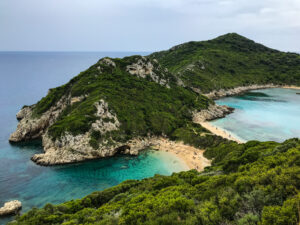
An average is not a forecast
The table shows how Corfu behaves on average over ten years. It does not tell you what the weather will do during your week, and the gap between the two is widest exactly when most people are planning. September’s 100 mm can fall in three thunderstorms within a single week or be scattered across ten brief showers, and the average looks identical either way. We have had a soaking September on Corfu, and we have also had a dry, cloudless second week of October.
Our rule of thumb: use the climate averages to decide which month to go, and the forecast to decide what to pack. On Corfu it is worth watching the forecast from about three days before you fly. The 14-day and 30-day outlooks that pop up most often for this destination are more mood than substance in a Mediterranean autumn: they tell you whether a low-pressure system is in the area, not whether it will rain on Tuesday. What works for us is comparing two sources, for example the Norwegian yr.no and Windy, where you can switch between several weather models. When two models disagree about the same day, that is useful information in itself: anything could happen, so keep a plan up your sleeve that does not depend on the weather.
Why Corfu is the wettest Greek island
Corfu sits on the north-western edge of Greece, open towards the Adriatic and the Italian mainland. Moist air coming in off the sea runs into the Pantokrator ridge and the mountains on the Albanian side, and drops its water. The further north and the higher up you go, the more it rains. That is the whole mechanism, and it is why the island is known as green rather than rocky.
So that this is more than a claim, we used the same source and the same period to calculate the annual rainfall for eight Greek places that are popular holiday spots. The difference turned out bigger than we expected.
| Place | Annual rainfall | Compared with Corfu |
|---|---|---|
| Corfu | 1,467 mm | — |
| Lefkada | 1,223 mm | 83% |
| Kefalonia | 925 mm | 63% |
| Zakynthos | 878 mm | 60% |
| Kos | 653 mm | 45% |
| Athens | 492 mm | 34% |
| Rhodes | 478 mm | 33% |
| Crete (Heraklion) | 451 mm | 31% |
| Santorini | 278 mm | 19% |
Annual totals calculated from the ERA5 reanalysis (Open-Meteo) for 2015 to 2024, each for a point next to the main town or airport. Inland and in the mountains the figures are higher, on the coast they are lower.
The table shows the whole Greek gradient: the further south-east, the drier. The Ionian Islands are green, the Cyclades are bare. For a holiday that gives you a simple rule: go to Corfu because it is green, and accept that you pay for that greenery at the edges of the season. If you want guaranteed dry weather in October, Crete or Rhodes is the safer bet.
Corfu sea temperature by month
The Ionian Sea warms up more slowly than the shallow Aegean coasts, but it also holds on to its heat for longer. The whole swimming window is shifted later in the year, and that has a few practical consequences.
June already feels like summer on land, but not yet in the water. The sea is 22.8 °C, which is pleasant, but the first plunge still takes your breath away. If swimming is the main point of your trip, aim for the second half of June.
For the water, September is just as good as August. The difference between 26.4 °C in August and 26.3 °C in September is statistically zero, while prices and crowds both drop. That is the strongest argument for a September holiday on Corfu, and it holds for most other Mediterranean destinations in September too.
October is a pleasant surprise. The sea is still 23.6 °C, warmer than in June. The catch is not the water: from mid-month the beach services and some hotels close, so you swim off an empty beach with no sunbeds and no bar. We like it that way, but it is good to know in advance.
The sea is coldest in February and March, both at 15.8 °C. Interestingly, January is still 16.9 °C. The sea simply lags behind the air: it is coldest about a month after the coldest air and warmest about a month after the warmest.
Corfu weather by month: what to expect and when to go
So what is the weather like in Corfu, and when should you go? Whatever month you pick, pack a rain jacket (we needed ours in May too).
January to March
Cool and wet, but not winter in the northern European sense. Daytime highs stay between 12.7 and 15.2 °C, with nights around ten. It rains a lot: January gets 196 mm. The island is a deep green at this time of year, the mimosa is in bloom and practically nothing is open in the resorts. Most direct flights from the UK are seasonal, so in winter you will usually connect, typically via Athens. It only makes sense as a city break in Corfu Town, or combined with Saranda across the water in Albania.
April
The first month when things turn. Rainfall drops to 74 mm with only eight rainy days. Daytime highs reach 18.3 °C and the sea is 16.8 °C, so swimming is for the hardy. In our view April is the best month for walking on the island: everything is green and in flower, and you can climb Pantokrator without suffering. Most hotels, though, only open at the end of the month.
May
22.1 °C by day, 16.4 °C at night and a sea of 19.3 °C: water you go into once a day and then dry off on a warm rock. It rains on nine days of the month, but the total is only 67 mm, so these are mostly short showers. The season is getting going, prices are low and the island is still green. We love May on Corfu because it is the last moment the island still looks like spring, yet it is already warm enough to sit outside in the evening.
June
A big jump: 27.4 °C by day, 20.9 °C at night, a sea of 22.8 °C and just 31 mm of rain over four days. For us June is the best compromise of the first half of the year. It is warm and dry, the beaches are up and running but not yet packed, and you can still walk in the hills.
July
The driest month of the year: 8 mm of rain and on average two days when anything falls at all. Daytime highs of 31.1 °C, nights of 23.8 °C, and the sea at 24.6 °C. The weather is a safe bet, but this is also the start of the busiest and most expensive part of the season. If you do not cope well with heat, stay on the east coast in the shade of the hills.
August
The same daytime temperature as July, 31.1 °C, but nights are half a degree warmer and the sea is at its warmest of the year, 26.4 °C. Rainfall is 29 mm, usually in quick evening thunderstorms. August is the busiest month on the island and also the one when the landscape is most parched.
September
A month with two faces. The first half is essentially an extended August, with warmer air than in June and a sea of 26.3 °C. The second half is already autumn: a monthly total of 101 mm and ten rainy days show the weather starting to break. If you are planning Corfu in September, go for the first two weeks.
October
Daytime highs of 22.3 °C and a sea of 23.6 °C are great numbers. Rainfall, however, jumps to 176 mm. That makes October a month for exploring the island, for walking and for the town, with swimming as a bonus. The season winds down in the middle of the month.
November and December
The wettest part of the year. November gets 308 mm and fifteen rainy days, December 209 mm. Temperatures are not low, though: November still has 18.3 °C by day and a sea of 21.0 °C. So this is warm rain, not cold. It makes no sense for a beach holiday, but for strolling the Venetian old town with its empty streets and eating Corfiot food in tavernas full of locals, it is an oddly pleasant time to be here.
Is Corfu windy?
Less than people expect, and this is one of the big differences between the Ionian and the Aegean. In summer the Aegean gets the meltemi, a northerly wind that can put a stop to swimming for a week in the Cyclades and parts of Crete. Corfu lies outside its reach.
According to the same data, the average daily maximum wind speed stays around 15 km/h in June and August and around 16 km/h in July and September. It is windiest in winter and spring, from January to March and in November, at 18 to 19 km/h. None of these values matter for a beach holiday.
What does matter is which way the coast faces. The west side of the island faces the open sea, and waves build there even when there is no wind on land, because the swell comes from far away. The east side lies in the narrow strait facing Albania and is calm almost all the time. So if the forecast shows waves, it does not mean you cannot swim; it means you should head to the other side of the island. We look at the differences between the coasts in more detail in our Corfu holiday planner.
When it is worth visiting Corfu out of season
Off-season Corfu is not a lesser Corfu, it is a different one. It pays off in three cases.
If you are going to walk. April, May and October are the only months when you can walk on the island in comfort. In summer it is too hot, and the shade of the olive groves is not enough. Corfu has waymarked trails right across the island, and April makes for a completely different holiday from August.
If you are going for the town and the food. Corfu Town runs all year, and in November or March it is a Greek town rather than a tourist backdrop. The tavernas are open, the cooking is the same and prices are lower.
If you want the sea without the crowds and can live with the risk. The second half of September and the first half of October give you warm water and half-empty beaches. The risk is that you draw a week of thunderstorms. We accept that and this is actually our favourite time to come, but we would never promise anyone it is a sure thing.
What does not work out of season: most direct flights from the UK between November and March, beach bars and sunbed hire from mid-October, some of the hotels and organised boat trips. Opening hours at historic sites are shorter in winter.
What to pack for Corfu, month by month
- April and May: a jumper for the evening, a light rain jacket and sturdy shoes. Daytime temperatures are pleasant, but after sunset it cools by five to seven degrees.
- June to August: a hat, high-factor sun cream and water shoes. Much of the east coast is pebbly, and getting into the sea barefoot is no fun.
- September: the same as in summer, plus a light jacket for the second half of the month. September storms blow in fast.
- October: still bring your swimsuit, but add a waterproof jacket and long trousers. The evenings are already cool.
- November to March: an umbrella is useless, because the rain comes with wind. Bring a hooded jacket and shoes that can cope with the wet.
Where to stay in Corfu depending on the weather
A detailed look at the coasts, types of accommodation and prices is in our Corfu holiday planner. As far as the weather goes, two things apply.
In high summer the east coast is easier to bear. It lies in the shadow of the ridge and cools down earlier in the afternoon. At the edges of the season the west is better, because the sun shines there until evening, and in April or October you feel the difference. If you are travelling out of season and want to be sure you will have somewhere to go when it rains, stay within easy reach of Corfu Town.
You can search by area: places to stay in Corfu Town for an off-season trip, places to stay in Benitses on the calm east coast, and places to stay in Paleokastritsa on the sunnier west.
What we would do differently
We made two mistakes with the weather on Corfu, and there is one thing we would do exactly the same way again.
We would not trust the average in the table. Our first September trip to Corfu landed on a week when it rained three days in a row, and we were miserable, because we had read beforehand that it rains “ten days a month” in September and had pictured that spread out evenly. It does not work like that. Autumn rain on Corfu comes in fronts, not in drops. If we were planning it again, we would either go at the start of September or admit up front that we were taking a risk, with Corfu Town, museums and tavernas as plan B.
We would not chase the hottest month. For years we went in August, because “that is when it is hottest”. But between August and September the sea temperature differs by one tenth of a degree and the air is four and a half degrees cooler, which in practice is the difference between being able to go out in the afternoon and hiding indoors. Add lower prices and fewer people, and the choice is obvious.
And the one thing we would do the same: we would go again in April, even though the sea is cold. Corfu in spring is the most beautiful thing we know in Greece, and yet hardly anyone is on the island at that time. We once spent a whole afternoon sitting on a low wall above an empty cove, not taking photos and not ticking anything off, and it is our strongest memory of the whole island. In the end, the best month for Corfu is the one when you do not have to tick anything off. We write about this in a similar spirit in our piece on slow travel.
Frequently asked questions
What is the weather like in Corfu in September?
Daytime highs of 26.5 °C, nights of 21.2 °C and a sea of 26.3 °C, practically as warm as in August. On average there is 101 mm of rain and ten days when it rains, but it is not spread evenly: the first half of September tends to be dry, the second half more changeable. If you are planning Corfu in September, we recommend the first two weeks.
What is the sea temperature in Corfu by month?
The sea is warmest in August (26.4 °C) and September (26.3 °C) and coldest in February and March (both 15.8 °C). It is 22.8 °C in June, 24.6 °C in July and still 23.6 °C in October. In practice, the swimming season on Corfu runs from June to mid-October. The figures are averages from satellite measurements of the surface temperature of the Ionian Sea around the island (Open-Meteo, calculated on 13 September 2026).
Does it rain a lot in Corfu?
Yes, more than anywhere else in Greece people usually go to for a beach holiday. The annual total comes to 1,467 mm, compared with 478 mm on Rhodes, 451 mm on Crete and 278 mm on Santorini. Almost all of it falls outside the summer, though: July gets 8 mm and August 29 mm, while November gets 308 mm. The rain is exactly why Corfu is so green.
What is the best time to visit Corfu?
For swimming, July and August; for a mix of beach and sightseeing, the first half of September; for walking, April, May and October. Personally, we find June and early September work best: warm, dry and you can still breathe. Peak summer means 31 °C by day and the busiest resorts of the year.
Is it warm enough to swim in Corfu in May?
Yes, but it is bracing. The sea is 19.3 °C in May and the daytime air 22.1 °C. It is not weather for lying on the beach all day, but fine for a quick dip. If the water is the main reason for your trip, wait for the second half of June, when the sea is above 22 °C.
What is the weather like in Corfu in October?
22.3 °C by day, 17.6 °C at night and the sea still at 23.6 °C, which is warmer than in June. Rainfall, however, jumps to 176 mm, and most beach services close in the middle of the month. We treat October as a month for exploring the island with swimming on the side, not as a beach holiday.
Is Corfu windy?
Less so than the Cyclades or Crete, because the Ionian Sea does not get the summer meltemi. The average daily maximum wind speed in summer stays around 15 to 16 km/h. Waves are more a question of which coast you are on: the west side faces the open sea and waves build there even when there is no wind, while the east lies in the narrow strait facing Albania and is calm almost all the time.
Is it worth going to Corfu in winter?
Not for a beach holiday, but yes for a city break. Temperatures stay between 12.7 and 15.2 °C, it rains a lot and the beach resorts are closed. Corfu Town, however, runs all year, and its Venetian old town with empty streets is a completely different experience. Bear in mind that most direct flights from the UK are seasonal, so in winter you will usually have to connect, typically via Athens.
Where next
- Corfu holiday guide: a planner for the whole trip. Which coast suits whom, how to get to the island, what it costs and whether to hire a car.
- Things to do in Corfu: twenty specific places, from the Venetian fortresses and the Achilleion to Pantokrator.
Potřebujete pomoct s cestováním?
-
Ubytování 🏨
Vyberte si to nejlepší ubytování, ať už jste kdekoliv, přes Booking.com. -
Půjčení auta 🚗
Auto si snadno najdete přes Booking.com, kde máte často slevu díky ubytování, nebo Rentalcars.com, kde porovnáte nabídky většiny půjčoven. -
Zážitky 🎟️
Přes GetYourGuide.com si vyberete z nejrůznějších výletů i zážitků po celém světě, navíc se zrušením zdarma do 24 h předem.