Last updated 27.10.2026
Basel is the Swiss city where you can see France and Germany from the riverbank, and where in summer people commute to work by river. Literally: locals stuff their clothes into a waterproof bag shaped like a fish, jump into the Rhine and let the current carry them three kilometres past the cathedral. Around 176,000 people live here, which makes Basel the third-largest city in Switzerland after Zurich and Geneva, and for its size we think it has more art than anywhere else in Europe. About forty museums, several of them world-class, plus a river you can swim in: those are the two big things to do in Basel.
Most lists of things to do in Basel, Switzerland stop at the town hall and the cathedral. We have put together eighteen tips in and around the city, added day trips, and covered the practical side that matters most on any Swiss trip: how to get there, what it costs and where you can save. Basel has one big advantage here. If you spend a night in the city, you ride the trams for free and pay a quarter less at most museums.
Things to do in Basel at a glance
- Stay overnight and the trams are free. Every guest at a hotel, hostel, B&B or holiday flat gets a BaselCard at check-in: free trams and buses plus 25% off museums, the zoo and Rhine boats (basel.com).
- Direct flights from the UK. Basel’s EuroAirport Basel-Mulhouse-Freiburg is in France, but it has a Swiss sector, and bus 50 takes you to the main station in about 20 minutes.
- By train it is Eurostar to Paris and a TGV Lyria to Basel. Drivers need a Swiss motorway vignette for 40 CHF (about £36), but you can reach Basel itself without using Swiss motorways.
- Swimming in the Rhine is the big summer pastime. Only when the water is above 18 °C. Most people get in below the Museum Tinguely and drift about three kilometres along Kleinbasel. A Wickelfisch dry bag costs from 20 CHF (about £18).
- The Kunstmuseum is free on the first Sunday of each month and on some early evenings. Otherwise the collection costs 25 CHF (about £23).
- Fondation Beyeler is free for anyone up to 25, and from 18 October 2026 adults pay 30 CHF (about £27). Tram 6 takes you there from the centre.
- Three countries in one afternoon. The Dreiländereck tripoint is a short ride on tram 8, and the Vitra Campus in Weil am Rhein, Germany, is a few bus stops past the border.
- Basel Fasnacht 2027 starts on Monday 15 February at 4 am and lasts exactly 72 hours. It is on the UNESCO list of intangible cultural heritage, and rooms for those days get booked months ahead.
How to get to Basel from the UK
Basel sits in the north-western corner of Switzerland, right where the Swiss, German and French borders meet. For British travellers that makes it one of the easiest Swiss cities to reach: a short flight, or a rail journey through France that never touches the rest of Switzerland.
By plane. This is the quickest way. There are direct flights to Basel from London and from a number of other UK airports, and from London the flight takes roughly an hour and a half. Routes and frequencies change with the season, so check the current schedule before you plan. The airport, EuroAirport Basel-Mulhouse-Freiburg (code BSL), stands entirely on French soil but is split into a French and a Swiss sector. For Basel, leave through the Swiss side: from the arrivals hall of the Swiss sector, bus 50 runs to Basel SBB station every 7 to 10 minutes from about 4:30 am until midnight, and the ride takes around 20 minutes (euroairport.com).
By train. There is no direct train from the UK, but the route is straightforward: Eurostar from London St Pancras to Paris, then a high-speed TGV Lyria from Paris Gare de Lyon to Basel. Allow most of a day including the change of station in Paris. Once you arrive you will notice that Basel has three international stations. The Swiss Basel SBB and the French Basel SNCF share one building, while the German Basel Badischer Bahnhof is on the other side of the Rhine in Kleinbasel.
By coach. Long-distance coaches from London to Basel usually involve at least one change and take the best part of a day. It is the cheapest option and by far the least comfortable.
By car. Driving means a Channel crossing and a long day on French motorways, most of which are tolled. We would break the journey with a night in Champagne or Alsace. On Swiss motorways you need a vignette costing 40 CHF (2026, about £36), either as a sticker or as an e-vignette linked to your number plate. It is valid from 1 December of the previous year to 31 January of the following year, and there is no shorter version, so you pay the same even for a single day. Buy the e-vignette only on the official e-vignette.ch. If you are only going to Basel and not driving on around Switzerland, you can reach the city without the motorway: just set your sat nav to avoid toll roads before you reach the border.
💡 Leave the car in a garage and walk. The Old Town is mostly pedestrian and tram-only. Underneath Basel SBB station is the Parking Centralbahn, where during the day (7 am to 7 pm) you pay 3.50 CHF for every half hour or part of it on level P1 and 2.50 CHF on levels P2 and P3, up to a maximum of 35 CHF or 25 CHF respectively for 24 hours (parking.ch). The lower levels are therefore cheaper. Your hotel will give you a BaselCard, and from then on the trams are free.
Is Basel expensive? Prices and how to save
Switzerland is expensive, and Basel is about on a par with Zurich. The difference is that a lot of the best things to do in Basel cost nothing at all: the river and swimming in it, a walk through the Old Town, the cathedral, the town hall courtyard, the Tinguely Fountain, the tripoint and the view from the Pfalz terrace. You mostly pay for museums, and there are so many of them that it is easy to spend more than you meant to.
BaselCard. This is the biggest saving. Everyone who spends a night in a hotel, hostel, B&B or holiday flat in Basel gets one at check-in, valid for the whole stay. You can also load it onto your phone as a web app that works almost offline. It includes (basel.com):
- free bus and tram travel around the city,
- 25% off admission to 26 museums, including the Kunstmuseum, Fondation Beyeler, Antikenmuseum, Augusta Raurica, Basler Papiermühle and Cartoonmuseum,
- 25% off the zoo, the sightseeing bus, the public Old Town walking tour, scheduled Rhine boats and the Läckerli biscuit workshop,
- e-bike hire at the SBB station for 25 CHF a day.
Watch out for the borders. The BaselCard is not valid on the way to the Vitra Campus in Germany or into France, because that is where its zone ends. Each discount can be used once per attraction and cannot be combined with other offers.
If you are not staying overnight. A single-zone ticket costs 4.20 CHF and is valid for an hour, a short-hop ticket for up to four stops 2.60 CHF for half an hour (Tarifverbund Nordwestschweiz, tnw.ch). The Old Town is so compact, though, that you will walk it anyway.
Museum pass. If you are coming mainly for the art and plan to visit other towns in the region, consider the Museums-PASS-Musées, which covers 345 museums, castles and gardens in Switzerland, Germany and France, including the Kunstmuseum and Fondation Beyeler. For a weekend in Basel, though, the free BaselCard is the better deal.
Swiss Travel Pass and Half Fare Card. A 2nd-class Swiss Travel Pass for an adult costs 254 CHF for 3 days and 309 CHF for 4 days (about £230 and £280). The Swiss Half Fare Card at 150 CHF (about £137) for a month gives you 50% off most tickets (SBB, prices valid until 31 December 2026). For Basel alone neither is worth it. They only make sense if you continue to Bern, Lucerne and the mountains.
Food. Restaurant prices are Swiss prices, and they will surprise you even if you live in London. We handle it the way we do everywhere in Switzerland: lunch from the food counters at Coop and Migros, bread from a bakery and a picnic on the steps by the Rhine in Kleinbasel, where half the city does the same in summer. Then one restaurant meal in the evening that is worth the money. Try Basler Läckerli, hard honey biscuits with candied peel, and if you come for Fasnacht, Mehlsuppe, a thick soup made from browned flour.
Water. Basel has more than two hundred fountains, and you can drink from almost all of them. The exceptions carry a “Kein Trinkwasser” sign. A refillable bottle is the best investment you can bring.
| Item | Price in CHF (2026) | Approx. in £ |
|---|---|---|
| BaselCard for overnight guests (free public transport) | free | 0 |
| Public transport ticket, 1 zone, 1 hour | 4.20 | 3.80 |
| Münster cathedral towers (adult) | 6 | 5.50 |
| Kunstmuseum, collection / with special exhibition | 25 / 30 | 23 / 27 |
| Fondation Beyeler (adults 26 and over) | 30 | 27 |
| Museum Tinguely (adult) | 18 | 16 |
| Zoo Basel (adult / child) | 22 / 10 | 20 / 9 |
| Wickelfisch dry bag for Rhine swimming | from 20 | from 18 |
| Swiss Travel Pass, 3 days, 2nd class | 254 | 230 |
| Swiss motorway vignette | 40 | 36 |
| Parking Centralbahn by the station, max. 24 h (P1) | 35 | 32 |
Prices come from the operators’ official websites (Basel Tourismus, TNW, Basler Münster, Kunstmuseum Basel, Fondation Beyeler, Zoo Basel, SBB, parking.ch) and, for the Museum Tinguely, from Switzerland Tourism. Conversions are approximate, at 1 CHF ≈ £0.91. The Vitra Campus is in Germany and charges in euros.
18 things to do in Basel, Switzerland
The tips roughly follow the map: first the Old Town on the left bank (Grossbasel), then the river and Kleinbasel on the right bank, then the museums, and finally places on the edge of the city and the events worth timing your trip around. You can walk most of the first ten in a single day.
1. Grossbasel Old Town
The Old Town sits on the raised left bank of the Rhine and is one of the best preserved in Switzerland. It is a tangle of steep lanes and stairways between Marktplatz, the cathedral and the Spalentor, lined with guild houses, painted façades and oriel windows. The best-known street is Spalenberg, which climbs uphill from Marktplatz and is full of small shops and cafés. We prefer the parallel lanes higher up, Heuberg and Nadelberg, where hardly anyone goes, and the quiet Augustinergasse behind the cathedral, with views over the gardens above the river.
Give yourself at least three hours and go in the morning or towards evening. If you want a guide, join the public Old Town walking tour run by Basel Tourismus: from April to October it runs every afternoon and on weekend mornings too, in winter only on Saturdays, and with a BaselCard you pay three quarters of the price (basel.com).
2. Marktplatz and the red town hall
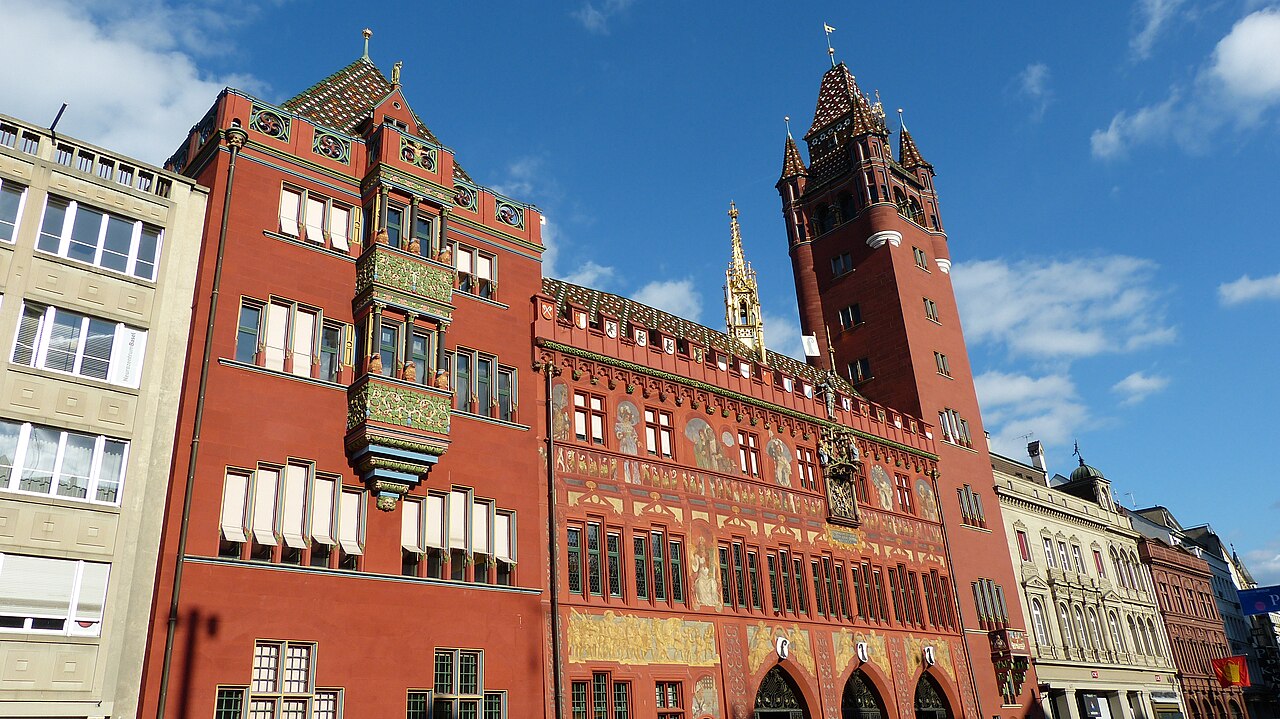
You cannot miss the town hall on Marktplatz. It is bright red, with a tower, gilded details and frescoes covering the whole façade, and it was built at the start of the 16th century after the great earthquake. When Basel joined the Swiss Confederation in 1501, the front gained battlements decorated with the coats of arms of Basel and the eleven cantons of the time. The cantonal government and the hundred-member parliament, the Grosser Rat, still meet here today.
You can walk into the courtyard for free on weekdays from 8 am to 5 pm. At weekends it is closed (basel.com). In our view the courtyard, with its painted staircase and arcades, is even prettier than the façade, and if you come in the morning you will have it almost to yourself. On weekdays there is a market with fruit, vegetables and flowers on Marktplatz.
3. Basel Minster and its two towers
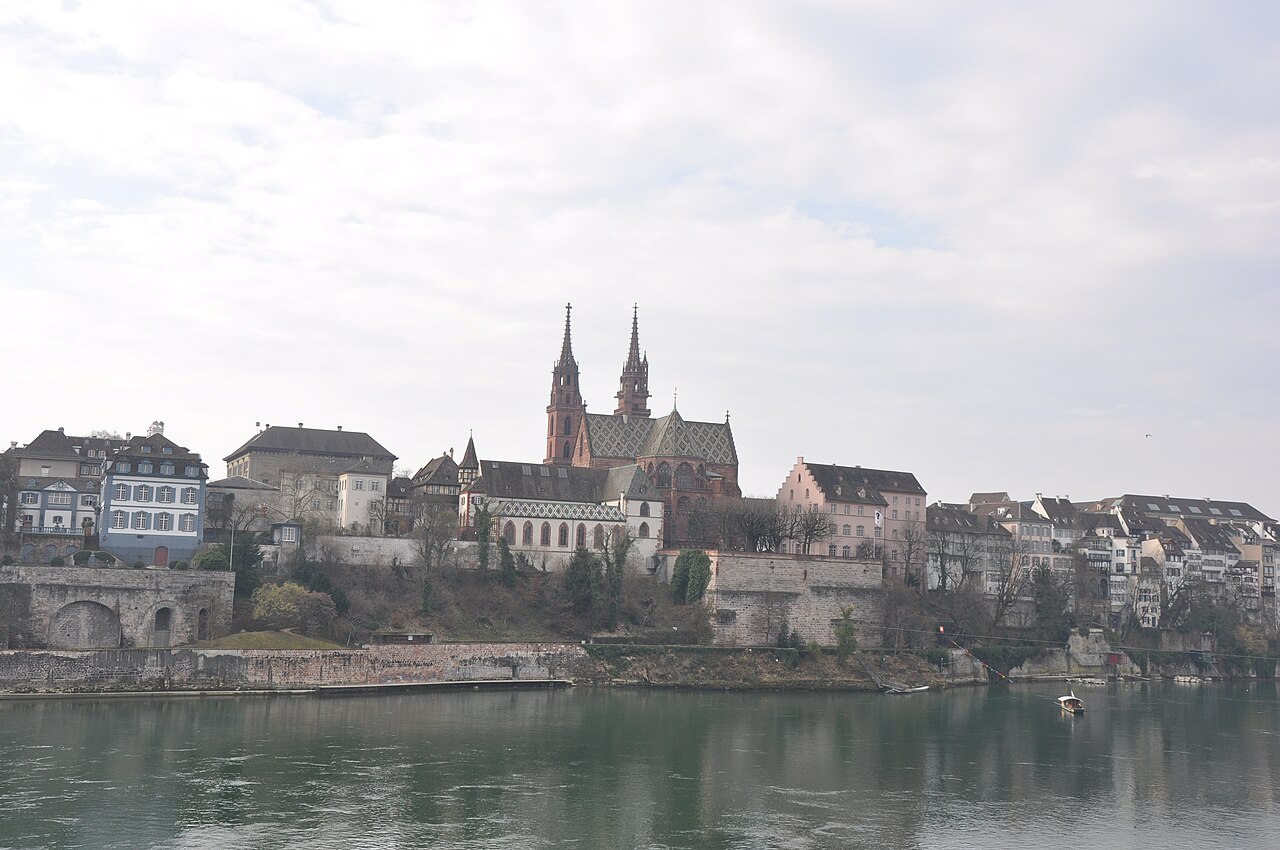
The Münster, built of red sandstone with two slender towers and a colourful glazed-tile roof, is the symbol of the city. The Romanesque cathedral was consecrated in 1019, rebuilt in Gothic style after the earthquake of 1356, and has been Protestant since the Reformation in 1529. Inside is the tomb of Erasmus of Rotterdam, who spent much of his life in Basel and published his books here.
Entry to the cathedral is free. In summer it is open Monday to Friday from 10 am to 5 pm, on Saturdays until 4:30 pm and on Sundays from about 11:30 am, after the service, until 5 pm. In winter it opens on weekdays from 11 am to 4 pm, on Saturdays until 4:30 pm and on Sundays from 11:30 am to 4 pm (baslermuenster.ch).
About 250 steps lead up a narrow staircase to the Georgsturm and Martinsturm towers. Admission is 6 CHF (about £5.50), 4 CHF for seniors and students, and free for children under 14. Last entry is half an hour before the cathedral closes, no one goes up between 12:00 and 12:20 because of midday prayers, and there can be no more than 30 people on the towers at once. The unusual part is that you cannot go up alone: only groups of two or more are let in. From 1 to 23 December there is usually a lit evening climb on weekdays between 4 and 6 pm, with a view over the Christmas city, for the same price.
4. The Pfalz terrace and the cloister
Behind the cathedral is the Pfalz terrace, high above the river, with chestnut trees and a low wall you can sit on. It is open to everyone, and we think it is the best view in Basel, better than from the tower: the Rhine flows directly below you, Kleinbasel lies opposite and the Black Forest rises behind it. If you skip the tower climb, you miss nothing here. Steps lead down from the terrace to the river and the Leu ferry.
Right next to it is the Gothic cloister (Kreuzgang), open daily from 8 am until dusk, 8 pm at the latest. It is cool, quiet and nearly empty even when Münsterplatz outside is packed.
5. Mittlere Brücke and the Lällekönig
The Mittlere Brücke links the Old Town with Kleinbasel. The first bridge across the Rhine stood on this spot as early as 1225, and for a long time it was the only fixed crossing of the river between Lake Constance and the sea. Today’s stone bridge dates from 1905. In the middle stands a replica of the Käppelijoch chapel, the spot where punishments were carried out until the 17th century.
Before you cross, look up at the corner of a building on Schifflände on the Grossbasel side. There hangs the Lällekönig, the head of a king sticking his tongue out towards Kleinbasel. It is how the two halves of the city have always teased each other. The bridge gives the best view of the cathedral and the houses above the river, and in the evening, when the lights come on, we always stop on it for a while.
6. Rhine ferries with no engine
Four small wooden ferries cross the Rhine in Basel: the Wilde Maa by St. Alban, the Leu below the cathedral, the Vogel Gryff by Klingental and the Ueli by St. Johann. They have no engine. Each hangs from a cable stretched across the river, the ferryman sets the rudder and the current pushes the boat over to the other bank on its own. The crossing takes a few minutes and you pay the ferryman directly.
For us it is the nicest way to get from one bank to the other in Basel, and from the water you get the best view of the Münster. The ferries are traditional boats kept going by local associations, not a tourist attraction, so feel free to use them simply as transport. In winter and when the river is high they run less often or not at all. We could not find an official fare list on the operators’ websites, but the fare is a token amount.
7. Swimming in the Rhine (Rheinschwimmen)
This is what Basel is all about. In summer the whole Kleinbasel bank turns into one long beach, and locals swim into town, out of town or just for fun. They put their clothes in a Wickelfisch, a bright waterproof bag shaped like a fish that was invented right here in Basel. You put your things inside, roll the open end seven times and close it, and then it floats along with you like a buoy. You can buy one at the tourist office and in shops from 20 CHF (about £18, basel.com), and it doubles as the best souvenir from Basel.
The most popular starting point is the bank below the Museum Tinguely, from where the current carries you about three kilometres along Kleinbasel. Strong swimmers get in between the Wettsteinbrücke and Johanniterbrücke bridges. The lifesaving society SLRG publishes a map of entry and exit points, and the free BachApp shows everything, including the current water temperature and level. Basel Tourismus recommends swimming only when the water is above 18 °C and the gauge reads below 650 cm. The current is strong and the bridges and boats are real obstacles, so only swim if you are a strong swimmer, never alone and never after drinking.
If it is your first time, you can join a group with trained lifeguards every Tuesday in July and August. They meet at 5:45 pm below the Museum Tinguely and you need to sign up in advance. Once every summer there is the official Basler Rheinschwimmen, when the river fills up with colourful fish, and taking part is free.
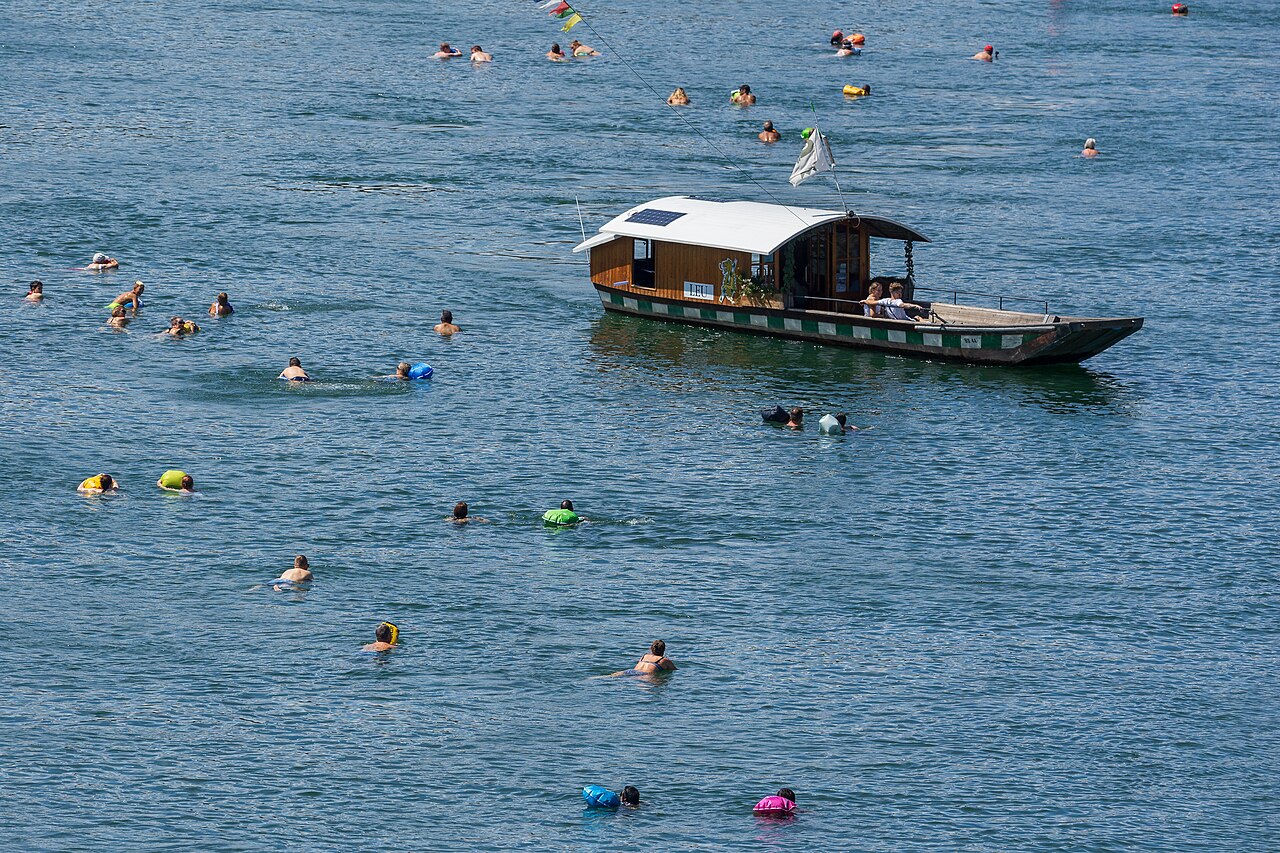
💡 Not confident in the current? Head to a Rheinbad. Two Art Nouveau river baths stand on the bank, Rheinbad Breite and Rheinbad St. Johann, open from May to September depending on the weather. They have changing rooms, a place to get into the river and somewhere to lie down. Locals walk upstream along the bank, jump in and let the current carry them back to the baths.
8. Kleinbasel, the Rhine promenade and the buvettes
The right bank feels like a different world from the Old Town opposite. It is flat, with the Oberer and Unterer Rheinweg promenade, steps right down to the water and, in summer, buvettes: small open-air bars and kiosks where you can get a beer and a bite to eat and dry off after a swim. Kleinbasel is generally less touristy and more studenty, and in the evening it is livelier than the Old Town.
We would come and sit on the steps by the water in the early evening, when the sun sets behind the cathedral across the river and the whole of Grossbasel turns red. It costs nothing and, for us, it is the best moment of any day in Basel. In summer the promenade hosts concerts and open-air film screenings.
9. Spalentor and the city gates
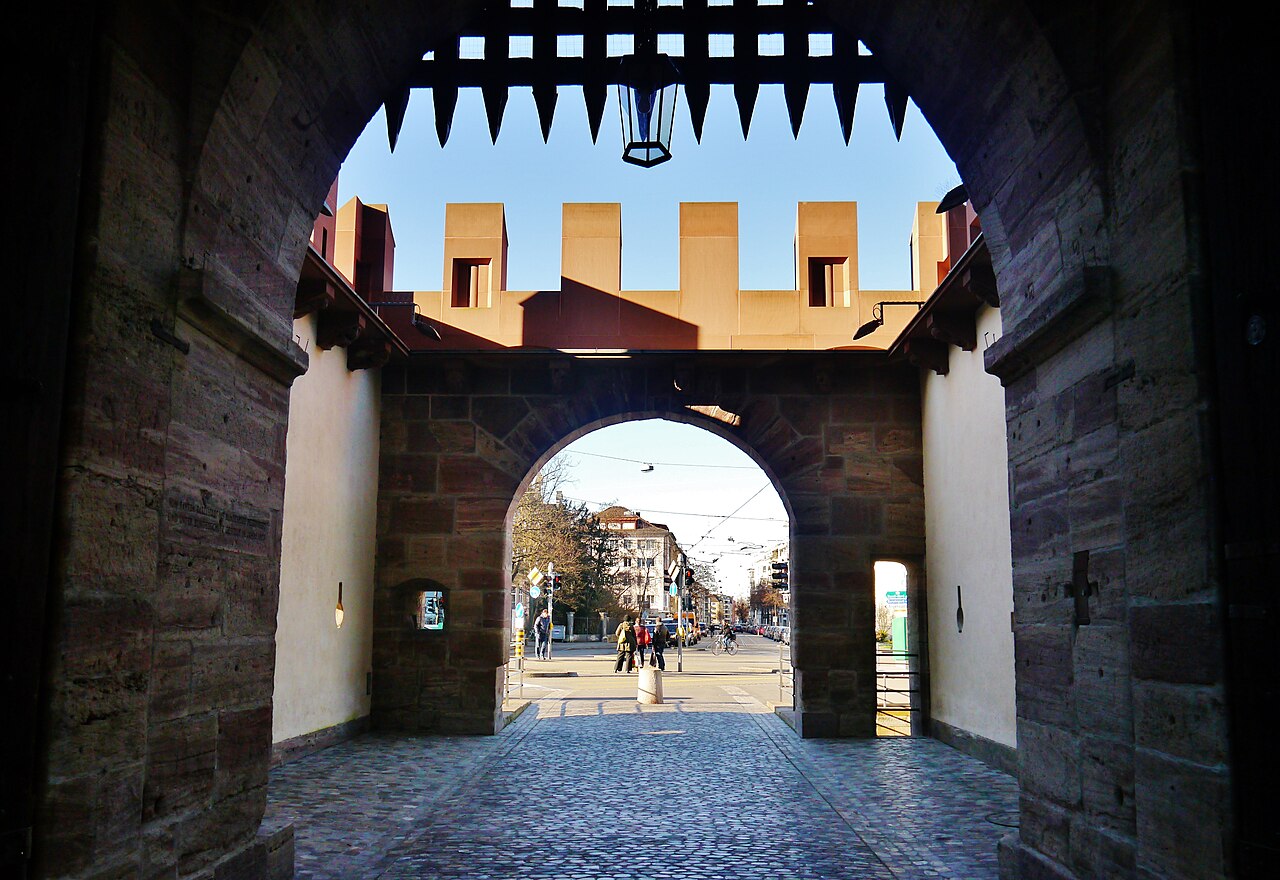
Three gates survive from Basel’s medieval fortifications, built between 1362 and 1398. The finest is the Spalentor on the western edge of the Old Town, a Gothic gate from around 1400 with a roof of coloured tiles, statues and a portcullis that still hangs above your head. From Marktplatz it is a ten to fifteen minute walk up Spalenberg.
The other two are the St. Alban-Tor in the east, which still has its wooden doors, and the St. Johanns-Tor in the north by the Rhine. If you enjoy walking, you can link them into a loop around the Old Town along the line of the former walls, through parks and quiet neighbourhoods.
10. Tinguely Fountain
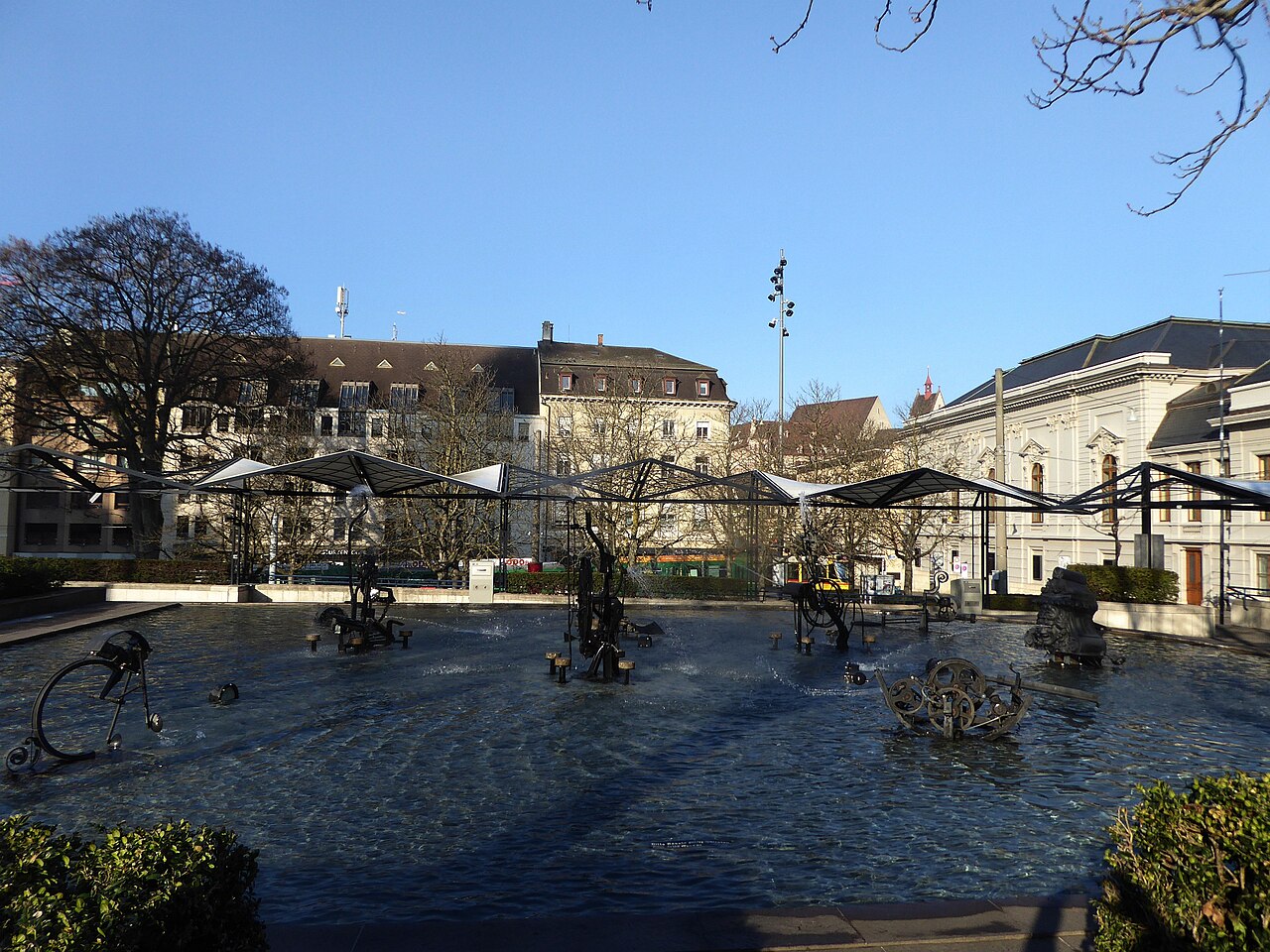
On Theaterplatz by the city theatre, a few steps from Barfüsserplatz, ten black machines by the Swiss sculptor Jean Tinguely stand in a shallow pool. He built the fountain in 1977 on the spot where the stage of the old theatre used to be, and the machines still move, turn, splash and squirt water at each other like actors who never left the stage. Locals call it the Fasnachtsbrunnen, the carnival fountain.
It is open around the clock and free. It looks best in the evening when it is lit up, and on freezing days when icicles grow on the machines. If you like Tinguely, carry on to his museum (tip 12).
11. Kunstmuseum Basel
If you only have time for one museum in Basel, make it this one. The collection grew out of the Amerbach Cabinet, which the city bought in 1661, and that is why the Kunstmuseum is considered the oldest art collection in the world open to the public. It holds a large group of works by Hans Holbein the Younger and old masters from the Upper Rhine, then jumps through the Impressionists and Picasso all the way to the present day. The museum has three buildings: the main building, the new building linked to it by an underground passage, and the Gegenwart for contemporary art.
Admission to the collection is 25 CHF (about £23), 30 CHF with a special exhibition, and 12 CHF for students aged 20 to 25 and for young people aged 13 to 19. With a BaselCard the collection costs 18.75 CHF. The collection is free on the first Sunday of every month, on Tuesdays, Thursdays and Fridays from 5 to 6 pm and on Wednesdays from 5 to 8 pm. It is open Tuesday to Sunday from 10 am to 6 pm, until 8 pm on Wednesdays, and closed on Mondays. The Gegenwart building is closed until 28 November 2026 while an exhibition is installed (kunstmuseumbasel.ch).
Allow at least two to three hours for the collection. We would go on a Wednesday at five: three free hours and the museum almost to yourself.
12. Museum Tinguely
The Jean Tinguely museum stands in Solitude Park right on the bank of the Rhine in Kleinbasel and was designed by the Ticino architect Mario Botta. Inside are Tinguely’s full-size machines, which spring into life at the press of a button and rattle, creak and do all sorts of pointless things. It is a museum where even people who can’t stand modern art end up laughing, and children don’t want to leave. It sits right on the riverside, so the Rhine is never far away.
Adults pay 18 CHF (about £16), students 12 CHF, and children under 16 with an adult go free. It is open Tuesday to Sunday from 11 am to 6 pm, usually until 9 pm on Thursdays, and closed on Mondays (Switzerland Tourism). Below the museum is the most popular starting point for Rhine swimming, so you can combine the two on one summer afternoon.
13. Fondation Beyeler in Riehen
Hildy and Ernst Beyeler’s private collection holds more than 500 works of classic modern and contemporary art and is housed in a building by Renzo Piano in Riehen, on the edge of Basel. Through the big windows you see meadows, pastures and vineyards below the Black Forest, so you find yourself looking at Monet one moment and cows the next. The museum has recently added buildings by Peter Zumthor, the Wyss Museum, the Ammann Pavilion and the Erlen Gatehouse, plus a park with old trees and ponds.
From 18 October 2026 adults pay 30 CHF (about £27), or 23 CHF with a BaselCard, and visitors aged 25 and under get in free. Entry is also free with the Museums-PASS-Musées, but the Swiss Museum Pass is not valid here. It is open daily from 10 am to 6 pm, until 8 pm on Wednesdays (fondationbeyeler.ch). Timed tickets are worth buying online, as there are queues for the big exhibitions. Tram 6 runs from the centre right to the Fondation Beyeler stop.
14. Vitra Campus in Weil am Rhein
Just across the border, in Weil am Rhein in Germany, the furniture maker Vitra has a campus that people visit for its architecture. The Design Museum was designed by Frank Gehry, the fire station by Zaha Hadid, and the Schaudepot and VitraHaus showroom by Herzog & de Meuron. The Schaudepot displays a collection of 20th-century chairs and furniture, and until 9 May 2027 it hosts a major exhibition marking Verner Panton’s 100th birthday. There is also the Slide Tower, a viewing tower with a slide, open daily from April to September and in winter only in the afternoon and in good weather.
The Vitra Design Museum costs €16 (about £14), a combined ticket with the Schaudepot €23 and a guided architecture tour €18 (design-museum.de). The museum and Schaudepot are open daily from 10 am to 6 pm (vitra.com). Bus 55 runs from Claraplatz to the Vitra stop, but the BaselCard is no longer valid here because you are in Germany. Bring your passport.
15. St. Alban quarter and the paper mill
On the eastern edge of the Old Town, below the St. Alban-Tor, lies a quarter along the St. Alban-Teich canal, which branches off from the river Birs. For centuries the water drove mill wheels here, grinding grain and, above all, making the paper that kept Basel’s printers in business. Today it is the quietest and, in our view, the most romantic corner of Basel: the canal, houses covered in vines, mill wheels and, a little further on, a park by the Rhine with remains of the city walls.
One of the mills houses the Basler Papiermühle, a museum of paper, writing and printing where you can try making paper by hand and setting type. With a BaselCard it is a quarter cheaper. The Wilde Maa ferry and the Basel Youth Hostel are also here, so St. Alban makes a good base if you want somewhere quiet to stay.
16. Zoo Basel (Zolli)
The zoo, which locals call the Zolli, is the oldest in Switzerland. It opened in 1874 and is only a few minutes’ walk from the SBB station. There are elephants, lions, hippos, okapis, cheetahs, a vivarium with an underwater world, and a children’s zoo with farm animals for the little ones. In winter, when it is below ten degrees, the penguins set off on a walk around the zoo at about eleven in the morning.
A day ticket costs 22 CHF (about £20) for adults, 20 CHF for seniors, 16 CHF for young people and 10 CHF for children. The price includes a voluntary one-franc nature conservation donation, and if you don’t want to pay it, the ticket office will sell you a ticket one franc cheaper. They accept euro notes but not coins, and give change in francs. It is open daily: from November to February 8 am to 5:30 pm, in March, April, September and October until 6 pm, and from May to August until 6:30 pm (zoobasel.ch). With a BaselCard admission is 25% cheaper. With children, allow at least half a day.
17. Dreiländereck, the tripoint on the Rhine
In the north of the city, at the Rhine port near Kleinhüningen, Switzerland, Germany and France meet. The tripoint itself is in the middle of the river, and on the Swiss bank about 150 metres away a metal pylon marks it. At the tip of the jetty you can stand so that you see into both neighbouring countries at once. Around you are container ships, cranes and harbour bars, so it is not romantic, but it is an interesting sight.
Take tram 8 to the Kleinhüningen stop and walk the rest. If you really want three countries in one afternoon, carry on to the Dreiländerbrücke, a footbridge and cycle bridge across the Rhine between Weil am Rhein in Germany and Huningue in France. Germany on one bank, France on the other and Switzerland behind you.
18. Fasnacht and other events worth planning around
Basler Fasnacht is the biggest carnival in Switzerland and has been on the UNESCO list of intangible cultural heritage since 2017. It has nothing in common with Rio de Janeiro or the Rhineland carnivals in Cologne. It starts on the Monday after Ash Wednesday at exactly 4 am, when all the lights in the centre go out and the Old Town fills with hundreds of groups (Cliquen) with piccolos, drums and huge illuminated lanterns. This is the Morgestraich. Then come three days and three nights that the people of Basel modestly call “die drey scheenschte Dääg”, the three most beautiful days. In 2027 the Morgestraich starts on Monday 15 February (fasnacht.ch). Book accommodation for those days well in advance. And during the Morgestraich, don’t use your phone torch or flash: the whole magic depends on the city being dark, lit only by the lanterns.
Other dates for the calendar:
- Herbstmesse, the autumn fair, a tradition going back to 1471. In 2026 it runs from 24 October to 8 November on several squares around the city, with the crockery market on Petersplatz until 10 November (bs.ch).
- The Christmas market on Münsterplatz and Barfüsserplatz runs in 2026 from 26 November to 23 December, daily from 11 am to 8:30 pm and until 6 pm on the last day (bs.ch).
- Art Basel, the leading fair for modern and contemporary art, takes place in 2027 from 17 to 20 June at the Messe Basel exhibition centre (Switzerland Tourism). Hotels are full and expensive on those days.
Day trips from Basel
Basel makes a good base, because you can reach three countries in under an hour by train. You can do all of these day trips without a car.
Augusta Raurica. The remains of a Roman town about twenty kilometres from Basel, with a well-preserved ancient theatre, temples, a reconstructed Roman house and a museum. The outdoor site is free, the museum with the Roman house costs 8 CHF (about £7.30) and is cheaper with a BaselCard. From March to October it is open daily from 10 am to 5 pm, from November to February Tuesday to Sunday from 10 am to 3 pm (museums.ch). Take the train to Kaiseraugst station, from where it is a short walk.
Rheinfelden. A small medieval town on the Rhine, about a quarter of an hour by train from Basel. A pretty old town, a bridge across the river to the German half of Rheinfelden, the Feldschlösschen brewery and thermal baths. Ideal for half a day.
Freiburg im Breisgau. A university city on the edge of the Black Forest in Germany, with a Gothic cathedral, colourful lanes and the Bächle, little streams running alongside the pavements. The train takes about 40 minutes to an hour depending on the service.
Colmar. A fairy-tale Alsatian town with half-timbered houses and the La Petite Venise quarter along the canal. It is in France, just under an hour by train from Basel SNCF station, and especially lovely during Advent.
Other Swiss cities. Trains from Basel reach Zurich and Bern in under an hour, and there is a direct service to Lucerne too, so Basel fits easily into a longer trip around Switzerland. We cover how to do it in our guides to Zurich and Lucerne. Basel itself is not on a lake. The nearest large one is Lake Zurich.
Where to stay in Basel
Accommodation in Basel is expensive, and even more so during the big trade fairs, Art Basel and Fasnacht. Every place to stay, though, adds a BaselCard to your room, so even a hotel a little way from the centre comes with free transport. For a first visit we would stay in the Old Town or in Kleinbasel by the Rhine, where the evenings are liveliest. If you want to save money, look at the Gundeldingen district behind the SBB station.
- Grand Hotel Les Trois Rois stands right on the Rhine in the Old Town, by the Mittlere Brücke, and is one of the oldest city hotels in Europe. Napoleon, Pablo Picasso, Thomas Mann and Queen Elizabeth II all stayed here. The prices match.
- Boutique & Design Hotel Volkshaus Basel is a four-star design hotel in Kleinbasel with a garden, terrace and bar, a few minutes from the Rhine promenade. A good choice if you want to stay where people swim in summer and sit by the water in the evening.
- Motel One Basel is a simple, modern, reasonably priced hotel near Barfüsserplatz, about 200 metres from the cathedral and the Pfalz terrace. The rooms are on the small side, but the Old Town location is hard to beat.
- Basel Youth Hostel is a design hostel in the quiet St. Alban quarter, right by the St. Alban-Tor and close to the Rhine. A mix of historic building and modern interior, with a public transport pass included in your stay.
- Hostel by Hyve Basel is a budget hostel about 300 metres from the SBB station (Gundeldingen exit), with a shared kitchen and a café. The centre is a fifteen-minute walk or a few tram stops away.
You will find all these hotels on Booking.com. Prices vary with the dates and are much higher during trade fairs. For more options, see places to stay in Basel.
When to visit Basel
July and August are river season. The Rhine warms up above 18 °C, the buvettes on the promenade are open, the Rheinbads are running and the whole city lives by the water. The average summer temperature is around 20 °C, and the wettest month tends to be June, though the rain usually comes in short thunderstorms.
Spring and autumn are best for the Old Town and the museums. There are fewer people, hotels are often cheaper and walking all day is more pleasant. At the end of October and start of November the Herbstmesse is on as well.
Winter belongs to the museums, the Christmas markets and, in February or March, Fasnacht. It rains and can be foggy, but the Kunstmuseum, Beyeler and Tinguely are open all year round.
We would go at the end of June or in the first half of September: the water is already, or still, warm enough to swim, but the summer holiday crowds and Art Basel prices are gone. Just check that a big trade fair hasn’t filled every hotel in town.
A little history
On the hill where the cathedral stands today there was already a Celtic oppidum in the 1st century BC. The Romans replaced it with a fortified camp and founded the large town of Augusta Raurica a little way downstream. The name Basilia first appears in 374, when Emperor Valentinian camped here with his army. In the 8th century the bishopric moved here from Augusta Raurica, and the bishops of Basel then ruled the city as princes until the Reformation.
In the 13th century the first bridge across the Rhine was built, where the Mittlere Brücke stands today, and Kleinbasel grew up around it on the other bank. In 1356 the city was hit by one of the strongest earthquakes Central Europe has ever recorded, which together with the fires that followed destroyed most of Basel. From the rubble rose the Gothic city whose remains you walk through today.
From 1431 to 1449 the city hosted the Council of Basel, which among other things negotiated with the Hussites, followers of the Czech reformer Jan Hus. The talks produced the Compacts of Basel, which allowed the Hussites to receive communion in both kinds and were proclaimed in the Moravian town of Jihlava in 1436. In 1460 the first Swiss university was founded here, where Erasmus of Rotterdam, Paracelsus and later Friedrich Nietzsche taught. Basel joined the Swiss Confederation in 1501, adopted the Reformation in 1529, and thanks to its printers and paper mills became one of the centres of European book printing.
In 1833, after disputes between the city and the countryside, the canton split into Basel-Stadt and Basel-Landschaft, and the two halves have never managed to reunite. The last attempt was rejected by the countryside in a 2014 referendum. In 1897 Theodor Herzl convened the first Zionist Congress here. In the 20th century the chemical works and dye factories on the Rhine grew into pharmaceutical giants, today Novartis and Roche, which made the canton the richest in Switzerland. Patrons from this world are also behind some of the collections that bring us here today.
What we would do differently
Basel tempts you into a museum marathon. The Kunstmuseum in the morning, Beyeler in the afternoon, Tinguely in the evening and Vitra the next morning. It can be done, and with a BaselCard it is even cheaper, but after the third museum you are looking at paintings as if you were flicking through a catalogue. We would pick one or two and leave the rest of the time for the city.
Because the best things in Basel are not in any museum. Stepping off the ferry on the other bank with no idea where to go next. Turning off Spalenberg into a lane that climbs uphill and finding a tiny square with a fountain at the top and nobody there. Sitting on the steps in Kleinbasel watching people float past with their colourful fish.
Try things you don’t know. A piece of Läckerli from a bakery instead of a station shop, a little buvette on the bank where locals go, or a restaurant in Kleinbasel you haven’t read about anywhere. And if it is summer and you are brave enough, get into the Rhine. No viewpoint can match the feeling of the current carrying you past the cathedral.
And feel free to leave your phone in your pocket. After all, the Morgestraich, which people travel to from every corner of Switzerland, is celebrated by switching off the lights. The people of Basel know that some things are better just experienced.
Things to do in Basel: frequently asked questions
What can you do in Basel in one day?
See the Old Town with the red town hall on Marktplatz, the Münster and the Pfalz terrace behind it, cross the Rhine on one of the ferries, stroll along the Kleinbasel promenade, then walk over the Mittlere Brücke and on to the Tinguely Fountain. If you have time left, add one museum, ideally the Kunstmuseum. Everything is on foot or a few tram stops apart.
How do you get to Basel from the UK?
The quickest way is to fly. There are direct flights from London and other UK airports to EuroAirport Basel-Mulhouse-Freiburg, taking roughly an hour and a half from London. From the airport, bus 50 runs to Basel SBB station in about 20 minutes. By train, take the Eurostar to Paris and a TGV Lyria from Paris Gare de Lyon to Basel. Driving means a Channel crossing and a long day on French motorways.
Is Basel airport in Switzerland?
No. EuroAirport Basel-Mulhouse-Freiburg lies entirely on French territory, but it has a French and a Swiss sector. For Basel, leave through the Swiss sector, from where bus 50 runs to the main station, Basel SBB, every 7 to 10 minutes.
What is the BaselCard and who gets it?
It is a free card for everyone who spends a night in a hotel, hostel, bed and breakfast or holiday flat in Basel. You get it at check-in and it is valid for your whole stay. It includes free tram and bus travel around the city and 25% off museums, the zoo, Rhine boats and city tours. It is not valid for trips into Germany or France, so not for the Vitra Campus either.
Can you swim in the Rhine in Basel?
Yes, in summer it is the favourite local pastime. Most people get in below the Museum Tinguely and the current carries them about three kilometres. You put your things in a Wickelfisch waterproof bag, which costs from 20 CHF (about £18). Basel Tourismus recommends swimming only when the water is above 18 °C and only if you are a strong swimmer. On Tuesdays in July and August you can join a group with lifeguards.
How many days in Basel is enough?
One full day is enough for the Old Town, the cathedral and the river. With two days you can add the Kunstmuseum, Fondation Beyeler or the Tinguely, and with three also Vitra, the tripoint and a day trip to Augusta Raurica or Colmar. If you are coming mainly for the art, you can easily stay longer.
When is Basel Fasnacht 2027?
Fasnacht starts on the Monday after Ash Wednesday at 4 am with the Morgestraich and lasts exactly 72 hours. In 2027 it starts on Monday 15 February and ends at 4 am on Thursday 18 February. It is on the UNESCO list of intangible cultural heritage.
What currency is used in Basel?
Swiss francs (CHF), roughly 1 CHF to £0.91. Cards are accepted almost everywhere. Many places also take euros, but they give change in francs and at a worse rate. At the Vitra Campus in Germany you pay in euros.
Where to next
- Zurich: Switzerland’s largest city, under an hour by train from Basel.
- Lucerne: the wooden Chapel Bridge, the Lion Monument and trips up Pilatus and Rigi.
- Geneva: the Jet d’Eau, the UN and the French-speaking side of Switzerland.
- Zermatt, Switzerland: the mountain resort below the Matterhorn, which you can reach from Basel by train.
Potřebujete pomoct s cestováním?
-
Ubytování 🏨
Vyberte si to nejlepší ubytování, ať už jste kdekoliv, přes Booking.com. -
Půjčení auta 🚗
Auto si snadno najdete přes Booking.com, kde máte často slevu díky ubytování, nebo Rentalcars.com, kde porovnáte nabídky většiny půjčoven. -
Zážitky 🎟️
Přes GetYourGuide.com si vyberete z nejrůznějších výletů i zážitků po celém světě, navíc se zrušením zdarma do 24 h předem.