Last updated 27.10.2026
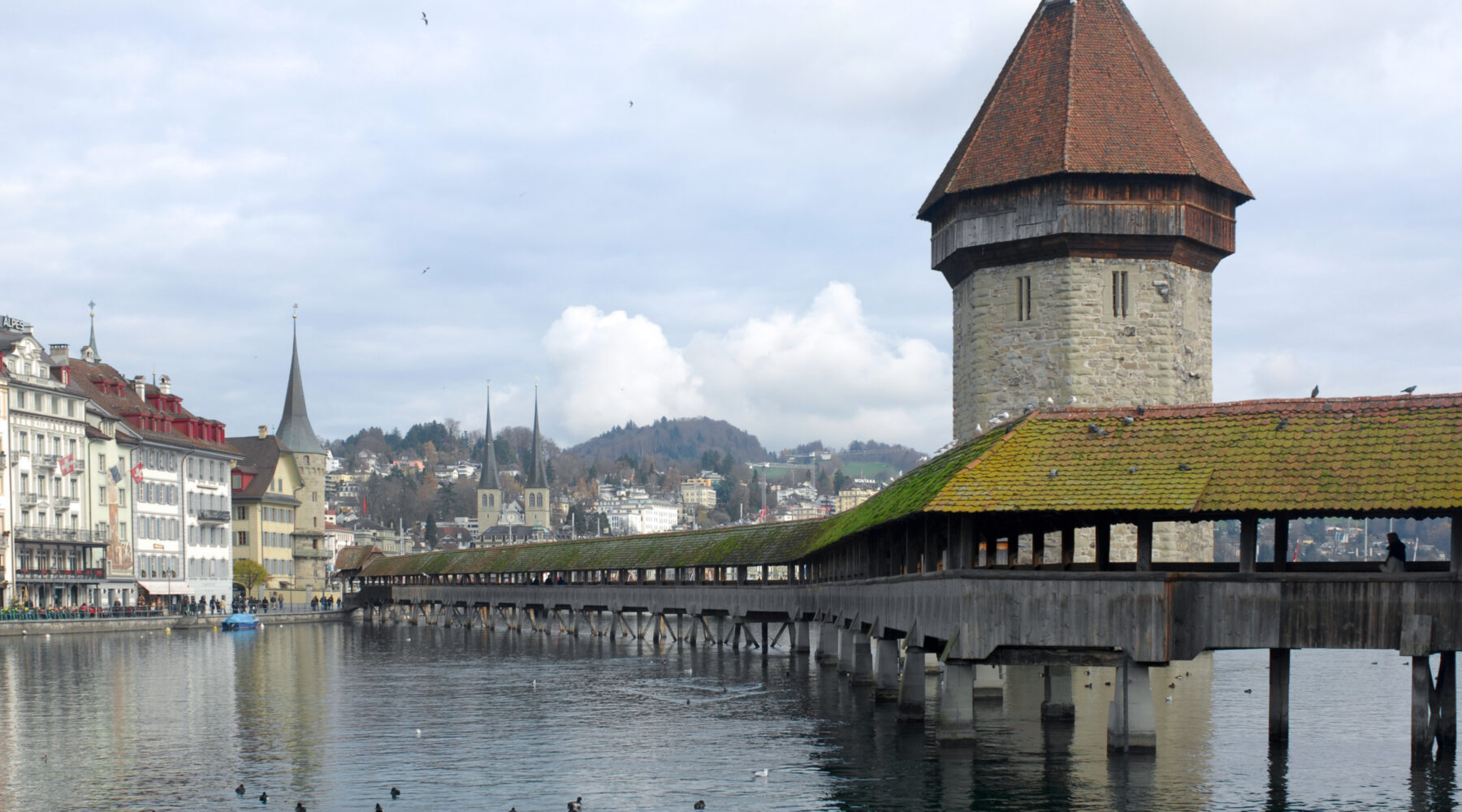
Lucerne fits an entire postcard into one view: a wooden bridge with an eight-sided tower, church spires behind it, a medieval wall on the hill and, on the horizon, the mountain served by the steepest cog railway in the world. You can walk the whole old town in an afternoon, and Kapellbrücke is five minutes from the station. So when you sit down to plan things to do in Lucerne, the question is never whether there is enough. It is what to leave out, how to avoid paying twice for the same thing, and which bed gets you free buses and trains thrown in.
We like Lucerne mostly as a base. Mountains in the morning, the lake in the afternoon, a walk along the waterfront in the evening. And it is still a real town with a university, a market and people who live here, not an open-air museum.
Things to do in Lucerne: the short version
- Lucerne sits at the north-western end of Lake Lucerne, where the River Reuss flows out of it, 436 m above sea level. The city has about 86,000 inhabitants, the wider urban area more than 220,000.
- Staying in a hotel? Local transport is free. Hotel guests in the city get the Visitor Card Lucerne, which covers buses and trains in zone 10 and adds discounts on cable cars and museums.
- The big sights cost nothing. Kapellbrücke, Spreuerbrücke, the Lion Monument and the Musegg Wall with its towers are all free.
- From Zurich Airport the train gets you to Lucerne in about an hour, and Zurich is the easiest airport to reach from the UK.
- Driving? You need a motorway vignette for 40 CHF (about £36). There is no short-term version: the 2026 vignette is valid from 1 December 2025 to 31 January 2027.
- Pilatus is the city’s own mountain. The Golden Round Trip by boat and the world’s steepest cogwheel railway only runs from May to October, in 2026 from 11 May to 18 October.
- Heads-up for autumn 2026: from 19 October to 27 November 2026 the gondolas and aerial cableway from Kriens up Pilatus are closed for maintenance, and on Titlis the revolving Rotair cable car is out of service from mid-August to 11 December 2026.
- The biggest savings are on food and transport. A picnic from Coop or Migros, water from the public fountains and a hotel that gives you the Visitor Card.
Things to do in Lucerne: 15 sights in town
All fifteen places are within walking distance of the station. The furthest are the Swiss Museum of Transport and the Lido beach, about half an hour on foot along the lake or a short bus ride. The town alone needs one full day, the town plus the transport museum two. Mountain day trips have their own chapter further down.
1. Kapellbrücke (Chapel Bridge) and the Wasserturm
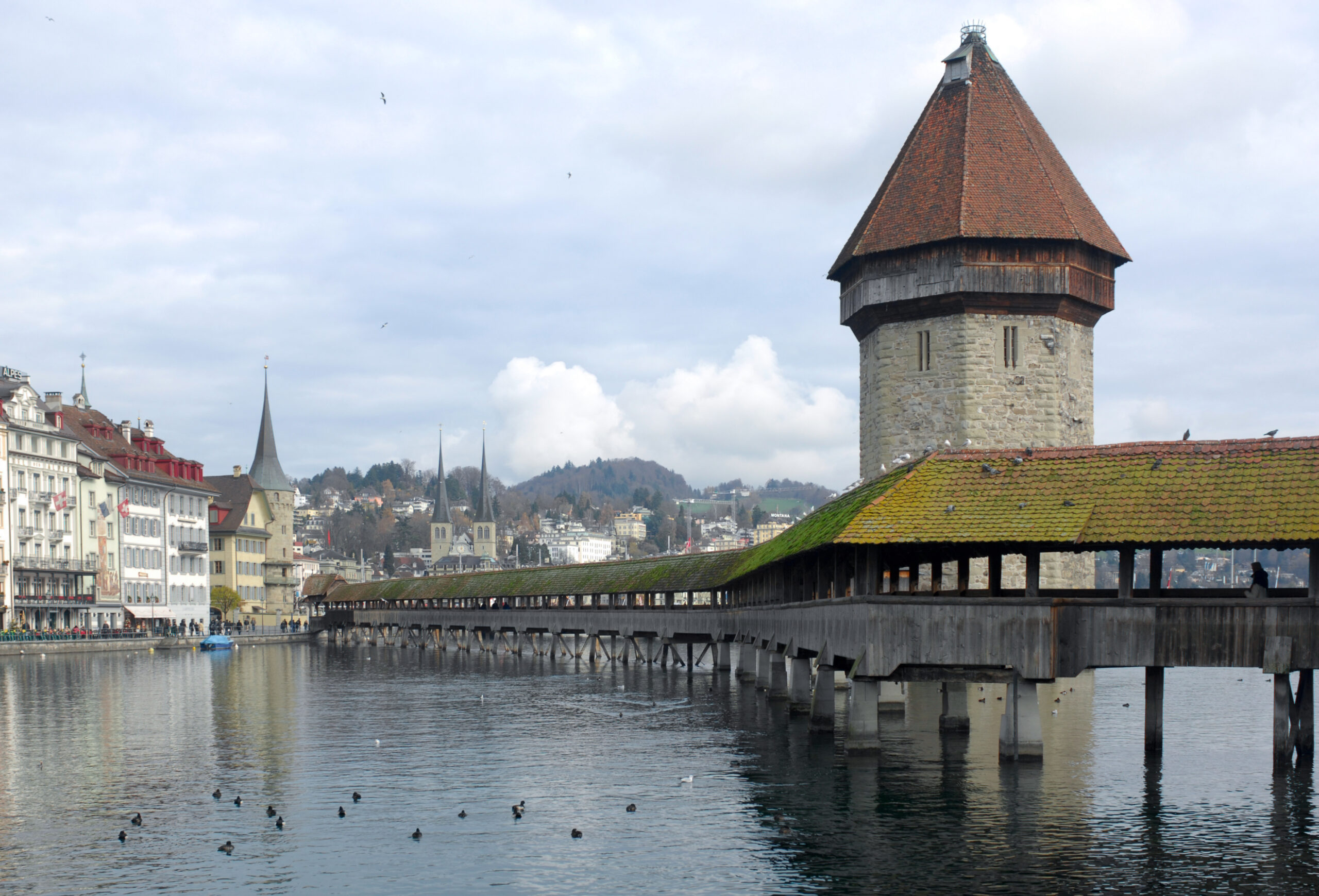
This is the image of Lucerne, and according to most sources the oldest covered wooden bridge in Europe. It was built in the 14th century as part of the town’s fortifications. The exact year varies between sources (both 1333 and 1365 are quoted), and it takes its name from St Peter’s Chapel nearby. Today it is around 204 metres long. It used to be longer, but was shortened in the 19th century when the embankment was built.
Under the roof hang triangular painted panels from the 17th century showing scenes from the history of the town and its patron saints. On the night of 18 August 1993 most of the bridge burned down. Only the two ends and the stone tower survived, and it reopened on 14 April 1994. According to the tourist board, 147 of the original 158 paintings were still there before the fire, and most of them were destroyed, so much of what you see today is reconstruction and copies. Worth knowing, so you are not surprised that the timber looks newer than you might expect.
The octagonal Wasserturm stands in the water next to the bridge. Over the centuries it has been a prison, a torture chamber, an archive and the town treasury. It is not normally open to visitors. The bridge itself is free and open at all hours. We think it is at its best early in the morning, before the first tour groups, and again in the evening when it is lit up. The best view of the whole thing is from the Rathausquai or from outside the Jesuit Church.
2. Spreuerbrücke and the needle dam
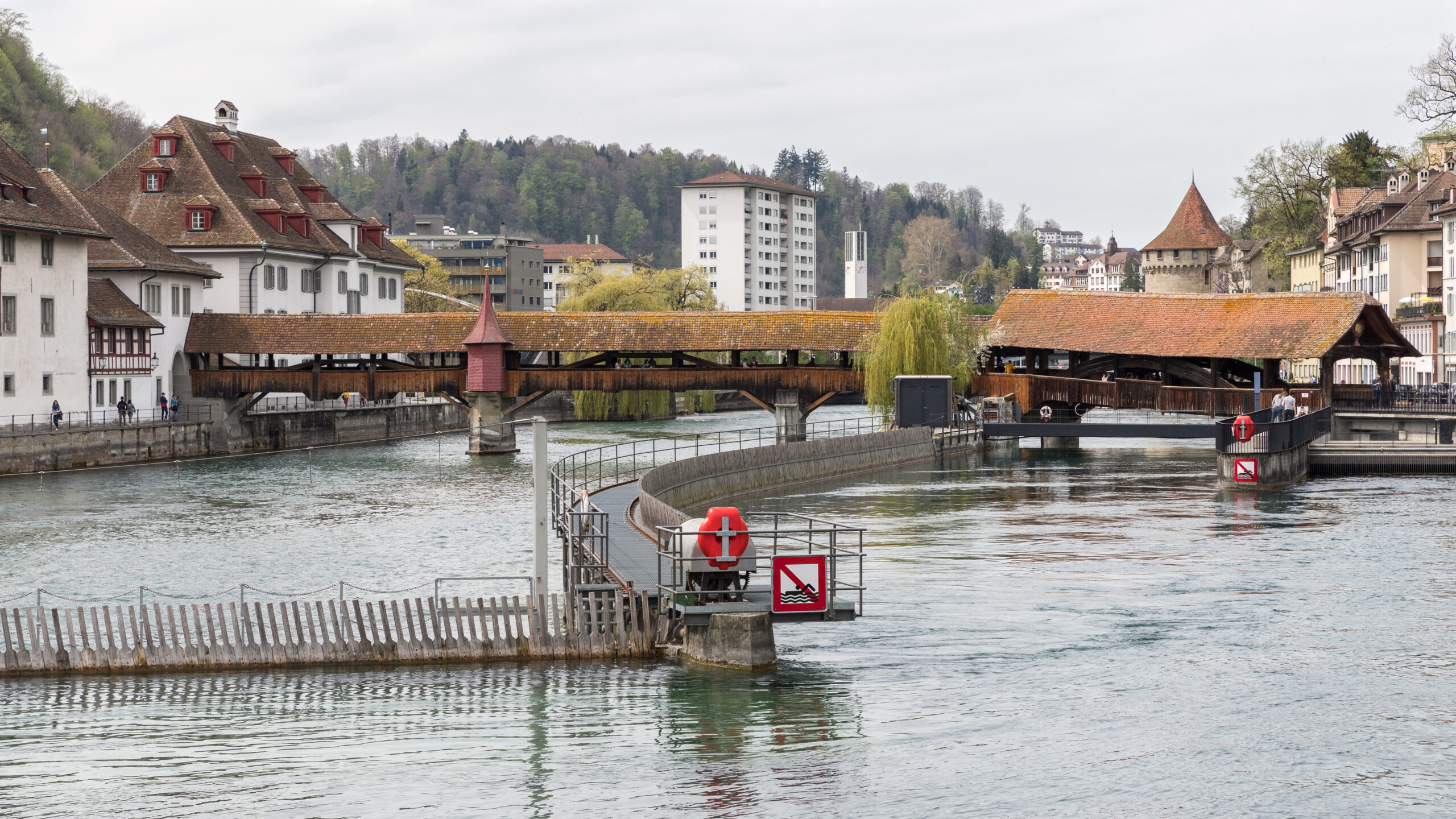
The second covered bridge is a little further downstream and noticeably quieter. It was built in 1408 and rebuilt in the 16th century after a storm. Its name comes from chaff (Spreu in German): it was the only bridge from which millers were allowed to tip their waste into the river, because it was the furthest from the centre.
The main reason to come is the paintings under the roof. Kaspar Meglinger’s Dance of Death cycle shows Death coming for kings, peasants, children and merchants alike. It is darker and, in our view, more interesting than the panels on Kapellbrücke, because these are the 17th-century originals. There is a small chapel halfway across.
Right next to the bridge is the needle dam (Nadelwehr), which still regulates the level of the lake by hand: wooden “needles” are pulled out or pushed back in. Most people walk past without noticing it, and yet it has been doing its job for more than 150 years.
3. Lucerne Old Town: Weinmarkt, Kornmarkt and the painted houses
The old town is on the right bank of the Reuss, a chain of small squares that run into one another: Kornmarkt, Weinmarkt, Hirschenplatz and Mühlenplatz. The house fronts are covered in frescoes, there are fountains on the corners and each square has a slightly different feel. Weinmarkt, with its fountain in the middle, is our favourite, and it is usually where first-time visitors stop and admit that it really does look like the lid of a chocolate box.
On Kornmarkt stands the Renaissance town hall from the early 17th century (construction is given as 1602 to 1606, or up to 1608), with a stone façade and a roof you would expect on an Alpine farmhouse rather than a town hall. Below it runs the Rathausquai with cafés by the water. This part is best explored without a map: just follow the lanes.
4. Jesuit Church
A Baroque church with two towers on the left bank, right on the river. It was built between 1666 and 1677 and was the first large Baroque church in Switzerland north of the Alps. Inside there is Baroque and Rococo stucco work and a big high altar, and when it is raining outside it is the best ten minutes you can spend in town. The acoustics are excellent, so concerts are held here too. Entry is free; just be respectful if a service is on.
5. Musegg Wall (Museggmauer) and its towers
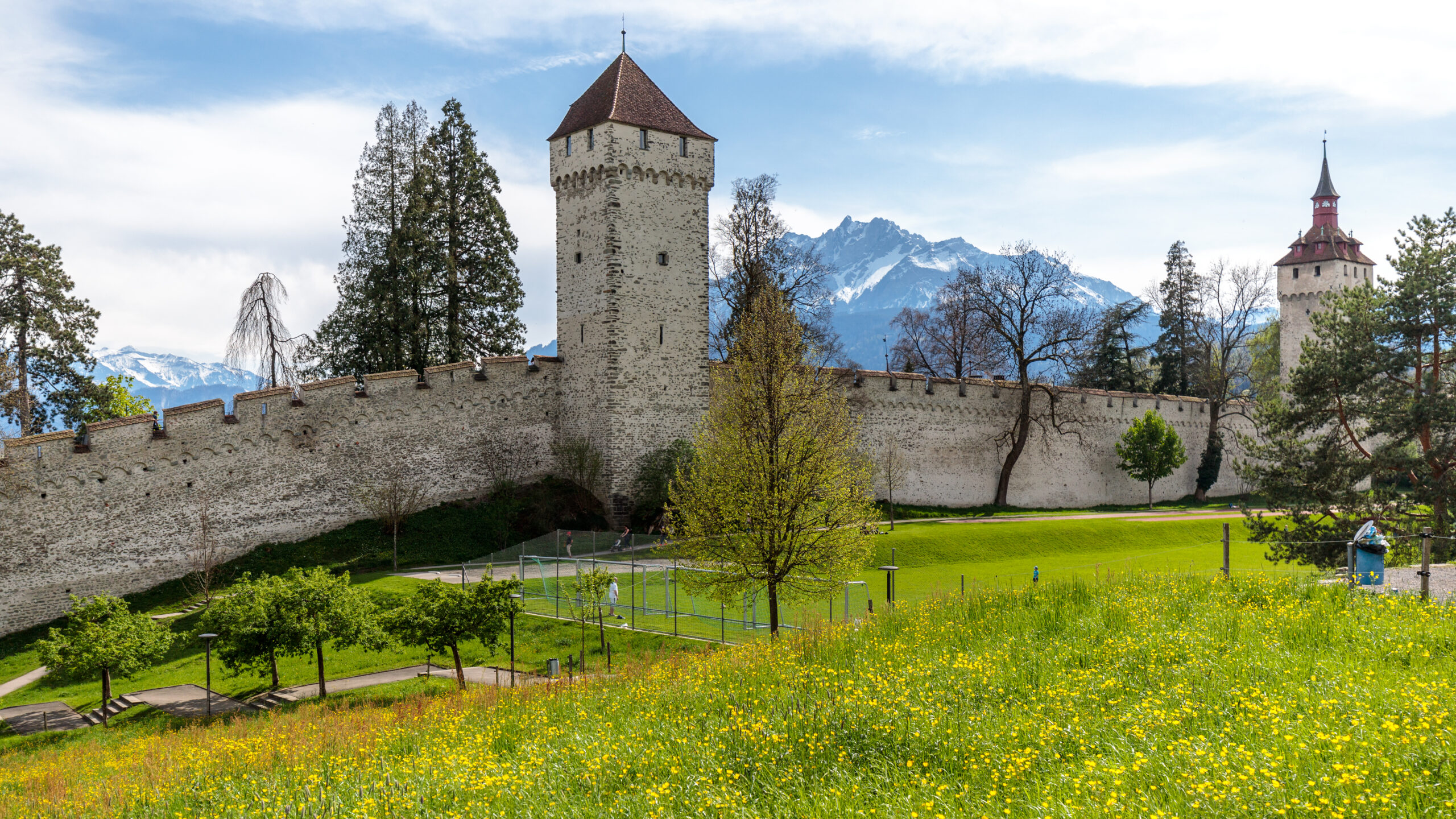
Above the old town runs a medieval wall with nine towers. About 870 metres of it survive, and four of the towers are open to visitors: Männliturm, Wachtturm, Zytturm and Schirmerturm. The Zytturm houses the town’s oldest clock, dating from 1535, which by tradition is allowed to strike one minute before every other clock in Lucerne.
Entry is free. The wall is open roughly from April to early November, daily during the day, and closed in winter. The opening date of the season is tied to Good Friday, so check it on museggmauer.ch. Expect narrow, steep wooden stairs: no buggies, no wheelchairs. The reward is a view over the rooftops to the lake and the mountains, in our opinion the best in the centre.
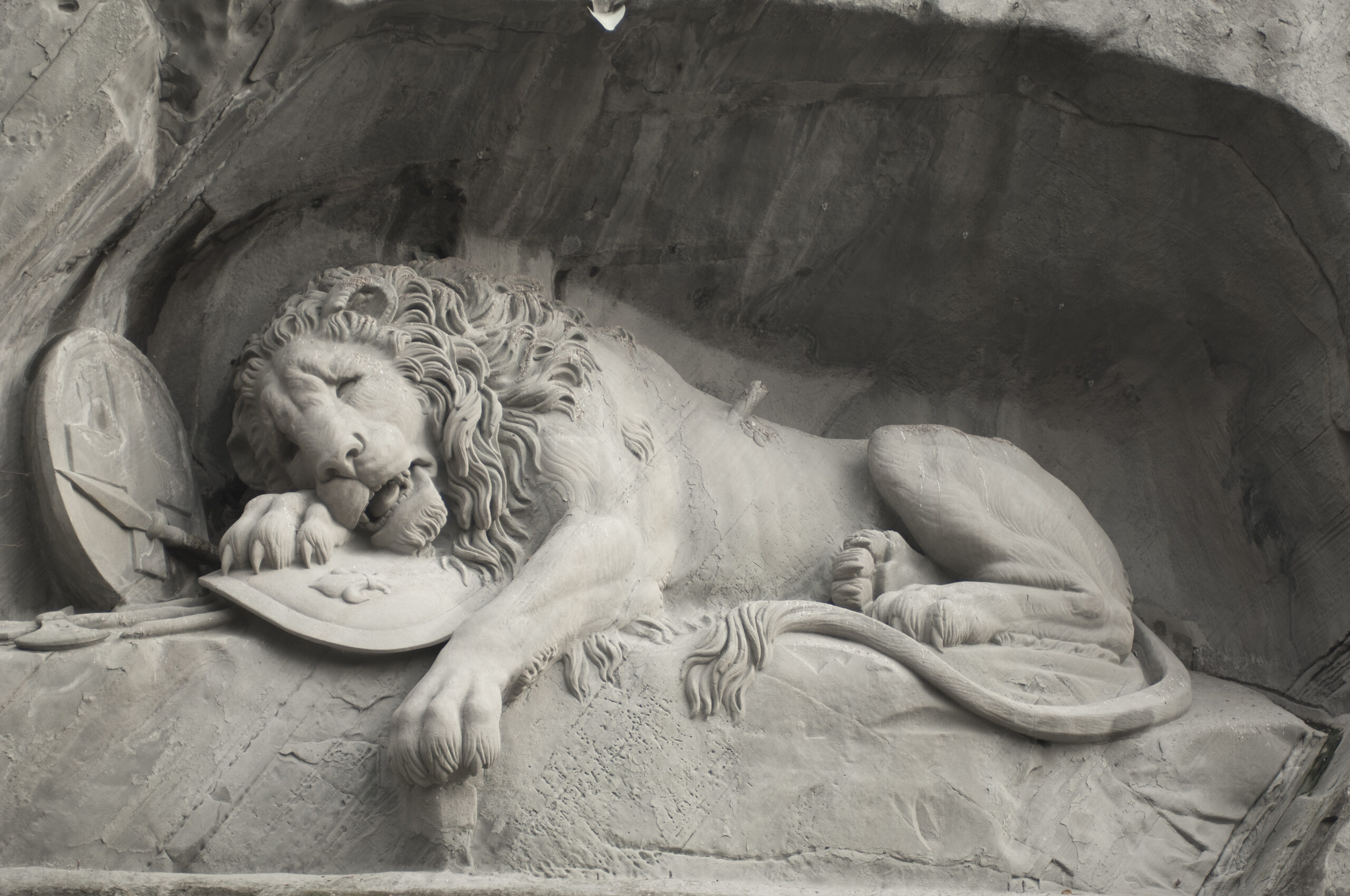
6. Lion Monument (Löwendenkmal)
A dying lion carved straight into the sandstone rock above a small pond. It commemorates the Swiss Guards who died in 1792 defending the Tuileries and King Louis XVI during the French Revolution. The design is by the Danish sculptor Bertel Thorvaldsen, and Lukas Ahorn carved it into the rock in 1820 and 1821. The lion is about ten metres long and six metres high, and its paw rests on a shield with the Bourbon lilies. Above it is the inscription Helvetiorum Fidei ac Virtuti, “to the loyalty and bravery of the Swiss”.
Mark Twain called it the saddest and most moving piece of stone in the world, and once you have stood in front of it, that is hard to argue with. It is a ten-minute walk from Kapellbrücke, entry is free and there are public toilets. Give it a few minutes. Most groups stop for two minutes to take a photo, and once they have gone it is one of the quietest spots in town.
7. Glacier Garden and the Bourbaki Panorama
Just above the Lion Monument is the Gletschergarten, or Glacier Garden, with giant potholes ground into the rock by a glacier at the end of the last ice age. There is also a small museum about how ice shaped the landscape here, and with children it is, in our view, one of the most rewarding stops in town. Prices differ between sources, so check the current ones on gletschergarten.ch. The garden is included in the museum pass (see below).
A few steps further, on Löwenplatz, is a round building housing the Bourbaki Panorama. Inside is a huge circular painting of the defeated French army of General Bourbaki crossing into Switzerland in the winter of 1871 and being interned here. It is an unusual museum and a good choice for a rainy day.
8. Hofkirche St. Leodegar
The two slender, pointed spires you see in most photos of Kapellbrücke belong to the Hofkirche, on the right bank just behind the waterfront. It stands on the site of the Benedictine monastery from which Lucerne grew, first mentioned in the 8th century. Most of the interior dates from the 17th and 18th centuries. The church is surrounded by arcades with old graves where tourists hardly ever go, and it is a lovely quiet spot a few minutes from the lake.
9. KKL Luzern and the station waterfront
Right next to the station is the KKL Luzern culture and convention centre, with a huge flat roof that juts out over the lake. It was designed by the French architect Jean Nouvel, and inside there is the concert hall that hosts the Lucerne Festival, the Kunstmuseum Luzern art museum, a restaurant and a bar. Even if you are not going to a concert, it is worth stopping under that roof: it is a sharp contrast to the medieval town across the river, and the terrace looks out over the whole lake.
In front of the KKL is the boat pier and a wide promenade where people sit on the low wall in the evening looking across to Pilatus. That, by the way, is the cheapest evening out in Switzerland.
10. Swiss Museum of Transport (Verkehrshaus)
The most visited museum in Switzerland, and one of the few where only people who are determined to be bored will be. Locomotives, cars, ships, planes, a 31.5-metre model of the Gotthard railway in the new rail hall, a planetarium, a cinema and the Swiss Chocolate Adventure, a ride “from cocoa bean to praline”. Allow at least three to four hours.
The Day Pass covering the museum, planetarium, film and chocolate ride costs 62 CHF for adults according to the official price list (about £56), 46 CHF for students under 26, 29 CHF for children under 16 and 12 CHF for children under 6 (verkehrshaus.ch). The museum on its own, without the extras, is cheaper; the current price is on the ticket page of the website. Opening hours are 10:00 to 18:00 in summer and until 17:00 in winter. The museum is on the lakeshore about two kilometres from the centre, a few minutes by bus or boat, and the Luzern Verkehrshaus train stop is right outside the entrance.
11. Sammlung Rosengart
A private art collection in a former bank building, a short walk from the station. Its core is work by Pablo Picasso and Paul Klee, and for such a small museum it is a surprisingly strong collection. If you like modern art and have two days in Lucerne, we would pick this over another round of the souvenir shops on Kapellgasse.
12. Lakeside walk to the Lido
From the centre, a promenade runs along the right bank of the lake past the grand belle-époque hotels all the way to the Lido beach and the transport museum. It takes just under half an hour on foot, with views of the lake, Pilatus and Rigi the whole way. In summer you can swim in the lake at the Lido; the rest of the year it is simply the nicest walk in town. You can come back by bus or boat.
Swimming spots, water temperatures and other places around Lake Lucerne are covered in our guide to Switzerland’s lakes.
13. Château Gütsch and the view over town
On the hill above the left bank stands Château Gütsch, a fairy-tale hotel with turrets that looks like a castle from a distance. The little Gütschbahn funicular runs up to it, and according to guidebooks the Visitor Card covers it. At the top there is a terrace with a view over the whole old town, the Reuss and the lake. You do not have to stay there: ride up, walk along the wooded ridge and come back down on foot.
14. The riverside market
Every Tuesday and Saturday morning a weekly market sets up on both banks of the Reuss: on the right bank along the Rathausquai and Unter der Egg, on the left by the Jesuit Church. Cheese, bread, fruit and cured meats from local farmers. We think it is the best way to put together lunch in Switzerland at a sensible price, and one of the few places in the centre where locals outnumber tourists.
15. A boat trip on Lake Lucerne
Lucerne without a boat trip is like London without the Thames. From the pier in front of the station, SGV boats, including historic paddle steamers, sail to villages all around the lake: Weggis, Vitznau below Rigi, Alpnachstad below Pilatus, or all the way to Flüelen at the far end. The lake is shaped like a cross with several arms, each one looks different, and even a one-hour cruise is worth it.
Boats are included in the Swiss Travel Pass and the Lucerne Travel Pass, and with a Half Fare Card you pay half. The Visitor Card Lucerne does not cover boats. Routes, swimming and the villages around the lake are a topic for our article on Swiss lakes; there is no room for them here.
💡 How to see Lucerne in one day. Start at Kapellbrücke in the morning, before the coaches arrive, then the old town and Weinmarkt, up onto the Musegg Wall, down to Spreuerbrücke and back to the river past the Jesuit Church. In the afternoon, the Lion Monument and the Glacier Garden, and in the evening the waterfront by the KKL. All on foot, and all free except the Glacier Garden.
Day trips from Lucerne into the mountains
Lucerne is ringed by mountains served by cog railways and cable cars, and the Swiss call them the “Big Six” of Central Switzerland: Pilatus, Rigi, Stanserhorn, Titlis, Stoos and Brienzer Rothorn. You can reach any of them from town within an hour and be back for dinner. They are expensive outings, though, so read the section on discounts below first. And watch the weather: if the summit is in cloud you will see nothing, and nobody gives you your money back. Most lifts have a live webcam on their website, so check it in the morning.
Mount Pilatus and the Golden Round Trip
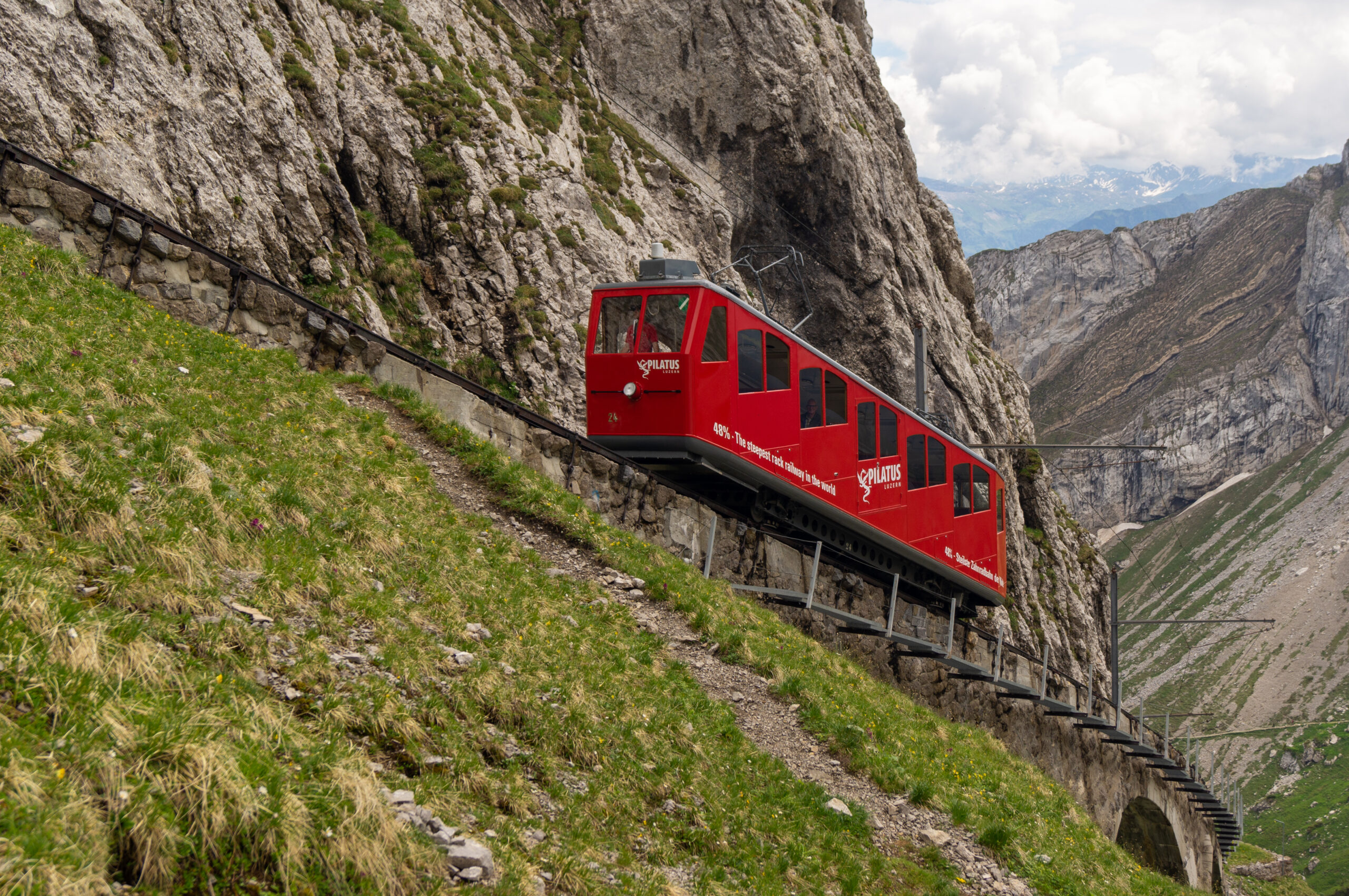
Pilatus (2,132 m) rises directly above the city, and getting up it is half the experience. Since 1889 the steepest cog railway in the world has climbed from Alpnachstad to the summit, with gradients of up to 48%, and the ride up takes about half an hour. From the other side, gondolas and the large Dragon Ride cable car run up from Kriens on the edge of Lucerne.
The most popular option is the Golden Round Trip: boat from Lucerne to Alpnachstad, cog railway to the top, cable cars down to Kriens and bus number 1 back into town. It only runs from May to October, in 2026 from 11 May to 18 October (the cog railway only runs in summer, the cableway from Kriens for most of the year). The official site pilatus.ch quotes a price “from 59.90 CHF”, but that is the Half Fare Card price. The full 2nd-class fare is double, roughly 120 CHF (about £110). With a Swiss Travel Pass the boat and bus are included and you get a discount on the mountain railways. The operator recommends booking a seat on the cog railway in advance; in summer you will otherwise queue.
At the top there is a hotel, restaurants and several short viewpoint trails. The easiest walk leads to the Tomlishorn, the highest point of the mountain. Our favourite way to do it is up by cog railway, because looking out of the window straight at the rock face is something you will not get anywhere else, and slowly back down by cable car.
💡 No Golden Round Trip in autumn 2026. From 19 October to 27 November 2026 the gondolas and the cableway from Kriens are closed for maintenance, and the only way up is the cog railway from Alpnachstad (announcement on pilatus.ch). In winter the cog railway does not run at all. If you are travelling outside the main season, check the operating status online the day before.
Rigi, the “Queen of the Mountains”
Rigi is on the other side of the lake and is gentler and friendlier than Pilatus. According to Switzerland Tourism there are nine different ways up. The nicest combination from Lucerne is the boat to Vitznau and the cog railway from there to Rigi Kulm, returning via Arth-Goldau or by cable car to Weggis. On top there are meadows and ridge paths with the lake on one side and the Alps on the other, and the trails are easy enough for children.
A Rigi day pass costs from 78 CHF (about £70) and covers the cog railways from Vitznau and Arth-Goldau and the cable cars from Weggis and Kräbel (myswitzerland.com, for the period from 8 June to 31 December 2026). The boat from Lucerne to Vitznau is extra. According to SBB, the Swiss Travel Pass covers Rigi in full, including the boat from Lucerne to Vitznau, and that is one of the main reasons the pass pays off in Central Switzerland.
Stanserhorn and the open-top cable car
The Stanserhorn above Stans has the CabriO, opened in 2012 and the first cable car in the world with an open upper deck. You ride under the open sky, wind in your hair, with the lake below you. The lower section from Stans is a funicular. The 2026 season runs from 11 April to 22 November, and an adult return ticket costs 82 CHF according to stanserhorn.ch (about £75), or 41 CHF with a Half Fare Card.
At the top a short circular path goes round the summit with views of the lake and the Alps. We think the Stanserhorn is the best choice if you do not want a full-day trip but do want one really good experience.
Titlis and the glacier above Engelberg
Titlis is the only day trip from Lucerne that takes you onto a glacier and into year-round snow. The train to Engelberg takes about 45 minutes, and from there a series of cable cars climbs to the top station at around 3,000 metres. The best-known is the Rotair, a revolving cabin that turns 360 degrees on the way up, and at the top the Cliff Walk path leads along the cliffs to a suspension bridge.
Note for 2026: according to the operator, the Rotair is out of service for maintenance from 16 August to 11 December 2026, and the new Titlis Connect cable car takes visitors up instead. Titlis is also the most expensive of the mountains around Lucerne, so check the full price directly on titlis.ch.
Bürgenstock and the Hammetschwand Lift
The Bürgenstock is a rocky ridge above the lake. From Lucerne you take the boat to Kehrsiten and then the funicular up to the resort. From the resort a path leads through the woods to the Hammetschwand Lift, the highest outdoor lift in Europe, which carries you up to a rocky viewpoint. The lift runs roughly from April to October. It is a shorter outing than Pilatus or Titlis and works well for an afternoon when cloud has settled on the higher peaks.
How to combine the trips
With three days in Lucerne, this is what we would do: one day for the town, one day for Pilatus on the Golden Round Trip, one day for the boat to Vitznau and Rigi. With a fourth day, add the Stanserhorn or Titlis. If you are travelling on around Switzerland, there are direct trains from Lucerne to Bern, Zurich and Basel, and through the Gotthard to the south. Zermatt is one change of train away, and the Matterhorn deserves a whole day of its own.
How to get to Lucerne from the UK
Lucerne is right in the middle of Switzerland, so wherever you land, the last stretch is by train or car. Trains from Zurich to Lucerne run several times an hour and take just under an hour.
By plane
The nearest major airport is Zurich (ZRH), which has direct flights from several London airports and from other UK cities, so from the UK this is usually the easiest way in. From the airport you take the train to Lucerne, changing at Zurich main station or direct depending on the timetable, about an hour in total. A cheaper alternative can be easyJet to Basel (EuroAirport, on the French side of the border), then the bus to Basel station and the train on to Lucerne, about an hour and a half in total. Routes and frequencies to Basel change with the season, so check the current schedule.
By train
There is no through train from the UK, but the route is straightforward: Eurostar from London to Paris, then a high-speed TGV Lyria to Basel or Zurich, and a regular Swiss train on to Lucerne. Count on the best part of a day. Connections and fares are on the SBB app and website. The big advantage of the train is that you arrive right in the centre: Lucerne station stands on the lakeshore, and Kapellbrücke is five minutes’ walk away. The tourist information office is inside the station building.
By car
Driving from the UK means a Channel crossing and a long day through France, where most motorways are tolled. In Switzerland you need a motorway vignette for 40 CHF (about £36). Only an annual one exists: the 2026 vignette is valid from 1 December 2025 to 31 January 2027 and can be bought as a sticker or electronically (e-vignette through the official portal via.admin.ch; do not pay a mark-up to third-party sellers).
Parking in central Lucerne is expensive and limited. On-street parking in the centre costs 3 CHF an hour according to the city (about £2.70), and the spaces are short-stay. Guidebooks recommend the multi-storey car parks by the station (Bahnhofparking) or in the Löwencenter shopping centre on Zürichstrasse, a few steps from the Lion Monument. In our view the best solution is a hotel with parking: leave the car there and get around town for free with the Visitor Card.
Getting around Lucerne and the Visitor Card
You can walk the old town; buses are mainly useful for the transport museum, for Kriens and the Pilatus cable car, and for getting back to your hotel in the evening. And this is where the best thing Lucerne offers visitors comes in.
The Visitor Card Lucerne is free if you stay overnight in a hotel in the city. The hotel gives it to you on arrival, and it is valid for your whole stay, including the days you arrive and leave. According to the official site luzern.com it includes:
- free travel on all buses and trains in zone 10 of the city network, which, according to guidebooks, reaches as far as Kriens and the valley station of the Pilatus cableway,
- discounts on cable cars, mountain railways, museums and excursions in the Lucerne and Lake Lucerne region (the current list of partners is on luzern.com),
- free wifi at the “Free WiFi – LUZERN.COM” hotspots around town.
Boats on the lake are not included. The card cannot be bought, so if you are staying in an apartment or at a campsite, ask your host whether they issue it.
Is Lucerne expensive? Costs and how to save
Switzerland is expensive, and Lucerne is no exception. It helps to work out in advance what you really want to do and pick your ticket accordingly. For comparison, a few checked prices (pound conversions are approximate, 1 CHF ≈ £0.91):
| Item (adult, 2026) | Price | Approx. in £ |
|---|---|---|
| Swiss motorway vignette (annual) | 40 CHF | £36 |
| Local transport in zone 10 with the Visitor Card (hotel guests) | free | £0 |
| Kapellbrücke, Lion Monument, Musegg Wall | free | £0 |
| Swiss Museum of Transport, Day Pass | 62 CHF | £56 |
| Lucerne Museum Card (2 days) | 36 CHF | £33 |
| Pilatus Golden Round Trip, 2nd class | about 120 CHF (59.90 CHF with Half Fare) | £110 |
| Rigi day pass (without boat) | from 78 CHF | from £70 |
| Stanserhorn CabriO, return | 82 CHF (41 CHF with Half Fare) | £75 |
| Half Fare Card (one month) | 150 CHF | £135 |
| Lucerne Travel Pass, 3 days | 240 CHF | £220 |
Price sources: verkehrshaus.ch, pilatus.ch, stanserhorn.ch, sbb.ch, myswitzerland.com and Switzerland Travel Centre.
Which ticket to choose
The Lucerne Travel Pass (called the Tell Pass until 31 March 2026) is a regional ticket for 3, 4, 5 or 10 consecutive days. It covers trains, buses and boats across Central Switzerland and a long list of mountain railways, including Pilatus, Rigi, Stanserhorn, Stoos and Titlis. Three days cost 240 CHF, and children aged 6 to 15 travelling with a parent pay a flat 30 CHF. No further discounts apply on top. It pays off if you are staying in Central Switzerland only and want to do two or three mountains.
The Swiss Travel Pass makes sense if Lucerne is just one of several stops. It covers trains across the whole country, boats on the lake, city transport and Rigi, and gives a discount on Pilatus and other mountain railways. Current prices by number of days are on sbb.ch.
The Half Fare Card, 150 CHF for a month, halves the price of every ticket, including most mountain railways. It is worth it if you are in Switzerland for longer and do not travel every day.
The Lucerne Museum Card, 36 CHF, is valid for two consecutive days at most Lucerne museums, including the transport museum, the Glacier Garden, the Sammlung Rosengart and the Richard Wagner Museum (according to Switzerland Tourism). If you plan on more than two museums, it saves you money.
Saving money on food
Eating out in Switzerland is an expense you need to budget for, and in the touristy centre of Lucerne doubly so. Our approach is simple: picnic for lunch, restaurant for dinner. The Coop and Migros supermarkets have ready meals, salads and bread, and you take it all down to the waterfront or the meadow below the Musegg Wall. On Tuesdays and Saturdays there is the riverside market as well.
Do not buy water. Most of the town’s fountains run with drinking water, and if a fountain has a sign saying “kein Trinkwasser” (not drinking water), just move on to the next one. Take your own snacks up the mountains: summit restaurants are the most expensive places in the area.
Where to stay in Lucerne
Lucerne is small, so from almost anywhere in the centre you are within fifteen minutes’ walk of Kapellbrücke. The main decision is whether you want the old town on the right bank (atmosphere, lanes, more noise in the evening), the left bank by the station (practical, close to trains and boats) or the lakefront (views, quiet, highest prices). Whatever you choose, make sure it is a hotel in the city that issues the Visitor Card, and you save on transport.
- Luzern Youth Hostel (Sedelstrasse 12): the cheapest option, a Swiss Youth Hostels property near the small Rotsee lake. You get into the centre by bus, which is free with the Visitor Card.
- The Lubo (Rössligasse 2/4): a boutique hostel with self check-in right in the historic centre, for anyone who wants to stay in the old town without paying hotel prices.
- Waldstätterhof Swiss Quality Hotel (Zentralstrasse 4): mid-range, opposite the station, ideal if you will be heading out by train or boat every day.
- Hotel Des Alpes (Furrengasse 3): on the Reuss in the old town, a few steps from Kapellbrücke. In our opinion the rooms looking out over the river and the bridge are reason enough to book.
- Romantik Hotel Wilden Mann (Bahnhofstrasse 30): a historic hotel in the Kleinstadt on the left bank, close to the Jesuit Church, for those who want old timber and peace and quiet.
- Hotel Schweizerhof Luzern (Schweizerhofquai 3a): a large 19th-century hotel on the lakefront, for when you want proper luxury once in a while, with views of Pilatus and Rigi.
For more places to stay in town, use our Lucerne accommodation search. In summer and during festivals prices go up and the cheapest rooms disappear first, so book well ahead.
A little history
Lucerne began as a monastery. Around the year 710 the Benedictine monastery of St Leodegar was founded where the Hofkirche stands today, with a fishing village around it. Nobody knows for sure where the name comes from. The Latin lucerna, “lamp”, is the obvious guess, but linguists lean more towards “place with lots of pike”.
The town itself grew up between 1180 and 1200, and then received an enormous gift: around 1220 the St Gotthard Pass was opened up, and Lucerne found itself on the main trade route from Germany to Italy. Goods were shipped across the lake and the town grew rich on them, with warehouses, markets and townhouses going up. In 1332 Lucerne joined the three forest cantons of Uri, Schwyz and Unterwalden and became the first city in the Swiss Confederation. After the Battle of Sempach in 1386, when the Confederates defeated the Habsburgs, Lucerne took control of the surrounding countryside, roughly the area of today’s canton. The Musegg Wall and both wooden bridges, which were part of the fortifications, date from this period.
When the Reformation split Switzerland in the 16th century, Lucerne stayed Catholic and became a stronghold of the Counter-Reformation. Hence the Jesuit Church and the Baroque gloss on an otherwise Gothic town. For a few months in 1798 it was even the capital of the Helvetic Republic, set up here by the French army.
The real turning point, though, came in the 19th century with tourism. English travellers discovered the Alps, the railway arrived in 1856, grand hotels went up along the waterfront and cog railways began to climb the surrounding mountains. Lucerne was one of the first tourist towns in Europe, and between 1850 and 1913 its population quadrupled. It has made a good living from visitors ever since, and it shows: the town is used to guests, but it still keeps its own character.
Best time to visit Lucerne
For the mountains, the best time is June to September, when every lift runs, including the Golden Round Trip on Pilatus, and you can swim in the lake. It is also the time of the biggest crowds and highest prices. In our view the best compromise is late May and September: the mountains are open and the town is calmer.
In autumn and winter Lucerne works better as a city break with museums. Some mountain railways close for maintenance, so check the operating status online before you set off. Dates worth knowing are the Lucerne carnival, Fasnacht, at the end of winter, and the Lucerne Festival of classical music, whose main summer season takes place in the KKL. In 2026 a new spring festival, Pulse, was also held in May (8 to 17 May).
What we would do differently
We would not try to tick off every mountain. Pilatus, Rigi, Stanserhorn, Titlis, Bürgenstock. Each one is beautiful, and each one costs about as much as a decent dinner for two. One mountain on a clear day beats three in fog. We would rather choose one or two and leave the rest for next time, or for a day when the webcam shows blue sky in the morning.
We would spend more time wandering the Kleinstadt. Most people stick to the Kapellbrücke, Weinmarkt, Lion Monument circuit. Yet the left bank between the Jesuit Church and Spreuerbrücke, and the lanes below the Musegg Wall, are just as old and half as busy. Turning into a street that does not lead to any sight pays off here.
We would try the local food. Lucerne’s vol-au-vent, the Luzerner Chügelipastete, cheese from the riverside market, something we have never heard of in a place nobody recommended. And for the rest of the day, a picnic on the wall by the KKL.
And we would keep the phone in our pocket. Kapellbrücke has been photographed millions of times, and your photo will not be any different. The evening on the waterfront, as the light fades over Pilatus and the last steamer comes back across the lake, is better remembered than photographed.
Frequently asked questions
What to see in Lucerne in one day?
Kapellbrücke with its water tower, the old town with Weinmarkt square, the Musegg Wall and its view, Spreuerbrücke with the Dance of Death paintings, the Jesuit Church and the Lion Monument. All of it is on foot and free. In the evening, walk along the waterfront by the KKL. For the mountains or the transport museum you need another day.
How do I get to Lucerne from London?
The quickest way is to fly from London to Zurich and take the train from the airport, about an hour. An alternative is easyJet to Basel and then the train, about an hour and a half from the airport. By rail it is Eurostar to Paris, TGV Lyria to Basel or Zurich and a Swiss train on to Lucerne, most of a day. If you drive, you need a Swiss motorway vignette for 40 CHF (about £36).
Is public transport in Lucerne free?
For guests of hotels in the city, yes. With the Visitor Card Lucerne, which your hotel gives you on arrival, you travel free on buses and trains in zone 10 of the city network for your whole stay. The card cannot be bought and does not cover boats on the lake.
How much does Mount Pilatus cost from Lucerne?
The Golden Round Trip by boat, cog railway and cable cars comes to roughly 120 CHF in 2nd class (about £110), or 59.90 CHF with a Half Fare Card. With a Swiss Travel Pass the boat and bus are included and you get a discount on the mountain railways. The round trip only runs from May to October, in 2026 from 11 May to 18 October.
Is the Swiss Travel Pass worth it in Lucerne?
If Lucerne is one of several stops in Switzerland, often yes: it covers trains, boats on the lake, city transport and Rigi, and gives a discount on Pilatus. If you are staying in Central Switzerland only, compare it with the regional Lucerne Travel Pass (3 days for 240 CHF), which also includes Pilatus, Stanserhorn and Titlis.
Where can I park in Lucerne?
The easiest option is a hotel with its own parking. Guidebooks recommend the car parks by the station (Bahnhofparking) and in the Löwencenter shopping centre. On-street parking in the centre costs 3 CHF an hour and the spaces are short-stay.
What to do in Lucerne with kids?
Above all the Swiss Museum of Transport with its locomotives, planetarium and chocolate ride, which easily fills a whole day. Then the Glacier Garden by the Lion Monument, a steamer trip and Rigi, where the paths are gentle and the meadows wide. In summer, swimming at the Lido.
When is the best time to visit Lucerne?
For the mountains, June to September, when every lift is running. In our view late May and September offer the best balance between open lifts and crowds. In winter Lucerne suits a city break with museums, but some mountain railways are closed.
Where next
Potřebujete pomoct s cestováním?
-
Ubytování 🏨
Vyberte si to nejlepší ubytování, ať už jste kdekoliv, přes Booking.com. -
Půjčení auta 🚗
Auto si snadno najdete přes Booking.com, kde máte často slevu díky ubytování, nebo Rentalcars.com, kde porovnáte nabídky většiny půjčoven. -
Zážitky 🎟️
Přes GetYourGuide.com si vyberete z nejrůznějších výletů i zážitků po celém světě, navíc se zrušením zdarma do 24 h předem.