Last updated 27.10.2026
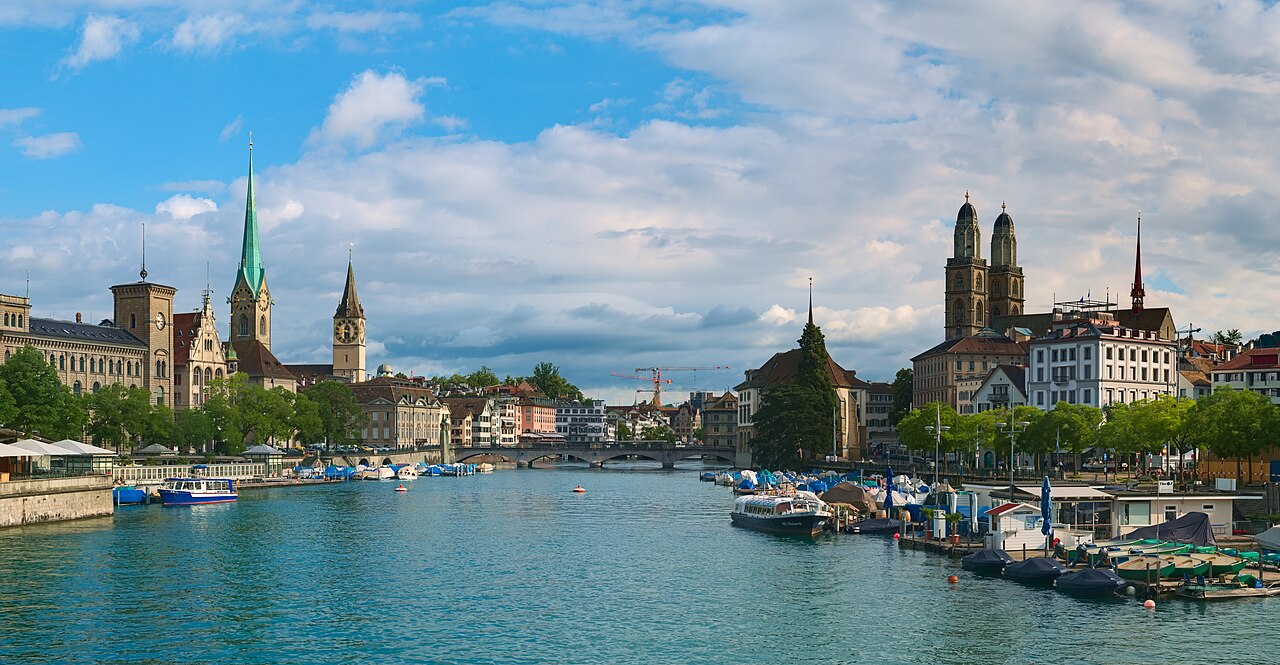
Zurich has a reputation for banks, watches and prices that make your eyes water, and all of it is deserved. But step off the train at the main station, walk five minutes to the river and you see a different city: clear green water where office workers go for a swim in their lunch break, medieval lanes climbing up both banks, and at the end of the street a lake with the Alps glowing white behind it on a clear day. Zurich, Switzerland is the country’s largest city, yet the centre is small enough to cover entirely on foot, which makes planning the things to do in Zurich much easier than the city’s size suggests.
We have put together 18 tips on what to see, from churches and viewpoints to museums and swimming in the river. On top of that you will find how to get here from the UK, prices in CHF with a rough conversion to pounds, exactly what the Zürich Card covers, where to save money and where to sleep. The Rhine Falls and other day trips get their own section, because from Zurich they are all short train rides away.
Things to do in Zurich: the short version
- The centre is compact. The old town sits between the main station and the lake on both banks of the Limmat, and you can walk it in two to three hours, stops included.
- The Zürich Card costs 29 CHF for 24 hours and 56 CHF for 72 hours (about £26 and £51). It covers public transport, the train from the airport, the ride up the Uetliberg, a short lake cruise and free entry to many museums (zuerich.com). New prices apply from 13 December 2026.
- The Grossmünster is under restoration until 2029. The church and the Karlsturm tower stay open, but expect scaffolding in your photos.
- The Chagall windows in the Fraumünster are the city’s best-known work of art. Entry is 5 CHF, free with the Zürich Card.
- Zurich has around 1,200 fountains, and most of them run with drinking water. There is no need to buy bottled water.
- In summer people swim right in the centre, in the river and in the lake. Some of the city’s bathing spots are free.
- From London it is a short flight to Zurich Airport, which has direct services from several UK airports. If you drive, you need a Swiss motorway vignette for 40 CHF (about £36).
- The Rhine Falls, by volume of water the largest waterfall in Europe, are less than an hour from Zurich by train.
Things to do in Zurich: 18 tips in the city
The easiest way to read Zurich is by following the river. The Limmat flows north out of Lake Zurich and splits the old town into two halves. On the right (east) bank you have the Niederdorf with its bars and the Grossmünster; on the left bank, the Lindenhof, the Fraumünster, St. Peter’s Church and the Bahnhofstrasse. Several bridges cross the river in the centre, so you can zigzag from one side to the other without missing anything.
1. The Niederdorf and the right bank of the old town
The Niederdorf, which locals call the Dörfli (“little village”), is the liveliest part of the old town. Its main street, the Niederdorfstrasse, runs parallel to the river from Central square all the way to the Grossmünster, and lanes branch off it up the hill, lined with small shops, second-hand bookshops and old guild houses. By day it is a shopping street; in the evening it turns into the city’s pub quarter.
Our favourite part is the side streets above the main drag, around the Rindermarkt and the Neumarkt for example, where hardly anyone walks and you can still find a café without a tourist menu. On the Spiegelgasse stands the Cabaret Voltaire, where Dada was born in 1916. It is still running today, and entry is free with the Zürich Card.
2. The Grossmünster and the Karlsturm tower
The two stone towers of the Grossmünster are the symbol of Zurich, and you will see them from almost everywhere. Legend says Charlemagne founded the church on the spot where the city’s patron saints, Felix and Regula, were buried. The Romanesque basilica you see today was built between 1100 and 1220. From 1519 Huldrych Zwingli preached here, and it was from the Grossmünster that the Reformation spread across German-speaking Switzerland. That is why the interior is so bare, with no decorated altars, exactly as Zwingli thought a church should look.
Entry to the church is free, and photography is not allowed inside. The south tower, the Karlsturm, has 187 steps, and from the top you get one of the best views over the city and the lake. The tower is open from March to October, Monday to Saturday 10:00 to 18:00, from November to February until 17:00, and on Sundays only after the service. Admission is 5 CHF (about £4.50), children and students pay 2 CHF, and the climb is free with the Zürich Card (zuerich.com).
The Grossmünster has been under restoration since January 2025 and the works run until 2029. The church is open as usual, but part of the façade may be hidden behind scaffolding. A little way downstream stands the small late Gothic Wasserkirche, where, according to the legend, Felix and Regula were executed.
3. The Fraumünster and the Chagall windows
On the opposite bank, across the Münsterbrücke, rises the Fraumünster with its slender green spire. In 853 Louis the German founded a convent here for his daughter Hildegard. Today people come for the windows. The five-part cycle of stained glass in the choir and the rose window in the south transept were designed by Marc Chagall; the windows in the north transept are by Augusto Giacometti.
The light is best in the morning, when the sun shines into the choir from the east. The church is open from March to October, Monday to Saturday 10:00 to 18:00, in winter until 17:00, and on Sundays after the service. Entry costs 5 CHF; children under 16 and students get in free, and so do Zürich Card holders (zuerich.com). Photography is not allowed in the choir, which we think is no bad thing: at least you actually look at the windows.
The Münsterhof square in front of the church is the largest square in the old town and is lined with historic buildings.
4. St. Peter’s Church and the largest clock face in Europe
A few steps from the Fraumünster stands Zurich’s oldest parish church. Its tower has a clock face 8.7 metres across, often described as the largest church clock face in Europe, and you can read the time from the bridges and from the Lindenhof. Inside, the church is Baroque, bright and, unlike the Grossmünster, quite ornate. Entry is free.
5. The Lindenhof
The Lindenhof is a green hill above the left bank where the Roman fort and customs post of Turicum once stood, followed later by a Carolingian palace. Today it is a park with lime trees, benches and a giant chessboard with knee-high pieces. The viewing terrace gives you the best view of the Niederdorf, the Grossmünster and the university above the city.
This is where we would go first, straight after arriving, because from up here you understand how the centre fits together. It is also the best place for a picnic from the Coop when you do not feel like paying Zurich restaurant prices. Entry is free and it is open at all hours.
6. The Augustinergasse and the Schipfe
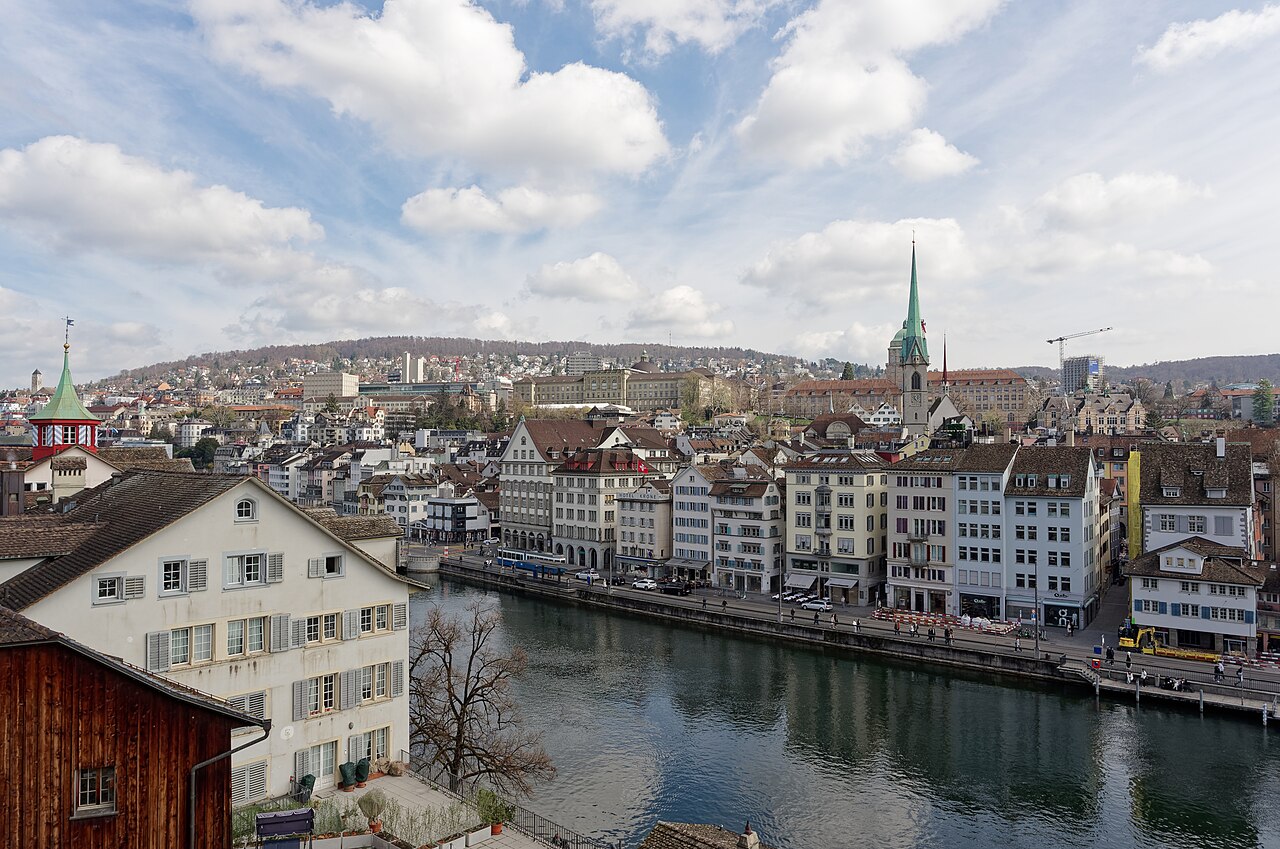
Two of the most photogenic spots on the left bank lie just below the Lindenhof. The Augustinergasse is a short lane between St. Peter’s and the Bahnhofstrasse, with colourful houses and wooden oriel windows. The Schipfe is a row of old craftsmen’s houses right on the water below the Lindenhof, once the fishermen’s and boatmen’s quarter. Today there are workshops and small shops on the ground floors and a few benches by the river where almost nobody ever sits.
7. The Bahnhofstrasse and Paradeplatz
The Bahnhofstrasse runs for about a kilometre from the main station down to the lake and is one of the most expensive shopping streets in the world. Only trams use it, so it is a pleasant walk even if you are not buying anything. Halfway along is Paradeplatz, the square with the headquarters of the big banks and the symbol of Swiss banking.
On Paradeplatz you will find the Sprüngli confectionery, home of the small macarons called Luxemburgerli, and at the station end of the street there is a large Lindt shop. From the second-to-last Thursday in November, the Lucy Christmas lights hang over the Bahnhofstrasse, made up of around 23,000 light crystals. For us this is the best time to come, because in the evening the street turns from a luxury promenade into an Advent stroll.
8. The lakefront, Bürkliplatz and a boat trip on the lake
The Bahnhofstrasse ends at Bürkliplatz on the lakeshore. This is where the ZSG excursion boats leave from, and on Tuesday and Friday mornings there is a farmers’ market. Promenades run along the water in both directions: west along the Mythenquai to the Arboretum park, and east over the Quaibrücke past the opera house and Sechseläutenplatz all the way to Seefeld.
The cheapest way onto the water is the short round trip (kleine Seerundfahrt). It takes around an hour and a half, loops around the lower part of the lake, and a regular ZVV ticket for zones 110, 140 and 150 is valid on it, as is the Zürich Card. You can sit out on deck, and if you like, hop off along the way and catch a later boat back. Longer cruises over the whole of Lake Zurich, to Rapperswil for instance, are covered in our guide to Swiss lakes.
9. Swimming in the Limmat and the lake
This is what we enjoy most about Zurich. The water in the river and the lake is so clean that the whole city goes swimming in summer, and the bathing spots (locally called a Badi) are right in the centre. The wooden Frauenbad baths on the Stadthausquai date from the 1880s and are for women only during the day; entry is 8 CHF (about £7). In the evening they become the Barfussbar, open to everyone (zuerich.com). The men’s equivalent, the Männerbad, sits in the Schanzengraben canal and is free.
A little further downstream are the Oberer and Unterer Letten, where you swim in the river itself: locals let the current carry them and climb out again on ladders. On the lake there are the Mythenquai baths on the west shore and Tiefenbrunnen on the east. The season runs roughly from May to September and opening hours depend on the weather, so it is worth checking the city’s website the day before.
💡 Pack your swimming things, even for a city break. A dip in the Limmat at lunchtime is the most Zurich thing you can do in summer, and many of the bathing spots cost nothing. Just do not get into the current outside the marked areas: the Limmat flows faster than it looks, and you can only get out where there are ladders.
10. Zürichhorn and the Chinese Garden
On the east shore of the lake, in the Seefeld district, is the Zürichhorn park, with big lawns by the water, a restaurant and an open-air cinema. Trams 2 and 4 run out here. Close by is the Chinese Garden, a gift from Zurich’s twin city of Kunming, with a pond, pavilions and little bridges. It opens seasonally, roughly from March to October, and according to the tourist board entry is free. We would combine it with a walk along the lakefront from Bellevue, which takes about half an hour along the water.
11. The Polybahn and the Polyterrasse
The red car of the Polybahn funicular has been running since 1889 from Central square up to the main building of the ETH, the Swiss Federal Institute of Technology, and the ride takes just a few minutes. At the top is the Polyterrasse, a terrace looking across the roofs of the old town to the lake and, in good weather, all the way to the Alps. Albert Einstein studied and later taught at the ETH.
12. The Swiss National Museum (Landesmuseum)
The building right behind the main station looks like a castle, with turrets and a courtyard, and was completed in 1898. Inside you get an overview of Swiss history from prehistory to the 20th century, collections of Gothic art, weapons and period rooms, and a modern extension for temporary exhibitions. On a rainy day it is the best choice in the centre.
Admission is 13 CHF (about £12); children under 16 and Zürich Card holders get in free. From 5 January 2027 the price goes up to 18 CHF. The museum is closed on Mondays and otherwise open 10:00 to 17:00 (zuerich.com and the museum’s own announcement). Since October 2026 it also closes at 17:00 on Thursdays.
13. Kunsthaus Zürich
The largest art museum in Switzerland stands on Heimplatz above the old town, and since the recent extension by David Chipperfield it is genuinely big. The collection includes works by Alberto Giacometti, Ferdinand Hodler, Johann Heinrich Füssli (Henry Fuseli), Picasso, Monet, Matisse and many more. A ticket for the collection and exhibitions costs 31 CHF (about £28); with the Zürich Card the permanent collection is free and you pay extra for the exhibitions. Closed on Mondays, open until 20:00 on Thursdays (zuerich.com).
14. Museum Rietberg
This museum of non-European art occupies several villas in the Rieterpark above the lake in Enge, and its collection of art from Asia, Africa, the Americas and Oceania numbers more than 23,000 objects. Even if Asian bronzes are not your thing, the park itself, with its view of the lake, is worth a stroll. Admission is 18 CHF (about £16), free with the Zürich Card, and the museum is closed on Mondays (zuerich.com).
15. Lindt Home of Chocolate in Kilchberg
The Lindt chocolate museum is in Kilchberg on the shore of the lake, about a quarter of an hour from the main station on the S8 or S24 train and then a ten-minute walk. People come for the chocolate fountain in the entrance hall and for the interactive exhibition on the history and making of chocolate, which ends with a tasting.
Admission is 17 CHF for adults (about £15.50), children aged 8 to 15 pay 10 CHF, and the Zürich Card gets you 20% off (zuerich.com). The fountain, the shop and the café are open without a ticket. Tickets are sold for time slots and same-day ones often sell out, so book online in advance. Near the museum there is also the Lindt Factory Outlet Kilchberg, where the bigger packs are cheaper.
16. FIFA Museum
The football museum in Enge, a short walk from Enge station, covers the history of the World Cup, displays the original trophy and has interactive exhibits including a giant football pinball machine. Adults pay 26 CHF (about £24), children under 6 go free, and entry is free with the Zürich Card. It is open Tuesday to Sunday, 10:00 to 18:00 (museums.ch and zuerich.com). In our view this is the classic case where the Zürich Card pays for itself: the FIFA Museum and the Landesmuseum on the same day cost more without the card than the card does.
17. Zürich West and Frau Gerolds Garten
The former industrial quarter behind the station, in District 5, is the youngest face of Zurich. The factories have become lofts, clubs and restaurants, the arches under the railway viaduct house shops and a market hall, and in summer there is Frau Gerolds Garten, a garden restaurant and bar set among shipping containers and flower beds. It is where people from Zurich go in the evening when they do not fancy the touristy Niederdorf. If you prefer beer to museums, keep one evening free for it.
18. The Uetliberg, Zurich’s own mountain
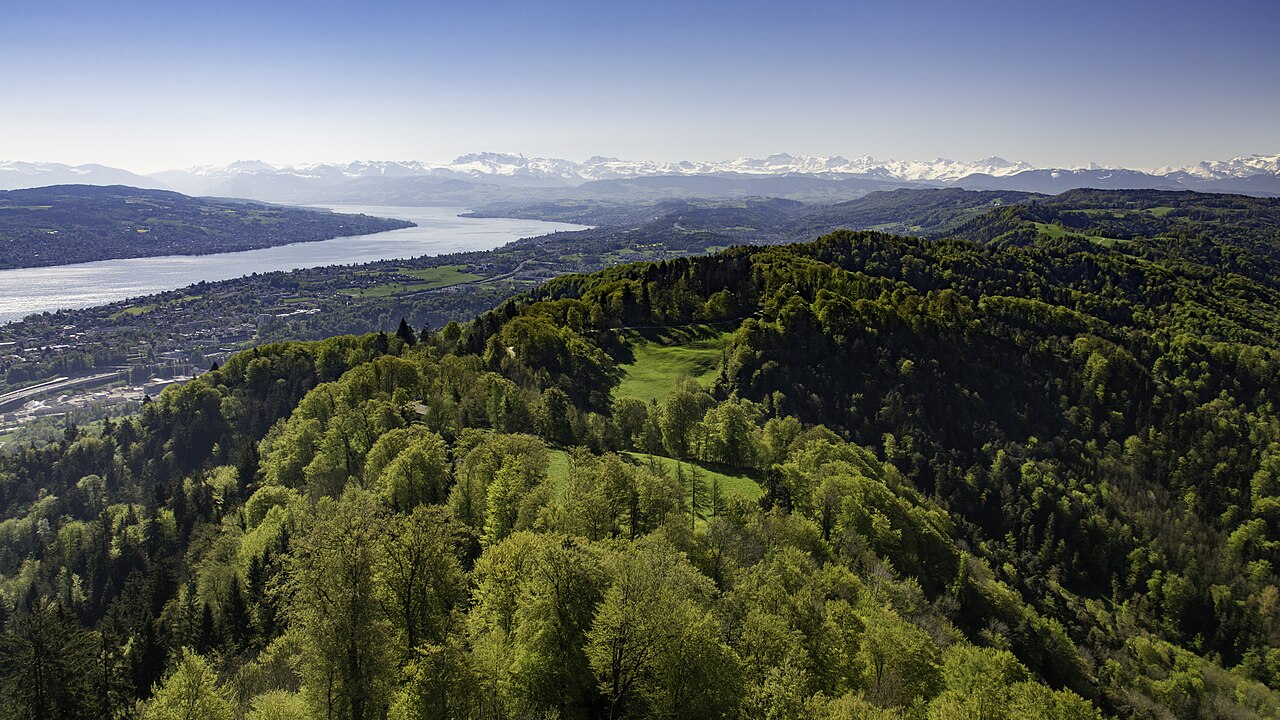
The Uetliberg (869 m) is a wooded ridge above the western part of the city. The S10 train takes you up from the underground SZU platform at the main station in around 20 minutes. From the last stop it is a ten to fifteen-minute walk to the observation tower and the Uto Kulm hotel. From the top you can see the whole city, the lake and, on a clear day, the chain of the Alps. The trip up the Uetliberg is included in the Zürich Card.
The best way to do it, we think, is not to go back down the way you came but to follow the ridge along the Planetenweg, a trail with scale models of the planets, to Felsenegg. It is about two hours of easy walking. There is a restaurant at Felsenegg, and from there a gondola takes you down to Adliswil, where the S4 train runs back into Zurich. In winter people go sledging down from the Uetliberg.
More things to do in Zurich if you have time
Zurich has far more museums than fit into eighteen tips. Animal lovers should take the tram up to Zoo Zürich on the Zürichberg, with its Masoala Hall recreating a Madagascan rainforest. For children there is the WOW Museum of illusions, for watch fans the small Uhrenmuseum Beyer in the centre, for design lovers the Museum für Gestaltung near the station, and for the evening the Urania observatory in the city centre. And if you want a thermal pool on the roof of a former brewery with a view over the city, try the Hürlimannbad & Spa.
Day trips from Zurich
Zurich is the biggest rail hub in Switzerland, and within an hour you can reach half the country. That is why we think it pays to stay in the city and head out from there, rather than moving from hotel to hotel.
The Rhine Falls, the largest waterfall in Europe
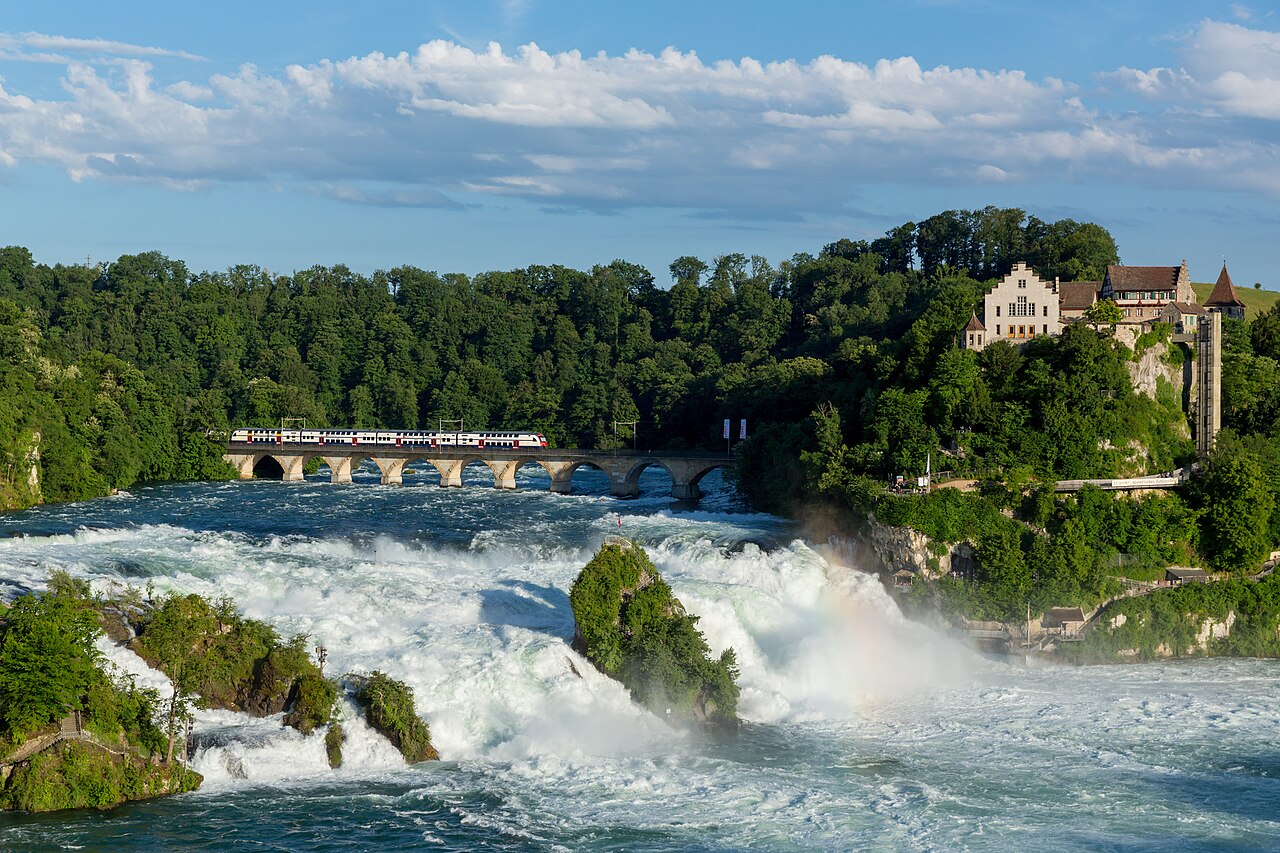
At Neuhausen the Rhine drops 23 metres over a rock sill 150 metres wide, and in summer around 600,000 litres of water a second pour over it (ZVV figures). It is the most popular day trip from Zurich and one of the few you can manage in half a day. The train takes just under an hour depending on the connection, either straight to Schloss Laufen am Rheinfall station below the castle on the south bank, or to Neuhausen on the north bank.
You can watch the falls for free from both banks. What you pay for is the grounds of Laufen Castle, with viewing platforms that take you right out over the water: adults pay 5 CHF, children from 6 pay 3 CHF (zuerich.com). Small boats take visitors into the spray below the falls and out to the rock in the middle. We find the best view is from the path leading down from the station to the water, before you even reach the platforms.
Rapperswil by boat
A small town with a castle at the far end of Lake Zurich. You can sail there from Bürkliplatz and come back by train. A cruise along the whole lake is slow and peaceful, and in our view it is the best way to spend a warm afternoon. There is more about the lake in our overview of Swiss lakes.
Baden and Winterthur
Two smaller towns within half an hour by train, both recommended by the Swiss tourist board too. Baden has thermal baths and a pretty old town above the River Limmat; Winterthur is a city of museums and a good choice for a rainy day.
Einsiedeln Abbey
A Baroque Benedictine monastery with the pilgrimage church of the Black Madonna, the most important place of pilgrimage in Switzerland. It sits in the hills by the Sihlsee lake and makes a quiet contrast to the busy city.
Lucerne, Bern and Zermatt
Lucerne is about an hour away by train and works as a day trip, but we would give it at least one night, because Pilatus and Rigi belong to Lucerne too. We have covered it all in our guide to things to do in Lucerne. The Swiss capital, Bern, is about as close. To the north-west, on the borders with Germany and France, lies Basel. And if you are heading for the mountains, you can go all the way from Zurich to Zermatt below the Matterhorn by train. It is a longer journey with a change, but you do not need a car, and cars are not allowed into Zermatt anyway.
How to get to Zurich from London and the UK
By plane
The quickest option by far. Zurich Airport (ZRH) has direct flights from several London airports and from other UK cities, so from Britain this is the easiest way in. Current routes and fares change with the season, so check them when you book. The airport is about ten kilometres from the centre, and trains from the underground station below the terminal run to Zurich main station every few minutes; the journey takes 10 to 15 minutes. The airport train is included in the Zürich Card, so if you buy the card to start when you land, the ride into town is already sorted.
By train
There is no through train from the UK, but the route is simple: Eurostar from London to Paris, then a TGV Lyria high-speed train from Paris to Zurich. Count on the best part of a day. The big advantage is that you arrive right in the centre, at Zurich main station, a few minutes’ walk from the old town. Connections and fares are on the SBB app and website, and it is worth checking them close to your trip, as timetables change during engineering works.
By car
Driving from the UK means crossing the Channel and then a long day’s drive through France or through Belgium and Germany. If you go through France, budget for motorway tolls; German motorways are free for cars.
In Switzerland you need a motorway vignette. It costs 40 CHF (about £36), comes as a sticker or as an e-vignette linked to your number plate, and the 2026 vignette is valid from 1 December 2025 to 31 January 2027 (BAZG). There is no short-term version. Only buy the e-vignette on the official website via.admin.ch.
Once in Zurich, leave the car parked. Parking in the centre is expensive: the Urania car park by the old town, for example, charges 4 CHF an hour and 45 CHF a day during the daytime, and 2 CHF an hour at night and on Sundays (parking.ch). It is cheaper to leave the car at a park-and-ride near an S-Bahn station on the outskirts and take the train into town.
Getting around Zurich and the Zürich Card
Public transport in the city and the surrounding region is run by the ZVV transport network, and tickets are valid on trams, buses, S-Bahn trains, funiculars and the city boats. The city of Zurich forms zone 110, which counts as two zones. A single ticket for one hour around the city costs 4.70 CHF (about £4.30), and a short-hop ticket (Kurzstrecke) for half an hour is 2.80 CHF (ZVV). ZVV is putting prices up slightly from 13 December 2026, and under the proposal a single ticket will cost 4.80 CHF. You buy tickets from machines at the stops or in the SBB Mobile or ZVV apps.
The centre is so small, though, that you will mostly be on foot. Public transport comes in handy for getting in from the airport and out to the Uetliberg, the zoo and the museums outside the old town.
The Zürich Card costs 29 CHF for 24 hours and 56 CHF for 72 hours; children aged 6 to 15 pay 19 and 37 CHF, and children under 6 nothing. New prices apply from 13 December 2026, and what counts is the date the card starts, not the date you buy it (zuerich.com). The card includes:
- unlimited 2nd-class travel on all public transport in the city and the immediate surroundings (zones 110, 111, 121, 140, 150, 154 and 155), including the train to and from the airport,
- the ride up the Uetliberg,
- the short lake round trip, the mini cruise and the boats on the Limmat,
- free entry to many museums, among them the Landesmuseum, the Kunsthaus (permanent collection), Museum Rietberg, the FIFA Museum, the Museum für Gestaltung, Cabaret Voltaire, the Fraumünster and the Karlsturm tower,
- discounts, for example 20% at Lindt Home of Chocolate, 10% at Zoo Zürich, 15% in selected restaurants and 50% on a guided walk through the old town.
The card does not cover the Rhine Falls, which lie outside its zones.
Is Zurich expensive? Prices and how to save money
Zurich is one of the most expensive cities in the world, and there is no point pretending otherwise. But you can spend a few days here sensibly if you know what is worth paying for and what is not. These are the prices from official websites and the tourist board; the conversion to pounds is approximate (1 CHF ≈ £0.91).
| Item | CHF (2026) | approx. £ |
|---|---|---|
| Zürich Card 24 h / 72 h (adult) | 29 / 56 | 26 / 51 |
| One-hour city ticket (zone 110) | 4.70 | 4.30 |
| Short-hop ticket (Kurzstrecke) | 2.80 | 2.50 |
| Karlsturm tower at the Grossmünster | 5 | 4.50 |
| Fraumünster with the Chagall windows | 5 | 4.50 |
| Landesmuseum (until 4 January 2027) | 13 | 12 |
| Kunsthaus (collection and exhibitions) | 31 | 28 |
| Museum Rietberg | 18 | 16 |
| Lindt Home of Chocolate | 17 | 15.50 |
| FIFA Museum | 26 | 24 |
| Frauenbad bathing spot | 8 | 7 |
| Laufen Castle at the Rhine Falls | 5 | 4.50 |
| Swiss motorway vignette 2026 | 40 | 36 |
| Urania car park, per day | 45 | 41 |
Is the Zürich Card worth it, or which ticket to choose
If you are in Zurich for two or three days and want to see two museums, the Zürich Card almost always pays off. The maths is simple: the Landesmuseum and the FIFA Museum together cost 39 CHF, the 24-hour card costs 29 CHF, and your public transport comes on top.
If you are travelling on around Switzerland after Zurich, look at the nationwide SBB passes. A three-day Swiss Travel Pass in 2nd class costs 254 CHF (about £231) and covers trains, buses, boats and public transport in the cities. The Swiss Half Fare Card costs 150 CHF (about £137), is valid for a month and halves the price of trains, buses, boats, most mountain railways and public transport in more than 90 towns and cities. These prices apply until 31 December 2026 (sbb.ch). For Zurich on its own neither is worth it; the Zürich Card is cheaper.
Saving money on food and drink
- Water from the fountains. Zurich has around 1,200 fountains and most of them run with drinking water. Bring a bottle and skip the bottled stuff.
- Coop and Migros supermarkets have buffets and ready meals that are much cheaper than restaurants. You will find a big Coop and a big Migros right in the main station, where they open on Sundays too, while most shops in the city are closed on Sundays.
- A picnic instead of lunch. The Lindenhof, the lakefront at Bürkliplatz, the Zürichhorn and the lawn at the Letten are all places where locals eat lunch as well.
- Hiltl, near the Bahnhofstrasse, is a vegetarian restaurant dating from 1898 that is billed as the oldest in the world. The buffet is priced by weight, so you decide how much you spend.
- The Zürich Card gives you 15% off in selected restaurants.
We would still keep some money back for one traditional dinner. The local speciality is Zürcher Geschnetzeltes, strips of veal in a creamy mushroom sauce, served with rösti. You can try it at the Zeughauskeller, a beer hall in the old armoury a short walk from Paradeplatz.
Where to stay in Zurich
Accommodation is the biggest item in any Zurich budget. The best bet is to stay in the centre or near the main station, because then you can walk everywhere and set off on day trips straight from the station. We have picked hotels in different price ranges and districts, all checked on Booking.com:
- Zurich Youth Hostel (Mutschellenstrasse 114): the cheapest decent option in the city, a Swiss Youth Hostels property in Wollishofen near the lake. The centre is a few tram stops away, and in a shared dorm you sleep for a fraction of a hotel price.
- 25hours Hotel Langstrasse (Langstrasse 150): a design hotel in District 4, about a kilometre from the main station. The area around the Langstrasse is Zurich’s liveliest nightlife quarter, so this is a pick for people who want to go out in the evening, not for those after peace and quiet.
- Motel One Zürich near Paradeplatz: small but modern rooms at a price that is reasonable by Zurich standards, with everything within walking distance. For a short city break, we think it offers the best balance of price and location.
- Hotel Marta (Zähringerstrasse 36): a smaller hotel in the Niederdorf a few minutes from the station, furnished in 1950s style. You stay in the old town and are at the Grossmünster in ten minutes.
- Hotel Adler Zürich (Rosengasse 10): a traditional hotel in a lane just off the Niederdorfstrasse, with a Swiss restaurant on the ground floor that serves fondue. A good choice if you want to be right in the thick of things.
- Storchen Zürich (Weinplatz 2): a historic hotel right on the bank of the Limmat opposite the town hall, with a terrace over the river. For a special occasion, when you want to see the Grossmünster from your window.
For more options, use our Zurich accommodation search. Prices in Zurich climb highest during trade fairs, conferences and big events, so if your dates are fixed, book well ahead.
A little history
People lived at the spot where the Limmat flows out of the lake as far back as the Neolithic, and later the Celtic Helvetii settled here. Around 15 BC the Romans set up a customs post and called the settlement Turicum. The customs house stood on the hill we now call the Lindenhof, and over the centuries the Latin name turned into Zürich.
The city’s Christian beginnings include the legend of the siblings Felix and Regula, who according to the story fled from a Roman legion and were beheaded in Zurich. The Grossmünster stands on the site of their grave. In 853 Louis the German founded a convent on the opposite bank, today’s Fraumünster, and the town grew up between these two powerful church institutions. In 1262 Zurich became a free imperial city. In the 14th century the mayor Rudolf Brun took power from the merchant nobility and handed it to the craft guilds, which then ran Zurich for centuries. Their guild houses still stand on the riverfront and on the Münsterhof. In 1351 Zurich joined the Swiss Confederation.
The great turning point came in 1519, when Huldrych Zwingli began preaching at the Grossmünster. Zurich became the centre of the Swiss Reformation; images were stripped from the churches, and the city turned into a strict Protestant community that grew rich on textiles, trade and later banking. In the 19th century Zurich became the country’s industrial and railway centre, and in two major expansions, in 1893 and 1934, it absorbed the surrounding villages. That is why it is divided today into twelve districts, called Kreis, which locals use as part of their address: “I live in Kreis 4” sounds very different from “Kreis 7”.
In the 20th century Zurich was a meeting place for artists and émigrés: Dada was born at the Cabaret Voltaire in 1916, and Albert Einstein studied at the ETH. Today Zurich has around 452,000 inhabitants, more than a million in the wider metropolitan area, and it is the financial centre of Switzerland. The bank towers, though, stand mostly outside the old town, so the centre has kept the scale it had five hundred years ago.
Best time to visit Zurich
Zurich is a year-round city, but it looks different in every season. The warmest month is July, with an average temperature of around 19 °C, and the coldest is January, at around 1 °C (MeteoSwiss, 1991–2020 normals). Most rain falls in summer, usually in short thunderstorms.
From June to August Zurich is at its liveliest. The river and lake baths are open, people sit along the waterfront late into the night, and they head up the Uetliberg for the sunset. It is also the most expensive time for accommodation. May and September are the best compromise in our view: you can walk all day, the water is still warm in September and hotels are a little cheaper. In November and December the Christmas lights go up on the Bahnhofstrasse and the Advent markets open, but expect fog and short days. In January and February Zurich is quiet and makes a good base for skiing, for example in Flumserberg.
Things to do in Zurich in one day: what we would do differently
Zurich tempts you to rush from one museum to the next, because the Zürich Card only “pays off” if you squeeze in as much as possible. We would not do it that way. With only one day, we would start with the Lindenhof and the Fraumünster in the morning and spend the rest of the day by the water: a walk along the lakefront, a seat on the steps by the Limmat, a jump into the river at the Letten in summer and a trip up the Uetliberg in the evening. One museum, two at most.
The best moments in Zurich, we think, are not on any list. They are the Niederdorf lanes above the main street, where tourists never get to, the small cafés in Districts 4 and 5 where nobody speaks English, and an evening on the Schipfe, when only a handful of people are sitting by the water. Try something you do not know: Zürcher Geschnetzeltes, Luxemburgerli from Sprüngli, a local beer or wine from the slopes above the lake.
And you do not have to see everything. The Rhine Falls, Lindt, Rapperswil and Lucerne will still be there next time. Better three things at a relaxed pace, phone in your pocket, than ten at a run with Google Maps in your hand. Zurich is not a city to tick off. It is a city where the best thing to do is sit by the water and watch everyone else go swimming.
Frequently asked questions
What to do in Zurich in one day?
Start on the Lindenhof, where you can see the whole old town. Then walk over to the Fraumünster with its Chagall windows and to St. Peter’s Church with the largest clock face in Europe, cross the Münsterbrücke to the Grossmünster and climb the Karlsturm tower. In the afternoon, wander through the Niederdorf and down the Bahnhofstrasse to the lake, go for a swim in the Limmat in summer, and in the evening take the S10 train up the Uetliberg.
How many days do you need in Zurich?
One day is enough for the main sights in the old town, as the centre is small and walkable. With two or three days you can add museums, the Uetliberg and a trip to the Rhine Falls or Lindt Home of Chocolate. If you also want to visit Lucerne or the mountains, allow extra days and keep staying in Zurich, which has direct trains to all of them.
Is the Zürich Card worth it?
Usually yes, if you are arriving from the airport and want to visit a museum. The card costs 29 CHF for 24 hours and 56 CHF for 72 hours (zuerich.com, new prices from 13 December 2026) and includes public transport with the airport train, the ride up the Uetliberg, the short lake cruise and free entry to the Landesmuseum, the Kunsthaus (permanent collection), the FIFA Museum, the Fraumünster and the Grossmünster tower, among others. A single city ticket alone costs 4.70 CHF for an hour, the Landesmuseum 13 CHF and the FIFA Museum 26 CHF.
Can you swim in Zurich?
Yes, and it is one of the best things to do in Zurich in summer. People swim in the lake and in the River Limmat right in the centre, at the city’s bathing spots. The Frauenbad on the Stadthausquai is for women only during the day and costs 8 CHF, the Männerbad in the Schanzengraben canal is free, and for river swimming there are the Oberer and Unterer Letten. The season runs roughly from May to September.
How do I get from Zurich Airport to the city centre?
By train from the station directly below the terminal. Trains to Zurich main station (Zürich HB) run every few minutes and the journey takes 10 to 15 minutes. The ticket is included in the Zürich Card; otherwise buy one from a machine or in the SBB Mobile app.
Is Zurich expensive to visit?
Yes, it is one of the most expensive cities in the world. A single public transport ticket costs 4.70 CHF (about £4.30), museum entry runs from 13 to 31 CHF and accommodation is the biggest item in your budget. You can save with drinking water from the fountains, food from the Coop and Migros buffets, picnics by the lake and the Zürich Card, which covers transport and a good number of museums.
How do I get to Zurich from London?
The fastest way is to fly: Zurich Airport has direct flights from several London airports and other UK cities, and the train from the airport gets you to the centre in 10 to 15 minutes. By rail it is Eurostar to Paris and a TGV Lyria train on to Zurich, most of a day in total. If you drive, you need a Swiss motorway vignette for 40 CHF (about £36).
How far is the Rhine Falls from Zurich?
The Rhine Falls at Neuhausen are just under an hour from Zurich by train, either to Schloss Laufen am Rheinfall station or to Neuhausen. You can watch the falls for free from both banks; the viewing platforms in the grounds of Laufen Castle cost 5 CHF for adults. The Zürich Card is not valid for this trip.
Where to next
- Lucerne: the Kapellbrücke, Pilatus and Rigi, an hour by train from Zurich.
- Basel: the Rhine, museums and floating downstream with a Wickelfisch dry bag.
- Geneva: the Jet d’Eau, the UN and CERN at the other end of the country.
- Zermatt: the car-free village below the Matterhorn, which you can reach by train from Zurich.
Potřebujete pomoct s cestováním?
-
Ubytování 🏨
Vyberte si to nejlepší ubytování, ať už jste kdekoliv, přes Booking.com. -
Půjčení auta 🚗
Auto si snadno najdete přes Booking.com, kde máte často slevu díky ubytování, nebo Rentalcars.com, kde porovnáte nabídky většiny půjčoven. -
Zážitky 🎟️
Přes GetYourGuide.com si vyberete z nejrůznějších výletů i zážitků po celém světě, navíc se zrušením zdarma do 24 h předem.