Last updated 27.10.2026
Bucharest has a bad reputation. Polls now and then put it among the ugliest capitals in Europe, most visitors only know its airport on the way to the mountains or the Black Sea, and the first view from the taxi window, grey housing blocks for miles, does not help. Stay two days, though, and the picture changes. You find an Orthodox monastery from 1724 tucked between cocktail bars, a bookshop inside a former bank, Art Nouveau palaces from the years when the city was called Little Paris, and right next to them the second-largest administrative building on earth, for which a dictator flattened a fifth of the historic centre. Bucharest, Romania is a city of contrasts in the most literal sense, and that is exactly why we enjoy it.
Below you will find 16 things to do in Bucharest, how to book the Palace of Parliament tour, how to get from the airport into the centre, what everything costs in lei and in pounds, where to stay and which day trips are worth it. If you are only passing through on the way to Transylvania, the first ten tips are all within walking distance of each other and fit into a single day.
Things to do in Bucharest: the short version
- Romania’s capital has 1.7 million inhabitants (2021 census) and lies on flat land in the south of the country on the River Dâmbovița, about 60 km from the Danube and the Bulgarian border. The currency is the leu (RON); 1 leu is roughly £0.17.
- Direct flights from the UK leave London (Heathrow, Luton, Stansted) and several regional airports, including Birmingham, Manchester, Bristol, Leeds Bradford, Liverpool and Edinburgh.
- From the airport to the centre the round-the-clock bus 100 costs 3 lei (about 50p, pay by contactless card on board), or take the train to Gara de Nord in about 20 minutes.
- Book the Palace of Parliament by phone at least 24 hours ahead. Entry is 85 lei (about £14.50) and you will not get in without a passport or national ID card.
- Most museums close on Mondays; the National Museum of Art and the Museum of the Romanian Peasant also close on Tuesdays.
- Free: the Lipscani old town, Stavropoleos, Cărturești Carusel, Calea Victoriei, Revolution Square and the Cișmigiu and Herăstrău parks.
- Two to three days are enough for the city. Use a third for Snagov and Mogoșoaia, the Therme spa, or the train to Peleș Castle.
How to get to Bucharest from the UK
By plane
By far the easiest option. Bucharest’s main airport is Henri Coandă (code OTP, usually just called Otopeni after the town it sits in), and it has direct links with a surprising number of British airports. British Airways flies from London Heathrow, Wizz Air from London Luton, Birmingham, Leeds Bradford and Liverpool, and Ryanair from London Stansted, Birmingham, Bristol, Leeds Bradford, Manchester and Edinburgh. Smaller carriers come and go on these routes and timetables change with the season, so compare current options in a flight search engine shortly before you book. From London the flight takes roughly three hours.
From Ireland there are direct flights from Dublin. The small Băneasa airport in the north of the city now mainly handles private flights; scheduled flights from the UK do not land there.
By train
Getting to Bucharest by rail from Britain is a project rather than a journey, but it can be done: Eurostar to Paris or Brussels, onward trains to Vienna or Budapest, then a night train. The Dacia sleeper runs from Vienna via Budapest to Bucharest, and other overnight services from Budapest go via Brașov. From Budapest to Bucharest allow 14 to 15 hours; seat reservations are compulsory and you can book couchettes or sleeping cars. Timetables change every December, so check current connections with Hungarian railways (MÁV) or Romania’s CFR Călători. It is slow, but if you are spending two weeks in Romania anyway, you can arrive in Bucharest by train and head home from Transylvania.
By car
Driving from the UK means crossing the Channel and then more than 2,500 kilometres through Western and Central Europe, usually via Germany or Austria and Hungary, so plan at least three days each way. In Romania you need a road vignette, the rovinieta (from 1 October 2026, 30 lei for 10 days for a Euro 6 car, roughly £5), plus vignettes or tolls in the countries you cross on the way. We would not drive into Bucharest itself though: traffic is heavy, parking in the centre is hard and the metro gets you everywhere. If you do come by car, pick a hotel with parking and leave the car there.
From the airport to the city centre and getting around Bucharest
Otopeni airport lies about 17 kilometres north of the centre. You have three sensible ways into town.
Bus 100. This express line, which replaced the old 783, runs 24 hours a day: every 15 minutes during the day and every 30 minutes at night. It goes via Piața Victoriei and Universitate to Piața Unirii, and you should allow around 45 minutes to the centre depending on traffic. A normal city ticket costs 3 lei (about 50p) and the simplest way to pay is to tap your contactless card on the validator on board. One thing to know: because of construction work at the airport, since April 2026 the buses no longer stop at arrivals but at the stop by the departures hall, which is now called Aeroport Henri Coandă.
The train to Gara de Nord, the main station. Trains leave the airport station roughly every 40 minutes, including at night, and the ride takes about 20 minutes. Two operators (CFR Călători and Transferoviar) run the line at different prices; in 2026 a ticket cost between about 6.50 and 11 lei (roughly £1.10 to £1.90). Buy it beforehand from a machine or the ticket office, not on the train. From Gara de Nord you continue by metro.
Taxi, Bolt or Uber. Both apps work in Bucharest, and a ride between the centre and the airport costs about 60 to 100 lei (roughly £10 to £17) depending on traffic, more at rush hour. If you want a regular taxi, order it from the touchscreen machine in the arrivals hall, which prints a ticket with your car number. Turn down any driver who approaches you at the exit.
A metro line to the airport (M6) is under construction but is not running yet in 2026.
Metro, trams and buses
Bucharest’s metro has five lines and covers nearly everywhere a visitor needs to go: Piața Unirii (old town), Universitate, Izvor (Palace of Parliament), Piața Romană, Piața Victoriei, Aviatorilor (Herăstrău Park, Arch of Triumph) and Gara de Nord. Trams, trolleybuses and buses are run by the city operator STB, while the metro belongs to a separate company, Metrorex, so the tickets are separate too.
- Metro: single journey 5 lei, day ticket 12 lei, 72 hours 35 lei (roughly 85p, £2 and £6; Metrorex fares valid since January 2025). In spring 2026 a rise in the single fare to 7 lei was announced, but the transport ministry withdrew it in June. At the barrier just tap a contactless card or phone; for each extra person press “+” and tap again.
- STB trams and buses: 90-minute ticket 3 lei, 24 hours 8 lei, 72 hours 20 lei. Tap your card on the validator on board, or use the 24Pay app.
- Combined metro and STB ticket: 24 hours for 18 lei, 72 hours for 49 lei (roughly £3 and £8.30, STB fares). Worth it if you ride a lot.
For two days in the city we would not buy anything in advance and would simply tap a card for each ride. The centre between the Palace of Parliament, the old town and the Athenaeum is easy to cover on foot anyway.
16 things to do in Bucharest
We have ordered them roughly by location: from the Palace of Parliament through the old town and along Calea Victoriei north to the parks and the Arch of Triumph. You can walk the first day (tips 1 to 10); for the northern part (11 to 15) you will want the metro. One warning before you plan: most museums in Bucharest are closed on Mondays, and some on Tuesdays too.
1. Palace of Parliament
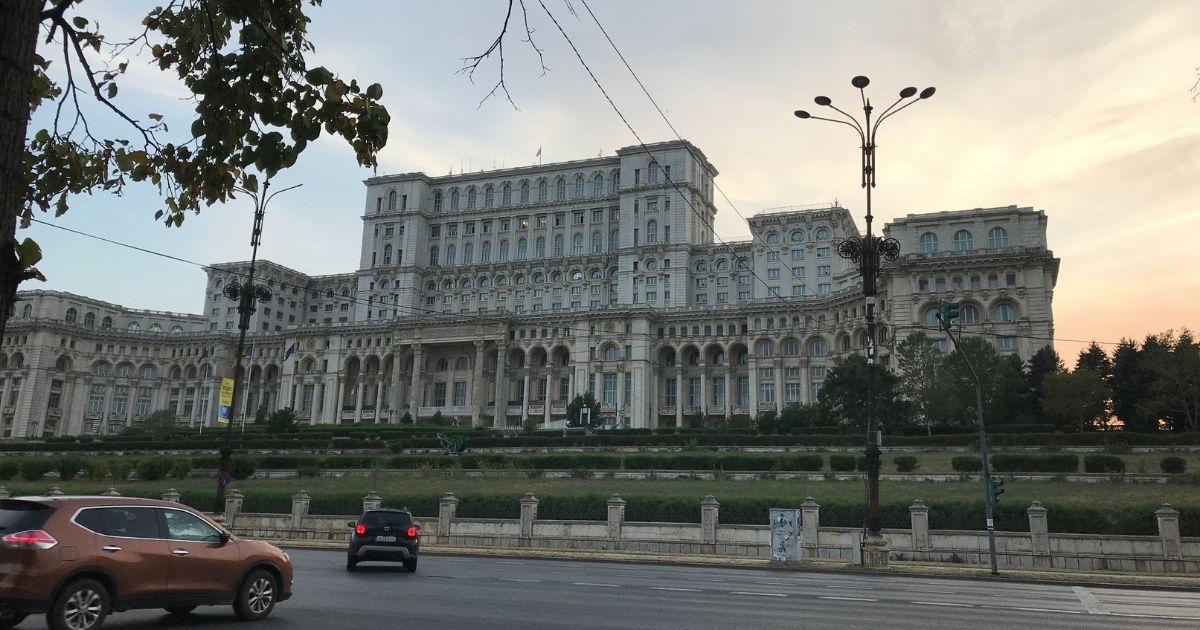
Known under Ceaușescu as the House of the People, it is the second-largest administrative building in the world after the Pentagon and, according to Guinness World Records, the heaviest building on the planet. It has more than 1,100 rooms, 12 floors above ground, 8 below, and a footprint of around 330,000 m². Construction began in 1984 to a design by Anca Petrescu, an architect who was 28 at the time, and it was still unfinished when Ceaușescu was executed in 1989. To make room for it, most of the Dealul Spirii hill district disappeared, along with its churches, monasteries and thousands of homes. Today it houses both chambers of parliament, a conference centre and the National Museum of Contemporary Art (MNAC).
Inside it is a parade of Romanian marble, crystal chandeliers and carpets woven to fit individual halls. The tour takes you through a handful of state rooms and corridors and usually out onto the balcony overlooking Bulevardul Unirii. Even so, you only see a fraction of the building. For us the strongest part of the visit is the sheer scale: corridors you could drive a bus down, and the knowledge that all this was built while people queued for bread.
How to visit in 2026 (according to the parliament’s visitor centre):
- Booking is required. Groups of 1 to 9 people book by phone at least 24 hours ahead on +40 733 558 102 or +40 733 558 103 (the line is open 9am to 4pm); groups of 10 or more by email at least three days ahead. There is no official online booking or ticket sale; tickets you find online are sold by resellers with a mark-up.
- Standard tour prices: adults 85 lei (about £14.50), students aged 19 to 26 pay 55 lei, children 7 to 18 pay 40 lei, under-sevens go free. You pay on the spot.
- Open daily 9am to 5pm, closed on public holidays and during parliamentary events.
- Bring your original passport or national ID card; a driving licence is not accepted. Arrive at least 15 minutes early: there is an airport-style security check and you cannot bring liquids.
- The visitor entrance is on the side street Izvor (Str. Izvor 2–4), not on the square in front of the main façade. The nearest metro station is Izvor.

2. Bulevardul Unirii and the Piața Unirii fountains
From the palace balcony you look straight down Bulevardul Unirii, a boulevard Ceaușescu had built slightly longer and wider than the Champs-Élysées in Paris. It is lined with blocks of luxury flats for party officials with the same façades as the palace, and a strip of fountains runs down the middle all the way to Piața Unirii. It is the best place to understand what the so-called Civic Centre meant: not one building but a whole district built as a stage set.
The fountains on Piața Unirii have an evening music show (Simfonia Apei), but in 2026 it only ran until the end of June. Since 30 June the fountains have been switched off for repairs to the structure beneath the square, and they are not expected back before 2027. We would still walk the full length of the boulevard at least once, ideally around dusk, when the palace at the far end is lit up.
3. Lipscani, the old town
The historic centre between the Dâmbovița river and Regina Elisabeta boulevard is what survives, in one piece, of Bucharest before Ceaușescu. The streets are named after the guilds and merchants that once worked in them: Lipscani after the traders who brought goods from Leipzig, Șelari after the saddlers, Covaci after the blacksmiths. Twenty years ago this was a district of crumbling houses; today it is a pedestrian zone with one restaurant after another, which by day feels like any tourist centre and by night like one big bar.
The old quarter also holds Hanul lui Manuc, a former coaching inn from 1808 with wooden galleries around its courtyard, and Bucharest’s most famous beer hall, Caru’ cu Bere, from the late 19th century, with a neo-Gothic interior and a frequent wait for a table. A few steps from Stavropoleos you will also find the National Museum of Romanian History and, opposite it, the CEC Palace with its glass dome.
4. The Old Princely Court (Curtea Veche)
The oldest part of Bucharest. Of the seat of the Wallachian princes, where Vlad III the Impaler signed the 1459 charter that first mentions the city, mainly the foundations, cellars and a bust of Vlad himself remain, and everyone who comes here poses for a photo with it. Right next door stands the Biserica Curtea Veche (St Anthony’s Church) from 1559, the oldest surviving church in the city. The museum on the site, however, has been closed since November 2015, and in 2026 work to make the ruins safe was only being prepared, so you can only see them from outside through the fence. The church is open for worshippers. For Dracula fans, this is in our view a more authentic place than Bran Castle, which we cover in our guide to Dracula’s castle.
5. Stavropoleos Monastery
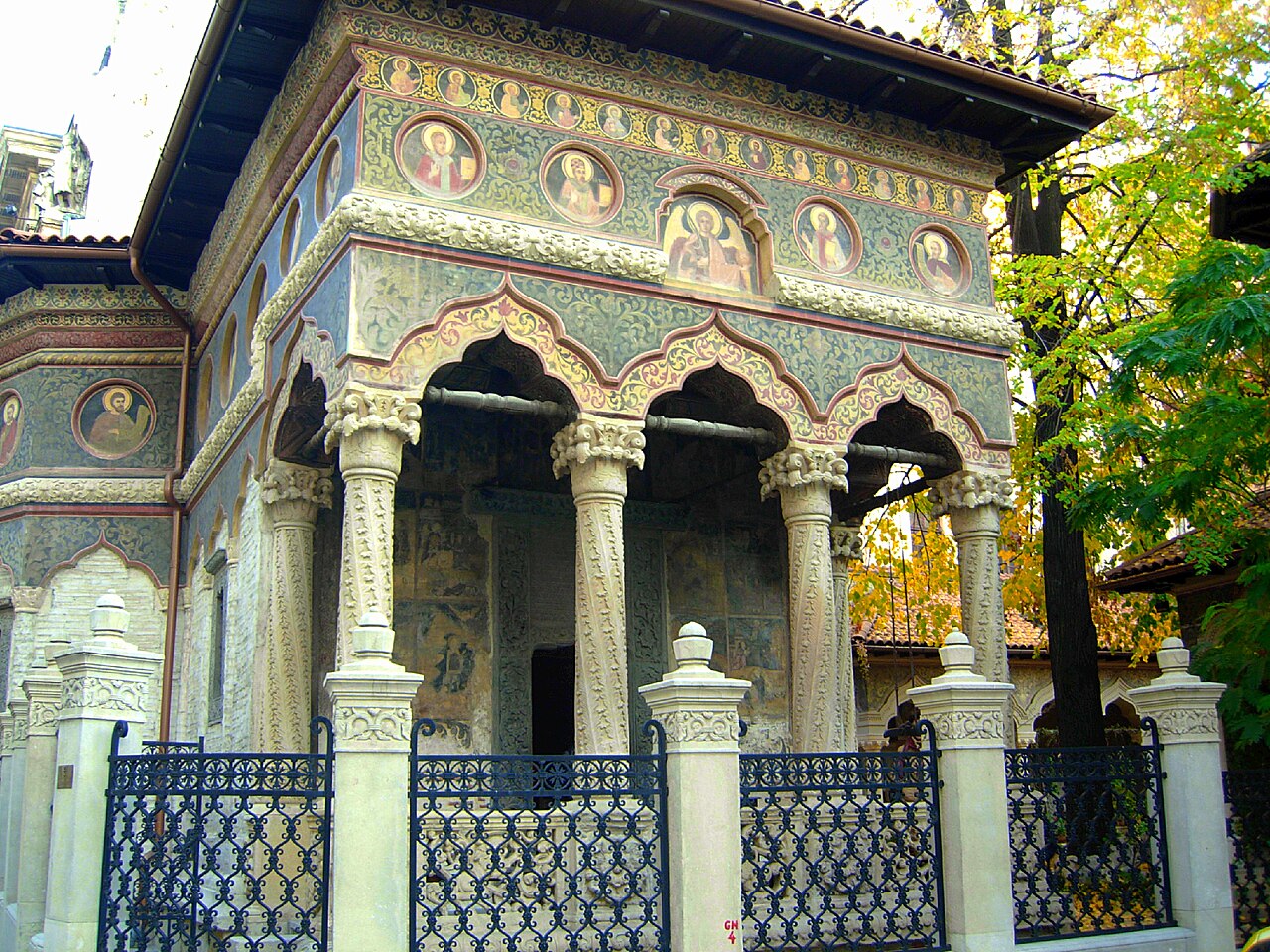
If we could show you just one place in Bucharest, it would be this one. The little church was built in 1724 by the Greek monk Ioanichie and is a textbook example of the Brâncovenesc style, a Wallachian blend of Renaissance, Byzantine and Ottoman elements: stone columns carved with tendrils, arches that could be in Istanbul and a façade covered in frescoes of saints. In the courtyard behind the church is a lapidarium of stone crosses and fresco fragments rescued from churches demolished under Ceaușescu. The monastery has its own Byzantine choir and a library.
It is a working monastery, so keep your voice down and do not take photos during services. It stands in the middle of the busiest corner of the old town, and that contrast is what makes it special.
6. Cărturești Carusel bookshop
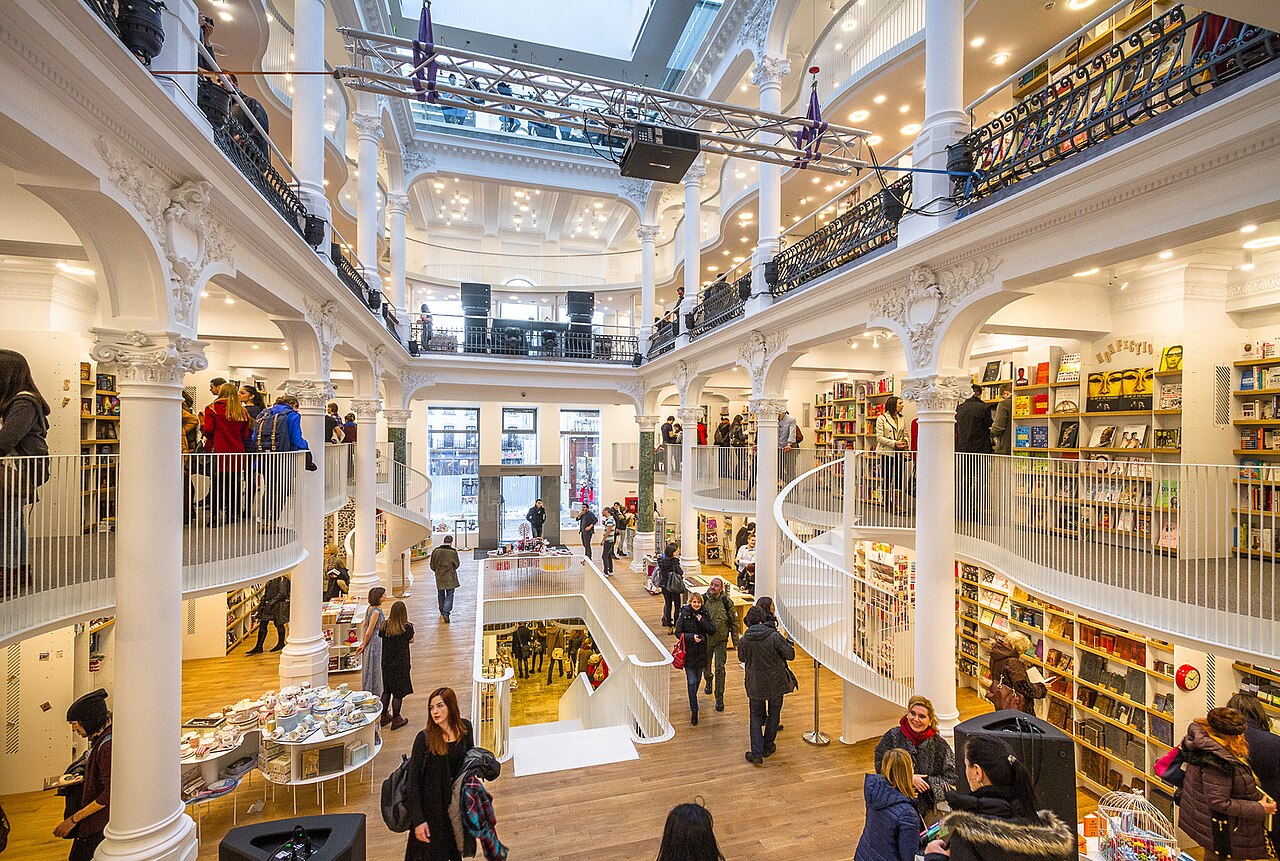
A white atrium rising through several floors, spiral staircases, columns and balconies with wrought-iron railings. The building at Lipscani 55 was built in the late 19th century by the Chrissoveloni banking family; the communists nationalised it and turned it into a department store, and after the revolution it fell into decay. In 2015, after restoration, the Cărturești chain reopened it as a bookshop, and it has been one of the most photographed places in the city ever since. Besides books (some in English) you will find stationery, records, gifts by Romanian designers and a café on the top floor.
It opens at 10am and stays open until late in the evening. If you want a photo without the crowds, come first thing; if you want the atmosphere, drop by in the evening for a coffee on the top floor.
7. Calea Victoriei and the arcades
Bucharest’s oldest and most elegant avenue runs almost three kilometres north from the river, and it is lined with most of what earned the city its Little Paris nickname. At the southern end stand the CEC Palace (1900) and the National Museum of Romanian History in the former Post Office Palace, home to a cast of Trajan’s Column and the Romanian royal treasure. Further north come the National Military Circle Palace, the Odeon Theatre, the former Royal Palace, the Athenaeum and the Cantacuzino Palace with the George Enescu Museum.
Between Calea Victoriei and the old town, two arcades are worth a detour. Pasajul Macca-Vilacrosse, from the mid-19th century, is horseshoe-shaped, with a glass roof and one shisha café after another. Pasajul Victoria is a narrow lane hung with colourful umbrellas in summer, and probably the most Instagrammed spot in Bucharest. The umbrellas only go up in the warmer months.
8. Revolution Square
On Piața Revoluției, on 21 December 1989, Ceaușescu’s last speech from the balcony of the Communist Party Central Committee building turned into booing, and the next day the dictator fled by helicopter from the roof of the same building. The balcony is still there; the building now belongs to the interior ministry. Opposite stands the Memorial of Rebirth, a white pyramid with a “potato” skewered on top, which locals simply call the potato on a stick. Around the square you will see the Central University Library with an equestrian statue of King Carol I, the small brick Kretzulescu Church from 1722 and the former Royal Palace.
The Royal Palace houses the National Museum of Art of Romania (MNAR) with two galleries: Romanian art from medieval icons to the 20th century (including the sculptor Brâncuși), and European painting with El Greco, Rembrandt and Rubens. One gallery costs 32 lei, all galleries 60 lei and the whole building including the historic royal rooms 80 lei (roughly £5.40, £10 and £13.60, MNAR prices). Entry is free on the first Wednesday of every month. It is open Wednesday to Friday 10am to 6pm and at weekends 11am to 7pm, closed on Mondays and Tuesdays. On the façades around the square you can still spot bullet holes from December 1989.
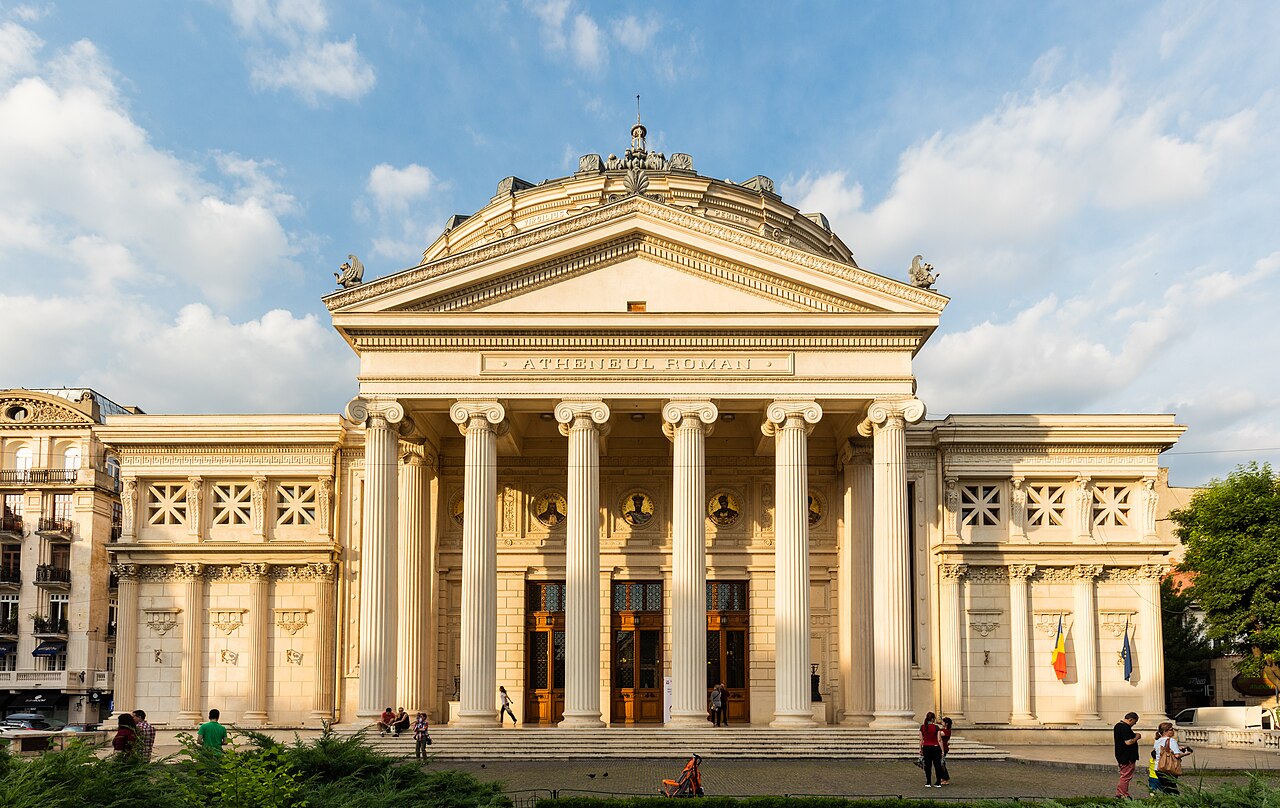
9. Romanian Athenaeum
This round concert hall from 1888, with its dome and Ionic columns, is in our opinion the most beautiful building in Bucharest. It was designed by the French architect Albert Galleron and paid for by a public collection under the slogan “Give a leu for the Athenaeum”. It is home to the George Enescu Philharmonic. Inside, a fresco roughly 70 metres long runs right around the hall, telling the story of Romania from the Roman conquest of Dacia to the union of 1918.
You can see the interior either at a concert or on a guided tour. In 2026 tours were sold through Eventim by a private agency for 170 lei (about £29), and we could not confirm the tour price on the philharmonic’s official website. Our advice is to go straight to a philharmonic concert: you see the hall and the fresco, and you hear why music has been played here since 1888. The programme and tickets are on the George Enescu Philharmonic’s website.
10. Cișmigiu Park
Bucharest’s oldest public park dates from the mid-19th century and sits a short walk from University Square. The German landscape architect Carl Meyer laid it out on the site of a marsh. Today it covers around 16 hectares, with a lake where you can hire rowing boats in summer and skate in winter, and the Writers’ Rotunda with busts of Romanian authors. Unlike the vast Herăstrău, this is a park for a short break, ideal between the old town and Calea Victoriei.
11. Museum of the Romanian Peasant
If you only have time for one museum, we would choose this one. The Muzeul Național al Țăranului Român, in a red-brick building on Șoseaua Kiseleff near Piața Victoriei, is about rural Romania: folk costumes, pottery, icons painted on glass, wayside crosses and an entire wooden house moved here from a village. The displays are unusual, closer to art installations than to glass cases with labels.
According to the museum’s website, admission is 20 lei (about £3.40), seniors pay 10 lei and students 5 lei. It is open Wednesday to Sunday 10am to 6pm, with entry in groups at 10:00, 11:30, 13:00, 14:30 and 16:00, and closed on Mondays and Tuesdays. Tickets can be bought online.
12. Arch of Triumph
Bucharest’s Arcul de Triumf on Șoseaua Kiseleff is 27 metres high and got its present stone form in 1936. Before that, a temporary arch of wood and plaster stood here, built for the victory parade after the First World War. It commemorates the creation of Greater Romania in 1918. You can go inside and up to the viewing terrace: according to the site’s managers, the arch is open all year except Mondays, in winter (November to March) Tuesday to Sunday 9am to 5pm, and admission is 15 lei (about £2.50). Traffic circles the arch on a roundabout, so the best photos are from the pavement on Kiseleff.
On the way north from Piața Victoriei, Kiseleff is also home to the Grigore Antipa Natural History Museum, one of the best museums in the city for children, with animal dioramas and the skeleton of a prehistoric elephant relative, Deinotherium. Admission 32 lei (about £5.40), students 8 lei, closed on Mondays.
13. King Michael I Park (Herăstrău)
Bucharest’s largest park wraps around Lake Herăstrău in the north of the city and covers more than a hundred hectares. In 2017 it was renamed after Romania’s last king, but most locals still call it Herăstrău. This is where Bucharest comes to run, cycle, hire a boat or sit in one of the lakeside restaurants. Walking all the way round the lake takes a couple of hours. The nearest metro stations are Aviatorilor and Piața Victoriei, and the entrance by the Arch of Triumph is a few minutes’ walk away.
14. Dimitrie Gusti Village Museum
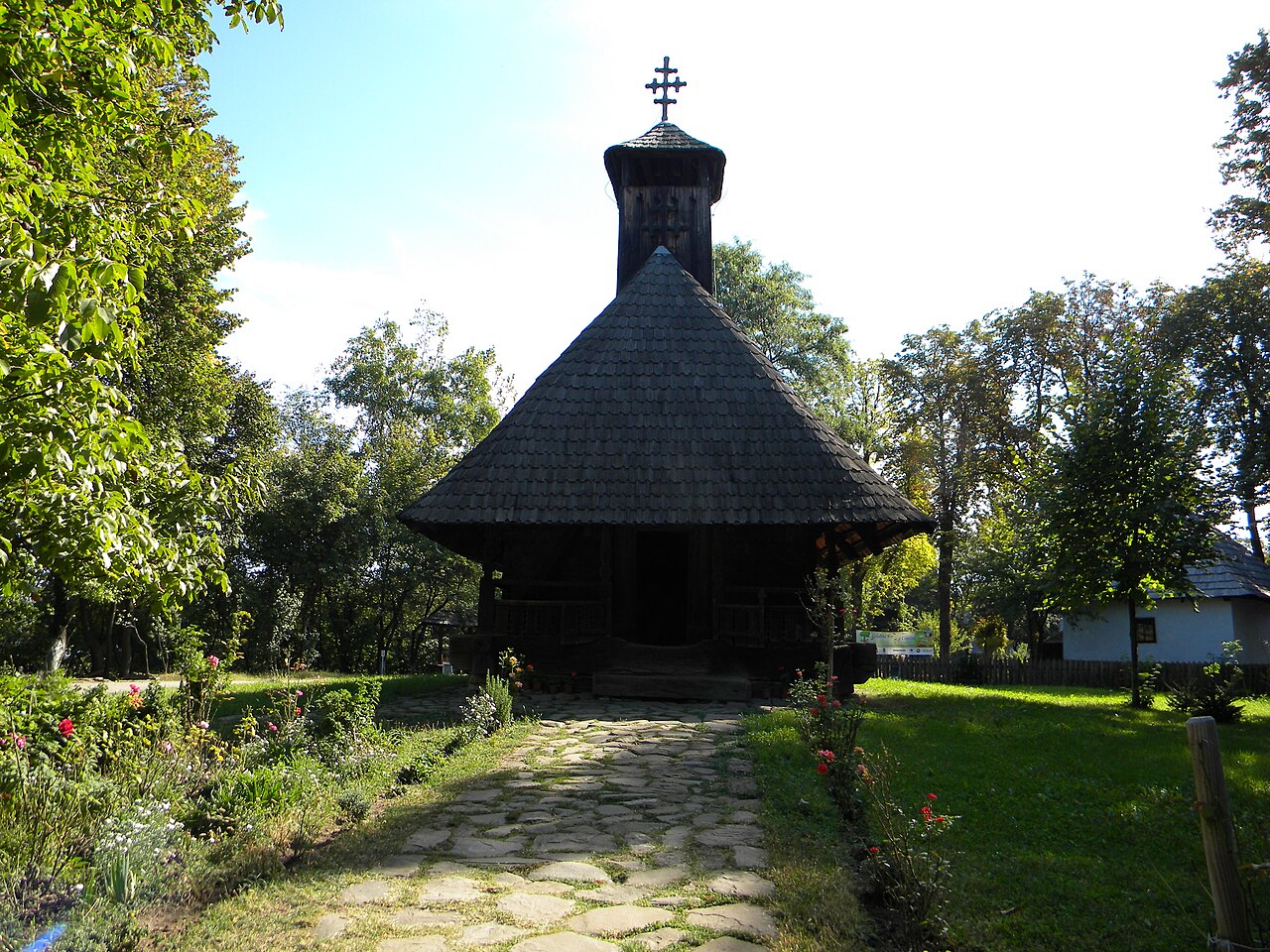
On the shore of Lake Herăstrău stands one of the oldest open-air museums in Europe. The sociologist Dimitrie Gusti founded it in 1936, and today it holds more than 300 buildings from every corner of Romania: wooden churches from Maramureș, windmills, half-sunken houses from Oltenia, Transylvanian farmsteads and reed-thatched cottages from the Danube Delta. The houses were taken apart and rebuilt here; you can look inside, and some sell local crafts. Adults pay 40 lei (about £6.80), students 10 lei, and children under six go free. On Mondays and Tuesdays you pay half, because most of the houses are closed. In winter the museum is open daily 9am to 5pm (according to the museum), and the entrance is at Kiseleff 28–30, close to the Arch of Triumph.
In our view this is the best place in Bucharest for families with children and the fastest way to see the whole of Romania in two hours. And if you came to Romania for the mountains and villages, this is where you get a preview of what is waiting for you.
15. Ceaușescu Mansion in Primăverii
If the Palace of Parliament shows how Ceaușescu wanted to impress the people, his private villa in the Primăverii district shows how he lived. Casa Ceaușescu (Palatul Primăverii) was the family home of the dictator and his wife Elena from the 1960s until December 1989. You will see the children’s bedrooms, Elena’s wardrobe full of furs, a private cinema, bathrooms with gilded fittings and an indoor pool with mosaics. Unlike the palace, this is a house people actually lived in, and that is exactly why it feels more chilling.
Visits are guided only (in Romanian or English) and last 45 minutes. According to the official website, you need a reservation or an online ticket; the standard tour costs 85 lei (about £14.50), with a documentary film 115 lei, and children under seven go free. The website quotes different prices in two places, though, so double-check when you book. Open Tuesday to Sunday 10am to 5pm, closed on Mondays. Photography is not allowed inside. The nearest metro station is Aviatorilor.
16. Obor Market
If you want to see how Bucharest eats when it is not sitting in a tourist restaurant, head to Piața Obor, the largest market in the city. Inside the concrete hall and around it, traders sell fruit, vegetables, cheese, cured meats, pickles and spices, and outside there are stalls grilling mici (mititei), small skinless sausages served with mustard and eaten standing up. You will meet few tourists here. The market is next to the metro station of the same name on line M1, a few stops from the centre.
Is Bucharest expensive? What things cost
Bucharest is one of the cheapest capitals in the European Union, even though prices in the centre have risen noticeably over the last few years. Here is a rough guide to admission and transport prices (conversion at 1 leu ≈ £0.17):
| Item | Price (2026) | Roughly in £ |
|---|---|---|
| Palace of Parliament tour (adult) | 85 lei | £14.50 |
| Ceaușescu Mansion (standard tour) | 85 lei | £14.50 |
| Dimitrie Gusti Village Museum | 40 lei | £6.80 |
| National Museum of Art, one gallery | 32 lei | £5.40 |
| Museum of the Romanian Peasant | 20 lei | £3.40 |
| Arch of Triumph, Mogoșoaia Palace | 15 lei | £2.50 |
| Metro, single journey | 5 lei | 85p |
| Bus or tram, 90 minutes (including bus 100 to the airport) | 3 lei | 50p |
| Metro + buses and trams, 24 hours | 18 lei | £3 |
| Therme, Galaxy zone for 3 hours (Mon–Thu) | 71 lei | £12 |
For food, the crowd-sourced Numbeo comparison gives a useful guide: a cheap restaurant meal around €13 (about £11), dinner for two in a mid-range restaurant around €51 (about £43), half a litre of beer in a restaurant about €3.40 (roughly £2.90) and a cappuccino around €3 (about £2.50). Expect a mark-up in the old town; a few streets away, and in canteens with a lunch menu (meniul zilei), you pay less. For a quick breakfast, bakeries with filled pastries do the job, or grab covrigi, the salty pretzel rings sold on every corner in Bucharest.
Day trips from Bucharest
Snagov Monastery
Some 30 to 40 kilometres north of Bucharest, a small monastery stands on an island in Lake Snagov, and tradition holds that Vlad III Țepeș is buried there. In front of the altar lies a stone slab with his portrait; whether he really rests beneath it, historians have not been able to confirm. A footbridge has led to the island since 2019, so you no longer need to find a boat. We could not verify admission prices or opening hours on an official website, but bring some cash. If the Dracula legend grabs you, there is more in our guide to Dracula’s castle.
Mogoșoaia Palace
This brick palace just beyond the north-western edge of the city was built around 1700 for the Wallachian prince Constantin Brâncoveanu, the same man who gave his name to the Brâncovenesc style of Stavropoleos. Its arcaded loggia is reflected in the lake, and the large park around it is where Bucharest families come for weekend picnics. The palace costs 15 lei (about £2.50), photography inside 20 lei and parking 10 lei; it is open Tuesday to Sunday, from October to April 9am to 5pm and in summer 10am to 6pm (Brâncoveanu Centre). We would combine Mogoșoaia and Snagov into one half-day by car or Bolt, as they lie in the same direction.
Therme București
This thermal spa and wellness complex in Balotești, just past the airport, is one of the largest in Europe: thermal pools, waterslides in the Galaxy zone, the quieter Palm zone with palm trees under a glass dome, and the Elysium sauna world. According to the Therme price list (2026), three hours in the Galaxy zone cost 71 lei on weekdays and 81 lei at weekends, a full day 141 and 151 lei, and the priciest zone, Elysium, 132 to 217 lei. It is open daily, until midnight on Fridays and Saturdays. City bus 442 runs there from Piața Presei Libere via the airport. We think it is the perfect plan for a rainy day or an afternoon before an evening flight home.
Sinaia and Peleș Castle
The best day trip into the mountains. Trains from Gara de Nord to Brașov run up the Prahova Valley and stop in Sinaia, and the fast ones get there in about an hour and a half. Above the little town stands the neo-Renaissance Peleș Castle, the summer residence of Romania’s kings with richly carved interiors, and above Sinaia and neighbouring Bușteni the trails into the Bucegi Mountains begin. More on hiking in our guide to the mountains in Romania.
Brașov and Transylvania
The IC train from Bucharest to Brașov takes just under two and a quarter hours, and there are plenty of trains a day. As a day trip it is a rush, though: Brașov, Bran and Râșnov deserve two or three days. Brașov, Sibiu, Sighișoara and the Saxon fortified churches combine well into one longer trip through Transylvania.
The Black Sea
The fastest train from Bucharest to Constanța takes just over two hours, and in summer twice as many trains run. Too far for a day, but for two or three days at the seaside Bucharest is a good starting point. Which resort to choose, from Mamaia to Vama Veche, is covered in our guide to the Romanian seaside.
Where to stay in Bucharest
Hotels in Bucharest are much cheaper than in Western European capitals: for the price of an average hotel in London you can sleep in a historic building in the centre. The neighbourhood is what matters most:
- Old town (Lipscani) and around Universitate: everything within walking distance, including the Palace of Parliament. It is noisy in the evening and at night, though, especially at weekends. If you stay here, ask for a room facing the courtyard or on a higher floor.
- Calea Victoriei, Cișmigiu and Piața Amzei: in our view the best compromise. Ten minutes’ walk to the old town, but quieter nights and prettier streets.
- Piața Romană and Piața Victoriei: the business and office district, with good metro links and bus 100 to the airport, and close to Herăstrău and the Village Museum.
- Around Gara de Nord: cheap hotels and hostels near the station, handy for one night before an early train. For longer stays we would pick the centre.
Our picks on Booking.com across different price levels:
- Moxy Bucharest Old Town (old town): a modern design hotel on Strada Doamnei, 500 metres from Stavropoleos and 350 metres from Universitate metro. Smaller, practical rooms, a bar and lounge, and a garage. For those who want to sleep right in the old town and do not need period interiors.
- Capitol Hotel (Calea Victoriei): a hotel in a 1901 building right on Calea Victoriei 29, close to Cișmigiu Park and 400 metres from Universitate metro. Classic rooms, its own restaurant and parking. In our view the best balance of price and location.
- Hotel Cismigiu (Cișmigiu): an Art Nouveau building from 1912 on Regina Elisabeta boulevard by Cișmigiu Park, 700 metres from the old centre, with underground parking. In Bucharest you will appreciate that if you arrive by car.
- The Marmorosch Bucharest (old town): a luxury hotel in the palace of the former Marmorosch Blank bank on Strada Doamnei, with an indoor pool, sauna, spa, restaurant and bar. If you are going to splurge once, do it here.
You will find more options across the city, including hostels and apartments, among places to stay in Bucharest. With cheap deals in the old town, read the reviews for comments on noise, and in older buildings do not hesitate to ask whether the building has been seismically strengthened. Bucharest lies in an earthquake zone, and the city marks its highest-risk buildings with a red dot (bulină roșie) on the façade.
Is Bucharest safe? Money and practical tips
- Bucharest is a safe city for tourists, and violent crime is low. The UK Foreign Office’s travel advice mainly asks you to watch out for petty theft in large towns, especially Bucharest. The usual care applies on a packed metro, at Gara de Nord and in the old town at night.
- Watch the card terminals in bars and clubs. The Czech foreign ministry warns that in Bucharest’s historic centre, staff in restaurants and especially nightclubs sometimes key in an amount many times higher than the bill, and the losses can run into thousands of pounds. The FCDO separately notes that cards have been copied in some bars and restaurants. Check the display before you tap and do not let the terminal out of your sight.
- The currency is the Romanian leu (RON, plural lei), roughly £0.17 per leu. Romania does not use the euro. You can pay by card almost everywhere, including public transport; cash is handy at markets and in small places. Change money only at banks and official exchange offices, never on the street.
- Taxis only via an app (Bolt, Uber) or ordered in advance. Unmarked cars and drivers touting for business at the airport and the station tend to be the most expensive part of the trip.
- Tap water is drinkable and regularly tested, according to the city water company Apa Nova. In old buildings, let it run for a while first.
- Stray dogs, which Bucharest used to be notorious for: according to the Czech foreign ministry the situation has improved considerably, and you mainly need to be careful outside the city and at motorway rest areas.
Best time to visit Bucharest
Bucharest sits on a plain far from the sea and has a continental climate: hot summers and cold winters. We like it best from April to June and in September and October, when temperatures are around 15 to 25 °C, the parks are green or turning gold and you can walk all day. In July and August the daily average is around 22 °C, but afternoons regularly go above 30 °C and heatwaves of around 38 °C are not unusual. The concrete of the wide boulevards then radiates heat well into the night. Winter hovers around freezing, often with wind and snow, but brings Christmas markets and the lowest hotel prices.
Two to three days are enough for the city itself. If you want to add a trip to the mountains or the sea, allow four to five.
A little history
Legend says Bucharest was founded by a shepherd called Bucur, and in Romanian the city’s name is linked to the word bucurie, joy. The documented history is more sober. Bucharest first appears in a charter dated 20 September 1459, issued here by the Wallachian prince Vlad III, nicknamed Țepeș, the Impaler. Yes, the same man whose other name, Dracula, the Irish writer Bram Stoker borrowed for his vampire four centuries later. The princely fortress on the Dâmbovița grew into the Old Princely Court (Curtea Veche), and in 1659 Bucharest permanently replaced Târgoviște as the seat of the Wallachian princes.
The next two centuries were anything but quiet. Wallachia paid tribute to the Ottoman Empire, its princes were appointed by the sultan, the city was occupied several times by both the Habsburgs and the Russians, and in 1847 a fire destroyed much of it. The turning point came in 1859, when Wallachia and Moldavia elected a joint prince, Alexandru Ioan Cuza, and in 1862 Bucharest became the capital of a united Romania, a kingdom from 1881.
Then came the era Bucharest loves most. The Romanian elite studied in Paris, the city hired French architects and built boulevards, the Athenaeum, the CEC Palace and later the Arch of Triumph. Hence the nickname Little Paris. After the Second World War came communism, and in 1965 Nicolae Ceaușescu. The earthquake of 4 March 1977 gave him a pretext for a rebuild he is said to have been inspired to undertake by a visit to North Korea in 1971: tear down the old quarters on Dealul Spirii hill (then called Uranus) and put up the Civic Centre with the House of the People, today’s Palace of Parliament, in their place. Churches, monasteries, hospitals and thousands of homes fell.
The regime ended in December 1989. The revolution began in Timișoara and on 21 December spilled over into Bucharest, where the dictator’s speech from the balcony on today’s Revolution Square turned into booing. Ceaușescu fled by helicopter from the roof of the building the next day and, after a summary trial, was executed with his wife on Christmas Day. More than a thousand people died across the country during the revolution. Since then the city has slowly been putting itself back together: Romania joined NATO in 2004 and the European Union in 2007, and the old centre that Ceaușescu did not get round to demolishing has gradually turned from crumbling houses into one big pedestrian zone.
What we would do differently
We would not chase the list. The 16 tips above are a menu, not homework. Bucharest is sprawling, the wide boulevards make distances between sights longer than they look on the map, and summers are hot. We would pick the palace, one pocket of the old town and one park, and leave the rest of the day to chance.
We would turn down more side streets. The best of Bucharest is not the big monuments but the old villas with gardens around Mântuleasa and Popa Nan streets or in the Cotroceni district, small churches hidden in courtyards between housing blocks, and cafés no guidebook mentions. Just get lost.
We would eat what we do not know. Ciorbă de burtă, tripe soup with cream and vinegar that Romanians also swear by as a hangover cure. Zacuscă, a spread of roasted peppers and aubergine. Papanași, fried cheese doughnuts with sour cream and jam that do not fit any diet. And with it a glass of local wine from Dealu Mare, a wine region about a hundred kilometres from the city. In our experience you eat best where the menu is only in Romanian and the waiter patiently translates it with their hands.
And we would simply sit more. On a bench by the lake in Cișmigiu, on the grass by Lake Herăstrău, or in the courtyard of Stavropoleos, where five minutes from the loudest bars in town it suddenly goes quiet. Without a phone in hand.
FAQ: things to do in Bucharest
What can you see in Bucharest in one day?
In the morning, the Palace of Parliament tour (booked in advance), then walk along Bulevardul Unirii to the Lipscani old town with Stavropoleos Monastery, the Old Princely Court and the Cărturești Carusel bookshop. In the afternoon, follow Calea Victoriei past Revolution Square to the Athenaeum, and head back to the old town for dinner in the evening. For the Village Museum and Herăstrău Park you need a second day.
Do I need to book the Palace of Parliament tour in advance?
Yes. The parliament’s visitor centre takes bookings for 1 to 9 people by phone at least 24 hours ahead (+40 733 558 102 or 103, 9am to 4pm), and for groups by email at least three days ahead. Adult admission is 85 lei (about £14.50), paid on the spot. Bring your original passport or national ID card and arrive 15 minutes early for the security check.
How do I get from Bucharest airport to the city centre?
The cheapest way is the 24-hour bus 100 for 3 lei (about 50p), which runs via Piața Victoriei and Universitate to Piața Unirii in around 45 minutes; you pay by tapping a contactless card on board. The train to Gara de Nord is faster (about 20 minutes, 6.50 to 11 lei depending on the operator), and from there you take the metro. Bolt or Uber costs around 60 to 100 lei (roughly £10 to £17).
Is Bucharest safe for tourists?
Yes. Violent crime is low and Bucharest is a safe city to visit. Watch out for pickpockets on a crowded metro and at Gara de Nord, avoid unmarked taxis, and above all check card terminals in nightclubs in the old town, where staff have been known to key in an amount many times higher than the bill.
How much is the metro in Bucharest?
A single metro journey costs 5 lei (about 85p), a day ticket 12 lei and 72 hours 35 lei. At the barrier you just tap a contactless card or phone. Trams and buses have their own tickets (3 lei for 90 minutes), and a combined 24-hour ticket for both systems costs 18 lei.
How many days in Bucharest is enough?
Two to three days for the city: the first for the Palace of Parliament, the old town and Calea Victoriei, the second for the Village Museum, Herăstrău Park, the Arch of Triumph and the Ceaușescu Mansion. A third day works well for a trip to Snagov and Mogoșoaia, the Therme spa or the train to Sinaia and Peleș Castle.
What is the weather like in Bucharest and when should I go?
Continental: in July and August it is regularly over 30 °C, in winter around freezing, often with wind and snow. The most pleasant times are spring from April to June and September to October, when it is around 15 to 25 °C.
What currency is used in Bucharest?
The Romanian leu (RON, plural lei); 1 leu is roughly £0.17. The euro is not an official currency. You can pay by card almost everywhere, including the metro and buses, while cash is useful at markets and in small places.
Where next
- The Romanian seaside: resorts from Mamaia to Vama Veche, two hours by train from Bucharest.
- Mountains in Romania: Bucegi above Sinaia, Făgăraș and the other ranges, and what to know before you go.
- Dracula’s castle: Bran, the legend and the real Vlad the Impaler.
Potřebujete pomoct s cestováním?
-
Ubytování 🏨
Vyberte si to nejlepší ubytování, ať už jste kdekoliv, přes Booking.com. -
Půjčení auta 🚗
Auto si snadno najdete přes Booking.com, kde máte často slevu díky ubytování, nebo Rentalcars.com, kde porovnáte nabídky většiny půjčoven. -
Zážitky 🎟️
Přes GetYourGuide.com si vyberete z nejrůznějších výletů i zážitků po celém světě, navíc se zrušením zdarma do 24 h předem.