Last updated 30.8.2026
Say Dracula’s Castle and most people picture one particular silhouette on a rock above the village of Bran. The problem is that three different places in Romania claim the title, and the most famous of them has the weakest link of all to Vlad the Impaler. This guide sorts out which castle is which, what actually happened at each one and which is worth your day, with opening hours, tickets, transport and how to avoid the queue that can swallow an hour of your afternoon in summer.
In short: Dracula’s Castle in Romania
- Bran Castle is the one sold as Dracula’s Castle, yet historians agree there is no real link either to Vlad the Impaler or to Bram Stoker.
- Bran was built by the Saxons in 1377 under a privilege granted by the Hungarian king Louis I. It served as a fortress against the Ottomans and as a customs post.
- Corvin Castle in Hunedoara is the second contender and its link to Vlad is stronger: according to the information given on site, Vlad was held prisoner here by John Hunyadi.
- Vlad’s genuine stronghold is Poenari, a ruin above the Transfăgărășan road reached by more than 1,400 steps.
- Bran sits roughly 25 km south-west of Brașov and is the most visited monument in Romania.
- In the 20th century Bran was Queen Marie’s favourite residence. Nationalised in 1948, it was returned to the descendants of Princess Ileana in the 2006 restitution.
- Go right at opening time or late in the afternoon. The interior is cramped and by midday you shuffle through it at walking pace.
Three castles, one Dracula: which is which
Before you set off, it pays to know what each place actually offers. Guidebooks and blogs tend to blur the three together, and people then drive hundreds of kilometres to something quite different from what they had in mind.
| Castle | Where | Link to Vlad | What you will see |
|---|---|---|---|
| Bran | 25 km from Brașov | none documented | well preserved castle with a museum, by far the busiest |
| Corvin | Hunedoara | said to have been imprisoned here | huge Gothic castle, the most spectacular of the three |
| Poenari | beside the Transfăgărășan road | Vlad’s genuine stronghold | ruin, a climb of more than 1,400 steps |
Bran Castle: the one sold as Dracula’s Castle
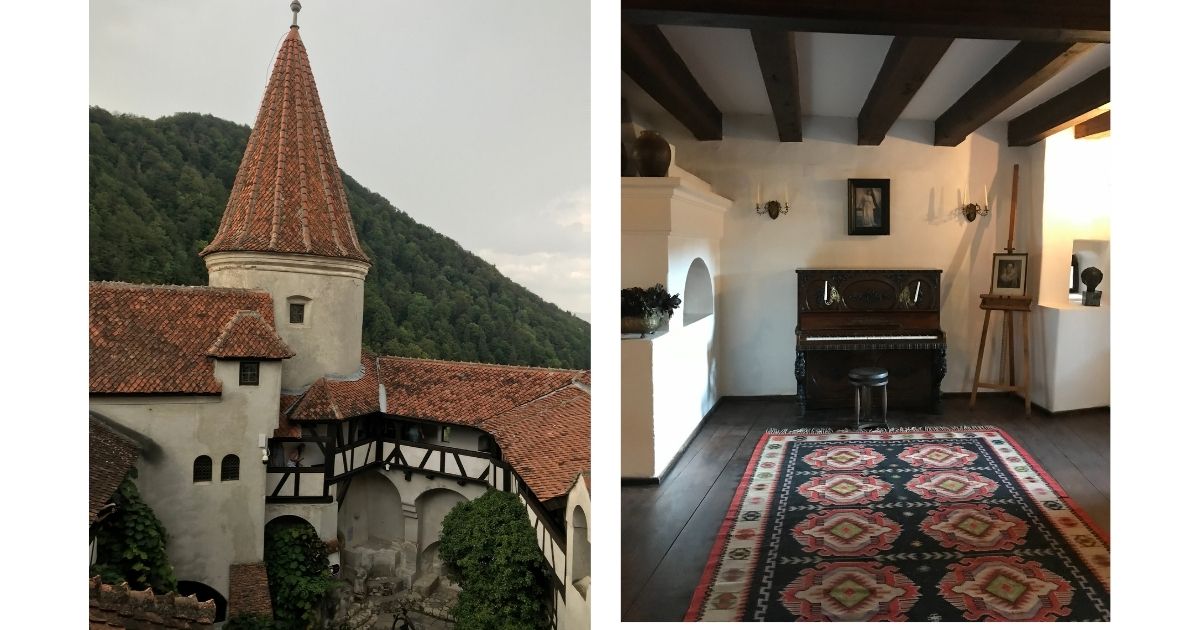
Bran stands about 25 kilometres south-west of Brașov in Transylvania and it is the most visited monument in the whole of Romania. It was built in 1377 by the Saxons under a privilege from the Hungarian king Louis I. It was never meant as a residence. It was a fortress guarding the mountain pass against the Ottoman advance, and at the same time a customs post collecting duty on the goods that came through.
The history of Bran: from the Teutonic Knights to Queen Marie
The stone castle of 1377 was not the first structure on the site. In 1211 the Hungarian king Andrew II granted the surrounding land to the Teutonic Knights so that they would defend Hungary against the Cumans, and in 1212 the knights put up a timber fort called Dietrichstein. It did not last: around 1225 the knights were driven out of the country and their fort disappeared with them.
Only then came the stone. By a charter dated 19 November 1377, King Louis I granted the Saxons of Kronstadt, today’s Brașov, the privilege of building a stone castle here. The Saxons paid for it and defended it, and for centuries the castle worked as a customs point and as a stopper in the pass against the Ottomans.
The most interesting chapter, though, comes from the 20th century. After the Treaty of Trianon in 1920, Bran became the favourite residence of Queen Marie of Romania, who had it thoroughly rebuilt and furnished. The remodelling was led by the Czech architect Karel Zdeněk Líman, so the look that visitors admire today is largely his work rather than anything medieval.
The castle passed to Marie’s daughter, Princess Ileana, who ran a hospital in it during the Second World War. In 1948 the communists seized it, and in the 2006 restitution proceedings it went back to Archduke Dominic of Habsburg-Lorraine, Ileana’s son. On 1 June 2009 the Habsburgs opened it to the public as the country’s first private museum, with art collections and period furniture.
So where does Dracula come in?
Here it is worth being blunt: historians agree that there is no real link between Bran Castle and Vlad the Impaler, and there is no evidence that Bram Stoker even knew the place existed. The association is pure marketing, and it stuck because Bran looks from the outside exactly the way a reader imagines Dracula’s home should look. The novel’s castle stands in the Borgo Pass in the north of Transylvania, hundreds of kilometres away, and Stoker described it from library books in Whitby and London.
None of that is a reason to skip it. Bran is a handsome castle with a genuinely interesting history and an excellent location near Brașov. Just look at it as Queen Marie’s castle rather than as a vampire’s lair and you will not come away disappointed.
Bran Castle: tickets, opening times and queues
- It is open all year round, with longer hours in summer than in winter. Check the exact times on the castle’s official website, they change from month to month.
- Admission is charged separately for the castle itself and for the additional exhibitions, with reduced rates for students, seniors and children. Prices are in lei (RON), cards are accepted at the ticket office and the rates are revised every year, so check before you travel rather than budgeting from an old blog post.
- Queues are the main problem. The inside is cramped, you move along narrow staircases, and by midday the whole route slows to a shuffle. Arrive as it opens or in the last hour before closing.
- Below the castle there is a market full of vampire souvenirs. It is kitsch, but it works surprisingly well with children.
- Parking is paid and full to bursting in season.
The best tip for Bran: combine it with Râșnov, which lies on the way from Brașov. It is a sprawling peasant citadel on a hill that sees a fraction of Bran’s crowds, and the view from the top is better. Together the two make a relaxed full day out of Brașov.
Corvin Castle: the most spectacular of the three
Corvin Castle stands in Hunedoara on a rock above the river, and plenty of visitors call it the most impressive castle in Romania, full stop. It went up in stages: the first between 1440 and 1446, the second between 1458 and 1480, with further alterations in the 17th and 19th centuries. Construction was begun on his own estate by John Hunyadi, voivode of Transylvania, whose father had received the property from Sigismund of Luxembourg in 1409.
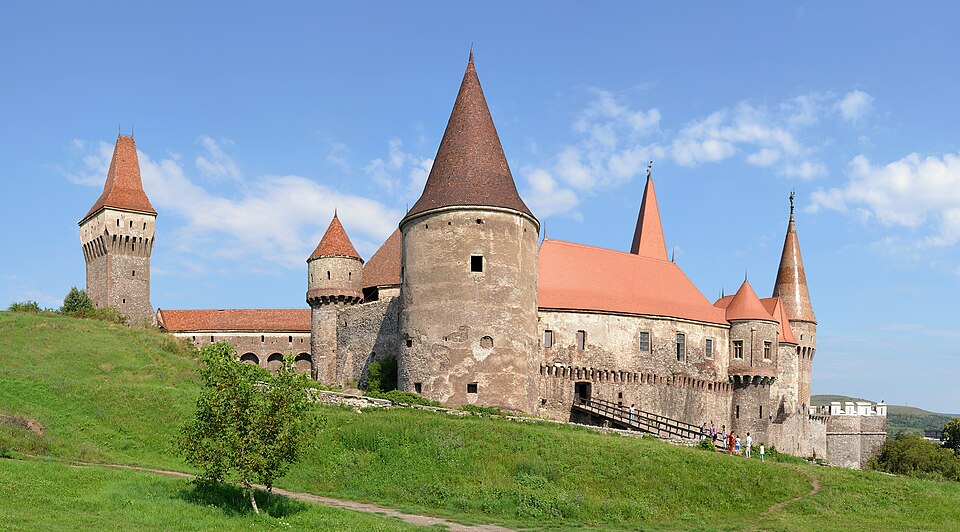
It is one of the largest castles in Europe, Gothic-Renaissance in style, with tall towers, battlements, an inner courtyard and steeply pitched, brightly tiled roofs. Inside you will find the Knights’ Hall, the Diet Hall, spiral staircases and a set of towers including the last defensive tower, Nebojša.
From family seat to romantic rebuild
The history of Corvin is the story of one family that made it all the way to the Hungarian throne. The estate was granted in 1409 by Sigismund of Luxembourg to John Hunyadi’s father, and John turned it into a serious fortress. His son Matthias Corvinus went on to become king of Hungary, and the castle carries his name.
After the line died out the castle changed hands repeatedly and gradually fell into decay. The decisive moment was the 19th-century restoration, when the building was repaired in the spirit of romantic historicism. That is where today’s fairy-tale appearance comes from, the one with the colourful conical roofs that visitors routinely mistake for medieval. Corvin is therefore in equal measure a Gothic fortress and a Victorian idea of what a castle ought to look like, and that mix is part of its appeal.
The link to Vlad the Impaler
Here the connection is firmer than at Bran. According to the information presented at the castle itself, Vlad the Impaler was imprisoned here by John Hunyadi, at the time military commander and regent for the underage king. Whether every detail of that story holds up is disputed among historians, but it is considerably closer to the record than Bran’s marketing.
The practical drawback of Corvin is where it sits. Hunedoara is in a completely different part of Romania from Brașov and Bran, so you cannot fold the two into one day. If you only have room for one castle and what you want is the visual hit, come here.
Poenari Citadel: where Vlad the Impaler really sat
If what interests you is the historical Vlad III rather than the cinema Dracula, this is the address. Poenari is a ruin on a rocky spur above the Argeș valley, right beside the Transfăgărășan road. Vlad had it repaired and used it as one of his strongholds.
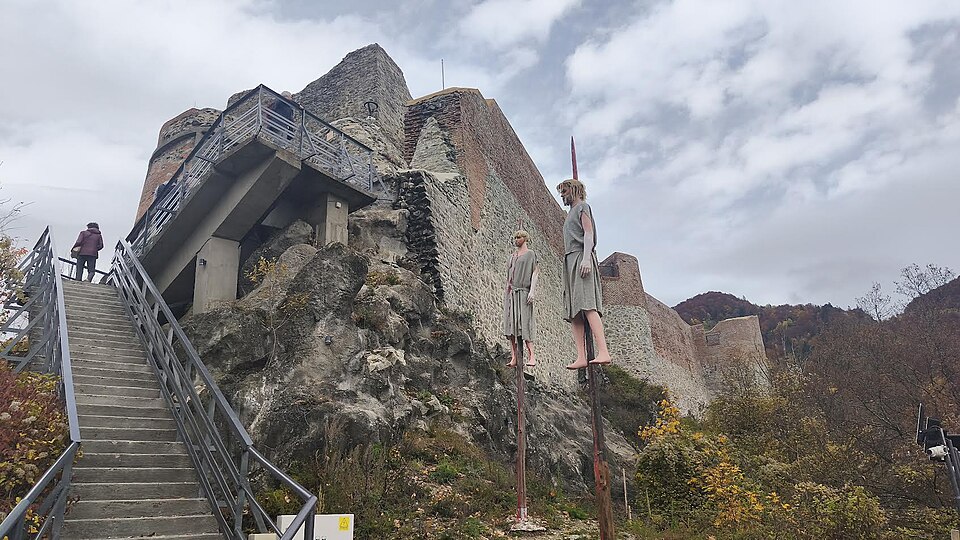
The approach is the thing everyone remembers: a concrete stairway of 1,480 steps built into the hillside. The climb takes around half an hour and it is genuinely hard work. At the top there are no furnished interiors and no museum, only the remains of walls and towers and an enormous view down the valley.
The history of Poenari
There was a fortress on this spot long before Vlad. At the beginning of the 13th century the Wallachians built a castle here known as Argeș, which was gradually abandoned. Poenari in the form we know it dates only from the middle of the 15th century.
The key year is 1459. Vlad the Impaler saw what a second fortress on a steep rocky spur could do for him and had it repaired and strengthened. He did not hire craftsmen for the job: he used the arrested families of the Wallachian boyars, his political opponents, and many of them died during the work. Poenari then became one of his principal fortresses.
After Vlad’s death the castle lost its purpose. It was abandoned in the first half of the 16th century and by the 17th century it was already a ruin. Nature finished the job: on 13 January 1913 a landslide triggered by an earthquake carried part of the castle into the river below, and the earthquakes of 1940 and 1977 did further damage. What you see up there today is a fragment of what once stood.
That is precisely why Poenari is the best choice for anyone chasing atmosphere. It draws a fraction of Bran’s visitors, and standing on the spur you understand immediately why somebody picked this rock. Check in advance that the stairway is open, it closes from time to time because of bears in the area or for repairs.
Who was Vlad the Impaler, and what does he have to do with Dracula?
Vlad III, called Țepeș or the Impaler, was a 15th-century prince of Wallachia known for brutal executions by impalement and, in equal measure, for fighting the Ottoman Empire. In Romania a large share of the population sees him as a national hero rather than a monster, which catches out every visitor who arrives with a head full of horror films.
Bram Stoker borrowed nothing but the name in 1897. Vlad carried the byname Dracula, son of the dragon, from his father, a member of the Order of the Dragon. Stoker set his character in Transylvania, but his count has very little in common with the historical Vlad, and even less with Bran Castle.
One more thing worth knowing before you go: Vlad was born, by tradition, in Sighișoara, and the house pointed out as his birthplace still stands on the main square of the UNESCO-listed old town. He ruled from Târgoviște, not from Transylvania, and Wallachia, his actual princedom, lies south of the Carpathians. Almost every place the Dracula tourist circuit sells sits in the wrong region for the real man.
How to reach the castles
- Bran: easiest from Brașov, with regular buses from the Autogara 2 terminal taking around an hour. By car it is roughly 25 kilometres. Brașov also makes the best base for several days.
- Corvin: Hunedoara, reachable by train or by car from Deva or Sibiu. Treat it as a trip in its own right.
- Poenari: by car along the Transfăgărășan from the northern side, or from Curtea de Argeș in the south. Without a car you will struggle to get there at all, and the road is closed in winter.
Getting to Romania in the first place is straightforward. Most international flights land at Bucharest Otopeni (OTP), which is the widest choice of routes and car hire desks; from there it is about three hours by road or train to Brașov. Brașov-Ghimbav (GHV) is the closest airport to Bran, though the route network is thin and seasonal, so check what is flying before you build a plan around it. Cluj-Napoca, Sibiu and Timișoara are the other useful entry points, Timișoara being the sensible one for Corvin. Trains connect the main cities reasonably well and are cheap, but between the individual monuments public transport is slow, so a hire car is the realistic option if you want more than one castle. Budget roughly the price of a mid-range European rental, book ahead in summer, and remember that fuel and tolls are paid in lei (RON).
Other Romanian castles worth the detour
Once you are in Transylvania for Dracula, it would be a waste to see a single castle. These are worth the detour, and at most of them you will meet a fraction of Bran’s crowd.
Peleș Castle in Sinaia
The complete opposite of a grim defensive fortress: a Neo-Renaissance summer residence of the Romanian kings, built between 1873 and 1914 and formally opened in 1883. It has more than 170 rooms plus thirty bathrooms. The most interesting part, though, is the engineering. Peleș was the first castle in the world powered entirely by electricity from its own generating plant, built on the estate itself. It lies around 48 kilometres from Brașov, so it slots neatly into a loop with Bran.
Făgăraș Fortress
A massive moated fortress between Brașov and Sibiu, begun in 1310 on the site of a 12th-century timber fortification. It also has a dark modern chapter: in 1950 the communist regime turned it into a prison for political prisoners. Around five thousand people passed through it, many were tortured, and the available figures record 161 deaths caused by the conditions, with former inmates citing higher numbers. Restored between 1965 and 1977, it now houses a museum.
Râșnov Citadel and Dino Parc
A peasant citadel on a hill between Brașov and Bran that sees a fraction of the visitors and offers a better view than Bran does. Directly below it lies Dino Parc Râșnov, the largest dinosaur park in south-eastern Europe, which is the simplest way of turning a day of castles into a day the children will also enjoy.
Valea Cetății Cave
An accessible show cave just outside Râșnov with a concert hall underground where performances are staged. It stays around ten degrees inside all year, which makes it a welcome stop on a hot day.
Bánffy Castle in Bonțida
A Baroque manor north of Cluj known as the Versailles of Transylvania. It decayed badly under communism and is being restored piece by piece, so you will see it half ruined. That, oddly, is the charm of it.
Sturdza Castle in Miclăușeni
A Neo-Gothic residence in Moldavia, in the east of the country, which looks like something out of a storybook and sits well away from the main tourist routes. Worth it if you are crossing Romania and do not intend to stay inside Transylvania.
The Dracula legends you will hear on site
Several stories circulate around Bran that are sold as history when all they share with it is a name. They are worth knowing, because you will hear them at the castle from guides and souvenir sellers alike.
- That Vlad was imprisoned here, or lived here. Not documented. Vlad reached the area around Bran on military campaigns, but he never owned the castle and never resided in it.
- That Stoker set the novel here. Stoker never visited Transylvania, and the description of the castle in the book does not match Bran. There is no evidence he knew of it.
- That it has always been called Dracula’s Castle. The nickname is a marketing creation of the 20th century, once it became clear how well Bran photographs.
- That Vlad drank blood. Vampirism was Stoker’s addition. The historical Vlad was accused of impalement, not of drinking blood.
Romanians themselves have mixed feelings about the commerce: it brings in money, but it overshadows the country’s real history, and the fact that most people here see Vlad as a defender against the Ottomans.
Where to stay
Because the three castles are scattered across the country, there is no single base that covers them all. Choose according to where you actually want to go.
Brașov: the best choice for Bran
If Bran is your main reason for coming, stay in Brașov. It is a lovely city with the Black Church and Piața Sfatului, it has the widest choice of accommodation in Transylvania, and Bran is about 25 kilometres away. From here you can also reach Râșnov, the Bucegi mountains and Sighișoara, which makes it a base for three or four days rather than one night.
- The historic centre for atmosphere and somewhere to go in the evening, though you will be leaving the car in a paid car park.
- The districts under Tâmpa, quieter and cheaper, with the centre still walkable.
Bran and around: for being first at the ticket office
The village of Bran itself and neighbouring Moieciu and Predeal are full of guesthouses and apartments. There is one advantage, and it is a decisive one: you will be at the castle the moment it opens, ahead of the day trips from Brașov and Bucharest. The drawback is that once the castle closes the village empties and there is essentially nothing to do.
Hunedoara and Deva: for Corvin
Corvin is in an entirely different part of the country, so you will not pair it with Bran. You can stay in Hunedoara, where the choice is limited, or in nearby Deva, or treat the castle as a stop on the drive between Sibiu and Timișoara.
Curtea de Argeș and Sibiu: for Poenari
Poenari is reached along the Transfăgărășan. From the south the nearest base is Curtea de Argeș, from the north Sibiu, which happens to be one of the prettiest cities in Romania. If you want the road to yourself, you can also sleep at Bâlea Lake at the top, but book a long way ahead.
The most sensible four-day plan: three nights in Brașov with day trips to Bran, Râșnov and the Bucegi, then the drive over the Transfăgărășan with a stop at Poenari, and a last night in Sibiu. Save Corvin for another trip. Adding it to this loop buys you an extra day of sitting in the car and little else.
Accommodation in Brașov, in Bran and along the Transfăgărășan can be compared on a single map through Stay22. In high season and around Halloween, book well ahead: Bran sells out completely at that time of year.
When to go
- May, June and September are the best months: warm, everything open and far less pressure than in high season.
- July and August mean the longest queues at Bran and the highest accommodation prices in Brașov.
- Around Halloween Bran stages themed events and is extraordinarily busy. Either come for that on purpose or avoid the date altogether.
- Winter is quiet at Bran and the castle looks its best in snow, but Poenari and the Transfăgărășan are out of reach.
What else to add to the trip
- Brașov with the Black Church and Piața Sfatului, the best base in Transylvania.
- Râșnov, the peasant citadel on the way to Bran.
- Sighișoara, a UNESCO-listed fortified town where Vlad was born, by tradition.
- Peleș in Sinaia, the Neo-Renaissance palace that is the opposite of a grim fortress and one of the loveliest in Europe.
- Sibiu and the fortified Saxon churches around it.
- The Carpathians, if you want to swap castles for ridges. Our overview of the mountains of Romania covers where to walk.
- The Banat highlands in the south-west, where a cluster of Czech villages in Romania has kept a 19th-century way of life going in near isolation.
Frequently asked questions about Dracula’s Castle
Is Bran Castle really Dracula’s Castle?No. Historians agree that there is no documented link between Bran Castle and Vlad the Impaler, and there is no evidence that Bram Stoker knew the castle existed. The association is a marketing invention that stuck because Bran looks exactly the way readers picture Dracula’s home.
Is Bran Castle worth visiting?Yes, as long as you go for the right reasons. It is a well preserved castle with real history, an art collection and the furniture of Queen Marie, and it sits 25 kilometres from Brașov in beautiful countryside. Come expecting a vampire’s lair and you will be disappointed; come for Queen Marie’s residence and you will not be.
Which castle in Romania is closest to Vlad the Impaler?Poenari, the ruin above the Transfăgărășan road, which Vlad had repaired and used as a stronghold. Corvin Castle in Hunedoara also has a stronger claim than Bran: according to the information given on site, Vlad was imprisoned there by John Hunyadi. Vlad himself, incidentally, is remembered by many Romanians as a national hero who fought the Ottomans, not as a horror-film monster.
How do I get to Bran Castle from Brașov or Bucharest?From Brașov there are regular buses and the journey takes about an hour; by car it is roughly 25 kilometres south-west. From Bucharest, Bran is a long day trip of some three hours each way, which is why staying in Brașov makes far more sense if you want more than a single photograph.
How many steps lead up to Poenari Citadel?More than 1,400. The stairway is built into the hillside, the climb takes around half an hour and it is hard work. There are no furnished interiors at the top, only the remains of walls and towers and the view over the Argeș valley. Check before you set off that the stairway is open, it closes periodically because of bears.
When is Bran Castle least busy?Right at opening time and in the last hour before closing. The interior is cramped and by midday the route slows to a shuffle. Winter is the quietest season overall, while the days around Halloween are extraordinarily busy because of the themed events.
Can you visit Bran and Corvin Castle in one day?No. Hunedoara, where Corvin stands, is in a completely different part of Romania from Brașov and Bran. They are two separate excursions and your route needs to be planned around that from the start.
Who owns Bran Castle today?After the nationalisation of 1948 the castle was confiscated, and in the 2006 restitution proceedings it was returned to the descendants of Princess Ileana. The Habsburg family has run it since 2009 and it is open to the public as a museum, with art collections and furniture from Queen Marie’s day.
Potřebujete pomoct s cestováním?
-
Ubytování 🏨
Vyberte si to nejlepší ubytování, ať už jste kdekoliv, přes Booking.com. -
Půjčení auta 🚗
Auto si snadno najdete přes Booking.com, kde máte často slevu díky ubytování, nebo Rentalcars.com, kde porovnáte nabídky většiny půjčoven. -
Zážitky 🎟️
Přes GetYourGuide.com si vyberete z nejrůznějších výletů i zážitků po celém světě, navíc se zrušením zdarma do 24 h předem.