Last updated 27.10.2026
Romania beach holidays are a different animal from a week in Croatia, Greece or Italy. There are no islands and no coves tucked between rocks. What you get instead is wide sandy beaches, shallow water, food and drink at prices well below the Mediterranean, and a string of resorts built under communism and named after Roman gods. We went down the coast and picked 10 resorts from north to south: what sets each one apart, how to get there from the UK, and who will love the Romanian Black Sea and who really should book somewhere else.
Romania beach holidays: the short version
- The Romanian coast runs for roughly 245 kilometres, with resorts stretching from Mamaia in the north to Vama Veche on the Bulgarian border. North of that, up to the Ukrainian border, the coast belongs to the Danube Delta.
- The beaches are wide and sandy and the water gets deeper very gradually. If you are travelling with small children, that is a big plus.
- Mamaia is the biggest and busiest resort, squeezed onto a narrow strip of land between the sea and Lake Siutghiol.
- Vama Veche is the exact opposite: a former fishing village with a hippie feel and nightlife right on the sand.
- A cluster of resorts is named after gods: Olimp, Neptun, Jupiter, Saturn and Venus. These are the quieter, family-friendly options.
- The sea is shallow and warm, but less salty and much less clear than the Adriatic or the Aegean. Do not come for snorkelling.
- From London it is a flight of around three hours to Bucharest, then about two and a half hours by road or rail to the coast. Constanța also has its own airport, but direct flights are mostly seasonal.
- Where to stay: Mamaia and Constanța for full service, Eforie for spa treatments, Neptun and Olimp for families, Mangalia as a quiet base in the south and Vama Veche for guesthouses and late nights. Specific hotels are further down.
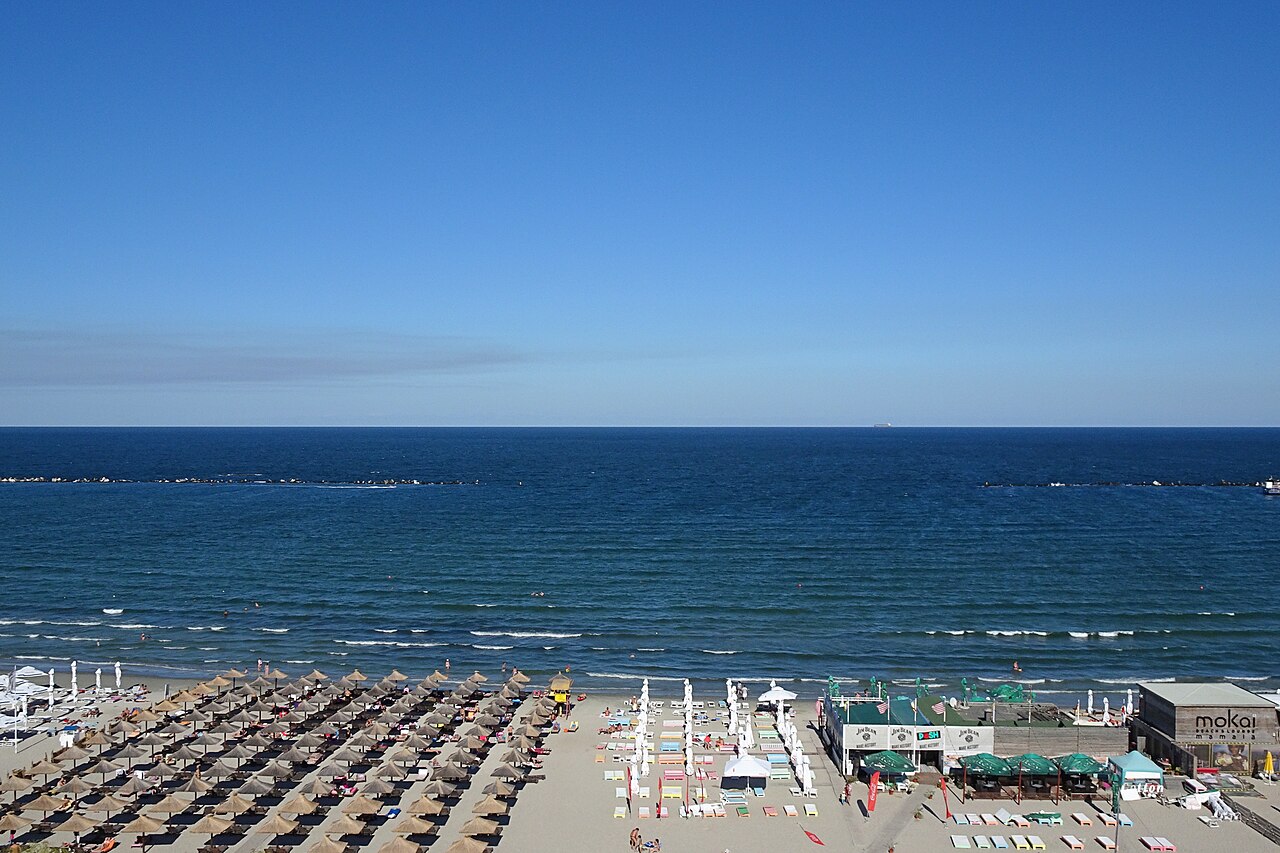
Is Romania good for a beach holiday? Who it suits and who it doesn’t
Short answer: yes, but only for the right kind of trip. Let us save you some time. The Romanian Black Sea coast is a good fit if you:
- Have young children and want soft sand and shallow water, with no pebbles or rocks to clamber over.
- Want to spend less than you would around the Mediterranean, especially on eating out and drinks.
- Like mixing beach days with sightseeing. Constanța, the Danube Delta and several ancient Greek and Roman sites are all within reach.
- Don’t mind communist-era architecture, which dominates long stretches of the coast.
On the other hand, pick a different destination if you:
- Are after crystal-clear water and snorkelling. The Black Sea is shallow, less salty and visibility underwater is poor.
- Dream of rocky coves and islands. The Romanian coastline is flat and sandy from end to end.
- Want to be on the sand within a couple of hours of leaving home. With a flight, a transfer and, more often than not, a change in Bucharest, the journey takes most of a day.
Romania beach holidays: 10 favourite resorts from north to south
So where on the coast will your Romania beach holiday be worth the trip? Here are the resorts in order, starting at the top of the map.
1. Mamaia
The most important and by far the largest resort, just north of Constanța on a thin strip of land that separates the Black Sea from Lake Siutghiol. You have salt water on one side and a freshwater lake on the other, and water sports run on both.
It is also the liveliest place on the whole coast: hotels, clubs, a water park and a cable car gliding over the rooftops. The beach is broad, with fine sand. If you want everything laid on and don’t mind crowds, this is your place.
A few numbers to picture it: Mamaia sits on a strip about 8 kilometres long and only around 300 metres wide, so from most hotels the sea is a few minutes’ walk away. The Telegondola cable car has run since 2004 for about two kilometres above the resort, from the Constanța end to the area by the old casino, and riding it is the quickest way to grasp just how narrow the strip really is. At the southern end, near Constanța, you will find the Aqua Magic water park. The southern part is busier, with bars and clubs, while Mamaia Nord tends to be calmer, and at the very northern tip there are campsites too.
A whole week in Mamaia would be too much for us. As a base for trips to Constanța, to the ruins of Histria and to the wild beaches further north, though, it makes a lot of sense.
2. Constanța
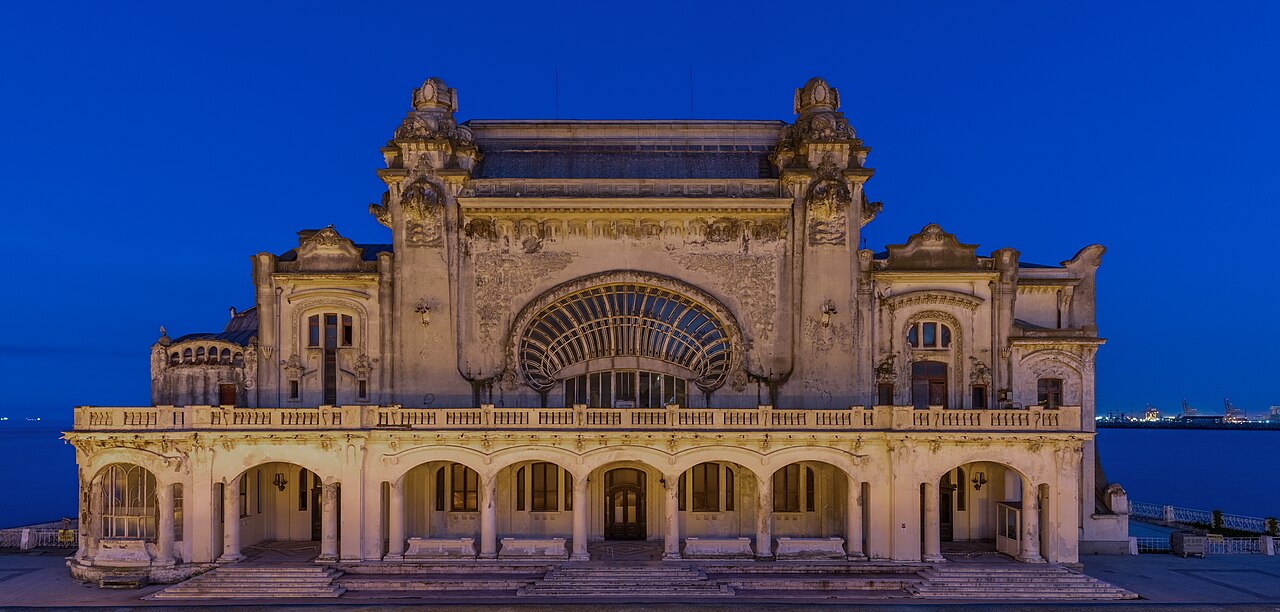
Romania’s biggest port and the capital of the region, rather than a classic resort. People come here mainly for the history: it is one of the oldest cities in the country, with an ancient past, a casino on the seafront promenade and an archaeological museum with a Roman mosaic. There is a beach, but the city is more interesting than the swimming.
The main reason to stop is the Art Nouveau casino perched on the cliff above the sea. Built in 1910, it stood abandoned for years and reopened to the public in 2025 after restoration. Tours require a ticket, sold at the desk in the building and on the official website cazinoul.com, which also says it is closed on Tuesdays (check prices there too). From the casino, the promenade leads to the Genoese Lighthouse, and a short walk away is Ovid Square with its statue of the Roman poet, the archaeological museum, a vast Roman mosaic and the Great Mosque, a reminder that the city was Ottoman until 1878. For a swim, most people recommend the town’s Plaja Modern, where the water deepens gently, or Plaja 3 Papuci.
We would treat Constanța as one long day: the old town and casino in the morning, the beach in the afternoon, the promenade in the evening. It also works well if you are travelling without a car, since trains run here from Bucharest and the centre is easy to explore on foot.
3. Eforie Nord and Eforie Sud
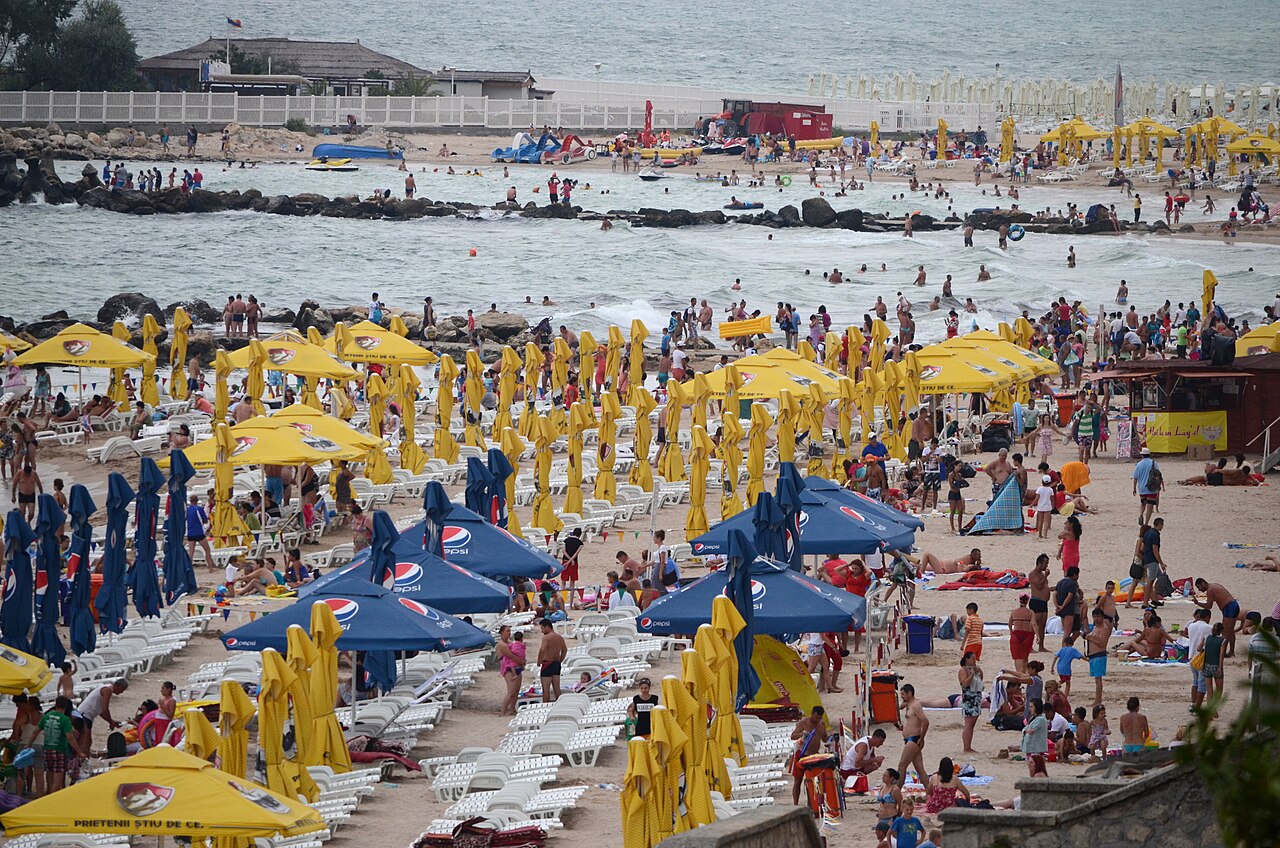
A pair of resorts south of Constanța with a long history as spa towns. Nearby is the salt lake of Techirghiol, famous for its therapeutic mud, which draws visitors even outside the swimming season. Both are quieter than Mamaia, and cheaper.
The beach at Eforie Nord stretches for about four kilometres and in places is around a hundred metres wide. Stone breakwaters chop it into sections, though, so in the northern part you sometimes have to step over rocks to get into the water. Eforie Nord is the livelier of the two, with a promenade and a water park, while Eforie Sud is more peaceful. From Constanța you can get here by train to Eforie Nord station or by bus, and Lake Techirghiol lies just behind the town. If you fancy trying a mud wrap, this is the place. And if it sounds like something for pensioners, in our view it is exactly the thing you will end up telling stories about after a holiday on the Romanian coast.
4. Costinești
The traditional student resort. It is the youngest and cheapest corner of the coast, full of campsites, hostels and nightlife that simply does not stop. Families with children are better off elsewhere.
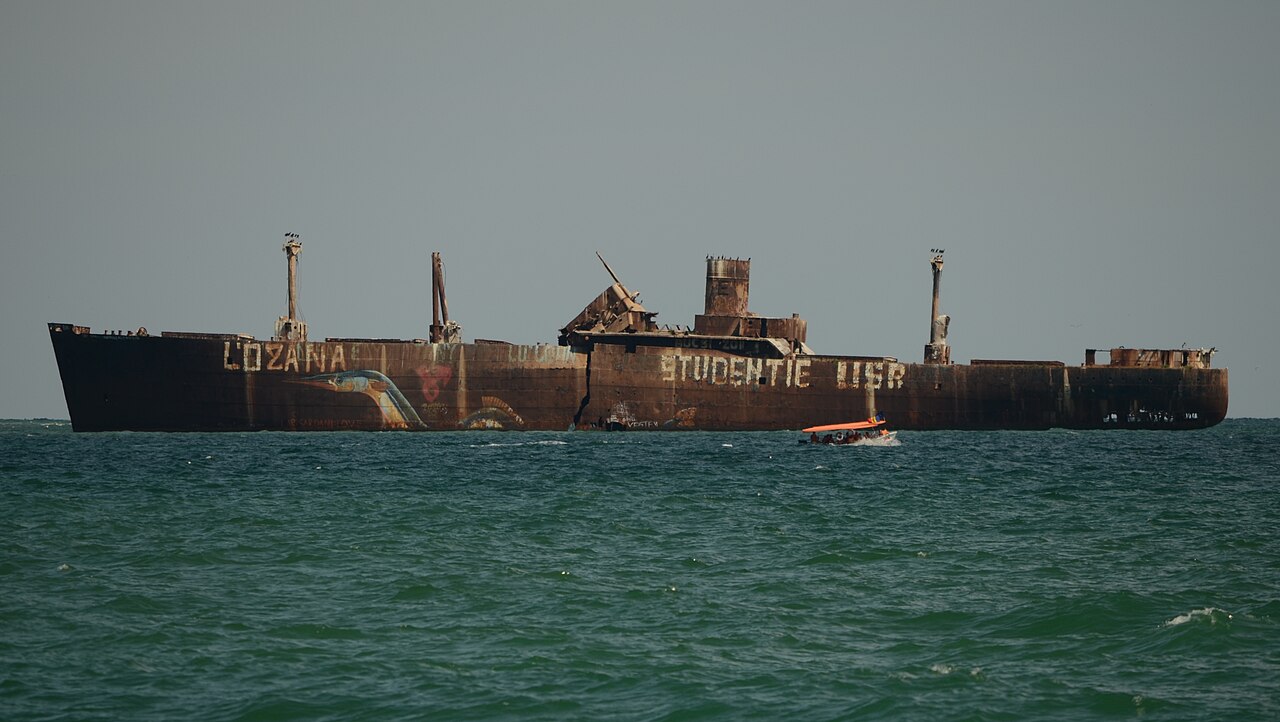
Costinești is about 30 kilometres south of Constanța, so it is easy to pop over for an afternoon even if you are staying somewhere else. Apart from beaches and bars, it has two landmarks: a white obelisk and, above all, the wreck of the Evangelia, a ship that ran aground here in 1968 and is still rusting a short distance from the shore. It is one of the most photographed spots on the coast. Just don’t climb on it or swim out to it, as the structure is old and dangerous.
5. Olimp
The first of the resorts named after the gods, and the northernmost of the group. Quieter and geared more towards families.
Olimp lies about 7 kilometres north of Mangalia, right next to the Comorova forest, and under communism it was one of the most expensive and exclusive spots on the coast. One practical point: between the beaches and some of the hotels there is a high bank, practically a cliff. The view from the top is lovely, but you reach the beach by stairs, so if you are travelling with a pushchair or with someone who has trouble walking, check with your hotel how you actually get down to the water.
6. Neptun
The greenest resort of the group, surrounded by parks and small lakes. In communist times the party leadership had a residence here, and you can still tell from the way the place is laid out. For us, it is the best balance between peace and facilities.
The greenery comes from the Comorova forest to the west and two lakes, Neptun I and Neptun II, right in the resort, where you can hire pedalos. In August, when most of the coast is bare and shadeless, that makes more of a difference than you might expect. These days Neptun and Olimp have practically merged, so during one stay you can choose between several beaches with just a short walk.
7. Jupiter, Cap Aurora and Venus
Smaller resorts between Neptun and Saturn, built around hotels and aimed at families. Nothing spectacular, but they work, and they are cheaper than Mamaia.
Between Jupiter and Venus sits tiny Cap Aurora, which package listings often lump in with its neighbours. Venus officially opened in 1972. Its hotels stand among trees and most of them still carry women’s names. The beach is split by small bays into narrower sections, with a lagoon behind it. If you are expecting shiny new buildings you will be disappointed, but if you want an ordinary beach holiday without a disco under your window, you will find it here.
8. Saturn
The southernmost of the gods, right next to the town of Mangalia. A wide beach and a line of hotels along the water.
9. Mangalia
A port town with an ancient past and a spa tradition, which also serves as the transport hub for the surrounding resorts.
Where Mangalia stands today, there was once the Greek city of Callatis, and the archaeological museum displays its remains and finds. It makes a good plan B for a rainy day. The town also has a 16th-century mosque. The beach is one of the widest on the coast, and Mangalia has a strong spa tradition built on seawater, sapropelic mud and sulphur springs. It feels more like a seaside town than a resort, but from a single base here you can reach the whole southern half of the coast, from Saturn down to Vama Veche, which is about 12 kilometres away.
10. Vama Veche and 2 Mai
Vama Veche is the southernmost point of the Romanian coast, right on the Bulgarian border, and it is a different world altogether. A former fishing village famous for its hippie spirit, it was where people went under communism to escape the regime for a while, and it still attracts those who don’t want a hotel. People sleep in campsites and guesthouses, there is live music on the beach and the party winds down only at dawn.
Neighbouring 2 Mai is the calmer version of the same thing: smaller, quieter and with a similarly laid-back vibe.
Because of the border zone, no big hotels were built here under communism, and the village became a refuge for intellectuals and anyone who wanted to drop out of sight for a while. Today there are more buildings and even a few modern hotels, but the beach, with bars right on the sand, guitars and a southern end where nude bathing is tolerated, still lives at a different pace from the rest of the coast. The beach is narrower and stonier in places, so water shoes come in handy. If you want to experience Vama without the worst of the crowds, come in June or September. And one thing to remember at the border: Bulgaria has used the euro since 2026, so a trip south means carrying two currencies.

Romanian Black Sea resorts at a glance
| Resort | Location | Best for | Be prepared for |
|---|---|---|---|
| Mamaia | just north of Constanța | full service, nightlife, water park | the busiest place on the coast in high season |
| Constanța | the coast’s main city | sights, travelling without a car | city beaches |
| Eforie Nord and Sud | about 15 km south of Constanța | spa treatments, Techirghiol mud, families | breakwaters, rocks underfoot in places |
| Costinești | about 30 km south of Constanța | students, partying | packed and noisy in August |
| Olimp and Neptun | about 38 km south of Constanța | families, shade in the Comorova forest | stairs down to the beach in Olimp |
| Jupiter, Cap Aurora, Venus, Saturn | between Neptun and Mangalia | a quiet beach holiday | older hotels |
| Mangalia | the south, about 12 km from Vama Veche | peace, spa, a base for the south | more town than resort |
| Vama Veche and 2 Mai | on the Bulgarian border | guesthouses, campsites, music | noise until morning, narrower beach |
Best wild beaches in Romania: the sea without the crowds
The resorts are not the whole story. The Romanian coast also has stretches with no hotel, no sunlounger and no kiosk, and these are often the reason people keep coming back. Bear in mind that there are no showers, no shade and no shops, and that some of them can only be reached on dirt tracks.
- Vadu. A village in the commune of Corbu in Constanța County and one of the best-known wild beaches. It lies in the north of the coast, towards the edge of the Danube Delta, and is wide and almost completely undeveloped. People come here for the silence and for a view of nothing but sand and sea.
- Corbu. The neighbouring stretch, with the same character and slightly easier to reach than Vadu.
- Watch out for Gostinu. Some guides and websites list it among the seaside beaches, but Gostinu is in Giurgiu County on the Danube, opposite Bulgaria, and has nothing to do with the Black Sea. It is a pleasant river beach, but the whole width of southern Romania separates it from the coast.
- Sfântu Gheorghe. A small fishing village right in the Danube Delta, where the southern arm of the Danube meets the sea. It is not a resort, it is the end of the road: locals live from fishing and from guiding visitors through the delta. You get here by boat from Tulcea, and it is the most remote beach on the Romanian coast. The village has guesthouses, a campsite and glamping, but no hotel complexes.
Take everything with you to the wild beaches. Water, food, a parasol and a bin bag. Most of these stretches lie in a protected area adjoining the Danube Delta, so you cannot simply camp or light a fire wherever you like. Vadu, Corbu and the delta also require an access permit for the biosphere reserve (permis de acces), issued online or by SMS by the reserve administration, ARBDD. Do not drive onto the beach, and check the rules for each specific spot, because the fines are steep.
Băile Felix thermal spa and the rest of inland Romania
If your seaside holiday is getting longer, or you are driving across the whole of Romania, it is worth knowing that the country has a strong spa tradition inland too. The best-known address is the Băile Felix thermal spa in the west near Oradea, where you can easily spend a few days soaking in thermal water.
The inland spas are at the opposite end of the country from the coast, though, so you cannot combine them in a single day. It only makes sense if you are driving to Romania overland through Hungary and want to break up the journey, or if you are planning a loop through the Banat and Transylvania.
Is the Black Sea safe to swim in? What the water is like in Romania
A few things worth knowing in advance, because the Black Sea is not the Mediterranean:
- The water is less salty. Thanks to the Danube and other rivers flowing into it, the Black Sea has roughly half the salinity of the Mediterranean. You float less easily, but it doesn’t sting your eyes the way the Adriatic does.
- It is shallow and warms up quickly. In summer it often reaches comfortable temperatures earlier than the Mediterranean.
- Visibility underwater is poor. Snorkelling and diving are pointless here.
- The seabed is sandy, so you don’t need water shoes, which is a huge relief for families used to pebble beaches in Croatia or Greece. The exceptions are the stretches by the stone breakwaters, for example in Eforie, and parts of the beach at Vama Veche.
- There is practically no tide, so you won’t need to keep moving your towel up the beach during the afternoon.
- Jellyfish turn up from time to time, mostly in late summer, but they are not dangerous species.
How to get to the Romanian Black Sea coast from the UK
- By air to Bucharest, which has direct flights from London and several regional UK airports. From the capital it is roughly two to two and a half hours to the sea by car or train. You can also fly straight to Constanța, which has a seasonal airport. From Bucharest to Constanța it is about 230 kilometres on the motorway, so allow two and a half hours by car. Mihail Kogălniceanu Airport lies around 25 kilometres from Constanța, and direct flights there are mostly seasonal and charter, so you cannot count on them year-round. Whether anything flies direct from the UK in your dates is something to check when you book.
- By train, fast services run from Bucharest to Constanța, with buses on to the resorts. According to the 2025/2026 timetable, the fastest trains cover the 225 kilometres in about two and a quarter hours, and there are more of them in summer. Some summer trains continue south to Eforie, Neptun and Mangalia. Current connections are on the CFR Călători website.
- By car, either a hire car from Bucharest or your own if you are touring Europe. Driving from the UK means well over 2,500 kilometres across the continent, so most people only do it as part of a longer road trip, with the last leg through Hungary, where you need a motorway e-vignette, and then Romania, where you need the road vignette known as the rovinietă. The final stretch runs from Bucharest along the A2 motorway, which crosses the Danube at Fetești and Cernavodă, where the bridge toll is paid separately, on top of the rovinietă. Under the tariff in force since September 2025, a car pays 19 lei (around £3.20) each way. You can pay online through the CNAIR portal or at petrol stations along the route. Paying by SMS only works for cars with Romanian number plates.
- Between the resorts, buses run, and in season shared minibuses (maxitaxi) too, while city lines connect Constanța with Mamaia and Eforie. A car is mainly useful for the wild beaches and the delta.
- On a package holiday. Several UK tour operators sell holidays to Romania, which takes care of flights and transfers in one go. Check whether the package actually covers the coast and not just the mountains or Bucharest.
The rovinietă is compulsory, including in a hire car. Romania’s electronic road vignette is linked to the number plate and applies on most main roads, not just motorways. Buy it online on the official website erovinieta.ro before you set off, or at the latest at the border crossing, because it must be valid the moment you drive onto a Romanian road. Checks are done by camera and fines can arrive afterwards. The price depends on how long it is valid for, and tariffs are changing from 2026, so always take the current price list from the official website. With a hire car, ask the rental company to confirm the vignette is already paid.
When to go to the Romanian seaside
- June: the beaches are half empty, prices are lower and the water is already fine for swimming.
- July and August: peak season, the warmest weather but also the biggest crowds and highest prices. August is the hottest month.
- September: in our view the best choice. The sea is still warm after the summer, the crowds are gone and accommodation gets cheaper. Towards the end of September, though, some beach bars and hotels start closing.
- Off season: the resorts all but shut down, but spa towns such as Eforie keep going all year thanks to their mud treatments.
What to add to your Romania beach holiday
This is the main reason the Romanian coast can be more interesting than it looks at first glance. Within easy reach there are several things you won’t find anywhere else:
- The Danube Delta, Europe’s largest river delta and a UNESCO biosphere reserve. Boats leave from Tulcea and it is one of the best places for birdwatching in Europe. Set aside a full day, ideally with an overnight stay.
- Histria, the remains of the oldest ancient city on Romanian soil, founded by Greek colonists.
- Constanța with its casino and Roman mosaic.
- Lake Techirghiol and its healing mud near Eforie.
- Bulgaria next door. From Vama Veche it is just a few kilometres to the first Bulgarian resorts, so the two are easy to combine.
If you would like to pair the sea with a few days in the Carpathians, our guide to the mountains in Romania covers the ranges, the highest peaks and what to know before you hike. Heading inland through Transylvania? Read which of the three castles really deserves the name Dracula’s castle. And if you fly into the capital and have a spare day before or after the coast, our Bucharest guide will help you fill it.
A short history of the Romanian Black Sea coast
The resorts with their concrete hotels are the newest thing on this coast. As early as the 7th century BC, Greek colonists from Miletus sailed here and founded Histria, which historians today regard as the first city on Romanian territory. Other colonies followed: Tomis, on the site of present-day Constanța, and Callatis, today’s Mangalia. In AD 8, Emperor Augustus exiled the poet Ovid to Tomis. He spent the rest of his life here and filled his verses with complaints about the cold, the barbarians and the wind. History has a sense of irony: today he has a statue on Constanța’s main square and the locals won’t hear a word against him.
After the Romans and Byzantium came the Bulgarians, the Tatars and, for centuries, the Ottomans. Northern Dobruja, including Constanța, only became part of Romania after the Russo-Turkish War in 1878. The new state set about turning a sleepy port of a few thousand people into its main naval harbour. The first spa in Mamaia opened in 1906, and in 1910 the casino on the cliff followed, a symbol of how young Romania wanted to look by the sea.
The second big wave came with communism. In the 1960s and 1970s, Nicolae Ceaușescu’s regime built a chain of new resorts south of Constanța and named them after gods and planets: Olimp, Neptun, Jupiter, Venus, Saturn. Olimp was reserved for party officials and foreign guests, Neptun got its greenery and lakes. Only Vama Veche was left alone, because nothing could be built in the border zone, and that is exactly why it grew into a place where people went to breathe a little more freely. When you stroll between the concrete hotel blocks in Jupiter, remember that a few kilometres away lie the remains of a Greek city more than two and a half thousand years old.
Practical information for a trip to the Romanian coast
- Documents. Romania is in the EU and, since 1 January 2025, a full member of the Schengen area, and border checks at land borders have been lifted. UK travellers need a valid passport and fall under the Schengen 90-in-180-days rule. EU citizens can use their national ID card.
- Money. The currency is the Romanian leu (RON), and euros are generally not accepted. One leu is worth roughly 17p (about €0.20). Hotels and larger restaurants take cards, but bring cash for kiosks and the smaller resorts.
- Healthcare. With a UK GHIC (or a valid EHIC) you are entitled to necessary care in state facilities, but the standard of Romanian healthcare varies from region to region and the extra charges can be high. Proper travel insurance is a must here.
- Emergency number. The European number 112 works throughout the country, including on the coast, and the operators speak English.
- Tap water. In the resorts it is treated and technically safe to drink, but it tastes bad and locals don’t usually drink it. Bottled water is cheap.
- Mobile and data. Romania is in the EU, so EU SIM cards roam at home rates. UK networks set their own roaming terms, so check your provider’s EU charges before you go.
- Safety. The coast is an ordinary tourist area. On the beaches and in clubs, keep an eye on your belongings as you would anywhere in high season.
- Weather. The coast has a milder climate than the interior. The season runs from mid-June to early September. In July and August temperatures stay around 30 °C and the water is 23 to 26 °C. May and September are pleasant for walking, but the sea is usually cold.
- Tolls. On Romanian roads you need the electronic vignette, the rovinieta. You buy it online or at petrol stations and it is checked by cameras. Driving without one means a fine.
Where to stay on the Romanian coast
- Mamaia for full service, clubs and the water park.
- Neptun and Olimp for families who want peace and greenery.
- Eforie for spa treatments and lower prices.
- Costinești for young travellers and tight budgets.
- Vama Veche and 2 Mai for campsites and a laid-back atmosphere.
Below are a few specific picks for the main bases. We chose hotels with good guest ratings on Booking.com across different price levels. Prices change from week to week in high season, so we don’t quote them here; click through for current rates.
Mamaia
- Iaki Conference & Spa Hotel: a large four-star hotel in the heart of the resort with its own beach, outdoor pools and a spa. A safe bet if you want everything in one place.
- Bavaria Blu Hotel and Conference Centre: four stars about 20 metres from the beach, with a seasonal outdoor pool.
- Splendid Conference & Spa Hotel – Adults Only: an adults-only hotel on the main boulevard, for couples who want Mamaia without children shrieking by the pool.
Constanța
- Continental Forum Constanta: a city-centre hotel within walking distance of the casino and the old town.
- Hotel Bulevard: on the boulevard towards Mamaia, with a spa and about 900 metres to the beach.
- Hotel Megalos: another option on the same road between the city and Mamaia, a good fit as a cheaper base.
Eforie Nord
- Mirage Medspa Hotel: in the northern part of Eforie Nord next to the promenade and the beach, with an indoor pool and spa treatments at extra cost.
- STEAUA DE MARE – Eforie Resort: right on the beach with its own spa and treatment centre, ideal if the mud is part of the reason you are going.
- Hotel Evia: a three-star hotel that tour operators also sell as part of package stays in Eforie.
Neptun, Olimp and Jupiter
- Hotel Agora: in Neptun, with a seasonal outdoor pool and a garden, about 1.3 kilometres from the beach in Olimp.
- STEAUA DE MARE – Olimp Resort: in Olimp, for families who prefer the quieter part of the coast.
- Hotel Cometa: in Jupiter, with a garden and parking, about 600 metres from the beach.
Mangalia
- Hotel Corsa and Hotel Solymar: smaller hotels side by side on Frumoasei Street, a good quiet base for the south of the coast.
- Vila Theo: a guesthouse with excellent guest reviews for those who would rather not stay in a hotel.
Vama Veche
- Hotel La John: a hotel on Falezei Street, for those who want a regular hotel room in Vama.
- Artelier Vama Veche: a smaller place to stay with good guest ratings.
- OZ Vacances: another small place in the village, for those happy to sleep more simply.
You can also compare accommodation on the Romanian coast more broadly, for example all places to stay in Mamaia, in Eforie Nord, in Neptun, in Mangalia or in Vama Veche.
💡 Book ahead for high season. In July and August the best hotels in Mamaia and Eforie also fill up with package-holiday guests. In June and September you can still pick and choose at the last minute, and for less.
What we would do differently
The Romanian seaside tempts you to pick one hotel, lie down on a sunlounger and get up again ten days later. Fair enough, that is a holiday too. Next time, though, we wouldn’t treat the coast as a single place. The gap between Mamaia and Vama Veche is bigger than between plenty of neighbouring countries, and it is worth experiencing: a family beach in Neptun in the morning, a bar on the sand under the cliff in Vama in the evening.
In our view, the best moments here are not on any list of resorts. They are fish in a plain fishermen’s tavern where nobody speaks English, your first sarmale and mici with mustard, a Romanian wine from Dobruja that nobody back home has ever heard of. Try things, taste things, turn into the street behind the promenade where the stalls selling inflatable crocodiles stop.
And you don’t have to do it all. The Danube Delta, Histria, the casino, a mud wrap, the shipwreck, a wild beach in the north: that is enough for three holidays, not one. Better two things at a relaxed pace than six from the back seat of a car. And every now and then, leave your phone in your bag, sit down on the sand at Vadu and watch the sun go down over the steppe. The photo would never look the way it actually did anyway.
Romania beach holidays: frequently asked questions
Does Romania have nice beaches?Yes. They are wide and sandy, the water deepens gradually and the seabed is sand too, so you don’t need water shoes. The coast is flat, with no rocky coves or islands, which makes it a good choice for families with small children.
What are the best Black Sea resorts in Romania?Mamaia for full service and nightlife, Neptun and Olimp for a quiet family holiday, Eforie for spa treatments and lower prices, Costinești for students and Vama Veche for campsites and a laid-back atmosphere. Constanța is more of a city than a resort.
How do you get to the Romanian Black Sea coast from the UK?The easiest way is to fly from London or a regional UK airport to Bucharest and continue by train or car, which takes about two to two and a half hours. Constanța has its own airport, but direct flights there are mostly seasonal and charter. Driving all the way from the UK means well over 2,500 kilometres.
Is the Black Sea safe to swim in Romania?Yes, but it is different from the Mediterranean. It is shallow, warms up quickly and is much less salty, so you float less easily. There is practically no tide and the jellyfish that sometimes appear are not dangerous. Visibility underwater is poor, so snorkelling and diving make no sense here.
Do I need a vignette to drive in Romania?Yes. It is called the rovinietă, it is electronic and it is linked to the number plate. It applies on most main roads, not just motorways, and checks are done by camera, so a fine can arrive after you get home. The Danube bridge on the A2 to the coast is paid for separately.
When is the best time to visit the Romanian coast?September, when the sea is still warm after the summer, the crowds have gone and accommodation is cheaper. June is good too, with half-empty beaches and lower prices. July and August are the warmest months, but also the busiest and most expensive.
What is there to do on the Romanian coast apart from the beach?A trip into the Danube Delta, Europe’s largest river delta and a UNESCO biosphere reserve, for which you need a full day. Then there are the ancient ruins of Histria, Constanța with its casino and Roman mosaic, and the salt lake of Techirghiol with its healing mud near Eforie.
What makes Vama Veche different from other Romanian resorts?It is the southernmost point of the Romanian coast, on the Bulgarian border, and a former fishing village famous for its hippie spirit. People stay in campsites and guesthouses rather than hotels, there is live music on the beach and the party goes on until morning. Neighbouring 2 Mai is the quieter alternative.
Potřebujete pomoct s cestováním?
-
Ubytování 🏨
Vyberte si to nejlepší ubytování, ať už jste kdekoliv, přes Booking.com. -
Půjčení auta 🚗
Auto si snadno najdete přes Booking.com, kde máte často slevu díky ubytování, nebo Rentalcars.com, kde porovnáte nabídky většiny půjčoven. -
Zážitky 🎟️
Přes GetYourGuide.com si vyberete z nejrůznějších výletů i zážitků po celém světě, navíc se zrušením zdarma do 24 h předem.