Last updated 30.8.2026
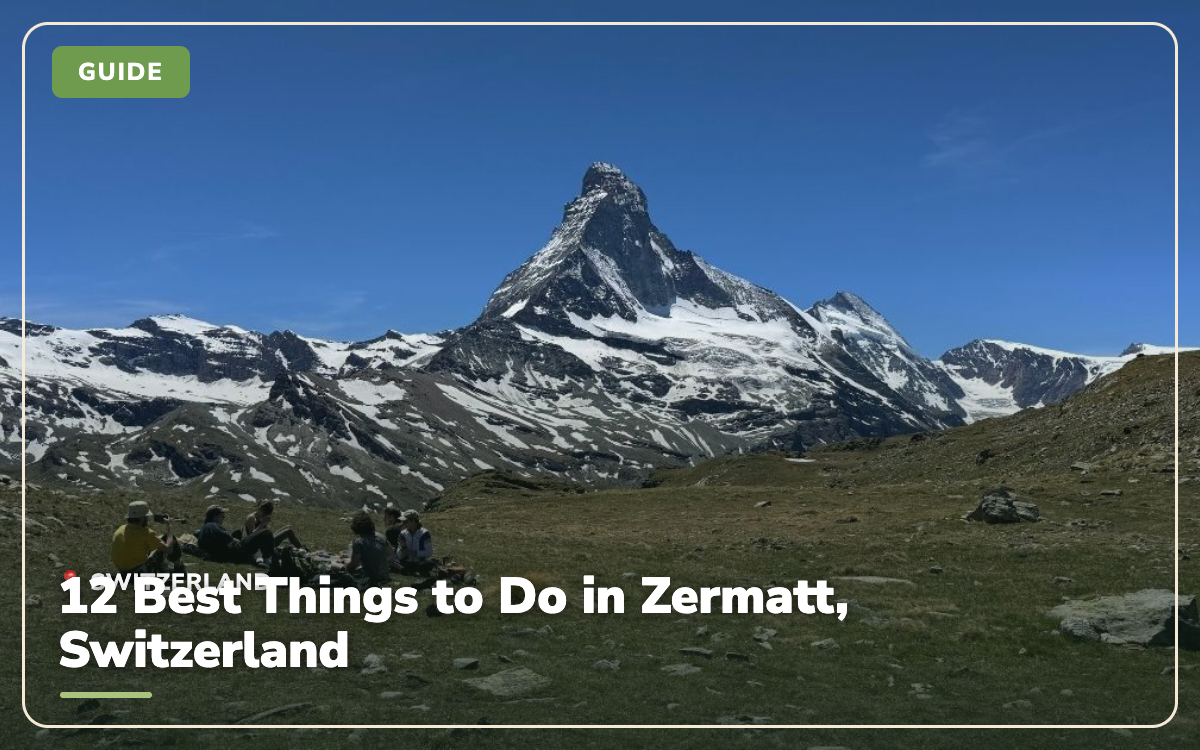
Zermatt is one of those places that takes your breath away the moment you arrive. You step off the little train, look up, and forget to breathe for a second, because there above the rooftops of the wooden chalets rises the perfect triangle of the Matterhorn (4,478 m), the most photographed mountain in the Alps.
Here’s what you’ll want to know before you go: when to visit, how to get there (and where to leave the car), where to stay, and above all what not to miss, from the Gornergrat viewpoint and Europe’s highest cable car to the lake where the Matterhorn is mirrored like a postcard. And because Switzerland has a talent for emptying your wallet, we’ll walk you through the budget and share the backpacker tricks that stop it costing a fortune.
Zermatt in a nutshell
- Why go: the Matterhorn (4,478 m), the most photogenic mountain in the Alps, a quiet car-free village and superb hiking and skiing.
- When: summer (June–September) for hiking and the lakes; December–April for skiing; spring and autumn for peace and quiet and lower prices.
- Getting there: Zermatt is car-free, so you leave the car in Täsch and cover the last 5 km by train (around CHF 17 return).
- Airports: Zurich or Geneva, both roughly 3.5 hours away by train.
- Budget: Switzerland is expensive, so reckon on around CHF 120–150 per person per day; less with a hostel and self-catering.
- How to save: the Swiss Travel Pass, the Half-Fare Card (Halbtax) or a multi-day Peak Pass all give hefty discounts on the cable cars and trains.
When to Visit Zermatt
Zermatt is lovely all year round and every season has its own appeal. For fellow backpackers and mountain lovers, the best time is summer and early autumn, roughly June to September. That’s when the walking trails are open, the lakes are full and reflecting the Matterhorn, and the weather is at its most settled. July and August are also the priciest and busiest months, mind you.
For skiing, the season runs from December to April, but thanks to the glacier you can ski on the Klein Matterhorn practically all year (yes, even in June). Spring (May) and late autumn (November) are the quietest and cheapest, though some cable cars and huts close for maintenance. Bear in mind, too, that mountain weather changes fast: even in August, snow can fall up on the Gornergrat.
If you’re mainly after the lakes with their Matterhorn reflections (Stellisee, Riffelsee), aim for July and August, when the trails are snow-free and the water is high. For flower-filled meadows and marmots, June is gorgeous; for golden larches and fewer people, head over in the second half of September or early October. Whenever you go, pack layers, because above 3,000 metres it’s chilly even in summer.
💡 Tip: The Matterhorn loves to hide in the clouds. Plan your viewpoints and photos for the morning, when the sky is usually clearest; by the afternoon the peak often clouds over. We’ve broken the year down month by month in our article Zermatt Weather: When to Go and What to Expect Month by Month (2026).
How to Get to Zermatt
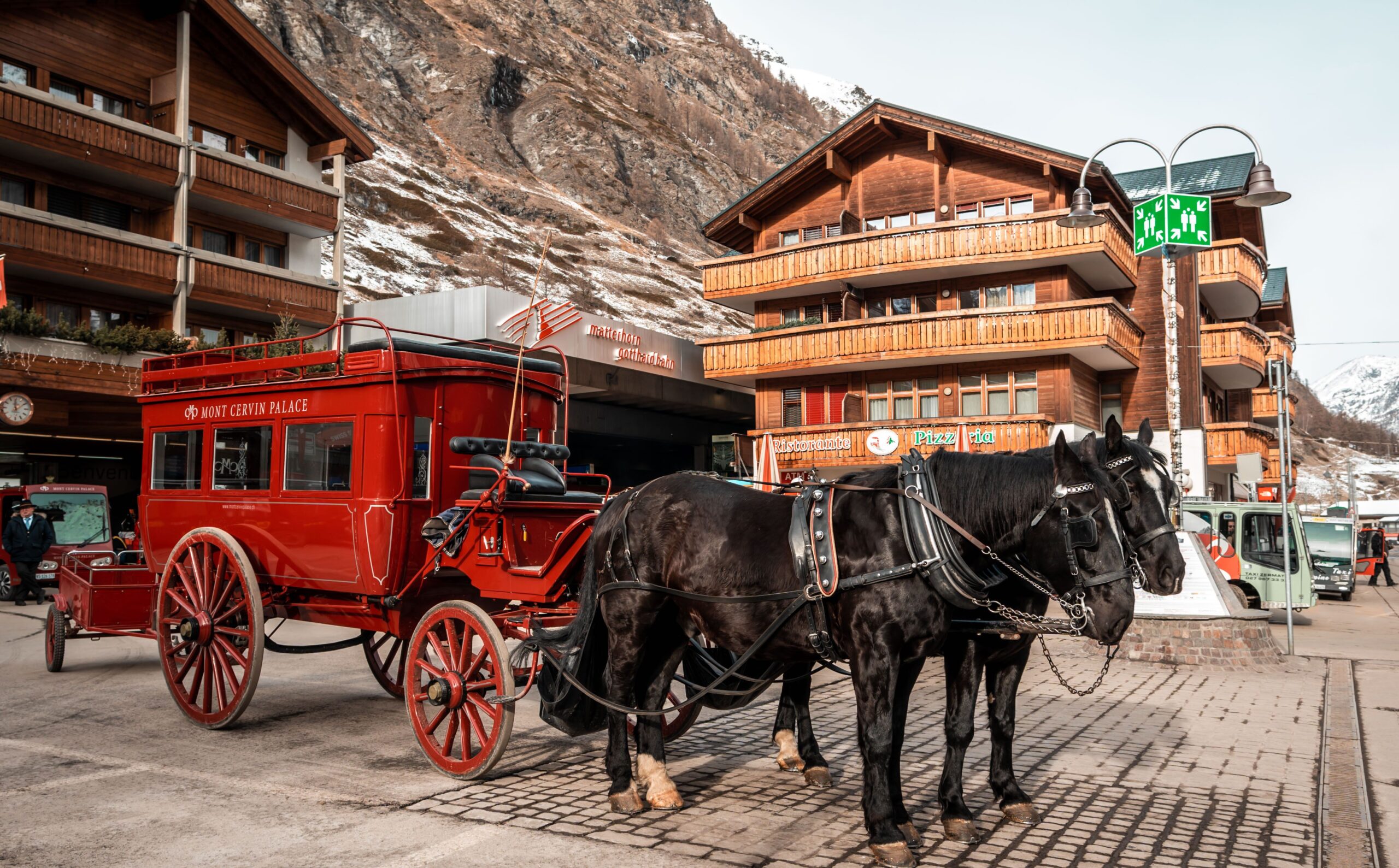
This is the first thing to sort out, because Zermatt is a car-free village. In its lanes you’ll meet only electric buggies, horse-drawn carts and the odd bin lorry, and that’s by design: the village protects its famously clean mountain air and its quiet.
By Car (and Where to Park)
By car you can only get as far as the village of Täsch, about 5 km short of Zermatt. Here you park in the covered Matterhorn Terminal car park (roughly CHF 16–18 for 24 hours) and cover the last few kilometres on the Zermatt Shuttle train. It runs roughly every 20 minutes, the journey takes just a few minutes, and a return ticket costs around CHF 17. Most visitors, though, find the train the easiest way in and skip the drive altogether.
By Air and Rail
The nearest major airports are Zurich and Geneva (though Basel or Milan work too). From either, you can reach Zermatt comfortably by train in around 3.5 hours with one or two changes (usually via Visp). Swiss trains are punctual and frequent, so plane plus train is the most sensible option for a car-free backpacker (just be warned, the trains here are genuinely pricey).
You can compare flights and connections easily here: find flights to Switzerland →
Scenic Rail: The Glacier Express and Gornergrat
If you have the time, make the journey part of the experience. The famous panoramic Glacier Express links Zermatt with St. Moritz right across the Alps and ranks among the most beautiful rail routes in the world, with Zermatt as its terminus. And straight from the village runs the Gornergrat Railway, Europe’s highest open-air cogwheel railway, which has been climbing the mountain since 1898.
Where to Stay in Zermatt
Zermatt has over a hundred hotels in every category, from luxury five-star spas to mountain lodges and hostels. Let’s be honest: nowhere here is cheap, but even a backpacker can find a spot. A few pointers on where to look:
- The centre around the main street, Bahnhofstrasse — everything on foot, but the priciest and busiest.
- The Winkelmatten district and the edges of the village — quieter, often with a lovely Matterhorn view and slightly friendlier prices.
- Hostels and self-catering flats — the holy grail for budget travellers; Zermatt has both a town hostel and a youth hostel where you’ll sleep for far less than in a hotel.
💡 Tip: A place with its own kitchen will save you more money than anything else in Zermatt, because eating out is the single biggest expense here. Browse what’s available and the current prices here: see Zermatt accommodation on the map →
12 Best Things to Do in Zermatt
Zermatt is first and foremost a launchpad into the mountains. Here are twelve places that make it worth coming for, from viewpoints you reach by cable car to hikes you can do on your own two feet for free. Head somewhere the cable cars don’t reach and you’re all but guaranteed to meet hardly a soul.
1. Gornergrat – The Best View of the Matterhorn
If you only have time for one thing, make it Gornergrat (3,089 m). The cogwheel train carries you straight up from the village in around 33 minutes, and at the top a jaw-dropping panorama opens up — the Matterhorn, the Gorner Glacier and, all around, 29 four-thousand-metre peaks, among them Monte Rosa, the second-highest mountain in the Alps. A return ticket costs roughly CHF 96 in winter and around CHF 132 or more in summer, though with a Half-Fare Card or Swiss Travel Pass you’ll pay half that.
💡 Tip: You don’t have to ride both up and down. Take the train up to Gornergrat and walk part of the way back down (perhaps to Riffelsee, where the Matterhorn is mirrored in the water). You’ll save money and see far more.
2. Matterhorn Glacier Paradise (Klein Matterhorn) – The Roof of Europe
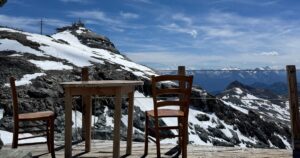
Klein Matterhorn (3,883 m) is the highest cable-car station in Europe. From the village you reach it in around 40 minutes with a couple of changes, and at the top you’ll find a viewing terrace, a glacier palace with ice caves and sculptures, and year-round skiing. A return ticket costs roughly CHF 99–132 depending on the season. Be ready for the cold, the thin air and possible altitude sickness, because you climb almost 2,300 metres above the village. There’s more on the mountain itself in our guide The Matterhorn: A Guide to Switzerland’s Most Famous Mountain (2026).
3. Sunnegga–Rothorn – The Sunny Side of the Valley
An underground funicular whisks you up to Sunnegga (2,288 m) in a few minutes, from where gondolas carry on up to Rothorn (3,103 m). This is the sunniest part of the area, ideal for families and easy-going walks. Right by the top station at Sunnegga lies the little lake of Leisee, with a children’s playground and, when the air is still, another beautiful Matterhorn reflection.
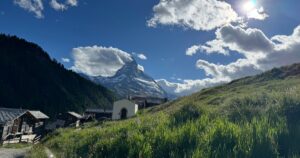
4. The Five Lakes Walk and Stellisee
This is our favourite hike in the area. The Five Lakes Walk (5-Seenweg) links five mountain tarns (Stellisee, Grindjisee, Grünsee, Moosjisee and Leisee), and the star of the show is Stellisee: on a still morning the whole Matterhorn is mirrored in its surface, giving you the most iconic photo you’ll take home from Zermatt. The route is about 9 km, manageable even for a family, and easily combined with the Sunnegga/Rothorn cable cars; on foot it’s free.
💡 Tip: For the reflection at Stellisee, set off early in the morning. As the day warms up the wind picks up, the surface ripples and the mirror is gone.
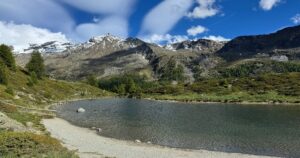
5. Schwarzsee – The Dark Lake Beneath the Peak
Schwarzsee (2,552 m) is a small mountain lake right at the foot of the Matterhorn, reached by gondola. A little white chapel stands beside it and the view of the mountain feels close enough to touch. It’s also the starting point for climbers heading up the Matterhorn to the Hörnlihütte hut (3,260 m), reached by a popular high-mountain hike with around 700 m of ascent.
6. The Gorner Gorge
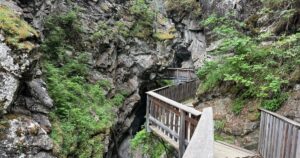
When you fancy a change from the views up high, drop down into the Gorner Gorge. Wooden walkways lead you through a narrow ravine that the water has carved into the rock — cool air, the roar of the river and a completely different world from the summits above. There’s a small entry fee (around CHF 5), but it’s a token amount next to the cable cars.
7. The Historic Hinterdorf Quarter
The oldest part of Zermatt, Hinterdorf, is a huddle of old wooden granaries and barns raised on stone “mushrooms” (flat stones that stopped mice reaching the stores). Some of the buildings are hundreds of years old. Wandering the narrow lanes is free and shows you what Zermatt looked like before it became a world-famous resort.
8. Skiing in the Matterhorn Ski Paradise
In winter (and, thanks to the glacier, in summer too) Zermatt is one of the top Alpine resorts, with around 360 km of pistes and skiing that carries on over the ridge into Italian Cervinia. The ski pass isn’t cheap, but the scale and quality of the terrain are among the best in the Alps. And thanks to the Matterhorn Alpine Crossing you can happily nip over for a coffee in Italy, just don’t forget to bring your ID.
9. Matterhorn Museum – Zermatlantis
If the weather doesn’t play ball, take shelter in the underground Matterhorn Museum – Zermatlantis in the centre of the village (admission around CHF 12). It tells the story of the first, tragic ascent of the Matterhorn in 1865, when only three of the seven-man party came back. The snapped rope from that fateful climb is on display, too — guaranteed goosebumps.
10. Zmutt – The Oldest Hamlet Below the Matterhorn
Just above Zermatt, about an hour and a half of easy walking along a marked path, lies Zmutt (1,936 m), a tiny hamlet of some twenty dark wooden houses that have stood here for over 500 years. The larch granaries sit on stone discs that once kept the mice from the stores, and above the green meadows the Matterhorn towers as clear as day. The walk is free, easy enough for families with children, and up top you can stop off at one of the traditional mountain restaurants.
💡 Tip: Rather than retrace your steps, head back via Furi and the Gorner Gorge. That way you make a neat loop and roll two stops into one walk.
11. The Mountaineers’ Cemetery
Right beside St. Mauritius church in the centre you’ll find the Mountaineers’ Cemetery, a quiet, moving place with dozens of graves of climbers who died on the Matterhorn, the Weisshorn or Monte Rosa. Headstones from the 19th and early 20th centuries often give the cause of death, too — a fall, an avalanche or rockfall. Entry is free and it’s a reminder of just how serious the mountains around Zermatt really are.
12. Kirchbrücke – A Postcard Matterhorn from the Village
You don’t even have to go anywhere: one of the finest views of the Matterhorn opens up right down in the village. Stand on the Kirchbrücke bridge over the River Mattervispa and you’ll see the mountain rising above the rooftops of the wooden chalets. The best light is early morning and at dusk, when the village is calm and the peak hasn’t yet slipped into the clouds.
How Much It Costs (Budget)
We won’t sugar-coat it: Switzerland is one of the most expensive countries in Europe, and as a premium resort Zermatt piles a bit more on top. A main course in a restaurant can easily be CHF 30–40, and cable cars run from tens of francs to well over a hundred. Here’s a rough daily budget per person:
| Item | Rough cost per day (1 person) |
|---|---|
| Accommodation (hostel / shared room) | from ~CHF 50–80 |
| Accommodation (hotel, twin room / person) | from ~CHF 120 and up |
| Food (restaurants) | CHF 50–80; far less with your own kitchen |
| Cable car / train (1 trip) | ~CHF 50–130 depending on destination and season |
| Täsch–Zermatt shuttle (return) | ~CHF 17 |
| Total (backpacker) | from around CHF 120–150 / day |
How to save money in Zermatt (backpacker tricks):
- Half-Fare Card (Halbtax) or Swiss Travel Pass — both give 50% off the trains and most cable cars. With two or more trips up the mountain they easily pay for themselves. And it’s cheaper still if you buy a month or so ahead.
- Peak Pass from Zermatt Bergbahnen — if you’re planning several trips up (Gornergrat, Klein Matterhorn, Sunnegga), a multi-day Peak Pass is worth it. In summer it starts at roughly CHF 212 and covers the cable cars, entry to the glacier palace and the shuttle from Täsch; prices vary by season and number of days, so treat them as a guide.
- Stay somewhere with a kitchen and cook — the single biggest saving there is. Stock up at a supermarket (Coop, Migros) and have breakfast and dinner in.
- Walk wherever you can — hikes like the Five Lakes Walk, the stroll to Zmutt, Hinterdorf or the path to the Gorner Gorge are free or nearly so.
- Ride the cable car one way only and walk the other — you’ll save money and see more.
- Carry tap water — Zermatt’s is drinkable and excellent, whereas bottled water here is dear.
💡 Tip: It pays to buy experiences and cable-car tickets in advance, especially in high season, so you can skip the queues at the ticket desks. Have a look at what’s on offer: tours and cable cars in Zermatt →
Where to Next
- Zermatt Weather: When to Go and What to Expect Month by Month (2026)
- The Matterhorn: A Guide to Switzerland’s Most Famous Mountain (2026)
Frequently Asked Questions About Zermatt
Experiences and tickets in Zermatt
traveller-verified · GetYourGuide

Zermatt: Matterhorn Glacier Paradise Cable Car
★ 4.8 · 1,265 reviews
from CHF 105


Prices and ratings are approximate (source: GetYourGuide); you’ll see the latest once you click through.
Why is Zermatt car-free?
Zermatt has banned combustion-engine vehicles for decades to protect its clean mountain air and its quiet. Only electric buggies, electric buses, taxis and horse-drawn carts run in its lanes. You leave the car in the village of Täsch, around 5 km short of Zermatt, and cover the last few kilometres by shuttle train.
How do you get to Zermatt?
The most comfortable way is to fly into Zurich or Geneva and take the train from there, roughly 3.5 hours (with a change, usually via Visp). If you’re driving, you can’t take the car all the way in: you park in Täsch and switch to the shuttle train for the final leg to Zermatt.
Where do you leave the car if Zermatt is car-free?
You park in the covered Matterhorn Terminal car park in the village of Täsch (roughly CHF 16–18 for 24 hours). From there the Zermatt Shuttle train runs to Zermatt about every 20 minutes, and a return ticket costs around CHF 17.
How much does the Gornergrat railway cost?
A return ticket on the Gornergrat cogwheel train costs roughly CHF 96 in winter and around CHF 132 or more in the summer 2025/2026 season. With a Half-Fare Card (Halbtax) or Swiss Travel Pass you get 50% off. Prices change with the season, so treat them as a guide.
How much does it cost to go up Klein Matterhorn (Matterhorn Glacier Paradise)?
A return ticket from Zermatt up to Klein Matterhorn (3,883 m) costs roughly CHF 99–132 depending on the season, cheapest in winter and dearest in peak summer. Here too you get 50% off with a Half-Fare Card or Swiss Travel Pass. It’s the highest cable-car station in Europe, so expect cold and thin air.
When is the best time to visit Zermatt?
For hiking, the lakes and the trails, summer and early autumn (June–September) are ideal. For skiing it’s December–April, and thanks to the glacier you can ski on the Klein Matterhorn all year round. Spring and late autumn are the quietest and cheapest, but some cable cars close for maintenance.
Is Zermatt expensive?
Yes, Zermatt is one of the most expensive resorts in Switzerland. Reckon on around CHF 120–150 per person per day. You’ll save with self-catering accommodation, cooking your own meals, a Half-Fare Card for the discounts, and walking instead of taking the cable cars.
How many days should you set aside for Zermatt?
Two to three days are enough for the highlights: one day for Gornergrat, another for Klein Matterhorn or Sunnegga and the lake hikes. If you want to do more walking or skiing, set aside a whole week, as the surroundings offer plenty to keep you busy for far longer.
Is the Swiss Travel Pass or Half-Fare Card worth it?
If you’re planning several cable-car trips and rail travel around Switzerland, it’s almost always worth it. The Half-Fare Card (Halbtax) gives 50% off trains and most cable cars, while the Swiss Travel Pass also covers public transport. If you’re mainly heading up into the mountains around Zermatt, consider a multi-day Peak Pass from Zermatt Bergbahnen too.
How tall is the Matterhorn and how high does Zermatt sit?
The Matterhorn is 4,478 m and one of the best-known mountains in the Alps. The village of Zermatt itself sits at around 1,620 m in the canton of Valais in southern Switzerland, close to the Italian border.
Potřebujete pomoct s cestováním?
-
Ubytování 🏨
Vyberte si to nejlepší ubytování, ať už jste kdekoliv, přes Booking.com. -
Půjčení auta 🚗
Auto si snadno najdete přes Booking.com, kde máte často slevu díky ubytování, nebo Rentalcars.com, kde porovnáte nabídky většiny půjčoven. -
Zážitky 🎟️
Přes GetYourGuide.com si vyberete z nejrůznějších výletů i zážitků po celém světě, navíc se zrušením zdarma do 24 h předem.