Zermatt Weather: When to Go, Month by Month (2026)
Last updated 26.7.2026
The first time we arrived in Zermatt, in the middle of June, the morning was pure sunshine, the Matterhorn stood over the valley like something straight off a postcard — and by one in the afternoon the cloud had rolled in so thickly that the mountain vanished into mist and it started to rain. The next day did exactly the same thing in reverse. That sheer unpredictability is precisely why the weather in Zermatt deserves an article all of its own. This is a high-alpine resort sitting at 1,620 metres above sea level, where conditions can turn in a couple of hours and where you’ll want a warm hat in your bag even in August.Here’s what the weather in Zermatt looks like month by month, when to come for hiking and when for skiing, how the Matterhorn behaves when it comes to visibility, and what to pack so the mountains never catch you out.
Altitude: Zermatt sits at 1,620 m — an alpine climate, with cold nights even in summer.
Best for hiking: July and August (daytime highs around 15 °C, trails fully open).
Best for skiing: December to March; for longer days and more sun, aim for February and March.
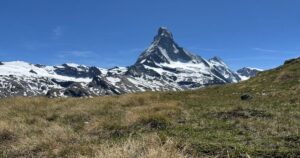
The Matterhorn is clearest in the morning — cloud and thunderstorms often build in the afternoon.
Fast-changing weather: pack layers, a windproof jacket and a hat even in summer.
Rainfall: Zermatt lies in a dry inner-alpine valley (around 640 mm a year), but summer brings afternoon storms.
What the weather in Zermatt is like
Zermatt lies at the head of the Mattertal valley in the canton of Valais, at roughly 1,620 metres above sea level, and the climate reflects that. It’s classic high-mountain weather: long, cold winters, short and mild summers, and a big swing between day and night. Even in the warmest month, when the village sees around 15 °C in the daytime, the temperature can easily drop towards 8 °C overnight. And the surrounding four-thousanders — the Matterhorn tops out at 4,478 m — hold snow and ice all year round.One thing sets Zermatt apart from many other alpine resorts: it sits in one of the driest corners of the Alps. The high ridges all around wring most of the moisture out of the air before it reaches the valley, so only about 640 mm of precipitation falls here each year — remarkably little for the mountains. That’s also why there’s so much sunshine, roughly 1,650 hours a year. It doesn’t mean it’s calm and dry all the time, though.The main thing to remember about the weather in Zermatt is how quickly it changes. In the mountains, morning and afternoon can feel like two different seasons. A clear dawn clouds over by midday, sunshine gives way to wind, and in summer an afternoon thunderstorm is nothing unusual. So plan any demanding hikes and your Matterhorn photos for the morning — more on that below.
💡 Tip: At altitude the sun is far stronger than you’d expect. You can burn quickly even on a cool day, so pack sun cream and sunglasses for the slopes in winter too — the glare off the snow makes burning far worse.
Zermatt weather month by month
The table below sums up the approximate average temperatures and precipitation in Zermatt month by month. These are long-term averages for the village elevation (1,620 m) — up on the glacier it’s obviously far colder. Any given year can differ, so always check the current forecast before you travel (links further down).
Month
Daytime °C
Night °C
Rain / snow
What to do
January
−3 to 1
−10 to −7
snow, good cover
skiing, reliable snow
February
−2 to 0
−9 to −6
driest month, powder
skiing + longer days
March
0 to 4
−7 to −4
snow, more sun
spring skiing, sunshine
April
3 to 8
−3 to 0
thaw, snow up high
end of season, shoulder
May
7 to 12
1 to 4
wettest month, rain
shoulder season, much closed
June
10 to 16
5 to 8
rain, afternoon storms
hiking starts, meadows in bloom
July
13 to 20
8 to 10
afternoon storms
peak hiking season
August
13 to 19
8 to 10
afternoon storms
peak hiking season
September
9 to 15
4 to 7
more settled, clear
best for hiking, quieter
October
5 to 10
0 to 3
first snow up high
autumn colours, shoulder
November
−1 to 3
−6 to −3
snow arrives
shoulder season, peace and quiet
December
−3 to 0
−9 to −6
most snowfall, Advent
skiing starts, Christmas
So how do you prepare for the weather in Zermatt?
July and August are the warmest — daytime highs around 15 °C, and over 20 °C in the sun. It’s still not swimming weather, though; think T-shirt-and-fleece hiking temperatures.
January is the coldest, with the average staying below freezing and nights routinely dropping to around −10 °C. On the glacier and the cable cars, expect lower still, with wind on top.
The most precipitation comes in late spring and summer — and, oddly, not as steady rain but as afternoon showers and thunderstorms. Mornings are usually clear.
February is the driest and often the clearest month — which is exactly why it’s one of the most popular for skiing.
When to visit Zermatt
Zermatt essentially has two full seasons — summer and winter — with two quieter shoulder periods in between. Which one suits you best comes down entirely to what you want from the trip.
Summer (June–September): hiking and walking
If you’re here for the walking, the viewpoints and the Matterhorn without skis, July and August are the best months. The trails are snow-free, the cable cars and mountain huts are in full swing, the meadows are in flower and the daytime temperatures are lovely for walking. Our own favourite, though, is September — the weather tends to be more settled and clearer than in high summer, there are fewer people, accommodation prices drop and the Matterhorn shows itself more often. Just be ready for chillier mornings.
💡 Tip: Plan your hikes and cable-car trips up to the viewpoints (Gornergrat, Matterhorn Glacier Paradise) for the morning. Partly for the mountain’s visibility, but also because afternoon thunderstorms in summer are common, and being caught on an exposed ridge at altitude is no joke.
Winter (December–March): skiing
Thanks to its glacier, Zermatt is one of the most reliable ski resorts in the Alps — the snow here is all but guaranteed for the whole winter. The main season runs from December to March. December and January offer the most snow and that festive atmosphere, but the days are short and it’s at its coldest. February and March are the sweet spot, in our view — there’s still plenty of snow, but the sun already has some warmth, the days are longer and you can sit out on the terraces of the mountain restaurants in a T-shirt. And because Zermatt links up with Cervinia in Italy, you can ski over to the Italian side and treat yourself to a cheaper Aperol while you’re at it.
Shoulder seasons (April–May, October–November): quiet and cheaper
Let’s be honest — the shoulder seasons are a gamble. In late spring (April–May) and autumn (October–November), Zermatt is at its quietest and cheapest, but there’s a trade-off: some of the cable cars and restaurants close for maintenance, the skiing is either past its best or not yet going, and the weather is changeable. May is also one of the wettest months. If you’re mainly after the atmosphere and the calm, and you don’t mind that some things won’t be running, you can save money. But for specific must-do experiences, aim for the main seasons.Find accommodation in Zermatt for your dates here →
Weather and Matterhorn visibility
Let’s face it — a lot of people come to Zermatt for one thing above all: to see the Matterhorn. And it has a mind of its own. For a full guide to the mountain itself, see our article The Matterhorn: Switzerland’s most famous mountain; here we’re focusing purely on when you actually stand a chance of glimpsing it cloud-free.There’s a simple but dependable rule: the Matterhorn is clearest early in the morning. The air is most stable after the night and the summit tends to be clear. As the sun warms the valley, cloud starts to build around the peak, and by the afternoon it’s often wrapped in what’s known as the “banner” — a plume of cloud that streams off the summit. Beautiful in a photo, but it hides the actual point of the mountain.
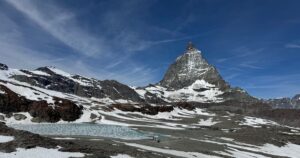
💡 Tip: If you want that iconic shot of the Matterhorn reflected in a mountain tarn, get up at dawn and head for Stellisee or Riffelsee. The surface is mirror-still in the morning, the peak is cloud-free and there’s hardly anyone about. By nine or ten the wind picks up and the calm is gone.
The second thing worth knowing: even when it’s overcast down in Zermatt, it can be clear up top — and the other way round. It pays to check the webcams from the summit stations (Gornergrat, Matterhorn Glacier Paradise) before you buy a cable-car ticket. When there’s fog in the valley, above the inversion you may find blue sky and a sea of cloud below you.
What to pack for Zermatt
The golden rule for high-mountain weather is: layers, layers, layers. Rather than one thick jacket, take several thinner layers you can add and shed as the weather shifts through the day. And shift it does — as we’ve said.
In summer (June–September)
T-shirts and a fleece — a T-shirt by day, a jumper or light fleece for the mornings and evenings.
A waterproof jacket — essential for those afternoon storms and the wind up on the ridges.
Long trousers for hiking and comfortable, ideally waterproof boots.
A hat and thin gloves — even in August, especially if you take the cable car above 3,000 m.
Sunglasses and high-factor sun cream — the sun is merciless at altitude.
In winter (December–March)
A proper winter jacket, thermals, a hat, a neck gaiter and two pairs of gloves.
Ski goggles and face cream — the combination of cold, wind and sun is hard on your skin.
Boots with a decent grip — the streets tend to be snowy and slippery (and Zermatt is car-free, so you’ll be walking everywhere).
💡 Tip: Whenever you go, take a small rucksack you can stuff with an extra layer, water and a snack. On a hike above the valley you can easily meet sun, wind and a shower all in one afternoon.
Webcams and forecasts: where to check the weather in Zermatt
Because the weather changes so fast here, it’s worth checking before every trip up the mountain. These are the sources we use ourselves:
Webcams from the summit stations — the Zermatt Bergbahnen site (zermatt.ch) has dozens of cameras from Gornergrat, Matterhorn Glacier Paradise and the village centre. The fastest way to see whether the Matterhorn is visible right now.
Meteoblue — detailed mountain forecast with a “meteogram” and hour-by-hour probability of precipitation.
MeteoSwiss (the official Swiss weather service) and yr.no — both reliable for the mountain environment.
Mountain-forecast.com — forecasts by elevation, handy for deciding how high to go.
The Met Office and AccuWeather — quick and easy for a general few-day overview.
No mountain forecast is ever 100% reliable, but a day or two ahead they’re pretty accurate these days. For anything further out, treat forecasts as a rough guide and always have a plan B for poor weather (the Matterhorn Museum, the wellness spas, the cafés in the centre).If you want to make the most of your time in Zermatt even when the weather’s uncertain, it pays to have a few activities booked in advance. Tours and experiences in Zermatt via GetYourGuide →
Weather in the village versus up on the glacier
The figures in the table above apply to the village of Zermatt at 1,620 metres. The moment you step into a cable car, though, the climate changes with every hundred metres you climb. As a rough rule, the temperature drops about half a degree for every 100 metres of ascent, so there’s commonly a difference of 13 to 15 °C between the centre and the top station. When it’s a pleasant 18 °C in the village in August, up at Matterhorn Glacier Paradise (3,883 m) it hovers around freezing even in summer — and the wind makes it feel colder still.It isn’t just about temperature. Higher up there’s more wind, the sun bites far harder and the weather turns more quickly. Overcast in the valley doesn’t mean overcast up top, either: thanks to inversions, you’ll often rise out of the fog in the village into blue sky above a sea of cloud. That’s exactly why it’s worth a glance at the webcam from your destination station before every trip up.
Location
Summer (Jul/Aug)
Winter (January)
What it’s for
Zermatt village (1,620 m)
day 13 to 20 °C
day around freezing, night −10 °C
hiking, base, strolls
Gornergrat (3,089 m)
roughly 3 to 8 °C
roughly −10 to −15 °C
viewpoint, views of the Matterhorn
Matterhorn Glacier Paradise (3,883 m)
roughly −2 to +2 °C
roughly −15 to −25 °C
year-round skiing, viewpoint
💡 Tip: Whenever you take the cable car, pack a hat, gloves and a warm layer even in summer. At the summit stations you’ll be cold in a T-shirt even on a sunny August morning, and the wind knocks the feels-like temperature lower still.
Year-round skiing on the glacier
Zermatt is one of the few places in the Alps where you can ski 365 days a year. That’s thanks to the glacier area around Matterhorn Glacier Paradise, which, at 3,883 metres, is the highest cable-car station in Europe. On the Theodul Glacier you’ll find around 20 kilometres of pistes and a freestyle park even in summer. In the warmest months, though, the skiing is mostly a morning affair: once the sun softens the snow on the glacier, the pistes close, usually around midday. So if you want to ski in July or August, you’ll need an early start.In the main winter season the glacier area connects with the huge ski domain above Zermatt and with Cervinia in Italy, so the snow and the lift network stay reliable even when lower-lying resorts are struggling for cover.
Snow in Zermatt month by month
Thanks to its high position and the glacier, Zermatt is one of the most snow-sure resorts in the Alps. The figures below are approximate long-term averages for snow depth on the pistes, given separately for the lower and upper parts of the ski area. Any particular winter will differ, of course, but the order of the months tends to be similar: the cover builds through the winter and is usually deepest in March and April high up on the slopes.
Month
Lower slopes
Upper slopes
Conditions
December
around 60 cm
around 150 cm
base forming, most fresh snowfall
January
around 130 cm
around 210 cm
reliable snow, cold, powder
February
around 100 cm
around 210 cm
stable conditions, dry and sunny
March
around 125 cm
around 230 cm
deepest snow up high, longer days
April
around 130 cm
around 240 cm
spring skiing, still deep up top
Each year Zermatt sees roughly four metres of snowfall. High up and on the glacier the snow lies permanently, so even outside the main season there are ski conditions here that you simply can’t count on down in the valley.
Prices and ratings are indicative (source: GetYourGuide); you’ll see the current details when you click through.
What is the weather like in Zermatt in summer?
In July and August daytime temperatures are around 13–20 °C, dropping towards 8 °C at night. Summer is ideal for hiking, but be ready for afternoon thunderstorms and cool mornings — even in August a fleece, a windproof jacket and a hat are handy for cable-car trips up high.When is the best time to visit Zermatt?
For hiking, July and August (open trails, pleasant temperatures), or September, which tends to be more settled and quieter. For skiing, December to March, ideally February and March for the longer days and more sun. The shoulder seasons (April–May, October–November) are calm and cheap, but some of the lifts and restaurants are closed.What is the weather like in Zermatt in winter?
Winter is long and cold — daytime temperatures in January and December hover around freezing or below, with nights routinely at −10 °C. Thanks to the high altitude and the glacier, snow is all but guaranteed the whole winter, so ski conditions are reliable from December to March.How high is Zermatt above sea level?
The village of Zermatt sits at roughly 1,620 metres above sea level, at the head of the Mattertal valley in the canton of Valais. The surrounding peaks, including the Matterhorn (4,478 m), rise beyond four thousand metres and hold snow and ice all year round.When is the Matterhorn best seen?
Early in the morning. The air is most stable after the night and the summit is usually cloud-free. During the day cloud builds around the mountain and often wraps it by the afternoon. For the reflection shot in a lake (Stellisee, Riffelsee), head out at dawn, when the water is calm.Does it rain a lot in Zermatt?
No — Zermatt lies in one of the driest corners of the Alps, with only around 640 mm of precipitation a year, remarkably little for the mountains. The most rain comes in late spring and summer, but as afternoon showers and thunderstorms rather than all-day rain. Zermatt gets roughly 1,650 hours of sunshine a year.How cold is the water in the lakes near Zermatt?
Mountain tarns like Stellisee and Riffelsee are glacier-fed and stay cold even in summer — the water is roughly 5–10 °C. They’re mainly for photographing the Matterhorn’s reflection, not for swimming. It really isn’t a bathing spot.Do I need warm clothing even in summer?
Yes. Even when it’s 15–20 °C in the daytime, the mornings and evenings are cold at 1,620 metres, and on the cable cars above 3,000 m it’s around freezing even in August. Bring a fleece, a waterproof jacket, a hat and thin gloves — layering is essential in the mountains.How quickly does the weather change in Zermatt?
Very quickly. A clear morning often clouds over by midday, the wind picks up and in summer an afternoon thunderstorm rolls in. So plan demanding hikes and trips up to the viewpoints for the morning, and always have a backup plan for poor weather.How much colder is it up on the glacier than in the village?
Expect a difference of around 13 to 15 °C. When it’s about 18 °C in the village (1,620 m) in summer, up at the Matterhorn Glacier Paradise top station (3,883 m) it’s still around freezing, and the wind makes it feel colder still. In winter it’s commonly −15 to −25 °C up top, so even for a summer cable-car trip take a hat and a warm layer.Can you ski in Zermatt in summer?
Yes. On the glacier by Matterhorn Glacier Paradise, the highest cable-car station in Europe (3,883 m), you can ski almost all year round. In summer around 20 km of pistes are open, but mostly in the morning: once the sun softens the snow, the glacier pistes usually close around midday.Where can I check the current weather and webcams for Zermatt?
You’ll find webcams from the summit stations on the official zermatt.ch site, and forecasts on meteoblue, yr.no or MeteoSwiss. For a quick overview the Met Office, AccuWeather and mountain-forecast.com all work well. Before every cable-car trip it’s worth a look at a camera — it can be foggy in the valley while the sun is shining up top.
Potřebujete pomoct s cestováním?
Ubytování 🏨
Vyberte si to nejlepší ubytování, ať už jste kdekoliv, přes Booking.com.
Půjčení auta 🚗
Auto si snadno najdete přes Booking.com, kde máte často slevu díky ubytování, nebo Rentalcars.com, kde porovnáte nabídky většiny půjčoven.
Zážitky 🎟️
Přes GetYourGuide.com si vyberete z nejrůznějších výletů i zážitků po celém světě, navíc se zrušením zdarma do 24 h předem.
Abychom poskytli co nejlepší služby, používáme k ukládání a/nebo přístupu k informacím o zařízení, technologie jako jsou soubory cookies. Souhlas s těmito technologiemi nám umožní zpracovávat údaje, jako je chování při procházení nebo jedinečná ID na tomto webu. Nesouhlas nebo odvolání souhlasu může nepříznivě ovlivnit určité vlastnosti a funkce.
Funkční
Always active
Technické uložení nebo přístup je nezbytně nutný pro legitimní účel umožnění použití konkrétní služby, kterou si odběratel nebo uživatel výslovně vyžádal, nebo pouze za účelem provedení přenosu sdělení prostřednictvím sítě elektronických komunikací.
Předvolby
Technické uložení nebo přístup je nezbytný pro legitimní účel ukládání preferencí, které nejsou požadovány odběratelem nebo uživatelem.
Statistiky
Technické uložení nebo přístup, který se používá výhradně pro statistické účely.Technické uložení nebo přístup, který se používá výhradně pro anonymní statistické účely. Bez předvolání, dobrovolného plnění ze strany vašeho Poskytovatele internetových služeb nebo dalších záznamů od třetí strany nelze informace, uložené nebo získané pouze pro tento účel, obvykle použít k vaší identifikaci.
Marketing
Technické uložení nebo přístup je nutný k vytvoření uživatelských profilů za účelem zasílání reklamy nebo sledování uživatele na webových stránkách nebo několika webových stránkách pro podobné marketingové účely.