Last updated 8.10.2026
Corfu is not like most Greek islands, and the reason is history: the Ottomans never held it. The Venetians ran it for four centuries, then came the French, then the British, and what is left is an island that looks like a piece of Italy that drifted into the Ionian Sea. The Old Town has arcades straight out of Padua, its fortifications were drawn up by a Venetian military engineer, and cricket is played on the main square. So if you are wondering about the best things to do in Corfu, the answer is not just “beaches” (although they are great too). This is the one Greek island where you can spend a whole day in museums and still feel you are on holiday by the sea. We have picked twenty places we think are worth the detour, and on purpose there are more of them than anyone can fit into a week, so you can choose what suits you.
Things to do in Corfu: the short version
- Corfu Old Town is a UNESCO World Heritage Site (entry no. 978, inscribed in 2007). What is listed is the town together with its fortifications as one ensemble, not a single building.
- The Achilleion is partly closed in 2026. Because of restoration work only the outdoor areas and the imperial gardens are open, not the interior (notice on the official site achillion-corfu.gr, checked on 13 September 2026). Factor that in before you go.
- Two fortresses, not one. The Old Fortress sits on a rocky headland above the sea, the New Fortress above the port, and the views from each are completely different.
- Pantokrator (906 m) is the highest point on the island, and on a clear day you can see the Albanian coast and Italy from the top.
- The strangest coastline is in the north-west, where the sea has carved channels and tunnels into soft sandstone. The best known is the Canal d’Amour at Sidari.
- Paleokastritsa is the most photographed spot on Corfu and also the worst place to park all season. Get there early in the morning.
- Vidos is an island ten minutes by boat from the harbour that most visitors skip entirely. It has woodland, a few beaches and hardly anyone on it.
- Corfiot cooking is not standard Greek food. Pastitsada, sofrito and bourdeto are a Venetian legacy and you will find them practically nowhere else.
Things to do in Corfu Town and nearby
In Greek the capital is called Kerkyra, and in our view it is the finest town on any Greek island. Not the prettiest, that title goes to the villages of the Cyclades, but the most interesting. It has grand townhouses, arcades, a theatre, museums and two fortresses, which is a lot for an island of not quite six hundred square kilometres. If you are flying in from the UK, the town is only a few minutes from the airport, so it is also the easiest place to start.
1. The Old Town and the Liston promenade
The Old Town has been on the UNESCO World Heritage List since 2007, under number 978, and the listing covers all of it, fortifications included. The citation describes it as an exceptionally well preserved example of a fortified Mediterranean port and notes that the defences were designed by the Venetian engineer Sanmicheli.
The Liston is the arcaded promenade along Spianada Square, built by the French and modelled on the Rue de Rivoli in Paris. Today it is a long row of cafés under the arches. Coffee here costs more than anywhere else on the island, but an evening table is worth it. What we like best, though, is not the Liston itself but the lanes behind it, where washing hangs between the houses and two turns are enough to lose the crowds completely.
2. The Old Fortress (Palaio Frourio)
It stands on a rocky headland cut off from the town by a man-made moat, so you literally walk across a bridge to reach it. At the top there is a lighthouse and a view over the whole town, Spianada Square and the Albanian coast. It is the one place where you really see how the entire Old Town sits on a narrow peninsula.
The fortress is a Ministry of Culture site with an admission fee and seasonal opening hours. Check current prices and times on the official ticketing portal: they change, and when we were writing this the portal could not be reached from outside, so we would rather not quote them second-hand.
3. The New Fortress (Neo Frourio)
It is only new by name: building began in the late 16th century. It looms over the old port, and you can recognise it from outside by the Venetian lions carved in stone above the gates. Far fewer people come here than to the Old Fortress, and we think the view of the town is better, because the Old Fortress is in the frame.
4. The Church of St Spyridon
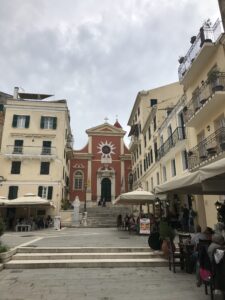
The tallest bell tower in town belongs to the church holding the relics of St Spyridon, the island’s patron saint. For locals this is not a tourist sight but a living place of pilgrimage. Several times a year the relics are carried in procession through the Old Town, and on those days the town practically stops. Entry is free; cover your shoulders and knees, and do not take photos inside.
The name Spyridon is so common on Corfu that you will run into it in every other taverna. When you see “Spiros” on a menu or a sign, that is him.
5. The Museum of Asian Art
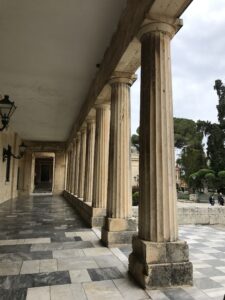
The Palace of St Michael and St George at the northern end of Spianada houses a museum of Asian art, and it is the most unexpected place on the island. A British palace full of Chinese porcelain and Japanese woodblock prints in the middle of Greece is a fairly bizarre combination, but the collection is the real thing, and on a hot afternoon it makes a pleasantly cool refuge.
6. Kanoni, Vlacherna and Pontikonisi
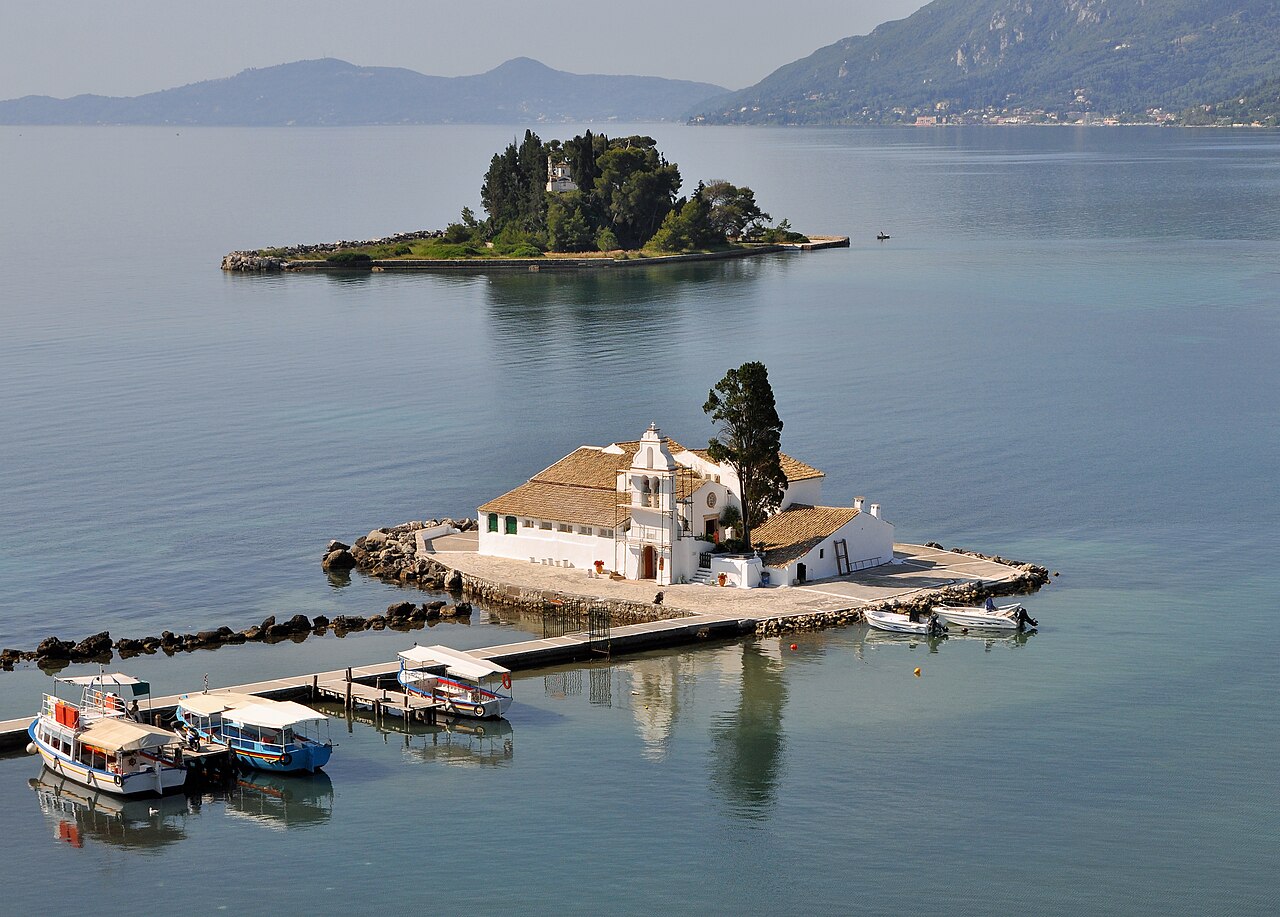
This is the picture on the cover of every brochure: a small white monastery at the end of a narrow causeway with a wooded islet behind it. The monastery is Vlacherna, the islet is Pontikonisi, Mouse Island in English, and legend says it is the Phaeacian ship from the Odyssey turned to stone.
You walk out to Vlacherna along the causeway; to reach Pontikonisi you take a small boat. The Kanoni peninsula, where everyone takes the photo from, is about four kilometres from the centre, and the airport runway runs right alongside it, so every now and then a plane passes a few dozen metres over your head.
7. Mon Repos
A neoclassical villa in parkland above Kanoni, built by a British Lord High Commissioner and later used by the Greek royal family. Prince Philip, later the husband of Elizabeth II, was born here. Today the house is a museum, surrounded by a large park with ancient ruins, shady paths and steps leading down to the sea. We come mainly for the park: in summer it is the coolest place you can find anywhere near town.
8. Vidos Island
A green islet directly opposite the old port, ten minutes away by boat, and almost nobody goes. There are no hotels and no roads, just pine woods, a few pebble beaches, one taverna and a mausoleum to the Serbian soldiers evacuated here from Albania during the First World War. For us it is the best half-day trip from Corfu Town, and it is a mystery why it is missing from most lists.
The Achilleion and the south: what to see in Corfu beyond the town
What is there to see in the south of Corfu? Two very different things: an imperial palace and a lagoon.
9. The Achilleion at Gastouri
The palace built for Empress Elisabeth of Austria, better known as Sisi, ten kilometres from Corfu Town. After her death it was bought by the German Kaiser Wilhelm II, and today it is the most visited sight on the island. The main draw is not the interiors but the terraced gardens with a view across the whole bay, and the statue of the dying Achilles.
Read this before you go. The official Achilleion website currently carries a notice that, because of restoration work, only the outdoor and open-air areas and the imperial gardens can be visited (checked on 13 September 2026). In other words, you will not see the inside of the palace for now. That does not make the trip pointless, the gardens and the view are worth it on their own, but if someone at your hotel is selling an excursion “to the palace”, it makes sense to ask what exactly you will see inside. Tickets and the current situation are on achillion-corfu.gr.
10. Lake Korission and the southern dunes
The southern third of Corfu is flat and nothing like the rest of the island. Most of it is taken up by the Korission lagoon, 427 hectares of water separated from the sea by nothing more than a narrow strip of beach. It is a protected Natura 2000 site, more than 120 bird species have been recorded here, and the dunes, in places over fifteen metres high, give way to an unusual juniper woodland that locals call the cedar forest.
On the sea side are the long sandy beaches of Halikounas and Issos, with nothing on them but sand and wind. We come here when we have had enough of the resorts: it is about an hour’s drive from Corfu Town, and even in high season you are more likely to meet anglers than people with inflatables.
Best places to visit on Corfu’s west coast
The west of Corfu is dramatic. Hills drop straight into the sea, the roads twist, and you cannot drive fast between the bays. If you only have one full day with a car, spend it here.
11. Paleokastritsa and the monastery above the bays
Six coves side by side, turquoise water and cypresses running down to the surface. Paleokastritsa is the best known place on Corfu, and in August you can tell. On the hill above the bays stands the 13th-century Theotokos Monastery; entry is free, shoulders and knees should be covered, and the terrace looks out over the whole coastline.
Small boats leave from the beach for the sea caves nearby, and this is one of the few organised trips that makes sense to us, because there is no other way to reach the caves. We come early, around nine, when you can still park and the water is perfectly still. By midday it is a different place.
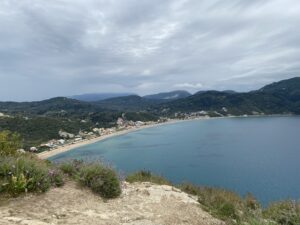
12. Angelokastro
A 13th-century Byzantine castle on a rock three hundred metres above the sea, just above Paleokastritsa. Not much of it survives, essentially the outer walls, a rock-cut cistern and a cave chapel, but the view is the best on the whole island. On a clear day you can see the Old Fortress in Corfu Town from here, and that was no accident: the two fortresses were meant to signal to each other.
A stone stairway leads up, and the climb is short but steep. In the midday heat it is no fun, so bring water.
13. Bella Vista and the viewpoints above Lakones
The road from Paleokastritsa up to the village of Lakones is reason enough on its own to hire a car on Corfu. Below the road the whole set of bays opens up, and in several places there are café terraces right by the roadside. The best known is called Bella Vista. It is a tourist stop and everybody knows about it, but the view simply works.
14. Porto Timoni and the village of Afionas
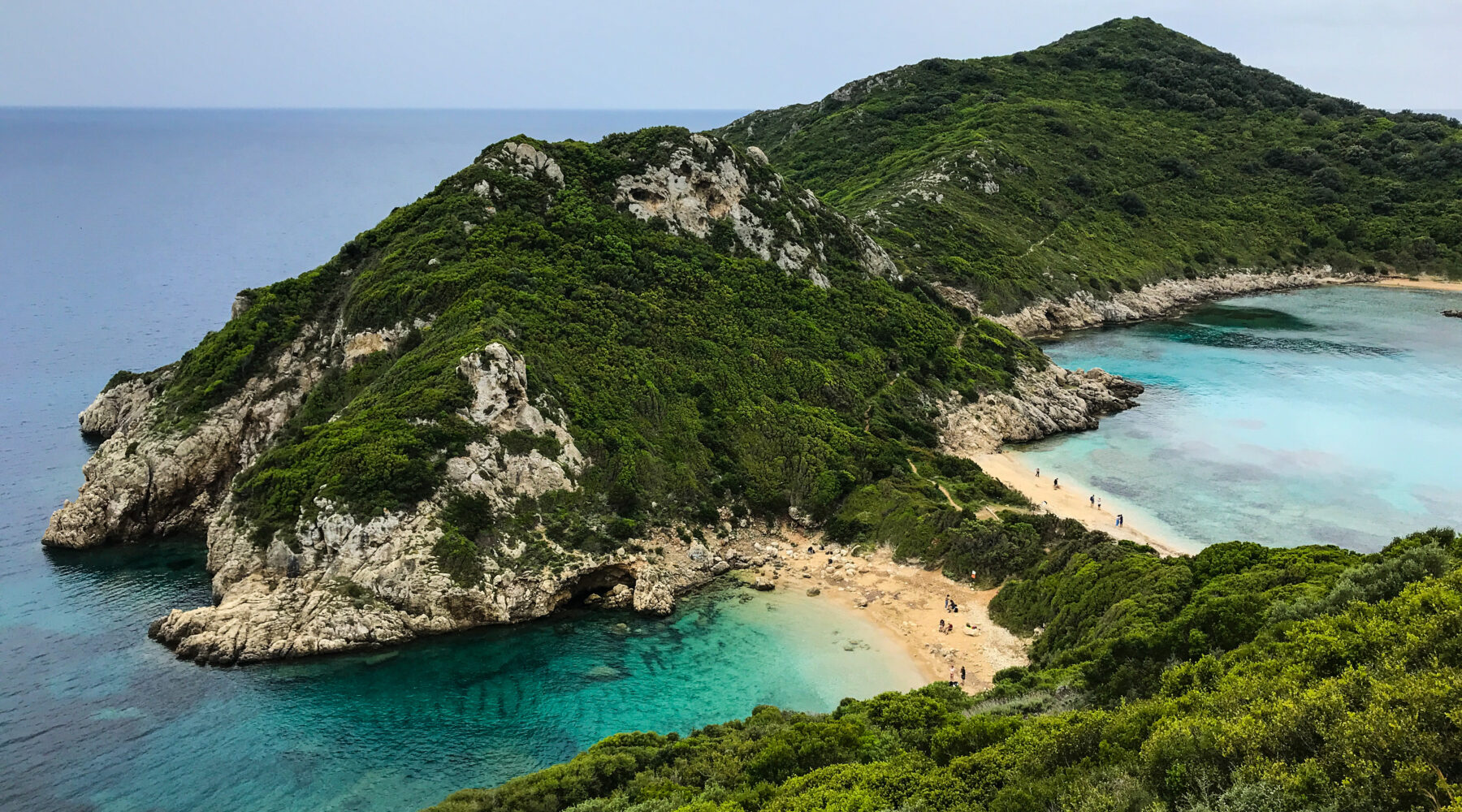
A double beach formed by a narrow neck of land between two bays, so you can swim on either side, and each has a slightly different colour of water. It is one of the most beautiful places on the island and also one of the least convenient: you park in Afionas, a steep, rocky path leads down, and there is nothing at all on the beach, no shade, no water, no bar.
That is exactly why it is noticeably quieter there than in the resorts, even in high season. Wear proper shoes, take plenty of water and do not walk down at midday.
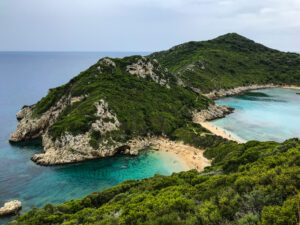
15. The Kaiser’s Throne above Pelekas
A viewpoint on the ridge above the village of Pelekas, where Kaiser Wilhelm II had a platform built so he could watch the sunset. It is one of the few places on Corfu from which you can see both sides of the island at once, the east coast and the west. A short detour for a big payoff, and it fits easily into a drive from Corfu Town to the west coast beaches.
Things to do in the north of Corfu
What is there to see in the north of Corfu? Something around almost every bend. All you need to do is take it slowly and look around.
16. The Canal d’Amour at Sidari
The north of Corfu is made of soft sandstone, and over thousands of years the sea has carved it into tunnels, towers and narrow channels. The most famous is the Canal d’Amour at Sidari, a channel between two rock walls with a legend attached: a couple who swim through it will stay together.
To be honest, in high season it gets crowded, and the legend is a modern one. It is also true that the rocks look as if they belong to another island, and in the morning or towards evening, when the light comes in from the side, it is one of the most photogenic places in Greece. Personally we prefer the formations a little further along, where nobody is queuing for a photo.
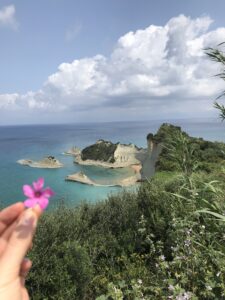
17. Cape Drastis and Logas Beach at Peroulades
The northernmost tip of the island, where white cliffs drop vertically into the sea with sharp rocky ridges sticking up between them. Below the cliffs lies the narrow Logas Beach, reached by a flight of steps, and above it a bar terrace that looks straight down. This is a sunset spot, and one of the few places on Corfu where you really do need to come in the evening.
The last stretch of the road to Cape Drastis is unpaved and not worth attempting in a low car. Park earlier and walk; it only takes a few minutes.
18. Pantokrator, the island’s highest point
At 906 metres it is Corfu’s highest mountain, with a 17th-century monastery on the summit surrounded by transmitter masts. The contrast is fairly brutal, and photos usually leave it out. It is still worth the trip: in good visibility you can see the Albanian coast, the Ionian islands to the south and sometimes even mainland Italy.
A narrow tarmac road climbs up from Strinylas, and it is not a drive you want to do in the dark or with a bus coming the other way. Go early in the morning, when the air is clear and the road is empty. If you prefer to walk, you can hike up from Old Perithia.
19. Old Perithia
An abandoned mountain village on the northern slopes of Pantokrator, the oldest on the island. People moved down to the coast once the threat of pirates had passed and tourism arrived, leaving behind several dozen stone houses, some of which have been restored in recent years. There are two or three tavernas and otherwise silence.
This is our favourite place on Corfu, and the one that makes it worth leaving your resort. After Sidari in August, Old Perithia feels like another country.
20. Kassiopi in the north-east
A fishing harbour on the north-eastern tip of the island, with the Albanian coast almost within touching distance. Tavernas line the waterfront around the harbour, and on the hill above the village stand the remains of a castle: the core of the walls is Byzantine, later strengthened by the Venetians, and the outer walls and gate still stand. You walk up on the path from the Church of Panagia Kassopitra, which gave the village its name.
Kassiopi is one of the few places in the north that works both as a living village and as a resort. Around it are several small pebble coves, and it is the closest base for a drive around the north-east coast.
Where to stay to see the best of Corfu
Corfu’s coasts suit very different holidays, but for this list one rule is enough: if you are coming mainly for the places above, stay close to Corfu Town or on the east coast, because from there both sides of the island are within easy reach.
In our view the best balance between sights and peace and quiet is a few nights right in the Old Town, where guesthouses occupy Venetian houses and where, once the shops close in the evening, the town is left almost empty. You can search for places to stay in Corfu Town. If you want to be closer to the west coast and Paleokastritsa, try accommodation in Paleokastritsa, and for the north and trips up Pantokrator, accommodation in Acharavi is a good fit.
Tip: many of the places on this list, Porto Timoni, Cape Drastis, Pantokrator or Old Perithia, are hard to reach without your own wheels. If you are flying in from the UK, it is worth booking a hire car to pick up at Corfu airport, which lies just outside town, rather than relying on organised excursions.
FAQ: things to do in Corfu
What can you see in Corfu in one day?
If you only have one day, give it to Corfu Town. The Old Town is a UNESCO site, both fortresses are within walking distance, as are the Church of St Spyridon and the Museum of Asian Art, and in the afternoon you can head out to Kanoni for the view of Vlacherna and Pontikonisi. If you have a car, add the Achilleion as well; it is ten kilometres away.
Is the Achilleion open?
Partly. The official website achillion-corfu.gr carries a notice that, because of restoration work, only the outdoor areas and the imperial gardens are open (checked on 13 September 2026). So the interior of the palace cannot be visited at the moment. The gardens, the statues and the view over the bay are accessible and worth the visit on their own, but it is good to know in advance.
What is the most beautiful place in Corfu?
The most photographed is Paleokastritsa on the west coast, and the best known view is of Vlacherna Monastery and Pontikonisi islet at Kanoni. Our own favourites are the abandoned mountain village of Old Perithia below Pantokrator and the double beach of Porto Timoni near Afionas, because both stay quiet even in high season.
How many fortresses are there in Corfu Town?
Two that you can visit: the Old Fortress on a rocky headland, separated from the town by a man-made moat, and the New Fortress above the old port, which was begun in the late 16th century. UNESCO lists the town’s whole fortified ensemble, not individual buildings. Both charge admission and have seasonal opening hours.
Is Mount Pantokrator worth visiting?
Yes, if the air is clear. From 906 metres you can see the Albanian coast, the southern Ionian islands and, in exceptional visibility, Italy. A narrow tarmac road climbs up from Strinylas, so do not drive it after dark. On the summit there is a 17th-century monastery with transmitter masts right next to it, so the summit shot will not look like a postcard.
What is the Canal d’Amour in Corfu?
A narrow natural channel between sandstone cliffs at the resort of Sidari in the north of Corfu. Legend has it that a couple who swim through it will stay together. In high season it is packed, but the other rock formations along the coast look just as interesting and are usually empty.
Can you drive around Corfu in a day?
Physically yes, but we would not recommend it. The island is over sixty kilometres long, the mountain roads are narrow and winding, and getting from the south to the north takes most of the day even with short stops. It is better to split it into two trips, one to the north and one to the west.
What food is Corfu famous for?
Corfiot cooking is a Venetian legacy and differs from the rest of Greece. Pastitsada is meat in a spiced tomato sauce served with pasta, sofrito is veal with garlic, vinegar and parsley, and bourdeto is fish in a hot paprika sauce. The classic souvenir is kumquat liqueur, made from a small citrus fruit that in Greece is grown practically only here.
Where next
- What to see in Albania: the mainland opposite Corfu is half an hour away by boat, and it is a completely different country.
- The best hotels in Albania: where to stay if you cross over from Corfu to the Albanian coast.
- Aeolos Beach Resort, Corfu: a large beach hotel with its own footpath up to the Achilleion.
Potřebujete pomoct s cestováním?
-
Ubytování 🏨
Vyberte si to nejlepší ubytování, ať už jste kdekoliv, přes Booking.com. -
Půjčení auta 🚗
Auto si snadno najdete přes Booking.com, kde máte často slevu díky ubytování, nebo Rentalcars.com, kde porovnáte nabídky většiny půjčoven. -
Zážitky 🎟️
Přes GetYourGuide.com si vyberete z nejrůznějších výletů i zážitků po celém světě, navíc se zrušením zdarma do 24 h předem.