Last updated 26.10.2026
Corfu is an easy island to get wrong. Not because it’s short of beautiful places, but because it’s more than sixty kilometres long, has four coastlines that feel like four different islands, and can swallow a week in which you spend every other day sitting in a car for two hours. Or the opposite: a week in which you never leave the resort, because the nearest village is over the hill.
That’s why a good Corfu holiday is decided before you even look at hotels. It’s decided the moment you choose which side of the island you’re going to. The east means calm sea and a short hop into town. The west means cliffs, sunsets and waves. The north is the greenest part and the furthest from the airport. The south is the easiest to reach and the most divided. Get that choice right and the rest tends to sort itself out.
Corfu holiday at a glance
- The airport is practically in town. Gouvia and Perama are 8 km away, Benitses 11 km, but Roda in the north is 40 km (distances from the Blue Style tour operator’s catalogue, checked 13 Sept 2026). Direct flights from the UK run in season, mostly as package charters and low-cost routes.
- Choose the coast first, the hotel second. East for calm water and families, west for beaches and sunsets, north for greenery and quiet, south for the cheapest deals.
- The first half of September is, in our view, the best value. The sea is at its warmest of the year, prices have dropped and the island can breathe again.
- The climate tax is paid on top and isn’t included in package prices: roughly €15 (about £13) for five-star hotels, €10 for four-star, €5 for three-star and €2 for lower categories, per room per night in season.
- A car pays off even for three days out of seven. Corfu is rugged, buses run in a star pattern out of Corfu Town, and getting between two resorts on the same coast by public transport usually means going via town.
- You can’t take a Corfu hire car on the ferry to Albania. The ferry operator says so right on the timetable (Ionian Seaways, checked 13 Sept 2026), so a trip to Saranda is done on foot and with local transport.
- Corfu is the rainiest of the Greek islands. You won’t notice in summer, but you will at the edges of the season, and it’s also the reason the island is so green. We break it down in our piece on Corfu weather.
- A package with flights is the cheapest way in. When we checked September late deals from Central European tour operators on 13 Sept 2026, seven nights all inclusive with flights came to roughly €480 to €600 (about £410 to £510) per person. UK prices differ, but the logic is the same.
How to get to Corfu
Corfu has its own international airport (code CFU), and it sits so close to town that you’ll see the Old Fortress from the taxi window before you’ve found the hotel address on your phone. It’s one of the few things Corfu does better than most Greek islands: you land, and twenty minutes later you can be at your hotel.
By air from the UK. In season, Corfu is one of the classic British holiday islands, and direct flights leave from a whole range of UK airports, mostly as part of package holidays or on low-cost carriers. Routes and frequencies change every year, so check what’s flying from your nearest airport when you book rather than relying on last year’s timetable. Seasonal routes run from spring to autumn, most seats are sold as part of a package, and if you want a flight only, the low-cost airlines are where to look. In winter, direct connections practically disappear and you fly via Athens.
By ferry from mainland Greece. The shortest crossing is from Igoumenitsa, about an hour and a half on a regular ferry. Boats run several times a day and it’s the usual choice if you’re touring Greece by car. Timetables and fares change every season, though, so check them directly with the operator, not in articles.
Overland via Italy. If you’d rather not fly, Corfu is reachable by car or train across Europe and then by ferry from Italy’s Adriatic ports. It’s by far the slowest option and only makes sense as part of a longer road trip, but it exists.
By ferry from Albania. From Saranda to Corfu it’s 30 to 45 minutes by fast catamaran or 55 to 70 minutes by ferry, depending on the boat (Ionian Seaways timetable, checked 13 Sept 2026). That’s the shortest international crossing in this part of Europe and the best reason to combine Corfu with a trip around Albania. Two things to watch: you check in an hour before departure and boarding closes half an hour before, and outside the season there’s often just one sailing a day (from January to early March it leaves at 9:00).
No hire cars to Albania. The operator has an explicit note next to the timetable: rental cars may not be taken from Corfu to Albania. So if you’re planning a trip to Saranda or Butrint, leave the car at the port in Corfu Town and arrange a transfer, a taxi or an organised trip on the other side. It’s exactly the kind of detail people find out an hour before sailing, when it’s too late to fix.
Which side of Corfu is best
For us, this is the most important decision of the whole holiday, and most brochures deal with it in a single sentence. Corfu has four sides, and each of them does something different.
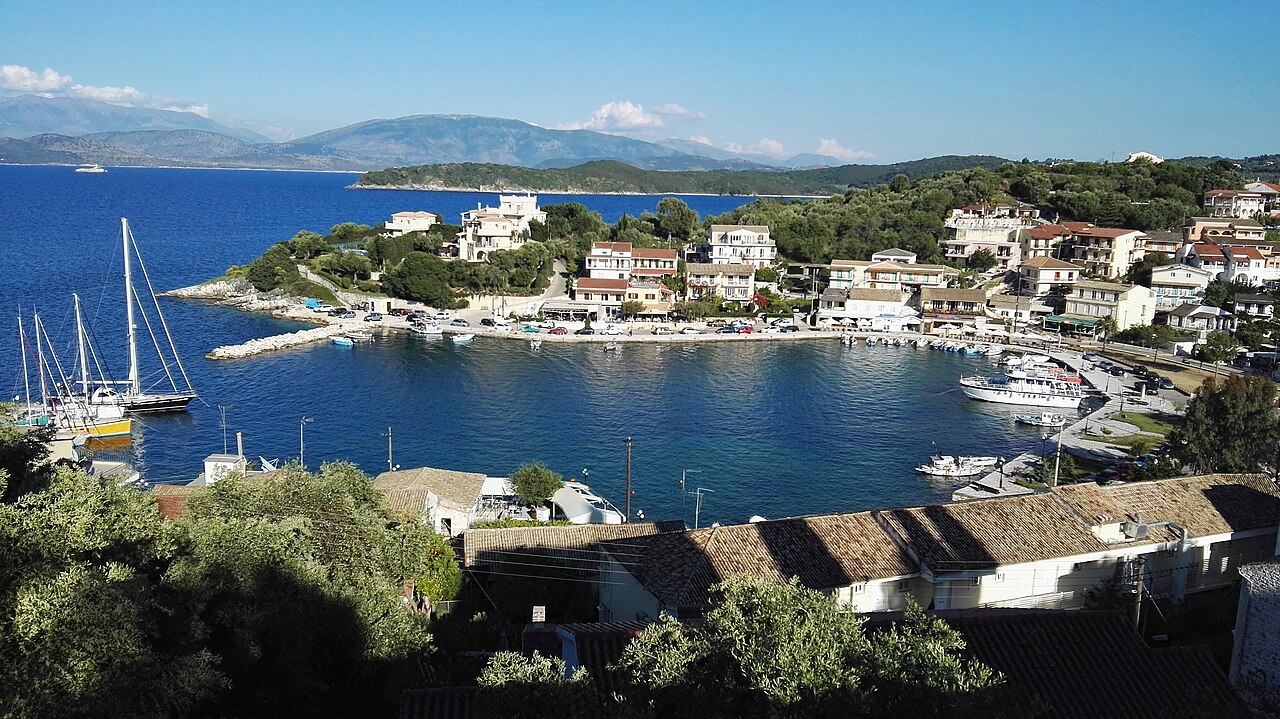
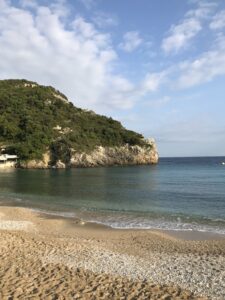
The east coast faces Albania, and the strait between them is only a few kilometres wide in places. The sea is calm almost all the time, the beaches are mostly shingle and it’s the closest coast to the airport. It suits families with small children, people who don’t want to spend their holiday behind the wheel, and anyone who wants to go into town in the evening. The downside: no sunsets, because the sun goes down behind the hills at your back.
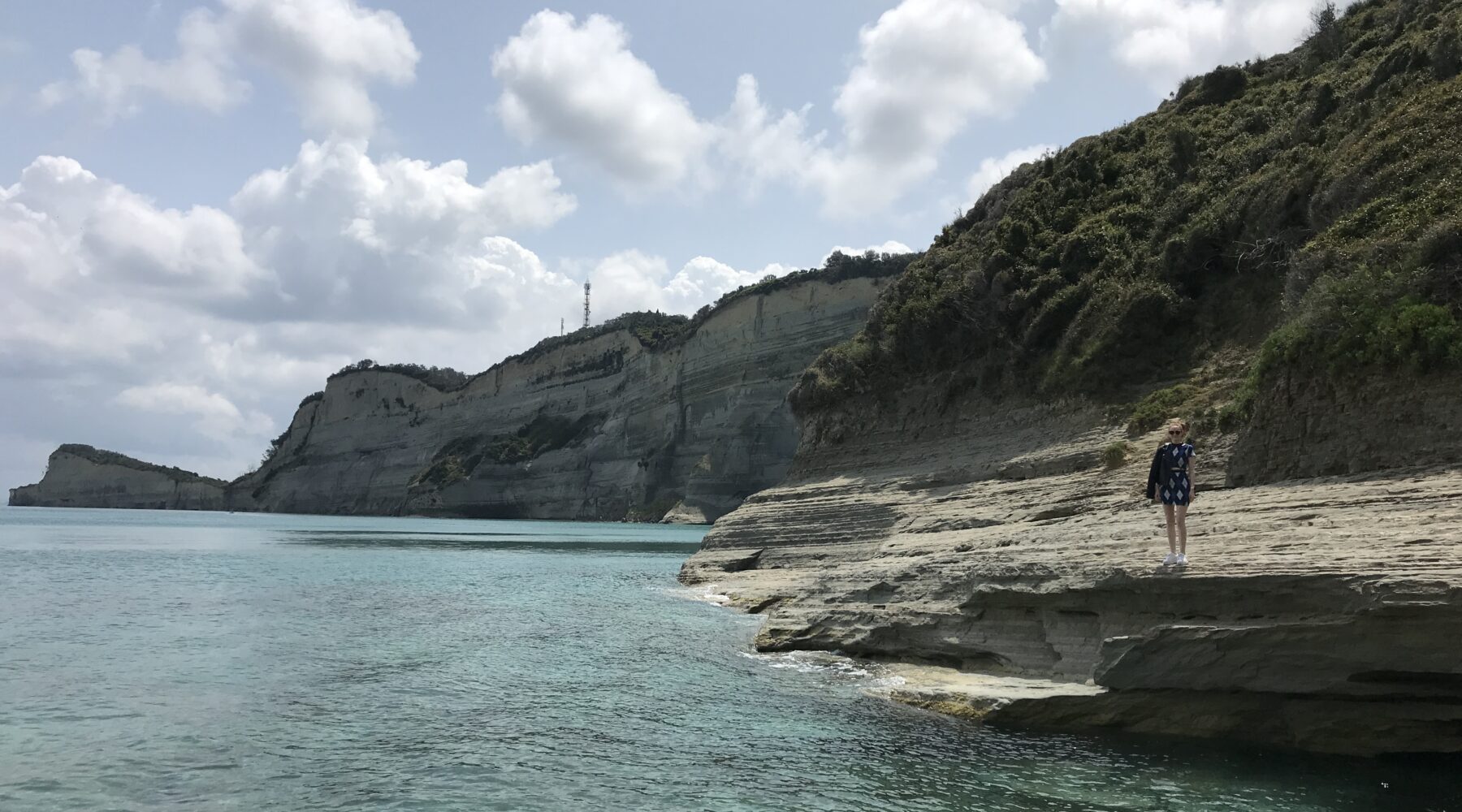
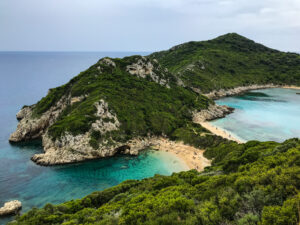
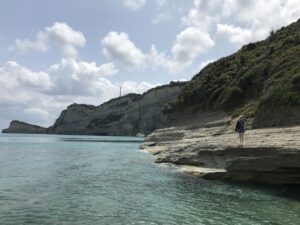
The west coast is the side Corfu gets photographed for. Cliffs dropping into the sea, deep coves, long sandy beaches and the open Ionian all the way to Italy. The sea can be rough, though, and waves are nothing unusual. Couples and photographers will love it, as will anyone who doesn’t mind a swell or actively wants one. With small children we’d choose the beach very carefully.
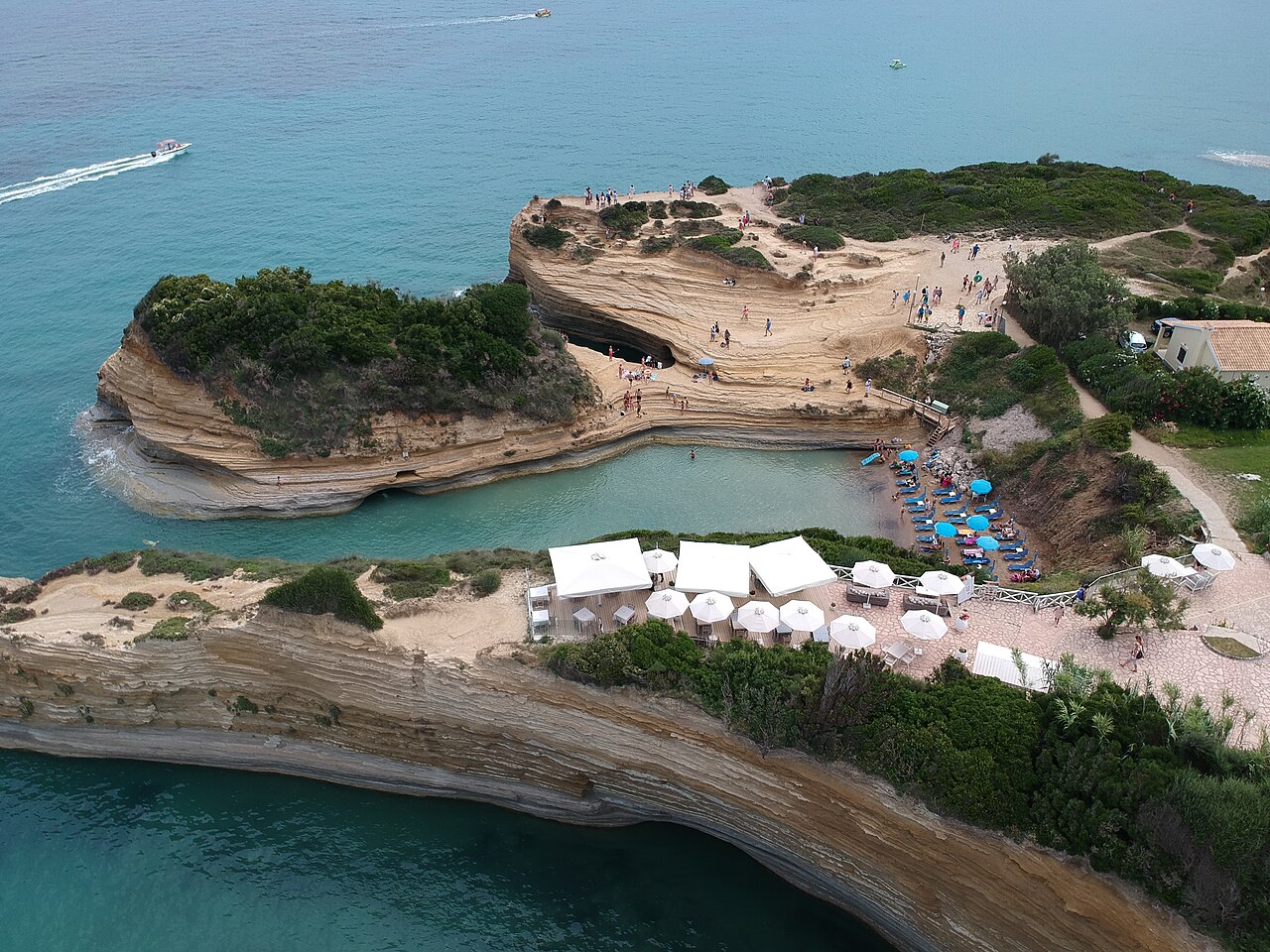
The north coast is the greenest and the furthest from the airport. The transfer can take up to an hour, but the reward is peace and quiet, mountains in view and resorts that are more than a hotel and a road. The north also has the strangest coastline on the island, because the sea has carved tunnels and channels into the soft sandstone.
The south coast is the cheapest and the most split. Part of it is quiet, flat and family-friendly, part of it is the nightlife capital of the whole island. If you’re going to Corfu for peace, double-check exactly where your hotel is. If you’re going for the opposite, you already know where to head.
| Coast | Best for | Sea and beaches | From the airport |
|---|---|---|---|
| East (Gouvia, Dassia, Ipsos, Barbati, Nissaki) | Families, first-timers, anyone who doesn’t want to drive | Calm, mostly shingle | 8 to 25 km |
| West (Paleokastritsa, Glyfada, Agios Gordios, Ermones) | Couples, photographers, sunset lovers | Sand and shingle, can get wavy | 17 to 30 km |
| North (Sidari, Roda, Acharavi, Kassiopi) | Greenery, quiet and less concrete | Shallow sandy beaches, cliffs in the north-west | 34 to 40 km |
| South (Benitses, Moraitika, Messonghi, Kavos) | The cheapest deals, and nightlife | Long, shallow beaches | 11 to 50 km |
| Corfu Town and around | Sights and food, not just the sea | Beaches a short ride out of town | 3 km |
Distances from the airport come from the Blue Style catalogue (checked 13 Sept 2026); the figure for Kavos is our own estimate by road.
Where to stay in Corfu
There are four quite different ways to stay on Corfu, and the gap between them is bigger than the gap between star ratings.
Big all-inclusive resorts make up most of what the package operators sell. They tend to be on the east and north coasts, have their own beach or sit a few metres from one, and their main advantage is that you don’t have to think about anything. Their main drawback is that plenty of guests never leave the grounds all week. Some of them are names people on Corfu know: Blue Princess in the south, Golden Mare in Barbati on the east coast or Aeolos Beach Resort near Perama. Each one is in a different place and means a different holiday, even though they’re all sold under the same all-inclusive label.
Small family-run hotels and apartments are what works best on Corfu if you’re hiring a car. They’re usually cheaper, they’re in a village rather than in the middle of nowhere, and dinner means the taverna across the street. Corfu has lots of them, because the island lived off tourism long before the big resorts were built.
Staying in Corfu Town is a category of its own. It isn’t a beach holiday, it’s a city break by the sea. The old town has guesthouses in Venetian buildings with high ceilings, the beach is a few kilometres’ drive away, and in the evening you’re in the one Greek town that looks like Italy. Personally, we like to spend two or three nights there at the end of a trip.
Villas and houses in the north-east are the most expensive and the quietest option. The stretch between Nissaki and Kassiopi is where the British have traditionally gone, renting whole houses with a pool above the sea. For the price of a five-star resort you get privacy, but you’ll have to drive and cook.
How to choose the exact spot
- Convert the distance from the airport into hours, not kilometres. Corfu’s roads are narrow and twisting. Forty kilometres to Roda is an hour’s drive in practice, not half an hour.
- Check whether you can walk to a village from the hotel. This decides whether your evenings are spent in tavernas or in the hotel restaurant. On Corfu, we think it’s the biggest difference between a good holiday and a dull one.
- Check what the beach is made of. Much of the east coast is shingle. That’s no bad thing, the water is clearer for it, but with kids you’ll want water shoes, and it’s not ideal for an inflatable.
- Watch out for “beachfront” hotels across a road. On Corfu the main road runs along most of the coast, and “0 m to the beach” sometimes means you have to cross it.
- Book early. Corfu is one of the best-selling Greek destinations, and the best places for July and August are often gone by spring.
We compare accommodation village by village, not across the whole island, because typing “Corfu” into a booking site lumps together places fifty kilometres apart. Here are the links for the individual resorts: places to stay in Corfu Town for a city break, places to stay in Paleokastritsa for the west coast, Acharavi and Sidari for the north, Benitses for the quiet south and Kavos for a completely different kind of holiday.
How much does a Corfu holiday cost
Corfu isn’t the cheapest Greek island, but it’s well below Santorini or Mykonos. In the catalogue of a premium holiday specialist we went through on 10 Sept 2026, the median price per room per night for two on Corfu was the equivalent of about €316 (around £270), while on Mykonos it was about €896 (around £760). In the mainstream market the gap is smaller, but it points the same way.
Package holidays. The cheapest way onto Corfu is a package with flights included. In the offers we checked on 13 Sept 2026 (Central European operators flying from Prague), four-day breaks started at around €396 (about £340) and September late deals for seven nights all inclusive came to €480 to €600 (about £410 to £510) per person. UK packages are priced in their own market, but the pattern holds: if you book flight and hotel separately in high season, you’ll rarely get below what a package costs.
The climate tax. Greece charges guests a climate crisis resilience fee, and it isn’t included in package prices. You pay it at reception in cash or by card, and it’s charged per room per night, not per person. According to tour operators (Blue Style, checked 13 Sept 2026), in season it’s roughly €15 (about £13) for five-star hotels, €10 (about £8.50) for four-star, €5 (about £4.25) for three-star and €2 (about £1.70) for lower categories. A week in a four-star hotel adds about €70 (around £60). Rates are lower outside the main season, but the ministry changes them from time to time, so check when you book.
Car hire. This is the most variable item of the lot. In July and August a small car costs considerably more than in May or October, and in high season it’s worth booking ahead because the island’s rental fleet is limited. Prices change week to week, so check them when you’re actually ready to book.
Food and drink. In an ordinary taverna away from the main resorts you’ll eat for less than in a resort, and in our view it’s the best-spent money of the whole holiday. Corfu has its own cuisine, different from the rest of Greece, because four centuries under Venice left behind pastitsada, sofrito and enough pasta to make you forget now and then where you are.
What to budget for in advance: on top of the package price, add the climate tax (per room per night), a transfer or car if it isn’t included, and days on the beach with sunbeds. A set of two sunbeds and a parasol is routinely charged on Corfu’s main beaches, and it adds up over a week. On smaller beaches without facilities you pay nothing, but you need to bring your own water and shade.
Do you need a car in Corfu?
Our answer is yes, but not for the whole week.
Corfu has public transport that works in a star pattern: the blue town buses cover the area around Corfu Town and the green long-distance buses run from town out to the resorts. The catch is that if you want to get from one resort to another, you usually have to go via Corfu Town, even when on the map it looks like a few kilometres along the coast. For one day trip that’s fine; for exploring the island it eats up a whole day.
A car isn’t ideal all the time either. The mountain roads are narrow, parking in Corfu Town is close to impossible, and in Paleokastritsa finding a space in season is a battle. So our advice is: hire a car for three or four days in the middle of your stay, use it to see both coasts, and spend the rest of the week by the sea within walking distance of everything.
If you don’t want to drive at all, pick the east coast or the area around Corfu Town. From there you can get almost everywhere by bus, and organised boat trips along the west coast will cover what you’d otherwise drive to. If you do drive, remember that Greece drives on the right.
Best time to visit Corfu
There are two ways to read the Corfu season. One is temperatures and rainfall, which we cover elsewhere. The other is prices, crowds and what’s actually open, and that’s where holidays go wrong far more often.
High season runs from mid-June to mid-September. It’s hot, it’s dry and it’s full. The last two weeks of July and the whole of August are the most expensive part of the year, because school holidays across much of Europe, the UK included, all overlap at once.
May and early June are the most beautiful time, as long as you don’t mind the sea still being cool. The island is green and in flower, prices are lower and you can actually park in Paleokastritsa. This is when we like coming most, because Corfu looks completely different from August, when the grass is scorched.
September is the best compromise and, for us, the best month on Corfu full stop. The water is at its warmest of the year, the main rush is over and prices have dropped. The second half of September tends to be noticeably more changeable, though.
October is, for us, an island for exploring, not for lying on a beach. By mid-month most beach services and some hotels close, but if you come for the mountains, the villages and the town, you’ll have it all to yourself.
Winter on Corfu is a city destination for us. There are no direct flights and the beach resorts are shut, but Corfu Town is alive, and combined with a trip to Albania it makes an interesting long weekend. Temperatures, rainfall and sea temperatures month by month are in our piece on Corfu weather.
How many days in Corfu is enough
Seven nights is a sensible minimum on Corfu, and fourteen isn’t too many. The island is big enough that you can’t cover it from one base, and rugged enough that every drive takes time.
The split that works best for us: four days by the sea on one coast, two days with a car on the other side of the island and two nights in Corfu Town at the end. If you’re travelling with small children, feel free to drop the middle part and stay put. If you’re going for ten days or more, consider splitting your stay between two bases, north and south, because it saves a lot of driving.
What we definitely don’t recommend is planning a different trip every day. Corfu is too slow and too hot for that, and it’s the surest way to come home from a holiday exhausted. Our list of places to choose from is in the guide to things to do in Corfu, and it’s deliberately longer than anyone can fit in.
Practical things worth knowing before you go
- Documents. Greece is in the EU and Schengen, so UK travellers need a passport, and Schengen rules on passport validity and date of issue apply. Check the current entry requirements on GOV.UK before you travel. For a day trip to Albania you’ll need your passport too, as Albania isn’t in the EU.
- Currency and time. Greece uses the euro and is two hours ahead of the UK.
- Electricity. 230 V and European two-pin sockets, so bring a UK-to-EU adaptor.
- Water. Tap water is commonly drunk on Corfu, but the taste varies from place to place, and in the south of the island it can have a noticeable taste. Bottled water is sold everywhere.
- Roads. The main routes are fine; village roads in the mountains are narrow with no crash barriers. The way down to a cove is often a steep hairpin road where two cars can only pass in lay-bys.
- Kumquats. A small citrus fruit that grows practically only here, and kumquat liqueur is the most typical Corfu souvenir. It costs a few euros and makes a better present than a fridge magnet.
Corfu holiday FAQ
How expensive is a holiday in Corfu?
A package with flights is the cheapest option. In the offers we checked on 13 Sept 2026 (Central European operators), four-day breaks started at around €396 and September late deals for seven nights all inclusive came to roughly €480 to €600 (about £410 to £510) per person. On top of that comes the climate tax, which isn’t included: roughly €2 to €15 per room per night depending on the hotel category. In the premium segment, the median price per room per night for two on Corfu was about €316 (a premium specialist’s catalogue, checked 10 Sept 2026).
Which side of Corfu is best?
It depends who you’re travelling with. The east has the calmest sea and the shortest transfer, so it suits families and anyone who doesn’t want to drive. The west has the best beaches and the sunsets, but it can get wavy. The north is the greenest and quietest, but furthest from the airport. The south has the cheapest deals and also the biggest contrast between quiet and noisy resorts.
How do you get to Corfu from the UK?
Most people fly direct: in season there are flights from many UK airports, mostly with package operators and low-cost airlines, so check what’s running from your nearest airport. Seasonal routes operate from spring to autumn; in winter you fly via Athens. The airport is three kilometres from the centre of Corfu Town, so the transfer to most resorts on the east coast takes under half an hour.
Do you need a car in Corfu?
Not for the whole stay, but for part of it, yes. Buses run in a star pattern out of Corfu Town, so getting between two resorts on the same coast by public transport often means going via town. What works best for us is hiring a car for three or four days in the middle of the stay. If you don’t want to drive at all, stay on the east coast or close to Corfu Town.
Can you do a day trip from Corfu to Albania?
Yes, and it’s the shortest international crossing around. From Saranda to Corfu it’s 30 to 45 minutes by fast boat or 55 to 70 minutes by ferry (Ionian Seaways timetable, checked 13 Sept 2026). UK travellers need a passport. Bear in mind that you can’t take a Corfu hire car to Albania, the operator states this explicitly. So you go as a foot passenger and arrange a transfer on the Albanian side.
When is the cheapest time to go to Corfu?
At the edges of the season: May, early June and from mid-September to mid-October. That’s when packages and car hire are cheapest and you can park in the resorts. The most expensive weeks are the end of July and all of August, when several countries’ school holidays overlap.
Is Corfu good for families?
Yes, but keep an eye on two things: what the beach is made of, and whether there’s a road between the hotel and the beach. The east coast has the calmest sea but a lot of shingle beaches, so water shoes come in handy. Shallow sandy beaches with a gentle slope are mostly in the north and south of the island.
How many days in Corfu is enough?
Seven nights is a sensible minimum, and ten to fourteen days is ideal. The split that works best for us is four days by the sea, two days with a car on the other side of the island and two nights in Corfu Town at the end. On a longer stay it makes sense to move once and stay on two different coasts.
Where next
- Things to do in Corfu: specific places, from the Venetian fortresses and the Achilleion to the Canal d’Amour. You now know when and where to go; this is what to do once you’re there.
- Corfu weather: air and sea temperatures month by month, rainfall, and why Corfu is greener than the rest of Greece.
- What to see in Albania: if you want to combine Corfu with the mainland opposite, here are thirty-five tips from over there.
Potřebujete pomoct s cestováním?
-
Ubytování 🏨
Vyberte si to nejlepší ubytování, ať už jste kdekoliv, přes Booking.com. -
Půjčení auta 🚗
Auto si snadno najdete přes Booking.com, kde máte často slevu díky ubytování, nebo Rentalcars.com, kde porovnáte nabídky většiny půjčoven. -
Zážitky 🎟️
Přes GetYourGuide.com si vyberete z nejrůznějších výletů i zážitků po celém světě, navíc se zrušením zdarma do 24 h předem.