Last updated 17.11.2026
Zante has a reputation as an island where it’s easy to book the wrong holiday. Not because it isn’t beautiful, it is. The trouble is that on an island barely bigger than the Isle of Wight you’ll find a resort with a bar on every corner, beaches you’re not allowed on after dark because of nesting turtles, and limestone cliffs in the west where you won’t meet a soul once the sun goes down. Book purely on the strength of a hotel photo and you can end up on a completely different holiday from the one you had in mind.
So in our view a good Zante holiday is decided before you start scrolling through hotels, with two questions: which part of the island will you stay in, and will you hire a car? Zakynthos, to use its Greek name (Brits and Italians mostly call it Zante, and it’s the same place), is small enough to cross from any resort in under an hour. It’s just that the other end can feel like a different country. Below we cover where the island is, how to get there from the UK, which area suits whom, the rules on the turtle beaches and at the famous Navagio shipwreck, and what a week on Zante really costs.
Zante holiday at a glance
- Direct flights from the UK run in season, roughly May to October, mostly with package holiday airlines and low-cost carriers. The airport is 6 km from Zante Town and under 5 km from Laganas, so the transfer to most hotels takes about a quarter of an hour.
- Pick the area first, the hotel second. Laganas means parties, Kalamaki and Vasilikos mean turtles and quiet, Tsilivi and Alykes are for families, Keri and the west for cliffs and sunsets.
- Navagio beach is off limits. For the 2026 season a ban applied to landing on the beach, swimming in the bay and boats coming closer than 50 m to the shore. You can still see the shipwreck from the clifftop viewpoint or from a boat.
- Turtle beaches are open from 7am until sunset only. That covers Laganas, Kalamaki, Gerakas, Dafni and Marathonisi. Sekania is closed completely.
- The climate tax is paid at reception, per room per night: from April to October €2 (about £1.70) at one- and two-star hotels, €5 at three-star, €10 at four-star and €15 (about £13) at five-star. Short-term lets such as Airbnb pay €8.
- Hire a car for at least two or three days. Buses run from town to the big resorts, but the west coast, the viewpoints and the coves are only reachable without a car on an organised trip.
- September is, in our view, the best mix of weather, sea and prices. We go through it month by month in our guide to Zante weather.
Where is Zante and what is the island like?
Zakynthos is the southernmost of the large Ionian Islands. It sits in the Ionian Sea off the west coast of the Peloponnese, just south of Kefalonia, which you can see on a clear day from Cape Skinari at the island’s northern tip. At 410 km² it’s the third largest island in the Ionian group after Kefalonia and Corfu. The coastline runs to 123 km and around 40,000 people live here, roughly a quarter of them in the capital, which shares the island’s name: Zakynthos Town, or simply Zante Town.
The island is shaped like an arrowhead and split into two very different halves. The east and south are lowland: olive groves, vineyards and long sandy beaches that shelve gently into the sea. Almost every resort is here, along with the airport and the town. The west is a high plateau that ends in limestone cliffs over a hundred metres tall. Beaches are scarce on that side, but the coves, sea caves and viewpoints are among the most photographed spots in Greece. The highest peak, Vrachionas, tops 750 metres.
The Venetians called Zakynthos Fior di Levante, the Flower of the Levant, and if you come in April or May you’ll see why. By Greek standards it’s a very green island, with pines, cypresses and olives, and in spring everything is in flower. By August the grass has burnt to yellow, but the forests in the west stay green all summer. Its other nickname is “turtle island”: Laganas Bay in the south is one of the most important nesting sites in the Mediterranean for the loggerhead sea turtle (Caretta caretta). That’s why the National Marine Park was created, and why some beaches come with rules, which we explain further down.
To give you a sense of scale: from Cape Skinari in the north to Gerakas in the south-east is about 36 km as the crow flies. By road from the airport it’s just under 5 km to Laganas, 10 km to Tsilivi, 17 km to Alykes, around 19 km to Vasilikos and Limni Keri, and 35 km to the viewpoint above Navagio (road distances from a route planner). Roads in the west twist and turn, so treat the kilometres there with some caution.
How to get to Zante from the UK
Zakynthos has an international airport, Dionysios Solomos (code ZTH), right on the southern edge of town. Most British visitors arrive on a package holiday, and that’s the easiest way to do it. But the island works perfectly well if you travel independently, too.
Flying from the UK. In summer Zante is a classic British holiday island. The airport’s own list of airlines includes Jet2.com, TUI Airways, easyJet, British Airways and Ryanair, which between them fly from a number of UK airports. Many seats are sold as part of packages, but plenty can be booked as flight-only. Routes and frequencies change from year to year, so check what’s flying from your nearest airport. The direct flights are seasonal, roughly May to October. In winter there are no direct flights and you’ll connect via Athens.
By ferry from the Peloponnese. Kyllini, a port on the west coast of the Peloponnese, is linked to Zakynthos Town by Levante Ferries. The crossing takes about 1 hour 15 minutes and in season there are several sailings a day. According to the operator’s fare list, a one-way ticket costs €13.50 (about £11.50) per adult and €7.50 for children aged 5 to 10, under-fives travel free, and a car costs €38.40 (about £33). It’s the route to take if you’re touring Greece by car or want to combine Zante with the Peloponnese or Kefalonia.
By bus from Athens. The island’s bus company, KTEL Zakynthos, runs four buses a day from Athens’ Kifissos bus station to Zakynthos, and the bus boards the ferry at Kyllini with its passengers. The operator says the ferry is not included in the bus fare and is paid separately. It’s the cheapest way to get from Athens airport to Zante, but expect it to take most of the day.
From the airport to the resorts. The airport is so close that a package transfer to Laganas or Kalamaki takes a few minutes, and to Tsilivi about a quarter of an hour. Independent travellers take a taxi or pick up a hire car at the airport. Regular KTEL buses mainly run from the bus station in town out to the resorts, to Laganas and Tsilivi several times a day.
💡 Check for aircraft noise before you book. The airport lies between Laganas and Kalamaki and the runway ends close to the bay, so planes fly low over this stretch of coast. Most people don’t mind during the day, but if you’re after peace and quiet, look at the map to see how far your hotel is from the runway.
Best time to visit Zante
The swimming season on Zante runs from about early June to early October, with peak season (and peak prices) from mid-July to the end of August. May is still cool for swimming, but the island is green and the hills are great for walking. If it were up to us, we’d go in September: after the summer the sea is at its warmest, the schools are back and even in Laganas you can get some sleep. From late October most hotels and tavernas in the resorts close, and the direct flights stop with the end of the season. We look at air and sea temperatures, rainfall and wind month by month in a separate piece on Zante weather.
Where to stay in Zante: which area suits whom
For us this is the single most important decision of a Zante holiday. Holiday brochures list over twenty “resorts”, but in reality there are five or six areas, and they differ from each other far more than the hotels within them do.
The south: Laganas and Kalamaki. Laganas Bay has the longest sandy beach on the island, and two completely different faces. Laganas is Zante’s biggest and loudest resort, its main strip packed with bars and clubs and very much the home of the young British party crowd. Yet on its edges and in neighbouring Kalamaki it’s quiet, with a gently shelving sandy beach and turtle nests. Kalamaki is, in our view, one of the nicest bases for families, as long as you can live with the airport next door. The beaches at both resorts are open during the day only. We cover Laganas, Agios Sostis with Cameo Island and turtle-spotting trips in detail in our guide to Laganas, Zante.
The south-west: Keri and Limni Keri. At the western end of the bay lies the small harbour of Limni Keri, with the village of Keri on the hill above. Boats leave from here for the sea caves in the cliffs and for Marathonisi, and up by the lighthouse is one of the best sunset viewpoints on the island. It’s a quiet area with a handful of hotels and apartments, good for couples and for anyone with a car who doesn’t need bars in the evening.
The south-east: the Vasilikos peninsula. The greenest and least built-up part of the south coast. Along the peninsula you’ll find Banana Beach (long, organised, with water sports), Porto Zoro, Agios Nikolaos, Porto Roma, Dafni and, right at the end, Gerakas, a turtle beach backed by sandstone cliffs. Hotels are scattered over the hillsides and there’s no centre or promenade. For us it’s the loveliest area for a week by the sea, but without a car it hurts: the bus from town only runs a few times a day.
The east and north: Argassi, Tsilivi, Planos, Tragaki, Alykes. Argassi sits on the edge of Zante Town, with a busy main street and a short hop into the centre. North of town is Tsilivi, the island’s second largest resort. It belongs to the village of Planos, which is why holiday listings use both names. It has a long beach with shallow water, water sports, a water park and plenty of tavernas, and it’s the classic choice for families with children. Further north come the smaller resorts of Tragaki, Amboula and Alykanas with Alykes, where the beaches stretch for two kilometres and the boat trips to the Blue Caves are close at hand. We describe Tsilivi and Planos in detail in our guide to Tsilivi and Planos, Zante.
The west: Kampi, Agalas, Volimes, Anafonitria. Nobody comes here for a beach holiday, people come for day trips. The villages on the plateau have tavernas, churches and viewpoints, and below the cliffs are the coves of Porto Limnionas, Porto Roxa and Porto Vromi. You can stay in villas and apartments, and if you’re looking for silence on Zante, this is where you’ll find it. But every trip to the sea means driving down a hairpin road.
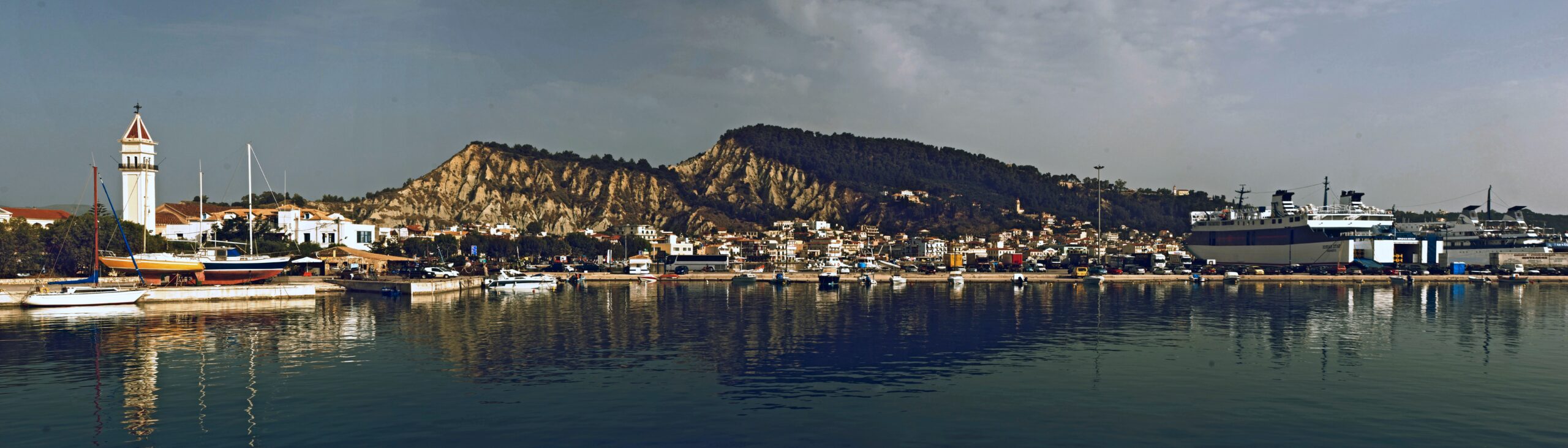
Zante Town. The capital was almost entirely rebuilt after the 1953 earthquake, yet it keeps its Venetian layout: Solomos Square with the waterfront, St Mark’s Square, the arcades of Alexandrou Roma street and the Church of St Dionysios with its tall bell tower by the harbour. Above town rises Bochali hill with a Venetian fortress and tavernas with a view. There are no beaches worth the name in town, but in our view two nights here at the start or end of your stay are well worth it.
| Area | Best for | Beach | From the airport |
|---|---|---|---|
| Laganas (centre) | Nightlife, groups of friends | Long and sandy, turtle beach, daytime only | just under 5 km |
| Kalamaki, edges of Laganas | Families, couples, short transfers | Sandy and shallow, turtle beach, daytime only | 5 to 9 km |
| Keri, Limni Keri | Couples, peace and quiet, boat trips | Small beach by the harbour, cliffs within reach by boat | 19 km |
| Vasilikos (Banana, Gerakas, Porto Roma) | Quiet, nature, anyone with a car | Sandy coves, some of them turtle beaches | 15 to 19 km |
| Argassi | Close to town on a budget | Smaller beach right in the resort | 8 km |
| Tsilivi, Planos, Tragaki | Families with children, first-timers | Long, sandy, shallow | 10 km |
| Alykanas, Alykes | Families, trips to the north | Long and sandy | 17 km |
| The west (Kampi, Agalas, Volimes) | Silence, villas, keen drivers | Rocky coves below the cliffs | 25 to 35 km |
| Zante Town | Food, evenings out, no car needed | Practically none | 6 km |
Distances are by road from the airport, taken from a route planner and rounded.
Zante hotels: what kind of place to book
Accommodation on Zante comes in two main types: large all-inclusive hotels sold by the big tour operators, and small studios and apartments with a kitchenette run by local families. The large resorts are mostly in Laganas, Kalamaki, Tsilivi and Tragaki. Studios are everywhere, but they make the most sense where there are plenty of tavernas nearby, which means Tsilivi, Alykanas, Argassi or Limni Keri. On Vasilikos and in the west you’ll mostly be staying in villas and smaller hotels set in gardens. We’ve picked four hotels in different parts of the island and at different price levels:
The Bay Hotel & Suites (Vasilikos). A five-star hotel on its own sandy beach on the Vasilikos peninsula, with free sunbeds for guests and a large pool. It’s one for people who want peace, the sea below the balcony and are planning to hire a car anyway, because there’s no resort around, just more beaches.
Diana Palace Hotel (Argassi). A four-star half-board hotel a few minutes from the beach and 3 km from Zante Town. It has a pool in a palm garden, an outdoor playground and an indoor games room, so it suits families who want to be close to town without having to think about dinner every night.
Koukounaria Hotel & Suites (Alykes). A hotel on the edge of Alykes in an olive garden, 300 metres from both the beach and the centre. It has two pools, one of them for children, and a restaurant that cooks with vegetables from its own garden. A good base for the north of the island and for trips to the Blue Caves.
Diana Hotel (Zante Town). A town hotel right on St Mark’s Square with a rooftop pool. It’s not for a beach holiday, but for two nights in town, with dinner in the back streets and morning coffee on the square, it’s exactly right.
If you’d rather choose yourself, search by village rather than for the whole island: places to stay in Kalamaki, in Laganas, on Vasilikos, in Limni Keri, in Tsilivi, in Alykes and in Zante Town. For more hotels sorted by type of holiday, from all inclusive to adults only and villas, see our guide to Zante hotels and where to stay.
How to choose the exact spot
- Your exact location in Laganas. The difference between a hotel on the main strip and one a kilometre further towards Agios Sostis or Kalamaki is the difference between sleeping and not sleeping. Check the map, not the “short walk from the centre” in the description.
- The beach below your hotel may be a turtle beach. In Kalamaki, Laganas and at Gerakas you can’t go on the beach after sunset, and umbrellas are allowed only in approved rows. No evening strolls on the sand there.
- Go car-free only where there’s plenty within walking distance. Tsilivi, Laganas, Kalamaki, Argassi, Alykanas and the town all work without a car. Vasilikos, Keri and the west don’t.
- A studio with a kitchenette is worth it here. Zante has a huge choice of small family-run studios with a pool and tavernas nearby. It’s cheaper than a resort and, in our view, more fun too.
Best places and beaches in Zante
Just a quick overview here, so you know what’s worth getting in a car or on a boat for. Exactly where to go and how, we cover in our guides to the individual resorts.
Navagio, Shipwreck Beach
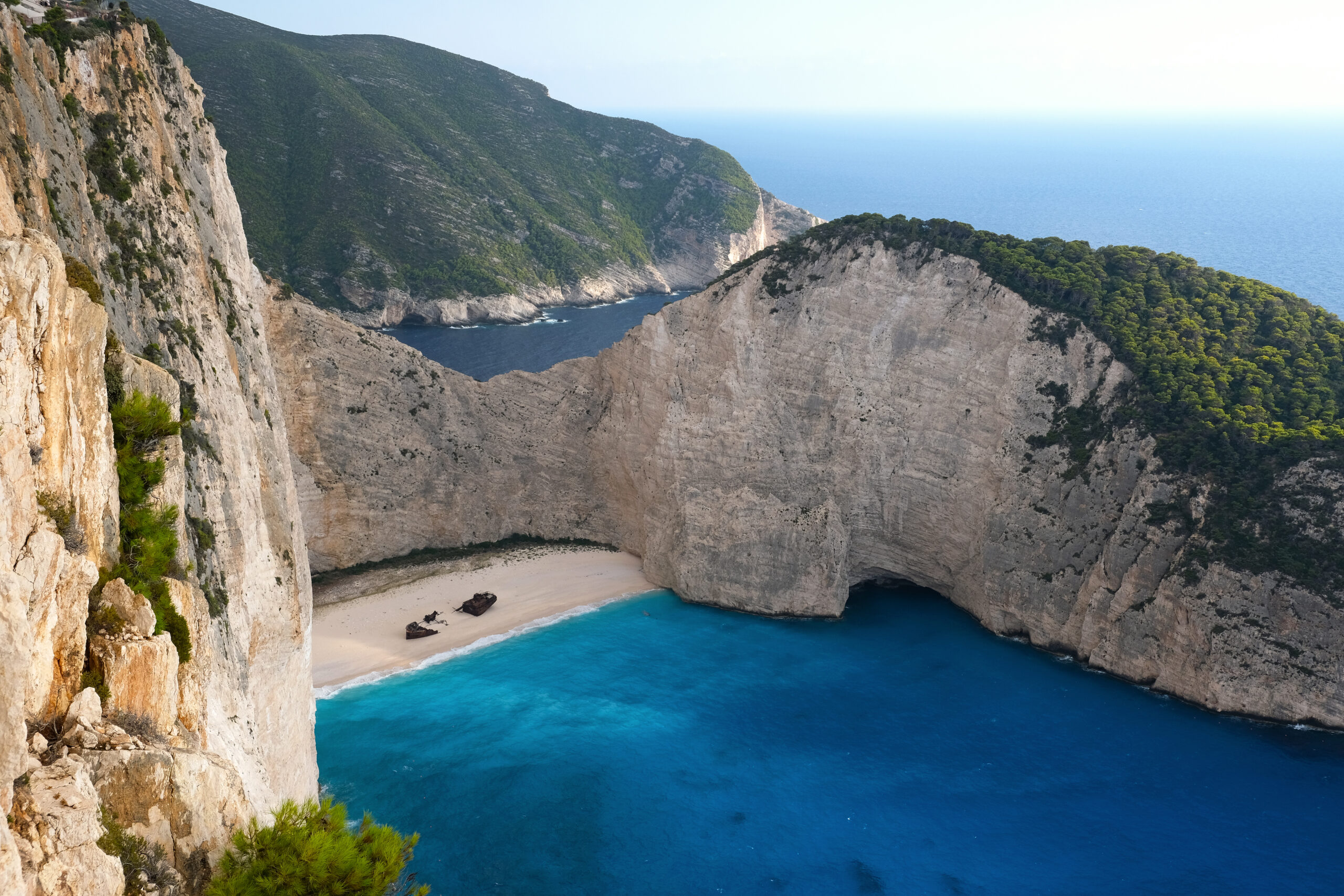
The island’s most famous spot and one of the most photographed beaches in Europe: a white cove in the north-west, hemmed in by cliffs, with the rusty wreck of the Panagiotis, which ran aground here in 1980. Since 2018, when large chunks of rock broke away from the cliffs, access to the beach has been restricted, and for the 2026 season a ministerial decree (ΦΕΚ Β 3033/2026) imposed a total ban: no landing on the beach, no swimming in the bay and no boats within 50 metres of the shore. The decree applied until 31 October 2026, and the government issues a new one each season. That leaves two options: the viewing platform on the clifftop above the bay (reached from Anafonitria monastery), or a sightseeing boat from Agios Nikolaos in the north or from Porto Vromi in the west, which sails into the bay and back out again. We’d head to the viewpoint in the morning, before the tour coaches arrive.
The Blue Caves at Cape Skinari
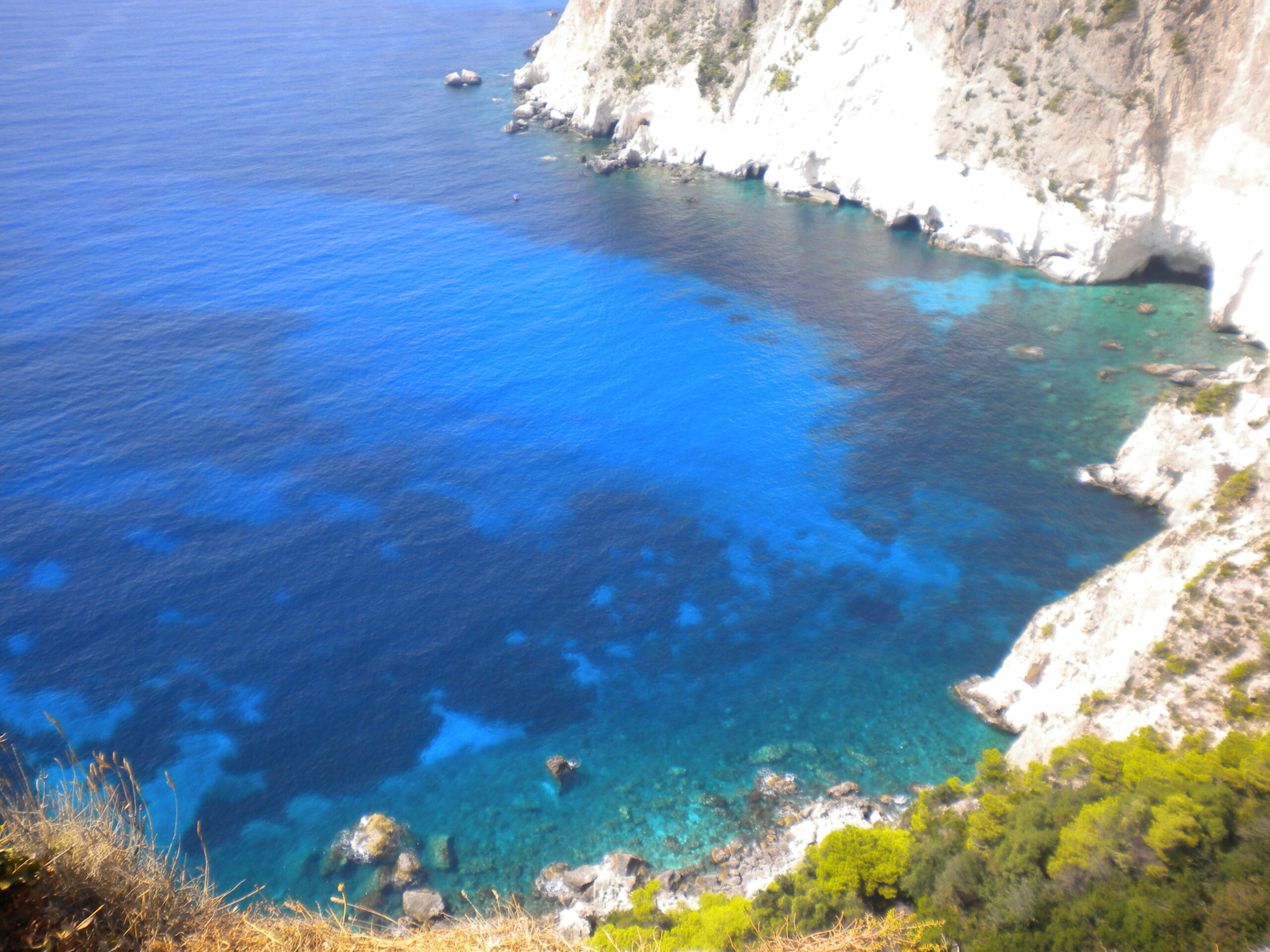
At the island’s northernmost tip, the limestone cliffs hide caves and arches where the water glows an almost unreal shade of blue. The rock itself is white; it’s the water that’s blue, and it shines brightest in the morning, when the sun reaches into the caves from the east. Small boats run out to them from the harbour at Agios Nikolaos below the village of Volimes, often combined with Navagio. Up on the cape there’s a lighthouse and two stone windmills, and on a clear day you can see Kefalonia.
Keri cliffs and the Mizithres rocks
For us, the south-western tip of the island is the best place on Zante to watch the sunset. By Keri lighthouse you stand on a white cliff above the open sea, with the limestone pyramids of the Mizithres rocks rising from the water below. There’s a taverna near the lighthouse, so you can combine dinner with the view. Mind the cliff edges: there are hardly any railings. From Limni Keri harbour below the cliffs, boats head out to the Keri caves, and you can even get there in a small hire boat, for which local rental firms don’t ask for a skipper’s licence.
Marathonisi, Turtle Island
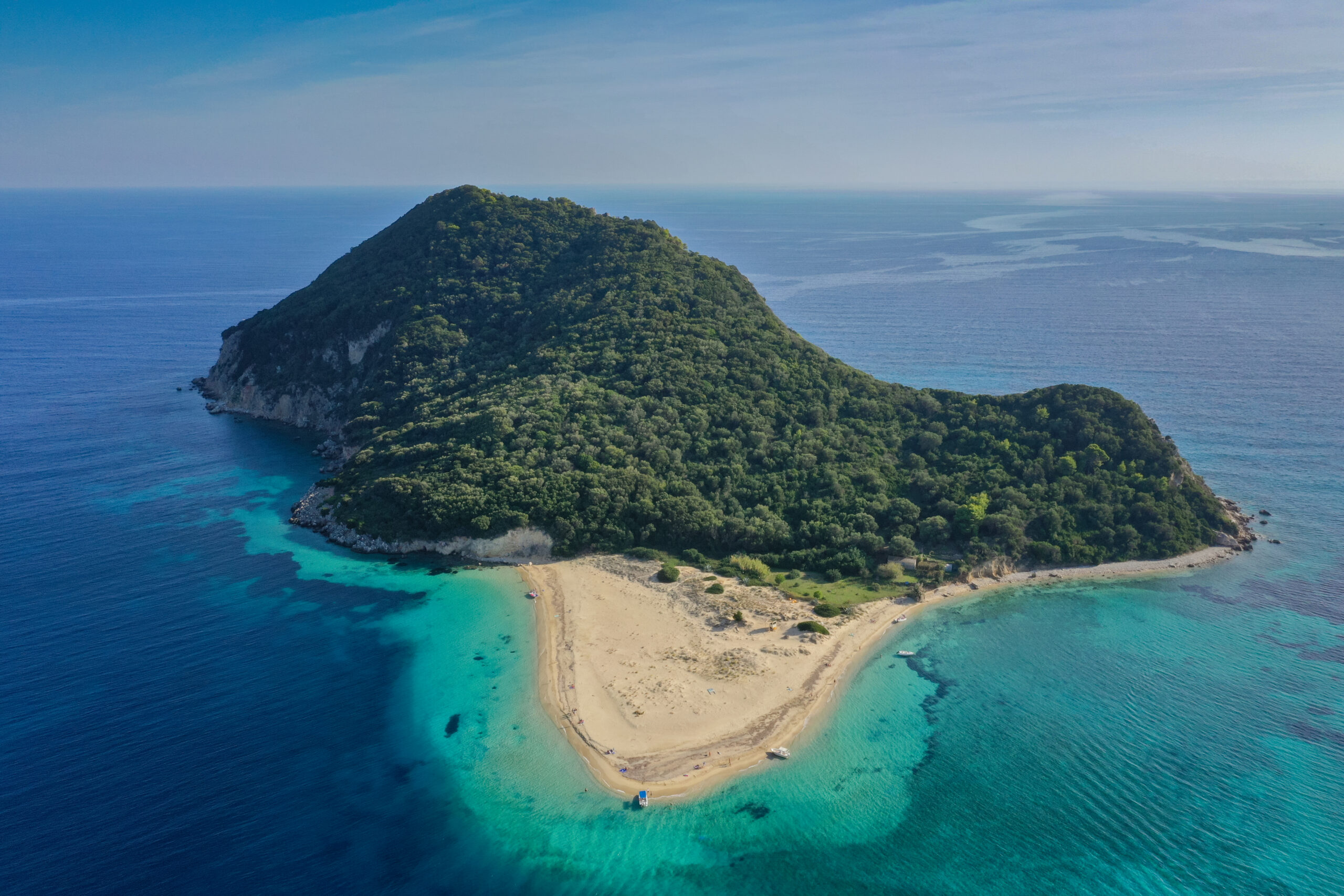
A small wooded islet in Laganas Bay, nicknamed Turtle Island because of its shape. Turtles lay their eggs on its sandy beach, so the same rules apply as on the other nesting beaches: daytime access only, no umbrellas, stay near the water. Boats come here from Laganas, Agios Sostis and Limni Keri, stopping on the way at the blue caves below the Keri cliffs. Anchoring off the islet is not allowed and boats in the park are limited to 6 knots, so be wary of anyone selling “fast” trips.
Gerakas and the Vasilikos beaches
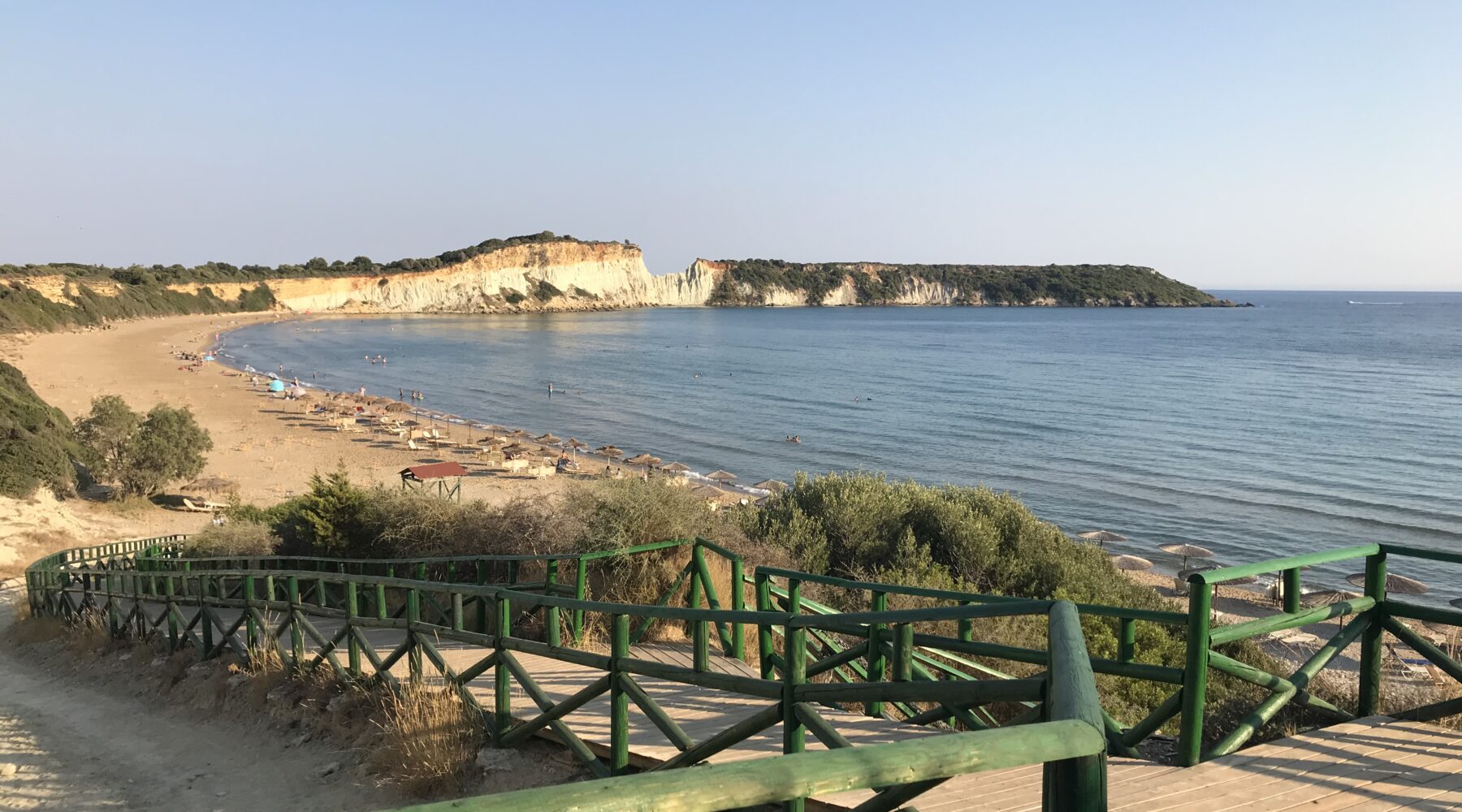
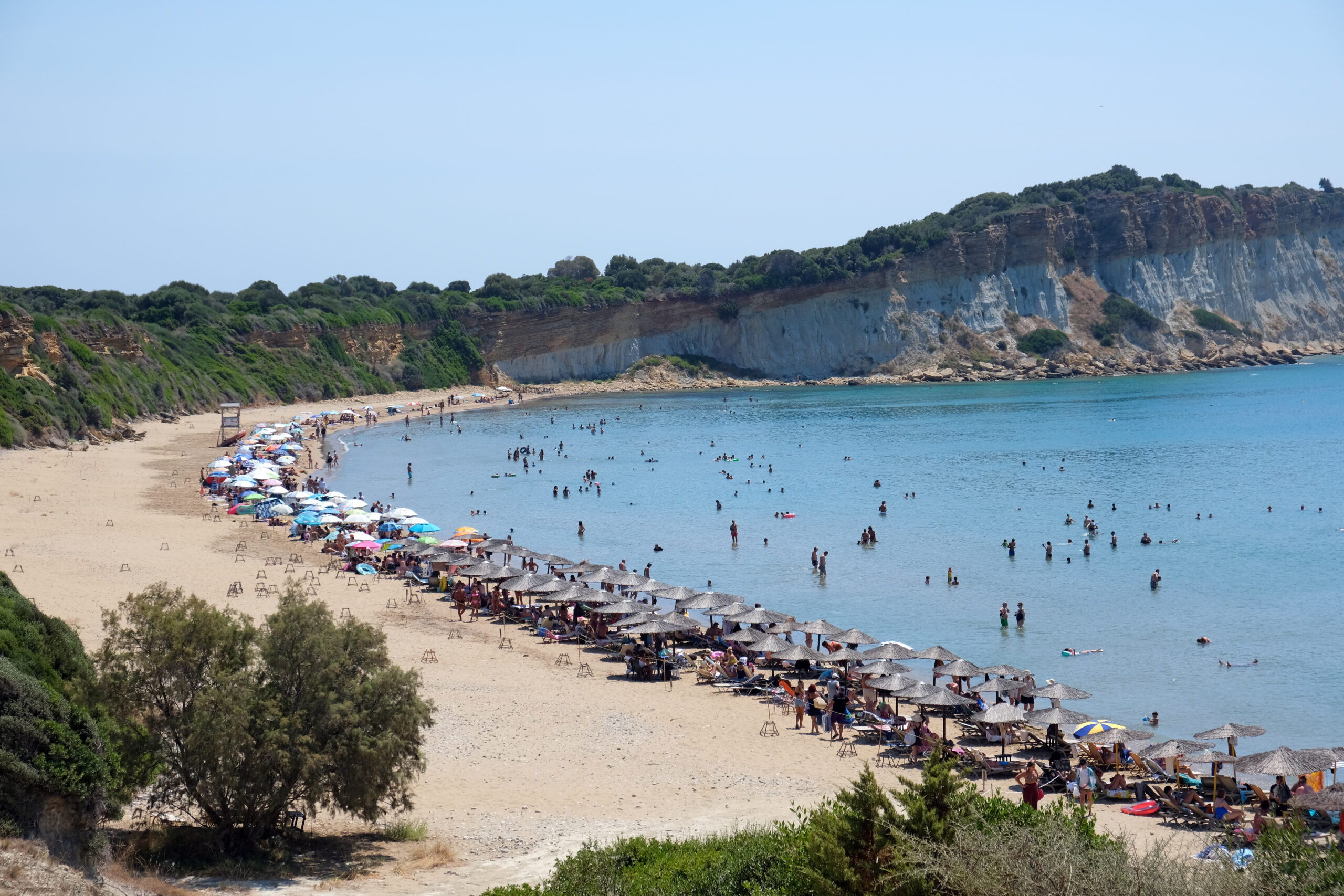
Gerakas, at the end of the Vasilikos peninsula, is a sandy cove below low sandstone cliffs, where the water stays shallow for a long way out. It’s also a protected nesting beach: the only umbrellas are the fixed ones approved by the park, taking clay from the cliffs is forbidden, and after sunset the beach belongs to the turtles. There’s a marine park information centre at the entrance. The same peninsula is home to Banana Beach with its water sports, Porto Zoro with rocks at one end, and little Porto Roma with a harbour and a taverna.
Porto Limnionas and Korakonissi
A narrow rocky inlet on the west coast below the village of Agios Leon, with turquoise water that’s deep right from the edge. There’s no sand: you lie on the rocks and either jump in or clamber down, and there’s a taverna above the cove. Close by is Korakonissi, a rocky islet joined to the land by a narrow neck, with caves and superb water for snorkelling. Both are better for confident swimmers than for small children.
Xigia and Makris Gialos
On the north-east coast between Alykes and Skinari there are small pebble coves with very clear water. Xigia is known for the sulphur springs that flow into the sea, so you’ll smell it before you see it, and in places the water is milky white. It’s small and fills up quickly in summer. A little further on is Makris Gialos, under a hundred metres of pebbles with tavernas above the beach; it pays to get there in the morning.
Kampi and the western viewpoints
The little village of Kampi, on the western edge of the plateau, sits above cliffs that drop straight into the sea, and in the evening people drive up for the sunset and dinner in tavernas looking out over the water. The area around the villages of Agalas and Kiliomenos has a similar feel, with viewpoints over the Plakaki cliffs. On the way it’s worth stopping in Volimes, with its little shops selling local handicrafts, and at Anafonitria monastery, where according to tradition the island’s patron saint, St Dionysios, lived.
Zante Town and Bochali
If you’re spending a week on Zante, give at least one evening to the capital. Walk along the waterfront from Solomos Square to the Church of St Dionysios, then down Alexandrou Roma street with its arcades and up to Bochali, where you can have dinner above the town looking out over the harbour and, on a clear day, all the way to the Peloponnese. The Byzantine Museum on Solomos Square displays icons and frescoes rescued from churches destroyed in the earthquake.
Zante turtles and the marine park: the rules you need to know
The south of the island, from Keri to Gerakas, is the National Marine Park of Zakynthos (since 2022 run by NECCA, the Greek natural environment agency). It protects the loggerhead turtle’s nesting beaches, all of which are in Laganas Bay: the eastern part of Laganas beach, Kalamaki, Sekania, Dafni, Gerakas and the beach on Marathonisi. Turtles come ashore to lay their eggs in summer, and the hatchlings emerge in the second half of summer and in autumn. The rules look strict, but in practice they mostly come down to this (based on the park’s guidelines):
- Nesting beaches are open from 7am until sunset. Nobody is allowed on them at night, because that’s when turtles lay their eggs and the hatchlings emerge.
- Sekania is closed completely. It has more nests than anywhere else in the bay, and you can’t even land there by boat.
- Stay close to the water, within about 5 metres of the sea. Further up the beach are the nests, marked with cages in busy spots. Build sandcastles by the water and flatten them before you leave, as hatchlings can get trapped in them.
- No putting up your own umbrella on Gerakas, Dafni or Marathonisi. Cars, motorbikes, bikes, horses and dogs are banned from the beaches.
- Jet skis and motorised water sports are banned in the park all year round, as is recreational fishing, spearfishing included.
- Boats in the park are limited to 6 knots and may only anchor in zone C. Keep at least 15 metres from a turtle, don’t approach it head-on and don’t stay with it for more than 10 to 15 minutes.
- Don’t feed or touch the turtles. If you come across hatchlings on the beach, don’t help them into the sea; call the park wardens instead.
Turtle-spotting trips are big business on Zante, and on some boats turtles are still surrounded or lured with food. For years, fishermen in Agios Sostis harbour fed an old male, who now turns up every morning and evening because of it, and the tour boats have turned this into an attraction. We’d choose a smaller boat whose crew bring up the rules themselves, with no promises of “guaranteed turtles”. We find it far more appealing to meet a turtle by chance while snorkelling off Keri, or early in the morning on the beach at Kalamaki, where nobody is around just after seven. You’ll find the park rules in the archive of the former park authority’s website (the original site is no longer updated).
Do you need a car in Zante? Car, quad, scooter or bus
You can do Zante without a car and spend the whole week in one resort. But everything people actually talk about when they talk about the island, the viewpoints in the west, Keri, coves like Porto Limnionas and Xigia, the villages on the plateau, lies beyond the reach of the buses. So our answer is: hire a car for at least two or three days in the middle of your stay.
Bus. The island’s KTEL buses run in a star pattern from the bus station in town to the big resorts: to Laganas and Tsilivi several times a day, and on to Alykes, Keri and Vasilikos. To get between two resorts you go via town. That’s enough for a trip into town or to one beach, but not for exploring the island.
Car. There are rental desks at the airport and in every resort. Check GOV.UK’s guidance on driving in Greece before you go to see which licence documents you need. Remember that Greeks drive on the right. The main roads are fine, but in the west and down to the coves you’ll be on narrow hairpins without crash barriers. Find out whether the rental firm wants a credit card for the deposit: with a debit card your choice will be smaller.
Quad bike. In summer they’re everywhere on Zante and they look like fun. According to Greek rules as quoted by rental firms, a standard car licence (category B) is enough for a quad, and helmets are compulsory for both rider and passenger. In summer 2026 the Ministry of Transport announced stricter rules for rental firms (the firm must supply the helmet, and riding a quad is to require five years’ driving experience), so check the current conditions when you hire. We’d only get on a quad if we were completely confident handling one: on narrow roads shared with cars and coaches, tourist quad accidents are sadly common in Greece, and insurance often doesn’t cover riding off the tarmac.
Scooter. With a car-only licence (category B) you can usually hire nothing bigger than a 50cc scooter in Greece. For a 125cc, Greek rules require a motorcycle licence (A1 or higher), and rental firms won’t accept a car licence on its own. On the hilly west of the island a 50cc is underpowered.
A boat without a licence. In Limni Keri, Agios Sostis, Porto Vromi or Agios Nikolaos you can hire a small motorboat, for which local rental firms don’t ask for a skipper’s licence. In our view it’s the nicest way to see the cliffs and caves without the crowds from the big boats. But the 6-knot speed limit applies in the marine park, and even in your own boat you can’t get closer than 50 metres to the shore at Navagio.
How much does a Zante holiday cost?
Zante is one of the more affordable Greek islands, largely because of the huge choice of package holidays. From the UK, packages with flights, transfers and all inclusive are sold by the big tour operators, and early-season dates in May tend to be the cheapest. In July and August the same hotel costs considerably more. If you book flights and accommodation separately, you’ll rarely beat the package price in peak season, but outside the school holidays it can be done.
Climate tax. Greece charges a climate crisis resilience fee, which isn’t included in package prices and is paid at reception per room per night. Since 2025 it’s been higher than before. According to the circular from the Greek tax authority AADE (A.1202/2024), the rates are:
| Type of accommodation | April to October (per room per night) | November to March |
|---|---|---|
| 1- and 2-star hotel | €2 (about £1.70) | €0.50 |
| 3-star hotel | €5 (about £4.30) | €1.50 |
| 4-star hotel | €10 (about £8.50) | €3 |
| 5-star hotel | €15 (about £13) | €4 |
| Rented rooms and studios | €2 (about £1.70) | €0.50 |
| Short-term lets (Airbnb etc.) | €8 (about £7), houses over 80 m² €15 | €2, houses over 80 m² €4 |
| Tourist villas | €15 (about £13) | €4 |
A week’s budget for two. Prices for accommodation, car hire and boat trips on Zante change from week to week, so the table only includes what can be checked at source. Work out the rest for your specific dates.
| Item (7 nights, 2 people) | Cost | Note |
|---|---|---|
| All-inclusive package holiday | depends on airport and dates | Compare UK operators; May and October are usually cheapest |
| Climate tax, 4-star hotel | €70 (about £60) | 7 nights at €10, in season |
| Climate tax, 3-star hotel | €35 (about £30) | 7 nights at €5 |
| Climate tax, studio or room | €14 (about £12) | 7 nights at €2 |
| Climate tax, Airbnb apartment | €56 (about £48) | 7 nights at €8 |
| Kyllini–Zakynthos ferry, 2 people and a car, return | €130.80 (about £111) | Only if you’re travelling independently by car |
| Car hire, food, boat trips | depends on dates | Most expensive in July and August, book the car in advance |
Prices are a rough guide.
💡 Easy to forget: the climate tax (per room, not per person), sunbeds on organised beaches, parking at the viewpoints in season, and the boat trips sold on every corner in the resorts. For Navagio and the Blue Caves, a trip from Agios Nikolaos or Porto Vromi is much shorter than a big boat from Laganas that sails round half the island.
Package holiday or going independently?
Zante is a classic package holiday island. In season, direct flights run from many UK airports and a large share of the seats are sold as packages, the airport transfer takes a few minutes, and all-inclusive hotels in Laganas, Kalamaki and Tsilivi are the tour operators’ bestsellers. If you want a week by the sea without organising anything, it’s hard to go wrong with a package.
Going independently makes sense when you want to stay somewhere other than the big resorts: a small studio on Vasilikos, a villa in the west or a room in Limni Keri. Then it pays to book a flight-only seat, pick up a car at the airport and choose accommodation by village. Independent travel is also the only sensible option out of season, when there are no direct flights and you go via Athens, or by car and ferry from Kyllini. A mix of the two works as well: a bed-and-breakfast or room-only package plus a car for a few days.
Is Zante good for families?
For families with children, Zante is one of the best Greek islands, and the reason is simple: a short transfer from an airport minutes from the hotels, and long sandy beaches with shallow water in the south and east. The most comfortable bases are Tsilivi and Planos (beach, tavernas, water park), Kalamaki, and Alykanas with Alykes. With children we’d only consider Laganas on its quiet edges.
A few things are worth thinking about with kids. On the turtle beaches you can’t stay after sunset, and sandcastles have to be flattened before you leave, which you can sell to children as a game of turtle guardians. Western coves such as Porto Limnionas or Korakonissi have deep water right by the rocks and aren’t suitable for small children. For a boat trip to Navagio and the Blue Caves, go for a smaller boat on a shorter loop from Agios Nikolaos rather than a full-day cruise from the south. And in July and August it gets genuinely hot around midday, so a lunchtime break in the shade isn’t laziness, it’s a necessity.
Is Zante safe? Safety and practical tips
Zante is a safe island, and the typical problems are the same as anywhere else in Greece: the roads, the sun and alcohol.
- Documents. Greece is in the EU and the Schengen area, so UK travellers need a valid passport that meets the Schengen entry rules. Every child needs their own passport. Check GOV.UK’s foreign travel advice for Greece before you go, as entry requirements for UK citizens have been changing.
- Money and time. Greece uses the euro (roughly €1 to £0.85). You can pay by card almost everywhere, but cash comes in handy in smaller tavernas and on the beaches. Greece is two hours ahead of the UK. Plugs are the European two-pin type, so bring a UK-to-EU adapter.
- The roads. The biggest risk of the whole holiday. Narrow hairpins in the west, quads, scooters and, in season, lots of people driving on mountain roads for the first time in their lives, on the right-hand side to boot. Drive slowly and don’t drive after an evening at the taverna.
- The cliffs. At Keri, above Navagio and in Kampi you’re standing on the edge of hundred-metre drops, and there are railings only at the main viewpoints. Cliff-edge photos should be taken lying down, and even then not too close.
- Laganas at night. The main strip is safe, but it’s a place for late-night drinking with everything that comes with it. Watch your drink and don’t accept anything from strangers.
- Sun and water. In summer, daytime temperatures are regularly above 30 °C. Take water, a hat and water shoes for the rocky coves on your trips.
- What to try. The local cheese ladotyri, verdea white wine, stifado stew and frigania, a sweet made from rusks, custard and whipped cream. Zante currants were once exported all over Europe, and you’ll find them at every market.
How many days in Zante is enough?
For lying on a beach, any number of days will do; to get to know the island, we’d allow a week. A split that makes sense to us: four days by the sea in one resort, one day on a boat to Navagio and the Blue Caves from the north, one day driving round the west with an evening on the cliffs at Keri or in Kampi, and one evening in town. If you’re staying ten days or more, you can split your stay between two bases, for example a week in Tsilivi or Alykes and a few nights on Vasilikos or in Limni Keri. The island is small, so moving takes an hour, not a day.
A little history
Zakynthos is already mentioned by Homer, and legend has it that it was named after Zakynthos, son of the Trojan king Dardanus. In antiquity the island passed between the Achaeans, Athenians, Macedonians and Romans, then belonged to Byzantium and in the Middle Ages to Italian noble families. For the Zante you see today, though, the key year is 1484, when the Venetians took it. They ruled for more than three hundred years, until 1797, and named it Fior di Levante, the Flower of the Levant, after its lush greenery and fragrant gardens. Under Venice the island became a wealthy trading centre for currants and olive oil, and because artists and scholars fled here from Crete and from the Ottoman-held mainland, it was also called the Florence of Greece. The nobility had its own Golden Book, the painters their own school of icon painting, and the town a theatre and palaces.
After the Venetians came the French, the Russians together with the Ottomans and finally the British, who governed the Ionian Islands until 1864, when Zakynthos joined Greece. In the meantime the island had made its mark on Greek history in another way: in 1823 local-born poet Dionysios Solomos wrote the Hymn to Liberty here, whose opening verses are still the Greek national anthem. His name is on the square by the waterfront and on the airport you’ll land at.
The turning point came on 12 August 1953. A powerful earthquake, followed by fire, destroyed almost the entire capital. Only three buildings were left standing: the Church of St Dionysios, the Church of St Nicholas on the Mole and the National Bank building. The town was rebuilt on the same plan, with its arcades and waterfront, only lower and under stricter building rules. So when you stroll across Solomos Square today, you’re looking at a Venetian town rebuilt in the 1950s. And the icons rescued from the collapsed churches hang in the Byzantine Museum a few steps away.
What we’d do differently
On Zante it’s easy to spend your whole holiday chasing photos. Navagio, the Blue Caves, Keri, Marathonisi, Cameo, and every day a different boat, a different viewpoint and a different crowd. You don’t have to tick them all off. Navagio is stunning, but from the viewpoint the shipwreck beach looks exactly like it does in millions of photos, and if you skip it, nothing terrible will happen. Better three places at a relaxed pace than eight in a rush.
Instead, we’d keep more time for things that aren’t on any list. We’d drive inland to the villages on the plateau between Kiliomenos and Volimes, where nobody in the café by the church is checking the time. We’d try tavernas we’d never heard of, the local verdea wine and cheese you won’t find elsewhere in Greece. And in the evening we’d drive out to the cliffs at Keri or Kampi without a camera in hand, just to watch the sun sink into the sea.
One more thing that’s specific to Zante: leave the turtles in peace. The best encounters tend to be the chance ones, early in the morning on the beach at Kalamaki or while snorkelling by the rocks, not from a packed boat chasing them at full throttle. Keep your phone in your bag. The turtle will notice.
Zante holiday FAQ
Where is Zante, and is it the same as Zakynthos?
Yes, Zante and Zakynthos are the same Greek island: Zakynthos is the Greek name, Zante the Italian one that Brits use too. It lies in the Ionian Sea off the west coast of the Peloponnese, south of Kefalonia. It’s the southernmost of the large Ionian Islands and, at 410 km², the third largest after Kefalonia and Corfu. The capital has the same name as the island.
How do you get to Zante from the UK?
Most people fly direct. In season, roughly May to October, airlines including Jet2.com, TUI Airways, easyJet, British Airways and Ryanair serve Zakynthos airport (ZTH), many as part of package holidays. Routes change every year, so check flights from your nearest airport. In winter there are no direct flights and you travel via Athens.
Where is the best place to stay in Zante?
It depends on what you’re after. For families with children Tsilivi, Kalamaki and Alykes; for nightlife central Laganas; for peace and the best beaches the Vasilikos peninsula; for sunsets and cliffs Keri and the west of the island. If you want to go into town in the evenings, stay in Argassi or in Zante Town itself.
Is Navagio beach open?
No. For the 2026 season a ministerial decree banned landing on the beach and swimming in the bay, and boats were not allowed within 50 metres of the shore. You can see Navagio from the viewing platform on the clifftop or from a sightseeing boat from Agios Nikolaos or Porto Vromi, which sails into the bay.
What are the rules on the turtle beaches in Zante?
The nesting beaches in Laganas Bay (Laganas, Kalamaki, Gerakas, Dafni, Marathonisi) are open only from 7am until sunset, and you should stay within 5 metres of the water. On Gerakas, Dafni and Marathonisi you can’t put up your own umbrella, and Sekania beach is closed completely. Boats in the park are limited to 6 knots and must keep at least 15 metres from a turtle.
Do you need a car in Zante?
Not for the whole week, but for two or three days, yes. KTEL buses run from the capital to the big resorts, but the west of the island, Keri, the viewpoints and the smaller coves are only reachable without a car on an organised trip. Check GOV.UK for the licence documents you need; a standard car licence (category B) covers a quad bike, and helmets are compulsory.
Is Zante expensive?
No, it’s one of the more affordable Greek islands, thanks largely to the wide choice of package holidays from the UK, with May and October usually cheapest. On top of that you pay a climate tax at reception per room per night: from April to October €2 at one- and two-star hotels, €5 at three-star, €10 at four-star and €15 (about £13) at five-star. July and August are the most expensive months.
Is Zante good for families?
Yes. The airport is only minutes from the hotels, and the south and east have long sandy beaches with shallow water. The best bases are Tsilivi, Kalamaki and Alykes. With children we’d only stay in Laganas on its quiet edges, and we’d save the rocky coves in the west for when the kids are strong swimmers.
Where next
- Zante weather: air and sea temperatures month by month, rainfall, wind and when to go for swimming, in season and out.
- Zante hotels: hotels by area and type of holiday, from all inclusive to adults only and villas.
- Laganas, Zante: the beach, the nightlife, Agios Sostis, Marathonisi and turtle trips that follow the park rules.
- Tsilivi and Planos: the family resort in the north-east, its beaches, the water park and trips to the north of the island.
- Corfu holiday guide: Zante’s northern neighbour in the Ionian Sea, greener, bigger and with Albania just across the water.
Potřebujete pomoct s cestováním?
-
Ubytování 🏨
Vyberte si to nejlepší ubytování, ať už jste kdekoliv, přes Booking.com. -
Půjčení auta 🚗
Auto si snadno najdete přes Booking.com, kde máte často slevu díky ubytování, nebo Rentalcars.com, kde porovnáte nabídky většiny půjčoven. -
Zážitky 🎟️
Přes GetYourGuide.com si vyberete z nejrůznějších výletů i zážitků po celém světě, navíc se zrušením zdarma do 24 h předem.