Last updated 29.8.2026
You take the metro to Plaça d’Espanya, walk one level down into a station most visitors never notice, and an hour later a ridge of grey stone fingers wrapped in pine rises outside the window. Then a cog wheel train hauls you the last five kilometres up the cliff. Working out how to get to Montserrat from Barcelona takes about ten minutes of reading and no car, no guide and no Spanish, because the whole day hangs on a single railway line.
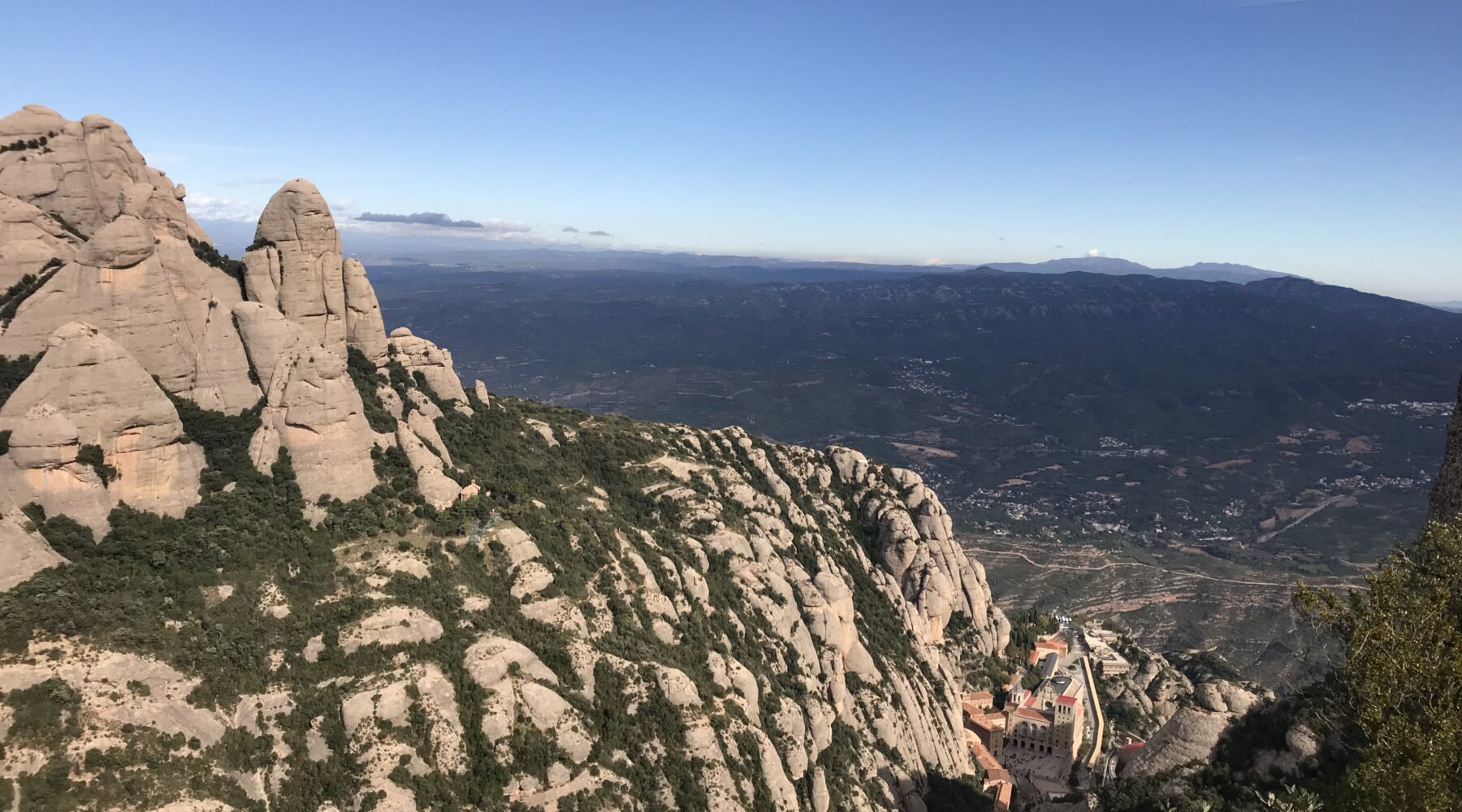
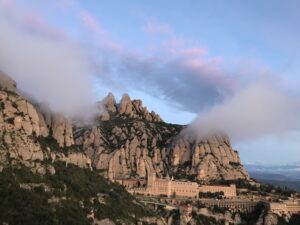
The mountain and its Benedictine abbey sit 48 km north-west of Barcelona. If you have ever been to Meteora in Greece or Mont-Saint-Michel in Normandy, you already know the genre: a monastery welded to a rock that has no business holding a building. Montserrat is the Catalan version, and unlike either of those it is a suburban train ride away.
One warning before the timetables. Montserrat is not a half-day. Allow roughly two hours each way door to door and a minimum of three hours on the mountain, and you have already spent seven hours. If Barcelona is a city break flown in from Gatwick, Heathrow, Stansted, Luton or London City, or a single port day off a cruise ship, this is the day, not an add-on to the Sagrada Família and the Gothic Quarter. Prices below are in euros, with a rough sterling figure in brackets at roughly €1 to £0.84.
Getting to Montserrat from Barcelona at a glance
- Distance: 48 km north-west of Barcelona.
- The train: FGC from the underground station at Barcelona Plaça d’Espanya, on the Llobregat–Anoia line, shown in timetables as R5 towards Manresa.
- Journey time: the operator quotes about 90 minutes, made up of 60 minutes on the train and 20 minutes on the rack railway including the change.
- Two ways up the last stretch: the Cremallera rack railway from Monistrol de Montserrat, or the Aeri cable car from Montserrat-Aeri station.
- Aeri cable car: five minutes, from €8.75 one way (about £7.35) and from €12.50 return (about £10.50).
- Combined tickets: Trans Montserrat from €50 (about £42), Tot Montserrat from €71.50 (about £60).
- Trains run hourly in each direction, so a missed connection costs a full hour.
- When to go: as early as you can. Afternoon trains bring the crowds and you queue for everything once you are up there.
How far is Montserrat from Barcelona, and how long does it really take?
As the crow flies and by road it is the same figure, 48 km north-west of Barcelona, which on paper looks like an hour. It is not, because the last few kilometres climb a cliff and you have to do them on a rack railway or a cable car.
The operator, Cremallera de Montserrat, quotes a total journey time of about 90 minutes: 60 minutes on the train plus 20 minutes on the rack railway including the change. That is measured from the moment you board to the moment you step out at the top. It does not include the metro ride to Plaça d’Espanya, finding the right platform, or waiting for a departure. Two hours each way from your front door is the number to plan around.
Trains run at hourly intervals, which sounds relaxed until you miss one. The return works the same way, so photograph the departure board while you are still at the top and write down the last service. Exact times shift with the season and the day of the week, which is why there is no point copying them out of a travel article. Check them on the operator’s site the evening before.
Montserrat from Barcelona by train: the FGC line from Plaça d’Espanya
The entire trip rests on one railway. Ferrocarrils de la Generalitat de Catalunya (FGC) runs the Llobregat–Anoia line, which appears in timetables as R5 towards Manresa. It is a suburban railway, not a tourist service, so nobody will announce Montserrat to you in English.
Where to board at Plaça d’Espanya
This is where the day most often goes wrong before it has started. Plaça d’Espanya is a big interchange and FGC has its own underground station there, separate from the metro. Do not look for a sign saying Montserrat. Follow the FGC signs, then the platform for Manresa.
The station also houses the Montserrat Reception Point, the operator’s information and ticket desk. The official site gives its hours as daily from 8.00 am to 2.00 pm. If you would rather not fight a machine, this is where you buy combined and return tickets over a counter, and where you can ask whether the rack railway and the cable car are both running today.
💡 Tip: Get to Plaça d’Espanya at least 20 minutes early. In the morning a queue builds at the machines and the desk, made entirely of people heading for the same train, and you do not want to be the one buying a ticket as the doors close.
Which station to get off at: Montserrat-Aeri or Monistrol de Montserrat
Here is the decision the whole journey turns on. The train from Barcelona calls at two different stations, and which one you get off at determines how you finish the climb:
- Montserrat-Aeri is the stop below the cable car. You get out, cross to the lower station and you are at the top five minutes later.
- Monistrol de Montserrat is a little further on, and it is where the Cremallera rack railway starts. You change onto the cog wheel train and it takes you all the way up to the monastery.
Both put you down in the same square by the abbey and neither is wrong. They differ in the experience, the price and how you feel about heights. The comparison table is further down.
💡 Tip: You do not have to travel the same way in both directions. The trick that works is cable car up, rack railway down, or the other way round. You get a fast ascent in the morning, an unhurried descent with no queue in the afternoon, and you see the mountain from two completely different angles. Just buy singles rather than returns.
R5 train schedule: how the timetable actually works
Searching for an R5 train schedule turns up PDFs of varying ages, which is exactly the wrong way to plan this. Three things about the timetable matter more than any specific departure time.
One: the interval is hourly, in both directions. That is the single most important number of the day. It governs when you leave, when you eat and when you go home, and it is the reason a five-minute delay at a ticket machine can cost you an hour.
Two: the R5 goes far beyond Montserrat. It is a Manresa service, so the destination on the front of the train is not your stop. Count the stations or watch for Montserrat-Aeri and Monistrol de Montserrat, which come one after the other.
Three: check the times for your actual date. Weekday, Saturday, Sunday and holiday timetables differ, and the seasonal changes move the first and last departures. Look them up on the FGC and Cremallera sites the night before, then screenshot them, because the mobile signal on the mountain is unreliable. Do the same for the last train back down, and treat the one before it as your real deadline.
Rack railway vs cable car: which way up should you take?
The most-asked question of the whole trip. The honest answer: it depends on whether you want to be at the top as quickly as possible, or to enjoy the last few kilometres.
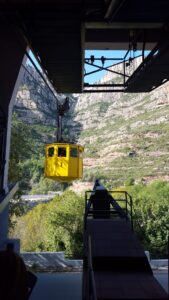
The Aeri de Montserrat cable car has hung over the valley since 1930 and the ride lasts five minutes. The cabin peels away from the rock and suddenly there is nothing underneath you but pine trees and a river. It is the fastest and cheapest way up, and also the one on which a certain number of people discover that they are less relaxed about heights than they assumed.
The Cremallera de Montserrat rack railway starts at Monistrol de Montserrat. Cremallera is simply the Catalan word for it. The line is 5 km long, climbs 550 m and reaches a gradient of 15.6% at its steepest. The first kilometre is ordinary adhesion track; for the remaining four the train climbs on an Abt rack. Services stopped in 1957 and the line was not reopened until 2003. Six electric trainsets work it today, each carrying 200 passengers, at hourly intervals.
| Cremallera rack railway | Aeri cable car | |
|---|---|---|
| Board at | Monistrol de Montserrat | Montserrat-Aeri |
| Time | part of the official 20 minutes for the change and the climb | 5 minutes |
| Price | the standalone fare varies by season, check the operator’s site | from €8.75 one way (about £7.35), from €12.50 return (about £10.50) |
| The line | 5 km of track, 550 m of ascent, maximum gradient 15.6% | aerial cableway, running since 1930 |
| Capacity | 6 trainsets of 200 passengers, hourly | smaller cabins, expect to wait for the next car at peak times |
| Best for | families with a pushchair, anyone uneasy with heights, railway enthusiasts | anyone after speed, the lower fare and a bird’s-eye view |
💡 Tip: The cable car is weather-sensitive. In strong wind or a thunderstorm the service is cut back, and you are left at the bottom holding a ticket. If the forecast is uncertain, the rack railway is the calmer bet. Check the operating status on the operator’s site in the morning, before you leave Barcelona.
Do not confuse either of these with the funiculars. Those are the two short mountain railways at the top, up to Sant Joan and down to Santa Cova, and they have nothing to do with getting there from Barcelona.
Tot Montserrat vs Trans Montserrat: which combined ticket is worth it?
You can buy everything separately, but that quickly becomes four to six transactions in a day. So the operator sells two combined tickets covering the journey there and back plus services at the top.
| Ticket | Price | What it covers |
|---|---|---|
| Trans Montserrat | from €50 (about £42) | Barcelona metro, the FGC train, the rack railway, both funiculars at the top, the audiovisual exhibition and entry to the sanctuary |
| Tot Montserrat | from €71.50 (about £60) | everything in Trans Montserrat, plus the museum and a buffet lunch |
The operator quotes both as “from” prices, because they vary by season and by what you choose. Treat them as a floor, not a fixed figure.
The rule of thumb: Trans Montserrat earns its keep if you intend to use the mountain funiculars as well and would rather not pay at every counter. Tot Montserrat pays off for people staying the whole day who plan on the museum and do not want to think about lunch. If you are eating a sandwich out of your rucksack and looking at the abbey from the outside, neither will pay for itself and separate tickets come out cheaper.
💡 Tip: Combined tickets can be bought online or on the day, but the simplest thing is to collect them at the Montserrat Reception Point inside Plaça d’Espanya station, which is where you are going anyway. It opens at 8.00 am, so even the first trains are covered.
Can you drive to Montserrat monastery, and where do you park?
Yes, you can drive all the way up, and a car is the only option that gets you to the top before the first train arrives. It is also the option that can ruin the day fastest. The distance is 48 km, the route leaves the motorway towards Manresa, and the final kilometres are hairpins up a steep face.
Reckon on about an hour behind the wheel if you set off outside the morning rush. After nine, getting out of Barcelona is slow, and the afternoon run back into the city is the same story in reverse.
There is a car park right by the monastery, and in high season it fills by mid-morning. Parking is charged and the rates change, so you will find them on the abbey’s official site rather than in travel articles. If it is full when you get there, you go back down and start again, which costs you an hour.
💡 Tip: The sensible compromise is to leave the car at the station in Monistrol and take the rack railway up. You skip the hairpins, the scrap over a parking space and the descent in the dark, and you still have the car for the rest of the day. Drivers who have once circled that car park tend to work this out for themselves.
Hiring a car is only worth the trouble if you are stringing other stops around Montserrat into the same day, the Penedès wine country for instance, or a return along the coast. For the trip out of Barcelona and back, the train is simpler, cheaper and does not leave you wondering where to put a car in the city centre.
Montserrat from the Barcelona cruise port: does it fit into a port day?
This is a question with an arithmetic answer rather than an opinion. The cruise terminals sit at the Port of Barcelona, at the seaward end of the city, and your starting point is therefore the same as everyone else’s: the FGC station under Plaça d’Espanya, reached by taxi or by metro from the port.
Now the sums. Two hours each way from the ship, plus a bare minimum of three hours on the mountain, is seven hours before you have stopped for lunch. Add the hourly train interval and the fact that you cannot afford to gamble on the last useful connection, and a realistic figure is eight to nine hours ashore.
That makes it workable on a long port call and reckless on a short one. If your ship is in from early morning until the evening, go, take the first train you can, and set an alarm for a departure two services earlier than the one that would theoretically get you back in time. If you are ashore for six or seven hours, do Barcelona instead. Missing the ship is a far more expensive mistake than skipping a mountain.
💡 Tip: Whatever your all-aboard time is, work backwards from it in whole hours, because that is how the trains run. Then take one hour off. That single hour is the difference between a good day and a taxi chasing a ship down the coast.
By bus, or on an organised day trip from Barcelona?
People look for a bus, but it is not what we would build the day on. The train from Plaça d’Espanya runs to a steady hourly rhythm, heads straight for the foot of the mountain and cannot be caught in the traffic leaving the city. Coach services and their timings also change more often than the railway, so if you do want to go that way, check the current position with the operator the day before rather than trusting an article.
An organised day trip is a different proposition. It makes sense in three situations: you have one free day in Barcelona and do not want to spend it studying timetables, you are travelling with someone who finds several changes difficult, or you want to combine the mountain with a wine tasting nearby. You pay more than the train costs and you give up the freedom to leave when you feel like it. Guided groups also move around the mountain at the same hours as each other, which puts you in the thick of the crowd.
If you are travelling independently and one change does not worry you, the train wins. If you would rather have the whole day settled with a single booking, look at what is on offer: tours and experiences in Barcelona →
What time to set off, and how much of the day you need
The hour you travel decides the quality of the trip far more than the month. The first trains leave around eight in the morning and those are the ones you want. Get to the top before ten and the abbey square is close to empty, there is no queue for the cable car and lunch is unhurried. Arrive after midday and you spend the day in lines and leave feeling you saw nothing.
If you want to hear the Escolania, the boys’ choir, plan to be at the basilica before 1 pm. Singing times, the booking you need and everything else about the monastery itself, the Black Madonna and the walks on the mountain are covered in our separate article on Montserrat monastery.
Season matters mainly for weather and what you wear. It is noticeably colder and windier on the mountain than down in Barcelona, and that holds in summer too, when the city is unbearable. Spring and autumn are the pleasantest: sensible temperatures, good visibility and fewer people than in July and August. In winter the top is raw and mist can take the view away entirely, so check the forecast in the morning and be willing to swap the day around.
💡 Tip: Do not put Montserrat on the day your flight home leaves in the evening. The way back depends on an hourly train interval and one missed connection is all it takes. If there is no alternative, come back two services earlier than the theory says you need to.
Look for somewhere to stay near a metro line with a connection to Plaça d’Espanya. The morning transfer is then a matter of minutes and you make the first train without stress. Find accommodation in Barcelona →
A Montserrat day trip itinerary from Barcelona, hour by hour
This is the shape of a day that works. The times are indicative; fit them to the timetable for your date.
- 7.15 am Leave your accommodation, metro to Plaça d’Espanya. Take breakfast with you, food is dearer at the top.
- 7.45 am At the FGC station. Buy tickets or collect your combined ticket, check the platform for Manresa.
- 8.00 am Train departs. Sit on the right-hand side; the last quarter of an hour has the best view of the massif.
- 9.00 am Get off at Montserrat-Aeri or Monistrol de Montserrat, depending on which way up you chose.
- 9.15 am Cable car or rack railway. You are at the top by about half past nine.
- 9.30 am to 1.00 pm The best part of the day. The squares are empty, the light is soft and there are no queues yet. This is the time for the abbey and for a walk on the mountain.
- 1.00 pm to 2.00 pm Lunch. There is a buffet and a restaurant up there, but at midday both are heaving. With a packed lunch you can find a viewpoint and eat in peace.
- 2.00 pm to 4.30 pm The second half of the programme. By now the crowds off the afternoon trains have arrived, so stay away from the main courtyard.
- 4.30 pm Head down. Expect a queue; everyone leaves at once in the afternoon.
- 5.00 pm Train back to Barcelona, arriving at Plaça d’Espanya around six.
If half a day is all you have, that works too. Take an early train, spend three hours at the top and come back after lunch. You are in Barcelona by mid-afternoon with time for a siesta and the whole evening for the city.
What to take on the trip from Barcelona
The commonest mistake is setting off in what you would wear on the beach at Barceloneta. The weather is different up there, and so is what is under your feet.
- An extra layer. A hoodie or a light windproof, even when the thermometer in the city says thirty.
- Shoes with a sole. The paths around the monastery are stony and flip-flops are miserable on them.
- Water. At least a litre each. Shade is patchy at the top and everything costs more up there.
- Something to eat. It saves money and the midday queue.
- A charged phone and offline tickets. The signal on the mountain comes and goes, and a QR code that will not load ruins the day.
- Sun cream and a cap. At altitude you can burn on a half-cloudy day.
- Some cash. Cards cover most things, but smaller stalls may not take them.
You can get a pushchair up, though the terrain does not suit it. With small children a carrier is more practical, and boarding the rack railway with one is easier than boarding the cable car.
Where to stay: Barcelona or on Montserrat itself
Most people visit Montserrat as a day trip from Barcelona and stay there. That makes sense: the journey takes about an hour and Barcelona has far more choice. There is a second option many visitors never consider, though: sleeping inside the monastery complex. The advantage is simple, in the early morning and in the evening the mountain is empty.
- Budget in Barcelona: a hostel bed roughly €30 to €50 per person per night.
- Mid-range in Barcelona: a double room €110 to €180. The most practical area is near Plaça Espanya station, where the train to Montserrat departs.
- On Montserrat: a hotel and apartments inside the monastery complex, plus simple pilgrim rooms. Book well ahead and expect the on-site restaurant to be your only dinner option.
- At the foot of the mountain: Monistrol de Montserrat and Collbató, where the rack railway and the cable car start and where prices are noticeably lower.
Compare current prices and availability through accommodation in Barcelona and around Montserrat.
Where to go next
- Montserrat monastery: the Black Madonna, the boys’ choir and the Sant Jeroni hike
- Valencia: what to see and how many days to give it
- A city break in Spain: where to go for a long weekend
- San Sebastián: what to see and where to eat
- Bilbao: a guide to the city
- San Juan de Gaztelugatxe: the stairway above the ocean
- Mallorca: what to see on the island
- Ibiza: what to see beyond the clubs
Frequently asked questions about getting to Montserrat from Barcelona
How do I get to Montserrat from Barcelona?
By FGC train from the underground station at Barcelona Plaça d’Espanya, on the Llobregat–Anoia line, shown in timetables as R5 towards Manresa. You climb the last stretch either on the Cremallera rack railway from Monistrol de Montserrat, or on the Aeri cable car from Montserrat-Aeri station. Trains run hourly.
How long does it take to get to Montserrat from Barcelona?
The operator quotes about 90 minutes, made up of 60 minutes on the train and 20 minutes on the rack railway including the change. Add the journey to Plaça d’Espanya and the wait for a departure. Two hours each way from your front door is the figure to plan around.
How far is Montserrat from Barcelona?
The mountain and its Benedictine abbey lie 48 km north-west of Barcelona. By car that is about an hour outside the rush hour, and by train with one change roughly an hour and a half.
Which is better, the Cremallera rack railway or the Aeri cable car?
The cable car is faster and cheaper: five minutes, from €8.75 one way and from €12.50 return. The rack railway is the calmer choice for families with a pushchair and for anyone uneasy with heights, and it keeps running in the wind that curtails the cable car. Best of all is one up and the other down.
How much does the journey from Barcelona cost?
It depends on the combination. The Aeri cable car costs from €8.75 one way and from €12.50 return. Standalone fares for the rack railway and the FGC train vary by season, so check the current prices on the operator’s site or at the Montserrat Reception Point in Plaça d’Espanya station.
Is the Trans Montserrat or Tot Montserrat ticket worth it?
Trans Montserrat costs from €50 and covers the metro, the FGC train, the rack railway, both funiculars at the top, the audiovisual exhibition and entry to the sanctuary. Tot Montserrat costs from €71.50 and adds the museum and a buffet lunch. They pay off if you are staying all day and intend to use several of those things. For a quick morning visit, separate tickets are cheaper.
Can you drive to Montserrat monastery and park there?
Yes, there is a car park right by the monastery, but in high season it fills by mid-morning and parking is charged. The last kilometres are hairpins. It is more comfortable to leave the car at the station in Monistrol and take the rack railway up.
Can you do the trip from the Barcelona cruise port?
Only on a long port call. Two hours each way plus a minimum of three hours on the mountain comes to seven hours before lunch, so eight to nine hours ashore is the realistic requirement. With six or seven hours, spend the day in Barcelona instead.
Is an organised day trip from Barcelona worth it?
It makes sense if you have a single free day in Barcelona, if you are travelling with someone who finds changes difficult, or if you want to combine the mountain with a wine tasting. You pay more than the train costs and you lose the freedom to leave when you like. Anyone happy to make one change saves money and is at the top before the groups.
Potřebujete pomoct s cestováním?
-
Ubytování 🏨
Vyberte si to nejlepší ubytování, ať už jste kdekoliv, přes Booking.com. -
Půjčení auta 🚗
Auto si snadno najdete přes Booking.com, kde máte často slevu díky ubytování, nebo Rentalcars.com, kde porovnáte nabídky většiny půjčoven. -
Zážitky 🎟️
Přes GetYourGuide.com si vyberete z nejrůznějších výletů i zážitků po celém světě, navíc se zrušením zdarma do 24 h předem.