Last updated 27.11.2026
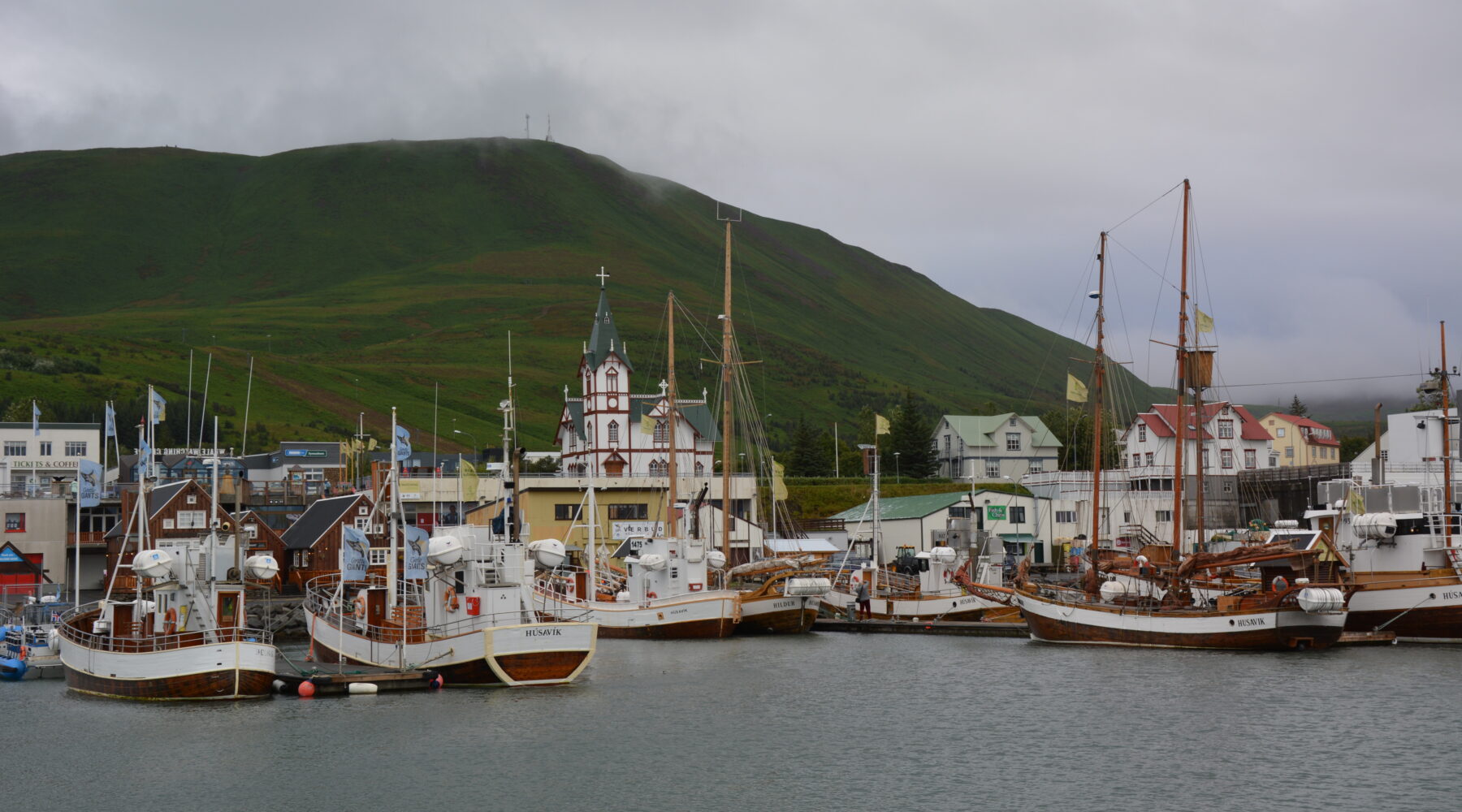
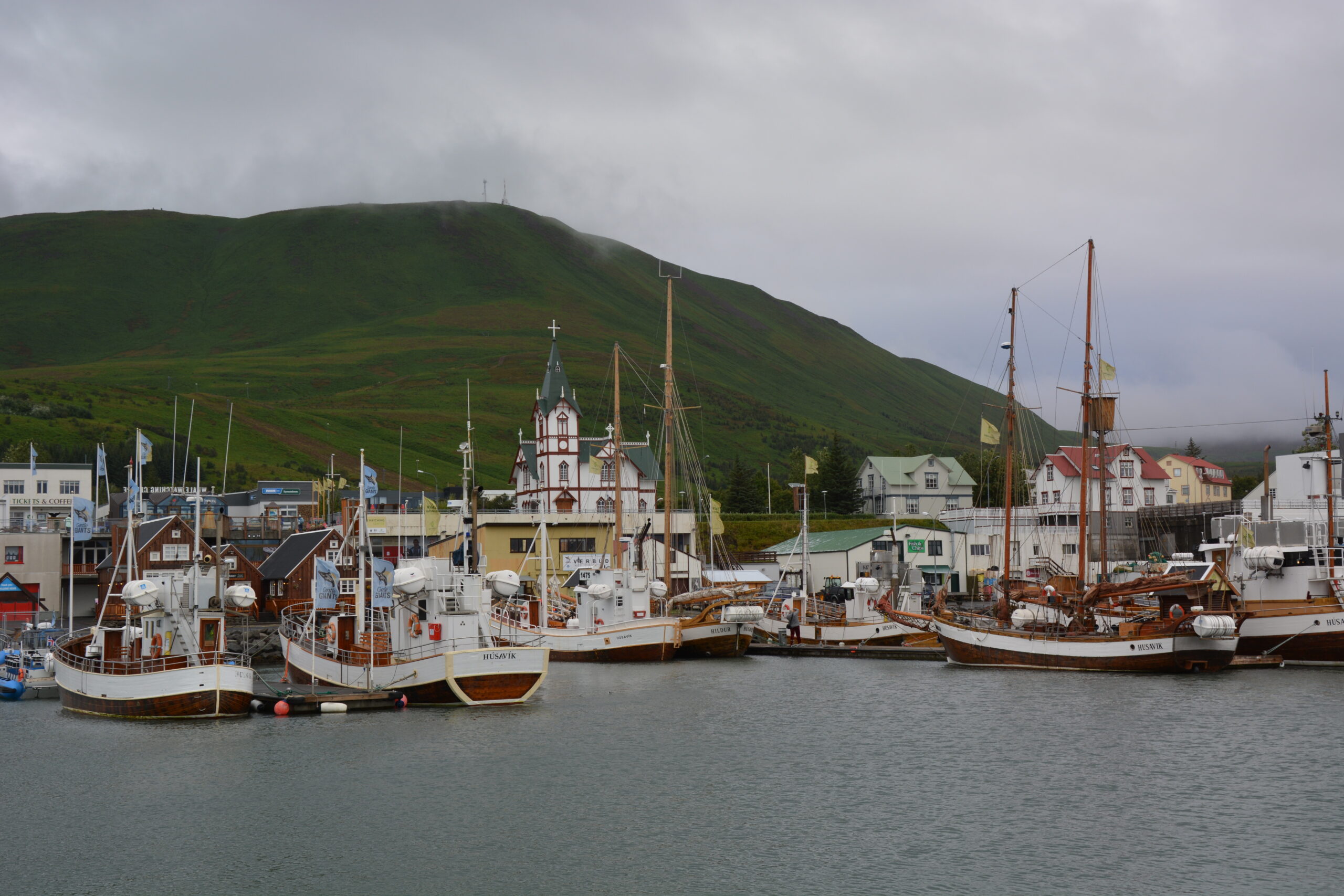
Most people who head to north Iceland come for two things: Lake Mývatn and whales. The whales have a capital of their own, and it is Húsavík, Iceland. This harbour town of roughly 2,400 people sits on Skjálfandi Bay, where old oak schooners painted with the tour companies’ names are moored next to working fishing boats, and a wooden church that looks lifted from a Scandinavian fairy tale stands above the quay. Whale-watching boats have been sailing from here since 1995, and the local operators like to point out that whales turn up on more than 97% of their trips.
This guide covers how to get to Húsavík, where to sleep, how to choose a whale-watching tour (slow oak boat or fast RIB, what it costs and what happens if no whale shows up), what else to do in town, from the Whale Museum to the GeoSea sea baths, and which day trips work from here. In our view Húsavík is best as a base for two nights: one morning out at sea, one afternoon in warm seawater looking across the bay at the mountains on the far shore.
Húsavík, Iceland at a glance
- Where it is: on Iceland’s north coast, on Skjálfandi Bay, about an hour’s drive from Akureyri and roughly 480 km (six hours without stops) from Reykjavík.
- Why go: whale watching. Tours leave straight from the harbour. With the main operators the season runs from March or April to the end of November, and the best months are May to September.
- What the whales cost: a classic three-hour trip on an oak boat is around 12,000 to 13,000 ISK (about £72 to £78), a fast RIB around 23,000 ISK (about £140). Children under 6 travel free on the big boats.
- What else: the Whale Museum with a blue whale skeleton, the GeoSea sea baths on a headland above the bay, a wooden church from 1907, puffins on the islet of Lundey and the view from Mount Húsavíkurfjall.
- A base for the Diamond Circle: Goðafoss, Mývatn, Ásbyrgi canyon and Dettifoss are all within 90 km of town.
- By the way: Húsavík is the town from Netflix’s Eurovision Song Contest: The Story of Fire Saga, and the song “Husavik (My Hometown)” was nominated for an Oscar.
Where Húsavík is and how to get there
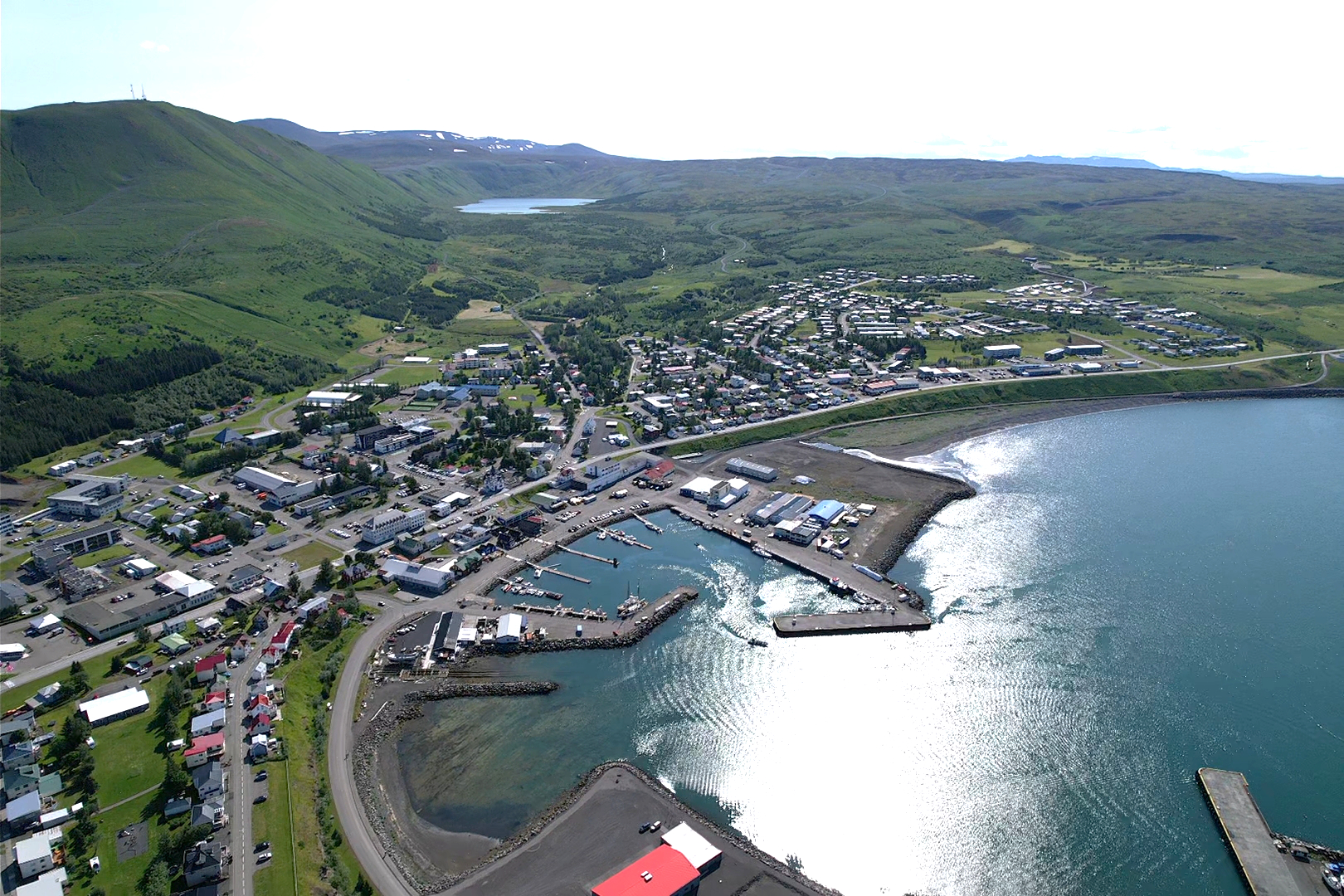
Húsavík lies on the eastern shore of Skjálfandi Bay, which opens north towards the Arctic Ocean. The name means roughly “bay of houses”, and according to the sagas it is one of the earliest settled spots in Iceland. The Swede Garðar Svavarsson spent the winter of 870 here, four years before the official start of the settlement of Iceland in 874. When he sailed off in spring, legend has it that one of his men, Náttfari, stayed behind with two slaves. Today, with around 2,400 inhabitants, it is one of the larger towns in north Iceland, with shops, a petrol station, a swimming pool and a pharmacy.
Getting to Iceland from the UK. Most British travellers fly into Keflavík, the international airport near Reykjavík, and continue north by car, bus or a domestic flight. Routes and schedules from UK airports change from season to season, so check what is currently on offer before you plan the rest of the trip around it.
By car. From Akureyri, take Ring Road 1 east and turn north onto Road 85 at Goðafoss waterfall. The whole drive takes about an hour. From Mývatn, Road 87 runs across the moors to Húsavík, or you can loop back via Goðafoss. From Reykjavík it is about 480 km and six hours of pure driving along Road 1, so nobody realistically combines it with sightseeing in one day. The roads to Húsavík are paved and maintained all year, but in winter expect snow and ice and check conditions on umferdin.is.
By bus. Strætó route 79 runs from Akureyri to Húsavík, and route 57 gets you from Reykjavík to Akureyri. Timetables change during the year and the rural routes were recently reshuffled, so look up current connections on straeto.is.
By plane. The nearest airport with scheduled flights from Reykjavík is Akureyri. The flight takes about 45 minutes, and from the airport it is roughly an hour by car to Húsavík. Domestic flights leave from Reykjavík’s city airport, not from Keflavík, so allow time for the transfer. The small airport near Húsavík only has flights from Reykjavík at certain times of year; check the current situation with Isavia or Norlandair.
| From Húsavík to | Distance (approx.) | Note |
|---|---|---|
| Goðafoss | 47 km | the “waterfall of the gods” on Road 1 |
| Mývatn | 57 km | lake, pseudocraters and lava fields |
| Ásbyrgi | 62 km | horseshoe-shaped canyon, Vatnajökull National Park |
| Akureyri | about 75 to 90 km | depending on the route, around an hour’s drive |
| Dettifoss | 90 km | Europe’s most powerful waterfall |
| Reykjavík | about 480 km | six hours on Road 1 |
Húsavík whale watching: how to choose a tour
Whales come into Skjálfandi Bay to feed, and the tours set off straight from the town harbour. Organised whale watching started here in 1995, and according to the operators’ logbooks more than 97% of trips over three decades have found whales. Gentle Giants quotes 97 to 99%, Húsavík Adventures over 98%. Treat these as the operators’ own figures, not a guarantee. These are wild animals, and the weather in the north can cancel a trip even in summer. Guide to Iceland says roughly one in ten whale-watching bookings in Iceland is cancelled because of weather and sea conditions.
Which whales you can see, and when
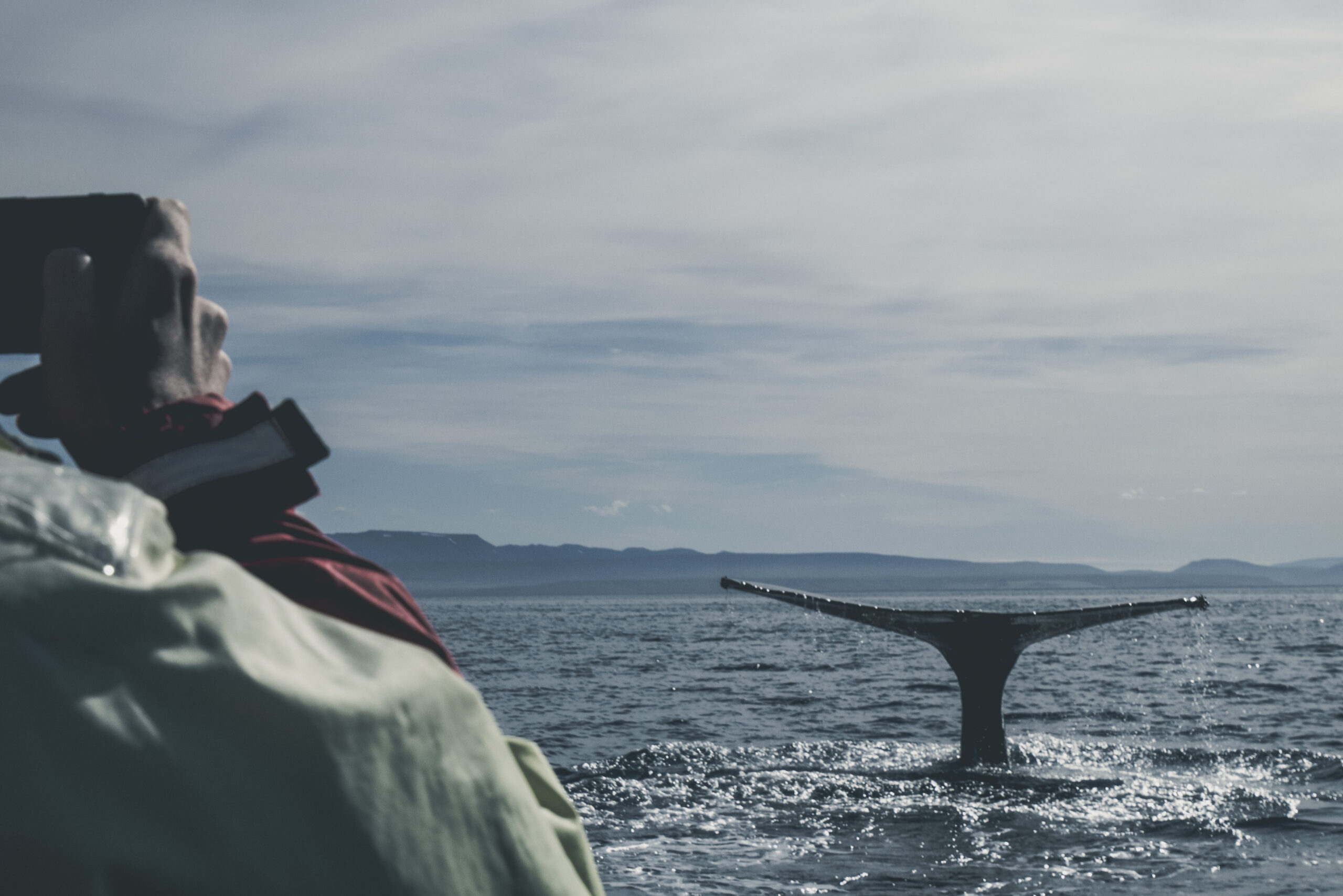
- Humpback whale: these days the most frequent star of the show. It surfaces, lifts its tail fluke and now and then breaches clear of the water. North Sailing says humpbacks have been seen here daily from spring to November in recent years, and in May 2025 they counted up to twenty of them in the bay.
- Minke whale: according to North Sailing the bay’s most common whale since whale watching began. Smaller and less showy, in photos it is usually just a back and a dorsal fin.
- White-beaked dolphin and harbour porpoise: both live in the bay all year, and your chances of seeing them are fairly good.
- Blue whale: the largest animal on Earth turns up mainly in early summer, roughly from May to early July. According to Visit Iceland only 2 to 5% of trips see one, so treat it as a lottery win rather than a plan.
- Rarely: fin whale, orca, sei whale or northern bottlenose whale.
Season. North Sailing’s big boats sail daily from 1 March to 30 November, Gentle Giants’ from 1 April to 30 November. The fast RIBs have a shorter season, roughly April to October. Whale numbers peak from May to September. In June and July there is also a midnight trip under the midnight sun. Autumn brings fewer people, plenty of humpbacks and the first snow on the mountains around the bay. From December to February no tours leave from Húsavík.
Oak boat or fast RIB?
This is the big decision, and in our view it mostly comes down to who you are travelling with.
A traditional oak boat is a former fishing vessel that carries dozens of passengers. The trip takes around three hours, you can walk around the deck, there is a toilet on board, and Gentle Giants says it suits families with children of any age. The operators lend out warm overalls and raincoats, and on the way back North Sailing serves hot chocolate with cinnamon buns. It is the slower, calmer and cheaper option, and it is the one we would pick for a first trip.
A RIB is an inflatable motorboat for a maximum of 12 people. It is fast, covers more of the bay in two hours, and you sit just above the waterline, so when a humpback surfaces next to the boat it is a completely different experience. On the other hand you stay seated the whole time, there is no toilet, a flotation suit is compulsory, and according to Gentle Giants RIBs are off limits to children under 8 or shorter than 130 cm, pregnant women and people with heart or back problems. Gentle Giants also says a RIB is more stable on the waves, so it can paradoxically be the better choice if you get seasick.
A silent electric boat. North Sailing also runs trips on the electric boat Andvari, which glides along without engine noise and disturbs the whales less. It only sails from June to mid-September and costs more than the classic tour.
| Tour (operator’s price list) | Boat and duration | Adults (approx.) | Children | Season |
|---|---|---|---|---|
| Gentle Giants GG1 | oak boat, about 3 h | around 12,000 ISK (£72) | ages 7 to 15 around 6,500 ISK (£39), under 6 free | 1 Apr to 30 Nov |
| North Sailing Original Whale Watching | oak boat, about 3 h | around 13,000 ISK (£78) | ages 7 to 15 around 7,000 ISK (£42), under 6 free | 1 Mar to 30 Nov |
| North Sailing Silent Whale Watching | electric boat, about 3 h | around 16,000 ISK (£96) | ages 7 to 15 around 8,000 ISK (£48), under 6 free | 1 Jun to 15 Sep |
| Gentle Giants GG2 Big Whale Safari (next season’s prices) | RIB, about 2 h | around 23,000 ISK (£140) | ages 8 to 12 around 17,000 ISK (£100) | 1 Apr to 31 Oct |
| Húsavík Adventures Big Whales and Puffins | RIB, max. 12 people | around 23,000 ISK (£140) | from age 8 | April to October |
Prices are approximate, include VAT and come from the operators’ websites. For the GG2 tour, Gentle Giants now only shows next season’s prices. North Sailing also lets you pay on the spot, but booking ahead is worth it in summer. Free cancellation is possible up to 24 hours before departure. The operators’ ticket offices are in the harbour.
The companies also run combined trips: whales plus puffins on the islet of Lundey (the puffins are here roughly from mid-April to mid-August), whales plus Icelandic horse riding, sailing trips under canvas, or excursions to the island of Flatey.
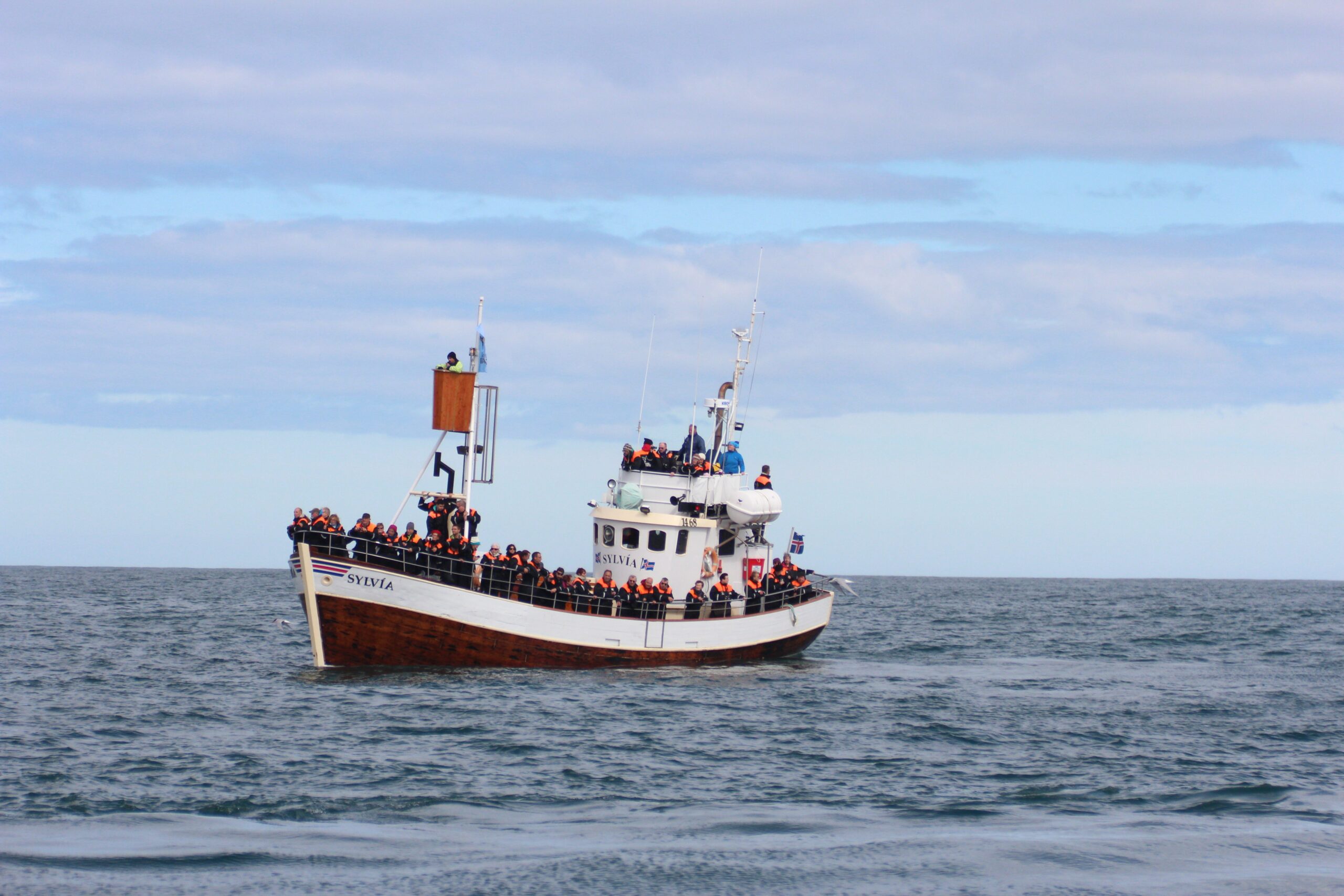
What if you don’t see a whale?
You won’t get your money back, because nobody can guarantee whales. Gentle Giants says in its FAQ that if neither a whale nor a dolphin appears, passengers get a voucher for a free GG1 trip, subject to availability and with no expiry date. North Sailing’s terms and conditions mention nothing of the kind, so if this matters to you, ask at the ticket office before you buy. If you have two nights in Húsavík, keep the second morning free as a backup for bad weather or a second attempt.
What to bring and how to deal with seasickness
It is windy out at sea and colder than in town. Gentle Giants recommends:
- a warm layer under the overalls (fleece or jumper), waterproof trousers instead of jeans and closed shoes, not sandals,
- a hat, waterproof gloves and a scarf or neck warmer, plus sunglasses and sun cream in summer,
- your own drink and a snack, because nothing is sold on board (count the hot chocolate on North Sailing as a bonus),
- seasickness tablets if you are prone to it. The operators don’t sell them, but the pharmacy is right opposite the Gentle Giants ticket office.
💡 Do the whales on your first day. We would take the first morning trip and spend the rest of the day on the museum, GeoSea or the drive onwards. If wind cancels the trip, you still have a shot at the afternoon departure or the next day. Outside the Húsavík season (December to February), North Sailing runs tours from Árskógssandur, about 30 minutes from Akureyri, where boats sail until mid-December and again from early February.
Where to stay in Húsavík
There aren’t many places to stay in Húsavík, and since almost everyone touring the north passes through in summer, book well ahead. You can search for accommodation in Húsavík here. The town is small, so from almost anywhere you can walk down to the harbour, where both the whale-watching tours and the evening stroll begin.
In town
- Fosshotel Húsavík: a hotel with a restaurant, 24-hour reception and free parking. Booking.com puts it a kilometre from the harbour, and some rooms look out to sea.
- Hótel Húsavík: a central hotel within walking distance of the harbour, restaurants, museums and the GeoSea baths. All rooms have a private bathroom, the better ones a view over the town and bay. Breakfast is only served in the summer season, and guests can use a shared kitchenette.
- Árból Guesthouse: a smaller guesthouse with a garden, breakfast and shared bathrooms. The cheaper option if you only need a bed for the night.
Just outside town
- Kaldbaks-kot cottages: cabins with a kitchenette and hot tub a short way from Húsavík. Good for families and for anyone who would rather cook and spend the evening in a hot tub than in a restaurant. And because you are away from the town lights, your chances of seeing the northern lights in winter are better too.
If Húsavík is full, you can also stay near Mývatn or Goðafoss and drive over in the morning for the whales. From Mývatn it takes just under an hour; just remember you’ll need an earlier alarm for a morning tour.
Húsavík campsite
The municipal Húsavík Camping Ground is right in town, so you can walk to the harbour and the restaurants. The table shows approximate prices according to Visit Iceland. Prices change, so it is a good idea to check them with the campsite before you travel.
| Húsavík campsite | Price (approx.) | Approx. in £ |
|---|---|---|
| Adult per night | around 2,200 ISK | £13 |
| Seniors and people with disabilities | around 1,600 ISK | £10 |
| Children under 14 | free | |
| During the Mærudagar festival (23 to 25 July) | around 3,900 ISK per person | £23 |
| Accommodation tax (per tent or vehicle) | around 400 ISK | £2.40 |
| Electricity per day | around 1,500 ISK | £9 |
| Washing machine or dryer | around 800 ISK | £5 |
Sources disagree on the season dates: Visit Iceland gives an opening date of 15 May, while camping websites say from 1 or 15 May to 30 September. If you are travelling at the edges of the season, check directly with the campsite. According to the Gocampers guide, Húsavík is one of the sites that accept the Camping Card. Overnight stays in a campervan or tent outside campsites are not allowed anywhere in Iceland.
Things to do in Húsavík beyond the whales
You can see the town of Húsavík itself in about two hours. Everything worth seeing is by the harbour or just above it, so you can leave the car parked.
Húsavík Whale Museum
The Húsavík Whale Museum (Hvalasafnið) stands right on the harbour in a building that served as a slaughterhouse until the early 1970s. The non-profit museum opened in 1997, and according to Guide to Iceland it displays eleven whale skeletons, among them a sperm whale, a northern bottlenose whale, a minke whale and a narwhal. The centrepiece is a blue whale skeleton, on show since 2016. Standing underneath it explains the size of these animals better than any photo from a boat.
In summer it is open daily from 9 am to 6 pm, with shorter hours the rest of the year. Sources give different admission prices and we couldn’t find a current price list, so check whalemuseum.is. Older sources say a whale-watching ticket gets you a discount. We would visit the museum after the tour, when you already know what a whale looks like from above and below.
GeoSea sea baths
In 2018 the GeoSea baths opened on the Húsavíkurhöfði headland north of the harbour. The pools are filled with seawater heated geothermally to 38 to 39 °C, and the infinity edge seems to merge with the bay and the mountains on the far shore. In 2019 TIME magazine put it on its list of the World’s Greatest Places.
The backstory is typically Icelandic. In the mid-20th century, drilling here hit hot salty water that was no use for heating homes but perfect for bathing. Locals put an old cheese vat (Ostakarið in Icelandic) up on the headland and used to soak in it. Today there is a swim-up bar in the pool, a steam bath and a café where people eat in their bathrobes.
| GeoSea | Price (approx.) | Approx. in £ |
|---|---|---|
| Adults | around 7,500 ISK | £45 |
| Children aged 6 to 16 | around 4,000 ISK | £24 |
| Children under 5 with an adult | free | |
| Towel hire | around 1,600 ISK | £10 |
| Swimwear hire | around 1,300 ISK | £8 |
| Bathrobe hire | around 2,800 ISK | £17 |
Seniors, students and people with disabilities pay less, but the price list on the website shows three different amounts at once, so ask at the till. According to the website it is open daily from 12 noon to 10 pm, though in past winters the baths have opened only at 5 pm on weekdays. Tickets are sold online at geosea.is, and booking ahead is worth it in summer. Unlike the Blue Lagoon, GeoSea is small and quiet. We like it best in the evening, when the sun hangs low over the bay.
Húsavíkurkirkja church
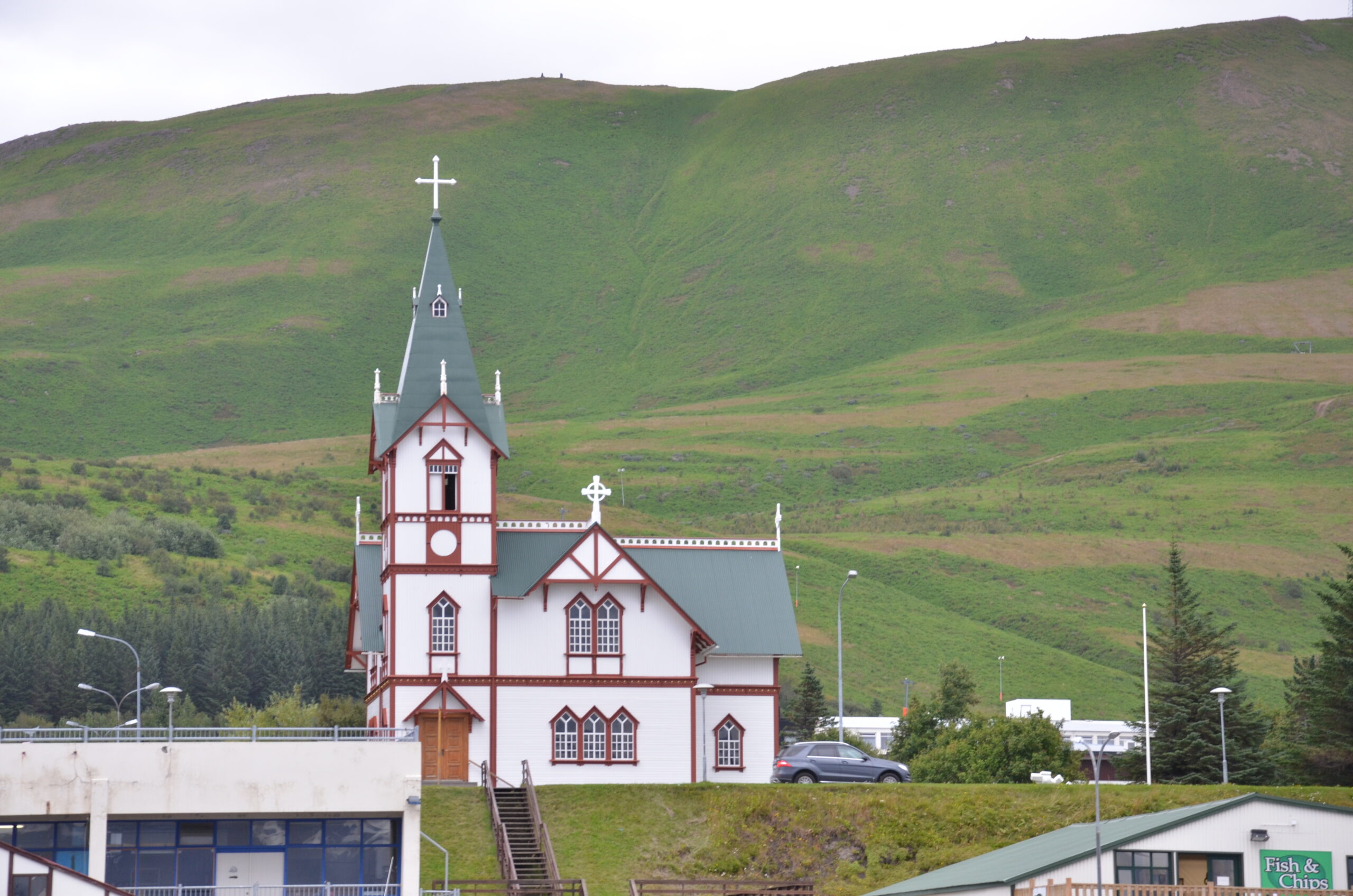
The wooden church above the harbour is the symbol of the town. It was built in 1907 from timber imported from Norway and consecrated in June of the same year. It was designed by Rögnvaldur Ólafsson, often described as Iceland’s first architect, although most sources say he never finished his architecture studies. The church has a cruciform plan, white walls, red decorative trim and a green roof with a slender spire. In good light it looks like a gingerbread house from the harbour. Icelandic media report that the church needs major repairs, so don’t be surprised if it is under scaffolding.
Safnahúsið Museum and the Exploration Museum
The town museum, Safnahúsið, covers the history of the region, old boats, Icelandic fishing and a stuffed polar bear. According to Visit Iceland, adult admission is around 2,200 ISK (about £13), seniors and students pay roughly 1,700 ISK and children get in free. Opening hours vary with the season.
The small Exploration Museum tells the story of explorers from Viking voyages to space flight. There is a reason it is here: in 1965 and 1967 more than thirty Apollo astronauts came to the area for geology training and collected rock samples around Mývatn and in the Askja caldera. Since 2015 a memorial in front of the museum has listed 32 of their names.
The view from Mount Húsavíkurfjall
The mountain behind the town is 417 metres high. Two footpaths lead to the top: one from the Gónhóll viewpoint on the northern edge of town, where you can park, the other through a small wood past the Skálatjörn pond. According to Komoot the second one is about 5.6 km with 480 metres of ascent. A gravel track for 4×4 vehicles also runs to the summit, but it is rough going after rain. From the top you see the whole town, the bay, the Kinnarfjöll mountains on the other side and, on a clear day, the islands of Flatey and Lundey. With a bit of luck you’ll even spot the boats stopped next to the whales.
Lundey and the puffins
According to Guide to Iceland, the islet of Lundey in the bay is the eighth-largest puffin colony in Iceland, with around 36,500 burrows. Landing is not allowed, but the whales-and-puffins tours sail close to the island. The puffins are here roughly from mid-April to mid-August; outside that window the combined trip is about whales only.
Húsavík and Eurovision
In 2020 Netflix released the comedy Eurovision Song Contest: The Story of Fire Saga, starring Will Ferrell and Rachel McAdams, in which Húsavík is the heroes’ hometown. The closing ballad “Husavik (My Hometown)” was nominated for the Oscar for Best Original Song, and the locals launched a “Húsavík for Oscar” campaign to go with it. The then Húsavík Cape hotel opened the Jaja Ding Dong bar, named after a song from the film, and in 2021 an exhibition about Iceland at Eurovision with props from the shoot followed. Both projects were meant to be temporary from the start, and we couldn’t confirm whether they are still running. The town still draws fans with tours of the filming locations; details are on visithusavik.is.
Where to eat in Húsavík
Almost all of Húsavík’s restaurants are on the harbour or a few steps from it, and they are used to hungry people who have just stepped off a boat.
- Gamli Baukur (Hafnarstétt 9): a timber restaurant and bar right on the harbour with a terrace over the water. Fish and seafood; Fodor’s calls it a favourite lunch spot after whale watching.
- Naustið (Ásgarðsvegur 1): open in summer only and best known for its fish soup. Guidebooks put main courses at around 3,500 to 6,000 ISK (about £21 to £36).
- Café Hvalbakur: a café directly below the North Sailing ticket office, good for coffee and cake before you sail.
- Fish & Chips (Hafnarstétt 19): quick food by the harbour, fish and chips Icelandic style.
- Salka (Garðarsbraut 6): a restaurant in one of the oldest houses in town. Some websites list it as temporarily closed, so check before you go.
Restaurant prices are normal for Iceland, which means steep even by British standards. A supermarket shop and a picnic on a bench above the harbour work out cheaper. As everywhere in Iceland, alcohol is only sold in the state-run Vínbúðin shops.
Day trips from Húsavík: the Diamond Circle
Húsavík is one of the stops on the Diamond Circle, a route of about 250 km through north Iceland that does for the north what the Golden Circle does for the south. Besides Húsavík it takes in four sights, and each of them is an easy day trip from town:
- Goðafoss (47 km): the “waterfall of the gods”, into which, according to the sagas, the chieftain Þorgeir threw his statues of the pagan gods in the year 1000, when Iceland converted to Christianity. It lies right on the road from Akureyri, so stop on your way in.
- Mývatn (57 km): a lake with pseudocraters, the Dimmuborgir lava labyrinth and the Hverfjall crater. Just beyond it is the Hverir geothermal area with mud pots and fumaroles.
- Ásbyrgi (62 km): a horseshoe-shaped canyon with sheer walls and a small wood inside. Legend says it is the hoofprint of Sleipnir, Odin’s eight-legged horse. It is part of Vatnajökull National Park.
- Dettifoss (90 km): Europe’s most powerful waterfall, in the Jökulsárgljúfur canyon. From Ásbyrgi you reach it on Road 862.
You can drive the whole loop in one long day, but we would split it in two: one day for Mývatn and Hverir, the other for Ásbyrgi and Dettifoss, sleeping in Húsavík or by the lake. The whales then fit into a free morning in between.
When to visit Húsavík, Iceland
- Summer (June to August): the most departures, the most people and the midnight sun, when you can even sail at midnight. Puffins on Lundey and, in June, a chance of a blue whale. Book accommodation ahead, especially around the town’s Mærudagar festival in late July.
- Spring and autumn (April, May, September, October): the best time in our view. The whales are here, the crowds are smaller, in May you may even see a blue whale, and in autumn the operators find humpbacks on almost every trip. On dark nights there is already, or still, a chance of the northern lights.
- November: the last month of the season for the big boats, with short days and wintry weather. Even so, humpbacks have been around in November in recent years.
- December to February: no whale-watching tours leave from Húsavík. GeoSea stays open in winter, and a pool above the bay under the northern lights is an experience in itself. In winter, whale watching moves to Árskógssandur near Akureyri.
💡 Pair the whales with the baths. After three hours at sea you’ll be chilled to the bone, even in summer. Book GeoSea for the afternoon after your tour: the Húsavíkurhöfði headland is about a kilometre from the centre, an easy walk, and from the warm water you can look out over the bay where you were hunting for whales that morning.
What we would do differently
Most people roll into Húsavík in the morning, spend three hours at sea with the whales, grab fish and chips and by the afternoon are already on the road to Dettifoss. Whales ticked off, and all they see of the town is the harbour. If we went again, we would give it two nights.
We wouldn’t fret about seeing a blue whale. It would be a bonus, not the goal, and whoever spends the trip scanning for one misses the humpback surfacing a bit further off. If the sea keeps us in port on day one, we simply go on day two. Nor do we need to fit in the RIB, the sailing boat and the puffins as well. One trip is enough; the rest of the time belongs to the town.
We would walk round the harbour in the evening, where fishing boats are moored next to the wooden schooners, and climb Húsavíkurfjall if the sky were clear. We would try the fish soup somewhere nobody from the boats is heading, not wherever the queue is longest. And at GeoSea we would leave the phone in the locker. You’ll have plenty of whale photos from the morning, and you’ll remember the view across the bay from the warm water without them.
Húsavík, Iceland: frequently asked questions
How much does whale watching in Húsavík cost?
A classic oak-boat trip with Gentle Giants or North Sailing costs roughly 12,000 to 13,000 ISK (about £72 to £78). Children aged 7 to 15 pay around half, and under-6s go free. A fast RIB is around 23,000 ISK (about £140), and North Sailing’s silent electric boat around 16,000 ISK (about £96).
What is the best time of year for whale watching in Húsavík?
May to September, when Skjálfandi Bay has the most whales. Tours run from March or April until the end of November, though, and humpbacks are often around in autumn too. Your best chance of a blue whale is from May to early July.
What are the chances of seeing whales in Húsavík?
According to the operators’ logbooks, more than 97% of trips see whales. It isn’t a guarantee, and there are no refunds. Gentle Giants gives passengers who see neither a whale nor a dolphin a voucher for a free repeat trip.
Oak boat or RIB in Húsavík?
The oak boat is cheaper and slower, has a toilet and suits families with young children. The RIB is a fast boat for 12 people that covers more of the bay in two hours and gets you closer to the whales. Children under 8 or shorter than 130 cm and pregnant women are not allowed on a RIB.
Can you see whales in Húsavík in winter?
No boats leave Húsavík from December to February. North Sailing restarts on 1 March. In winter, whale-watching tours run from Árskógssandur, about 30 minutes from Akureyri, where boats sail until mid-December and again from early February.
How far is Húsavík from Akureyri and Reykjavík?
From Akureyri it is about an hour by car, on Road 1 and then Road 85 from Goðafoss. From Reykjavík it is about 480 km and six hours of pure driving. Strætó bus 79 also runs from Akureyri to Húsavík.
How much is GeoSea in Húsavík?
Adults pay around 7,500 ISK (about £45), children aged 6 to 16 roughly 4,000 ISK (about £24), and children under 5 get in free with an adult. Towel hire is around 1,600 ISK, swimwear around 1,300 ISK. Tickets are sold online at geosea.is.
Where to stay in Húsavík?
In town there is Fosshotel Húsavík, Hótel Húsavík and the cheaper Árból Guesthouse; just outside town, the Kaldbaks-kot cabins with a hot tub. The cheapest option is the municipal campsite, at around 2,200 ISK (about £13) per adult per night in summer. If everything is full, you can sleep near Mývatn and drive over in the morning.
Where next
- Mývatn: lake, pseudocraters, Dimmuborgir and warm baths, just under an hour from Húsavík.
- Hverir: mud pots and fumaroles below Mount Námafjall, just past Mývatn.
- Goðafoss: the waterfall of the gods on the road from Akureyri.
- Dettifoss: Europe’s most powerful waterfall and the Jökulsárgljúfur canyon.
- Askja: the highland caldera where the Apollo astronauts trained; tours leave from Mývatn.
- Blue Lagoon: how Iceland’s other geothermal spas compare, if GeoSea leaves you wanting more.
Potřebujete pomoct s cestováním?
-
Ubytování 🏨
Vyberte si to nejlepší ubytování, ať už jste kdekoliv, přes Booking.com. -
Půjčení auta 🚗
Auto si snadno najdete přes Booking.com, kde máte často slevu díky ubytování, nebo Rentalcars.com, kde porovnáte nabídky většiny půjčoven. -
Zážitky 🎟️
Přes GetYourGuide.com si vyberete z nejrůznějších výletů i zážitků po celém světě, navíc se zrušením zdarma do 24 h předem.