Last updated 27.11.2026
Visit Lake Myvatn in July and you’ll probably remember it for two things: lava towers that look like the ruins of a castle, and the tiny flies that spend all day trying to get into your eyes. Both come with the territory. This shallow lake in north Iceland sits in a landscape that volcanoes rewrote a few thousand years ago, and within a few kilometres of the shore you’ll find pseudocraters that rose out of the water, the black crater of Hverfjall, the lava maze of Dimmuborgir, a hot-water cave from Game of Thrones and the Earth Lagoon geothermal baths. We’ve picked the eight stops at Lake Myvatn that we think are worth your time, plus everything practical: how to get there, when to go, where to stay, what it all costs, how to survive the midges and why winter here gives you one of the best chances of seeing the northern lights anywhere in Iceland.
Lake Myvatn at a glance
- A shallow lake in north Iceland. It covers about 37 km², is on average only around 2.5 metres deep and formed roughly 2,300 years ago when a lava flow dammed the valley.
- The main base is the village of Reykjahlíð on the north-east shore. It’s about an hour and a quarter by car from Akureyri, and roughly 480 km and six hours of non-stop driving from Reykjavik.
- Most sights around the lake are free. You pay for parking at Hverfjall crater (around 1,200 ISK, about £7) and at a few other places nearby, plus entry to the baths and any guided tours.
- Earth Lagoon Mývatn is the former Mývatn Nature Baths. It has reopened after a rebuild, tickets start at 7,900 ISK (about £47) and it’s open daily from 12 noon to 10 pm.
- Mývatn means “midge lake”. From June to August swarms of midges hang over the water. Most of them don’t bite, they’re just a nuisance, but a head net is worth having.
- Winter brings short days and a real chance of the aurora. In December there are only three to four and a half hours of daylight, and the northern lights can be seen roughly from September to April.
- No swimming in Grjótagjá. The water in the cave is still too hot after the Krafla eruptions of 1975 to 1984, and the landowners have banned bathing there.
What Lake Myvatn is and why everything here looks different
Mývatn is the fourth-largest lake in Iceland, though not in the way you might picture. It covers around 37 km² and stretches about 9.5 km end to end, yet it’s so shallow that the average depth is roughly 2.5 metres and the deepest spots are only a little over four. It sits about 280 metres above sea level and is dotted with several dozen small islands. In winter it freezes over, and in late February or early March horse races are held on the ice.
The lake was born roughly 2,300 years ago, when basalt lava poured out of the Lúdentsborgir and Þrengslaborgir crater rows east of today’s shoreline. The flow blocked the valley and water built up behind the lava dam. Where the molten rock spilled over wetland and shallow water, the water underneath flashed into steam and exploded upwards. That’s how the pseudocraters on the south shore formed, now the best-known image of Mývatn. The same flow created a lava lake whose remains are today’s Dimmuborgir. Hverfjall crater is a few hundred years older.
Beneath the whole area lies the Krafla volcanic system. Its two most recent big episodes were the Mývatn Fires of 1724 to 1729, when lava reached the village of Reykjahlíð, and the Krafla Fires of 1975 to 1984, when nine smaller eruptions broke out along fissures north of the lake. It was this last episode that heated the water in Grjótagjá cave so much that you still can’t bathe in it. Krafla is quiet these days, but it’s an active system, so the same rule applies as with any Icelandic volcano: check the current status with the Icelandic Met Office at vedur.is and travel warnings at safetravel.is. For what has been happening in the south-west of the island in recent years, see our guide to Fagradalsfjall and Iceland’s volcanoes.
The lake’s name literally means “midge lake”, and it’s well earned. Millions of midge larvae live in the mud on the lake bed, and in summer clouds of adult flies hatch from it. They feed the fish and the birds, which is why Mývatn and the Laxá river flowing out of it make up one of the most important bird areas in Europe. More than ten species of duck nest here, among them Barrow’s goldeneye, which breeds nowhere else in Europe, and harlequin ducks on the Laxá rapids. Bird numbers peak from late May to July. The lake and the river are a protected area and since 1977 a wetland of international importance under the Ramsar Convention.
How to get to Lake Myvatn
Flights from the UK land at Keflavík, so for most British visitors Mývatn is a stop on a longer trip round the island rather than a destination in itself. Once you’re in Iceland, these are your options.
By car. Mývatn sits right on the Ring Road (Route 1), and driving is the easiest way to get here and, in our view, the only sensible way to see more than one sight. The stops around the lake are spread along both shores, and you can drive all the way round on Route 1 and Route 848. Approximate distances to Reykjahlíð:
| From | Distance | Driving time without stops |
|---|---|---|
| Akureyri | about 100 km | 1 to 1.5 hrs |
| Egilsstaðir | about 165 km | 2 hrs |
| Reykjavik (via Akureyri) | about 480 km | 6 to 7 hrs |
| Keflavík airport | over 500 km | 6 to 7 hrs |
From Akureyri, Route 1 runs through the Vaðlaheiðargöng tunnel, which is a toll tunnel. A single trip in a car costs around 2,200 ISK (about £13), paid online at veggjald.is, in the app or at the machine by the tunnel. If you don’t pay, an invoice with a surcharge follows, and with a hire car it comes via the rental company. The free alternative is the Víkurskarð mountain pass, but it’s often impassable or dangerous in winter.
Route 1 is maintained in winter, but the stretches across the highland plateaus east of Mývatn (Námaskarð, Mývatnsöræfi and Möðrudalsöræfi) close in blizzards. Check umferdin.is and safetravel.is before every crossing. A normal car is fine for getting around the lake. The gravel turn-off to Hverfjall crater is often impassable in winter, and the F-roads to Askja are off-limits without a 4×4 and outside summer.
By bus. Strætó public bus 56 runs between Egilsstaðir and Akureyri via Mývatn, stopping in Reykjahlíð. Check the timetable in the journey planner at straeto.is, as summer and winter schedules differ. The bus gets you to the lake, but the sights around it are kilometres apart, so without a car or a bike expect a lot of walking along the road.
By plane to Akureyri. The domestic flight from Reykjavik’s city airport to Akureyri takes around 45 minutes. From there it’s about an hour by car to the lake. It makes sense if you only have a few days in Iceland and still want to see the north.
On an organised tour. Full-day tours to Mývatn leave from Akureyri, often combined with Goðafoss waterfall or the baths. A day trip from Reykjavik to Mývatn makes no sense to us: you’d spend most of the day on a plane or a coach.
💡 Treat Mývatn as a stop on a road trip, not a day trip from Reykjavik. Most people pass through on the Ring Road. We’d give it at least two nights: one full day for the lake itself and a second for Krafla and the waterfalls nearby.
Where to stay near Lake Myvatn
There isn’t much accommodation at Mývatn in summer and it sells out fast, so book as early as you can. Around the lake there are two smaller areas to stay in, and then there’s Akureyri, which has more choice and better prices but is an hour’s drive away. We’d stay right by the lake. Northern lights, an early walk before the coaches turn up and an evening in the baths only really work when you don’t have to drive an hour in the dark afterwards.
Reykjahlíð and the north shore. The only real village on the lake, with the Krambúðin shop, a petrol station, a cash machine, a health centre, a few restaurants, hotels and campsites. From here it’s a short hop to Earth Lagoon, Grjótagjá, Hverfjall and Krafla. Bjarg campsite right on the water is open in summer only; other campsites nearby have longer seasons. Hotels and guesthouses are listed under accommodation in Reykjahlíð. Just outside the village, on the way to the baths, is Fosshotel Mývatn.
The south and east shores (Skútustaðir, Vogar). The quieter side of the lake, with farms, guesthouses and hotels right next to the pseudocraters. Skútustaðir has the Gígur visitor centre, where the protected-area rangers can help you plan your walks. Vogar farm has a café and restaurant in its cowshed, Vogafjós, where you eat while watching the cows. For places to stay, see accommodation in Skútustaðir. Not far from the south shore is Hótel Laxá, about 4 km from the pseudocraters.
Akureyri. The largest town in north Iceland, with an airport, supermarkets, restaurants and the widest range of places to stay in the north. It suits you if you want to do Mývatn, Goðafoss and whale watching in Húsavík as day trips from one base, or if everything at the lake is booked up: accommodation in Akureyri.
When to visit Lake Myvatn
Lake Myvatn in summer and Lake Myvatn in winter are two completely different holidays. Summer means green slopes, birds, the midnight sun, every road open, and plenty of people and flies. Winter means snow, a frozen lake, darkness, silence and the aurora. The shoulder months are a compromise we like: in September and early October the midges are gone, accommodation gets cheaper, the landscape turns red and the nights are already dark enough for the first northern lights.
| Season | What to expect | What to prepare for |
|---|---|---|
| June to August | Long days, green landscape, the most birds, open roads to the craters and Krafla | Midges, full accommodation, booking months ahead |
| September and October | Autumn colours, fewer people, first northern lights | Shorter days, first snow at the end of October |
| November to February | Snow, frozen lake, northern lights, the Yule Lads in Dimmuborgir | Only 3 to 4.5 hrs of daylight in December, road closures, winter tyres |
| March to May | Longer days, winter festival, birds return in May | Thaw, mud, some tracks still closed |
Temperatures here aren’t extreme. July is the warmest month, with daytime highs of around 13 to 14 °C, roughly what you’d get on a cool day in Scotland, and in winter it hovers around freezing or below. The north tends to be drier and clearer than the south of the island, which is exactly what you want for the aurora. Weather and overnight cloud cover forecasts are on vedur.is.
Lake Myvatn midges: what to expect and how to cope
Ask anyone about Mývatn and the second question is usually “what about the mosquitoes?”. The answer: they aren’t mosquitoes, but there really are a lot of flies here in summer. And they’re two different kinds of insect.
Non-biting midges (rykmý in Icelandic) are the ones the lake is named after. Their larvae live in the mud on the lake bed and the adults hatch in huge swarms, mainly from early June to August. They don’t bite. On still days, though, they swarm round your head and crawl into your eyes, ears and nose, and on open ground by the shore there can be so many of them they look like smoke. When the wind picks up, they vanish.
Blackflies (bitmý in Icelandic) are smaller and they do bite. Their larvae live in the Laxá river, so that’s where you’ll find most of them. The bites itch much like a mosquito bite, more for some people than others. If you’ve met Scottish midges in the Highlands, you’ll know the feeling.
What helps: a head net, which the shops by the lake sell, light-coloured long-sleeved clothing and a repellent that works on blackflies. The flies are most active in warm, windless weather, so plan your lakeside walks for breezier days or cooler evenings. And remember, the midges are the reason so many birds and fish live here. Without them, Mývatn would be just another lake.
💡 Buy your head net straight away, not once you’re in Dimmuborgir. On the narrow paths between the lava towers and on the slopes of the pseudocraters, the swarms shelter out of the wind, and without a net you won’t remember much of the walk. If you’re visiting in September or later, you won’t need one.
Things to do at Lake Myvatn: 8 stops worth making
We’ve listed them in the order you reach them driving round the lake anticlockwise from the south. You can squeeze them all into one long summer day, but we think it’s better to split them over two and leave time for the baths.
1. Skútustaðagígar: the pseudocraters on the south shore
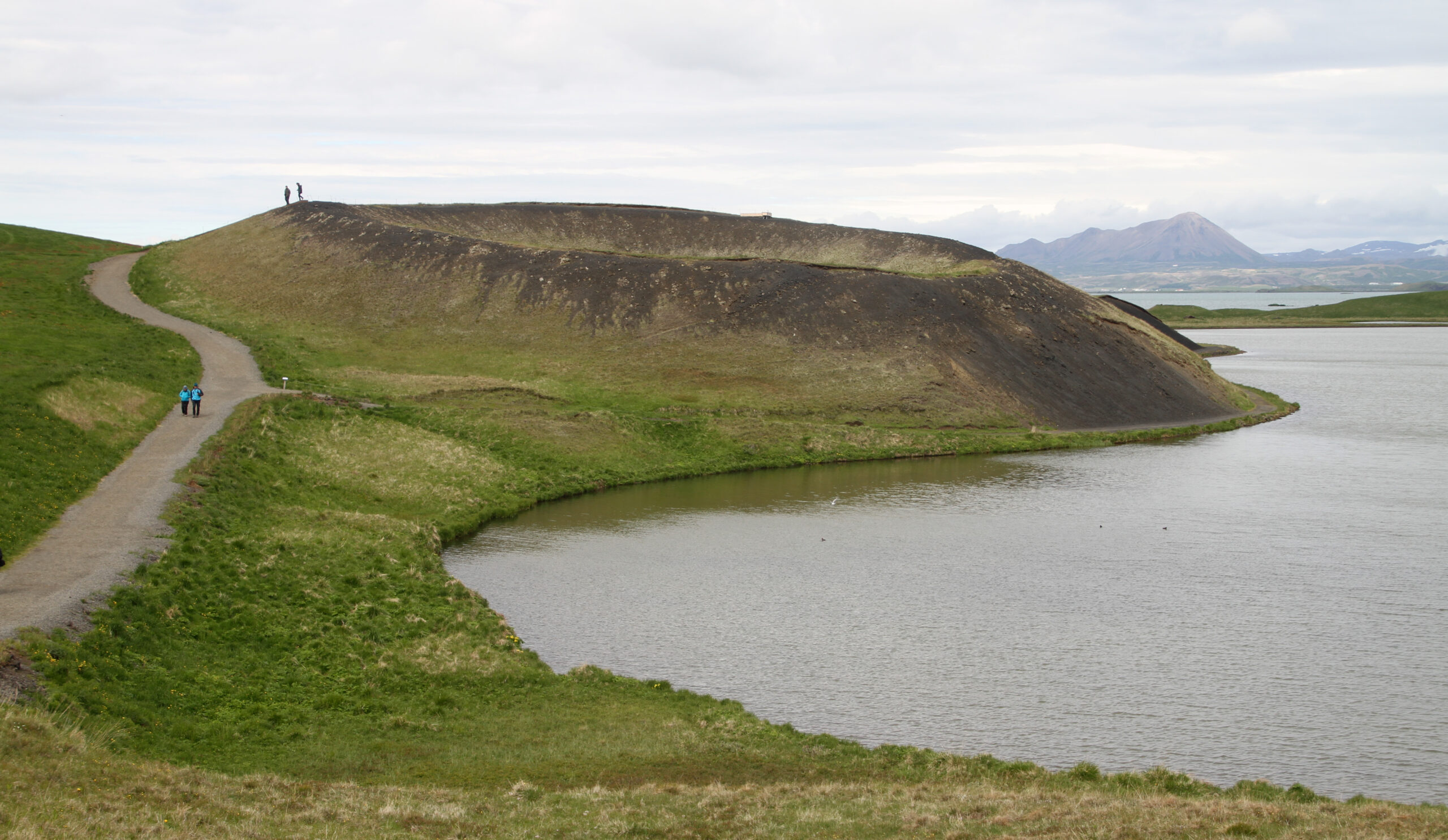
Grassy mounds with a hollow in the middle that look like miniature volcanoes but aren’t volcanoes at all. They formed 2,300 years ago when lava flowed over a wetland, and the water beneath it turned to steam and blasted its way out. Icelanders call them gervigígar, false craters. The finest cluster surrounds Stakhólstjörn pond by the village of Skútustaðir and has been protected as a natural monument since 1973.
The car park is by the road in Skútustaðir. From there a short loop over the nearest craters takes about half an hour, and a longer trail round Stakhólstjörn takes one to two hours. The crater rims give you one of the best views of the whole lake. Stick to the marked paths: the slopes are made of soft scoria and grass struggles to grow back. There are usually plenty of midges here in summer, so don’t forget your net. At the Gígur visitor centre in Skútustaðir, rangers can advise on routes and trail conditions. It’s open all year, daily from 10 am to 5 pm.
2. Höfði and the lava pillars of Kálfastrandarvogur
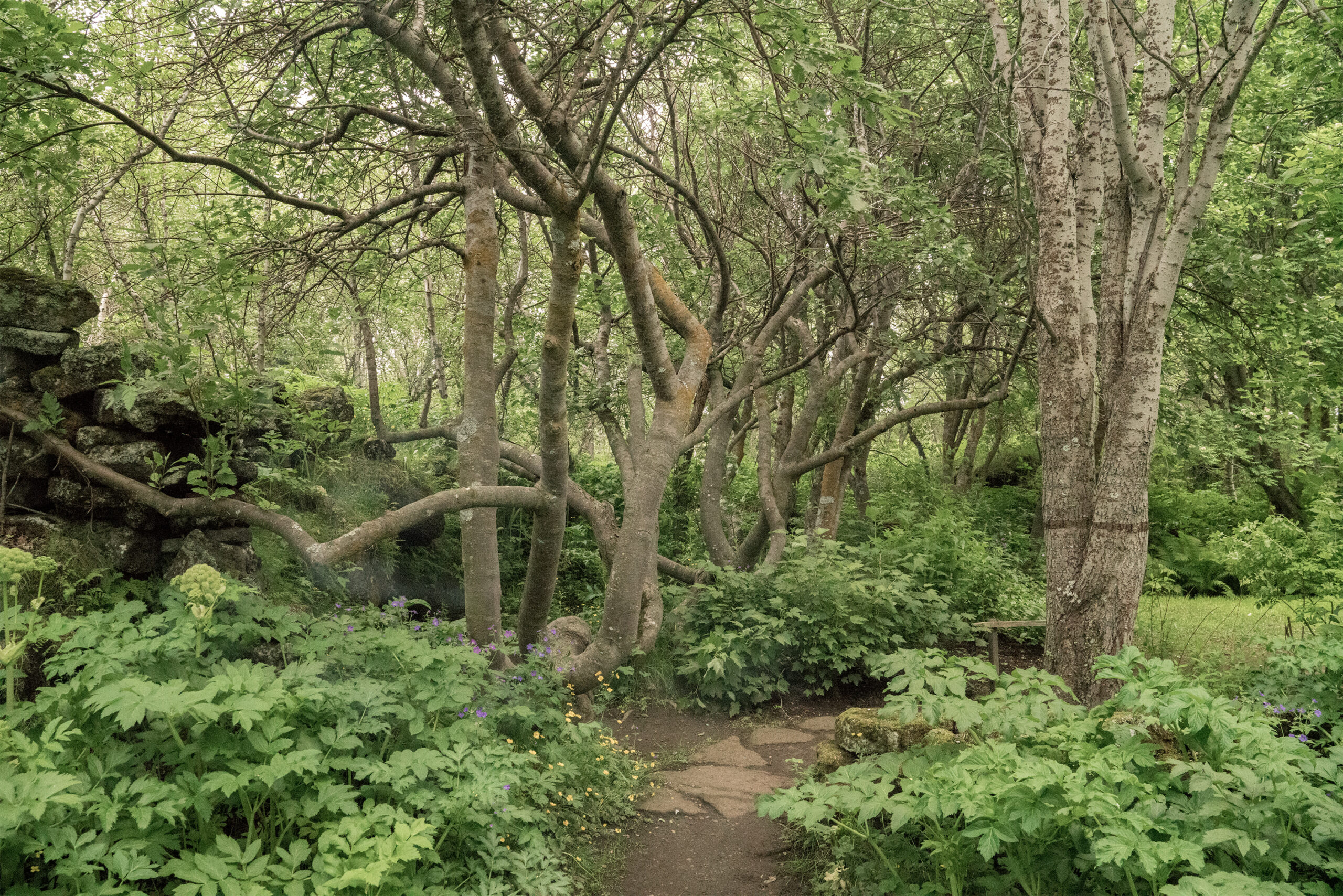
A small peninsula on the east shore that is almost improbably green for Iceland. As recently as the last century it was a bare spit of lava. Then the couple who owned the land started planting trees and shrubs, and when the husband died his wife gave Höfði to the municipality. Today it’s a small park of trees, shrubs and flowers, with short paths leading down to the shore.
From the Höfði shoreline and the neighbouring farm of Kálfaströnd you look out over the Kálfastrandarvogur inlet, where lava pillars and crags called Klasar stick up out of the water and along the shore. They’re the same kind of lava formations as in Dimmuborgir, only standing in the lake, and in the morning they’re mirrored in it. In our view Höfði is the best place on the lake for a quiet hour away from the crowds, and with binoculars, for birdwatching too. Entry is free and there’s a small car park on Route 848.
3. Dimmuborgir: the dark castles of lava
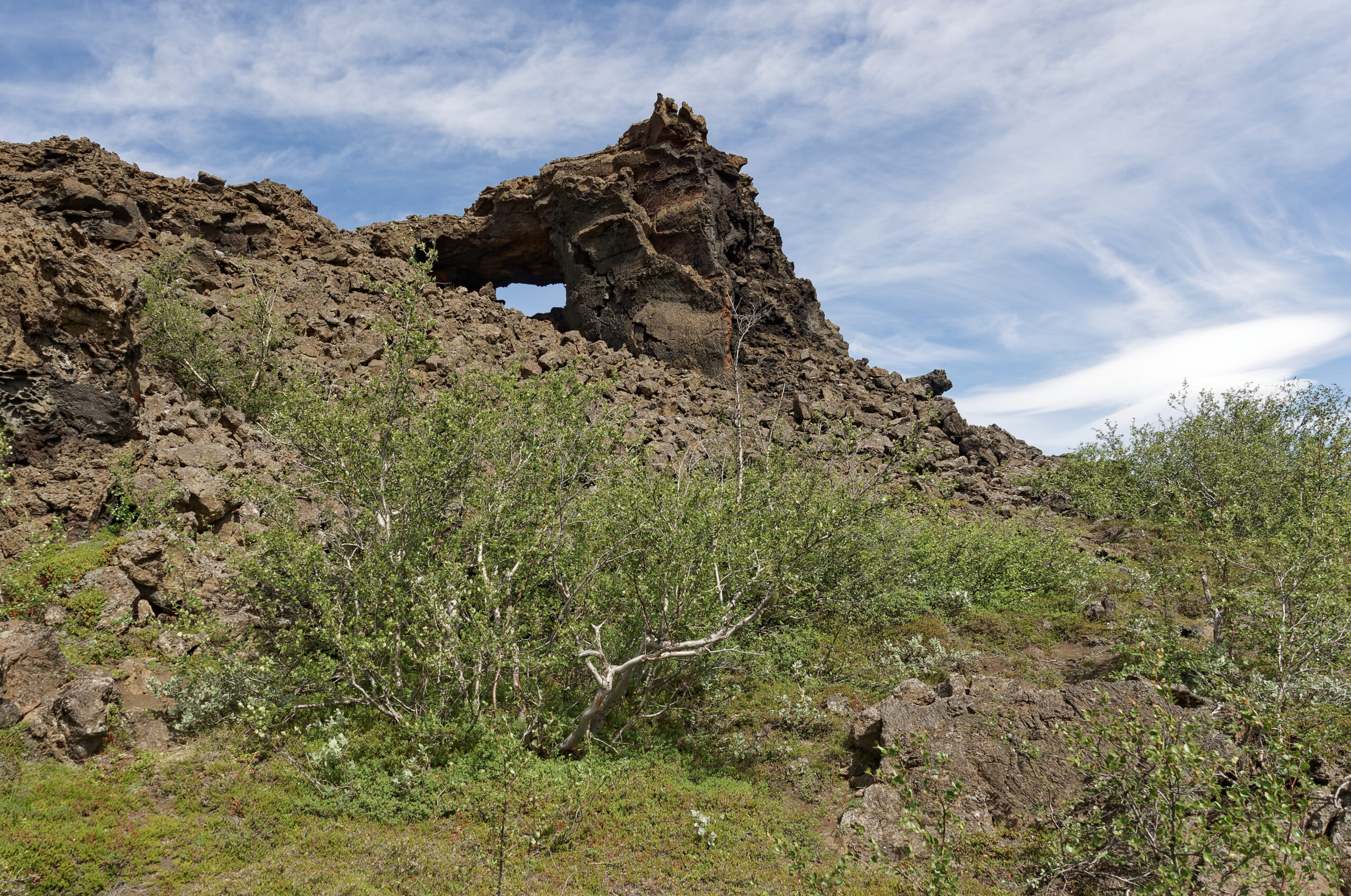
The name means “dark castles”, and it fits. Dimmuborgir is a field of lava towers, arches, chimneys and caves, with birch and heather growing between them. It formed about 2,300 years ago, when lava filled a hollow and created a lava lake roughly two kilometres across. Under the solidified crust the lava stayed molten, and when the lake drained westwards towards Mývatn, the towers and chimneys were left standing where they had hardened around vents through which steam had forced its way up from the wet ground below. It has been a natural monument since 2011, and the Soil Conservation Service has looked after it since 1942.
Trails. Several colour-coded loops start from the car park. The shortest is the paved Litli hringur (about 600 metres), which even small children can manage and which leads on to all the others. Stóri hringur (about 750 to 900 metres) goes to the large grassy hollow of Hallarflöt. The longest of the standard loops, Kirkjuhringur (about 2 km), leads to Kirkjan, “the church”, a vaulted lava cave that genuinely looks like a ruined chapel. If you want more, a waymarked trail continues from Dimmuborgir all the way to Hverfjall crater. Don’t climb on the lava: the rock is fragile and climbing on it is forbidden.
Practical info. A paved turn-off from Route 848 leads to the car park. According to guidebooks, there’s no parking fee here. Next to the car park is a building with toilets, a café and a souvenir shop. In winter, snow and ice can make the trails difficult and sometimes impossible to walk.
The Yule Lads. According to Icelandic folklore, Dimmuborgir is home to the thirteen Yule Lads, the jólasveinar, sons of the trolls Grýla and Leppalúði. On selected days in Advent they welcome visitors at Hallarflöt. Tickets cost around 2,300 ISK (about £14) for everyone aged six and over, and dates and tickets are on yulelads.is. Game of Thrones fans may recognise the place too: the wildling camp in season three was filmed here.
4. Hverfjall: a crater you can walk all the way round
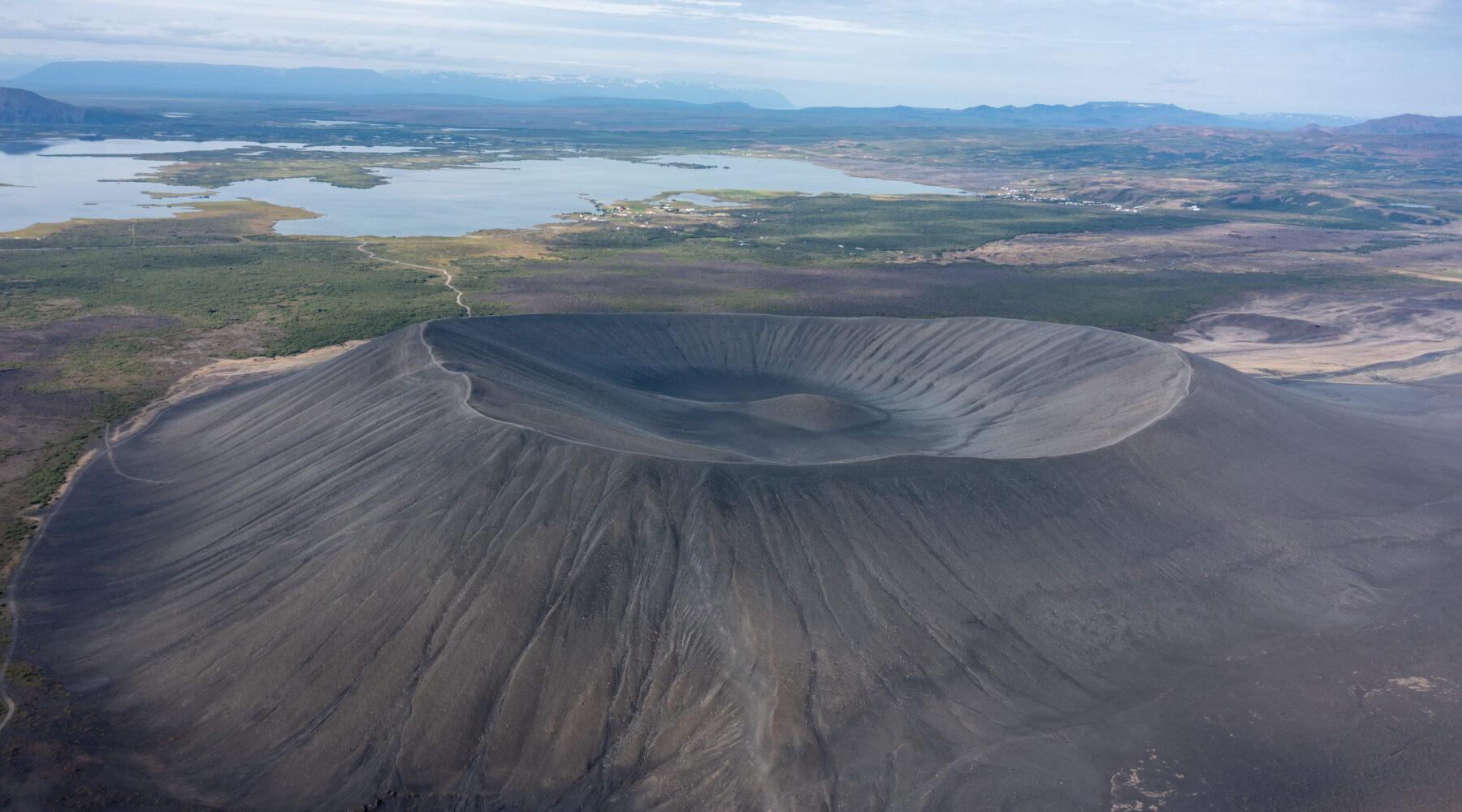
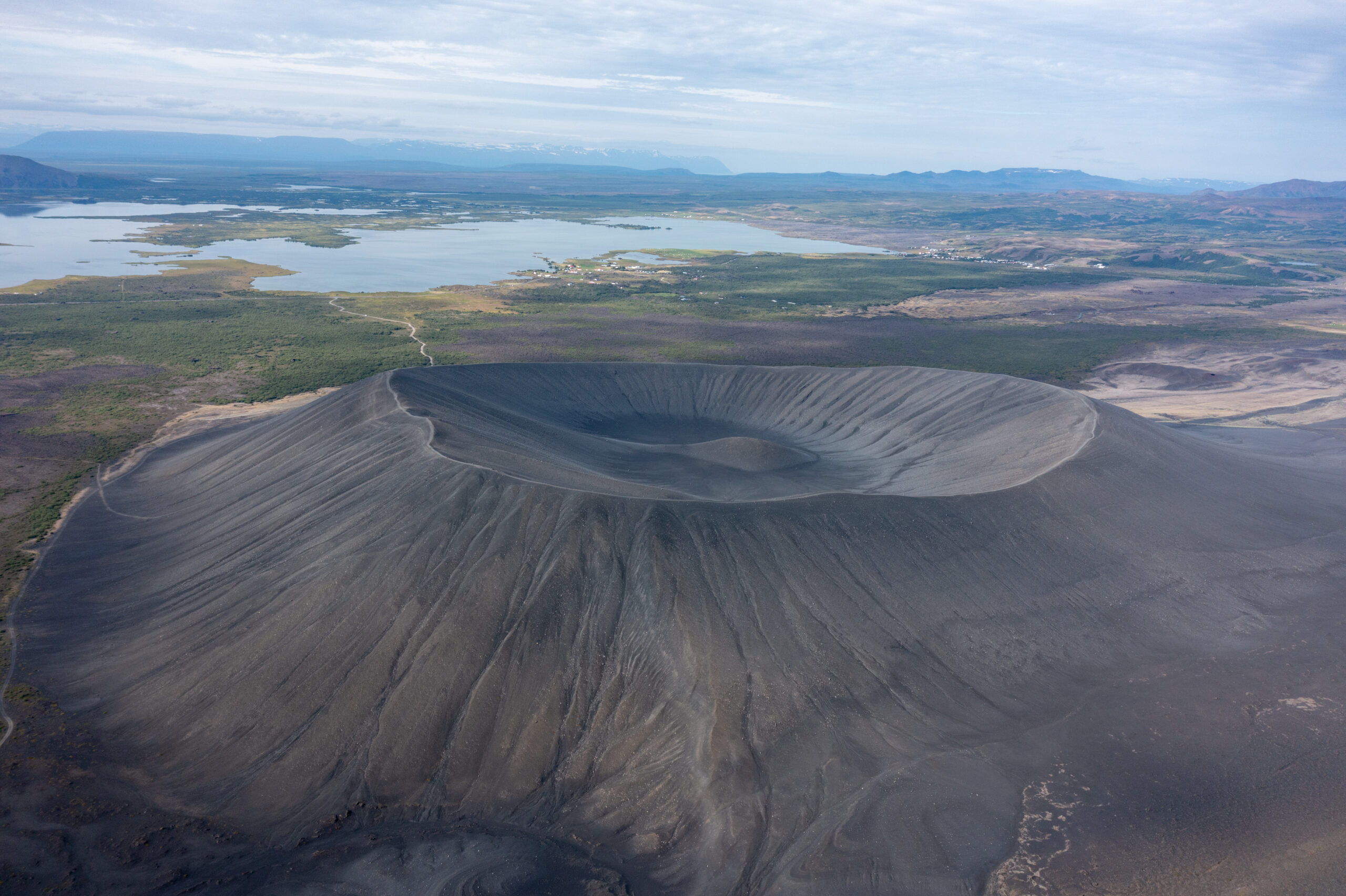
A huge black crater east of the lake that you can see from almost everywhere. It was created around 2,500 years ago in a single explosive eruption, when magma met groundwater. The crater is roughly a kilometre across, the highest point of the rim is 452 metres above sea level, and the inside is about as deep as the crater rises above its surroundings. A small cone stands in the middle. On maps you’ll find it as both Hverfjall and Hverfell; both names are in use.
The hike. From the north-west car park, a steep path about 600 metres long climbs to the rim. It takes 10 to 25 minutes on loose scoria. The full loop round the rim is about 3.2 km and takes around an hour. From the car park there’s also an easy trail of about two kilometres towards Dimmuborgir (20 to 30 minutes), and from the south side you can climb to the rim on a shorter but steeper and harder path. From every side you look out over the lake, the pseudocraters and the lava fields around Krafla. On the slopes, stay on the marked path: the loose scoria recovers only slowly from being trampled and slid down.
Hverfjall parking. The car park below the crater charges around 1,200 ISK (about £7) per day for a car with up to eight seats, toilets included. You pay through the Parka app or website within 24 hours, otherwise a fee of roughly 2,000 ISK (about £12) is added. Sleeping in the car park is not allowed. The turn-off from Route 1 south of Vogar is gravel and often impassable in winter.
5. Grjótagjá: the Game of Thrones hot-water cave
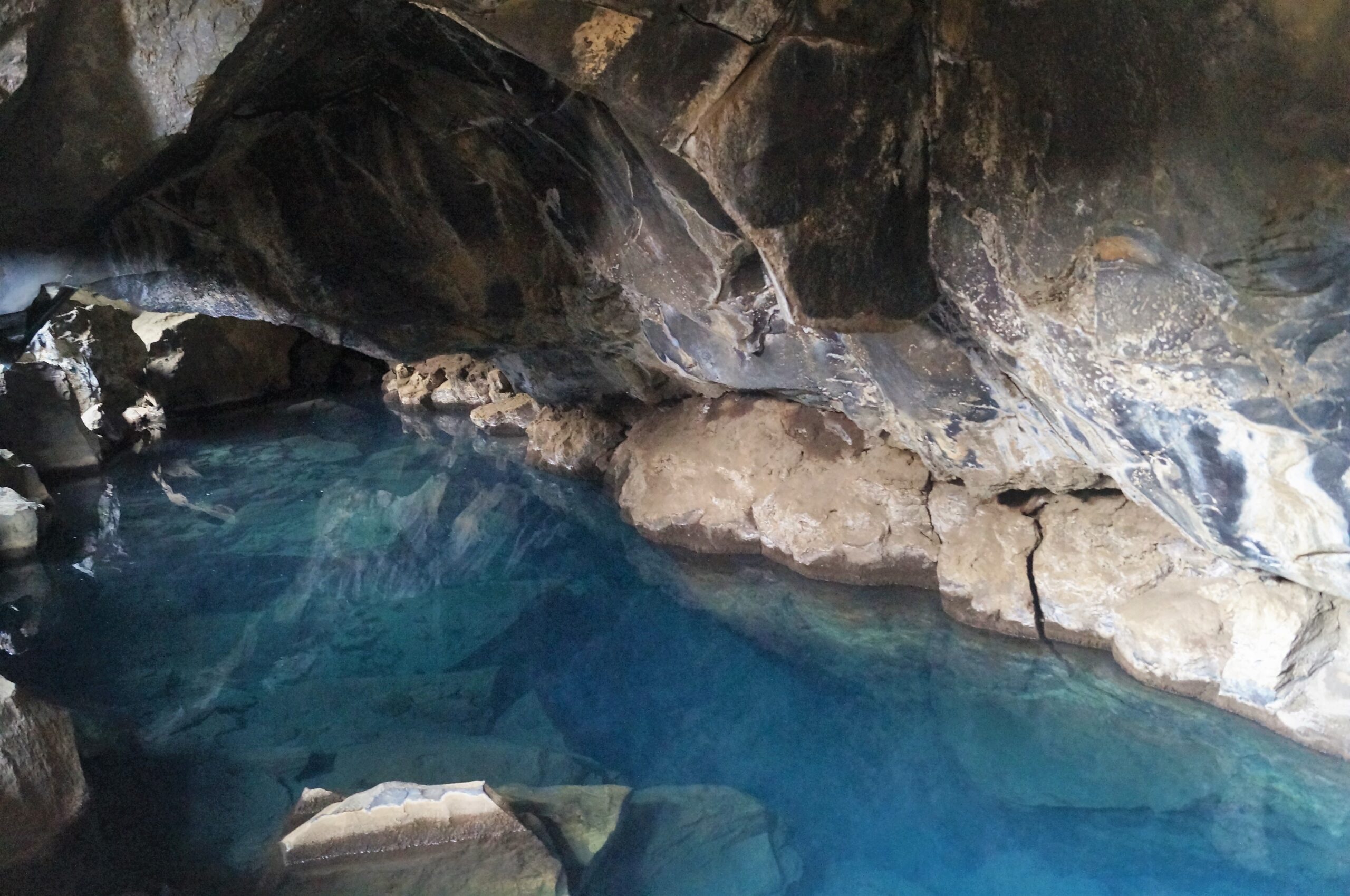
An unassuming fissure in the lava just outside Reykjahlíð, hiding an underground pool of clear blue water. Until the 1970s, locals used to come here to bathe. Then came the Krafla Fires (1975 to 1984), the water heated up to a temperature nobody could stand, and it has cooled only a little since. It’s usually given as around 50 °C. The scene with Jon Snow and Ygritte in season three of Game of Thrones was filmed here.
The land belongs to Vogar farm and bathing in the cave is forbidden. Because of the mess visitors left behind, the owners locked it for a while in 2018 and reopened it a year later. You’re welcome to look and take photos. Getting in means clambering down over boulders, and inside it’s dim with slippery rocks, so sturdy shoes and a torch help. The whole stop takes a few minutes and there’s a small car park by the cave.
Close by, right in Reykjahlíð, is a similar fissure called Stóragjá. Bathing there isn’t banned, but it isn’t recommended either: you climb down by ladder and rope, and bacteria turn up in the water. If you want a soak, go to the baths.
6. Reykjahlíð and the church the lava flowed around
The village on the north-east shore is more of a service hub than a destination, but one stop here is worth it. In August 1729, at the end of the Mývatn Fires, a lava flow from Krafla reached Reykjahlíð, destroyed farms and stopped just short of the wooden church, which stood on a low rise. The lava split in front of it and the church survived. Local tradition credits the priest’s prayers; geologists credit the higher ground. Today’s church stands on the same spot, and you can still see the solidified lava of 1729 around the village.
Reykjahlíð also has the shop, the petrol station and most of the restaurants on the lake, so you’ll end up coming here to stock up anyway. Bird lovers can head to the north-west shore to Sigurgeir’s Bird Museum (Fuglasafn Sigurgeirs), which displays a local collector’s stuffed birds and eggs. Opening hours change with the season, so check them at fuglasafn.is.
7. Earth Lagoon Mývatn: a soak with a view of the lake
Geothermal baths on the hillside above the lake, about 4 km from Reykjahlíð, formerly known as Mývatn Nature Baths (Jarðböðin in Icelandic). After a complete rebuild they reopened under the new name, with a bigger lagoon, a new steam bath in a cave you can swim into, a swim-up bar and a bistro. The water is 36 to 40 °C and about 1.3 metres at its deepest. Compared with the Blue Lagoon there are fewer people and more of a view: from the water you can see Mývatn, Hverfjall and the lava fields.
| Package (prices are a guide) | What’s included | Adults | Ages 13 to 15 | Ages 6 to 12 |
|---|---|---|---|---|
| Earth Essential | Lagoon, hot tub, steam bath, standard changing room, private shower | from 7,900 ISK (about £47) | from 3,900 ISK (about £23) | from 2,500 ISK (about £15) |
| Earth Signature | The same plus better changing rooms, towel, one drink, bistro discount (no private shower) | from 9,900 ISK (about £60) | from 4,900 ISK (about £29) | from 3,500 ISK (about £21) |
| Earth Exclusive | Private lagoon, private changing room for two, robes, prosecco, ages 20 and over only | from 52,000 ISK (about £310) | not available | not available |
Children aged five and under go free with an adult. Swimsuit hire costs around 1,100 ISK (about £7) and a towel around 1,200 ISK (about £7). The operator says prices vary with the time slot and demand, hence the “from”, so check them before you go. It’s open daily from 12 noon to 10 pm; in winter you have to be out of the water by 9.40 pm, in summer by 10.40 pm. On Christmas Eve, Christmas Day and New Year’s Eve it’s open from 12 noon to 4 pm only, and it’s closed on New Year’s Day. Hours are occasionally cut short for weather or maintenance; the latest information is on earthlagoon.is.
It pays to buy timed tickets in advance. Without a booking you’ll only get in if there are free lockers. You can arrive up to half an hour after the start of your booked slot. Cancelling more than 72 hours ahead is free, 24 to 72 hours ahead gets you half back, and after that only 10%. As in every Icelandic pool, you must shower without your swimsuit before getting in. Most people spend about an hour and a half here. For a comparison with the Blue Lagoon, Sky Lagoon and other baths, see our guide to the Blue Lagoon in Iceland.
💡 Go to the baths at the end of the day. In December it gets dark at around quarter past three, and you can then wait in the water for the northern lights. In summer, the evening brings the fewest people and the best light on the lake. And there are no midges at Earth Lagoon, unlike the ones that chased you round the lake all day.
8. Krafla, Víti and the Leirhnjúkur lava field
A volcanic caldera north-east of the lake, reached by paved Route 863, which branches off Route 1 beyond the Námaskarð pass. The Krafla caldera is about 10 km long and has 29 recorded eruptions in its history. The two most recent episodes (1724 to 1729 and 1975 to 1984) are the ones described above.
Víti. An explosion crater about 300 metres across, created in 1724 at the start of the Mývatn Fires. At the bottom lies a turquoise pool whose colour shifts from milky blue to green depending on the weather. A path runs round the rim, but you don’t go down to the water. The name means “hell”, and Iceland has several craters called that; the other well-known one is at Askja.
Leirhnjúkur. A lava field from the eruptions of 1975 to 1984, crossed by a waymarked loop. In places the lava is still warm, steam rises from the ground, and there are colourful mud pools and sulphur deposits all around. It’s the closest you’ll get to “fresh” lava at Mývatn, and in our view one of the most powerful walks in the whole area. The ground is thin and hollow in places, though, so don’t step off the marked trail.
Below the caldera stands the Kröflustöð geothermal power station, its pipes snaking across the landscape. According to guidebooks, the car parks at Víti and Leirhnjúkur charge around 800 ISK (about £5) through an app. In winter there’s a small ski area here.
Day trips from Lake Myvatn
Mývatn makes a good base for the whole of north-east Iceland. Everything below is within an hour’s drive, and we’ll cover each place in more detail in separate guides.
Hverir (Námaskarð). A geothermal field just over the Námaskarð pass, a few kilometres east of Reykjahlíð, right by Route 1. Bubbling mud pots, hissing fumaroles, yellow and orange ground and a smell of sulphur you’ll notice from the car. Parking is paid; according to the operator, a car costs around 1,400 ISK (about £8). Walk only on the marked paths: the mud and water are boiling and the ground is thin.
Dettifoss. Iceland’s most powerful waterfall, about 44 metres high and 100 metres wide, in the Jökulsárgljúfur canyon in Vatnajökull National Park. It’s about an hour’s drive from Reykjahlíð, and paved Route 862 leads to the west side. We write about the national park and its southern side in our guide to Vatnajökull.
Goðafoss. The “waterfall of the gods”, right on Route 1 between Mývatn and Akureyri, 12 metres high and 30 metres wide. According to tradition, around the year 1000 the lawspeaker Þorgeir threw his pagan idols into it when Iceland adopted Christianity. An ideal stop on the way to or from Akureyri.
Húsavík and Ásbyrgi. The harbour town of Húsavík on the north coast is Iceland’s whale watching capital, and the horseshoe-shaped Ásbyrgi canyon is part of Vatnajökull National Park. Both can be combined with Dettifoss into a loop known in the north as the Diamond Circle.
Lofthellir. A lava cave full of ice formations, which you can only enter with a guide. The entrance is narrow and part of the way is on all fours.
Lake Myvatn in winter and the northern lights
Winter Mývatn is a different place altogether. The lake freezes, the lava towers of Dimmuborgir fill up with snow, steam from Hverir and the baths rises into the frost, and there’s hardly anyone on the roads. The price is darkness and weather. In November the day lasts four and a half to eight hours, in December only three to four and a half, and around the winter solstice the sun doesn’t rise until about eleven and sets at around quarter past three. For planning, that means one or two sights a day and everything outdoors around midday.
| Month | Daylight at Mývatn |
|---|---|
| November | 4.5 to 8 hrs |
| December | 3 to 4.5 hrs |
| January | 4.5 to 7 hrs |
| February | 7 to 10 hrs |
| March | 10 to 13.5 hrs |
Northern lights at Lake Myvatn. The municipality calls itself “Iceland’s northern lights capital”, and it’s not just marketing. There’s little light pollution and the north tends to have clearer skies than the south. The aurora can be seen roughly from September to April, in the dark and under a clear sky. According to a study cited by the local tourism website, your chance of seeing it at Mývatn on any one night is around 41%, and over three nights around 71%. Nobody can guarantee it, though. The aurora activity and cloud cover forecasts are on vedur.is, and when the forecast looks good, all you need to do is walk out of the village, switch off your head torch and wait.
Things to do in winter. Dimmuborgir, the pseudocraters, Höfði and Hverir are accessible all year round; just expect snow and ice on the paths. You often can’t drive up to Hverfjall, but you can walk there from Dimmuborgir. Winter tours on offer include dog sledding, snowmobiling, horse riding, cross-country skiing and the Lofthellir ice cave. In December the Yule Lads are in Dimmuborgir, and in early December they even take a dip at Earth Lagoon. In late February or early March the Mývatn Winter Festival takes place, with horse races on the ice, dog sledding and a homemade sledge competition. In 2027 it’s scheduled from 26 February to 7 March.
Lake Myvatn entrance fee and other costs
There’s no entrance fee for Lake Myvatn itself, and most of the sights around it are free. You mainly pay for the baths, parking at a few places, the tunnel and accommodation, which in summer is by far the biggest item on the bill.
| Item | Price in ISK (approx.) | Approx. in £ |
|---|---|---|
| Earth Lagoon Mývatn, Earth Essential, adult | from 7,900 | from £47 |
| Earth Lagoon Mývatn, Earth Signature, adult | from 9,900 | from £60 |
| Hverfjall parking, car up to 8 seats, per day | around 1,200 | £7 |
| Hverir parking, car | around 1,400 | £8 |
| Víti and Leirhnjúkur parking (according to guidebooks) | around 800 | £5 |
| Vaðlaheiðargöng tunnel, car, one way | around 2,200 | £13 |
| Yule Lads in Dimmuborgir, ages 6 and over | around 2,300 | £14 |
| Dimmuborgir, Skútustaðagígar, Höfði, Grjótagjá | free | free |
The pound figures are rounded and based on roughly 100 ISK to £0.60, so treat them as a guide only. Parking in Iceland is mostly paid through the Parka or EasyPark apps, often with a small transaction fee. If you don’t pay within 24 hours, an invoice with a penalty follows, and with a hire car it comes via the rental company with their admin fee on top.
Staying safe at Mývatn
Mývatn isn’t a dangerous place, but geothermal areas have their own rules and they mean exactly what they say.
- Stay on the paths. At Hverir and Leirhnjúkur the ground is thin in places, with boiling mud or water underneath. Hold children by the hand.
- Only bathe in the baths. The water in Grjótagjá is around 50 °C, and in fissures and streams in geothermal areas it can be boiling.
- Don’t climb on the lava. The formations in Dimmuborgir and the lava pillars at Höfði are fragile and protected. A broken-off piece can never be put back.
- In winter, watch the weather and the roads. Stretches of Route 1 east of Mývatn close in blizzards. Road conditions are on umferdin.is, warnings on safetravel.is, weather and volcano updates on vedur.is. The emergency number is 112, the same as across Europe and in the UK.
- Don’t fly a drone without checking the rules. Drone restrictions apply in the protected areas around the lake, and during the nesting season the lake is sensitive to disturbance of the birds. Check the rules on the protected areas authority’s website beforehand.
What we’d do differently
If we went to Mývatn again, we wouldn’t try to drive round the whole lake in one afternoon, the way most people on a Ring Road trip do. Skútustaðir, Höfði, Dimmuborgir and Hverfjall are only minutes apart by car, so it’s tempting to tick them off one after another. But then all you remember are car parks, midges and the same photos as everyone else. We’d rather pick two or three places and leave the rest for the next day.
What stayed with us most is something you won’t find on any list: standing on the rim of some nameless pseudocrater by the road, with not even a signpost pointing to it, watching goldeneyes float across the water. Or having a coffee with homemade bread baked in the hot ground in the cowshed at Vogar, with nowhere to rush off to. North Iceland has its own food and it’s worth trying, even if it doesn’t look like something off Instagram.
And in winter we’d leave the phone in our pocket. Nobody ever photographs the northern lights the way they saw them, and when you’re standing on a frozen shore where the only sound is the ice cracking, there’s no reason to hurry. There are no midges at that time of year, no coaches either, and Mývatn suddenly becomes a completely different lake.
Lake Myvatn FAQ
Where is Lake Myvatn in Iceland?
In north-east Iceland, right on the Ring Road (Route 1). It’s about 100 km from Akureyri (one to one and a half hours by car), about 165 km from Egilsstaðir and around 480 km from Reykjavik, which means six to seven hours of driving without stops. The main village on the lake is Reykjahlíð on the north-east shore.
What are the best things to do at Lake Myvatn?
The Skútustaðagígar pseudocraters on the south shore, the wooded Höfði peninsula with its lava pillars, the Dimmuborgir lava maze, Hverfjall crater with its rim walk, Grjótagjá cave, the church in Reykjahlíð, the Earth Lagoon Mývatn baths and the Krafla caldera with Víti crater and the Leirhnjúkur lava field. Within an hour’s drive are the Hverir geothermal field and the Dettifoss and Goðafoss waterfalls.
How much does Earth Lagoon Myvatn cost?
The cheapest package, Earth Essential, costs from 7,900 ISK (about £47) per adult, and Earth Signature from 9,900 ISK (about £60). Children and teenagers aged 6 to 15 pay roughly 2,500 to 3,900 ISK, and children aged five and under go free. Prices vary with the time slot and demand. It’s open daily from 12 noon to 10 pm.
Are Myvatn Nature Baths and Earth Lagoon the same place?
Yes. Earth Lagoon Mývatn is the new name of the baths formerly called Mývatn Nature Baths (Jarðböðin in Icelandic). After a complete rebuild they reopened with a bigger lagoon, a steam bath and a bistro. On older maps and in sat navs you’ll find both names.
Are there midges or mosquitoes at Lake Myvatn?
No mosquitoes, but in summer, mainly from June to August, millions of midges swarm over the lake, which is named after them (“midge lake”). They don’t bite, they just get into your eyes and nose. The ones that do bite are the smaller blackflies, which live mainly by the Laxá river. A head net and long sleeves help, and when it’s windy, or from September on, you’ll be left in peace.
Can you swim in Grjótagjá cave?
No. Bathing in Grjótagjá is forbidden. After the Krafla eruptions of 1975 to 1984 the water heated up, and it’s still around 50 °C today. The land belongs to Vogar farm and the owners only allow visiting and taking photos. For a swim, go to the Earth Lagoon Mývatn baths.
When is the best time to see the northern lights at Lake Myvatn?
Roughly from September to April, in darkness and under a clear sky. According to guidebooks, the best chances tend to be in October and November and then in February and March, when the nights are still long enough but the days are already longer for sightseeing. The local tourism website puts the chance of seeing the aurora on any one night at around 41%, and over three nights at around 71%. The current forecast is on vedur.is.
How many days do you need at Lake Myvatn?
You can drive round the sights in one long day, but we’d plan on two nights: one day for the lake, Dimmuborgir, Hverfjall and the baths, the other for Krafla, Hverir and a trip to Dettifoss or Goðafoss. In winter, when there are only a few hours of daylight, it’s worth adding another night.
Where to next
- Blue Lagoon Iceland: tickets, prices and how it compares with Earth Lagoon, Sky Lagoon and other baths.
- Fagradalsfjall and Iceland’s volcanoes: the eruptions on Reykjanes and how to see the lava safely.
- Vatnajökull: Iceland’s largest glacier, ice caves and the national park that Dettifoss also belongs to.
- Landmannalaugar: the colourful mountains of the highlands, hot springs and F-roads.
- Things to do in Reykjavik: where to start and end your trip, the airport and getting into the city.
Potřebujete pomoct s cestováním?
-
Ubytování 🏨
Vyberte si to nejlepší ubytování, ať už jste kdekoliv, přes Booking.com. -
Půjčení auta 🚗
Auto si snadno najdete přes Booking.com, kde máte často slevu díky ubytování, nebo Rentalcars.com, kde porovnáte nabídky většiny půjčoven. -
Zážitky 🎟️
Přes GetYourGuide.com si vyberete z nejrůznějších výletů i zážitků po celém světě, navíc se zrušením zdarma do 24 h předem.