Last updated 27.11.2026
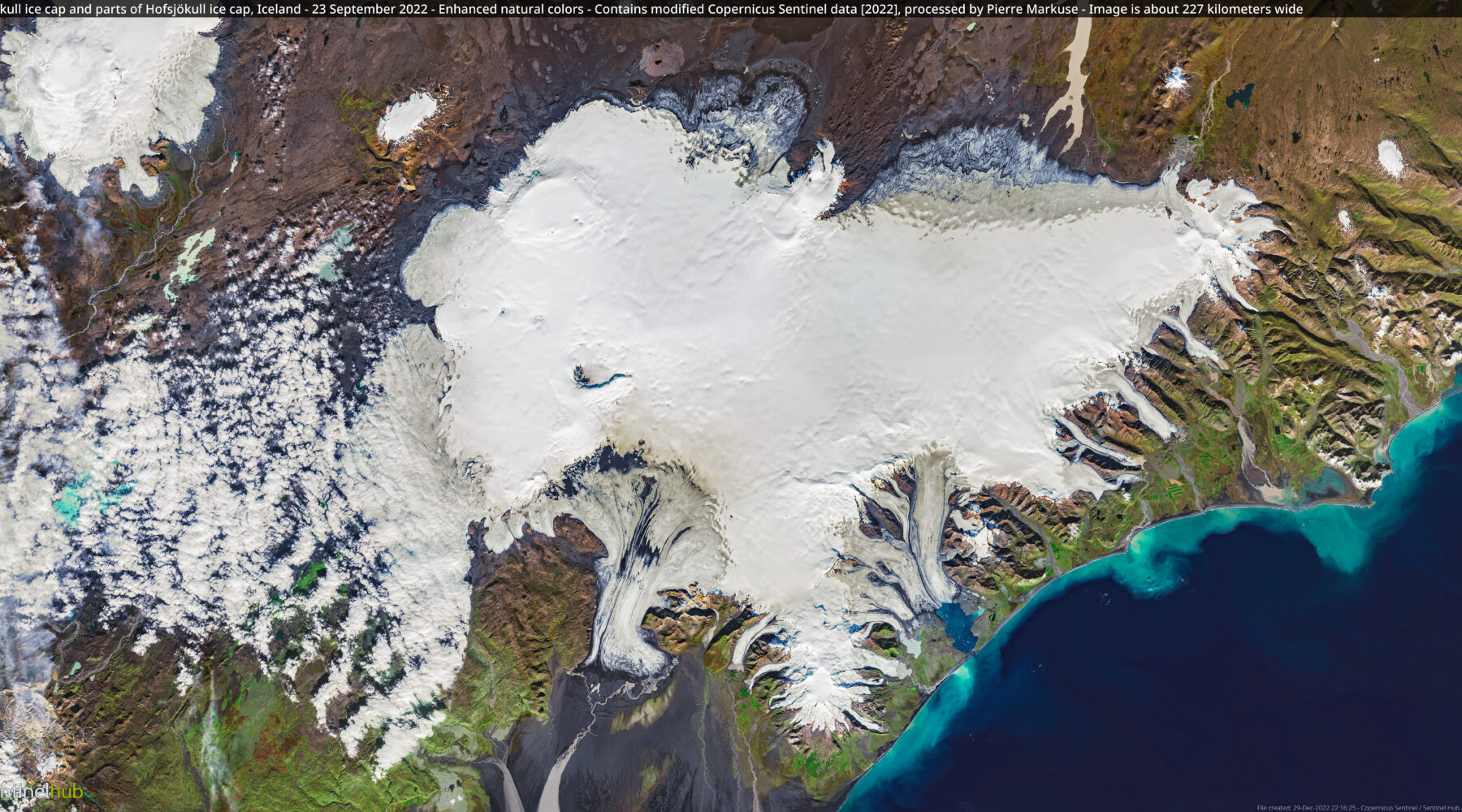
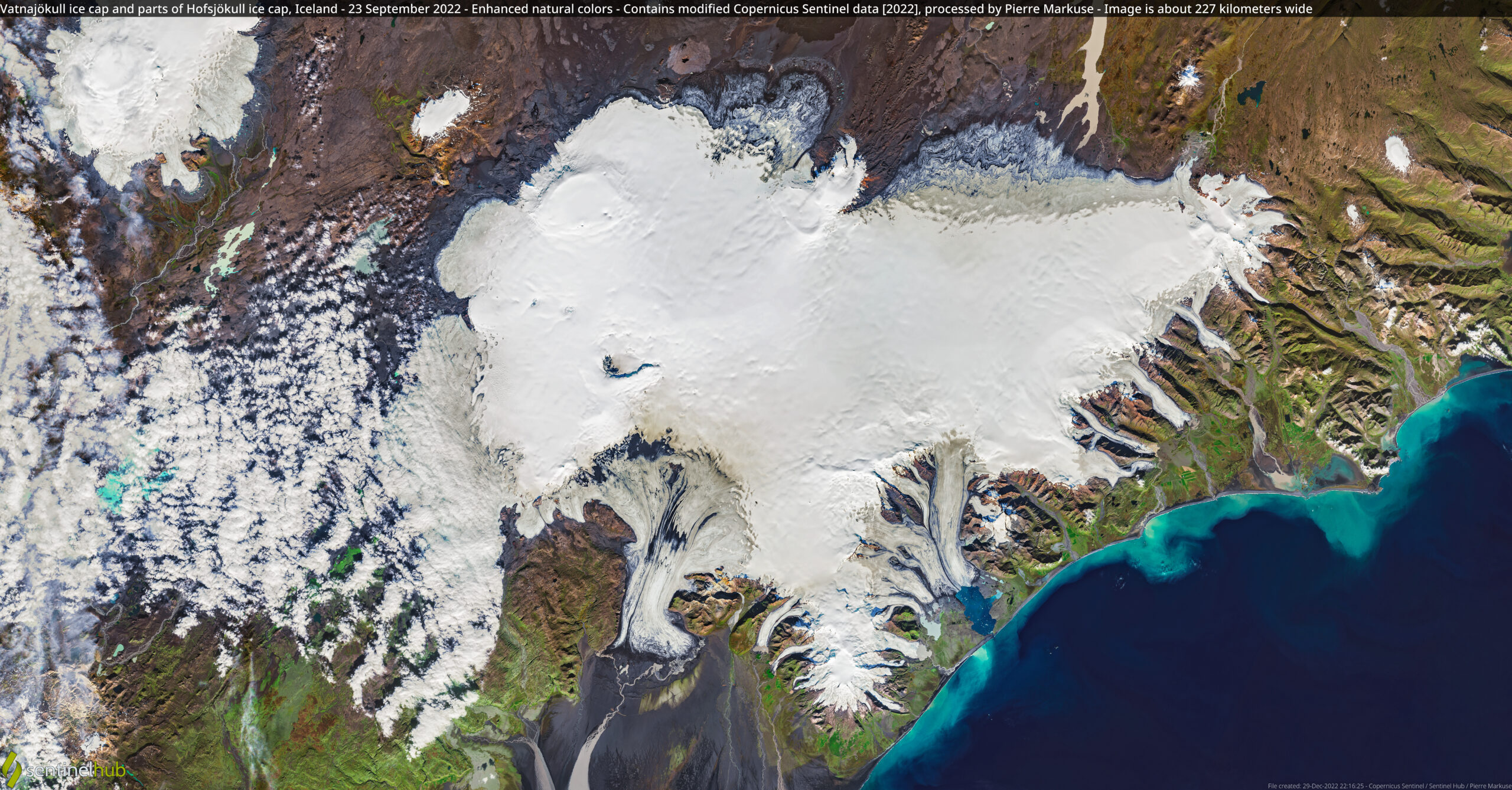
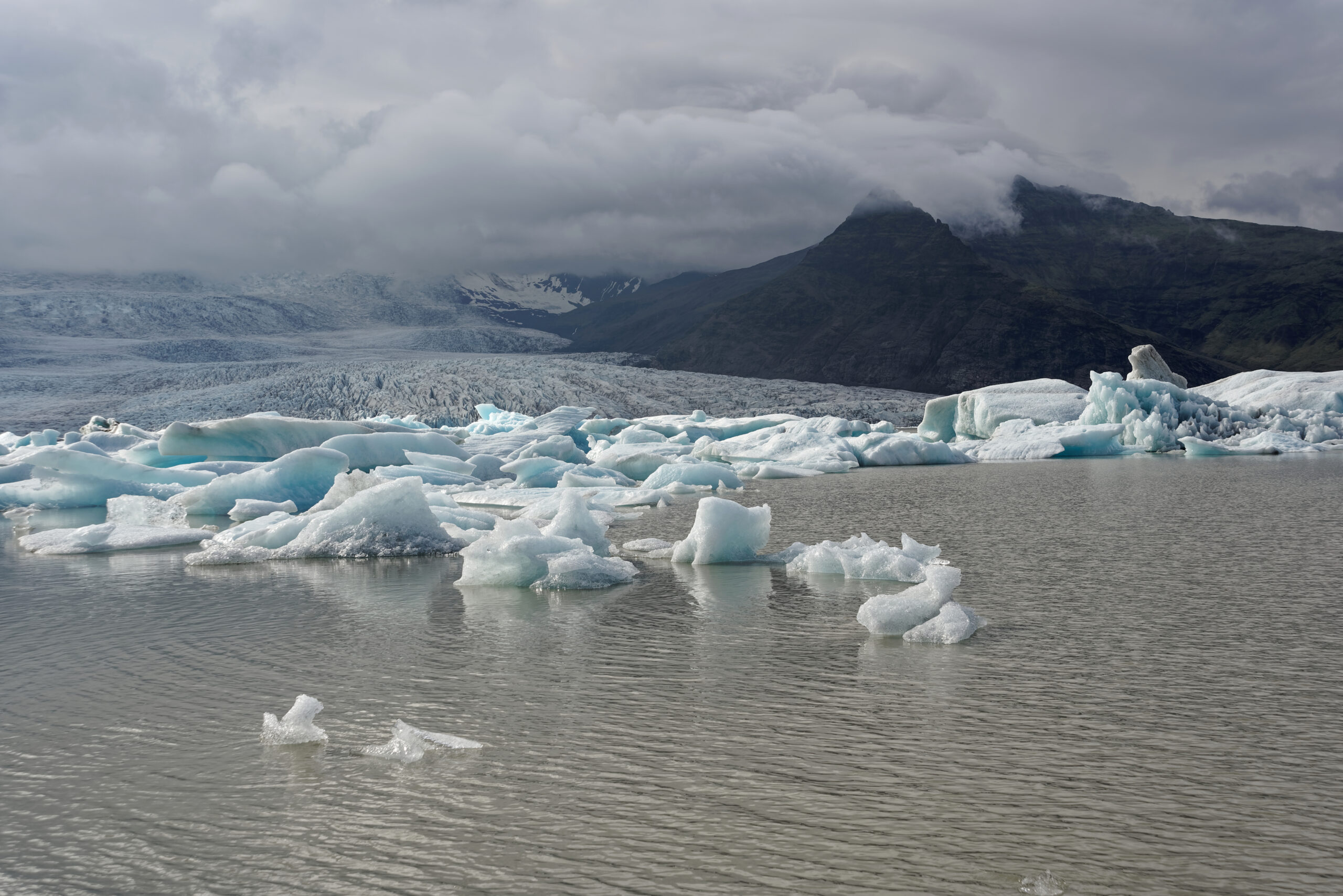
On a map of Iceland, the Vatnajökull glacier is the big white blot in the bottom right corner that at first glance looks like a printing error. It is an ice cap bigger than the whole of Devon, and several active volcanoes are at work underneath it. From the Ring Road you only ever see its edges: tongues of ice spilling off the plateau into the valleys, lagoons full of drifting icebergs and the black sand plains left behind by glacial floods. You can walk on the glacier itself and, in winter, climb inside an ice cave, but only with a guide. This guide covers how to get to Vatnajökull, when to go, what ice caves and glacier hikes cost, where to sleep and what to keep an eye on so that the trip ends with photos rather than a call to 112.
Vatnajökull glacier at a glance
- Iceland’s largest glacier. It covers around 7,700 km² (2019 figure), roughly 8% of the island, and it shrinks every year. The ice averages about 400 metres thick and is over 900 metres at its deepest.
- Vatnajökull National Park was founded on 7 June 2008 and has been a UNESCO World Heritage Site since 2019. At just under 15,000 km² it takes up about 14% of Iceland and also includes Skaftafell, Jökulsárlón, Askja and the Jökulsárgljúfur canyon.
- Ice caves are winter-only and guide-only. The season starts in October and ends in April; from May to September the caves in the park are closed. The ice is usually most stable from November to March.
- An ice cave tour costs roughly 20,000 to 25,000 ISK (about £120 to £150), a glacier hike from around 13,000 ISK (about £80). Only companies with a contract with the park are allowed to run them.
- It is a long way from Reykjavik. Skaftafell is about 325 km away, over four hours’ driving without stops, and Jökulsárlón another 56 km or so. We would not recommend doing it as a day trip there and back.
- Parking at Skaftafell and Jökulsárlón costs around 1,100 ISK (about £7) per car and is valid until midnight on the day you pay.
- There are active volcanoes under the ice (Grímsvötn, Bárðarbunga, Öræfajökull and others). Check vedur.is and safetravel.is before you set off.
What is the Vatnajökull glacier and where exactly are you going?
Vatnajökull is not a glacier in the sense most of us picture from the Alps. It is an ice cap: a flat dome sitting on a plateau in south-east Iceland, with around thirty outlet glaciers flowing off it in every direction. Icelanders call these tongues skriðjöklar, and each has its own name: Skaftafellsjökull, Falljökull, Svínafellsjökull, Fjallsjökull, Breiðamerkurjökull, Heinabergsjökull and so on. When someone tells you they “went up Vatnajökull”, they almost always mean they walked on one of those tongues. Ordinary visitors don’t get onto the dome itself.
If the figures you find online don’t match, there is a simple reason: the glacier is getting smaller. Older sources give more than 8,000 km², a 2019 survey put it at around 7,700 km², and the park authority already works with lower numbers. It holds about 3,000 km³ of ice, its average thickness is roughly 380 to 400 metres and the deepest points reach about 950 metres. You will often read that Vatnajökull is the largest glacier in Europe. That is not quite right: by area it is beaten by the ice cap on the northern island of Novaya Zemlya in the Russian Arctic. It is, however, comfortably the largest glacier in Iceland and one of the biggest in Europe.
Several volcanic systems lie beneath the ice. The most active is Grímsvötn, which last erupted in May 2011. Then there is Bárðarbunga, whose fissure eruption at Holuhraun on the northern edge of the glacier ran from August 2014 to February 2015, and in the south Öræfajökull, home to Iceland’s highest peak, Hvannadalshnúkur (2,110 m). When a volcano melts a large volume of ice from below, the result is a jökulhlaup, a glacial outburst flood. The 1996 flood swept away sections of the Ring Road bridges across Skeiðarársandur, and the black sand plains you drive over on the way from Reykjavik were laid down by floods just like it.
Vatnajökull National Park was created on 7 June 2008 by merging the older Skaftafell and Jökulsárgljúfur parks, and it has been extended several times since. Today it covers just under 15,000 km², about 14% of Iceland, and in July 2019 UNESCO added it to the World Heritage List for its interplay of fire and ice. Besides the glacier, the park includes the Lakagígar craters, the Askja area in the Highlands and the Jökulsárgljúfur canyon with Dettifoss waterfall in the north. In this guide we stick to the southern side of the glacier, which is where the vast majority of visitors go.
How to get to the Vatnajökull glacier from Reykjavik
Flights from the UK land at Keflavík, and from there you head south-east. Check the current airlines and routes yourself, as they change from season to season.
By car. Route 1, the Ring Road, runs along the southern side of the glacier, and driving is by far the easiest option. From Reykjavik to Skaftafell is about 325 km, which your sat nav will put at roughly four hours and twenty minutes without stops. In practice you will want to pull over at Skógafoss waterfall, Reynisfjara black sand beach or in Vík, so realistically allow a full day. From Skaftafell to Jökulsárlón glacier lagoon is about 56 km, and Höfn is roughly another 80 km beyond that. Kirkjubæjarklaustur, the last sizeable place before Skaftafell coming from the west, is about 70 km away from it.
The Ring Road is tarmac and is maintained in winter, but high winds and snow can close it for a whole day. Before every leg, check umferdin.is (road conditions) and safetravel.is (alerts). Remember that Icelanders drive on the right. You don’t need a 4×4 for the southern side of Vatnajökull unless you plan to go on F-roads. The north of the park, Askja and the Highland tracks up to the ice are out of reach without an off-road vehicle and outside summer.
By bus. The public Strætó route 52 now runs between Reykjavik and Höfn four times a week (Tuesday, Thursday, Friday and Sunday). Check stops and times in the journey planner on straeto.is, as timetables change between seasons. For ice caves and glacier hikes it’s impractical: meeting times tend to be early in the morning and the bus only runs every day or two.
On an organised tour from Reykjavik. There are day trips to Jökulsárlón, some including an ice cave. They take about fourteen hours, most of which you spend in a minibus. Two- and three-day tours with overnight stays in the south make more sense, or simply hire a car and spend two nights in Skaftafell or Höfn.
💡 Watch out for ice caves “from Vík”. The Katla ice cave tours sold from Vík or Reykjavik don’t go to Vatnajökull at all, but to the Mýrdalsjökull glacier beneath the Katla volcano, about 180 km from Reykjavik. They run all year round and it’s closer, but it is a different glacier and a different kind of cave. If you want the blue ice caves of Vatnajökull, look for tours that meet at Jökulsárlón or Skaftafell.
Where to stay near the Vatnajökull glacier
On the southern side of the Vatnajökull glacier, a bed for the night is the scarcest commodity of the whole trip. Along the 200-plus kilometres between Kirkjubæjarklaustur and Höfn there are only a handful of hotels, a few farms with rooms and the campsite at Skaftafell, so book as early as you can, in winter as well as in summer. We would choose a base according to where you meet your guide: for glacier hikes and ice caves around Skaftafell, stay as close to Skaftafell as possible; for caves that start from Jökulsárlón, Höfn works perfectly well.
Skaftafell and around (Öræfi). The best base for glacier hikes and for walking trails in the park. Skaftafell itself has a year-round campsite where a pitch costs around 2,800 ISK (about £17) per adult per night, under-16s go free with an adult, and electricity is roughly 1,500 ISK (about £9) a day. Hotels and guesthouses are scattered across the farms along the road: places to stay near Skaftafell.
Between Skaftafell and Jökulsárlón. Only a few hotels stand on this stretch, and their advantage is that both meeting points are within easy reach. One of them is Fosshotel Glacier Lagoon, probably the best-known hotel in the area and priced accordingly.
Höfn. The only proper town nearby, about 80 km past Jökulsárlón. It has a supermarket, a petrol station, restaurants, a swimming pool and more accommodation than the whole of Öræfi put together, so it tends to be cheaper. It suits ice caves that start from Jökulsárlón and makes a good stop if you are carrying on east around the island. The local speciality is humar, sold in English as lobster, although it is actually langoustine (Norway lobster): places to stay in Höfn.
Kirkjubæjarklaustur. A village about 70 km west of Skaftafell, and the last place with a shop and a petrol station before the empty stretch across Skeiðarársandur. It makes sense if you are driving from Reykjavik and want to break the journey earlier on the first night: places to stay in Kirkjubæjarklaustur.
💡 Fill up and stock up in advance. Between Kirkjubæjarklaustur and Höfn there are only a few shops and petrol stations, and in winter they keep shorter hours. If you are staying at Skaftafell, bring food for your whole stay.
When to visit Vatnajökull
There is no single best time to visit Vatnajökull. There are really two different holidays, and which one you want depends on what you plan to do. If you’re going for the ice caves, you have to go in winter. If you want to hike, camp and see the north of the park too, go in summer. Glacier hikes on the outlet glaciers run all year.
Winter (November to March) is ice cave season. Both the park authority and the guides recommend these months because the ice is firmest in the frost. October tends to be the least stable month, February the most reliable and January the quietest in terms of crowds. The price you pay is darkness: around the winter solstice, the south of Iceland gets only about four hours of daylight, so you drive in twilight, often in strong wind, and plan each day around the forecast. On the plus side, you have a chance of seeing the northern lights.
Summer (June to August) brings long days, open F-roads into the Highlands, campsites and multi-day treks around Skaftafell. The ice caves, however, are closed, including the ones that used to be offered in summer. Glacier hikes go ahead as normal, and in summer there’s actually more to see on the ice, because the snow melts away to reveal crevasses, moulins and blue ice.
April, May, September and October are shoulder months. There are fewer people and accommodation is cheaper, but in April and October the caves are only just opening or already closing, and there’s no guarantee which one will be accessible.
| Period | Ice caves | Glacier hikes | What to prepare for |
|---|---|---|---|
| November to March | Yes, best conditions | Yes | Short days, wind, road closures, winter tyres |
| October and April | Depends on conditions, ice is often less stable | Yes | Changeable weather, caves opening and closing |
| May to September | No, caves in the park are closed | Yes, most departures | Accommodation fills up, book ahead |
Vatnajökull ice caves: season, tours and prices
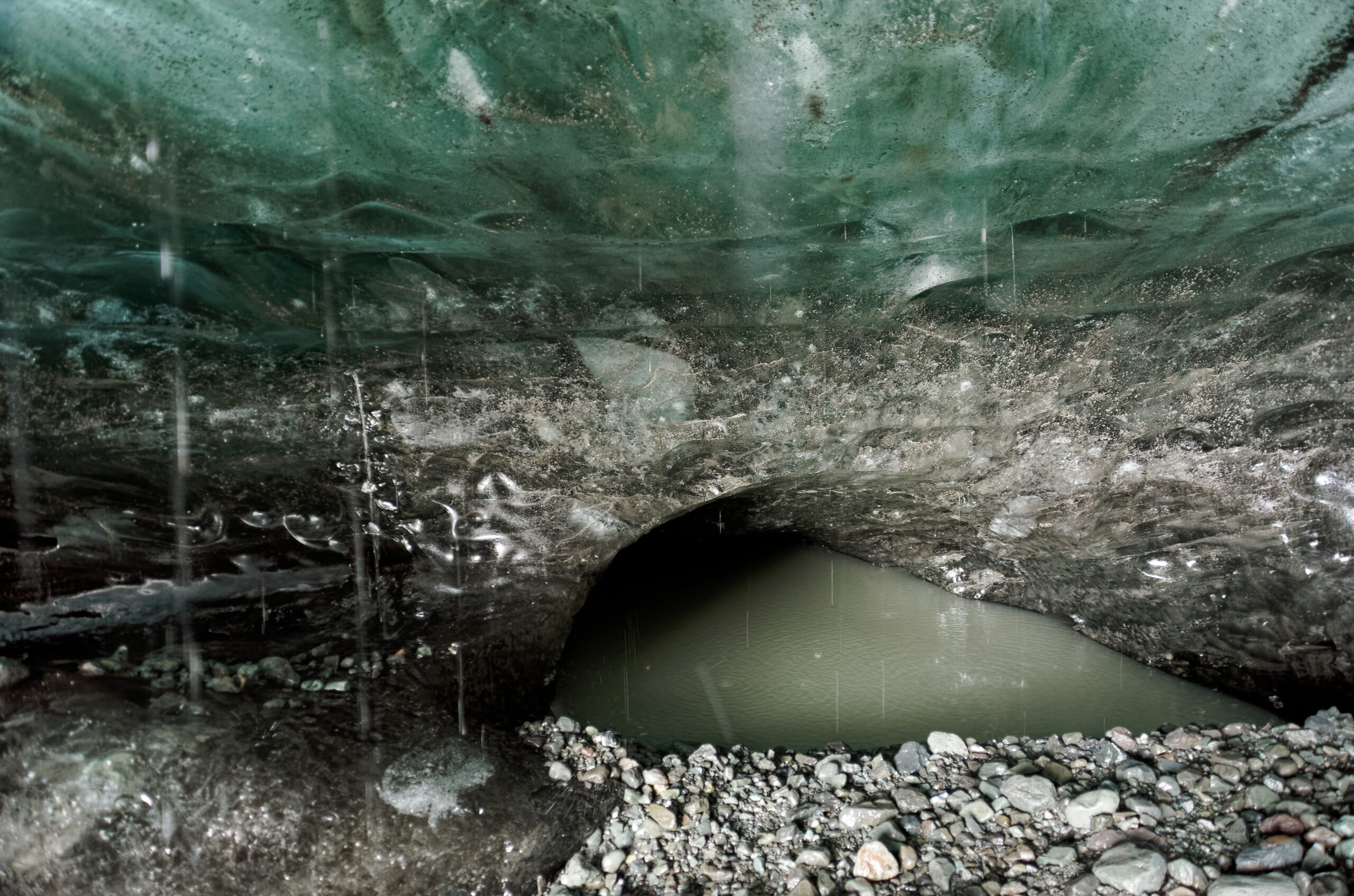
The ice caves are the reason most people come to Vatnajökull in winter, and the photos look almost unreal: blue ice holding air bubbles hundreds of years old, and a vaulted ceiling with daylight glowing through it. None of them is permanent, though. In summer, streams of meltwater carve them out as they run through and under the glacier. In winter the water freezes, stops flowing, and you can walk into the channels it has left behind. Every year the caves are in a different place and have a different shape. The “Crystal Ice Cave” sold at Jökulsárlón is therefore more of a trade name for the caves in the Breiðamerkurjökull glacier than one particular hole in the ice.
Why only with a guide, and only in winter. In August 2024, during a summer tour to a cave in Breiðamerkurjökull, part of the ice collapsed; an American tourist was killed and his partner injured. After the accident the park authority tightened the rules. Since 1 October 2025, ice caves and glacier hikes in the park may only be run by companies that have signed a contract with the park (valid until 30 September 2027 and awarded to 30 companies). The cave season is fixed: from May to September they are closed. One guide may lead a maximum of 8 to 16 people depending on the type of tour, and the companies assess every day whether a particular cave is safe. Never go into an ice cave on your own, even if you see footprints at the entrance. The ice moves, the roof can come down without warning and inside you have no way of calling for help.
How a tour works. You usually meet at the car park at Jökulsárlón or at Skaftafell. From there a super jeep or a modified truck takes you across the moraines to the glacier, you are given a helmet and crampons, and then you walk to the cave. You spend roughly half an hour inside, and the whole tour takes two to four hours depending on the company and the type. Inside it is usually just below freezing, around minus two to minus five degrees Celsius. The cave is at its bluest around midday, because the colour comes from daylight shining through the ice, so when the days are short it pays to book a slot between 10.30am and 1pm.
What to bring. Warm layers, a waterproof jacket and trousers, a hat, gloves and sturdy ankle boots that crampons will fit onto. The company lends you the helmet and crampons. Minimum ages vary by company; for short ice cave tours they usually start at six.
| Tour (operator) | Meeting point | Duration | Price from (approx.) |
|---|---|---|---|
| Crystal Ice Cave (Glacier Guides) | Jökulsárlón | 2 to 3 h | around 20,000 ISK (about £120) |
| Into the Glacier, hike with ice cave (Glacier Guides) | Skaftafell | about 4 h | around 20,000 ISK (about £120) |
| The Original Ice Cave Tour (Local Guide) | Jökulsárlón | 3 h | around 24,000 ISK (about £145) |
| Blue Ice Discovery (Local Guide) | Jökulsárlón | 4 h | around 25,000 ISK (about £150) |
| Ice Cave Discovery (Local Guide) | Jökulsárlón | 5 to 7 h | around 35,000 ISK (about £210) |
Prices are approximate, per person and taken from the operators’ websites. They change, so check directly with the company before you book. Book your tour in advance and keep a spare day up your sleeve. If the glacier is unsafe or there is a gale blowing, the company will cancel, and in the south of Iceland in winter that does happen. It works the other way too: if your guide says nobody is going out today, they are not being difficult.
Vatnajökull glacier hikes
A hike on one of the outlet glaciers is the more accessible and more reliable way to experience Vatnajökull. Hikes run all year, you don’t have to hit the winter season, and in summer there is actually more to see on the ice: crevasses, moulins where meltwater vanishes into the depths, and volcanic ash frozen into the layers of ice. Most hikes go onto Falljökull and the neighbouring tongues around Skaftafell, meeting at Skaftafell or at the Freysnes petrol station a short way from it.
The company provides crampons and a helmet, usually an ice axe and harness too, and the guide leads you in single file. The shortest tours last about three to four hours, of which one to two hours are spent on the ice. If you want more, you can add ice climbing. A standard hike needs average fitness and sturdy boots; ice climbing needs strong arms and a willingness to hang on a rope above a wall of blue ice.
| Tour (operator) | Duration | Season | Price from (approx.) |
|---|---|---|---|
| Glacier Wonders, Falljökull (Glacier Guides) | 4 h | all year | around 13,000 ISK (about £80) |
| Glacier Encounter (Local Guide) | 3 h | May to September | around 17,000 ISK (about £100) |
| Glacier Explorer, Falljökull (Glacier Guides) | 5 h | all year | around 20,000 ISK (about £120) |
| Glacier hike with ice climbing (Local Guide / Glacier Guides) | 4 to 7.5 h | depends on the company | around 30,000 to 32,000 ISK (about £180 to £190) |
For glacier hikes, the minimum age is usually a little higher than for ice caves and varies from company to company. Family tours take children who can walk in crampons on their own. Local Guide recommends a minimum of five years old; other companies want older children. Check when you book.
Climbing Hvannadalshnúkur. Iceland’s highest mountain (2,110 m) sits on the rim of Öræfajökull and is climbed with a guide on a full-day mountaineering trip across glaciated, crevassed terrain, with the whole group roped together. It’s a long day with a lot of ascent, and conditions at the top change faster than down below. Don’t attempt it without glacier travel experience and a guide.
Snowmobiles and super jeeps. On the south-eastern side of the glacier you can ride snowmobiles across the ice cap itself, with the operator driving you up to the start. It’s more about the adrenaline than the scenery, but it’s the only common way to get right up onto the dome.
Vatnajökull on your own: what you can do without a guide
Don’t go onto the ice without a guide. Going up to the glacier is another matter, and in our view these walks are almost as powerful as a paid tour, just from a different distance. The park authority has waymarked trails at Skaftafell and elsewhere that lead to the snouts of the outlet glaciers and up to viewpoints above them. Skaftafell has a visitor centre, Skaftafellsstofa, open all year, where rangers can tell you which trails are passable at the moment, and in season they also run free guided walks.
| Trail (park waymarking) | Distance | Time | Difficulty |
|---|---|---|---|
| S1 Glacier trail to Skaftafellsjökull (loop) | 4.1 km | 1 to 1.5 h | easy |
| S2 Svartifoss, Sjónarsker, Sel (loop) | 5.8 km | 2 h | easy |
| S5 Sjónarnípa, viewpoint above Skaftafellsjökull | 6.5 km | 2 to 2.5 h | moderate |
| S3 Skaftafellsheiði (loop) | 16.6 km | 5 to 6 h | challenging |
| S4 Kristínartindar | 18 km | 6 to 8 h | difficult |
| L1 Hjallanes by Skálafellsjökull | 8 km | 3 to 4 h | challenging |
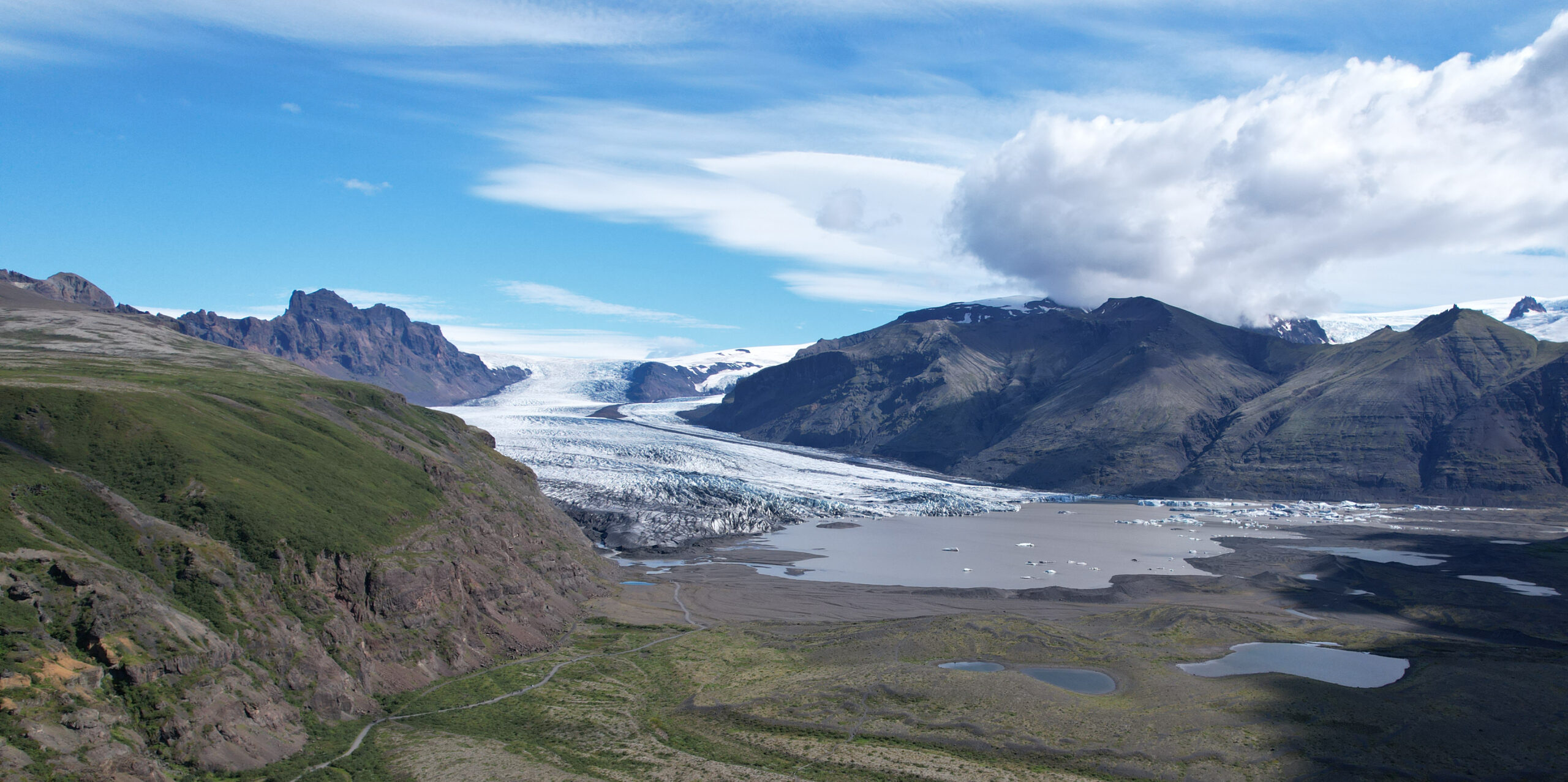
The shortest is the S1 loop to the snout of Skaftafellsjökull. In under an hour you’re at the little lake beneath the glacier, and from the moraines around it you can clearly see how far the ice reached not so long ago. If you have half a day, head up to Sjónarnípa. The viewpoint looks down on the whole glacier tongue as it curves off the ice cap into the plain, and in our opinion it’s the finest view of Vatnajökull you can get without a guide. On the way you can detour to Svartifoss waterfall with its basalt columns.
The second easy stop is the Fjallsárlón glacier lagoon by the Fjallsjökull glacier, a little before Jökulsárlón. It’s smaller and calmer, the glacier front is closer and fewer coaches stop here.
Svínafellsjökull from the viewpoint only. The glacier where scenes for Interstellar and Batman Begins were filmed lies right next to Skaftafell, a short detour off the main road. However, because of the risk of a landslide from the Svínafellsheiði slope above it, Iceland’s Civil Protection advises against walking on the glacier and recommends spending only a short time at the viewpoints by the glacier front. The Met Office continues to monitor the slope. Stop, take your photos and move on.
Parking at both Skaftafell and Jökulsárlón is paid. A car with up to five seats costs around 1,100 ISK (about £7), a vehicle for six to nine people roughly 1,400 ISK (about £8) and a motorbike around 500 ISK (about £3). The ticket is valid until midnight on the day you pay, and if you have already paid at another charging site in the park that day, you get 50% off.
Safety at the Vatnajökull glacier
Vatnajökull is a landscape that never stops changing, and most of the dangers here are invisible. A few rules that the park authority, rescue teams and guides all agree on:
- Only go on the ice with a guide. Crevasses are often hidden under snow, and from a distance the glacier looks like solid ground. The same goes for ice caves, even when they seem dry and stable.
- Keep away from the glacier front and out of the lagoons. Icebergs in a lagoon can roll over, the glacier front can calve and the water is close to freezing.
- Keep an eye on the warnings. Weather, earthquakes and volcanic activity on vedur.is, closures and travel alerts on safetravel.is, road conditions on umferdin.is. The emergency number is 112, and Icelandic rescue services have an app, 112 Iceland, that lets you send your location.
- Factor in the volcanoes. Grímsvötn and Bárðarbunga are under constant monitoring and seismic activity there is normal. If an eruption or glacial flood looks likely, the authorities close access and shut the road too. The situation can change within a day, so don’t just check it once when planning, but again in the morning before you set off.
- In the south of Iceland, wind is more dangerous than cold. On the open sand plains around the glacier it can knock walkers off their feet and rip a car door off its hinges. Open doors into the wind and hold them with both hands.
What to see near the Vatnajökull glacier
The southern side of the glacier packs more famous sights into a few dozen kilometres than anywhere else in Iceland. The best-known ones have their own rules and their own crowds, so here is just a quick overview.
Jökulsárlón. The glacier lagoon below Breiðamerkurjökull, where icebergs break off the glacier front and drift slowly out to sea. The car park is right on the Ring Road and is charged just like Skaftafell. In summer there are boat and amphibian tours on the lagoon; in winter it is the main meeting point for ice cave tours. We like it best early in the morning or late in the evening, when the coaches have gone and you can hear the ice cracking.
Diamond Beach (Fellsfjara). A black beach just across the road from Jökulsárlón, where the sea washes up chunks of ice from the lagoon. It’s free to visit; just watch out for waves, which can run further up the beach than you expect, and for large blocks of ice tumbling in the surf. To get between the lagoon and the beach, use the underpass beneath the bridge rather than crossing the road. More in our guide to Diamond Beach.
Skaftafell and Svartifoss. A green oasis between the glaciers with a small birch wood, a campsite, the visitor centre and Svartifoss, a waterfall that drops over a wall of basalt columns. Most of the walking trails described above start at Skaftafell.
Höfn and the glaciers further east. Beyond Jökulsárlón lie the less-visited outlet glaciers Heinabergsjökull, Skálafellsjökull and Hoffellsjökull, and at the end the fishing town of Höfn, with a view across the bay to the whole southern side of Vatnajökull.
The north of the park. Vatnajökull National Park also includes Dettifoss waterfall, the Ásbyrgi canyon, the Askja crater and the Lakagígar crater row. These are hundreds of kilometres away, though, and mostly only accessible in summer via F-roads. If you are driving all the way round the island, you’ll pass Dettifoss in the north. If you want to head into the Highlands, take a look at our guide to Landmannalaugar, where F-roads and Highland buses are covered in detail.
How much does a trip to Vatnajökull cost?
The Vatnajökull glacier itself is free. You pay for parking, accommodation and guided tours, and it’s the tours that make Vatnajökull one of the pricier items on an Iceland trip.
| Item | Price in ISK (approx.) | Roughly in £ |
|---|---|---|
| Parking at Skaftafell or Jökulsárlón, car up to 5 seats, per day | around 1,100 | 7 |
| Parking, vehicle for 6 to 9 people | around 1,400 | 8 |
| Skaftafell campsite, adult per night | around 2,800 | 17 |
| Glacier hike, shortest option | from 13,000 | from 80 |
| Ice cave, 2 to 4 hours | 20,000 to 25,000 | 120 to 150 |
| Glacier hike with ice climbing | from 30,000 | from 180 |
Conversions are based on roughly 100 ISK to £0.60 and are rounded. Tour prices are per person.
What we would do differently
If we went back to Vatnajökull, we wouldn’t cram an ice cave, a glacier hike, Jökulsárlón and Diamond Beach into a single day, the way “South Iceland in three days” itineraries promise. All you’d be left with is a string of photos taken from car parks. We would rather stay two nights in one place, go out on the ice with a guide in the morning and not rush anywhere in the afternoon.
What stuck with us most were the moments that aren’t in any itinerary: standing on the moraine below Skaftafellsjökull with nobody else around, listening to the glacier creak and hiss. Or pulling over at some turn-off to a glacier tongue that doesn’t even have a car park, and just watching the clouds roll across the ice cap. There are dozens of places like that along the road; all you need to do is ease off the accelerator.
And one more thing: if your ice cave tour is cancelled because of the weather, we wouldn’t see it as a defeat. The south of Iceland in a storm, with sand blowing across the road and waterfalls being blown back upwards, is an experience in itself. Phone in your pocket, a coffee from the petrol station at Freysnes, and just look out of the car window. The glacier will still be there tomorrow, only a little smaller.
Vatnajökull glacier FAQ
Where is the Vatnajökull glacier located?
In south-east Iceland. The southern edge of the glacier runs right alongside Route 1, the Ring Road, between Kirkjubæjarklaustur and Höfn. The most accessible spots are Skaftafell (about 325 km from Reykjavik) and the Jökulsárlón lagoon (about 56 km beyond Skaftafell). The whole glacier lies within Vatnajökull National Park.
How big is the Vatnajökull glacier?
Around 7,700 km² according to a 2019 survey, roughly 8% of Iceland, and it gets smaller every year. It holds about 3,000 km³ of ice, its average thickness is about 400 metres and the deepest points reach around 950 metres. It’s the largest glacier in Iceland and one of the largest in Europe.
When are the Vatnajökull ice caves open?
The season starts in October and ends in April; from May to September the caves in the national park are closed. The most stable ice and the most reliable tours are usually from November to March, best of all in January and February. Guides decide each day which cave is accessible, depending on the state of the ice.
Can I visit an ice cave without a guide?
No. Ice caves in the park may only be visited on tours run by companies with a contract with the park, and going in on your own is life-threatening. After the fatal accident in a cave in Breiðamerkurjökull in August 2024, the park tightened the rules and limited group sizes to 8 to 16 people per guide.
How much is an ice cave tour in Iceland?
Ice cave tours at Vatnajökull cost roughly 20,000 to 25,000 ISK per person (about £120 to £150) for a two- to four-hour trip meeting at Jökulsárlón or Skaftafell. Longer combinations with a glacier hike cost more, and day trips from Reykjavik considerably more.
Is Vatnajökull a volcano?
Vatnajökull itself is a glacier, but there are several volcanoes beneath it. The most active is Grímsvötn, which last erupted in 2011, then Bárðarbunga, whose Holuhraun eruption lasted from August 2014 to February 2015, and in the south Öræfajökull with Iceland’s highest mountain. Seismic activity under the glacier is normal, and the Icelandic Met Office reports the current situation on vedur.is.
Was Game of Thrones filmed at Vatnajökull?
Yes. Scenes beyond the Wall for season two were shot on the glacier in November 2011, and the neighbouring Svínafellsjökull provided footage for Interstellar and Batman Begins. The glacier had already appeared in the opening sequence of the 1985 Bond film A View to a Kill.
How do you pronounce Vatnajökull?
Roughly “VAHT-nah-yur-kutl”. In Icelandic, “j” sounds like an English “y”, the double “ll” is pronounced something like “tl”, and “ö” is close to the vowel in “her” or “fur”. The name means “glacier of lakes”.
Where next
- Skógafoss: the waterfall on the way from Reykjavik to the glacier, the steps up to the viewpoint and the start of the Fimmvörðuháls trail.
- Reynisfjara: the black beach with basalt columns near Vík, and why you should never turn your back on the sea there.
- Landmannalaugar: colourful Highland mountains, hot springs and F-roads, for when you want to see more of Iceland than the coast.
- Fagradalsfjall and Iceland’s volcanoes: eruptions on the Reykjanes peninsula and how to see the lava safely.
- Things to do in Reykjavik: where to start and end your trip, the airport and getting into town.
Potřebujete pomoct s cestováním?
-
Ubytování 🏨
Vyberte si to nejlepší ubytování, ať už jste kdekoliv, přes Booking.com. -
Půjčení auta 🚗
Auto si snadno najdete přes Booking.com, kde máte často slevu díky ubytování, nebo Rentalcars.com, kde porovnáte nabídky většiny půjčoven. -
Zážitky 🎟️
Přes GetYourGuide.com si vyberete z nejrůznějších výletů i zážitků po celém světě, navíc se zrušením zdarma do 24 h předem.