Last updated 27.11.2026
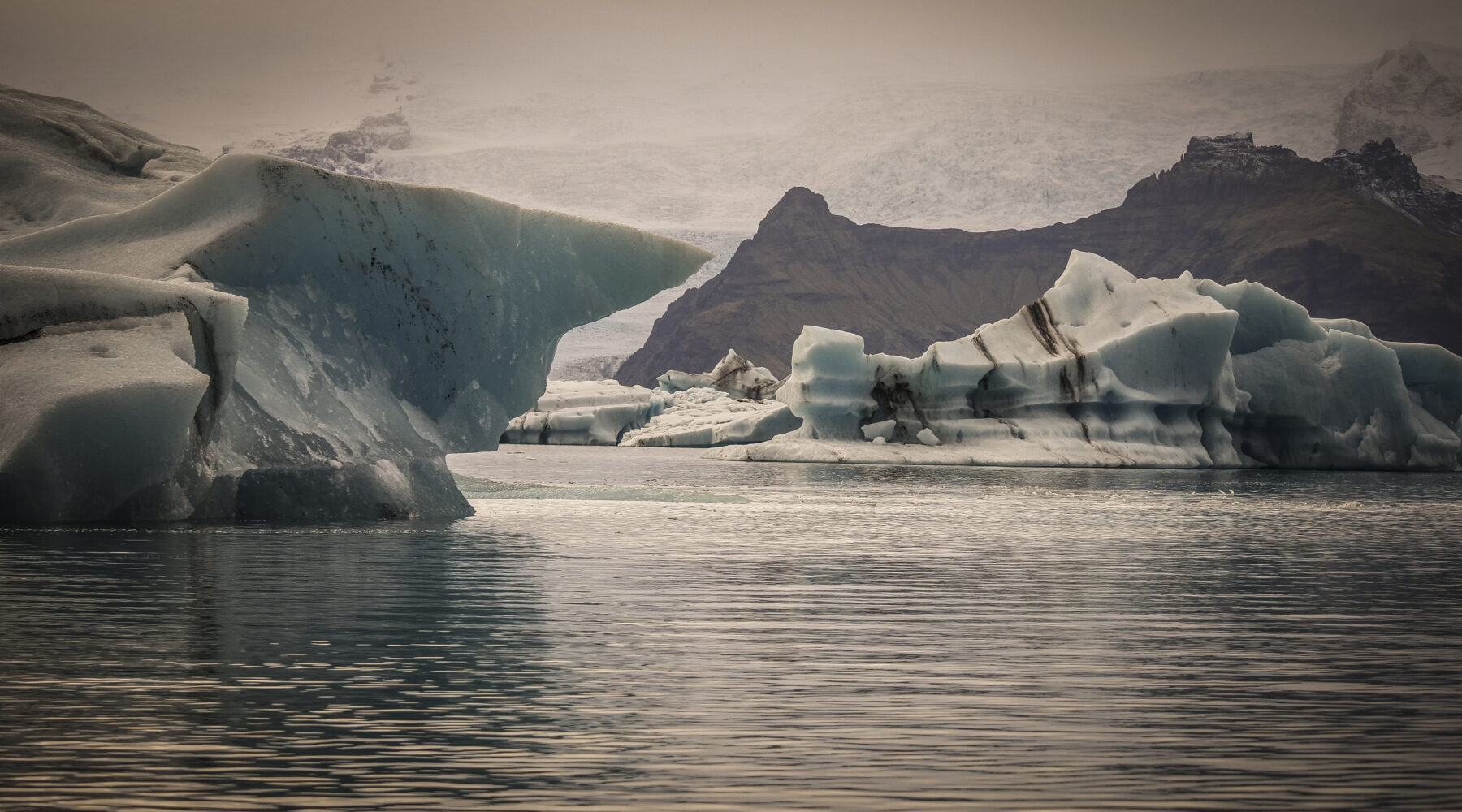
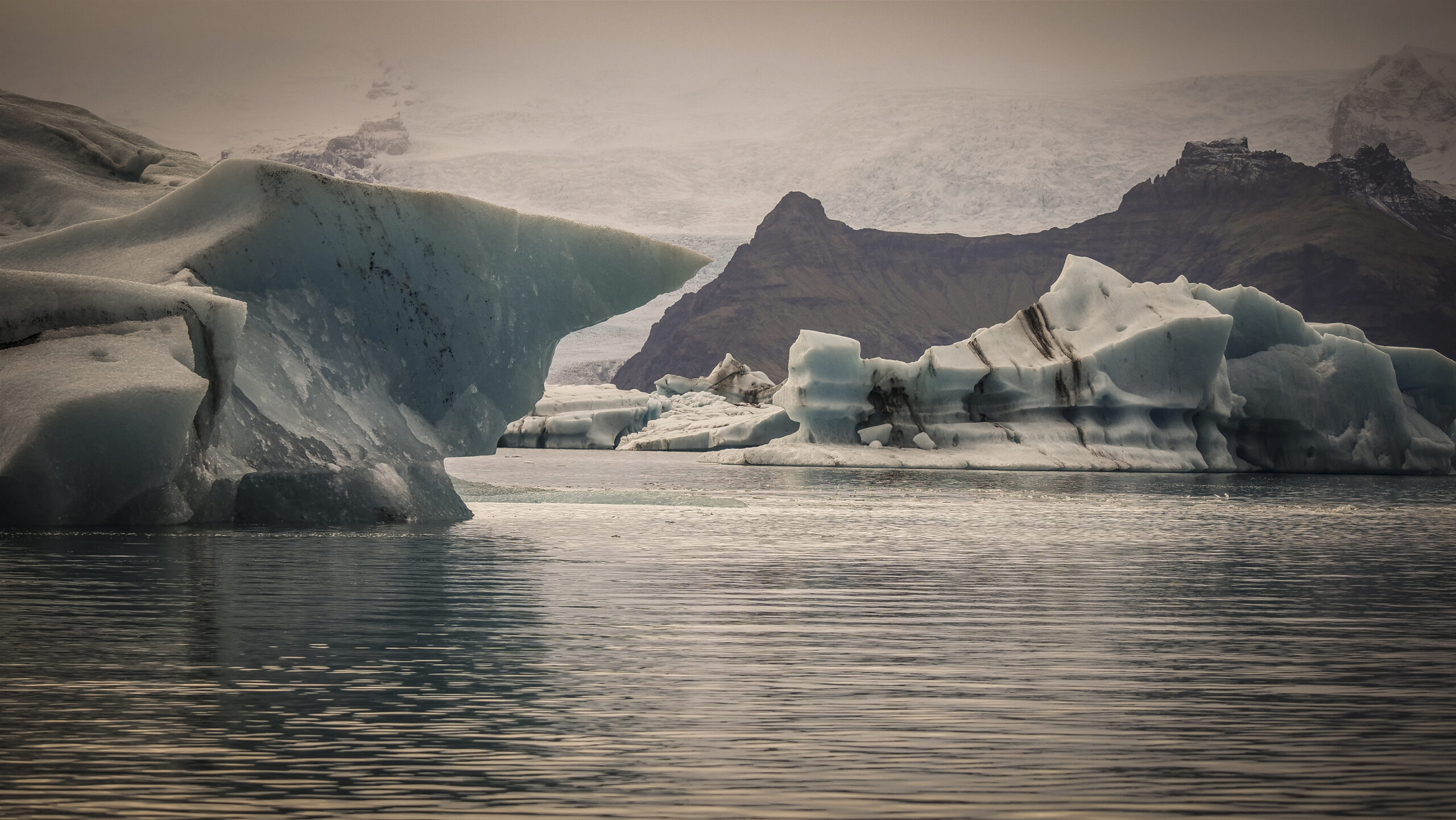
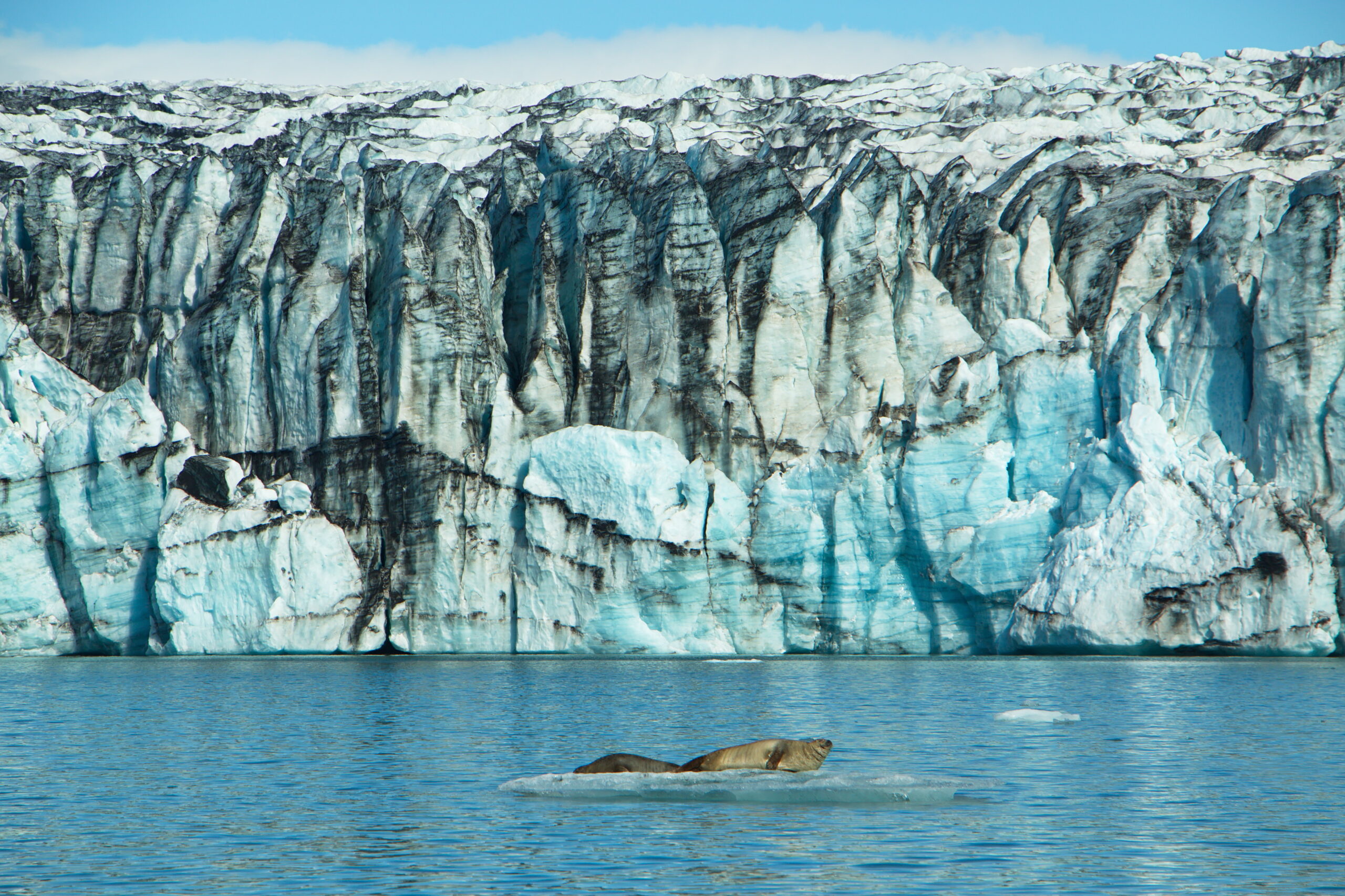
The Ring Road on the way to the Jökulsárlón glacier lagoon runs for mile after mile across a black desert of sand and gravel, with a glacier on one side and the sea on the other. Then you come over a moraine and there it is: a lake full of ice. Some of the icebergs are the size of a garage, a few are the size of a block of flats, and they come in white, deep blue and white striped with black ash. Jökulsárlón sits below Breiðamerkurjökull, a tongue of ice in south-east Iceland, and for a lot of people it ends up as the highlight of the whole trip around the island. Looking at it from the shore costs nothing. You can also get out on the water in an amphibious boat or a fast Zodiac, or in a kayak in summer, and seals are often swimming among the ice. Below we’ve put together what the boat tours cost and when they run, where to park, when to go, where to stay and what to watch out for around the ice.
Jökulsárlón glacier lagoon at a glance
- The deepest lake in Iceland. A 2009 survey measured 284 metres, and the lagoon now covers around 25 km². It began to form around 1935, when the Breiðamerkurjökull glacier pulled back from the sea, and it is still getting bigger.
- It’s right on the Ring Road (Route 1), about 370 to 380 km (230 to 235 miles) from Reykjavik, which is around five hours’ driving without stops. Skaftafell is roughly 56 km to the west and Höfn 75 to 80 km to the east.
- There’s no entrance fee, only a parking charge. A car with up to five seats pays around 1,100 ISK (about £7), valid until midnight the same day.
- Boat tours are run by a local company based at the lagoon. The amphibious boat costs around 7,100 ISK (about £43) for 30 to 40 minutes, the Zodiac roughly 17,000 ISK (about £100) for about 75 minutes. Boats start in May, the Zodiac runs until the end of October and the amphibian, weather permitting, into November.
- There are no boats in winter, but the car park becomes the meeting point for ice cave tours in Vatnajökull (roughly October to March, guided only).
- Diamond Beach (Fellsfjara) is just across the road, a few minutes’ walk away under the bridge.
- Never climb onto the icebergs. The blocks can roll over without warning and the water is close to freezing.
What is the Jökulsárlón glacier lagoon and why does it keep growing?
The name translates almost word for word: jökull means glacier, á river and lón lagoon. So, the lagoon of the glacier river. It’s pronounced roughly “YUR-kool-sour-lone”, and nobody will hold it against you if you mangle it the first time.
A hundred years ago there was no lake here at all. Breiðamerkurjökull, one of the outlet glaciers of Vatnajökull, reached almost to the coast, and the Jökulsá river ran straight out from under the ice into the sea, a kilometre or two away. As the climate warmed in the twentieth century, the glacier began to retreat, and around 1935 the first water appeared at its snout. Since the 1950s the lagoon has grown fast: in 1975 it covered around 8 km², today it’s around 25 km², and the glacier front now stands roughly eight kilometres from the sea. In 2009 a depth of 284 metres was measured, more than in any other lake in Iceland. Some sources give 248 metres, which is most likely a transposed digit. The trench the glacier has carved continues further inland beneath the ice, as much as 200 to 300 metres below sea level, so glaciologists expect that one day this will become a fjord.
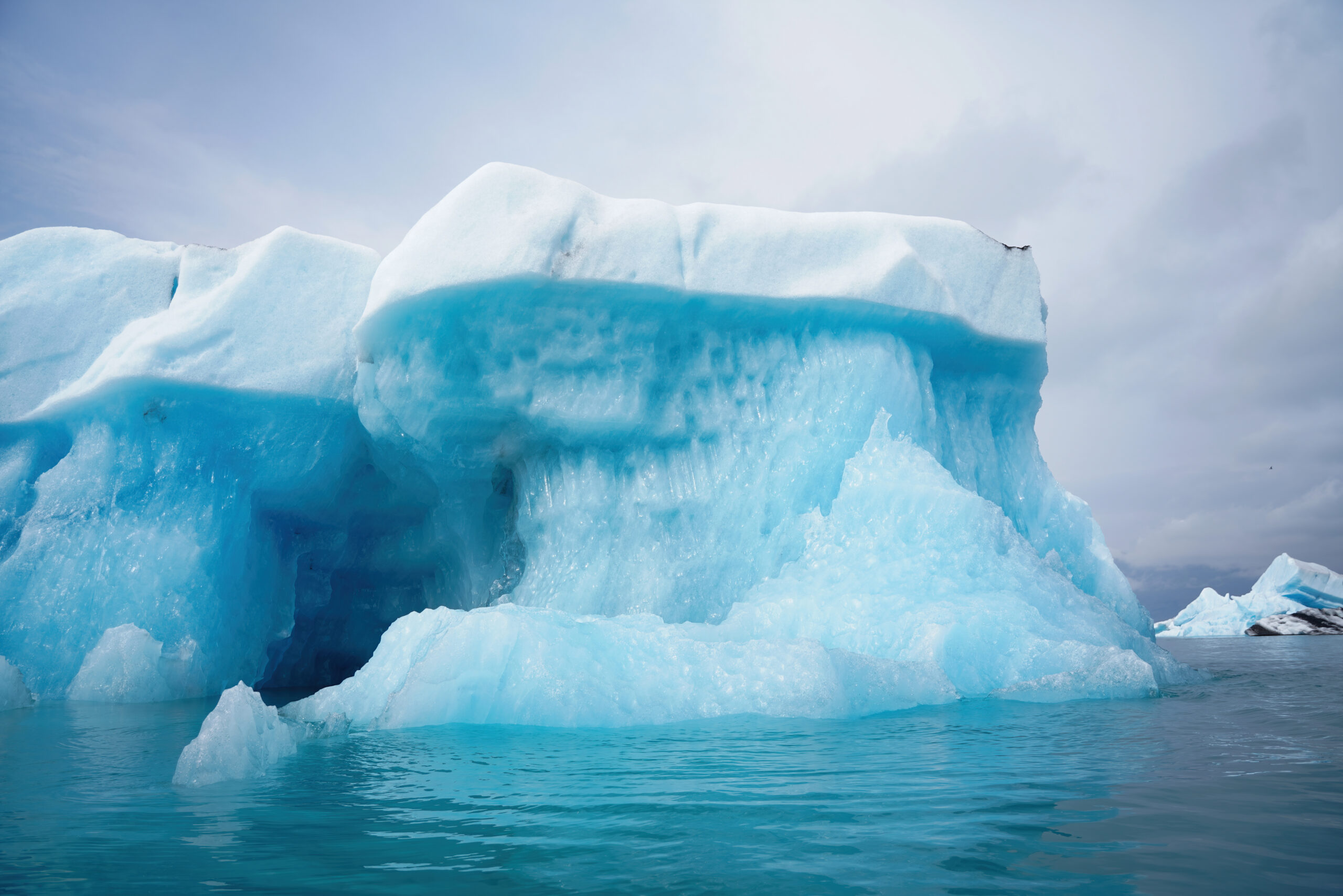
There’s one more thing that makes Jökulsárlón unusual. Its surface is at sea level, so at high tide salty, slightly warmer seawater flows in through the short river. The icebergs therefore melt faster from below than on top, lose their balance and every so often roll over. The intense blue you know from photos belongs to freshly flipped ice that has spent a long time underwater. After a few hours of sun and wind the surface cracks, takes in air and turns white. The black stripes are volcanic ash from eruptions, frozen into the glacier hundreds of years ago.
The lagoon lies on the Breiðamerkursandur plain, built up by glacial rivers and floods. Below the mountain called Fell there used to be a farm of the same name, which a glacial flood swept away in 1868. For a long time the only ways across the Jökulsá were risky ones, on horseback or over the crevassed glacier above the river’s source, and from 1932 a ferry ran here. The 108-metre bridge that now carries the Ring Road was built in 1966 and 1967. The river is only around 500 metres long, and the sea keeps eating away at the coast, so the road authorities reinforce the bank and the bridge piers with rock barriers.
The state bought the land of the Fell farm, lagoon included, in 2017, and that same year Jökulsárlón became part of Vatnajökull National Park, which has been a UNESCO World Heritage Site since 2019. Film crews have been coming here for decades: the lagoon appears in the Bond films A View to a Kill and Die Another Day, and in Lara Croft: Tomb Raider and Batman Begins.
How to get to the Jökulsárlón glacier lagoon
By car. Flying in from the UK, you’ll land at Keflavík, and most people pick up a hire car there or in Reykjavik. The lagoon sits right on the Ring Road (Route 1); the road actually crosses it on a bridge. Depending on where you start measuring, it’s 370 to 380 km from Reykjavik, and your sat nav will say around five hours without stops. The whole route is paved and passable in an ordinary car all year round, so you don’t need a 4×4. In winter, though, expect winter tyres, darkness and wind, and before every leg check umferdin.is (road conditions) and safetravel.is (alerts). There’s so much to see on the way that five hours usually turns into a full day: Seljalandsfoss, Skógafoss, the black sand beach at Reynisfjara and the village of Vík. From Skaftafell it’s about 56 km to the lagoon, and from there another 75 to 80 km to Höfn.
There’s no petrol station at the lagoon or at Diamond Beach. The nearest ones are at Freysnes near Skaftafell and in Höfn, so fill up beforehand, ideally in Vík or Kirkjubæjarklaustur.
By bus. The public Strætó route 52 runs between Reykjavik and Höfn and stops at Jökulsárlón. It doesn’t run every day, though, and timetables change between seasons, so check the journey planner at straeto.is. As a way to “pop over” to the lagoon for a few hours it doesn’t really work: the bus comes through once a day, and without a car you won’t get any further than the stop.
On a tour from Reykjavik. Day trips to the lagoon and Diamond Beach take around fourteen hours, of which you get about an hour and a half on site. Some include a boat tour in the price or as an add-on. It works, but you’ll spend most of the day sitting on a coach. Two- and three-day tours with an overnight stay in the south are far more comfortable.
💡 Don’t plan Jökulsárlón as a there-and-back trip from Reykjavik. Ten hours behind the wheel for one hour at the lagoon isn’t worth it. If you’re making the drive, spend at least one night somewhere between Skaftafell and Höfn. Then in the morning you’ll be at the lagoon before the first coaches.
Where to stay near the Jökulsárlón glacier lagoon
You can’t stay right at Jökulsárlón, and the whole area between Skaftafell and Höfn is very thinly populated. There aren’t many hotels or guesthouses, in summer and in ice cave season they tend to be booked up well in advance, and prices are higher than most of Europe. We’d stay as close as possible, so you can drive to the lagoon in the morning and come back again in the evening.
Right by the lagoon (Suðursveit). East of Jökulsárlón there’s a scattering of farms with a handful of places to stay. The closest is Hali Country Hotel, about 12 km from the lagoon, with a restaurant and views of Vatnajökull. Close by, in the hamlet of Gerði, you’ll find Hótel Jökulsárlón, with a restaurant, sauna and hot tub, and the simpler Gerði Guesthouse. Everything else in the area is here: places to stay near Jökulsárlón.
Between Skaftafell and the lagoon (Öræfi). A good base if you want to combine the lagoon with a glacier hike or walks in Skaftafell. The best-known option is Fosshotel Glacier Lagoon at Hnappavellir, about 29 km from the lagoon. More hotels and farms with rooms line the road around Skaftafell, which also has the national park’s year-round campsite (around 2,800 ISK, about £17, per adult per night): places to stay near Skaftafell.
Höfn. The only proper town in the area, about an hour’s drive east. It has a supermarket, a petrol station, restaurants, a swimming pool and the most accommodation, which usually makes it the cheapest too. It makes sense if you’re carrying on round the island to the east: places to stay in Höfn.
Coming from Reykjavik and don’t fancy five hours at the wheel on day one? Stop overnight in Vík on the way and reach the lagoon the next morning.
Parking, facilities and what’s free at the lagoon
There’s no entrance fee at the Jökulsárlón glacier lagoon. The lagoon, its shores, the trails and Diamond Beach are open to everyone all year round, day and night. The only charge is for parking, which the park calls an area fee. A camera at the entrance reads your number plate, and you can pay at the machine in the car park or in the Parka app. The ticket is valid until midnight on the day you pay, and in that time you can leave and come back as often as you like. If you’ve already paid at Skaftafell the same day, you get 50% off at the lagoon. Older websites still quote 1,000 ISK; the park’s current price list is a little higher. Prices do change, so check the park’s website before you go.
| Parking at Jökulsárlón | Price in ISK (approx.) | Approx. in £ |
|---|---|---|
| Car with up to 5 seats | 1,100 | 7 |
| Vehicle for 6 to 9 people | 1,400 | 8 |
| Motorbike | 500 | 3 |
Besides the main car park by the café and the boat ticket office, there are two more across the road at Diamond Beach: Eystri-Fellsfjara (east) and Vestri-Fellsfjara (west). When the main car park is closed for building work, the park sends visitors to these. Closures are announced by the park authority at vatnajokulsthjodgardur.is.
By the main car park is the boat operator’s café. It serves lobster soup, sandwiches and Icelandic hot dogs, with vegetarian and vegan options too, plus a small souvenir shop. It’s open all year apart from 24 to 26 December and 31 December to 2 January, from 9am to 7pm in summer and until around 5pm in winter. In season there are food stands as well. There are flushing toilets at Jökulsárlón and at the neighbouring Fjallsárlón lagoon. National park rangers look after the whole area every day of the year, and there’s a small exhibition of photographs from the national park by the Eystri-Fellsfjara car park.
The park has four short waymarked trails here. If you want more than a stroll along the shore, you’ve got options:
| Trail (park code) | Length | Time | Difficulty |
|---|---|---|---|
| B1 Jökulsárlón | 1.2 km | 15 min | easy |
| B2 Eystri-Fellsfjara | 1 km | 40 min | easy |
| B4 Fjallsárlón | 1.5 km | 45 min | moderate |
| B3 Breiðármörk | 15 km | 4 to 5 h | challenging |
Trail B2 runs from the Eystri-Fellsfjara car park under the bridges over the Jökulsá and has information boards along the way. For us it’s the best way to link the lagoon and the beach without dashing across the road. B1 is a quarter-of-an-hour walk along the lagoon on the main car park side.
When to visit Jökulsárlón
The Jökulsárlón glacier lagoon is open all year and looks good in every month. What changes is mainly what you can do there: boats on the water in summer, ice caves and the northern lights in winter.
Summer (June to August). All the boats are running, the amphibians leave at least every half hour in peak season and the Zodiac goes out around ten times a day. Around the solstice it stays light almost all night, so you can still take photos at eleven in the evening. It’s also the busiest time of year. Book the Zodiac in advance.
May and September. The best compromise, in our view. The boats are running, there are fewer people, and in September the dark nights return, so you’re in with a chance of the northern lights.
October and November. The Zodiac stops at the end of October, while the amphibian keeps going into November, depending on weather and ice. The ice cave season starts at the same time. The days get shorter fast.
Winter (December to March). No boats, but the shore is open and there’s still ice to see. The main reasons to come are the ice cave tours, which meet right in the car park, and the northern lights over the icebergs. Around the winter solstice, south Iceland gets only about four hours of daylight. According to its own observations, Guide to Iceland says the lagoon tends to hold the most floating ice in February and March.
| Season | Boat tours | Ice caves | What to expect |
|---|---|---|---|
| May to September | Amphibian and Zodiac, kayaks in summer | No | Crowds around midday, book ahead |
| October and November | Zodiac until end of October, amphibian weather permitting | Starting, depending on ice conditions | Short days, changeable weather |
| December to March | No | Yes, main season | Darkness, wind, road closures, winter tyres |
| April | No | Sometimes still running | In-between season, lagoon full of ice |
Our favourite times at the lagoon are early in the morning and late in the evening. Day trips from Reykjavik don’t arrive until around midday after their five-hour drive, so if you’re staying nearby you’ll have the lagoon almost to yourself in the morning. In the quiet you can hear the ice cracking and the icebergs knocking against each other.
Jökulsárlón boat tours: amphibian, Zodiac or kayak?
From the shore you only see part of the lagoon. The icebergs pile up mostly near the outflow into the river, and the glacier front is eight kilometres away, just a white line on the horizon from the car park. On the water you get in among the ice, and on a Zodiac all the way to the glacier. The boats on Jökulsárlón are run by a single local company that has been operating here for more than 35 years. Tickets are sold at the ticket office by the café and on its website, icelagoon.is, not through resellers. Tours are cancelled when it’s windy enough to whip up waves on the lagoon.
Amphibian. The amphibious boats roll down the shore on wheels straight into the water and then weave slowly between the icebergs near the outflow. The trip lasts 30 to 40 minutes with an English-speaking guide. The company has four boats and sends out around forty trips a day in July and August, so you can usually buy a ticket on the spot. Along the way the guide fishes out a chunk of ice for you to taste. Age and fitness don’t matter, and small children are fine. It’s a calm, cheaper way to see the ice up close. The amphibian doesn’t go to the glacier itself, though.
Zodiac. A fast inflatable boat for a smaller group. You get a flotation suit and a life jacket and need to check in half an hour before departure. In about an hour and a quarter it covers a large part of the lagoon and, when it’s safe, goes right up to the glacier front where the icebergs calve. It costs more, has a shorter season and sells out first in summer. Children must be at least ten years old or at least 130 cm tall. We’d pay extra for the Zodiac: the difference between “we saw some icebergs” and “we stood below a wall of glacier ice” is huge.
| Boat tours on Jökulsárlón | Duration | Season | Adult (approx.) | Child |
|---|---|---|---|---|
| Amphibian (icelagoon.is) | 30 to 40 min | May to November, weather permitting | around 7,100 ISK (about £43) | ages 6 to 12 around 3,500 ISK (about £21), under 6 free |
| Zodiac (icelagoon.is) | about 1 h 15 min | May to October | around 17,000 ISK (about £100) | ages 10 to 12 around 8,300 ISK (about £50) |
| Kayak (Ice Guide / Troll Expeditions) | 1.5 h | May to September | from around US$150 (about £115) | from age 14 |
The adult price applies from age 13 on both the amphibian and the Zodiac. The operator gives a full refund if you cancel at least 24 hours in advance and half the price between 23 and 2 hours before departure. The boat ticket office is open from 10am to 5pm in May, from 9am to 7pm from June to September and from 10am to 5pm from October to 15 November; the last amphibian leaves roughly an hour before closing.
Kayak. In summer Ice Guide takes kayakers out on the lagoon, meeting at their van in the main car park. You paddle stable sit-on-top kayaks, usually in pairs, and get a dry suit. Participants must be at least 14 and able to swim, and the kit is designed for up to 120 kg. It’s the quietest way to be out among the ice. Don’t take your own kayak or boat onto the lagoon; the boat operator explicitly advises against it because the icebergs can break apart or roll over.
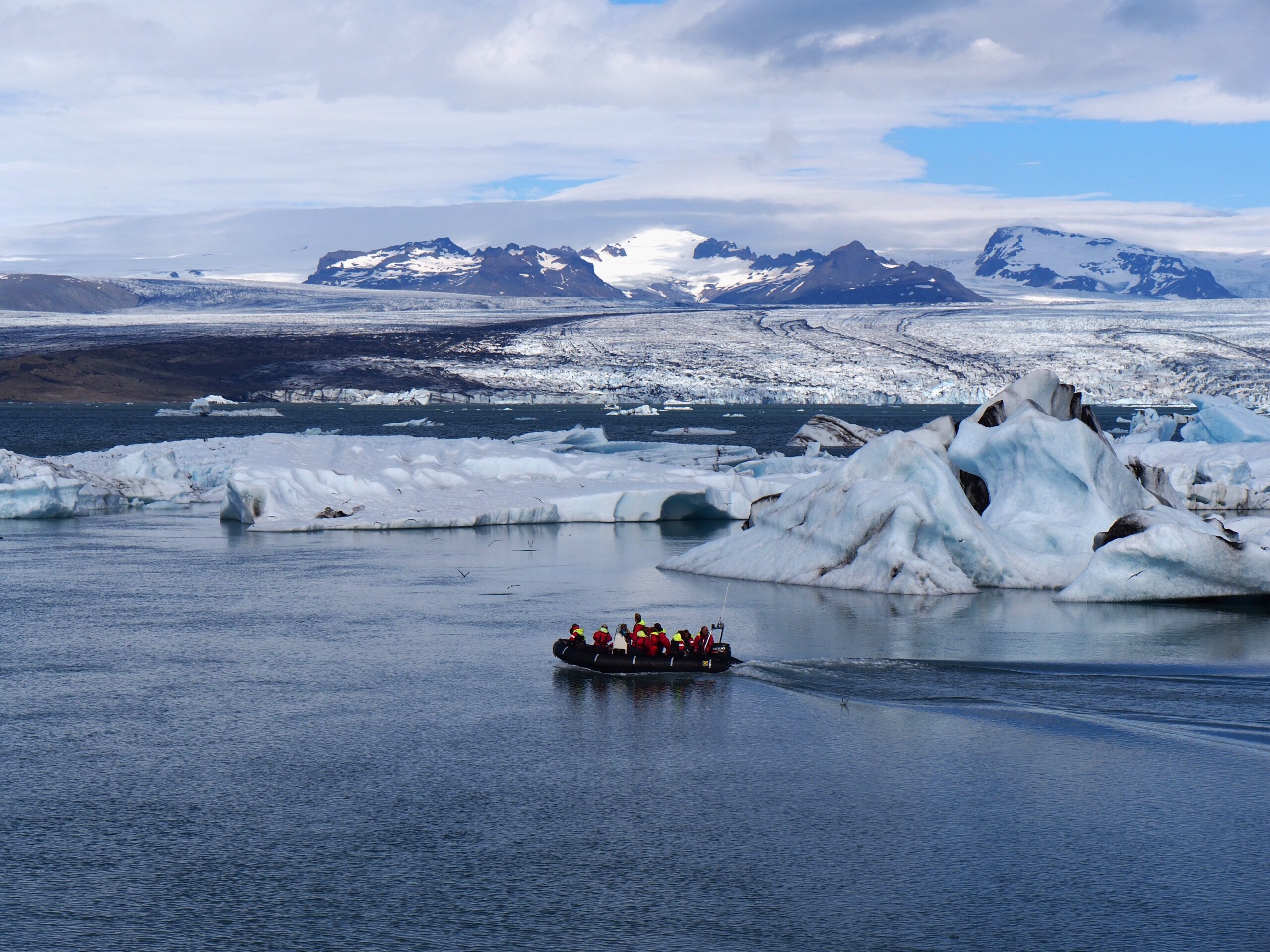
💡 Dress as if you were going up a mountain. It’s always colder and windier on the water than in the car park, even in July. A hat, gloves and a waterproof jacket are worth having even on the amphibian. On the Zodiac you’re given a suit, but wear a warm layer underneath.
Don’t want to pay for a boat? No problem. On a calm day the icebergs often drift close to the shore by the outflow, and in an hour by the water you’ll see them shifting with the tide. Look out for the blue ones. Those have just rolled over.
Seals at Jökulsárlón
Seals are almost a sure thing on the lagoon, though nobody can promise them. Capelin, herring and other fish come in with the tide, and seals and seabirds follow. Most of the ones you’ll see are harbour seals (landselur in Icelandic), resting on flat icebergs or poking their heads out of the water to watch the people on the shore. Large colonies gather where the rivers meet the sea, and in winter more of them collect at the lagoon’s outflow to hunt.
Where to look: best of all at the outflow into the Jökulsá river, close to the bridge, and on the icebergs near the shore by the main car park. It pays to stand quietly by the water for a while, as the seals surface and disappear again. You’ll usually see them on a boat tour too. Don’t feed them, don’t throw anything at them and don’t try to get closer by stepping onto the ice.
As for birds, Arctic terns nest here in summer, and the sands south of Vatnajökull are the largest great skua breeding ground in Iceland. Skuas defend their nests by dive-bombing your head, so anyone who leaves the path for the sands in June may find themselves under attack. Because of nesting birds, recreational drone flying is banned at Jökulsárlón and Fellsfjara from 15 April to 15 July, and outside that period drones still mustn’t fly over people or disturb wildlife.
Diamond Beach, just across the road
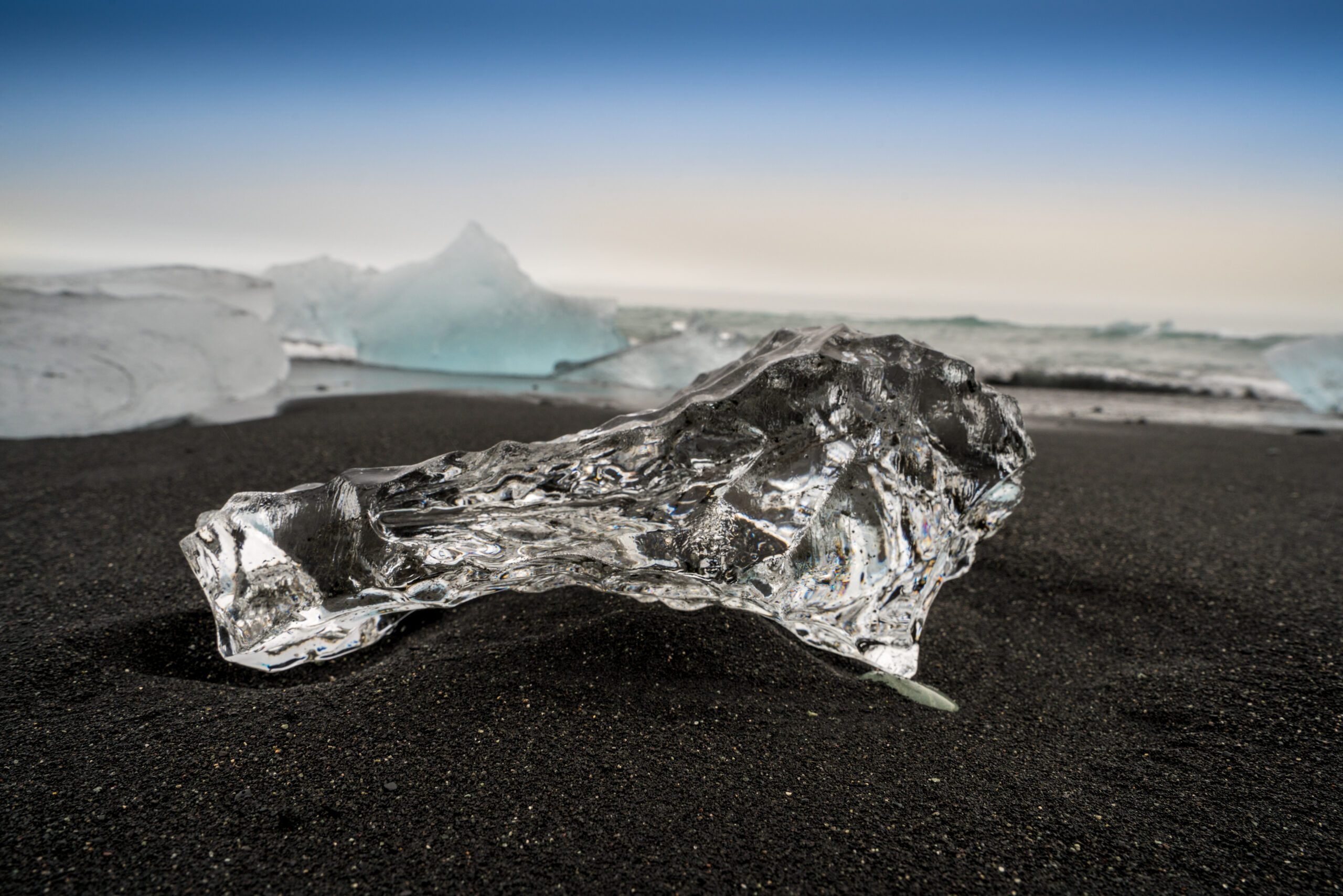
Icebergs that drift through the river under the bridge are carried out to sea by the current, and the waves then throw them back onto the black sand. Icelanders call this stretch of coast Fellsfjara; in English it’s Diamond Beach. The chunks of ice range from fist-sized to car-sized, smooth and clear, and they glow against the black sand. The beach is about 500 metres from the lagoon, and the easiest way there is the path under the bridge rather than across the road. It has two sections on either side of the river mouth, each with its own car park.
Just a few lines here, as we’ll be covering Diamond Beach separately. The same rules apply as on other Icelandic beaches: the sea is cold, a wave can run much further up the sand than the ones before it, and big chunks of ice tumble about in the surf. Never stand between the ice and the sea, don’t climb onto ice on the wet sand and don’t turn your back on the water. We explain in detail why Iceland’s waves are so treacherous in our guide to Reynisfjara.
Ice caves and glacier hikes from the lagoon
Once the boats stop for the winter, the Jökulsárlón car park becomes the meeting point for ice cave tours in the Breiðamerkurjökull glacier. A super jeep takes you across the moraines to the glacier, and from there you continue on foot in crampons and a helmet. The season runs roughly from October to March, sometimes into April, and you can only enter the caves with a guide from a company that holds a contract with the national park. The park rangers oversee the caves, and the operators assess every day whether each particular cave is safe. Glacier hikes, which run all year round, also start from the lagoon car park.
Prices, operators, the rules introduced after the fatal accident in 2024 and the difference between the caves in Vatnajökull and the Katla ice cave near Vík are covered in our article on Vatnajökull. Just one practical note here: book your ice cave for a day when you’ll definitely be at the lagoon, and keep a spare day in hand. Tours get cancelled because of wind and ice conditions.
Staying safe at the lagoon
Jökulsárlón looks peaceful, but a few things here are genuinely dangerous. The park authority and the boat operator agree on all of them:
- Don’t climb onto the icebergs, not even the ones by the shore. Seawater erodes them from below, so an iceberg can roll over or break apart without warning, and the water is close to freezing. If you fall in, you have only a few minutes before your hands go numb.
- Don’t let children go to the water on their own, and don’t let them throw stones at the icebergs by the edge.
- On Diamond Beach, keep an eye on the waves, especially when big pieces of ice are rolling around in them.
- Camping at the lagoon isn’t allowed, as it’s a national park. The nearest campsites are in Skaftafell and Höfn.
- Open your car door into the wind and hold it with both hands. The wind on the Breiðamerkursandur plain can rip a door off its hinges.
- Check the alerts. Weather and volcanic activity under Vatnajökull on vedur.is, closures and warnings on safetravel.is, road conditions on umferdin.is. The emergency number is 112, and the rangers for the Breiðamerkursandur area can be reached on 842 4355.
What’s near Jökulsárlón
Fjallsárlón. A smaller glacier lagoon about 10 km to the west. It’s quieter, parking is free, and the front of the Fjallsjökull glacier is in plain view from the shore, so you get more of that “standing below a glacier” feeling than at Jökulsárlón. A different company runs Zodiacs here from April to November (75 minutes for around 11,000 ISK, about £65), and all year round you can float among the icebergs in a drysuit (around 16,000 ISK, about £95). Park trail B4 leads from the car park to the lagoon.
Skaftafell. About 56 km to the west, a green oasis between glaciers with a campsite, a visitor centre and Svartifoss, the waterfall framed by basalt columns. Glacier hikes start from here, and walking trails lead to the glacier tongues.
Hali and Suðursveit. East of the lagoon are the farms where the writer Þórbergur Þórðarson was born. At Hali, right next to the hotel, is the Þórbergssetur cultural centre, with an exhibition on his life and on Suðursveit.
Höfn. A fishing town about an hour to the east, known for its langoustines (humar in Icelandic), with views across the bay to the southern side of Vatnajökull. If you’re carrying on round the island, you’ll be passing through anyway.
Vatnajökull. The glacier that feeds the lagoon, the national park as a whole, ice caves and glacier hikes are all covered in our article on Vatnajökull.
How much does a trip to Jökulsárlón cost?
The lagoon and the beach are free. The money goes on parking, a boat tour, food and, above all, accommodation, which is expensive and scarce in south-east Iceland.
| Item | Price in ISK (approx.) | Approx. in £ |
|---|---|---|
| Entry to the lagoon and Diamond Beach | free | free |
| Parking, car with up to 5 seats, per day | 1,100 | 7 |
| Amphibian, adult | 7,100 | 43 |
| Amphibian, child aged 6 to 12 | 3,500 | 21 |
| Zodiac, adult | 17,000 | 100 |
| Zodiac on neighbouring Fjallsárlón | 11,000 | 65 |
| Skaftafell campsite, adult per night | 2,800 | 17 |
Conversions assume roughly 100 ISK ≈ £0.60 and are rounded. Boat tour prices are per person.
What we’d do differently
If we went back to Jökulsárlón, we wouldn’t make it one of ten stops in a day, where you jump out of the car, photograph the icebergs, run over to the beach and drive on to Höfn. The lagoon changes with the tide, the wind and the light, and the best things here happen when you wait a while. An iceberg rolls over, a seal pops its head up, the sun shines through a piece of blue ice. An hour between coaches isn’t enough for that.
We’d rather stay right next door and go to the lagoon twice. Once in the evening, when the car park empties, with coffee from a flask on the moraine above the outflow, and once in the morning, when the water is as smooth as glass. The boat trip is great, but what stuck with us most was simply sitting on the shore with no plan.
And one more thing: you don’t have to do Diamond Beach, the lagoon, an ice cave and Fjallsárlón all in one day. Feel free to skip one of them and have a proper dinner in Hali or Höfn instead. Phone in your pocket, no agenda. The ice will still be here tomorrow, just a little different.
Frequently asked questions
Where is the Jökulsárlón glacier lagoon?
In south-east Iceland, right on the Ring Road (Route 1), about 370 to 380 km from Reykjavik. From Skaftafell it’s roughly 56 km to the lagoon, and from the lagoon to Höfn 75 to 80 km. It lies below the Breiðamerkurjökull glacier and is part of Vatnajökull National Park.
Is Jökulsárlón free?
Yes, there’s no entrance fee. The lagoon and Diamond Beach are open to everyone all year round. You only pay for parking: a car with up to five seats costs around 1,100 ISK (about £7), and the ticket is valid until midnight the same day. If you’ve already paid at Skaftafell that day, you get 50% off.
How much is a Jökulsárlón boat tour?
The amphibious boat costs around 7,100 ISK (about £43) for 30 to 40 minutes; children aged 6 to 12 pay around 3,500 ISK and under-6s go free. The Zodiac costs roughly 17,000 ISK (about £100) for around an hour and a quarter and only takes children aged 10 or over or at least 130 cm tall. Tickets are sold by the local operator at the ticket office by the lagoon and at icelagoon.is.
When do the boat tours run on Jökulsárlón?
From May. The Zodiac runs until the end of October, and the amphibian, depending on weather and ice, until mid-November. In summer the amphibians leave at least every half hour. From mid-November to May there are no boats on the lagoon; instead, ice cave tours start from here.
Will I see seals at Jökulsárlón?
Very likely, although it’s not guaranteed. Harbour seals rest on the icebergs or swim near the outflow into the river, where they hunt fish, and there tend to be more of them in winter. It’s worth waiting a while by the outflow.
How deep is the Jökulsárlón glacier lagoon?
A 2009 survey measured a depth of 284 metres, which makes Jökulsárlón the deepest lake in Iceland. The lagoon covers around 25 km² and keeps growing as the Breiðamerkurjökull glacier retreats.
Can you do Jökulsárlón as a day trip from Reykjavik?
You can, but it’s a long day. By car it’s around five hours each way; organised tours take about fourteen hours and give you roughly an hour and a half at the lagoon. It’s more comfortable to stay nearby, for example around Skaftafell, in Suðursveit or in Höfn.
Is Jökulsárlón the same as the Blue Lagoon?
No. The Blue Lagoon is a geothermal spa near Keflavík airport where you bathe in warm water. Jökulsárlón is a glacier lagoon in the south-east of the island, full of icebergs and ice-cold water that you can’t swim in.
Where next
- Vatnajökull: ice caves, glacier hikes and the national park the lagoon belongs to.
- Vík: the village halfway from Reykjavik, a good place to stay overnight and fill up.
- Reynisfjara: the black sand beach with basalt columns, and why you never turn your back on the sea there.
- Skógafoss: the waterfall on the way to the lagoon, with steps up to the viewpoint.
- Blue Lagoon: the geothermal spa near the airport, ideal for the end of your trip.
Potřebujete pomoct s cestováním?
-
Ubytování 🏨
Vyberte si to nejlepší ubytování, ať už jste kdekoliv, přes Booking.com. -
Půjčení auta 🚗
Auto si snadno najdete přes Booking.com, kde máte často slevu díky ubytování, nebo Rentalcars.com, kde porovnáte nabídky většiny půjčoven. -
Zážitky 🎟️
Přes GetYourGuide.com si vyberete z nejrůznějších výletů i zážitků po celém světě, navíc se zrušením zdarma do 24 h předem.