Last updated 27.11.2026
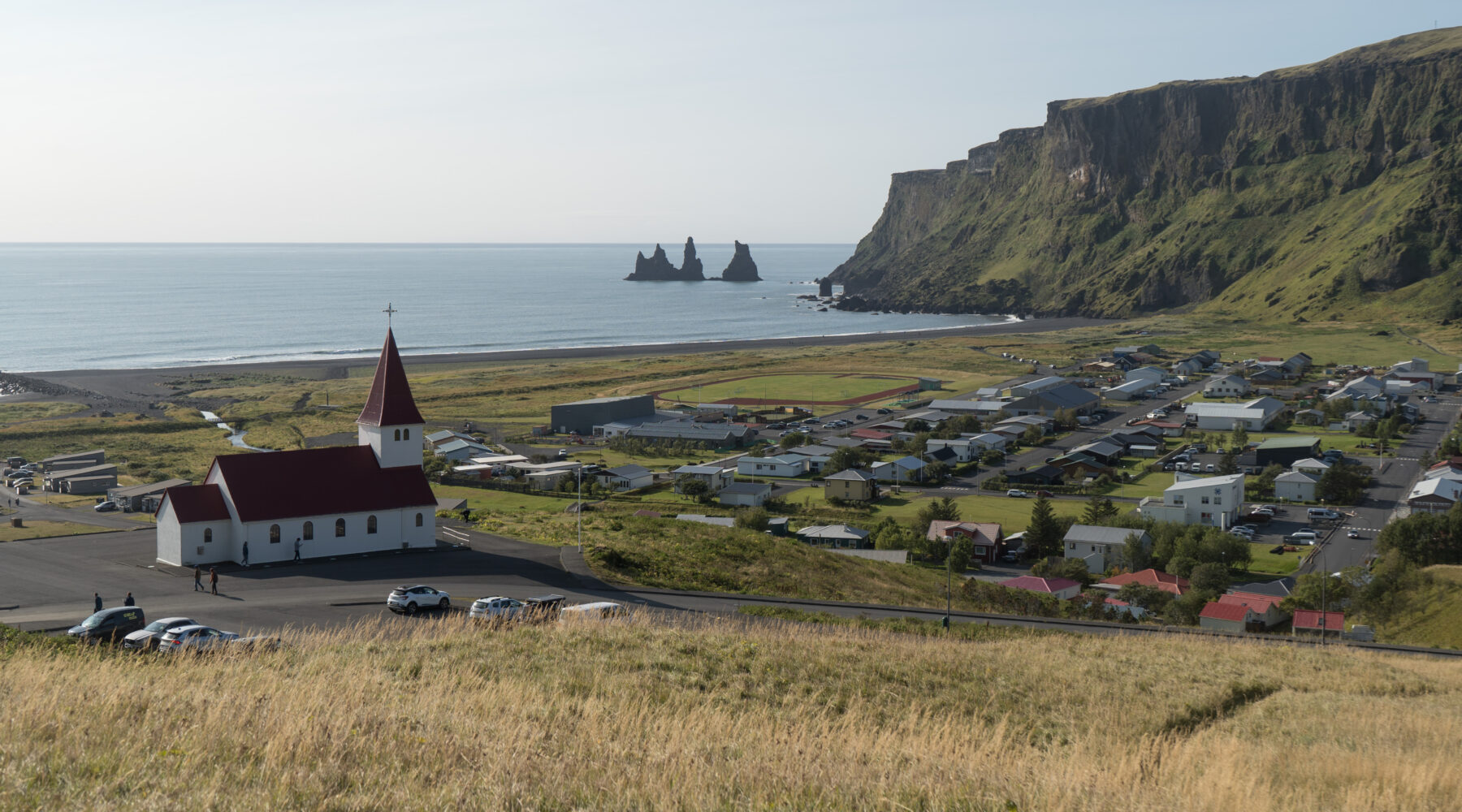
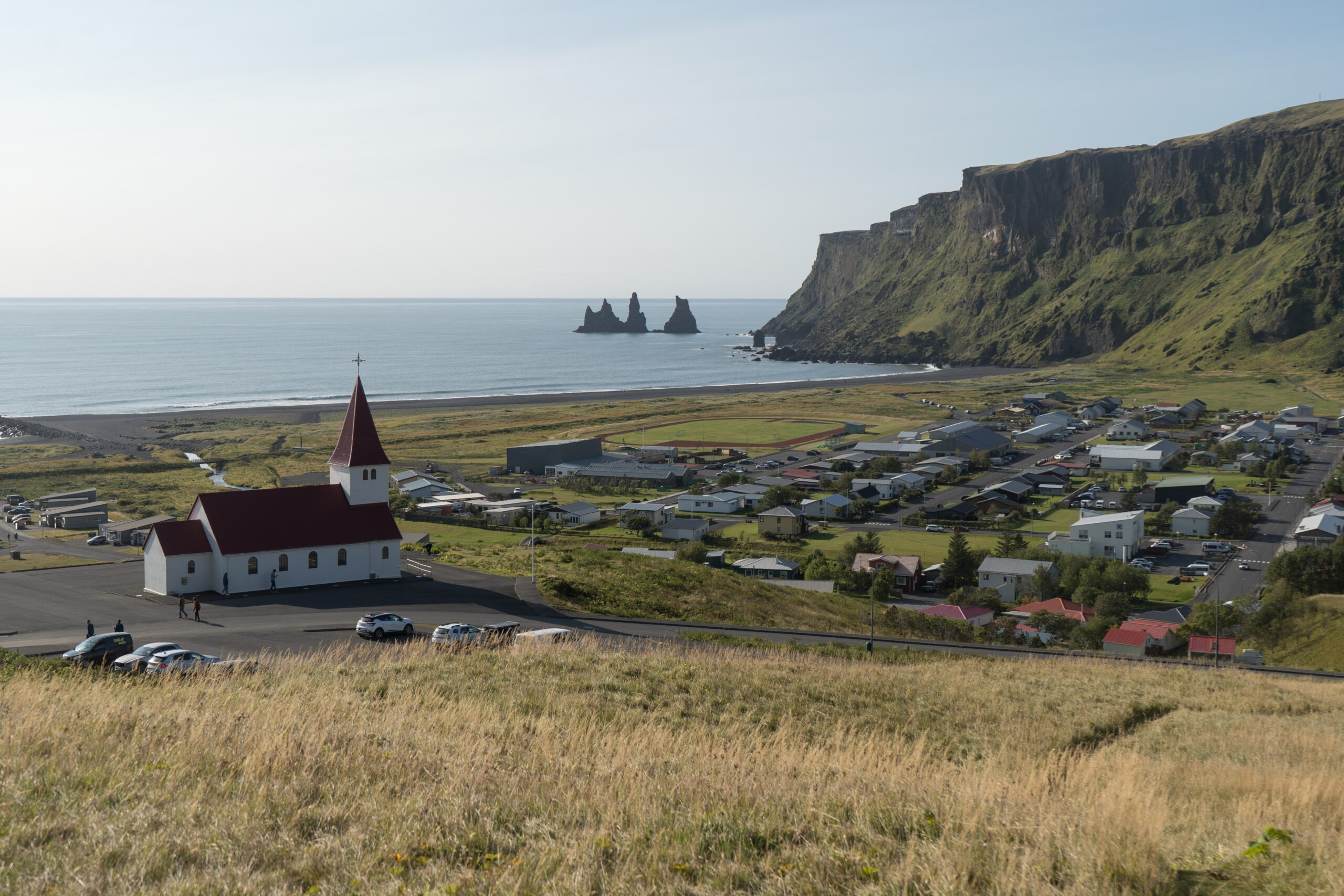
Drive east along Iceland’s south coast and sooner or later you end up in Vik, Iceland. Not because there’s so much to see, but because this is where you’ll find fuel, a supermarket, a bed and a hot bowl of soup, and the next place with all of that is seventy kilometres further on, across a black sand desert. The village sits under the mountain Reynisfjall, with a white church and a red roof on the hill, its own black beach facing the sea stacks of Reynisdrangar, and the Mýrdalsjökull glacier above it, under which the Katla volcano lies sleeping.
In this guide we cover where to sleep in the village and just outside it, how to get to Vík, where to eat, fill up and shop, what you can fit into half a day in and around Vík, and how the evacuation plan works in case Katla wakes up. To us, Vík works best as a two-night stop: one evening on the beach, one morning at Reynisfjara before the coaches from Reykjavik arrive.
Vik, Iceland at a glance
- Where it is: on the Ring Road (Route 1), about 180 km and roughly two and a half hours’ drive from Reykjavik. Its full name is Vík í Mýrdal, “the bay in Mýrdalur”. It’s the southernmost village in Iceland.
- Why stay here: it’s roughly halfway between Reykjavik and the Jökulsárlón glacier lagoon, and Reynisfjara, Dyrhólaey, Skógafoss and the Sólheimajökull glacier are all within half an hour by car.
- Book accommodation early. The village has around 740 residents and, according to Katla Geopark, about 1,400 hotel rooms, and in summer that’s still not enough.
- Facilities: a Krónan supermarket, three petrol stations (N1, Orkan and ÓB), the state-run off-licence Vínbúðin, a swimming pool, a campsite and more restaurants than you’d expect.
- Vík’s own beach, Víkurfjara, lies right below the village. Sneaker waves are just as much of a risk here as at Reynisfjara, so stay out of the water here too.
- Katla: the volcano under the glacier last erupted in 1918. If it erupts, every phone in the area gets a text message and people in the village are to gather at the church on the hill.
- Weather: one of the mildest and at the same time wettest places in Iceland. Pack a waterproof jacket whatever the month.
Where Vik, Iceland lies and how to get there
Vík is the main settlement of the Mýrdalshreppur municipality, which stretches from the Mýrdalsjökull glacier in the north to the black beaches in the south. It’s the centre of the Katla UNESCO Global Geopark and, according to Visit South Iceland, the only seaside village in Iceland without a harbour. The sea here is shallow and the shore is sand, so ships used to anchor offshore and cargo was ferried to the beach in smaller boats. Trade started in the late 19th century, when farmers from the surrounding area came here to buy and sell, and the village still does the same job today, except that the shoppers are now mostly people in hire cars.
Flying in from the UK. Flights from Britain land at Keflavík, which lies west of Reykjavik, so the drive to Vík is a bit longer than from the capital itself. Most visitors pick up a hire car at the airport and head straight for the south coast.
By car. From Reykjavik you simply follow Route 1 east through Selfoss, Hella and Hvolsvöllur. The road is tarmac and maintained all year, so in summer an ordinary car is fine. Without stops it takes about two and a half hours, but Seljalandsfoss and Skógafoss waterfall are on the way, so with stops allow more like four to five hours. In winter, wind or snow can close the stretches around Vík for a few hours, so check umferdin.is before you set off.
By bus. Strætó’s route 52 runs along the south coast from Reykjavik to Höfn, and at the time of writing it only operates four days a week (Tuesday, Thursday, Friday and Sunday). Timetables change during the year, so check the current one on straeto.is. It won’t work for a day trip there and back, but it’s fine for a transfer with a night in Vík.
On a tour. Day trips along the south coast from Reykjavik usually turn round at Reynisfjara and only stop in Vík for lunch or a photo of the church. If you want proper time in Vík, you need to spend the night.
Parking in the village is free: at the petrol stations, at the supermarket and along the main street. You only pay at Reynisfjara and Dyrhólaey, which have their own car parks.
Why Vik, Iceland is the best base on the south coast
Between Hvolsvöllur and Kirkjubæjarklaustur, Vík is the only place where you’ll find everything in one spot: fuel, a shop, a health centre, a bank and a choice of places to stay. East of the village begins the black desert of Mýrdalssandur, created by floods after Katla’s eruptions, and the next sizeable settlement is about seventy kilometres away.
The biggest advantage, though, isn’t the supplies but the timing. Lots of people do the whole south coast from Reykjavik in a single day and arrive everywhere at the same moment as the tour coaches. If you sleep in Vík, you have Reynisfjara and Dyrhólaey almost to yourself in the morning, and you can split the drive to the Jökulsárlón glacier lagoon into two sensible halves. We’d give it two nights, because one evening and one morning isn’t enough for everything around it.
| From Vík to | Distance (approx.) | Note |
|---|---|---|
| Reynisfjara | 11 km | black beach with basalt columns, about 12 minutes by car |
| Dyrhólaey | about 20 km | rock arch, lighthouse and puffins |
| Sólheimasandur plane wreck | about 25 km | 4 km on foot each way from the car park |
| Sólheimajökull glacier | about 25 km | glacier hikes with a guide only |
| Skógafoss | about 30 km | waterfall with steps up to a viewpoint |
| Seljalandsfoss | about 60 km | waterfall you can walk behind in summer |
| Kirkjubæjarklaustur | about 70 km | nearest sizeable settlement to the east |
| Jökulsárlón | about 190 km | glacier lagoon, roughly two and a half hours’ drive |
| Reykjavik | about 180 km | two and a half hours without stops |
Where to stay in Vik, Iceland
For Iceland, Vík and the area around it have plenty of places to stay, but almost everyone driving round the island comes through here. For summer, book well in advance: Guide to Iceland and local guides both warn that the village’s capacity doesn’t match the number of people passing through. You can search for accommodation in Vík, and before you start choosing, decide whether you want to sleep right in the village or a little outside it.
In the village everything is within walking distance: restaurants, the shop, the beach and the pool. You can stroll out for a pint in the evening without deciding who’s driving. West of Vík, between the village and Dyrhólaey, there are hotels and guesthouses on farms, closer to Reynisfjara and Dyrhólaey, with proper darkness at night that suits the northern lights. To the east there are only a few places along Route 1, handy mainly if you’re carrying on to Jökulsárlón in the morning.
In Vík itself
- Hótel Kría: a hotel that opened in July 2018. It has the Drangar restaurant serving Icelandic food and a cocktail bar, and according to Booking it’s a five-minute walk to the black beach.
- Hotel Vík í Mýrdal: a three-star hotel with a restaurant, a bar and a 24-hour front desk. According to Visit South Iceland it looks out over the cliffs, the sea and the Reynisdrangar stacks.
- Guesthouse Carina: a smaller guesthouse with breakfast and shared bathrooms, about 500 metres from the beach. A good choice if you want something cheaper than a hotel.
- Arsalir Guesthouse: a guesthouse with breakfast and a shared bathroom, seven minutes’ walk from the beach and right by the trailheads up Reynisfjall.
West of Vík, towards Dyrhólaey
- Black Beach Suites: apartments with a kitchen and sea views about 7 km from the centre of Vík, close to the turn-off for Reynisfjara. Good for families and for anyone who wants to cook for themselves.
- Hótel Dyrhólaey: a hotel 9 km from Vík with a restaurant and views of both the Mýrdalsjökull glacier and the ocean. Dyrhólaey and Reynisfjara are only a few minutes away.
- Volcano Hotel: a small country hotel ten minutes’ drive from Vík. It stands outside the village, which is why Booking also recommends it for watching the northern lights.
- Hótel Búrfell: a small hotel on the Steig farm, about 5 km from Dyrhólaey and ten minutes from Vík, with self check-in, so a late arrival is no problem.
East of Vík
- Hotel Katla by Keahotels: a hotel on the Höfðabrekka farm about 5 km east of Vík. Guests get an outdoor hot tub, sauna and gym included, which after a windy day on the beach you’ll appreciate more than you might think.
Camping in Vík
Vík Camping lies about a kilometre from the centre and, according to the operator, is one of the largest campsites in Iceland. The operator says you don’t need to book, only larger groups should let them know in advance. There are showers, an indoor eating area, a washing machine and dryer, Wi-Fi and 52 electric hook-ups for campervans. On the same site you can also rent four small brick cabins of 28 m², each with its own bathroom and kitchenette.
| Vík Camping | Price (approx.) | Roughly in £ |
|---|---|---|
| Camping per person per night | around 2,200 ISK | £13 |
| Accommodation tax | around 400 ISK | £2.50 |
| Electricity for a campervan | around 1,200 ISK | £7 |
| Shower | around 300 ISK | £2 |
| Washing machine or dryer | around 800 ISK | £5 |
Prices change, and at the time of writing the campsite’s website gave two different season dates: 20 April to 1 November on the home page and 15 April to 5 November on the campsite page. If you’re travelling at the edge of the season, check both prices and dates with the operator. The campsite is closed in winter. And note that outside campsites you’re not allowed to sleep in a campervan or a tent by the road anywhere in Iceland, and that includes the car park at Reynisfjara.
💡 If Vík is full, don’t keep hunting in the village. Hotels and guesthouses on the farms between Vík and Skógar are only ten to twenty minutes from the beaches, so treat them as a perfectly good alternative. Search for available accommodation in and around Vík and move the map west. We wouldn’t go east of Vík, where the next seventy kilometres have next to nothing.
Food, shopping and fuel in Vik
For a village of seven hundred people there are surprisingly many places to eat, because thousands of people stop here every day. Everything that matters is along the main road (Austurvegur) and on Víkurbraut, the street that runs down from it to the beach.
Where to eat. Visit South Iceland lists these places in Vík:
- Black Crust Pizzeria (Austurvegur 16): a pizzeria that opened in 2022, known for its black dough made with activated charcoal. If you’d rather not experiment, they also do a classic sourdough pizza.
- Smiðjan Brugghús: a small brewery with a restaurant, set up in 2017 by a group of family and friends. The beer is brewed on site.
- Suður-Vík (Suðurvíkurvegur 1): a restaurant for dinner when you don’t fancy eating at your hotel.
- Halldórskaffi (Víkurbraut 28): a café and restaurant in the same historic building as the information centre.
- The Soup Company (Víkurbraut 5): soups, in the same building as the Lava Show.
- Ströndin Pub: a pub close to the beach where people head in the evening.
- Drangar: the restaurant at Hótel Kría, serving Icelandic food.
The cheapest lunch is still a supermarket shop and a picnic on the beach, or a hot dog at the petrol station. Restaurants in Vík charge normal Icelandic prices, which are steep even by London standards, and in summer you’ll often wait for a table in the evening.
Shopping. Vík has a Krónan supermarket on the main road, one of the few bigger shops on the whole stretch between Hvolsvöllur and Kirkjubæjarklaustur. If you’re carrying on east, stock up on food for two days ahead. In Iceland, alcohol is only sold in the state-run Vínbúðin shops, and the one in Vík is at Sléttuvegur 2A. Its opening hours are shorter than the supermarket’s, so check them on vinbudin.is. The supermarket only sells low-alcohol beer.
Fuel. You can fill up at three stations in Vík: N1, next to the Víkurskáli shop and diner on the main road, Orkan and ÓB, the cheaper brand of the Olís group. Prices differ between them by a few krónur per litre, and you’ll find an up-to-date comparison of Icelandic petrol stations on the Gasvaktin website. East of Vík the stations are far apart, so fill up to the top before Mýrdalssandur, even if you still have half a tank. Pumps in Iceland take cards with a PIN.
Other services. Vík has a health centre (HSU Vík), a bank, a post office and an information centre in the Brydebúð building. You’ll find toilets at the petrol stations and in restaurants.
Things to do in Vik, Iceland: 10 tips
You can walk round the village itself in an hour. We’ve ordered the tips from what’s right in Vík to places you’ll need the car for. Two days is easily enough for all of it; with just one evening, pick two or three.
1. Víkurkirkja church on the hill
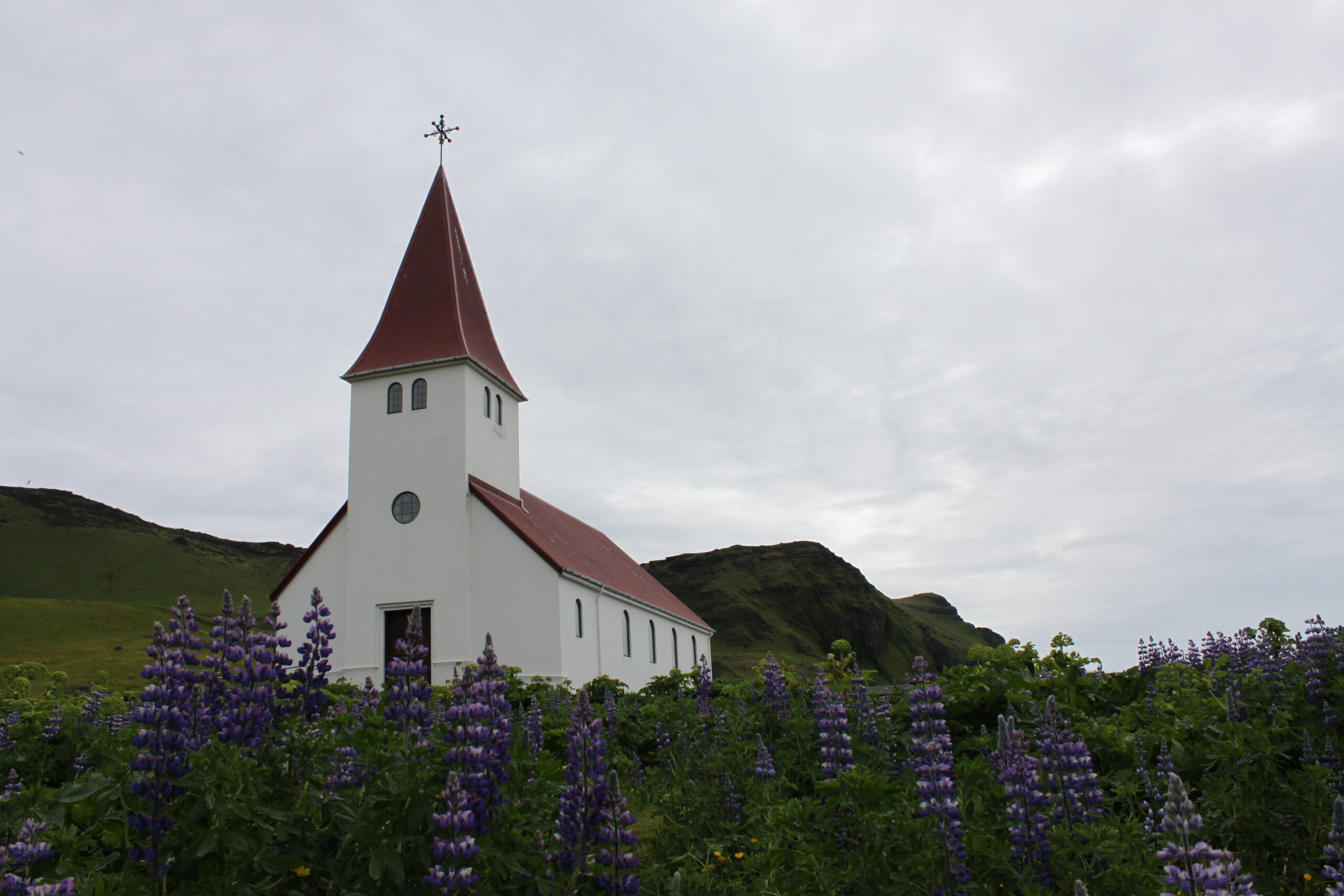
The white church with the red roof above the village is the most photographed building in Vík. It was built from concrete between 1931 and 1934 and seats 160 people. The design is attributed to Guðjón Samúelsson, the state architect who also designed Reykjavik’s Hallgrímskirkja. A small road leads up to the church from the village, and the car park by the church has the best view of the whole of Vík: rooftops, the black beach, the Reynisdrangar stacks out at sea and the cliff of Reynisfjall.
The church has a practical role too. According to Katla Geopark it stands high enough that a glacial flood from a Katla eruption wouldn’t reach it, so it’s the assembly point for the village (more on that below). In June and July purple lupins flower around the church, and in photos it looks almost too pretty to be real. We prefer to come up in the evening, when the sun is low over Reynisfjall and the car park is empty.
2. Víkurfjara black beach and Reynisdrangar from the village
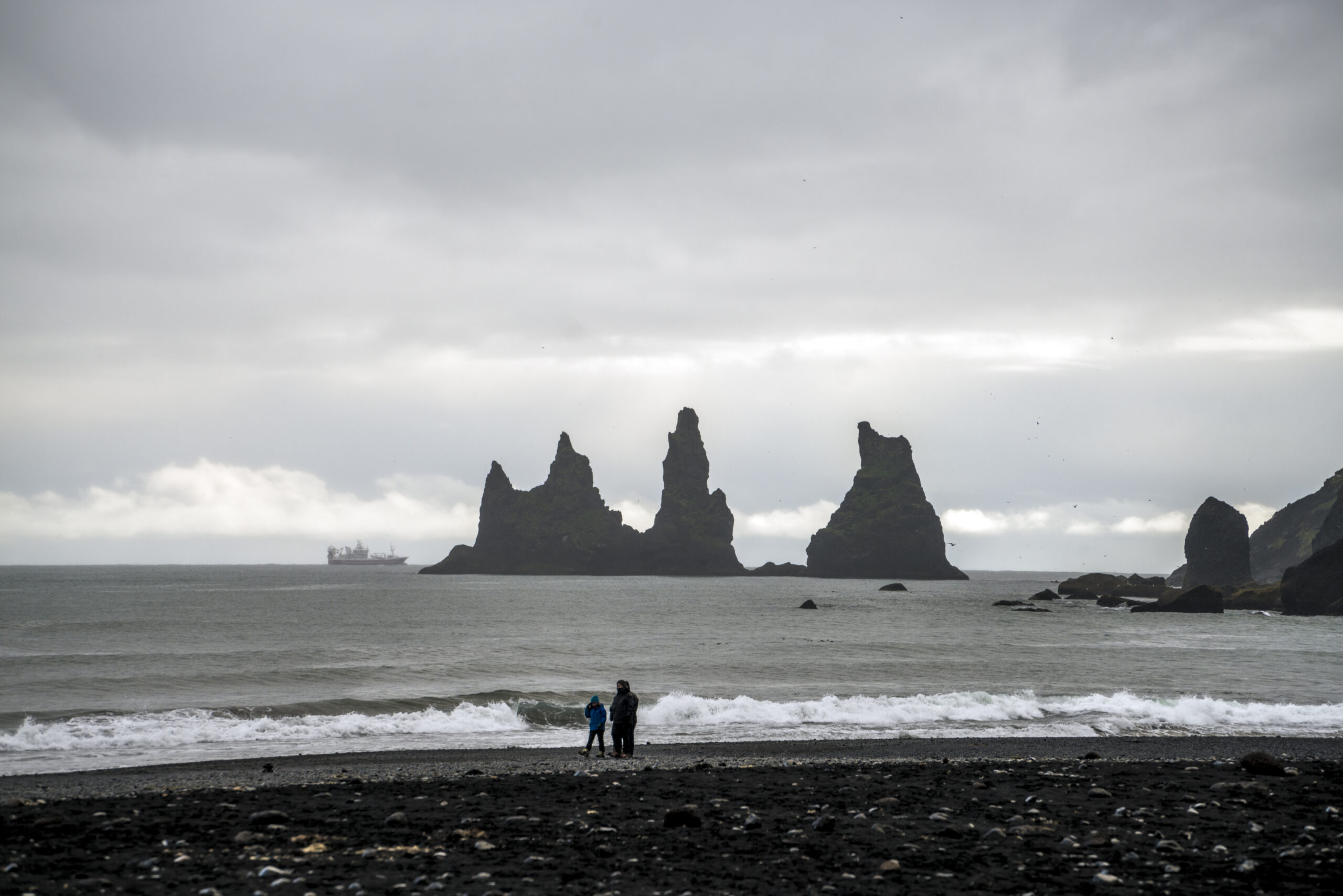
Vík has its own black beach right below the village, a few minutes’ walk from the main road. It’s called Víkurfjara and faces the Reynisdrangar sea stacks head-on, so from here you see them lined up in a row, while from Reynisfjara you only see them side-on. According to Visit South Iceland the tallest is 66 metres high. Legend has it they’re trolls who tried to drag a ship ashore at night and didn’t hide from the sunrise in time.
On the beach stands the bronze sculpture För (Voyage) by Icelandic sculptor Steinunn Þórarinsdóttir, from 2006. Its twin stands in Hull, and together they remember the seamen of both ports and the families who waited for them.
Víkurfjara is calmer than Reynisfjara, and that’s exactly why people lose their respect for it. Sneaker waves reach this beach too, the water is ice cold and the shore is just as exposed to the Atlantic. Stay on the dry sand and never turn your back on the sea. For a walk along the water towards Reynisfjall, though, it’s the best spot in Vík, and in the evening the beach is often almost empty.
3. Hiking up Reynisfjall
Reynisfjall, the mountain that separates Vík from Reynisfjara, is a 340-metre ridge of tuff. A gravel track leads to the top from the western end of the village, steepest in its first section, and at the top the view opens up over the Atlantic, down onto Reynisdrangar and along the bird cliffs. Loops along the ridge shared by hikers on Komoot are around seven to nine kilometres with 300 to 400 metres of ascent, so allow two to three hours.
Puffins nest on the cliffs of Reynisfjall in summer; according to Katla Geopark they arrive in late April or early May and leave in late August. It’s windier at the top than in the village and the cliffs have no railings, so keep well back from the edge, especially in fog. If you want more, Visit South Iceland also suggests the hill Hatta above the village, with views of the glacier and the small lake Heiðarvatn.
4. Lava Show
In a building at Víkurbraut 5 they show you real molten lava. First there’s a short film about Icelandic volcanoes and the 1918 Katla eruption, then the lights go down and lava heated to over 1,100 °C pours into the room a few metres from the audience. The guide shapes it into strands and drops with an iron rod and explains what’s happening as they go. You can feel the heat on your face.
The Lava Show started here in Vík and now has a second venue in Reykjavik. Ticket prices vary by date and type of show; you’ll find the current ones on the Icelandic Lava Show website, and in summer it’s worth booking ahead. For us it’s the best thing to do on a rainy afternoon, and Vík has more than its share of those.
5. Kötlusetur information centre and the maritime museum
The historic 19th-century wooden trading house Brydebúð in the middle of the village is home to the Katla Geopark information centre (Kötlusetur). According to Visit South Iceland there’s a free exhibition on the Katla volcano and the geopark, and you can pick up maps and information on hikes in the area.
The village also has a small maritime museum, Hafnleysa, built around the oak boat Skaftfellingur. Locals bought it in Denmark in 1917 so they had a way to carry goods and people from the Westman Islands along a coast with no harbour, and it reached Iceland in May 1918. The exhibition also covers shipwrecks off the south coast and includes a film about seamen’s lives in the 1950s. It’s a small museum you’ll see in half an hour, but it explains why Vík looks the way it does.
6. Vík swimming pool
The municipal pool is at Mánabraut 3 and, like most Icelandic pools, it’s outdoors. The main pool is 16.7 metres long and 28 to 29 °C, plus a children’s pool (37 to 38 °C), a hot pot (40 to 42 °C), a cold pot and a sauna. It’s an ordinary village pool where local families go, not a lagoon, but after a day in the wind on the beach it does the same job.
| Vík swimming pool | Price (approx.) | Roughly in £ |
|---|---|---|
| Adults, single entry | around 1,500 ISK | £9 |
| Children | around 600 ISK | £3.50 |
| Towel hire | around 1,300 ISK | £8 |
| Swimsuit hire | around 1,300 ISK | £8 |
The prices come from the Mýrdalshreppur municipality’s price list. The municipality doesn’t publish opening hours on its website, so check them locally or by phone on 487 1174. As at every Icelandic pool, you must shower naked, without your swimsuit, before going into the water.
7. Wool and jumpers from Vík
Vík has a long textile tradition, and on the main road (Austurvegur 20) there’s an Icewear shop, formerly Víkurprjón, selling Icelandic wool jumpers, hats, blankets and outdoor clothing. It’s a big shop where you’ll find everything in one place, and in the sales and with a VAT refund (tax free) you can come away with fair prices. If you’re after something more handmade, the village also has a small family business, Katla Wool, founded in 2020.
8. Guided tours: ice cave, horses, zipline
Plenty of activities start from Vík, and for these you need a guide:
- Ice cave under Katla: by super jeep across the black plain to the edge of the Mýrdalsjökull glacier. Unlike most Icelandic ice caves, this one is visited all year round. Never go onto a glacier on your own. We explain how it differs from the caves on Vatnajökull in our guide to the Vatnajökull glacier.
- Icelandic horse riding on the black beach below Reynisfjall, beginners welcome.
- Zipline in the Grafargil gorge near Vík.
- Paragliding in tandem with a pilot, according to Guide to Iceland only from May to September and for children aged 12 and over.
- Quad bikes on the black beaches of Sólheimasandur and snowmobiles on Mýrdalsjökull.
9. Hjörleifshöfði and Gígjagjá cave
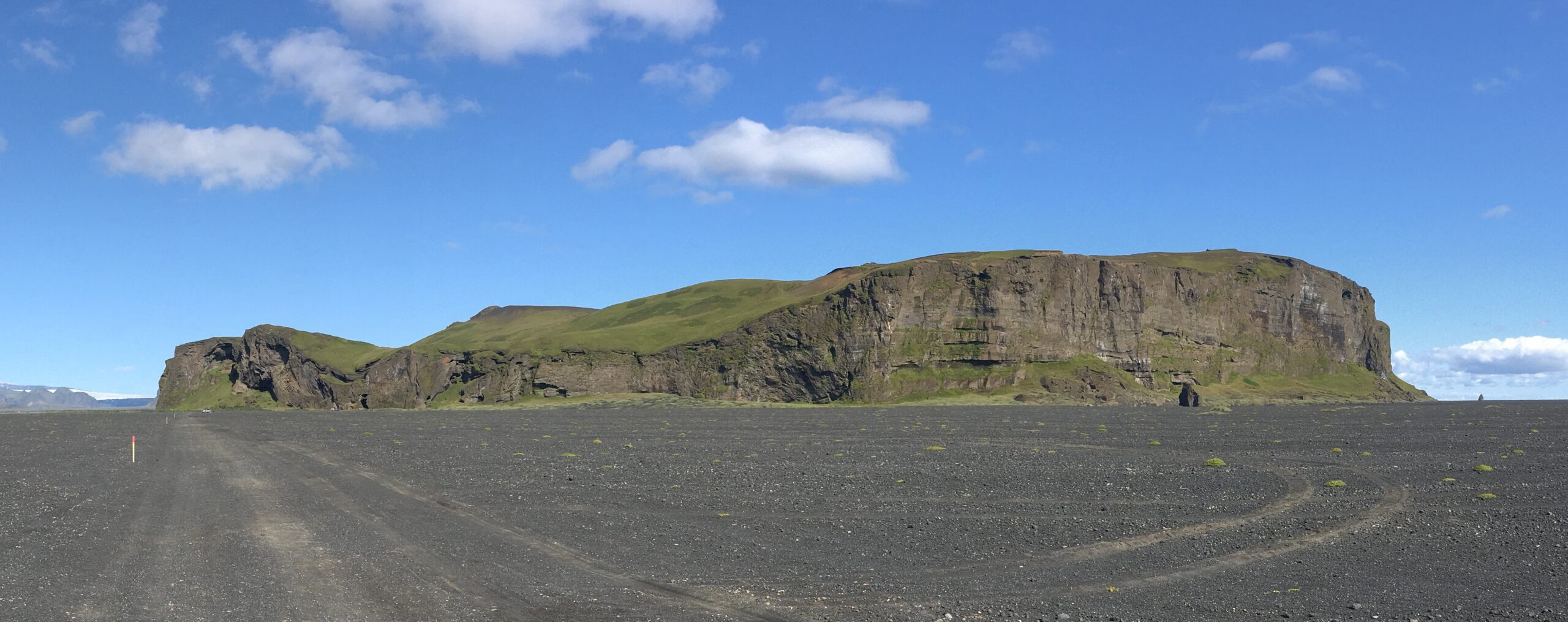
About 15 km east of Vík, the lonely table mountain of Hjörleifshöfði, over 220 metres high, rises out of the black plain of Mýrdalssandur. Around it lies black sand washed here by floods during Katla’s eruptions. According to Visit South Iceland you’ll find the remains of an old farm and a Viking burial mound here. The hill is named after Hjörleifur, blood brother and brother-in-law of Ingólfur Arnarson, Iceland’s first settler. According to the sagas, Hjörleifur settled here and was killed by his own slaves.
A gravel track leads here off Route 1; visitors say it’s passable in an ordinary car, though in winter it can be icy or muddy. At the foot of the hill is Gígjagjá, nicknamed Yoda Cave because of the shape of its entrance. It’s one of those places only people staying the night in Vík get to, and what we like about it is the sheer emptiness all around.
10. Reyniskirkja, Reynisfjara and Dyrhólaey
West of Vík, on the far side of Reynisfjall, are the three places most people stop here for in the first place. On the way to Reynisfjara (Route 215) you pass the small white church of Reyniskirkja, from 1929. According to a legend told by Guide to Iceland, it was built for a farmer by an elf. In return the elf wanted the farmer’s son, unless the farmer could guess his name, and in the end the farmer overheard it in a lullaby sung by the elf’s wife. The church is usually locked outside services, but the churchyard and the view are worth five minutes.
At the end of the road is Reynisfjara black sand beach with its basalt columns, one of the most dangerous places in Iceland. How to read the traffic-light warning system at the entrance, what parking costs and what erosion has done to the beach recently, we cover in a separate guide.
A little further west is the Dyrhólaey headland, about 120 metres high, with a rock arch in the sea, a lighthouse from 1927 and more nesting puffins than at Reynisfjara. During the nesting season (1 May to 25 June) the reserve’s managers may restrict access, and the upper part by the lighthouse is usually closed overnight. Parking is paid through the Parka app. We’d combine Reynisfjara and Dyrhólaey into one morning and leave Vík around seven.
Katla and the Vik evacuation plan
Above the village lies the Mýrdalsjökull glacier, and beneath it one of Iceland’s most dangerous volcanoes, Katla. It last erupted in October 1918, and according to Katla Geopark the flood from the melted glacier pushed the coastline two to three kilometres further out to sea. More than 150 eruptions have been recorded in the geopark area since the 9th century, and Katla tends to have a major eruption roughly once every 40 to 80 years. Over a hundred years have passed since the last one, which is why people talk about it as the volcano that’s “due”.
An eruption under the glacier would melt a huge amount of ice and send a glacial flood (in Icelandic, jökulhlaup) down the slopes. According to Katla Geopark it would head mainly for the black Mýrdalssandur plain east of the village, but for Vík, with houses on low ground by the sea, it’s still a serious risk. So the residents have an evacuation plan:
- The warning comes by text message to every phone connected to the local network, including visitors’ phones.
- The assembly point is Víkurkirkja church on the hill, which stands high enough for the flood not to reach it. According to local sources, residents would have only about fifteen minutes to get there.
- The village practises the evacuation regularly, and hotels have information for guests too. According to Icelandic media, the 2017 plan is being updated, and the authorities presented a draft of the new version to locals in 2025.
None of this means you shouldn’t go to Vík. Katla is monitored around the clock by the Icelandic Met Office, which says it will issue a warning at the first signs of an approaching eruption. Earthquake swarms under Mýrdalsjökull happen from time to time, the most recent bigger ones in May 2023 and October 2025, and so far no eruption has followed. For visitors, that boils down to three simple things: keep your phone on with a local signal, check where the evacuation information is posted in your hotel, and if a warning comes, don’t drive off towards Mýrdalssandur and follow the instructions. You’ll find the volcano’s current status on vedur.is and travel alerts on safetravel.is.
By the way, Vík and Katla are the main backdrop of the Icelandic Netflix series Katla, about the village after the first eruption since 1918. If you’ve watched it, you’ll recognise the church and the beach.
When to visit Vik and what the weather is like
Vík lies at the southernmost tip of Iceland and is one of the mildest and at the same time wettest places in the country. It gets roughly 2,250 mm of rain a year, about three times as much as Reykjavik. It rains often, but usually not for long; clouds and sunshine swap quickly, and a rainbow over the village is nothing unusual.
- Summer (June to August): long days, the most people and the most expensive accommodation. Lupins flower around the church and puffins nest on the cliffs of Reynisfjall and Dyrhólaey. Book accommodation months ahead.
- Spring and autumn (April, May, September, October): fewer people, good light and, on dark nights, the northern lights either already or still about. In our view the best time to use Vík as a base; the campsite opens in mid to late April.
- Winter (November to March): short days, wind, ice on the roads and the best chance of northern lights away from the village lights. Wind and snow can close Route 1 for a few hours, especially across Mýrdalssandur, so keep an eye on umferdin.is for road conditions and on vedur.is for weather warnings. In winter, hire a 4×4.
💡 Reynisfjara in the morning, the village in the afternoon. Tour coaches from Reykjavik reach the south coast in the late morning and work their way through every stop by the afternoon. If you stay in Vík, do Reynisfjara and Dyrhólaey first thing, then come back to Vík for lunch and the pool while the beaches are at their busiest. In the evening, walk up to the church, long after the coaches have gone.
What we’d do differently
Most people do the same thing in Vík: stop at the petrol station, take a photo of the church from the supermarket car park and drive on to Reynisfjara. For them the village is just a fuel stop. If we went again, we’d stay two nights and treat the village not as a service station, but as a place in its own right.
We’d walk down to Víkurfjara beach in the evening with no plan, just along the water towards Reynisfjall, watching the light change on Reynisdrangar. We’d climb part of the way up Reynisfjall, even if only halfway, because from there you understand how small the village is between the mountain, the glacier and the ocean. We wouldn’t need to fit in the ice cave, the zipline and the horses. One activity is enough; the rest of the day belongs to the beach.
In the evening we’d try whatever’s on the board instead of hunting for the best-rated place. Fish soup, lamb, local beer from the brewery a few streets away. And on a rainy afternoon we’d go to the pool with the local families instead of sitting in the car waiting for the rain to stop. It usually stops within a quarter of an hour anyway. This is Vík.
And we’d keep the phone in our pocket, with one exception. We’d keep it switched on for any text about Katla. We don’t need a tenth photo of the church.
FAQ about Vik, Iceland
Where to stay in Vik, Iceland?
In the village itself there are Hótel Kría and Hotel Vík í Mýrdal, plus smaller guesthouses such as Guesthouse Carina and Arsalir. West of Vík, towards Dyrhólaey, you’ll find Hótel Dyrhólaey, Volcano Hotel, Hótel Búrfell and the Black Beach Suites apartments; to the east there’s Hotel Katla. The cheapest option is the Vík Camping campsite. In summer, book well in advance.
How far is Vik from Reykjavik?
About 180 km along Route 1, roughly two and a half hours by car without stops. With stops at Seljalandsfoss and Skógafoss, allow four to five hours. At the time of writing, Strætó bus 52 only runs on Tuesdays, Thursdays, Fridays and Sundays.
How far is Reynisfjara from Vik?
About 11 km by road, around 12 minutes by car. As the crow flies it’s closer, but the Reynisfjall mountain stands between the village and the beach, so you drive round on Route 1 and then on Route 215.
What happens if Katla erupts?
Every phone connected to the local network gets a warning text. Residents and visitors in Vík are to gather at Víkurkirkja church on the hill, which a glacial flood wouldn’t reach. Follow the authorities’ instructions and don’t drive towards Mýrdalssandur. You’ll find the volcano’s current status on vedur.is and safetravel.is.
Is there a supermarket and petrol station in Vik?
Yes. Vík has a Krónan supermarket, the state-run off-licence Vínbúðin and three petrol stations: N1, Orkan and ÓB. East of Vík the stations are far apart, so fill up to the top before crossing Mýrdalssandur.
How much is the Vik swimming pool?
Adults pay around 1,500 ISK (about £9) for a single entry, children around 600 ISK (about £3.50). You can hire a towel or a swimsuit for roughly 1,300 ISK each. The pool is outdoors, with a 28 to 29 °C main pool, a hot pot, a cold pot and a sauna.
Can you see the northern lights in Vik?
Yes, from September to April on clear, dark nights. The village lights get in the way, so it’s better to drive a little west towards Dyrhólaey or stay at one of the hotels outside the village. You’ll find the aurora and cloud cover forecast on vedur.is.
Is there a campsite in Vik?
Yes, Vík Camping, about a kilometre from the centre. Camping costs around 2,200 ISK (about £13) per person per night, plus accommodation tax of around 400 ISK. You don’t need to book; it’s open from April to early November and closed in winter.
Where next
- Reynisfjara: the black beach on the other side of Reynisfjall, the warning lights at the entrance and how to stay safe there.
- Skógafoss: the waterfall half an hour west and the start of the Fimmvörðuháls trail.
- Seljalandsfoss: the waterfall you can walk behind, an hour’s drive west.
- Jökulsárlón: the glacier lagoon, the next big stop on the way east.
- Vatnajökull: Iceland’s largest glacier, ice caves and glacier hikes.
- Fagradalsfjall and Iceland’s volcanoes: the eruptions on Reykjanes and how to see lava safely.
- Things to do in Reykjavik and Hallgrímskirkja: for a spare day in the city.
Potřebujete pomoct s cestováním?
-
Ubytování 🏨
Vyberte si to nejlepší ubytování, ať už jste kdekoliv, přes Booking.com. -
Půjčení auta 🚗
Auto si snadno najdete přes Booking.com, kde máte často slevu díky ubytování, nebo Rentalcars.com, kde porovnáte nabídky většiny půjčoven. -
Zážitky 🎟️
Přes GetYourGuide.com si vyberete z nejrůznějších výletů i zážitků po celém světě, navíc se zrušením zdarma do 24 h předem.