Last updated 27.11.2026
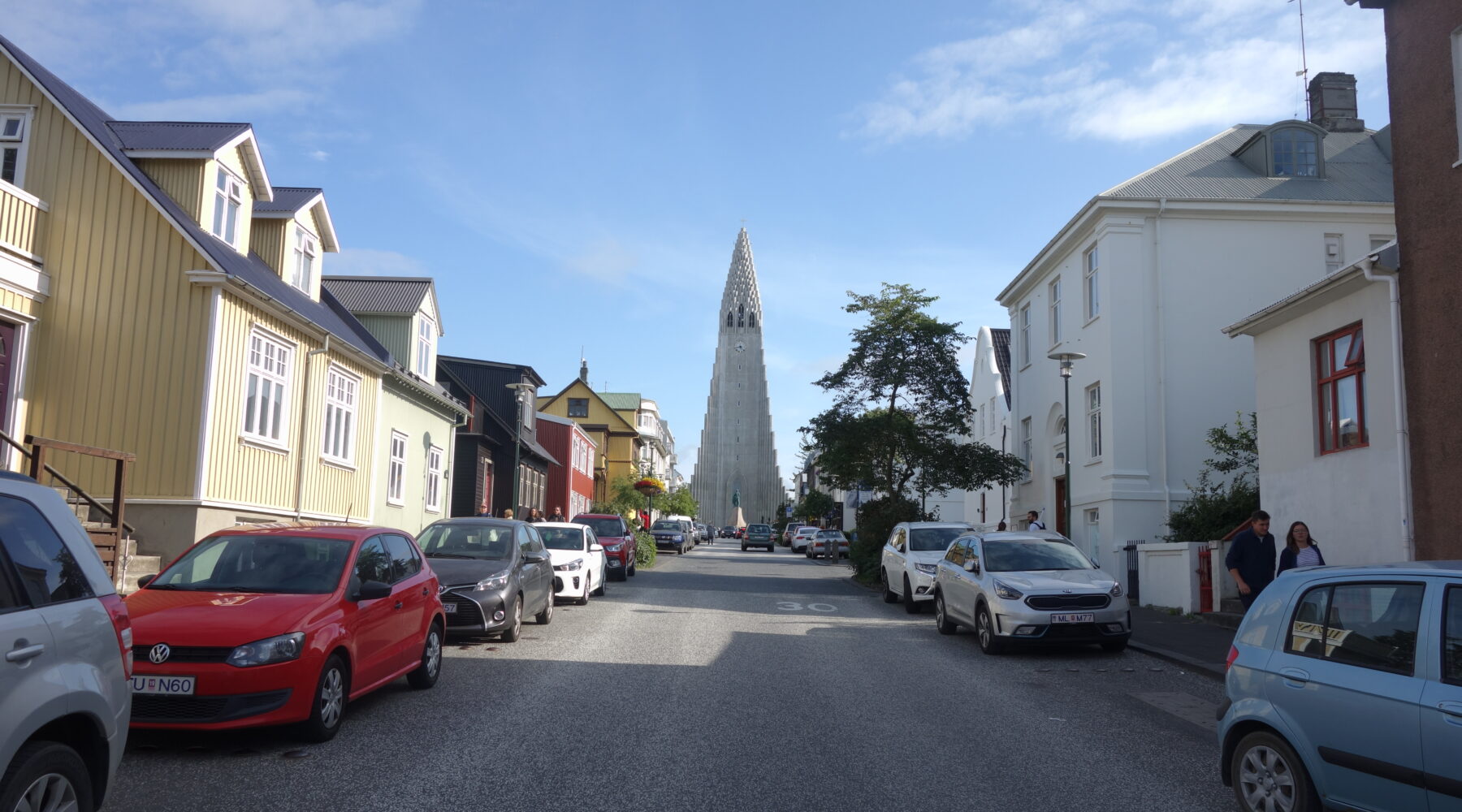
The white concrete tower on the hill above Reykjavik is the first thing you notice in the city and the last thing to drop out of sight. Hallgrímskirkja church is the largest church in Iceland and, according to the parish, the most visited tourist site in the country. On postcards it looks like something from another planet. Up close it is an ordinary parish church: there is a service on Sunday, a short morning service on Wednesday, and on Monday and Friday at noon people gather to pray in the side chapel.
In this guide we cover what the tower lift costs, when services close the church to visitors, what the basalt-column façade is meant to represent, how an organ with more than five thousand pipes sounds and when to buy a concert ticket. Tips on where to stay come early on, and at the end you will find where to head next once you walk back down the hill. Our favourite moment at Hallgrímskirkja is when the square in front of it is still free of coaches and the tower bells ring a quarter past nine.
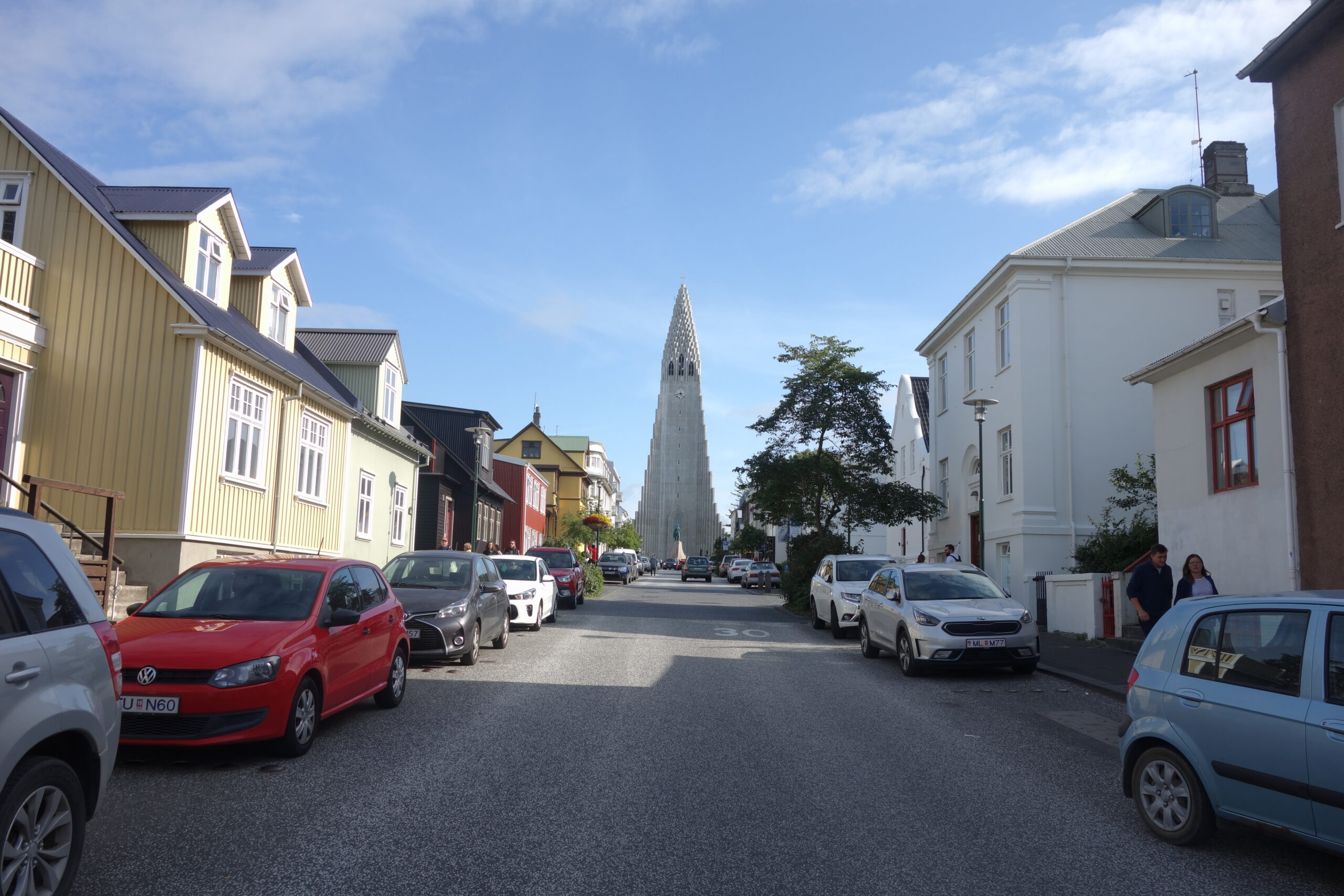
Hallgrímskirkja church at a glance
- Where it is: on Skólavörðuholt hill above central Reykjavik, address Hallgrímstorg 1. It is a ten-minute uphill walk from Laugavegur.
- The church itself is free to enter. You only pay for the tower lift: adults around 1,500 ISK (about £9), concessions and children aged 7 to 16 roughly 200 to 1,300 ISK.
- Tickets on the spot only. They are sold in the small shop to the left of the entrance and cannot be bought in advance, online or for groups.
- Opening hours: from 1 September until spring, daily 10:00 to 17:00, last lift up the tower at 16:45. In summer 9:00 to 20:00, tower until 19:45.
- Closed on Sunday mornings. Because of the 11:00 service, the church and the tower are closed to visitors from about 10:30 to 12:30. You are welcome to attend the service itself.
- The Klais organ has 5,275 pipes and is the largest in Iceland. Concerts take place mainly in summer and during Advent, with tickets at roughly 3,200 to 4,200 ISK.
- Allow 30 to 60 minutes for a visit, longer with the tower and a concert.
Where Hallgrímskirkja church stands and how to get there
The church sits on the highest point of old Reykjavik, Skólavörðuholt hill, on Hallgrímstorg square. You can see it from almost anywhere in town, so you do not need a map: just walk towards the tower. A statue of Leif Erikson stands in front of the main entrance, the museum of the sculptor Einar Jónsson is behind the church, and Skólavörðustígur runs downhill into the centre. If you have just landed at Keflavík from the UK, it is also the easiest landmark for getting your bearings on the first evening.
On foot. From most hotels in the centre this is the simplest option. From the bottom of Skólavörðustígur, where it meets Laugavegur, you reach the church in about ten minutes on a gentle climb. From the Old Harbour or Harpa, allow 20 to 25 minutes. In winter watch out for icy pavements, as only some stretches in the centre are heated.
By bus. The yellow Strætó buses run along the surrounding streets, but the centre is so compact that it is not worth looking for one just to reach the church. The main bus hub, Hlemmur, is about a kilometre away. Hop-on hop-off sightseeing buses stop right by the church.
By car. The streets around the church are part of the city’s paid parking zones. Most of them fall into zone P2, where an hour costs around 200 ISK (about £1.20) on weekdays from 9:00 to 20:00 and at weekends from 10:00 to 20:00. You pay at a machine or through the Parka and EasyPark apps. The city has also approved charges for the partly free area between the church and the Tækniskólinn technical college. The change takes effect once it is published in the official gazette and new signs go up (reykjavik.is). Older guides, Guide to Iceland among them, still mention free parking next to the church, so go by the signs on site. On some public holidays, such as Good Friday, Christmas Day or 17 June, parking in the zones is free.
Hallgrímskirkja entrance fee and opening hours
Anyone can walk into the nave for free whenever the church is open. The only thing you pay for is the lift to the viewing platform in the tower. You buy the ticket in the church shop, Guðbrandsstofa, immediately on the left inside the main entrance, then go through a turnstile to the lift. Advance booking is not possible, not even for groups. A ticket is valid for one trip up on the day of purchase.
| Tower lift | Price (approx.) | Roughly in £ |
|---|---|---|
| Adults | around 1,500 ISK | £9 |
| Students with ID, seniors aged 67+, disabled visitors | around 1,300 ISK | £8 |
| Children aged 7 to 16 | around 200 ISK | £1.20 |
| Children aged 6 and under | free | free |
| Entry to the church | free | free |
Groups of ten or more get 10% off when paying together, and school groups with pupils under 16 go up for free. Prices change, so check them on the church website before you travel. The sterling figures are only a rough guide. The tower is not included in the Reykjavík City Card, because the church belongs to the parish, not the city.
Opening hours vary with the season:
- Winter hours (from 1 September): church open daily 10:00 to 17:00, last lift up the tower at 16:45.
- Summer hours: church open daily 9:00 to 20:00, tower until 19:45. According to the church’s schedule, summer hours start around the end of May.
- Sundays: because of the 11:00 service, the church and tower are closed from roughly 10:30 to 12:30. Tower ticket sales on Sunday morning stop at 10:25 at the latest.
- Weekdays: the nave closes for short periods during the Wednesday morning service (10:00), the Thursday midday prayer with organ music (12:00 in winter), and for weddings, funerals and concerts. The tower usually stays open.
The church points out that times around services are approximate and that it may close a few minutes early if it gets very busy inside and in the queue for the lift. Special arrangements apply on public holidays. On Christmas Eve, Christmas Day and New Year’s Day the church is open for services only and the tower is closed. On New Year’s Eve it is open only in the morning, from 10:00 to 12:00, and on Good Friday the church is closed to visitors all day. On some Advent weekends it closes as early as 16:00.
💡 Check the weekly schedule before you go. On its Opening hours page, the church lists day by day when the nave or the tower will be closed. On a Sunday we would leave the tower until the afternoon. Turn up at 10:40 and you will just be standing at a locked door listening to the bells.
Where to stay near Hallgrímskirkja
The area around the church, the Þingholt district and the upper end of Skólavörðustígur, is in our view one of the best places to stay in Reykjavik. The streets are quieter than down by the bars on Laugavegur, the centre is a ten-minute walk downhill, and the tower works as a beacon when you head back in the evening. If you are coming by hire car, factor in the paid parking zones and look for a hotel with its own parking.
- Hotel Leifur Eiriksson (Skólavörðustígur): a small hotel directly opposite the church. You cannot sleep any closer, and some rooms have the tower right outside the window.
- Hotel Óðinsvé (Þórsgata 1): a hotel on the little Óðinstorg square in a quiet part of Þingholt, a few minutes’ walk from the church.
- Hotel Holt (Bergstaðastræti): a classic hotel below the church, known for its collection of Icelandic art. One for when you want to treat yourself.
- Skuggi Hotel by Keahotels (Hverfisgata): a modern hotel below the church towards the sea, close to Laugavegur. A good balance between peace and quiet and being in the thick of things.
- Loft HI Eco Hostel (Bankastræti): a hostel down in the centre with dorms and private rooms. From here it is ten minutes uphill to the church.
For more options, use our Reykjavik accommodation search. For an overview of the neighbourhoods worth staying in, see our guide to things to do in Reykjavik.
Hallgrímskirkja tower and lift: what you see from the top
According to the parish, the tower is 73 metres high, while Wikipedia and most guidebooks give 74.5 metres. The difference probably comes down to where the measurement starts, and it makes no difference to the view. Either way, Hallgrímskirkja is the tallest structure in central Reykjavik and, according to Wikipedia, the second-tallest building in Iceland. The tower still carries transmitters for radio and mobile networks, something the 1929 design competition had already planned for.
The lift takes you up to the eighth floor, and from there a few steps lead up to the viewing platform beside the clock faces. The lift is small, so a queue builds up in front of it in summer. The nave and the lift are step-free, but you cannot reach the viewing platform itself in a wheelchair because of those final steps.
The windows of the platform face all four points of the compass:
- North and north-west: directly below you are the Leif Erikson statue and Skólavörðustígur, beyond them the Harpa concert hall, the harbour and, across Faxaflói bay, the flat-topped mountain Esja.
- West: the old centre with its colourful metal roofs, Tjörnin lake and the sea.
- South: the glass dome of Perlan on Öskjuhlíð hill and the domestic airport.
- East and south-east: residential districts, with the Bláfjöll mountains behind them.
It is cold and windy at the top even in summer, and the viewing platform is not heated. For a few minutes that does not matter, but bring a jacket. One more practical point: during the day the bells ring every quarter of an hour. If you are standing by the windows on the hour, you will notice.
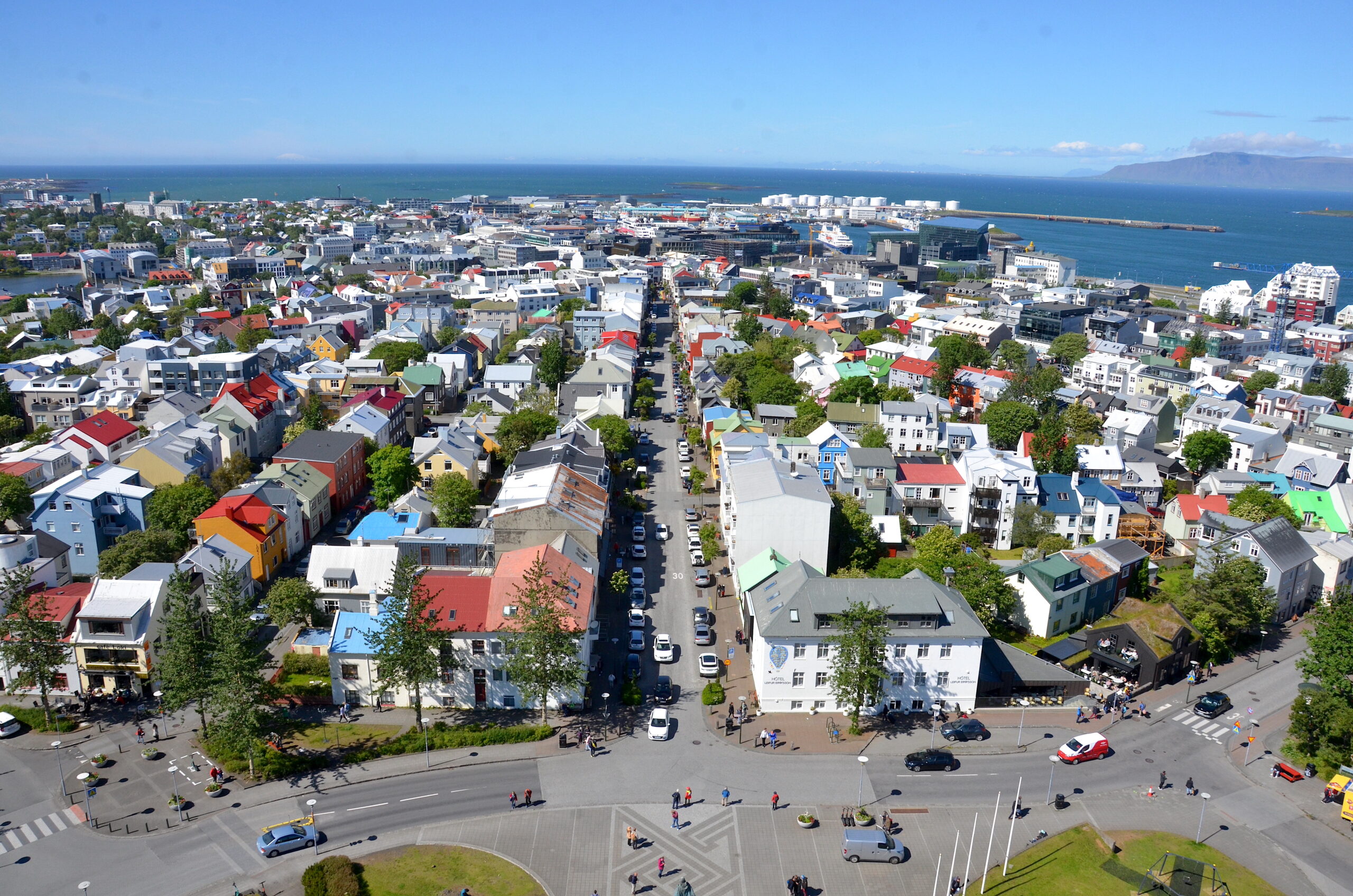
Is the Hallgrímskirkja tower worth it? On a clear day, definitely, because nowhere else shows you so well how small Reykjavik is and how close the mountains are. Under low cloud we would save the money and go for a coffee instead. If you want a view of the city with the church in it, try the viewing deck at Perlan, from where you can see Hallgrímskirkja across the whole of town.
The architecture: Guðjón Samúelsson and basalt columns
The church was designed by the state architect Guðjón Samúelsson (1887 to 1950), who also designed the main building of the University of Iceland, the National Theatre, the Catholic cathedral at Landakot and Sundhöll, the city’s oldest public swimming pool. Hallgrímskirkja was his last work. He was searching for a national Icelandic style and, according to the parish, wanted the building to evoke basalt columns, Icelandic mountains and glaciers. Guidebooks most often mention the columns at Svartifoss waterfall in Skaftafell, but you will see similar ones at Reynisfjara black sand beach. The stepped wings on either side of the tower are a concrete take on exactly these columns.
The building took far longer than you might expect:
- 1929: an architectural competition called for a church seating 1,200 people and a tall tower that could be used for the radio broadcasting then being planned.
- 1937: Guðjón Samúelsson begins designing the church.
- 1945: construction starts.
- 1948: the crypt beneath the choir is consecrated, and services are held there for decades.
- 1974: the tower with its side wings and the hall in the south wing are completed.
- 26 October 1986: the whole church is consecrated, the day before the 312th anniversary of Hallgrímur Pétursson’s birth and in the year Reykjavik celebrated its 200th anniversary.
So the building work went on for 41 years. The state and the city contributed, but according to the parish, two thirds of the cost was covered by the church and private donors. The church was not always popular: according to Wikipedia, critics during construction called it old-fashioned and a jumble of styles. The same source says the leadership of the Church of Iceland wanted the tower taller so that it would rise above the Catholic cathedral at Landakot. Architects today class Hallgrímskirkja as expressionist and compare it with Grundtvig’s Church in Copenhagen, completed in 1940, which has a similar “organ-pipe” façade.
The building has three parts: the tower with its wings, a fairly traditional nave, and a cylindrical apse at the far end, which reminds some people of a Viking helmet. Our favourite view is from the side, from Eiríksgata. From there you can see that behind the famous façade stands a fairly ordinary long church.
Inside Hallgrímskirkja church
If you are expecting gold and frescoes, you are in for a surprise. The nave is tall, narrow, pale grey and almost bare. Gothic arches are translated into concrete here, and the light falls through long, narrow windows. Inside the entrance stands a statue of Christ after his baptism in the Jordan by the sculptor Einar Jónsson, who gave it to the church in 1948. At the other end of the nave, above the main entrance, hangs the huge organ.
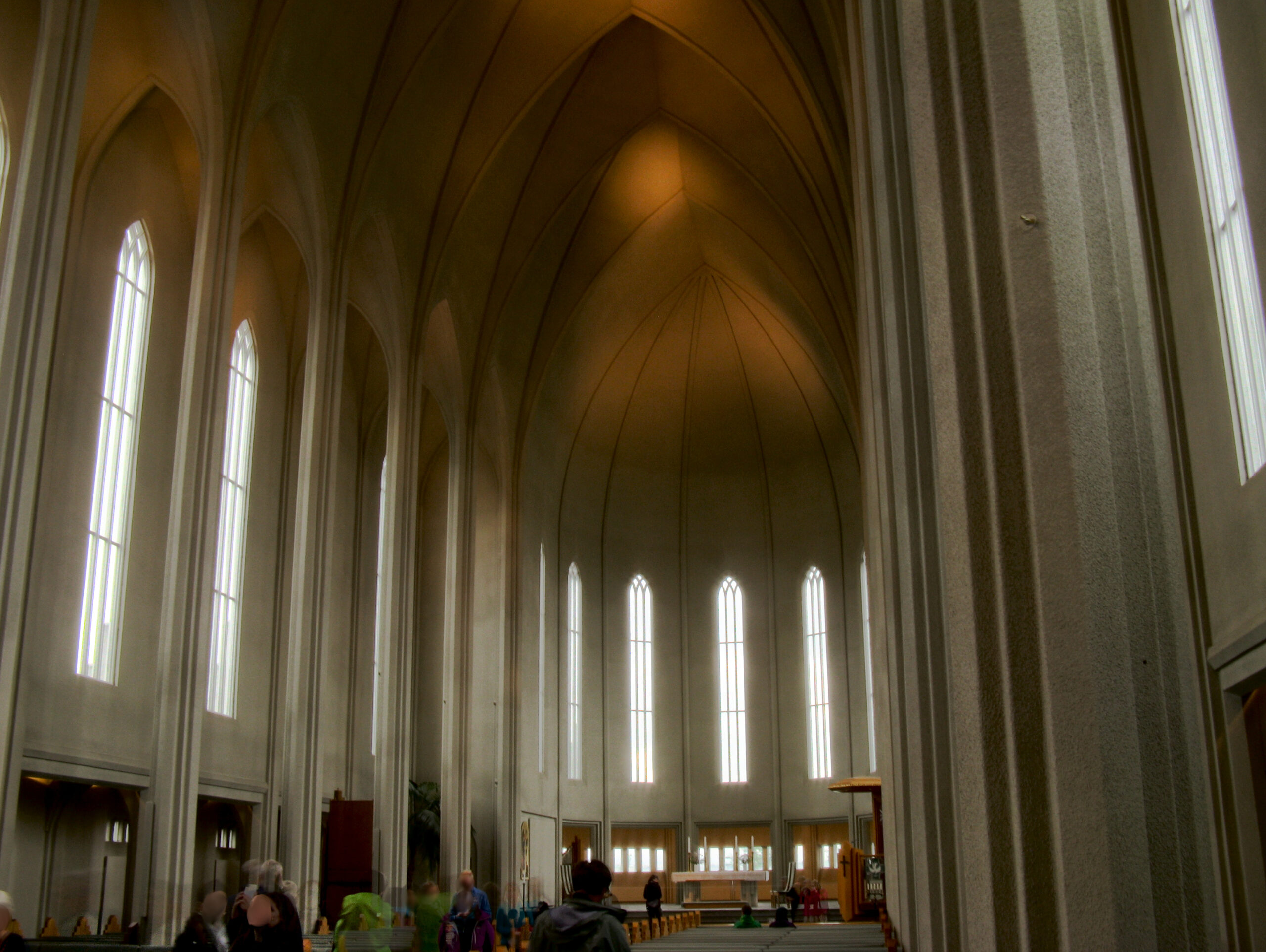
The details reward a closer look:
- The bronze doors of the main entrance and the stained glass above them are by the glass artist Leifur Breiðfjörður. The doors were added only in 2010. They are shaped like a quatrefoil, with a human figure on the left and Christ on the right, joined by a crown of thorns that ends in the door handle. The inscription on the doors reads “Come unto me”.
- The pulpit is by the same artist and features handwritten verses by Hallgrímur Pétursson rendered in glass.
- The font, from 2001, is made of Icelandic columnar basalt and Czech lead crystal.
- Sculptures: on the left of the nave, The Martyr by Sigurjón Ólafsson, and opposite, a small bronze statue of Hallgrímur Pétursson by Einar Jónsson.
- By the altar is a painting of the Virgin and Child by Guðmundur Einarsson, and on the walls of the choir are icons of the archangels Gabriel and Michael by Kristín Gunnlaugsdóttir.
You can take photos inside, just not with flash during services. Take your hat off and keep your voice down: this is still a working parish church, not a museum. There is no dress code.
The Hallgrímskirkja organ and concerts
The main organ was built by the Johannes Klais workshop in Bonn and inaugurated in December 1992. It has four manuals, a pedalboard, 72 stops and 5,275 pipes, stands 15 metres tall, weighs around 25 tonnes, and its longest pipes are about ten metres long. It is the largest organ in Iceland, and organists from all over the world come here to play and record. It was largely paid for through fundraising: people could “buy” a pipe, and the shop still sells certificates that make you the owner of a specific pipe.
The console is not up by the pipes. It is mobile and can be moved down into the nave, so at concerts you often see the organist up close. In the choir there is a second, smaller organ built by the Danish firm Frobenius in 1985, which was rebuilt and enlarged to 20 stops in 2024 for the 350th anniversary of Hallgrímur Pétursson’s death.
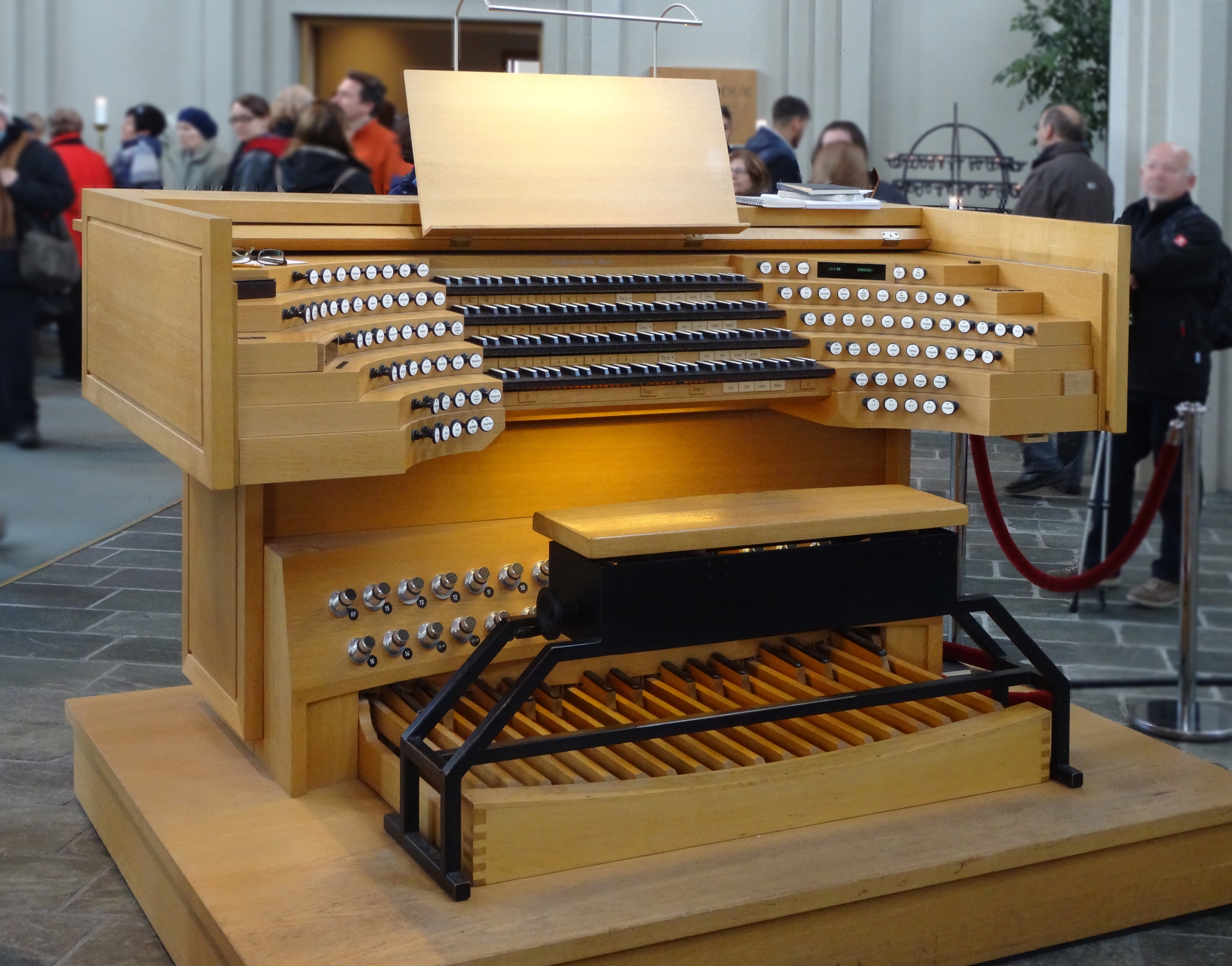
Hallgrímskirkja church hosts around 40 concerts a year, and its concert year has four parts: winter and spring, the Organ Summer (Orgelsumar), autumn, and Advent with Christmas. What to expect:
- The Organ Summer runs in July and August. Most recently it lasted from early July to mid-August, with Icelandic and international organists, including players from Switzerland, Germany and the USA. Tickets usually cost roughly 3,200 to 4,200 ISK (about £19 to £25) depending on the concert.
- Advent and Christmas: concerts by the church choir, organ recitals and performances by visiting choirs. In December the programme typically includes an organ concert on Boxing Day at 17:00 and a festive concert on New Year’s Eve at 16:00.
- Thursday midday prayer with organ music at 12:00 in winter lasts half an hour. It is a service, not a concert, and afterwards light refreshments are served in the south hall.
Tickets for concerts organised by the church are sold in the church shop and on tix.is, sometimes also at the door. Seats cannot be reserved, the nave usually opens half an hour before the start, and the doors close shortly after the concert begins. Concerts by visiting choirs are run by other organisers and have their own prices. The reverberation in the concrete nave lasts several seconds, which suits the organ better than the spoken word. If you have one free evening in Reykjavik, we would spend it on the organ.
Services at Hallgrímskirkja
Hallgrímskirkja belongs to the Evangelical Lutheran Church of Iceland, and more than 7,000 people live in the parish. Services are open to everyone:
- Sunday 11:00: the main service with the church choir, with Sunday school for children running alongside it in winter. It lasts until about 12:15.
- Last Sunday of the month, 14:00: an Anglican service in English, entrance at the back of the church.
- Wednesday 10:00: a morning service of about half an hour.
- Monday and Friday 12:00: short prayers in the chapel.
- Christmas: evensong at 18:00 and a late service at 23:30 on Christmas Eve, and a festive service at 14:00 on Christmas Day. On these days the church is open for services only, and seats cannot be saved.
Who was Hallgrímur Pétursson
The church is named after Iceland’s best-known religious poet. Hallgrímur Pétursson was born in 1614 in the north of Iceland, grew up near the bishop’s seat at Hólar and started training as a blacksmith in Copenhagen before moving to the Frúarskóli school. There he was asked to re-teach Christianity to a group of Icelanders who had been abducted by Algerian pirates and were returning home after years in slavery. Among them was Guðríður Símonardóttir, whom he later married. He served as a pastor at Hvalsnes and at Saurbær on Hvalfjörður fjord and died in 1674.
He is famous for his fifty Passion Hymns, meditations on the suffering of Christ. Icelandic radio reads them every year during Lent, and on Good Friday they are read aloud in the church all afternoon. The three largest bells in the tower are called Hallgrímur, Guðríður and Steinunn, after the poet, his wife and their daughter, who died as a small child. The tower also holds a carillon of 29 bells, the first of its kind in Iceland. On weekdays it chimes every quarter of an hour from 9:00 to 21:00, at weekends from noon.
The Leif Erikson statue in front of the church
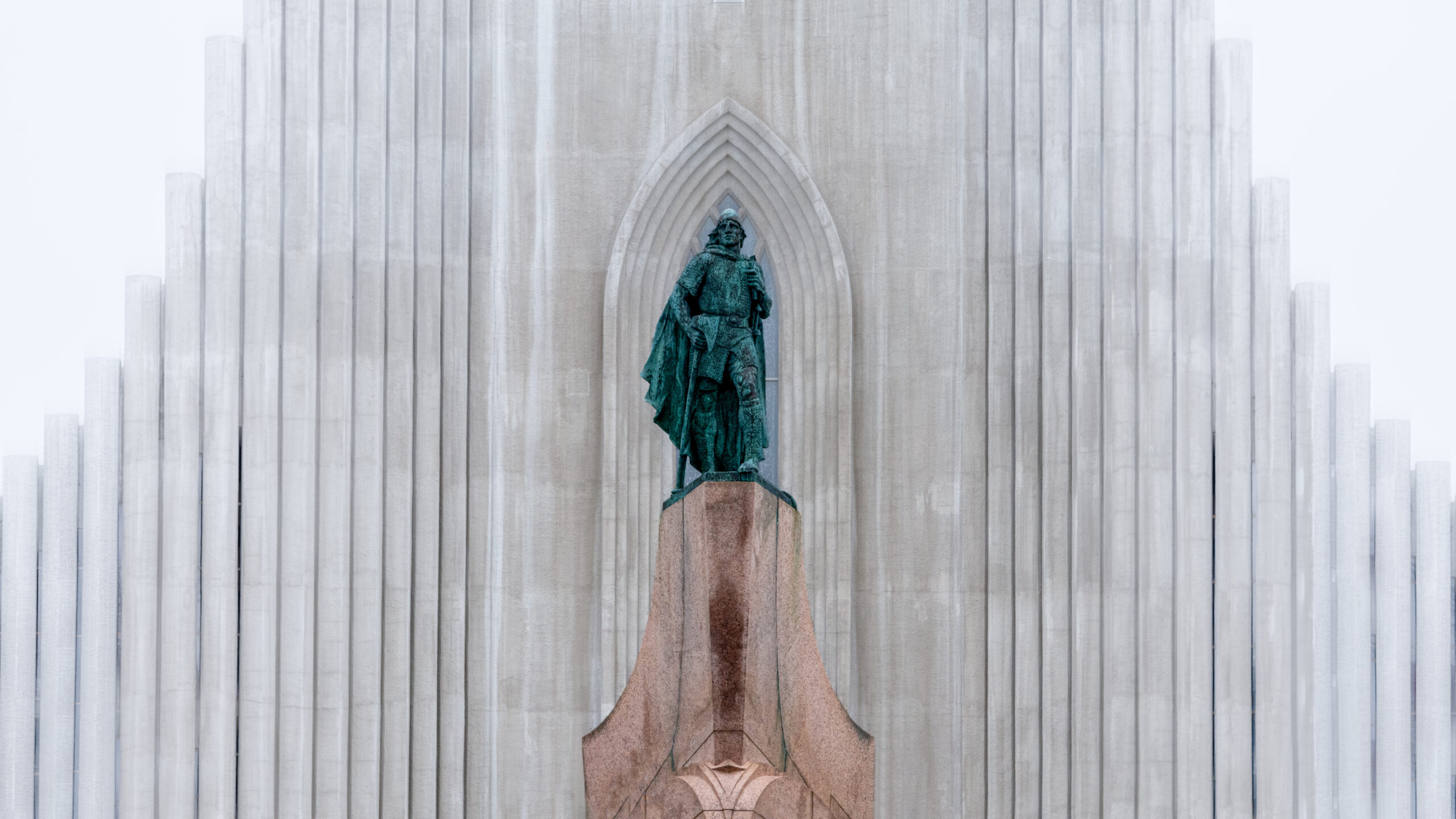
The bronze figure in chain mail standing on a plinth in front of the church and gazing out to sea is Leifur Eiríksson (Leif Erikson), the seafarer who reached North America around the year 1000 and called it Vinland. The statue is by the American sculptor Alexander Stirling Calder and was a gift from the United States to mark the thousandth anniversary of the Icelandic parliament, the Althing, in 1930. It was unveiled on 17 July 1932, thirteen years before work on the church began. To make room for it, the old stone tower Skólavarðan, which gave the hill its name, had to go.
The plinth, made of red Texas granite, is shaped like the prow of a Viking ship and is 4.6 metres tall. The inscription calls Leif a “son of Iceland, discoverer of Vinland”. Icelanders also took the gift as American recognition that Leif was an Icelander and not a Norwegian, as many Norwegians claimed. A second cast of the statue stands at the Mariners’ Museum in Newport News, Virginia.
When to visit Hallgrímskirkja church
The church is open all year, and a visit depends far less on the weather than trips out of town. For the tower, though, it pays to go when visibility is good, so if you can see Esja from your window in the morning, do not put it off until the afternoon.
- Time of day: it is usually quietest right after opening. In summer, coach tours and cruise passengers arrive from about ten o’clock, and the queue for the lift can stretch back into the entrance hall. Summer evenings are calmer too, when the church is open until eight and it is still light.
- Summer (June to August): the longest opening hours, the Organ Summer and the midnight sun. Also the biggest crowds.
- Winter (November to February): in December there are only about four hours of daylight, so you can only catch the view from the tower around midday. After dark the church is floodlit, and choir concerts take place during Advent. The northern lights can appear above the tower, but in the city lights they look fainter than out of town.
- Spring and autumn: fewer people, reasonably long days and, in our view, the best compromise.
Photographers recommend shooting the façade in the morning or in the last hour before dark, when Skólavörðustígur is almost empty. Guide to Iceland suggests one more trick: from the right-hand edge of the Einar Jónsson museum garden behind the church, you can photograph Hallgrímskirkja without people at any time of day.
What to see near Hallgrímskirkja: 6 places within a half-hour walk
The church stands above the centre, so everything else is downhill from here. We have listed the tips from the closest to those that take a bit longer to reach. For the whole city, with prices, museums and swimming pools, see our guide to things to do in Reykjavik.
1. Skólavörðustígur and Laugavegur
The street running down from the church into the centre is one of the most photographed in Reykjavik. A rainbow stripe is painted along the road, lined with shops selling wool, design and jewellery, plus plenty of cafés. At the bottom it joins Laugavegur, the main shopping street. Walking down from the church you look out at the sea and Mount Esja; walking up, you have the whole church façade in front of you. We walk it both ways, because each direction looks different.
2. Einar Jónsson Museum and sculpture garden
Just behind the church, across Eiríksgata, stands an unusual building that Iceland’s first sculptor, Einar Jónsson, built as his studio, home and museum all in one. He also made the statue of Christ inside Hallgrímskirkja. The sculpture garden is free to visit and is one of the few quiet spots near the church where you can sit for a while away from the crowds.
3. Sundhöll swimming pool
The oldest public swimming pool in Reykjavik, on Barónsstígur, five minutes’ walk from the church. It opened in 1937 and was designed by the same architect as Hallgrímskirkja, Guðjón Samúelsson. Inside there is an indoor pool with its original tiling, and outside there are hot tubs. If you want to see how locals spend an afternoon, you do not need to drive out of town to a spa.
4. Landakotskirkja and Dómkirkjan
Two churches that people often confuse with Hallgrímskirkja. Dómkirkjan, Reykjavik’s actual cathedral and the seat of the bishop, is a small church on Austurvöllur square next to the parliament. Landakotskirkja is the Catholic Cathedral of Christ the King on Landakot hill in the western part of the centre, also designed by Guðjón Samúelsson. Hallgrímskirkja itself is not a cathedral but a parish church. Both are about fifteen minutes’ walk downhill from Hallgrímskirkja.
5. Tjörnin lake and City Hall
A pond in the middle of the centre with ducks, swans and a city hall built partly over the water. From the church you can walk there downhill in a quarter of an hour through the Þingholt district, with its wooden houses clad in colourful corrugated metal.
6. Perlan
A glass dome on top of hot-water tanks on Öskjuhlíð hill, south of the centre. Inside there is a natural history exhibition about Iceland, and at the top a viewing deck. Perlan gives you the best view back towards Hallgrímskirkja rising above the city’s rooftops. On foot it takes about 25 minutes, partly through the Öskjuhlíð woods.
What we would do differently
Most people do the same thing at Hallgrímskirkja: walk up Skólavörðustígur, photograph the façade with the statue, join the queue for the lift, spend five minutes photographing rooftops and head back down. Twenty minutes and it is done. If we went again, we would not treat the church as a box to tick.
We would sit in a pew in the nave for a while and do nothing at all. Inside it is quiet, dim and cool, while outside the wind blows and the coaches come and go. Ten minutes in the church will tell you more about Iceland than another photo from the tower. And if someone happened to be practising on the organ, we would be in no hurry to leave.
In the evening we would go to a concert, even knowing nothing about organ music. You do not need to know the composer to hear what 5,275 pipes sound like in a concrete nave. Walking out of the church after a concert into a bright summer night, or into darkness and snow, is something we remember more than the view.
And we would not put so much weight on what the top-ten lists recommend. Right behind the church are streets the tour groups never reach: wooden houses clad in metal sheeting, cats on windowsills, cafés where locals sit by the window with a book. Have a cinnamon bun there, or whatever soup is chalked up on the board that day, and leave your phone in your pocket. The tower will still be there tomorrow.
Hallgrímskirkja church: frequently asked questions
How much does it cost to enter Hallgrímskirkja church?
Entry to the church is free. You only pay for the lift to the viewing platform in the tower: adults around 1,500 ISK (about £9), concessions and children aged 7 to 16 roughly 200 to 1,300 ISK, and younger children go up for free. The tower is not included in the Reykjavík City Card.
What are the Hallgrímskirkja opening hours?
From 1 September until spring the church is open daily from 10:00 to 17:00, with the last lift up the tower at 16:45. In summer it is open from 9:00 to 20:00, with the tower until 19:45. During services, weddings, funerals and concerts the nave or the whole church closes, and special hours apply on public holidays.
Is Hallgrímskirkja open on Sundays?
Yes, but because of the 11:00 service the church and tower are closed to visitors from roughly 10:30 to 12:30, and tower ticket sales stop at 10:25 at the latest. Anyone is welcome to attend the service itself. On a Sunday it is better to go up the tower in the afternoon.
Can you buy Hallgrímskirkja tower tickets online?
No. Tickets are sold only on the spot in the church shop to the left of the entrance and cannot be booked, not even for groups. A ticket is valid for one trip up on the day of purchase.
How tall is Hallgrímskirkja?
The parish gives the height of the tower as 73 metres, while Wikipedia and most guidebooks say 74.5 metres. It is the largest church in Iceland and the tallest building in central Reykjavik. The lift goes up to the eighth floor, and from there a few steps lead to the viewing platform.
Who designed Hallgrímskirkja and how long did it take to build?
The state architect Guðjón Samúelsson designed the church from 1937 onwards to evoke Iceland’s basalt columns, mountains and glaciers. Construction began in 1945 and the whole church was consecrated on 26 October 1986, so it took 41 years to build.
When are the organ concerts at Hallgrímskirkja?
Most concerts take place during the Organ Summer in July and August and during Advent. Tickets cost roughly 3,200 to 4,200 ISK (about £19 to £25) and are sold in the church shop and on tix.is. In winter there is a half-hour midday prayer with organ music every Thursday at 12:00.
How do you pronounce Hallgrímskirkja?
Roughly “HATL-kreems-kirk-ya”. In Icelandic a double ll is pronounced a bit like “tl”, and í like a long “ee”. The name means Hallgrímur’s church, after the poet Hallgrímur Pétursson.
Where next
- Things to do in Reykjavik: the whole city, museums, swimming pools, prices and getting in from the airport.
- Blue Lagoon Iceland: tickets and alternatives, ideally on the first or last day of your trip.
- Þingvellir and Silfra, Geysir and Strokkur and Gullfoss waterfall: the Golden Circle, the most popular day trip from Reykjavik. The Althing first met on the Þingvellir plain in 930, which links it to the Leif Erikson statue.
- Fagradalsfjall and Iceland’s volcanoes: eruptions on the Reykjanes peninsula, not far from the airport.
- Seljalandsfoss and Skógafoss: waterfalls on the south coast, and you can walk behind the first one.
- Reynisfjara black sand beach: the basalt columns that the church façade imitates.
Potřebujete pomoct s cestováním?
-
Ubytování 🏨
Vyberte si to nejlepší ubytování, ať už jste kdekoliv, přes Booking.com. -
Půjčení auta 🚗
Auto si snadno najdete přes Booking.com, kde máte často slevu díky ubytování, nebo Rentalcars.com, kde porovnáte nabídky většiny půjčoven. -
Zážitky 🎟️
Přes GetYourGuide.com si vyberete z nejrůznějších výletů i zážitků po celém světě, navíc se zrušením zdarma do 24 h předem.