Last updated 27.11.2026
Thingvellir National Park (Þingvellir in Icelandic, pronounced roughly “thing-vet-lir”) tends to get treated as one more Golden Circle stop: pull in, take a photo, drive on. It deserves better. This is a valley that is literally pulling apart under your feet, because it sits in a rift between the North American and Eurasian plates. It is also where Iceland’s parliament, the Althing, met from the year 930, so for Icelanders it carries the weight of Runnymede and Westminster rolled into one. And then there is Silfra, a fissure filled with glacial meltwater so clear that snorkelling in it feels like floating in an aquarium. Below we cover what to see in the park, what parking costs, which route to walk and what Silfra actually involves, including who it is not for.
Thingvellir National Park at a glance
- Entry to the park is free and it never closes. You only pay for parking: around 1,000 ISK (about £6) for a car with up to five seats, valid all day at car parks P1, P2 and P5.
- Reykjavík is roughly 45 to 50 km away, about 45 minutes by car on Route 36. No scheduled public bus runs to the park.
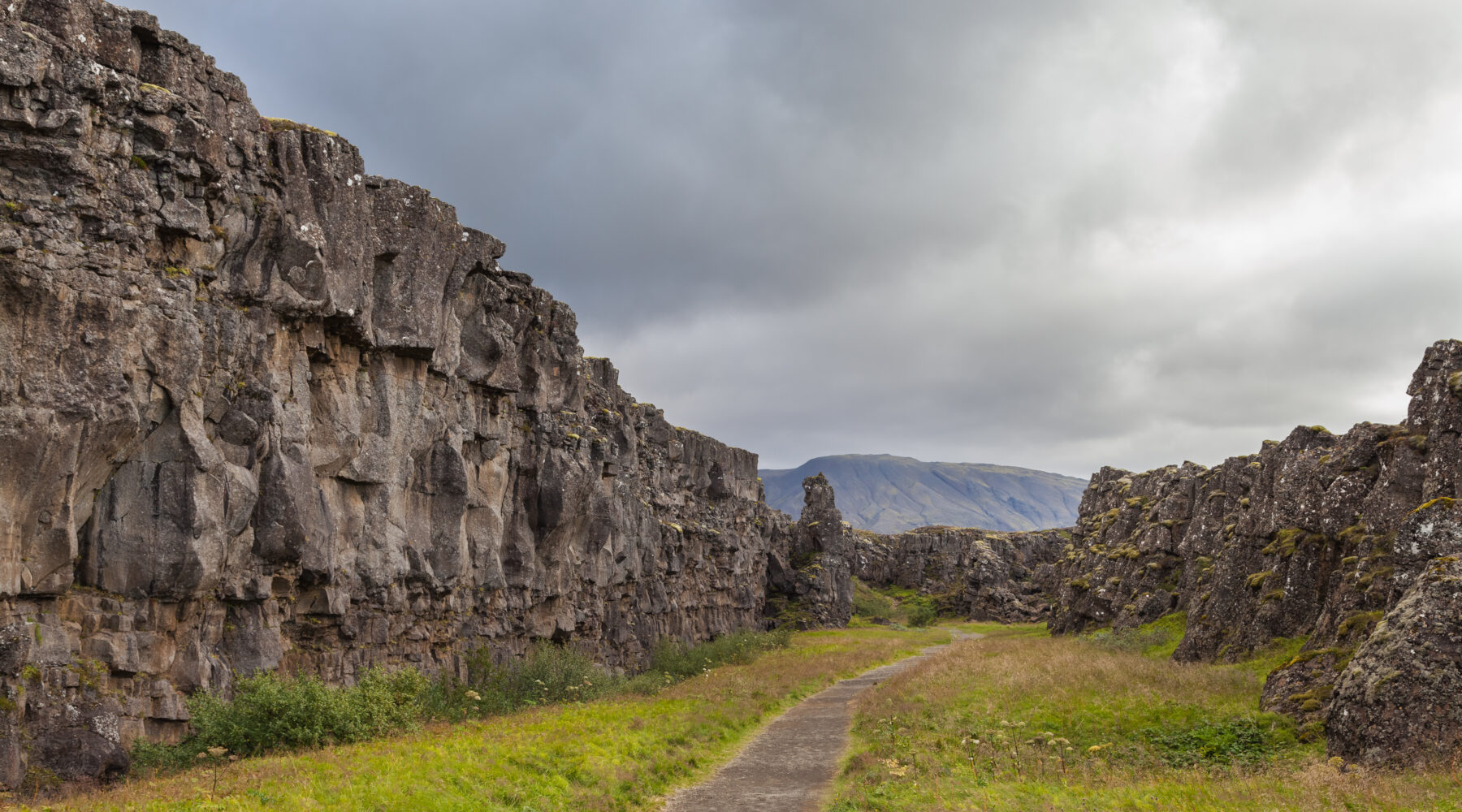
- The Almannagjá gorge is the main event. A footpath takes you through it from the Hakið visitor centre to the Law Rock (Lögberg) and on to the Öxarárfoss waterfall.
- “Walking between continents” is a bit of a simplification. Almannagjá is the edge of the North American plate, but the zone between the plates is several kilometres wide, and Silfra lies inside it.
- Silfra stays at 2 to 4 °C all year, with visibility of around 100 metres. You can only snorkel with a guide or a permit, in a drysuit (or a thick wetsuit).
- Snorkelling at Silfra costs roughly 18,000 to 21,000 ISK (about £110 to £125) if you meet the group on site, and around 27,000 ISK with pick-up from Reykjavík. The minimum age is usually 12, and operators ask over-60s for a doctor’s signature.
- To dive at Silfra you need Open Water plus a drysuit certification, or 10 logged drysuit dives in the last two years. Depth is limited to 18 metres.
- Allow 1.5 to 3 hours for the park, or half a day with Silfra. Early in the morning, before the coaches arrive, the gorge is noticeably quieter.
What Thingvellir National Park is and why it matters
Þingvellir means “Parliament Plains”. The national park lies about 45 km northeast of Reykjavík on the northern shore of Þingvallavatn, which at around 84 km² is Iceland’s largest natural lake and reaches 114 metres at its deepest point. According to UNESCO the park covers roughly 240 km², and it has been a World Heritage Site since 2004. Interestingly, it was listed as a cultural site, not a natural one: because of the Althing and the landscape around it.
Geologically, the valley is a block that has dropped between two faults. Almannagjá closes it off to the west, Heiðargjá to the east, and the strip in between, about seven kilometres wide, is slowly sinking. On average the plates move apart by about two centimetres a year, but not smoothly. Tension builds up and then releases all at once, most recently at Thingvellir in 1789. According to the park authority, the valley floor has dropped by almost four metres since the first assembly met here.
This is a good moment to correct something you will hear in almost every guidebook. The Almannagjá gorge really is the edge of the North American plate, but the opposite edge is not right across from it. The official park website says that between the North American plate and the Hreppar microplate (Hreppafleki), which belongs to the Eurasian side, there is a belt about five kilometres wide, scored by around a hundred fissures. Silfra is one of them. So when you slip into Silfra you really are “between continents”, you just can’t touch both plates at once. We think that is a better story than the simplified one: you are standing inside a rift that is opening up right beneath you.
How to get to Thingvellir National Park
By car is easiest. From Reykjavík, take Route 1 towards Mosfellsbær, then turn off onto Route 36 (Þingvallavegur), which runs straight into the park. It is around 45 to 50 km and in normal conditions about 45 minutes’ drive. The road is tarmac and an ordinary car without 4×4 is fine for Thingvellir. If you are coming straight from a UK flight into Keflavík, remember the airport is on the far side of Reykjavík, so add the drive from the airport on top. In winter, though, expect ice and wind, especially on the stretch over the Mosfellsheiði moorland, so check umferdin.is (road conditions) and safetravel.is (warnings) before you set off. The park itself publishes live webcams and current weather on its website.
Without a car it is more complicated. No scheduled city or long-distance bus serves the park, so your option is an organised tour. Thingvellir is almost always the first stop on Golden Circle day trips from Reykjavík, and the Silfra snorkelling operators also offer a version with pick-up in Reykjavík. The downside of a tour is obvious: you get about an hour in the park, usually just the stretch from Hakið to Lögberg.
Where to park: there are three main car parks. P1 by the Hakið visitor centre above the Almannagjá gorge (where nearly everyone goes), P2 below the Öxarárfoss waterfall, and P5 by the former Valhöll hotel, closest to the church and to Silfra. If you are snorkelling, park at P5. The small car park right next to Silfra is reserved for tour operators’ vehicles.
Where to stay near Thingvellir National Park
There is no hotel inside Thingvellir National Park. The last one, the Valhöll, stood near the park church and burned down in 2009, and nothing has been built in its place. That leaves you three options: camp in the park, stay at a hotel nearby, or base yourself in Reykjavík and drive out.
The park campsite is by the Leirar service centre at the junction of Routes 36, 361 and 52, about five minutes’ drive from the main sights. No booking is needed: you pick your own pitch and pay at the service centre or online. From 1 June to 15 September all four camping areas are open (Nyrðri-Leirar, Syðri-Leirar, Fagrabrekka and Vatnskot by the lake); outside the season only Nyrðri-Leirar. Showers are included, but don’t expect geothermal hot water as elsewhere in Iceland, because there is none here. Electric hook-up for campervans costs around 1,100 ISK (about £6.50) per 24 hours. Pay for three nights and the fourth is free.
If you want a roof over your head and still want to be in the park before the coaches, it pays to sleep nearby:
- ION Adventure Hotel (Nesjavellir): a design hotel on the southern side of Lake Þingvallavatn, standing alone in the lava fields by the Hengill geothermal area. The best-known address near the park, one for a special occasion and for watching the northern lights from your window.
- Héraðsskólinn Historic Guesthouse (Laugarvatn): a guesthouse in a historic former school building on the shore of Lake Laugarvatn. A good base between Thingvellir and Geysir.
- Farmhotel Efstidalur (near Laugarvatn): rooms on a working farm between Laugarvatn and Geysir. For anyone who wants to combine Thingvellir with the other Golden Circle stops without sleeping in town.
- Hotel Grimsborgir (Grímsnes): a Keahotels property halfway between Thingvellir and Selfoss. Handy if you are carrying on south to the waterfalls.
For a wider choice, browse places to stay in Laugarvatn, places to stay in Selfoss or places to stay in Reykjavík. For a single night we would pick Laugarvatn: it is under half an hour to the park, you are first into Thingvellir in the morning, and in the afternoon you can do Geysir and Gullfoss without rushing.
Thingvellir parking fee, entry and other charges
There is no entrance fee for the park. What you pay for is parking at P1, P2 and P5, and one payment is valid all day at all three. At P1 by Hakið, cameras read number plates on the way in and out, so your car won’t slip through unnoticed. You can pay at the machines by the visitor centre, in the toilet block next to it, at P2 and at P5, or online via Checkit.is. Cars displaying a disabled parking badge don’t pay, but the number plate has to be registered at the visitor centre or by email.
| Charge (approximate) | Price | Roughly in £ |
|---|---|---|
| Parking: motorbike | 400 ISK | £2.50 |
| Parking: car with up to 5 seats | 1,000 ISK | £6 |
| Parking: vehicle with 6 to 9 seats | 1,200 ISK | £7 |
| Heart of Iceland exhibition, adults | 1,200 ISK | £7 |
| Exhibition, seniors and students 18+ | 600 ISK | £3.50 |
| Exhibition, children up to 17 | free | free |
| Campsite, adult (18–66) per night | 1,800 ISK | £11 |
| Campsite, accommodation tax per tent or campervan | 400 ISK | £2.50 |
| Fishing permit, per day | 2,500 ISK | £15 |
| Guided Silfra snorkelling, meet on site | approx. 18,000–21,000 ISK | £110–125 |
| Guided Silfra diving | from approx. 36,000 ISK | from £215 |
Parking, exhibition, campsite and permit prices come from the official thingvellir.is website. For Silfra these are typical operator prices (DIVE.IS and the Guide to Iceland comparison), which vary by company and season and are often discounted. The sterling figures are rounded, at roughly 1,000 ISK to £6. All prices are a guide only and change over time, so check with the operator before you travel.
When to visit Thingvellir
The park is open all year, day and night, and every season turns it into a slightly different place.
Summer (June to August) is green, light until almost midnight and at its busiest. Golden Circle coaches mostly arrive in the morning, so if you get here before 9am, or in the evening after 6pm, you will have the gorge nearly to yourself. The Þingvallakirkja church only opens in summer (1 June to 31 August, when a ranger is on duty there), and summer is also when all four camping areas are open. According to Guide to Iceland, from June to August park rangers lead free guided walks in English every day, at 10am from the church and at 2pm from the visitor centre.
Autumn is our favourite. The moss and the low birch scrub in the lava field turn red and yellow, the crowds thin out, and there is still enough daylight for a longer walk.
Winter has its own appeal. Öxarárfoss partly freezes, the gorge is under snow, and on clear nights the northern lights are often easy to see, because there are no lights in the park. On the other hand, the paths can be like an ice rink, the days are short and in a storm the road over the moorland can become impassable. The visitor centre is open 9am to 5pm from November to March, and until 6pm from April to October.
Things to do in Thingvellir National Park: 10 places to see
Most of the sights cluster around the old assembly site between Hakið, Almannagjá and the church, and you can walk the lot in two to three hours. We have listed them roughly in the order you will reach them if you set off from the visitor centre.
1. Hakið viewpoint and visitor centre
Hakið is a viewing platform on the upper rim of the Almannagjá gorge, right by car park P1. It is the best place to “read” the park before you go down: the gorge below you, the fissured lava field beyond it, Lake Þingvallavatn to the south and on the horizon the mountains that close the valley in on three sides. On a clear day you can also pick out the shield volcano Skjaldbreiður to the north.
Next to the platform is the visitor centre, with toilets, a café, information and the interactive Heart of Iceland exhibition. The exhibition takes about 40 minutes and walks you through plate movement, how the old assembly worked and the archaeology of the site; in 2019 it won two Red Dot design awards. Adults pay around 1,200 ISK (about £7), under-18s go free. On a rainy day it makes an ideal introduction; on a fine day we would leave it until the end.
2. Almannagjá gorge
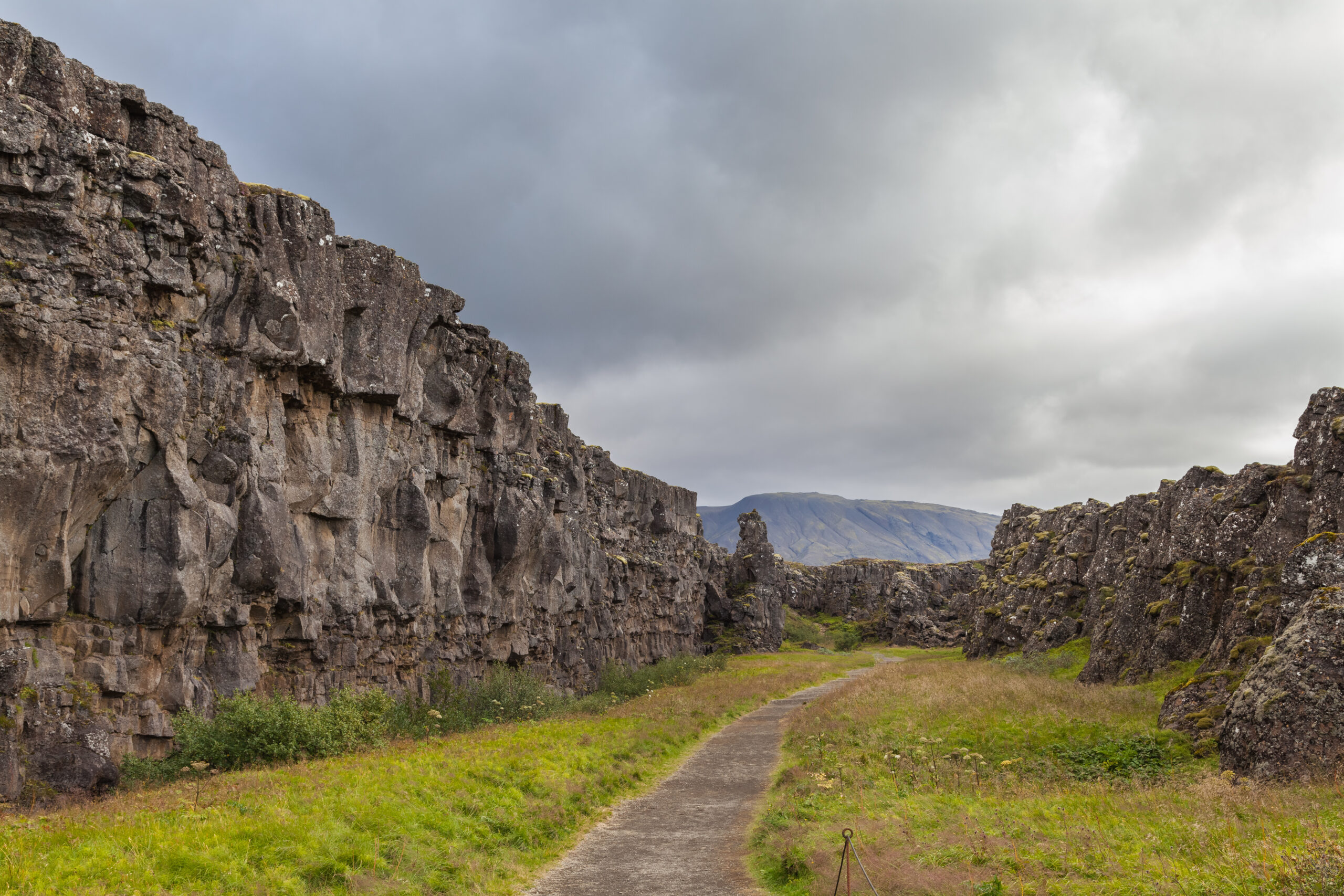
This is the main reason people come to Thingvellir. Almannagjá is a huge fault whose western wall marks the edge of the North American plate, and from Hakið a path takes you down into it between the rock walls. The higher western wall is tall and sheer, the lower eastern one is broken into blocks, and a wide path runs between them. The space at the bottom is so big that even coach groups get swallowed up in high season.
If the gorge looks familiar, you’re right: several scenes from Game of Thrones were filmed here. We like it best in morning light, when the sun comes across the valley from the side and lights up the whole tall wall. Allow 30 to 60 minutes to walk through, longer if you stop for photos and the information boards.
3. Lögberg, the Law Rock
On the slope below the gorge, above the plain by the river, a flagpole flying the Icelandic flag marks the most likely site of Lögberg. From here the lawspeaker (lögsögumaður) recited the laws from memory every summer, the opening and closing of the assembly were announced, and anyone could step up and speak. The lawspeaker had three years to get through the entire body of law and was the only paid official in the whole Icelandic “commonwealth”.
Nobody knows exactly where Lögberg was. Its role ended after 1262, when Icelanders swore allegiance to the Norwegian king, and today two spots are considered: the platform by the flagpole, or down in the gorge by the higher wall. In 1944 Icelanders declared their republic here. There isn’t much to see at the spot itself, but it is worth stopping to look down into the valley. This is where it all clicks: a natural amphitheatre, a rock wall acting as a sounding board, and below it the plain where the assembly-goers pitched their tents and booths.
4. Öxarárfoss waterfall
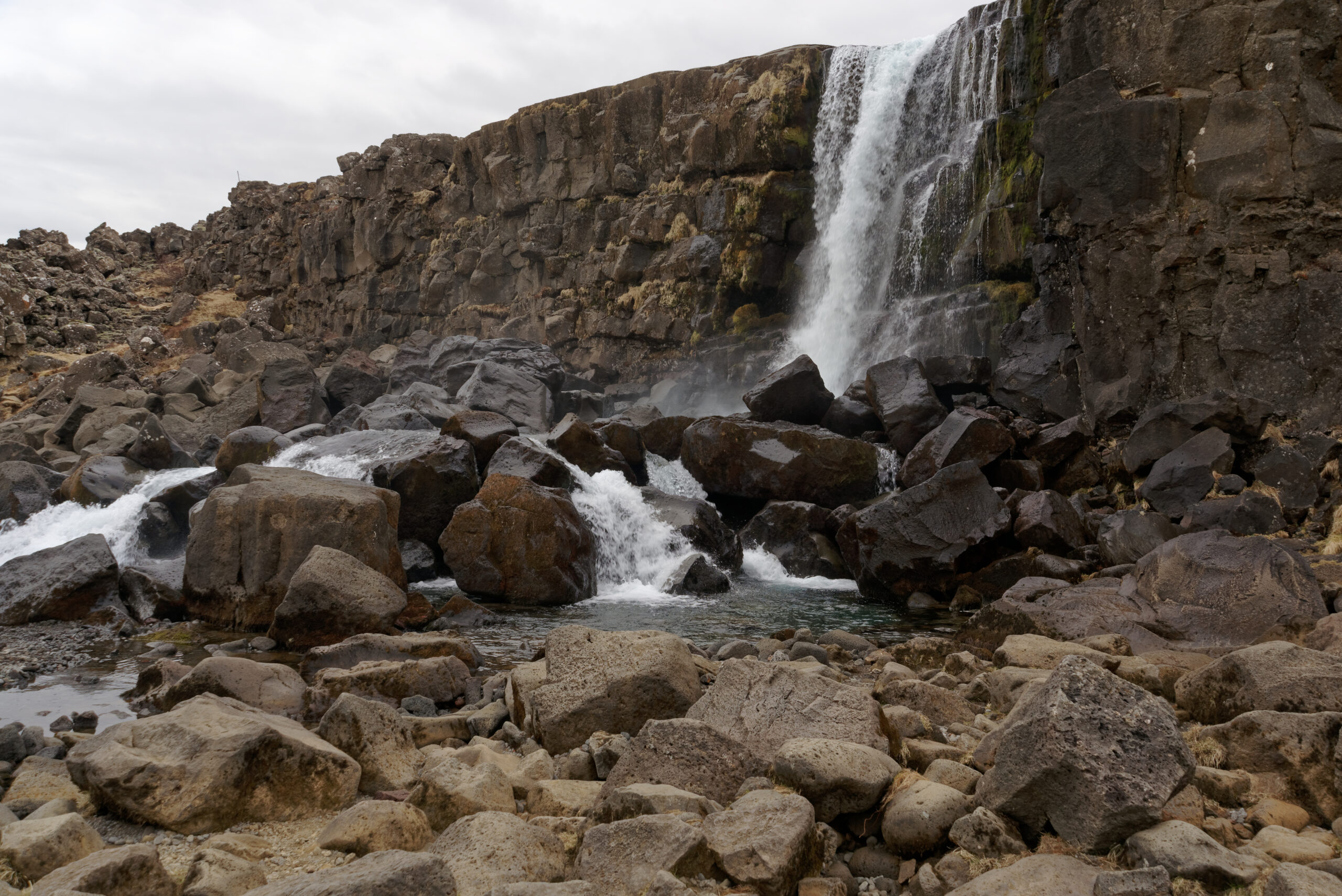
At the end of the gorge, the Öxará river drops over the edge of the North American plate into Almannagjá. The waterfall is about 20 metres high, and according to the sagas people diverted the river into the gorge so that those attending the assembly had water to hand. Whether that is really how it happened can’t be proved, but the story is told in the Sturlunga saga.
From Lögberg it is just under a kilometre along the path; the nearest car park is P2. Viewing platforms lead up to the falls. It is at its most powerful after rain and during the thaw, and in winter it turns into columns of ice. We would walk to it after going through the gorge: the waterfall should be the climax of the walk, not the car park.
5. Drekkingarhylur, the Drowning Pool
A quiet pool on the Öxará river below the gorge, reached by a short detour off the main path. During the era of the independent Icelandic “commonwealth” (930–1262) nobody was executed at Thingvellir, because there was no central authority to carry out punishments. That changed once royal officials began governing the country, and above all after 1564, when the so-called Great Verdict (Stóridómur) came into force. Women condemned under it, typically for adultery or infanticide, were drowned in Drekkingarhylur.
Today the spot is calm and pretty, and that is exactly what stops you short. There are other place names from that period nearby, such as the Gallows Rocks. We suggest reading the board by the pool about what happened here before you photograph it as a “picturesque little pool”.
6. Þingvallakirkja church and the Þingvallabær farmhouse
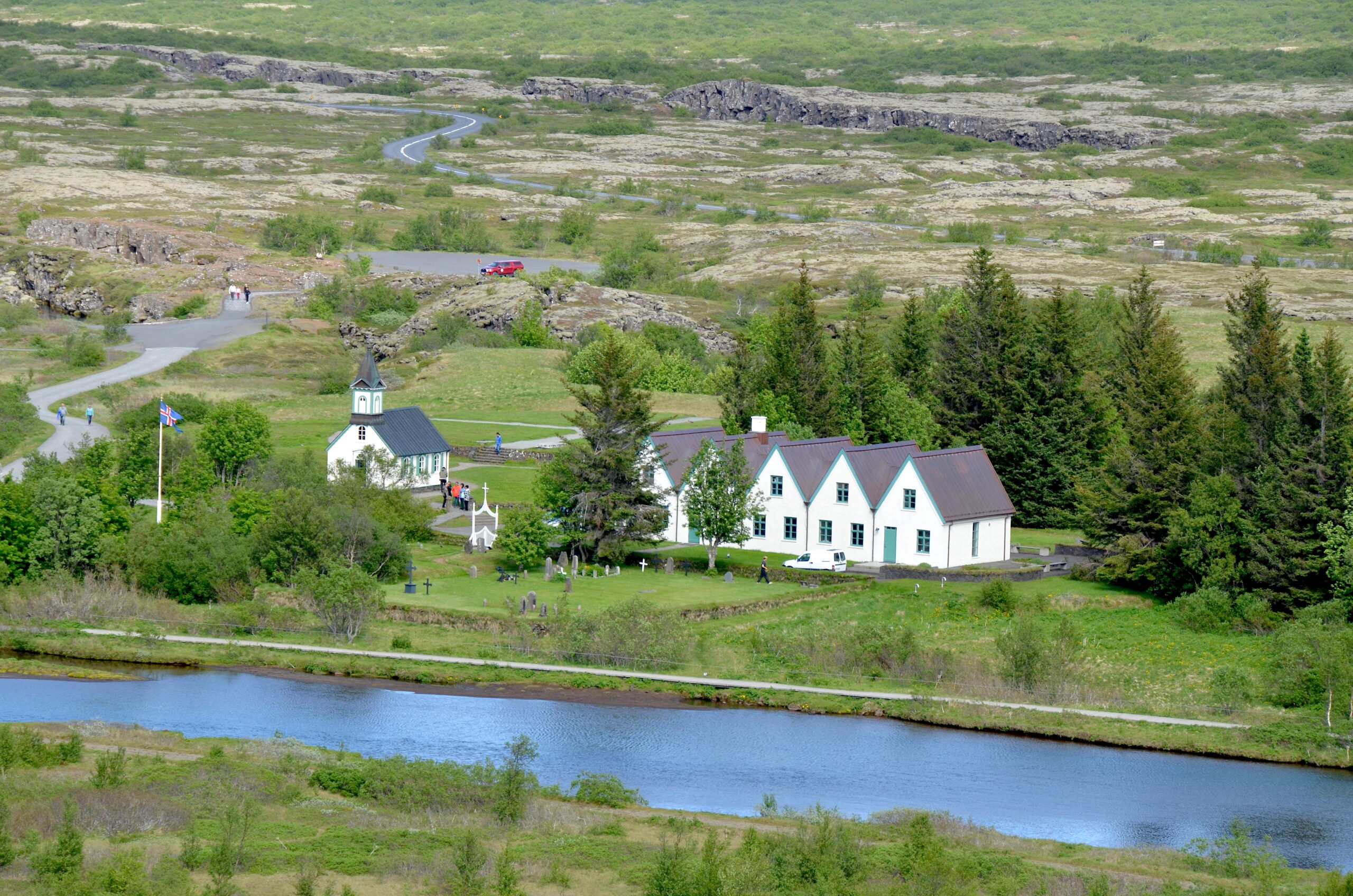
The small white timber church with its blue-roofed tower, and next to it the five white gables of the Þingvallabær farmhouse, are the most photographed sight in the park. According to the sagas a church has stood here since 1017, only a few years after Iceland adopted Christianity, and the timber and bell for the first one were reportedly sent by the Norwegian king. The current building dates from 1859 and got its tower in 1907. Inside there is a pulpit from 1683 and two altarpieces. It is open only in summer, from 1 June to 31 August, when a ranger is on hand, usually 9am to 10am and 1.30pm to 5pm.
The oldest part of Þingvallabær dates from 1930. It was originally the park warden’s office and today serves as the Icelandic prime minister’s summer residence, so you can’t go inside. Behind the church there is a small cemetery. The best view of the whole group is from above, at Hakið, or from the path above the river.
7. Flosagjá, Nikulásargjá and Peningagjá
Just east of the church, the water-filled Flosagjá fissure runs through the lava field, its crystal-clear water up to 25 metres deep. Opposite the old assembly site it splits in two, and the eastern branch is called Nikulásargjá. A small bridge crosses it, built in 1907 for a royal visit, and ever since people have been throwing coins in. That is why this stretch is known as Peningagjá, the “Money Gorge”.
The park authority states plainly on its website that there is no folk legend attached to Peningagjá, so the “wish that comes true” was invented by tourists. The coins on the bottom are a rather sad sight these days. Don’t throw anything in; just look at how far down you can see through the water. It is a small taste of what awaits snorkellers in Silfra.
8. Silfra from the shore
Silfra is about a five-minute walk from car park P5, and you can go and look even without a drysuit. You will see the entry platform with its metal steps, a queue of snorkellers in black suits and a narrow fissure of blue water that widens towards the lake at the far end. It is a nice stop even if you are not getting in yourself. And if you are even slightly undecided about snorkelling, this is probably where you will make up your mind. Everything you need to know about snorkelling and diving is in its own section further down.
9. Lake Þingvallavatn and Vatnskot
Iceland’s largest natural lake. About 90% of its water flows in underground from the Langjökull glacier, roughly 50 km away, and its journey through the lava takes 20 to 30 years. That is why it is so clean. Four forms of Arctic char live in it, having evolved here since the end of the last Ice Age, along with brown trout. The easiest way down to the shore is from P5 past the church; on a still morning the mountains are mirrored in the water.
For more peace and quiet, drive to the abandoned Vatnskot farm on the shore, about five kilometres from Leirar. In summer there is a tent campsite, a wooden jetty and the most popular fishing spot in the park. Fishing is allowed from 20 April to 15 September, from the shore only, with a permit costing about 2,500 ISK (around £15) a day.
10. Trails to the abandoned farms of Skógarkot and Hrauntún
Most visitors only see the area around the assembly site, but the park carries on for kilometres to the east across overgrown lava fields. Away from the old parliament site, the trails lead mainly to the deserted farms of Hrauntún, Skógarkot and Vatnskot, of which only overgrown walls and boundary banks remain. The paths are flat but stony, and the lava field is riddled with fissures, some of them hidden under moss or snow. Download the trail map in advance from the park website, because phone signal and waymarking out here are nothing like in the gorge.
For us this is the best part of Thingvellir. An hour’s walk from Almannagjá you are in a landscape where all you hear is the wind and the birds, and you are still in the same “famous” park that thousands of people visit every day.
Which route to walk and how long to allow
For a first visit, a simple loop works best. Park at P1 by Hakið, take in the view and walk down into the Almannagjá gorge. Carry on past Lögberg to Öxarárfoss, then head back to the flagpole and down to the river, past Drekkingarhylur to the church and Peningagjá. From there you either walk back up to P1 or, if you came in two cars or on a tour, carry on from P5. The parking fee covers all the paid car parks for the whole day, so moving the car from P1 to P5 or P2 costs nothing extra.
- One hour: Hakið, the Almannagjá gorge, Lögberg and back. This is what you will see on a coach tour.
- Two to three hours: the full loop above, with the waterfall, the church and Peningagjá, and perhaps the exhibition.
- Half a day: add Silfra snorkelling (you will spend about 2.5 hours on site) or a walk out to the abandoned farms.
💡 If you are driving the Golden Circle, start with Thingvellir, and start early. For coach tours from Reykjavík, Thingvellir is usually the first stop, so mornings are the busiest time here. Be at Hakið by 8am and you will walk through the gorge almost alone, staying ahead of the crowds for the rest of the day.
Silfra snorkelling and diving
For many people Silfra is the whole reason to come to Thingvellir, and we get it. It is one of very few places in the world where you can hang in fresh water above a fissure tens of metres deep and see all the way to the bottom. It is also a very particular experience, and simply not for everyone. Before you hand over £110 or more, read what it involves.
What is the Silfra fissure?
Silfra (the name means “silver”, after the clarity of the water) is a fissure in the lava field at the northern end of Lake Þingvallavatn, up to about 10 metres wide and as much as 60 metres deep. It is fed by groundwater from the Langjökull glacier, which filters through porous lava for around 30 years before it surfaces here. That is why it is so clear that visibility reaches about 100 metres, and why it stays the same temperature all year, 2 to 4 °C. Incidentally, you can drink it, and the guides will invite you to have a taste.
According to the park authority, two myths about Silfra keep doing the rounds. One, that it is “the” crack between the plates (it is just one of around a hundred fissures in the five-kilometre belt between them). Two, that it only formed in the 1789 earthquake. At a spreading rate of about 5 mm a year, a fissure ten metres wide takes at least 1,500 years to form, so it is much older. The 1789 earthquake only changed the water level. You will hardly see any fish in Silfra: people come for the water and the rock, not for wildlife.
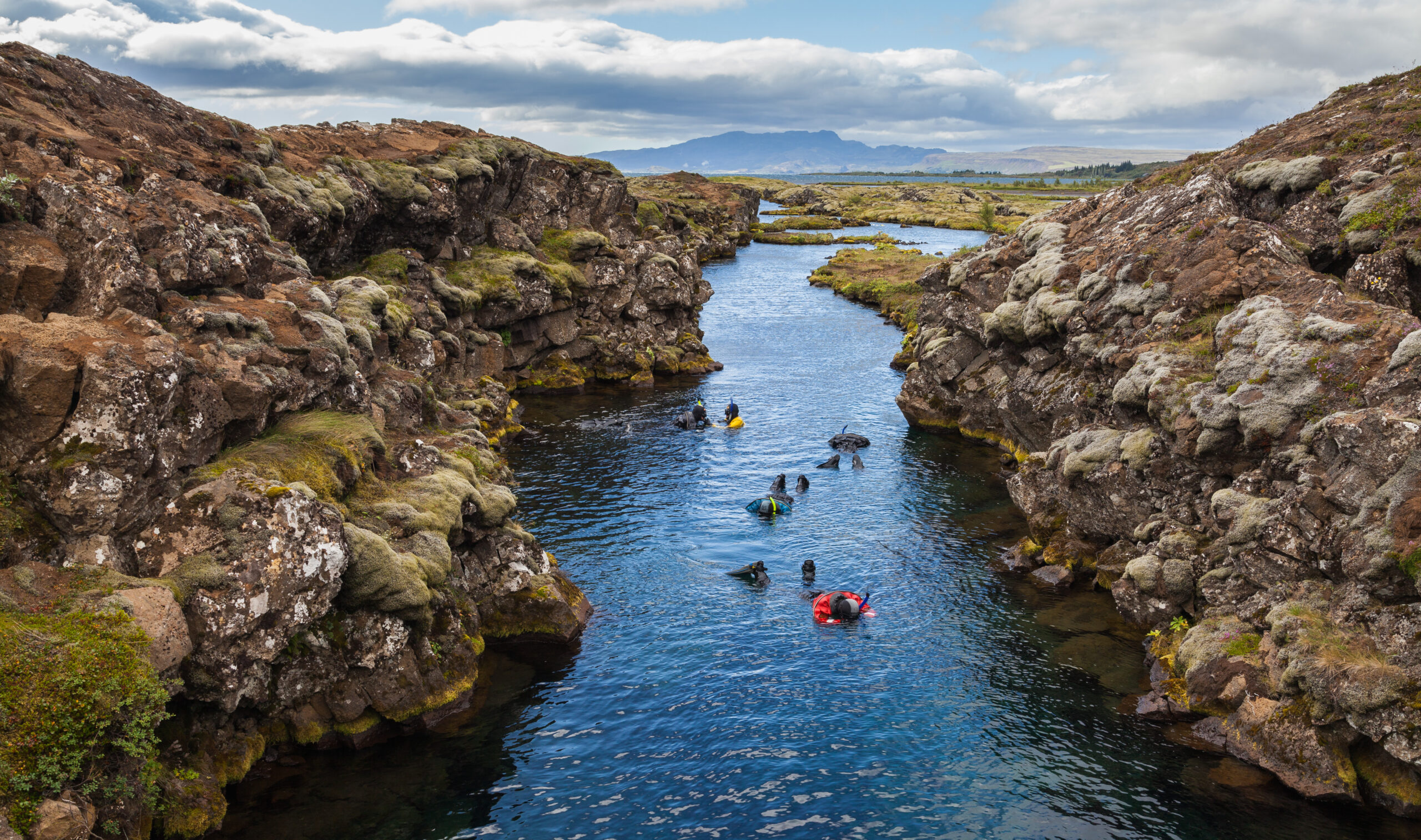
How Silfra snorkelling works
The route has four sections. Right after the entry platform comes the Big Crack, the narrowest part, with the walls close on either side. Then the fissure opens out into Silfra Hall, followed by the long, deep Silfra Cathedral, where there is more than 20 metres of water beneath you, and finally the shallow Lagoon with its weed beds, where you climb out. You spend 30 to 45 minutes in the water, letting a gentle current carry you along; you barely need to swim.
At DIVE.IS the whole programme looks like this: meet on site 15 minutes before the start, split into groups of no more than six, briefing and suiting up (about an hour), then a number from the park ranger that sets the order groups go in, a short wait on the platform, the snorkel itself and a walk of about 250 metres back. In total that is about 2.5 hours on site, or about 5.5 hours with transfers from and back to Reykjavík. The guides sell underwater photos for around 3,000 ISK (about £18).
Drysuit or wetsuit?
The standard is a drysuit. You get thermal layers to wear underneath, no water reaches your body, and the suit is so buoyant that you lie on the surface like on a lilo. Only your face and your hands in neoprene gloves get wet, and those are what feel the cold most. The suit is tight, especially around the neck and wrists, and anyone who dislikes that squeezed feeling will find it uncomfortable.
Park rules also allow snorkellers to use a sufficiently thick wetsuit with a hood, gloves and neoprene boots, and some operators offer this option. The water warms up against your body, you have more freedom of movement and you can even duck under the surface. You do feel the cold more, though, so it is better suited to cold-water swimmers and confident swimmers.
How much do Silfra snorkelling and diving cost?
| Silfra (approximate) | Snorkelling | Diving |
|---|---|---|
| Price, meeting on site | approx. 18,000–21,000 ISK (about £110–125) | from approx. 36,000 ISK (about £215) |
| Price with Reykjavík pick-up | approx. 27,000–28,000 ISK (about £160–170) | surcharge depends on operator |
| Minimum age | usually 12 | 17 (under 18 with parental consent) |
| Height and weight | 150–200 cm, 45–120 kg | 150–200 cm, 45–120 kg |
| Requirements | able to swim and confident in the water | Open Water plus drysuit certification, or 10 drysuit dives in 2 years |
| Time in the water | 30–45 minutes | 30–40 minutes, max. depth 18 m |
| Included | guide, full equipment including suit, Silfra entry fee | |
Snorkelling prices are the median across operators according to the Guide to Iceland comparison; diving prices and requirements are from the DIVE.IS website (standard price for snorkelling meeting on site around 18,000 ISK, diving around 36,000 ISK, though both are often sold at a discount). Other companies set different limits, one for example quotes an upper age limit of 65 or 69, so always read the conditions of the specific tour. Parking at P5 is not included in the tour price.
Who can snorkel at Silfra, and who can’t
At DIVE.IS, every snorkeller must meet these conditions:
- be at least 12 in the year of the tour and weigh at least 45 kg,
- be 150 to 200 cm tall, weigh no more than 120 kg and fit their drysuit size chart,
- be able to swim, feel comfortable in water and be in good physical condition,
- fill in a medical questionnaire, and if aged 60 or over, have it signed by a doctor,
- not be pregnant, be able to communicate in English and eat a proper meal before the tour.
Take the doctor’s signature for over-60s seriously. Cold water and a tight suit put strain on the heart, and snorkellers have died at Silfra in the past, most often from heart failure. That is why medical questionnaires are now compulsory with every operator. The park stresses on its website that diving and snorkelling are entirely at your own risk.
Scuba diving at Silfra
To dive at Silfra you need a qualification equivalent to an independent diver (such as PADI Open Water) plus a drysuit certification. Instead of the certification, proof of ten drysuit dives in the last two years, signed off by an instructor from a recognised diving organisation, is accepted. Maximum depth is 18 metres, entering caves or swimming under overhangs is forbidden, and you must never go in alone, only in pairs. If you don’t have a drysuit certification, you can get one in Iceland: DIVE.IS offers a two-day package with the course and a dive in Silfra. The park has a second permitted site too, the Davíðsgjá fissure out in the lake itself.
You can snorkel or dive Silfra without an operator, but only with your own kit for 2 to 4 °C water, a buddy and a permit, which you buy on the park website or at the Leirar service centre. For the average visitor without a drysuit, in practice that means going with a guide.
What to bring
Warm base layers (ideally technical or wool, not cotton), thick socks, clothes suited to the weather for waiting outside, and something to change into. If you wear glasses, bring contact lenses, because glasses won’t fit inside the mask. And eat beforehand: in that cold your body burns more than you would expect.
💡 Book ahead, and book a morning slot. In summer slots often sell out, and groups go into the water in the order of numbers handed out by the ranger, so around midday the wait on the platform is longer. A morning slot also leaves you the rest of the day for the park and the Golden Circle.
Staying safe in the park
Thingvellir feels like an easy stroll, but a few things deserve your attention:
- Hidden fissures. The lava field is riddled with cracks, and some are covered by moss or snow. Stick to the paths and keep children close; the park authority specifically warns about this.
- Winter ice. The paths through the gorge and to the waterfall are often icy in winter. Microspikes, or at least boots with good grip, are well worth it.
- Weather and roads. Before setting off, check umferdin.is and the warnings on safetravel.is. Under a yellow warning, like the one the park issued in November, the wind on the open plain can catch you out badly.
- Park rules. Don’t throw anything into the fissures, no off-road driving, dogs on a lead only, camping only at the campsite, no open fires, and quiet hours from 11pm to 8am.
- Silfra is at your own risk. Don’t brush off the medical questionnaire, and listen to your guide in the water.
Thingvellir National Park and the Golden Circle
Thingvellir is the first of the three classic stops on the Golden Circle, the best-known day trip from Reykjavík. The other two are the Geysir geothermal area with Strokkur, where the geyser erupts every few minutes, and Gullfoss waterfall on the Hvítá river. From Thingvellir to Geysir it is about an hour’s drive via Laugarvatn, and from Geysir to Gullfoss it is only a short hop. You can drive the whole circuit in a day, but we would give Thingvellir at least two hours rather than rushing it just to tick everything off.
A little history: from 930 to 1944
The Althing was founded around 930 and met at Thingvellir every summer for roughly two weeks. Chieftains passed laws here and courts settled disputes that couldn’t be resolved at home. Around 960 four courts were set up, one for each quarter of the country, and at the start of the 11th century a fifth, appeal court was added. A whole summer town grew up around the assembly: people traded, arranged marriages and passed on news. Some fifty remains of the temporary turf-and-stone booths survive, but only two, Njálsbúð and Biskupabúð, date from the era of the independent “commonwealth”.
In the year 1000 one of the strangest moments in European history took place here. The assembly split into pagans and Christians, each refusing to recognise the other side’s laws. The pagan lawspeaker Þorgeir Ljósvetningagoði withdrew for a day and a night, then came out to Lögberg and ruled that Icelanders would adopt Christianity, but that pagans could go on worshipping their gods in private. It was settled without a fight.
After 1262 Icelanders swore allegiance to the Norwegian king, the assembly’s power gradually waned, and the last session at Thingvellir took place in the summer of 1798. The valley was then forgotten for decades until the national movement of the 19th century rediscovered it. In 1874 the Danish king Christian IX brought Iceland its first constitution here, the park got its own act of law in 1928, and on 17 June 1944 Icelanders declared their independent republic here. The claim that the Althing is “the world’s oldest functioning parliament” appears on the official tourism portal too, with the small caveat that it was abolished at the start of the 19th century and only met again in 1845, this time in Reykjavík.
What we would do differently
Most people “do” Thingvellir in an hour: car park, viewpoint, gorge, photo by the flag and off to Geysir. That is a shame, because the best part starts right where most people turn back. Next time, after walking through the gorge, we wouldn’t hurry back to the car. We would go down to the river, sit on the bank below the church for a while, and then set off along the trail towards Skógarkot. An hour’s walk from Almannagjá, the lava field covered in birch scrub and moss is completely empty, and only out there do you grasp how big the valley really is.
You don’t have to snorkel just because “everyone does it”. If you hate the cold or tight clothing, save yourself the £110 or so, look at Silfra from the shore and then walk over to Peningagjá, where the water is just as clear. And the other way round: if it appeals to you, don’t worry that it will just be a tourist trap. Looking through water where you can see a hundred metres ahead is something a photo can’t pass on, which is why it is better to leave the phone behind and simply look.
One more thing: don’t try to squeeze the whole Golden Circle into half a day. If you stay the night in Laugarvatn, you can walk Thingvellir in peace in the morning and in the evening, soaking in warm water, decide whether the whole continents thing really was as dramatic as everyone says. We think it was.
Thingvellir National Park FAQ
Is there an entrance fee for Thingvellir National Park?
No. The park is open all year, 24 hours a day, and entry is free. You only pay for parking: around 1,000 ISK (about £6) for a car with up to five seats and around 1,200 ISK for a vehicle with six to nine seats. One payment is valid all day at car parks P1, P2 and P5. The Heart of Iceland exhibition in the visitor centre is also paid; adults pay around 1,200 ISK.
How do you get to Thingvellir from Reykjavík?
Drive Route 1 towards Mosfellsbær, then Route 36 (Þingvallavegur), which leads straight into the park. It is around 45 to 50 km and about 45 minutes’ drive, and an ordinary car is fine. No scheduled public bus goes to the park, so without a car your options are an organised Golden Circle tour or a Silfra snorkelling trip with pick-up from Reykjavík.
Where do you park at Thingvellir?
The main car park is P1 by the Hakið visitor centre above the Almannagjá gorge. P2 is below the Öxarárfoss waterfall and P5 is by the former Valhöll hotel, closest to the church and to Silfra; that is where snorkellers park too. You pay at the machines or online via Checkit.is, and at P1 cars are monitored by number plate recognition cameras.
Can you really stand between two tectonic plates at Thingvellir?
Partly. The Almannagjá gorge is the edge of the North American plate, and the whole valley lies in a rift that is pulling apart by about two centimetres a year. But the opposite edge isn’t right across from it: according to the park authority, the belt between the North American plate and the Hreppar microplate is roughly five kilometres wide. So you are walking through the zone between the plates, you just can’t touch both at once, and the same goes for Silfra.
How much does Silfra snorkelling cost?
According to the Guide to Iceland comparison, prices for meeting on site are around 18,000 to 21,000 ISK, which is about £110 to £125. With pick-up from Reykjavík it is around 27,000 to 28,000 ISK. The price includes a guide, a drysuit with full equipment and the Silfra entry fee; you pay for parking at P5 yourself. Scuba diving starts from about 36,000 ISK.
How cold is the water in Silfra, and is it for everyone?
The water is 2 to 4 °C all year. In a drysuit you stay dry underneath, and the cold is mainly on your face and hands. Operators do have limits, though: usually a minimum age of 12, height 150 to 200 cm, weight 45 to 120 kg, you must be able to swim, not be pregnant and, if 60 or over, have the medical questionnaire signed by a doctor. If you don’t cope well with cold or tight clothing, think about whether you really want to get in.
What do you need to dive at Silfra?
An independent diver qualification, such as PADI Open Water, plus a drysuit certification. Instead of the certification, proof of ten drysuit dives in the last two years, confirmed by an instructor, is accepted. Maximum depth is 18 metres, you may only dive in pairs, and entering caves or swimming under overhangs is not allowed. At DIVE.IS the minimum age is 17.
How much time do you need at Thingvellir National Park?
An hour is enough for the Almannagjá gorge itself with the viewpoint and Lögberg. The full loop with Öxarárfoss waterfall, the church and Peningagjá takes two to three hours. If you add Silfra snorkelling, allow half a day, because including suiting up you will spend about two and a half hours on site.
Where to go next
- Geysir and Strokkur: the second Golden Circle stop, with a geyser that erupts every few minutes.
- Gullfoss waterfall: the “Golden Falls” on the Hvítá river and the third highlight of the circuit.
- Things to do in Reykjavík: where to go in the city that most Thingvellir trips start from.
- Blue Lagoon Iceland: tickets, getting there and alternatives for when you want to warm up after Silfra.
- Fagradalsfjall and Iceland’s volcanoes: another place where you can see Iceland pulling apart.
Potřebujete pomoct s cestováním?
-
Ubytování 🏨
Vyberte si to nejlepší ubytování, ať už jste kdekoliv, přes Booking.com. -
Půjčení auta 🚗
Auto si snadno najdete přes Booking.com, kde máte často slevu díky ubytování, nebo Rentalcars.com, kde porovnáte nabídky většiny půjčoven. -
Zážitky 🎟️
Přes GetYourGuide.com si vyberete z nejrůznějších výletů i zážitků po celém světě, navíc se zrušením zdarma do 24 h předem.