Last updated 27.11.2026
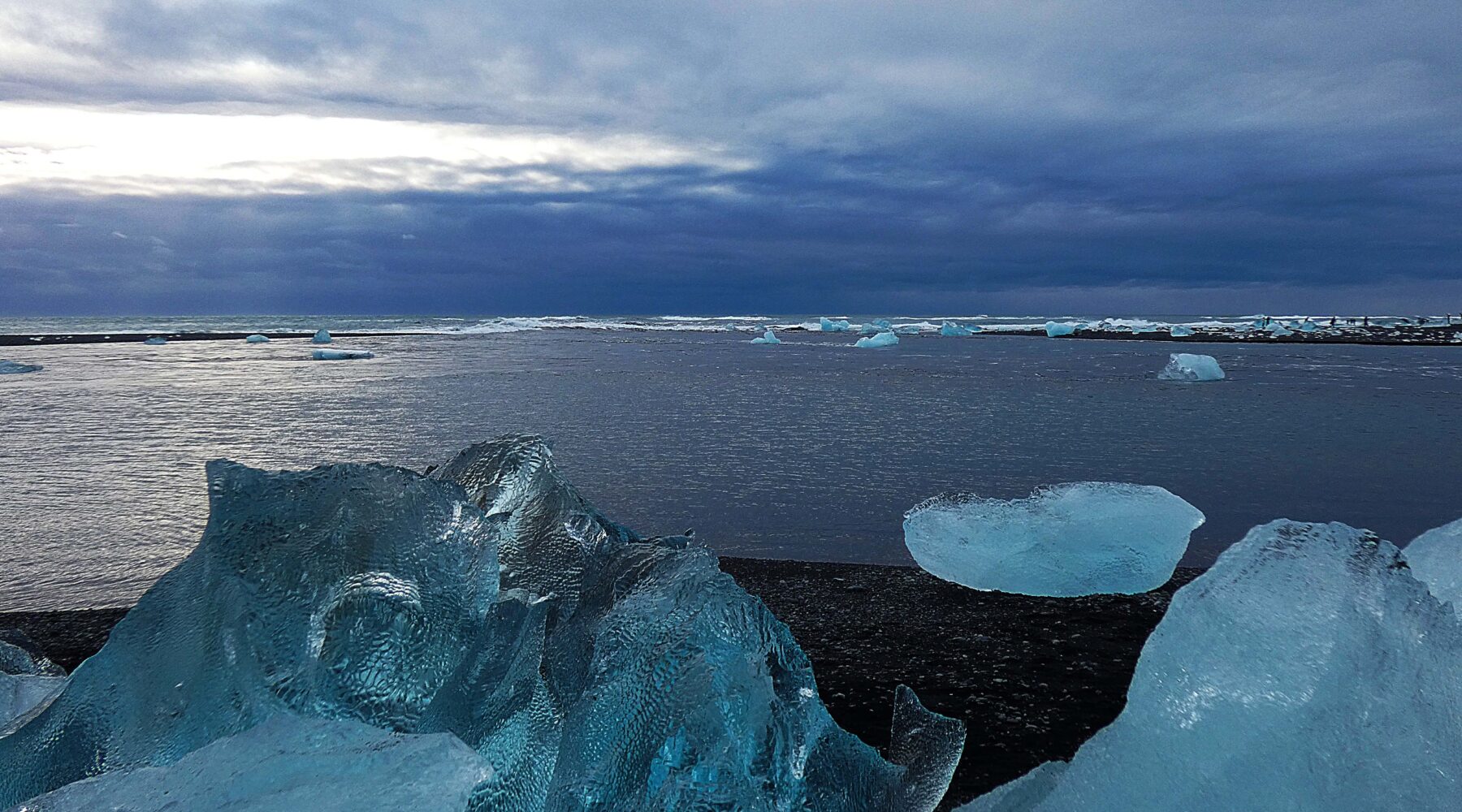
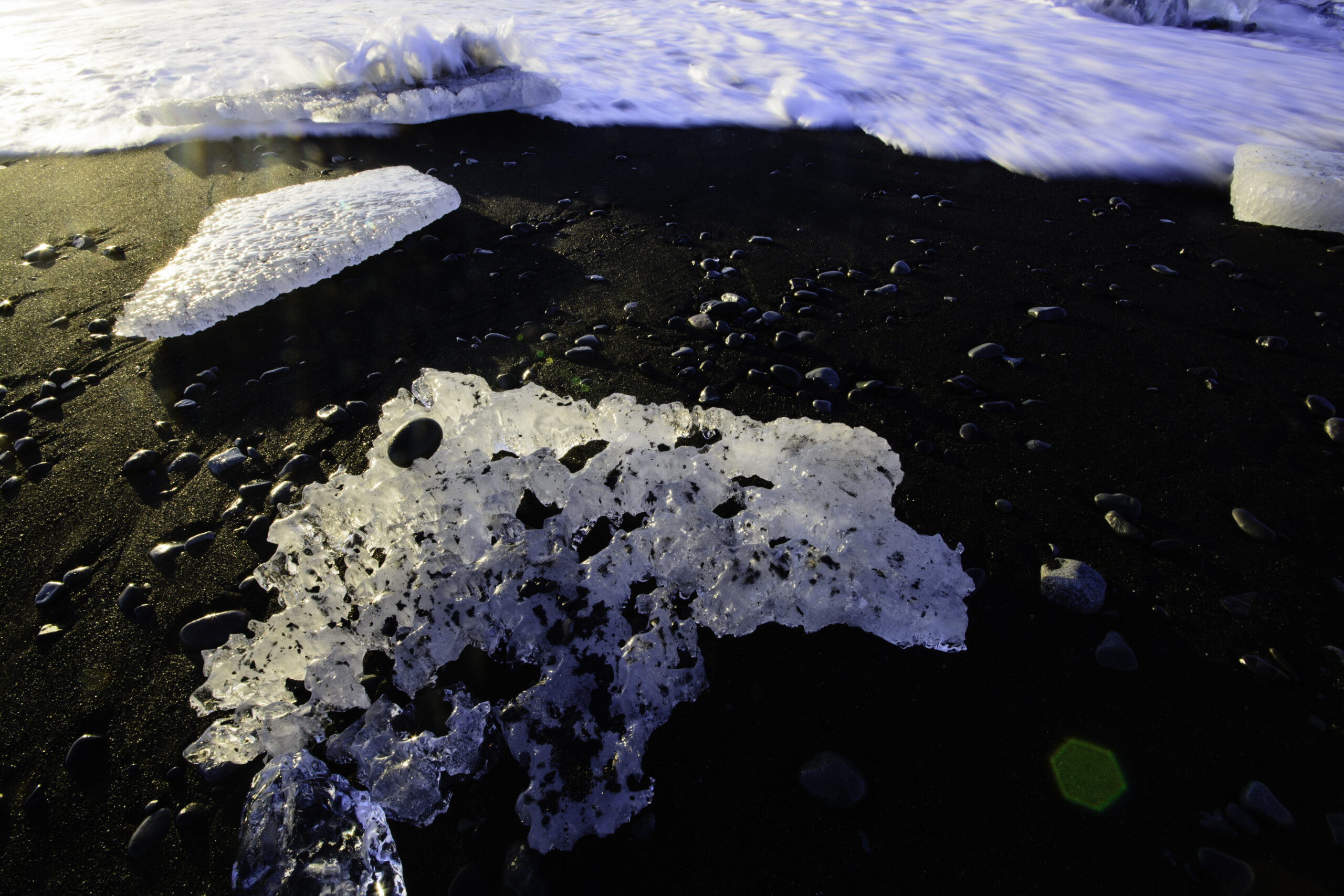
A lump of ice the size of a washing machine sits on black sand. A wave rolls over it and drains away. Next to it lies another piece, clear as glass, then one no bigger than a sugar cube, then a blue one striped with black volcanic ash. A few weeks or a few years ago, all of them were part of a glacier. Diamond Beach in Iceland, known locally as Fellsfjara, is the stretch of shore just below the bridge over the Jökulsá river, where the sea throws back the icebergs that drift out of Jökulsárlón glacier lagoon. There is no entry fee, it is open day and night, and it never looks the same two days running. Below we cover where to stay, where to park and how to walk over to the lagoon, when you can expect ice on the sand and good light, how to photograph it, and why you should never turn your back on the sea here.
Diamond Beach Iceland at a glance
- Where it is: in south-east Iceland on the Ring Road (Route 1), directly opposite Jökulsárlón lagoon, about 375 to 380 km from Reykjavík (roughly five hours’ drive without stops). The beach is part of Vatnajökull National Park.
- The beach is free, parking is not. A car with up to five seats pays around 1,100 ISK (about £7). The ticket is valid until midnight and covers all three car parks at the lagoon and the beach.
- Two halves. Eystri-Fellsfjara lies east of the river mouth (bigger car park, path under the bridge to the lagoon), Vestri-Fellsfjara lies to the west.
- There is usually ice all year, but it is never guaranteed. How much washes up depends on how much breaks off the glacier, on the wind, the waves and the tide. Nobody can predict it.
- The best light is in the morning and the evening. In winter the sun rises over the sea at around eleven, in June it barely gets dark.
- Don’t climb on the ice and don’t turn your back on the water. Waves here can surge surprisingly far up the beach and roll the blocks over.
- There are no facilities on the beach. Toilets and a café are across the road at the lagoon. The nearest fuel is at Freysnes near Skaftafell or in Höfn.
What is Diamond Beach in Iceland and where does the ice come from
“Diamond Beach” is a nickname coined by travellers and photographers. Icelanders call this piece of coast Fellsfjara, after the mountain and the abandoned farm of Fell, and the national park website uses both names. The beach belongs to Breiðamerkursandur, a wide plain of black sand and gravel laid down by glacial rivers in front of the Breiðamerkurjökull glacier, which is why some guidebooks use that name as well.
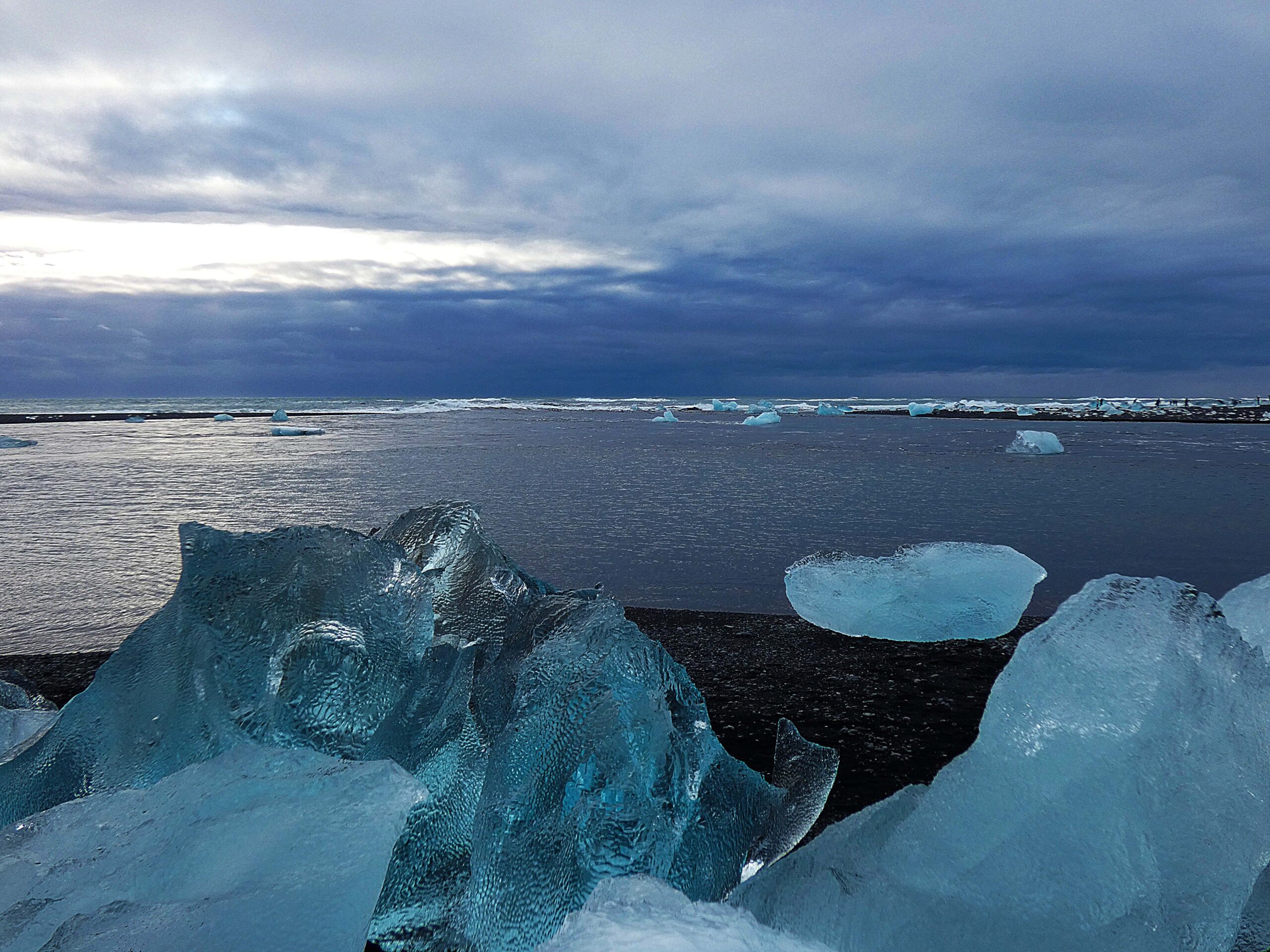
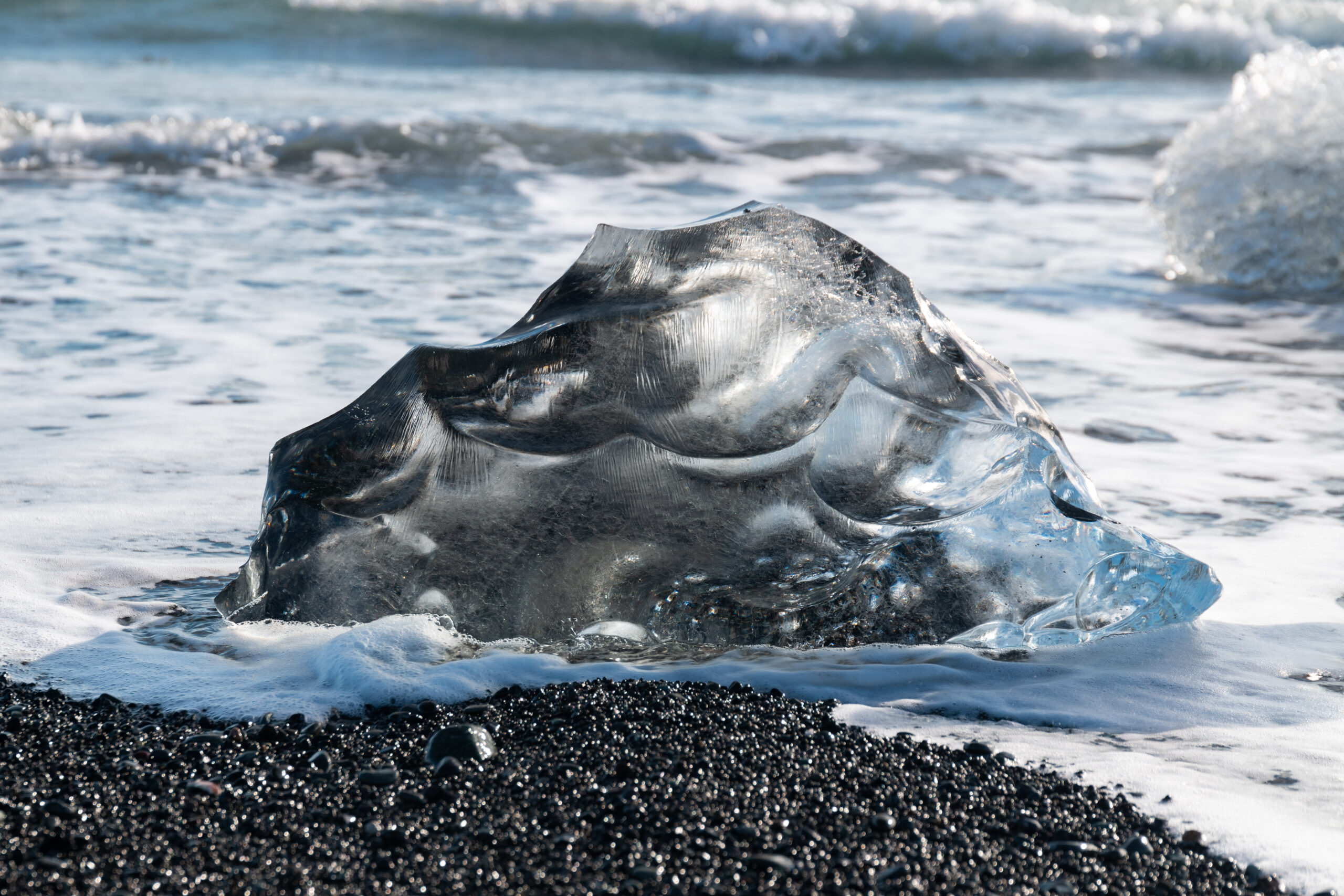
The ice really does come straight from a glacier. Breiðamerkurjökull, one of the many outlet glaciers of Vatnajökull, calves into Jökulsárlón lagoon. The icebergs float around the lagoon for months, sometimes years, slowly melting until they are small enough to squeeze through the short Jökulsá river, under the Ring Road bridge and out to sea. The current carries them off and the waves then dump them back on the sand on both sides of the river mouth. On the way the sea polishes them smooth, so what you find on the beach are rounded, often completely transparent chunks. Lying on black sand with the sun behind them, they shine like cut glass, and that is where the name comes from.
The size changes from one day to the next. Some days the beach is scattered with hundreds of small “diamonds”, other days there are just a few blocks as big as a car. The colours vary too: clear ice has been squeezed so hard that almost no air is left in it, white ice is full of tiny bubbles, and blue ice is usually a piece that has just flipped over after a long time under water. The black stripes are volcanic ash that froze into the glacier hundreds of years ago.
The beach and the lagoon are really one place, split only by the road and the bridge. The lagoon itself, the amphibian boat and Zodiac tours, the seals and how the lagoon formed are all covered in our guide to Jökulsárlón glacier lagoon. Here we stick to the beach.
How to get to Diamond Beach in Iceland
Flights from the UK land at Keflavík, about 45 minutes’ drive from Reykjavík, so if you pick up a hire car at the airport, add that to the driving times below. Most people then follow the south coast east along the Ring Road.
By car. The beach is right on Route 1, just after the bridge over the Jökulsá when you are coming from Reykjavík. The lagoon is on your left, the beach on your right. The whole way is tarmac and in summer an ordinary car is fine. Approximate distances:
| From | Distance | Driving time without stops |
|---|---|---|
| Reykjavík | 375 to 380 km | about 5 hrs |
| Vík | about 190 km | 2 to 2.5 hrs |
| Skaftafell | about 56 km | 40 mins |
| Höfn | about 80 km | 1 hr |
| Egilsstaðir | about 255 km | 3.5 hrs |
In winter allow an extra hour or two for snow, wind and short days. Before you set off, check umferdin.is (road conditions) and safetravel.is (alerts). There is no petrol station at the lagoon or the beach. The nearest ones are at Freysnes near Skaftafell and in Höfn, so fill up beforehand.
On paper it is a five-hour drive from Reykjavík, but in practice it takes all day, because you pass Seljalandsfoss, Skógafoss, the black beach of Reynisfjara and the village of Vík on the way. If you don’t want to rush, split the drive over two days.
By bus. Strætó route 52 runs between Reykjavík and Höfn and stops at Jökulsárlón. Watch out for older guidebooks: it used to be route 51, and today number 51 is the Selfoss–Reykjavík service. The bus does not run every day and the timetable changes between seasons, so check it on straeto.is. It won’t work as a there-and-back day trip, but if you are travelling round the island without a car, you can hop off here and carry on the next day.
On a tour. Day trips from Reykjavík to the lagoon and the beach take around 14 to 15 hours, and you get roughly an hour and a half on site. Two-day south coast tours spend the night near Skaftafell and in winter usually include an ice cave.
Hotels near Diamond Beach Iceland: where to stay
You can’t stay right at the beach or the lagoon, and camping is not allowed because this is a national park. The whole coast between Skaftafell and Höfn is thinly populated: a handful of farms with guesthouses, a few hotels and not much in between. In summer and during the ice cave season, rooms sell out months ahead, so book as soon as you know your dates. We would sleep as close as possible, so you can be on the beach in the morning before the coaches arrive.
East of the beach (Suðursveit). The closest options are the farms around Hali, about 12 to 14 km from the beach. Hali Country Hotel has a restaurant, and right next door is a cultural centre devoted to the writer Þórbergur Þórðarson. Smaller and very well reviewed is Skyrhúsið Guesthouse, and a short way from it Ekra Glacier Lagoon with its cabins. Everything else in the area is here: accommodation near Jökulsárlón and Diamond Beach.
West of the beach (Öræfi and Skaftafell). A good choice if you want to combine the beach with a glacier hike or a walk in Skaftafell. The biggest hotel in the area is Fosshotel Glacier Lagoon, about 30 km from the beach. Skaftafell has the national park’s year-round campsite (around 2,800 ISK, about £17 per adult per night, under-16s free). Hotels and farm stays near Skaftafell: accommodation near Skaftafell.
Höfn. The nearest proper town, about an hour to the east. It has a supermarket, a petrol station, restaurants serving langoustine and the most rooms, so it also tends to be the cheapest: accommodation in Höfn.
Kirkjubæjarklaustur. About 120 km and an hour and a half’s drive west of the beach. A good overnight stop if you are coming from the west and want to be at the ice by mid-morning the next day: accommodation in Kirkjubæjarklaustur. Another option is to spend the night in Vík.
Diamond Beach parking and how to combine it with the lagoon
There are three car parks at the lagoon and the beach, and one fee covers all of them. Vatnajökull National Park calls it an area fee. A camera at the entrance reads your number plate, and you pay either at the machine in the lagoon car park or in the Parka app. The ticket is valid until midnight on the day you paid. If you have already paid at Skaftafell the same day, you get 50% off here. Some websites still quote an older price of around 1,000 ISK. Prices change, so check them with the park before you go. At the time of writing they were roughly as follows:
| Parking at Jökulsárlón and Diamond Beach | Price in ISK (approx.) | Roughly in £ |
|---|---|---|
| Car with up to 5 seats | around 1,100 | £7 |
| Vehicle for 6 to 9 people | around 1,400 | £8 |
| Motorbike | around 500 | £3 |
Eystri-Fellsfjara (east car park). Coming from Reykjavík, cross the bridge and turn right. It is surfaced, there is room for motorhomes too, and in our view it is the best place to leave the car. The beach starts right next to it, and the park’s waymarked trail B2 (1 km, about 40 minutes, easy) runs from here along the shore and under the Jökulsá bridges all the way to the lagoon. There are information boards along the trail and a small exhibition of national park photos by the car park.
Vestri-Fellsfjara (west car park). On the right just before the bridge when you are coming from Reykjavík. There is ice here as well, often smaller pieces, and fewer people. The downside: the bridge stands between you and the lagoon and there is no comfortable way to walk there. Driving across is quicker.
Lagoon car park. On the other side of the road, by the café and the boat tour ticket office. It is gravel, the spaces are narrow, and around midday, when the tour coaches come and go, it is often full. It makes sense if you are going on a boat trip or kayaking, or meeting a guide for an ice cave tour. There are EV chargers here too.
Don’t walk across the bridge. The park explicitly asks visitors not to. It is narrow, has a single lane, and both cars and coaches use it. To get between the beach and the lagoon, walk under the bridge on the riverside path.
Now and then the park closes one of the car parks for construction work. At the time of writing, in early October, the main lagoon car park was shut for several days and visitors parked at Eystri- and Vestri-Fellsfjara instead. Current closures are listed on vatnajokulsthjodgardur.is.
💡 Start at the beach, not the lagoon. Park at Eystri-Fellsfjara, walk along the beach, then take the path under the bridge to the lagoon and back. You skip the crowded car park by the café, you don’t have to dash across the road, and you will often spot seals along the river on the way.
Facilities. There is nothing on the beach itself, no toilets and no bins. Flushing toilets, a café with soup and sandwiches and, in season, food stalls are all at the lagoon. National park rangers are on duty every day of the year, and their phone number for the Breiðamerkursandur area is +354 842 4355. The emergency number is 112, the same as across Europe and in the UK.
Best time to visit Diamond Beach Iceland
The beach is open all year, day and night. Before you plan your trip around the seasons, here is the inconvenient truth: nobody can tell in advance how much ice will be on the beach. Guide to Iceland had more than 1,600 satellite images of the lagoon analysed and found that Jökulsárlón tends to hold the most floating ice in February and March. In the same piece, though, it says that more ice in the lagoon does not mean more ice on the beach, and that the beach has no clearly best season. Other websites claim the sand is fullest of ice in winter. We wouldn’t count on it. There is almost always some ice here, it is just hundreds of small pieces one day and a few big blocks the next.
| Period | Daylight (Höfn) | What to expect |
|---|---|---|
| June and July | Around the solstice, sunrise at 2:25 and sunset at 23:39, it barely gets dark | Busiest time, mild weather, soft light for night photography, birds nesting around the lagoon |
| August and September | Days get shorter, dark nights return in September | Fewer people, a chance of the northern lights from September |
| October and November | In late November, sunrise around 10:05, sunset around 15:30 | Changeable weather, the ice cave season begins |
| December to February | Around 21 December, sunrise at 10:57, sunset at 15:00, only 4 hours of daylight | Low sun all day, wind, snow, northern lights, ice caves |
| March and April | Daylight increases fast | Plenty of ice in the lagoon, still a chance of the northern lights, fewer people than in summer |
The times are approximate, taken from tables for Höfn, and differ by only a few minutes at the beach.
Tides. Sources disagree here. Some guides tell you to go at low tide, because that is when the most ice is left on the wet sand and you have room to walk. Others point out that the tide matters less than how much ice breaks off in the lagoon and which way the wind blows. For photography, low tide has the advantage of giving you more space between the ice and the waves. Tide tables for the south coast are published by the Icelandic Met Office and in tide apps. It does no harm to have them with you, but we wouldn’t plan the whole day around them.
Time of day. Our favourite time here is early morning. Day trips from Reykjavík don’t get here until around midday, so if you are staying nearby you have the beach almost to yourself until then, and the low sun shines right through the ice. The evening is similar, except that in summer the sun only dips below the horizon around midnight.
Photographing Diamond Beach
Diamond Beach is one of the most photographed spots in Iceland, and it works with a phone as well as with a full camera kit. Here is what worked for us and what photographers tend to agree on:
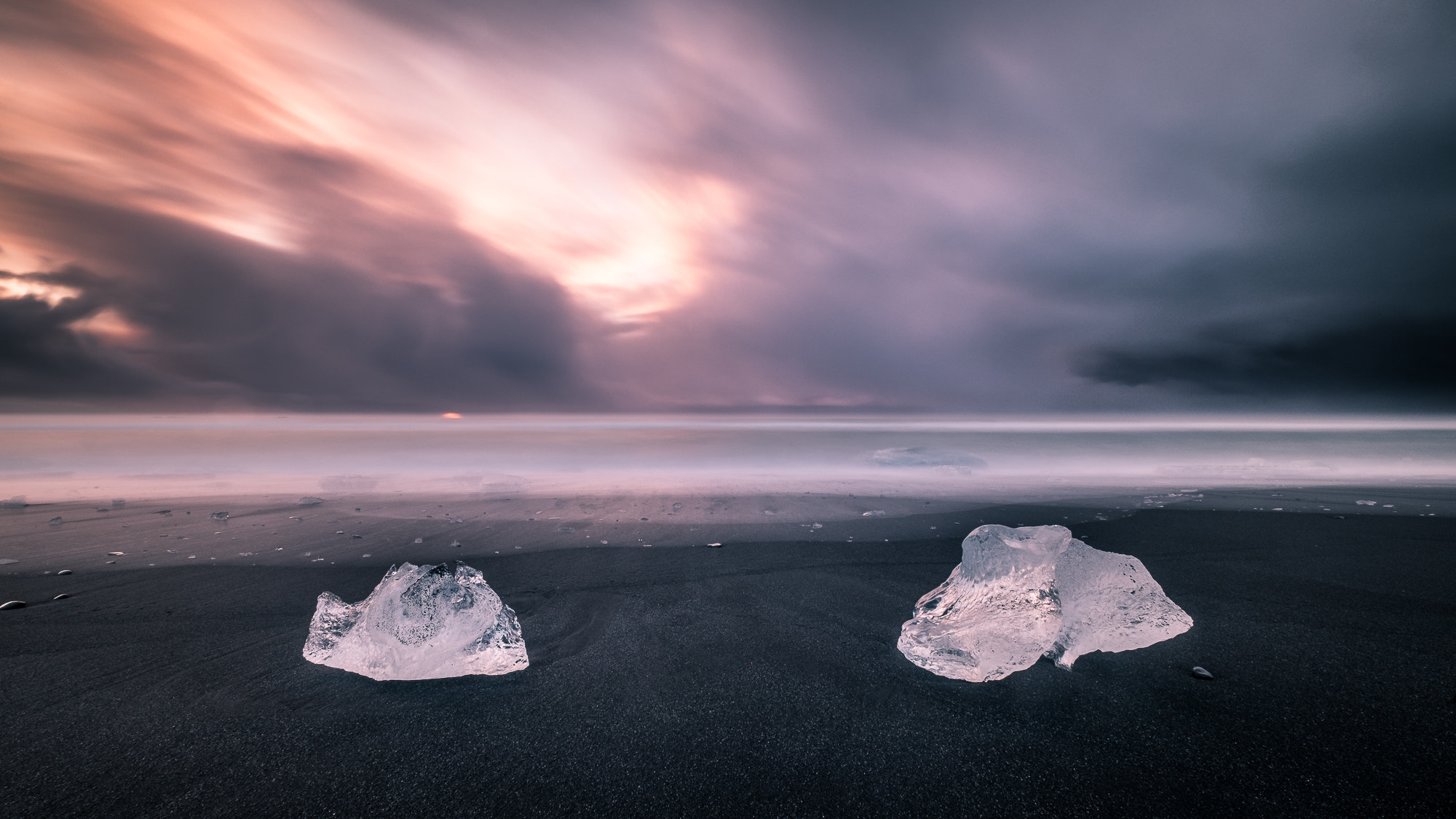
Get low. A chunk of ice shot from standing height is just a chunk of ice. Kneel down and hold your phone or camera just above the sand, and the ice grows into the foreground with the sea and the sky behind it. Look for clear pieces and position yourself so the sun shines through them, not onto them.
Long exposure with a wave. The classic shot here is an iceberg on the sand with a retreating wave blurred around it. You need a tripod and a shutter speed of about half a second to two seconds, ideally with an ND filter in daylight. Many phones have a long exposure mode that is good enough for this. Shoot as the wave starts to pull back, not as it comes in.
Light. In winter the sun stays low all day and rises over the sea to the south-east, so at around eleven in the morning you get the sunrise behind the ice. In summer the sun rises and sets in the north behind the glacier, and the softest light comes at night. An overcast sky is no problem: the blue of the ice looks even richer.
Northern lights. From September to April, on a clear, dark night, you can photograph the aurora over the ice. You need a tripod, a wide-angle lens and the cloud and aurora forecast on vedur.is. The further you walk from the bridge and the car parks, the fewer headlights end up in your frame.
Kit. Salt spray settles on the lens, so bring several cloths. The sand is fine and the wind carries it, so wipe and rinse your tripod after the shoot. In winter keep spare batteries in a pocket close to your body.
💡 When you’re taking photos, always keep one eye on the sea. Most people who get soaked or knocked over here are looking through the viewfinder, waiting for “that” wave. Set up your tripod so that you have room to step back, and never between a block of ice and the water.
Is Diamond Beach safe? Waves, ice and wind
Diamond Beach doesn’t have as bad a reputation as Reynisfjara, where waves have repeatedly dragged people into the sea. But it is the same open Atlantic coast and the same rules apply. There are no warning lights and no lifeguards on the beach.
- Don’t turn your back on the sea and keep away from the water. So-called sneaker waves run much further up the sand than the waves before them, without any warning. The sand gives way under the water and the backwash is strong.
- Don’t climb on the ice or sit on it. Big chunks roll over in the waves, and a wave can lift them even on dry sand. If your hand or foot is between the ice and the sand, you are in serious trouble. Forget the “me sitting on a diamond” photo.
- Don’t stand between the ice and the water. When a wave comes, you have nowhere to go.
- Hold children’s hands. To kids, ice on a beach looks like a climbing frame.
- Don’t swim. The water is around zero degrees and the currents at the river mouth are strong.
- Dress for the wind. The Breiðamerkursandur plain is exposed on all sides. A waterproof jacket, a hat and gloves are useful even in summer. Open car doors carefully and hold on to them, the wind can rip them off.
- Keep an eye on alerts. Weather on vedur.is, warnings on safetravel.is, roads on umferdin.is.
Seals and birds at the river mouth
Seals hang around the mouth of the Jökulsá, mostly harbour seals and occasionally grey seals. They hunt the fish that swim into the lagoon on the incoming tide and rest on the icebergs. You see the most in autumn, winter and early spring, but they are around all year. The best spot is the riverside path between the beach and the lagoon. Don’t feed them, don’t throw anything at them and don’t get between a seal and the water. Some guides say that in winter orcas occasionally come close to the shore after shoals of herring. That is a rare treat, though, not something you can plan on.
In summer Arctic terns and great skuas nest on the sandbanks around the lagoon, and they defend their nests by dive-bombing your head. Stay on the paths. Because of the nesting season, recreational drone flying is banned at Jökulsárlón and Fellsfjara from 15 April to 15 July, and even outside that period drones must not fly over people or disturb wildlife.
What to see near Diamond Beach
Jökulsárlón. The lagoon across the road, where the ice breaks off the glacier and where amphibian boats and Zodiacs run in season. Boat prices and everything else are in our guide to Jökulsárlón glacier lagoon.
Ice caves and glacier hikes. In winter the lagoon car park is the meeting point for ice cave tours into Vatnajökull, roughly from October to March and only with a guide. More in our article on Vatnajökull.
Fjallsárlón. A smaller, quieter glacier lagoon about 10 km to the west, with the glacier snout in view from the shore and a free car park.
Skaftafell. About 56 km to the west. A green oasis between glaciers, with Svartifoss waterfall and its basalt columns, a campsite and glacier hikes.
Stokksnes and Vestrahorn. Another black beach, this time with sand dunes below the jagged Vestrahorn mountain, just past Höfn. Worth it if you are carrying on round the island to the east.
Höfn. A fishing town an hour to the east, known for its langoustine (Icelanders call it humar, and it often appears on menus as “lobster”). Across the bay you can see the southern edge of Vatnajökull.
How much does a visit to Diamond Beach cost?
The beach itself is free. You pay for parking, and most of your money goes on accommodation, food and fuel, all of which are expensive in south-east Iceland.
| Item | Price in ISK (approx.) | Roughly in £ |
|---|---|---|
| Entry to the beach | free | free |
| Parking, car with up to 5 seats, per day | around 1,100 | £7 |
| Parking if you paid at Skaftafell the same day | around 600 | £4 |
| Amphibian boat tour on the lagoon, adult | around 7,100 | £43 |
| Skaftafell campsite, adult per night | around 2,800 | £17 |
The pound figures are rounded and based on 100 ISK being worth about 60p. Check the current exchange rate before you travel.
Is Diamond Beach worth it? What we’d do differently
You can pull up at Diamond Beach, spend ten minutes taking “the” shot of ice on black sand and drive on. Plenty of people do exactly that, and end up with the same photo on their phone as thousands of others. If we went again, we would give the beach at least an hour and not start shooting straight away. We would walk east along the sand, away from the bridge, where the crowds thin out bit by bit, and simply watch the sea bring the ice in, turn it over and take it away again. Every wave rearranges the picture a little.
You don’t need a sunrise, the northern lights and a perfect long exposure all at once. When it’s grey and windy, the beach is just as strange, only in a different way. And if there isn’t much ice on it that day, never mind. Walk under the bridge to the lagoon, sit down by the river and watch for a seal popping its head up.
One last thing: if you are staying nearby, come twice. Once in the evening, once in the morning. In those few hours the sea swaps out almost everything, and you will see two different beaches. Leave your phone in your pocket for a while and listen to the ice crackling on the sand.
Diamond Beach Iceland FAQ
Where is Diamond Beach in Iceland?
In south-east Iceland on the Ring Road (Route 1), directly opposite Jökulsárlón glacier lagoon, about 375 to 380 km from Reykjavík. Locally the beach is called Fellsfjara and it belongs to Vatnajökull National Park.
Is Diamond Beach free?
Yes, the beach is open to everyone all year, day and night, with no entry fee. You only pay for parking: around 1,100 ISK (about £7) a day for a car with up to five seats. The ticket is valid until midnight for all three car parks at the beach and the lagoon.
When is there the most ice on Diamond Beach?
It can’t be predicted. The sea washes ice onto the beach all year, and how much depends on how much breaks off the glacier, on the wind, the waves and the tide. The lagoon usually holds the most ice in February and March, but according to satellite measurements that doesn’t mean more ice on the beach.
How far is Diamond Beach from Reykjavik?
About 375 to 380 km, roughly five hours’ drive without stops and longer in winter. Day tours from Reykjavík take 14 to 15 hours, so it is more comfortable to stay nearby, for example around Skaftafell, in Suðursveit or in Höfn.
Is Diamond Beach the same as Jökulsárlón?
No, but they sit right next to each other. Jökulsárlón is the glacier lagoon on the north side of the road, and Diamond Beach is the beach on the south side, where the sea washes up the icebergs that float out of the lagoon under the bridge. You can walk between them on the path under the bridge.
Is Diamond Beach in Iceland safe?
Yes, as long as you keep away from the water and stay off the ice. Waves here can run unexpectedly far up the sand and roll big chunks of ice over. Don’t turn your back on the sea, don’t stand between the ice and the water, and hold children’s hands.
Where do you park for Diamond Beach?
The best option is the Eystri-Fellsfjara car park east of the bridge, where a path leads under the bridge to the lagoon. The second is Vestri-Fellsfjara before the bridge and the third is at the lagoon. One fee covers all three.
Can you see the northern lights at Diamond Beach?
Yes, from September to April on a clear, dark night. There is no town near the beach, only the lights of cars and car parks. You will find the cloud and aurora forecast on vedur.is.
Where to next
- Jökulsárlón: the glacier lagoon across the road, with boat trips among the icebergs and seals.
- Vatnajökull: ice caves and hikes on the glacier the beach ice comes from.
- Reynisfjara: the south coast’s other famous black beach, and why you can’t trust the waves there.
- Vík: the village halfway from Reykjavík, a good place to break the journey.
- Skógafoss: the big waterfall right by the Ring Road, an easy stop on the drive east.
Potřebujete pomoct s cestováním?
-
Ubytování 🏨
Vyberte si to nejlepší ubytování, ať už jste kdekoliv, přes Booking.com. -
Půjčení auta 🚗
Auto si snadno najdete přes Booking.com, kde máte často slevu díky ubytování, nebo Rentalcars.com, kde porovnáte nabídky většiny půjčoven. -
Zážitky 🎟️
Přes GetYourGuide.com si vyberete z nejrůznějších výletů i zážitků po celém světě, navíc se zrušením zdarma do 24 h předem.