Last updated 27.11.2026
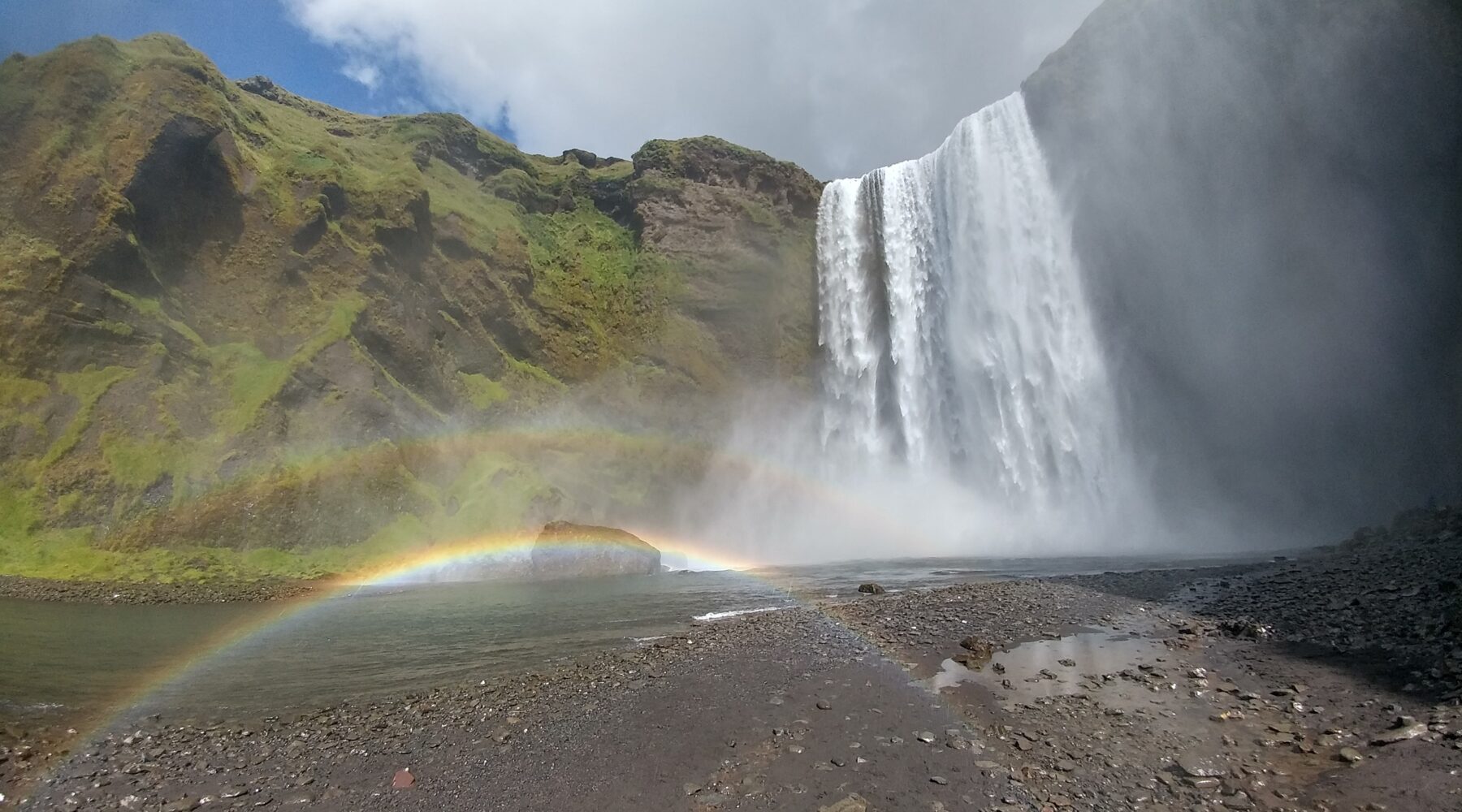
Drive along Iceland’s south coast and by day two you will stop pulling over for every waterfall, because there are simply too many of them. Skógafoss waterfall is the exception. Here the Skógá river drops sixty metres in one clean fall, with no cascades or ledges, straight off a cliff that once marked the edge of the sea. It is a few minutes’ walk from the car park, on a sunny day a rainbow hangs in the spray, and anyone who gets too close walks back soaked from head to toe.
Skógafoss is also one of the easiest big sights in the whole country to reach: it sits just off the Ring Road (Route 1), there is no entrance fee and you only pay for parking. That is exactly why it gets busy. In this guide we cover how to get there, what parking costs and how to pay it, what to expect on the steps up to the viewpoint, where the trail above the falls leads, and why you should also walk to little Kvernufoss, which most people standing below Skógafoss have never heard of.
Skógafoss waterfall at a glance
- 60 metres high and 25 metres wide, a single unbroken drop on the Skógá river by the village of Skógar. From Reykjavík it is about 155 km, or roughly two hours by car.
- Free to visit, but you pay for parking. A car with up to five seats costs around 1,000 ISK (about £6), paid through the Parka app or website. If you have not paid within 24 hours, a surcharge of roughly 2,000 ISK is added.
- Metal steps lead to the viewpoint above the falls on the eastern side. Guides quote anything from 370 to 527 steps depending on where they start counting, and the climb takes 15 to 30 minutes.
- A riverside trail starts at the top and passes dozens more waterfalls. The footbridge over the Skógá is about 8 km away, and from there the Fimmvörðuháls trail continues to Þórsmörk.
- Kvernufoss is 1.5 km to the east in a small canyon behind the museum, and you can walk behind it. Parking at the museum costs roughly 800 ISK (about £5).
- Skógasafn (the Skógar Museum) has turf houses, a small church and a museum of transport and technology. Adults pay around 3,000 ISK (about £18), children under 12 go free.
- Expect to get wet. The spray carries a long way, and a waterproof jacket matters more here than sunglasses.
What is Skógafoss waterfall and why stop there
The name Skógafoss literally means “forest waterfall”, although you will not find a single forest here today. The water tumbles over a former coastline: since then the sea has retreated about five kilometres to the south, leaving behind a band of old sea cliffs that runs for hundreds of kilometres along the south coast. That is what gives the landscape its odd look, with flat land running down to the ocean, then a sudden green wall, and water pouring off it.
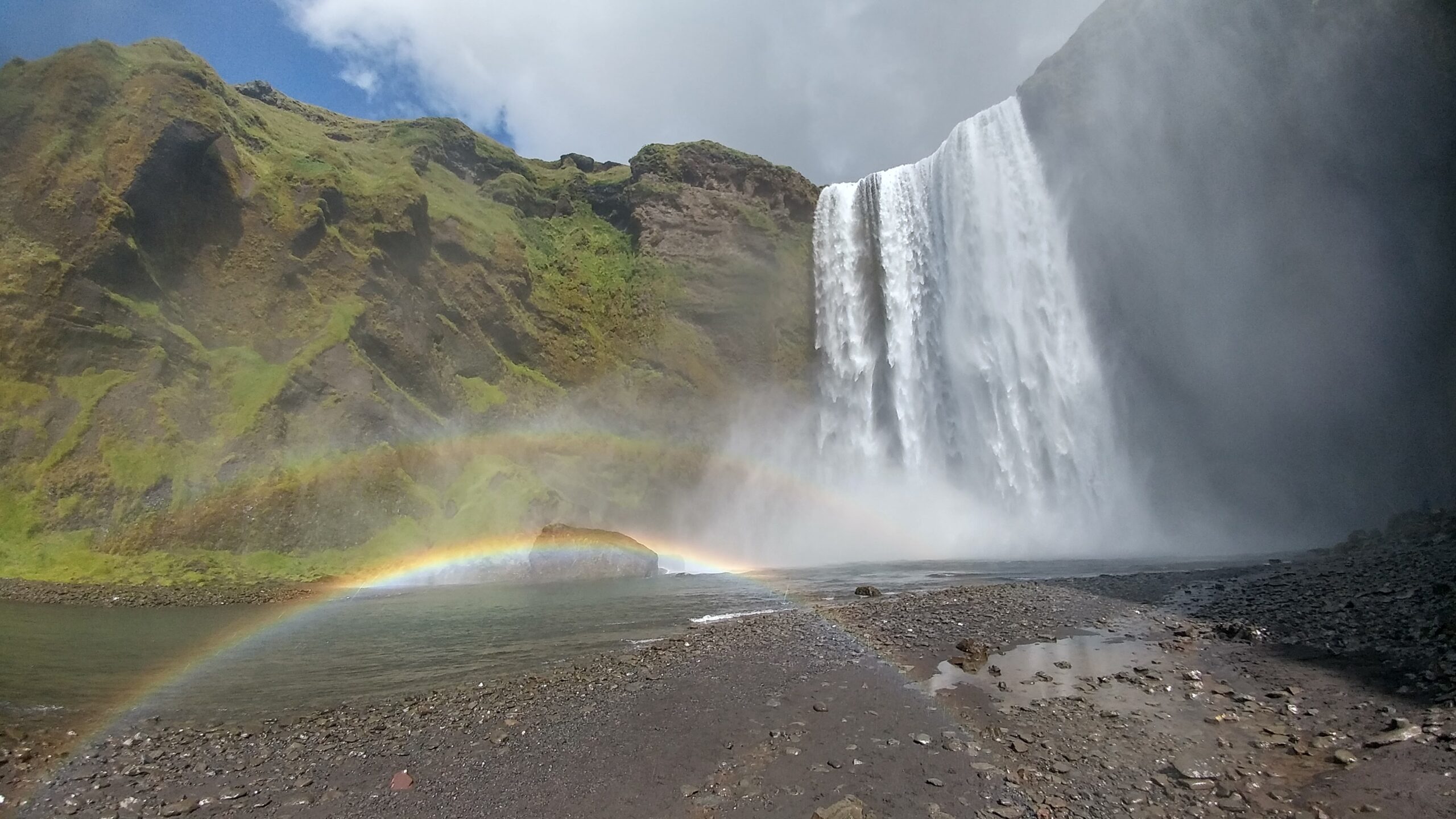
The Skógá river flows down from the highlands between the Eyjafjallajökull and Mýrdalsjökull glaciers. The waterfall is about 60 metres high and 25 metres wide and falls in one single drop, which is why it feels bigger than other Icelandic waterfalls of the same height. The spray is so heavy that on a sunny day a rainbow almost always forms in it, often a double one. Northern fulmars nest on the cliffs either side, a protected species for which, according to the site’s managers, Iceland has a special responsibility. The whole area around the falls is a protected natural monument looked after by the Environment Agency of Iceland, with a ranger based here all year round.
The legend of Þrasi’s chest
Skógafoss comes with its own treasure story. The settler Þrasi Þórólfsson, who according to the Book of Settlements lived in the eastern part of Skógar, is said to have hidden a chest full of gold beneath the falls. In the 19th century the folklore collector Jón Árnason recorded that around 1600 three men tried to pull the chest out. They hooked it by a ring, but the ring snapped off and the chest vanished under the water. The ring then hung on the door of the church at Skógar until the church was closed in 1890, later on the church at Eyvindarhólar, and since the 1960s it has been on display at the Skógasafn museum, which even uses it in its logo. So if you stand below the falls and spot something golden in the spray, legend says it is the treasure. Physics says it is the sun.
Skógafoss in films and Game of Thrones
Skógafoss has appeared in a long list of films, TV series and music videos. It was used for Thor: The Dark World and The Secret Life of Walter Mitty, Floki stands here in Vikings, and in the final season of Game of Thrones Daenerys and Jon Snow kiss in front of the falls. A good stop for fans, and for everyone else an explanation of why someone is standing on one particular rock with their phone and refusing to move for twenty minutes.
How to get to Skógafoss waterfall
By car. Skógafoss is next to the village of Skógar, about 155 km from Reykjavík along the Ring Road (Route 1). The drive takes around two hours, longer in winter or in strong wind. The turn-off is well signposted, and the short access road is passable all year in an ordinary car, so you do not need a 4×4. From Keflavík Airport, where flights from the UK land, it is roughly 200 km, so if you pick up a hire car on arrival, allow a good half day to get here. Most people do not come specifically for Skógafoss but stop on a south coast road trip, usually between Seljalandsfoss and Reynisfjara black sand beach.
By public bus. It can be done, with limitations. Skógar is on Strætó route 52 from Reykjavík (Mjódd stop) to Vík and Höfn. Since January the route has run only four days a week (Tuesday, Thursday, Friday and Sunday), with one bus a day. The bus leaves Mjódd at 14:18 and reaches Skógar at 16:30, and the return to Reykjavík leaves Skógar at 17:55. On a day trip that gives you an hour and a half at the falls, so the bus mainly makes sense if you are staying the night in Skógar or Vík. Check current times on straeto.is, as rural timetables change.
By highland bus in summer. In the summer season, operators also run so-called Highland Bus services from Reykjavík to Skógar, carrying hikers to the trails into Þórsmörk and over Fimmvörðuháls. Handy if you want to walk the trail above the falls and do not have a car. Timetables come out in spring and the buses run roughly from June to September.
On an organised tour. Skógafoss is a stop on practically every south coast day tour from Reykjavík, usually together with Seljalandsfoss, Reynisfjara and Vík. It is the most comfortable option without a car, but bear in mind you will normally get forty minutes to an hour at the falls, with no time for the trail above.
| From | Distance to Skógafoss | Note |
|---|---|---|
| Reykjavík | about 155 km | around 2 hours on Route 1 |
| Keflavík Airport | about 200 km | 2.5 to 3 hours |
| Seljalandsfoss | about 30 km | to the west, back towards Reykjavík |
| Vík | about 30 km | to the east, past Reynisfjara and Dyrhólaey |
| Kvernufoss and Skógasafn museum | 1.5 to 2 km | in the same village, a few minutes by car |
Where to stay near Skógafoss waterfall
Sleeping in Skógar, the village right by Skógafoss waterfall, has one big advantage: you can be at the falls in the evening and early morning, when the coaches have gone, and start the trail above it with a whole day ahead of you. The village has only around 25 residents but several hotels, guesthouses and a campsite, so rooms go early in high season. Book well ahead: on the south coast, whatever you have not reserved by winter may well be gone by July.
Skógar. Right by the falls, a few hundred metres from the car park, is Hótel Skógafoss, for those who want the waterfall outside the window. The village also has Hótel Skógá and a handful of guesthouses, and you can see everything available under places to stay in Skógar.
Vík. About 30 km to the east is the biggest settlement in the area, with a supermarket, petrol station, restaurants and the widest choice of beds. Vík also puts you close to Reynisfjara and Dyrhólaey, so it works well for two nights: one day for Skógafoss, the other for the black beaches. Browse places to stay in Vík.
Hvolsvöllur. Roughly halfway between Reykjavík and Skógar, this is a slightly bigger town with a supermarket, and both Skógafoss and Seljalandsfoss are under forty minutes away. A sensible choice if you want to stay closer to the capital: places to stay in Hvolsvöllur.
Camping. Directly below the falls is Skógar campsite, the only place in the protected area where you may stay overnight, whether in a tent, campervan or with a caravan. Sleeping anywhere else around the falls, including the car park, is not allowed. The campsite has showers and toilets; check prices and the season with the operator, as they change from year to year.
Skógafoss parking: fees and how to pay
The waterfall itself is open day and night and there is no entrance fee. What you pay for is parking, which has been charged since spring 2025. It is collected through the Parka system: you pay by number plate, either in the Parka app or on the parka.is website, and you can do so up to 24 hours after leaving. Do not expect barriers or a ticket machine. According to the operator, the fee also covers the toilets by the car park.
| Skógafoss parking (approximate) | ISK | Approx. in £ |
|---|---|---|
| Car with up to 5 seats | around 1,000 | about £6 |
| Car or campervan with 6 to 9 seats | around 1,300 | about £8 |
| Motorbike | around 400 | about £2.50 |
| Service fee for paying via Parka | around 90 | about 50p |
| Surcharge if not paid within 24 hours | roughly 2,000 | about £12 |
Prices change, so check the current rates on parka.is before you travel. Vehicle size goes by the number of seats in the registration document, so a seven-seat campervan falls into the higher band even if only two of you are in it. According to Parka’s terms, one fee covers five hours of parking, which is plenty for the waterfall, the steps and a stretch of the trail. If you are walking the whole trail to the footbridge and back, check in the app whether one fee will be enough. Sleeping in the car park is explicitly banned, campervans included.
Note that Kvernufoss has its own car park at the museum with its own price (roughly 800 ISK a day, about £5, also paid through Parka). If you drive from one to the other, you pay twice.
💡 Pay as soon as you park. An unpaid surcharge goes to the vehicle’s owner, which for a hire car means the rental company, and they will usually pass it on to you with their own admin fee on top. That is an expensive reminder for nothing. Install the Parka app before you leave home; you will use it at several other places on the south coast too.
When to visit Skógafoss
Skógafoss is open all year and every season has something going for it. In spring (April and May) snowmelt means the most water, and the falls are at their most powerful. In summer (June to August) the days are long and light, the trail above the falls is free of snow, and you can stay late into the evening once the coaches have left. It is also when the waterfall is at its busiest. In winter the falls are often partly frozen, the surroundings are under snow and there are only a few hours of daylight. Steps and paths can be icy, so microspikes are a good idea.
We like it best early in the morning or in the evening. It is not only that there are fewer people: when the sun is low it shines straight into the spray and the rainbow is at its clearest. At midday in summer the coaches park nose to tail and you have to squeeze between tripods to reach the water.
Below the falls and the Skógafoss steps to the top
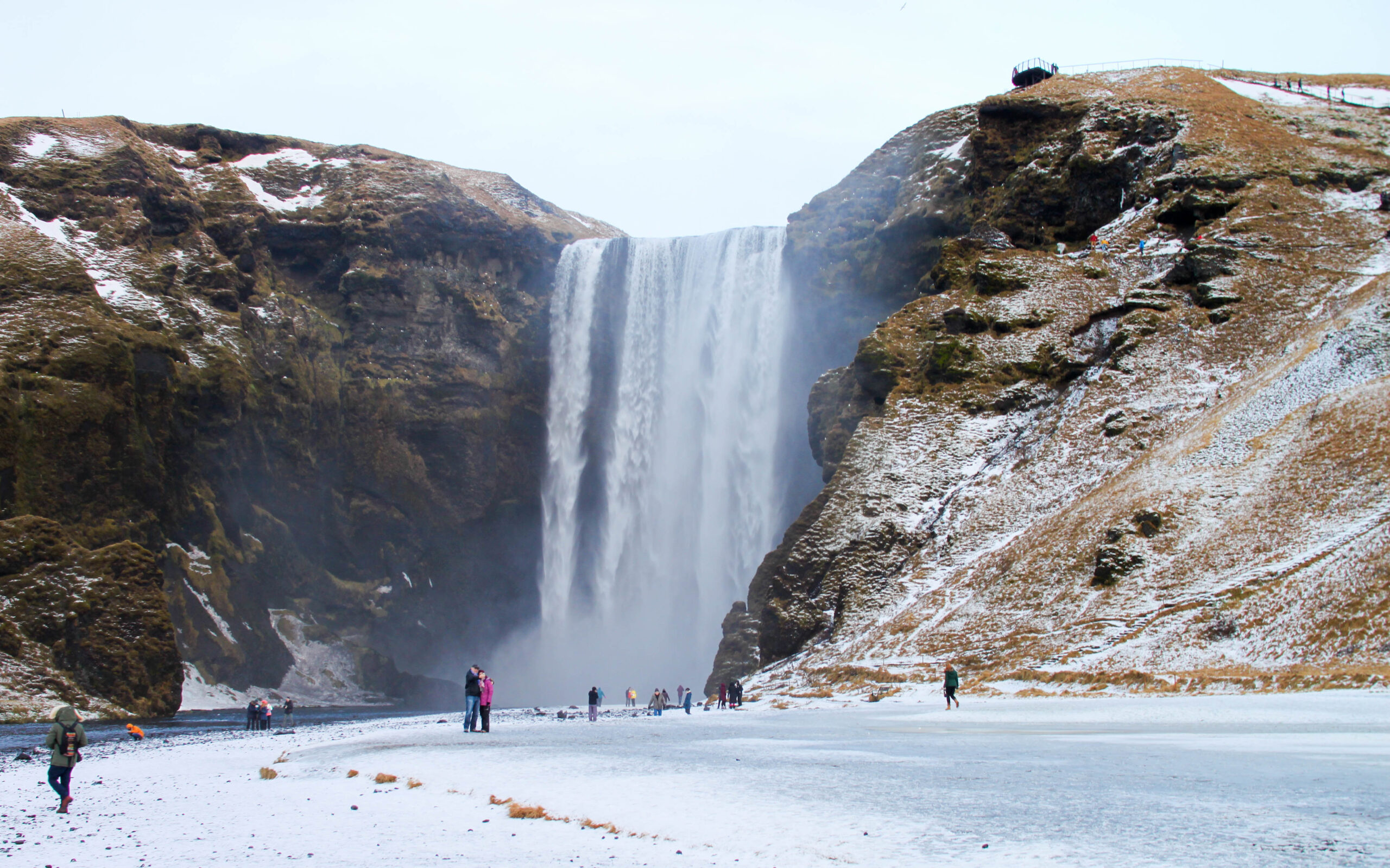
From the car park a flat path across the pebbles leads to the waterfall, and anyone can manage it. You can walk right up to the foot of the falls, but the closer you get, the more water is flying through the air, and the last thirty metres are more shower than stroll. The rocks by the water are slippery. Do not go swimming below the falls: the water is ice cold and the current is strong.
Steep metal steps lead up to the viewpoint above the falls on the right-hand (eastern) side as you face the waterfall. How many steps there are depends on who you ask: anything from 370 through roughly 430 up to 527, because everyone counts from a different point. Any sensible person reaching the top realises it does not matter. The climb takes 15 to 30 minutes, depending on your fitness and how many people are on the stairs with you. At the top is a platform looking straight down at the spot where the river breaks over the edge, and on a clear day you can see all the way to the sea.
To be honest, what we like more than the platform itself is what comes after it. Walk on upstream along the trail for ten minutes and the crowds shrink to a fraction.
The Skógafoss hike: Waterfall Way and the Fimmvörðuháls trail
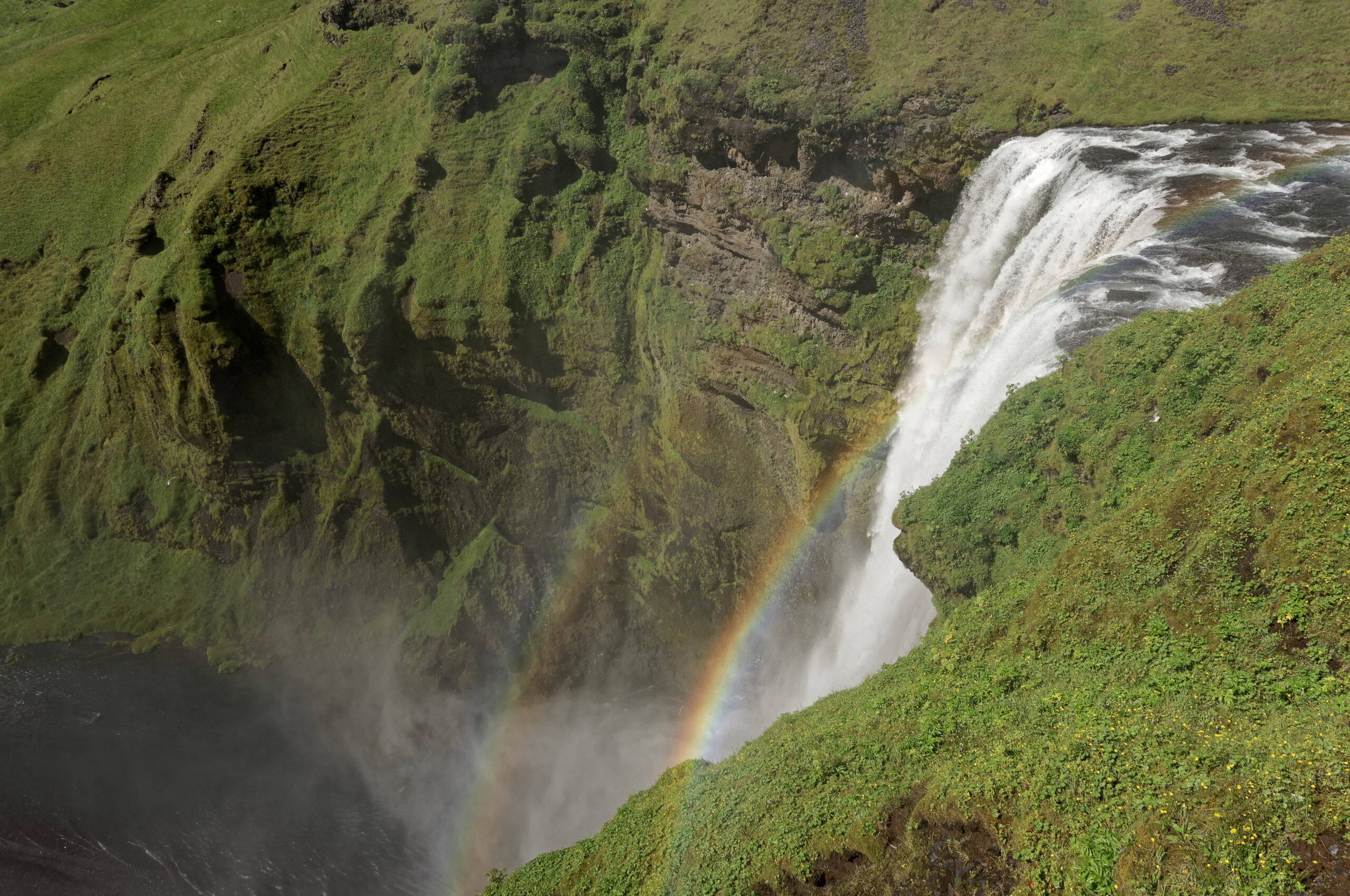
Above Skógafoss a waymarked trail carries on beside the Skógá river. It is known as the Waterfall Way, and it is easy to see why: in the first eight kilometres you pass around twenty-five more waterfalls in moss-covered basalt gorges. The first named one, Hestavaðsfoss, is about 200 metres from the top of the steps. Around the three-kilometre mark come Fosstorfufoss and Steinbogafoss, and the most powerful stretch, Króksfoss in its narrow canyon, is not far from the footbridge over the river.
After the initial steps the trail is mostly level or climbs only gently, partly on gravel and wet grass. The full walk to the footbridge and back is about 16 km and takes four to six hours. But nobody says you have to do it all: you can turn round at any point, and even the first hour of walking shows you more waterfalls than most visitors see all day. Beyond the bridge the landscape opens up and loses all shelter, so bear that in mind if the wind picks up.
Fimmvörðuháls: the trail to Þórsmörk
From the footbridge the trail continues up to the Fimmvörðuháls pass between the Eyjafjallajökull and Mýrdalsjökull glaciers and then down into the Þórsmörk valley. According to the Iceland Touring Association (Ferðafélag Íslands), the full crossing is 25 km with around 1,000 metres of ascent: from Skógar to the Baldvinsskáli hut is 12 km (4 to 5 hours), and from there to Þórsmörk 13 km (4 to 6 hours). The route crosses the Goðahraun lava field and passes the Magni and Móði craters, formed in the 2010 eruption, and on the descent follows the narrow Heljarkambur ridge, where a chain helps on the most exposed section. The trail is usually passable from late June to mid-September; the upper section often stays under snow for a long time, and the weather on the pass can change within minutes. It can snow up there even in July.
Check the current situation before you set off. In late August the Icelandic Tourist Board issued a warning: between the Baldvinsskáli and Fimmvörðuhálsskáli huts, the retreating glacier has opened up new gullies and crevasses, and steep scree slopes have formed where there used to be snow and ice. Ferðafélag Íslands, the Útivist hiking club and the Hvolsvöllur search and rescue team strongly advised against the crossing in these conditions, and a new, safer route is being looked for. The lower section from Skógar to the footbridge is not affected. Before planning the full crossing, check safetravel.is and the Ferðafélag Íslands website.
In Þórsmörk the Fimmvörðuháls trail links up with the famous Laugavegur trek, which starts in Landmannalaugar. If you have the time and the legs, you can walk both back to back.
What to see near Skógafoss
Skógar is a tiny village, but it has enough for a few extra hours. And on the south coast, the next stop is always less than half an hour away.
Kvernufoss
Kvernufoss is Skógafoss’s smaller, narrower and far quieter neighbour. It sits in a little canyon about 1.5 km to the east, reached by a footpath from the Skógasafn museum car park, and the walk takes about a quarter of an hour. The water drops into a green gorge and the path leads right round behind the curtain of water, so you can do here what people queue for at Seljalandsfoss, minus the queue. The museum car park is charged separately (roughly 800 ISK a day, about £5), and the price includes use of the museum toilets during opening hours.
We would put it straight after Skógafoss, ideally late in the afternoon. It is exactly the kind of place that shows you the best moments in Iceland are not necessarily the ones with the biggest sign by the road.
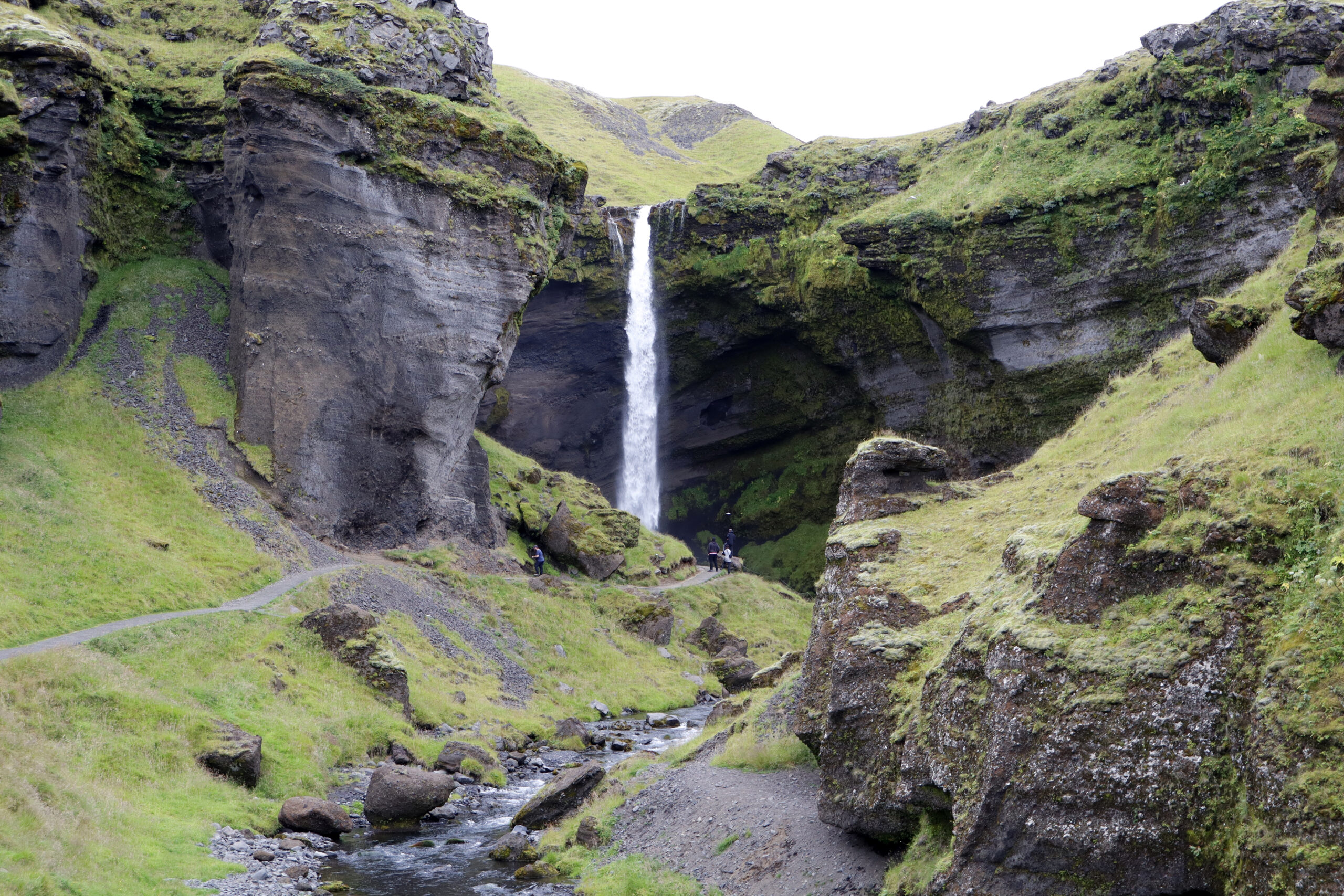
Skógasafn museum
Skógasafn is a regional museum founded in 1949, and its heart and soul was the collector Þórður Tómasson. Even as a young man he gathered objects his contemporaries regarded as outdated and worthless, ran the museum himself and spent more than sixty years welcoming and guiding visitors. Today it holds around 18,000 items in three parts: a folk museum, an open-air museum and a museum of transport, communication and technology from the 19th and 20th centuries.
The open-air museum is the most rewarding part. The turf houses with grass on their roofs contain rooms dating from 1838 to 1896, there is a wooden house built of driftwood in 1878, an old school, and a church consecrated in 1998 and furnished with items from older churches in the district. The museum also holds the ring from Þrasi’s chest. Allow at least an hour and a half for a visit, or nearer two with the technology museum.
| Skógasafn admission (approximate) | ISK | Approx. in £ |
|---|---|---|
| Adults | around 3,000 | about £18 |
| Students and seniors | around 2,000 | about £12 |
| Young people aged 12 to 17 | around 1,600 | about £10 |
| Family (2 adults and children under 17) | around 6,800 | about £40 |
| Children under 12 with an adult | free | free |
The museum is open 362 days a year, from 9am to 6pm in June to August and from 10am to 5pm from September to May. It is closed on 24 and 25 December and 1 January. The site also has the Freya café. Up-to-date information is on skogasafn.is.
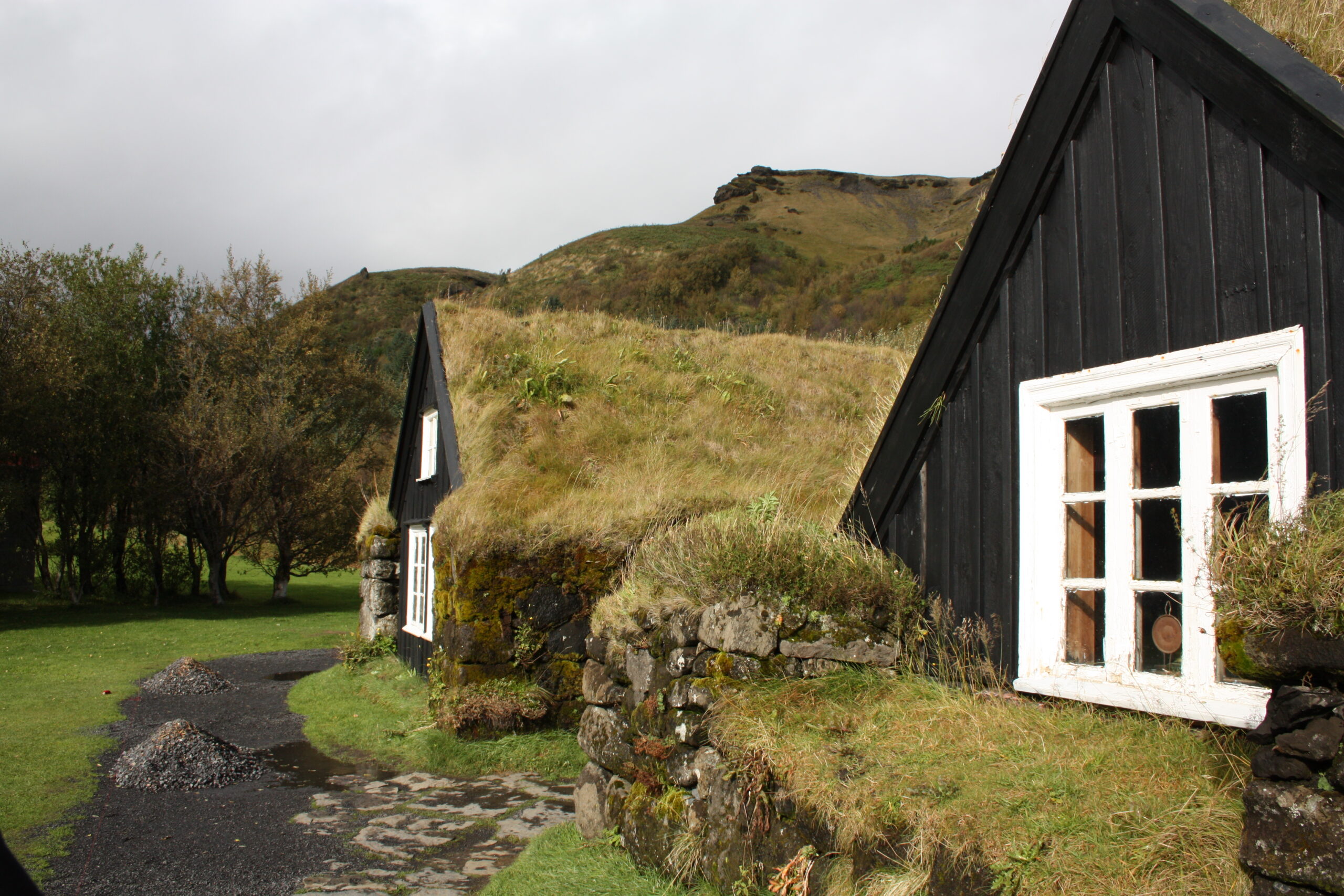
Seljalandsfoss
About 30 km to the west, back towards Reykjavík, is the south coast’s second most famous waterfall. Seljalandsfoss is narrower and falls from an overhang, so a footpath takes you all the way round behind it, and right next door Gljúfrabúi hides in a cleft in the rock. Treat the two as a single stop; most people combine them with Skógafoss in one day.
Sólheimajökull glacier and the plane wreck
A short way east of Skógar, a road turns off to Sólheimajökull, a glacier tongue of Mýrdalsjökull. You can walk up to the glacier snout on foot, but onto the ice itself only with a guide and crampons; several companies run glacier walks here. A little further on, on the black sand plain of Sólheimasandur, lies the wreck of a US military DC-3 aircraft, reached on foot from a car park on Route 1, about four kilometres each way.
Reynisfjara, Dyrhólaey and Vík
Another twenty to thirty kilometres east, the black beaches begin. There is the Dyrhólaey headland with its natural rock arch, Reynisfjara black sand beach with its basalt columns and the Reynisdrangar sea stacks, and beyond it the small town of Vík. At Reynisfjara watch out for sneaker waves, which can surge much further up the beach than the rest, and keep well back from the water.
Seljavallalaug
About six kilometres west of Skógar, in a valley below Eyjafjallajökull, is one of the oldest outdoor swimming pools in Iceland, fed by a warm spring. You walk to the pool up the valley, and the setting among the mountains is worth the stroll on its own.
Safety and practical tips
- Rain gear, even when the sun is shining. The spray from Skógafoss soaks you within minutes. A waterproof jacket and shoes, a cover for your camera and a towel in the car.
- The rocks below the falls and the steps are slippery. In winter they are often icy, and microspikes will save you a lot of stress.
- Drones are banned. Flying over the protected natural monument is only allowed with a permit from the Environment Agency of Iceland. Filming that could get in the way of other visitors also needs a permit.
- Dogs on a lead, and bikes only on roads and cycle paths.
- Stay on the paths. The vegetation on the plateau above the falls was trampled so badly that the managers had to fence it off and reroute the trail. The fences are not there for decoration.
- Let the weather decide on the trail above the falls. Before a longer walk, check the forecast on vedur.is and the alerts on safetravel.is. Strong wind is common on the south coast and gets stronger inland.
- Emergency number 112, which also works in the UK. In the Safetravel app you can send your location to the rescue services; on the Fimmvörðuháls trail there is often no signal.
Is Skógafoss worth it? What we would do differently
Most people stop at Skógafoss for forty minutes, take a photo in front of the falls, rush up the steps, come back down and drive on. Next time we would turn that round: just a short while at the bottom, then an hour or two upstream along the trail, where it is quiet, mossy and one waterfall follows another. How many you see does not matter. Turning back at the third one is perfectly fine.
We also would not cram Seljalandsfoss, Skógafoss, Reynisfjara and Vík into one day just because every itinerary does. It can be done, but by the evening what you mostly remember is the steering wheel. We would rather spend the night in Skógar, walk to Kvernufoss once everywhere has emptied, and have a bowl of soup in the local café, whatever it turns out to be like.
And one more thing: at a waterfall where a hundred people with phones are standing next to you, the best thing is to put the camera away and just listen for a while. You cannot photograph that roar, and it is the thing we remember most of all.
Skógafoss waterfall FAQ
How much is parking at Skógafoss?
A car with up to five seats pays around 1,000 ISK (about £6), a vehicle with 6 to 9 seats around 1,300 ISK (about £8) and a motorbike around 400 ISK. You pay through the Parka app or website, with a service fee of around 90 ISK on top. You can pay up to 24 hours after leaving; after that a surcharge of roughly 2,000 ISK (about £12) kicks in. The waterfall itself is free.
How many steps are there at Skógafoss waterfall?
Sources disagree, quoting anything from 370 to 527 depending on where they start counting. It is a steep metal staircase on the eastern side of the falls and the climb takes 15 to 30 minutes. In winter the steps are often slippery.
How far is Skógafoss from Reykjavik?
About 155 km along the Ring Road (Route 1), roughly two hours by car. From Keflavík Airport it is around 200 km. You can also get there on Strætó bus route 52, but there is only one bus a day and it does not run every day.
Can you walk behind Skógafoss waterfall?
No, there is no path behind Skógafoss, and you can only approach its foot from the front. To walk behind a curtain of water, head to Kvernufoss 1.5 km to the east or Seljalandsfoss about 30 km to the west.
Which is better, Skógafoss or Seljalandsfoss?
Do not choose: they are only about 30 km apart and most people visit both in one day. Skógafoss is more powerful and has a trail with more waterfalls above it, while at Seljalandsfoss you can walk all the way round behind the falls. If you only have time for one, go to Skógafoss and add Kvernufoss.
Was Game of Thrones filmed at Skógafoss?
Yes, Skógafoss appears in the final season of the series, where Daenerys and Jon Snow kiss in front of it. It was also used for the films Thor: The Dark World and The Secret Life of Walter Mitty and for the series Vikings.
What is Skógafoss like in winter?
It is open all year, often partly frozen, and the area is usually under snow. There are only a few hours of daylight in winter, and the steps and paths can be icy, so microspikes are a good idea. The trail above the falls is not recommended in winter without experience and crampons.
Can you camp at Skógafoss?
Yes, but only at Skógar campsite directly below the falls. It is the only place in the protected area where you may sleep overnight in a tent or campervan. Sleeping in the car park is explicitly banned.
Where next
- Reynisfjara black sand beach: basalt columns half an hour to the east, and why you keep away from the water there.
- Jökulsárlón glacier lagoon: icebergs floating out of Vatnajökull, Iceland’s largest glacier, if you carry on east along the south coast.
- Seljalandsfoss: the waterfall you can walk behind, half an hour to the west and the natural partner for Skógafoss.
- Gullfoss waterfall: on the Golden Circle, where the Hvítá river drops into a canyon in two tiers, a completely different type from Skógafoss.
- Things to do in Reykjavik: for when you start or finish your trip in the capital.
Potřebujete pomoct s cestováním?
-
Ubytování 🏨
Vyberte si to nejlepší ubytování, ať už jste kdekoliv, přes Booking.com. -
Půjčení auta 🚗
Auto si snadno najdete přes Booking.com, kde máte často slevu díky ubytování, nebo Rentalcars.com, kde porovnáte nabídky většiny půjčoven. -
Zážitky 🎟️
Přes GetYourGuide.com si vyberete z nejrůznějších výletů i zážitků po celém světě, navíc se zrušením zdarma do 24 h předem.