Last updated 27.11.2026
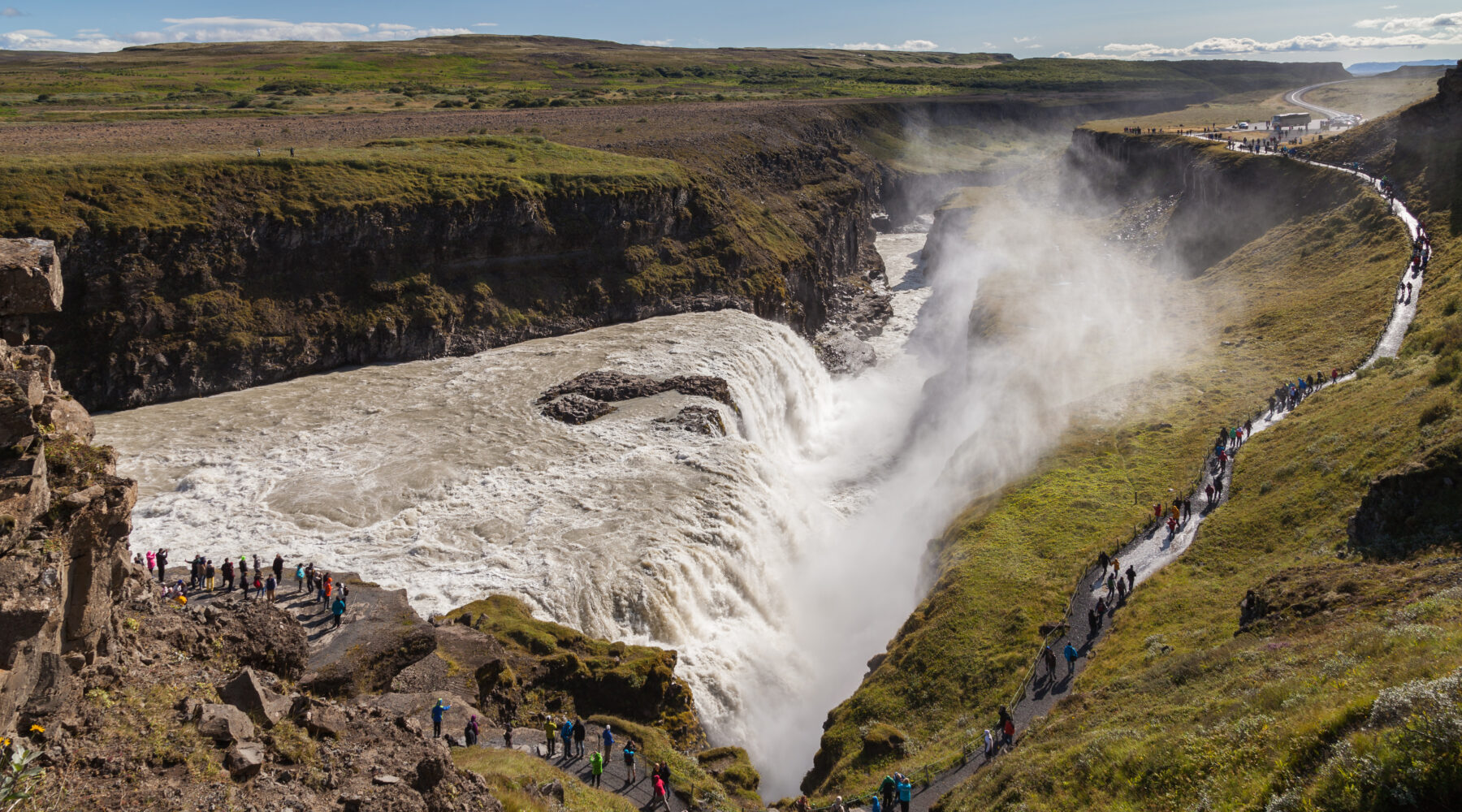
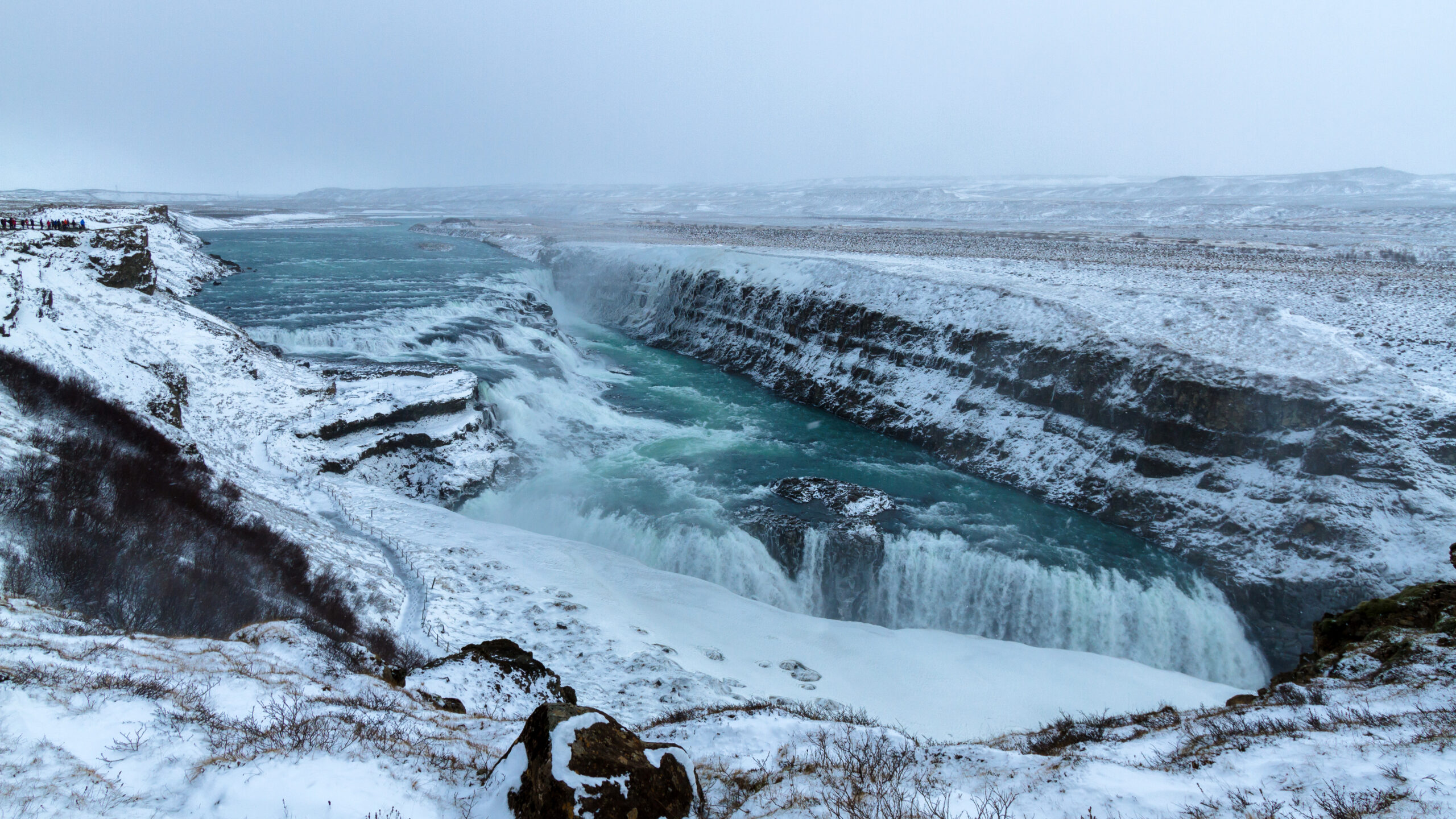
Pull into the car park at Gullfoss waterfall and the first thing you notice is what you can’t see. There’s a flat, open plain, a glacier on the horizon and, somewhere in the middle, a cloud of spray and a low roar. The river seems to vanish into the ground. Only when you reach the edge does it make sense: the Hvítá drops down two steps, turns almost at a right angle and plunges into a narrow canyon that you can only half see from above. Gullfoss, the “Golden Falls”, is the most famous waterfall in Iceland and the last big stop on the classic Golden Circle. Below we cover how to get there from Reykjavik, where to park, which viewpoints are worth your time, what Gullfoss is like in winter and why a stone by the path carries the face of a woman without whom this would probably be a reservoir today.
Gullfoss waterfall at a glance
- There’s no entrance fee and the falls are open around the clock. It’s public land with no gate and no ticket office. The café, shop and toilets in the visitor centre are open daily from 9:30 to 18:30.
- Parking was free at the time of writing, in both the upper and the lower car park. In the autumn, though, there were reports that charges had started, so check the signs at the entrance.
- A fee may arrive from May 2027. The Icelandic government has proposed an annual pass covering Geysir, Gullfoss and Þingvellir for around 4,500 ISK (about £27) for adults who aren’t tax-resident in Iceland. For now it’s only a draft bill.
- Reykjavik is 115 to 125 km away (roughly 70 to 80 miles) depending on the route, which is about 1 hour 45 minutes by car. The Strokkur geyser is only 10 km away. The road is paved all the way and you don’t need a 4×4.
- The waterfall has two drops of 11 and 20 metres and falls into a canyon with walls up to 70 metres high. On average 109 m³ of water pass through every second, around 130 m³ in summer.
- Allow 30 to 90 minutes. The upper viewpoint takes half an hour; add the lower path down to the water and it’s closer to an hour.
- In winter the lower path is often closed because of ice. The upper viewpoint stays open, and a waterfall wrapped in ice is worth the trip even in January.
- Drones are banned unless you have permission from the protected area’s management.
Where Gullfoss waterfall is and how to get there
Gullfoss sits in south-west Iceland on the Hvítá (the “White River”), which flows out of Langjökull, the second-largest glacier in the country. It’s the point of the Golden Circle furthest from Reykjavik and also the place where the inhabited lowlands end. Beyond the waterfall, Route 35 carries on north as the Kjölur highland road (F35), which is passable only in summer and only in a 4×4. You can check current road conditions across Iceland at umferdin.is.
Flying in from the UK, you’ll land at Keflavík, so most people either spend a night or two in Reykjavik first or pick up a hire car at the airport and head straight inland. Either way, the last part of the journey looks the same.
By car. From Reykjavik, head east on the Ring Road (Route 1) and after about 47 km turn left onto Route 35, which takes you past the geyser area and right up to the falls. The alternative is to go via Þingvellir National Park and Laugarvatn, which is the route most people take when they drive the whole Golden Circle. The road is tarmac the whole way, and the people who run the café at the falls say plainly that any car will get you to Gullfoss. In winter, though, check the weather and road conditions before you set off, because wind and black ice can make this stretch unpleasant.
On an organised tour. No public bus runs to Gullfoss, so without a car your option is a Golden Circle day trip from Reykjavik. Plenty of companies run them all year, from full-size coaches to minibuses for small groups, and almost all of them combine Gullfoss with Geysir and Þingvellir. A full-day tour usually takes seven to eight hours. In winter we think it’s the sensible choice for anyone who hasn’t driven on snowy roads before.
By snowmobile. Snowmobile trips onto the Langjökull glacier start right from the upper car park at Gullfoss, where the operator picks you up in a special vehicle and drives you to the ice. That means you can easily combine a glacier ride with the waterfall on the same day.
| From | Distance | Driving time (approx.) |
|---|---|---|
| Geysir and Strokkur | 10 km | 10 minutes |
| Flúðir | 32 km | 35 minutes |
| Laugarvatn | 39 km | 35 minutes |
| Þingvellir | 60 to 70 km | 1 hour |
| Selfoss | 70 km | 1 hour 5 minutes |
| Hella | 83 km | 1 hour 15 minutes |
| Reykjavik | 115 to 125 km | 1 hour 45 minutes to 2 hours |
Gullfoss parking, entrance fee and facilities
There’s no entrance fee. Gullfoss is a state-managed nature reserve and, according to the people who run the café there, it’s public land open 24 hours a day, all year round. No gate, no turnstiles.
There are two car parks. The upper one is right next to the visitor centre. It’s the biggest and the busiest, and a short path leads from it to the upper viewpoint. The lower one is smaller, closer to the canyon and usually has more space; the path to the lower viewpoint starts here. A footpath links the two, so it doesn’t really matter where you stop. According to Guide to Iceland and the independent site gullfossiceland.com, both car parks were free at the time of writing, which makes Gullfoss one of the few big Golden Circle stops where you don’t pay anything (at Geysir parking costs around 1,000 ISK, about £6, through the Parka app). In the autumn, however, reports appeared that the café operators had started charging for parking. We couldn’t find official confirmation, so look at the signs as you drive in. In Iceland you normally pay for parking through an app or at a machine in the car park, not in cash.
What’s planned from 2027. In the autumn the Icelandic government published a draft bill on a nature and infrastructure fee (government announcement, in Icelandic). It would apply from 1 May 2027 at the three busiest state-run sites: Geysir, Gullfoss and Þingvellir. An annual pass would cost around 4,500 ISK (about £27) from June to October and 3,000 ISK (about £18) from November to May. Prices and conditions may still change, so check before you travel. It would be paid by everyone aged 18 and over who isn’t tax-resident in Iceland, and parking charges would end at the state-owned sites where the fee is collected. Until the bill is passed, treat it as an outlook rather than a certainty.
The visitor centre. By the upper car park there’s a building with a café, a restaurant, a souvenir shop and toilets. It’s run by the family that has farmed the neighbouring Brattholt farm for decades, and according to their website it’s open daily from 9:30 to 18:30. Hot food stops being served an hour before closing. The place is famous for its home-made soup, which the family started serving from a small green tent long before today’s building went up. From the café it’s about a three-minute walk along a boardwalk to the falls.
Rules in the protected area. Gullfoss has been protected since 9 March 1979, and the reserve covers 154.9 hectares. Stick to the marked paths, don’t pick plants or disturb animals, and remember that drones are banned unless you have a permit from the management. Off-road driving is illegal everywhere in Iceland, and here doubly so.
Where to stay near Gullfoss waterfall
You can’t stay right at Gullfoss waterfall; the nearest accommodation is on farms and in small hotels in the surrounding area. If you’re doing the Golden Circle as a day trip from Reykjavik, you don’t need to sleep nearby. We’d still spend at least one night out here, though, because then you can be at Gullfoss before nine in the morning, when the car park holds a handful of cars instead of coaches, and in the evening you can step outside under a properly dark sky, where in winter you have a decent chance of seeing the northern lights.
Closest to the falls. Hotel Gullfoss stands a few kilometres from the waterfall, and there are several more hotels and guesthouses a little further towards Geysir. The choice is small and rooms sell out quickly in summer, so book well ahead here.
Flúðir is about 35 minutes south: a small village with the Secret Lagoon hot spring pool. It works well if you want Gullfoss and Geysir within easy reach and plan to carry on south the next day. You can compare places to stay in Flúðir here.
Laugarvatn is a lakeside village halfway between Þingvellir and Gullfoss and, in our view, the most practical base for the whole Golden Circle. It has the Fontana geothermal baths and a few hotels and guesthouses: places to stay in Laugarvatn.
Selfoss is the largest town in the area, an hour’s drive from the falls, with supermarkets, petrol stations and the widest range of reasonably priced accommodation. It makes sense if you’re continuing along Route 1 to the south coast after the Golden Circle: places to stay in Selfoss.
Reykjavik is the easiest option if you’re going on an organised tour, because the coaches pick up in town: places to stay in Reykjavik. For ideas on what to do in the city between trips, see our guide to things to do in Reykjavik.
The best viewpoints at Gullfoss waterfall
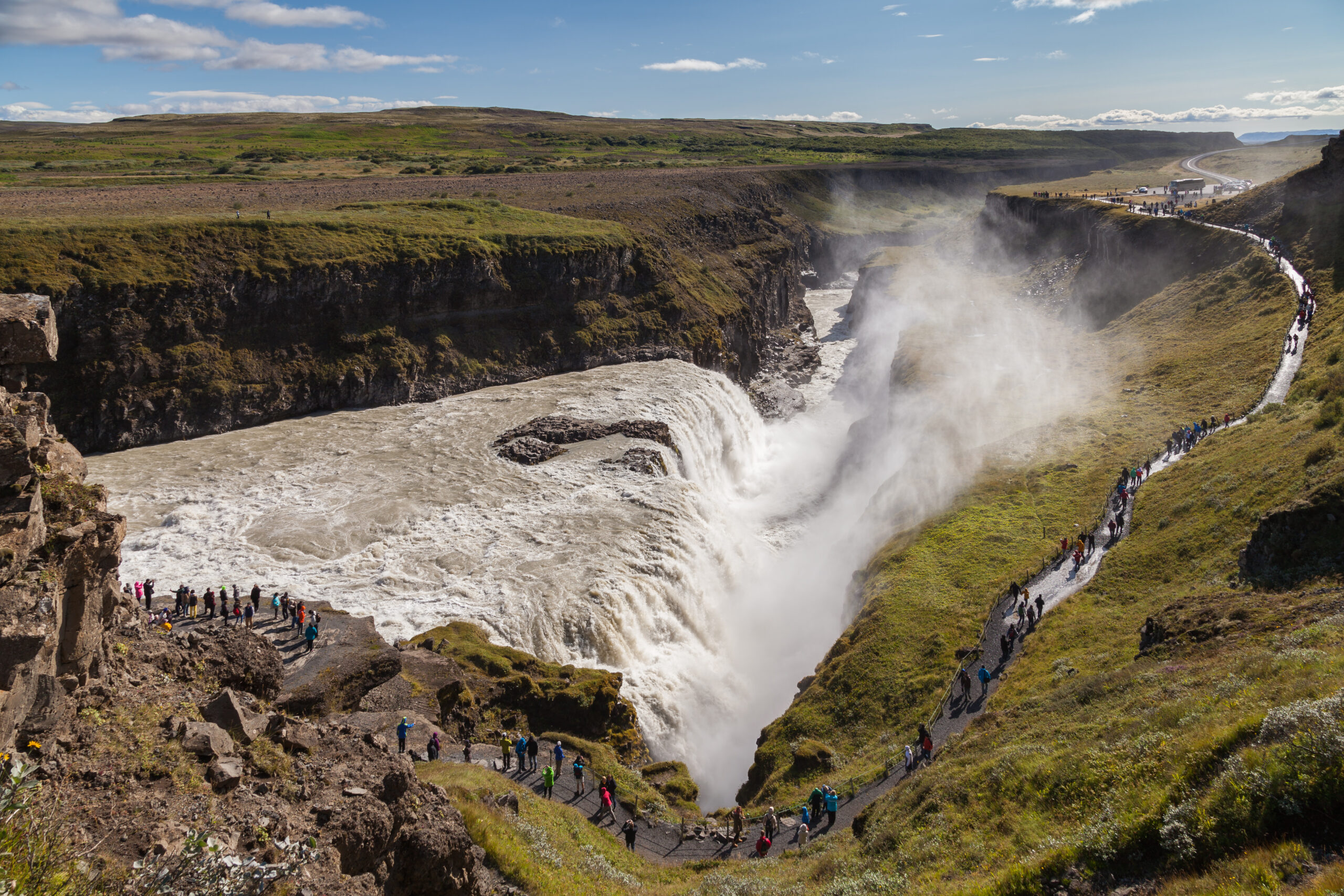
You can’t see all of Gullfoss from one spot, and that’s the best thing about it. The two drops are set at an angle to each other and the lower part disappears into a canyon you can barely see into from the top, so every viewpoint shows you a slightly different waterfall. On the west bank, where the car parks and the visitor centre are, there are three main spots; on the east bank there’s one quiet place with no facilities at all.
The upper viewpoint by the visitor centre
This is the classic postcard panorama: both drops, the canyon and, on a clear day, the Langjökull glacier on the horizon. A surfaced path and wooden boardwalks lead to it, so you can manage it with a pushchair and, according to Guide to Iceland, usually in a wheelchair too. It’s open all year. On a sunny afternoon this is where you’re most likely to see a rainbow in the spray. If you only have ten minutes, this is enough.
The lower path and the rock platform by the water
From the upper viewpoint, steps lead down to a path along the canyon that ends on a rocky spur right above the first drop. This is where you really feel the force of Gullfoss: the spray soaks you in minutes, the roar drowns out conversation and the water rushes past almost within arm’s reach. It’s our favourite spot, because from the top Gullfoss is a picture, while down here it’s an experience. Bring a waterproof jacket and a cover for your camera. The only way down is by the steps, and in winter or bad weather the path is often closed when the wet rock ices over. It pays to trust the signs at the top.
The canyon edge
The path between the two car parks gives you a side view into the Gullfossgljúfur canyon, where the river disappears after the second drop. The canyon is about two and a half kilometres long and its walls rise up to 70 metres. From here you’ll understand why, from the car park, the water seems to vanish underground.
The east bank, where hardly anyone goes
The opposite bank has no paths, railings or café, but you can see into the first bend of the canyon and the basalt columns that are hidden from the west side. According to Guide to Iceland, you get there by taking Route 35 and then Route 30 over the bridge at the Brúarhlöð canyon, turning left after it onto Route 349 and following the signs for Gullfoss. From where you park, it’s a 20 to 30-minute walk to the falls. Allow around two and a half hours in total for this detour, including the drive. It’s one for people who’ve already seen Gullfoss once or want the falls without the crowds; we don’t recommend it in winter.
Why Gullfoss is golden and how it formed
Gullfoss waterfall takes its name from its colour. The Hvítá carries fine glacial sediment down from Langjökull, and when low sunlight shines through the spray and the cloudy water, it turns a golden brown. On an overcast day you won’t see it: the water looks greyish white instead, and in winter it even turns turquoise. That’s no reason to be disappointed, though, because what makes Gullfoss is its power, not its colour.
The waterfall has two drops. According to the Environment Agency of Iceland, which manages the country’s protected areas, the upper one is 11 metres high and the lower one 20 metres (some sources say 21), so the total is usually given as around 32 metres. The falls are roughly 70 metres wide. On average 109 m³ of water flow over them every second, rising to about 130 m³ in summer when the glacier melts. In the biggest floods on record, the figure reached 2,000 m³ per second. You’ll often read that Gullfoss is “the most powerful waterfall in Europe”. We’d be careful with that claim: the title of Iceland’s and Europe’s most powerful waterfall usually goes to Dettifoss in the north of the island, and Gullfoss is more famous than it is powerful.
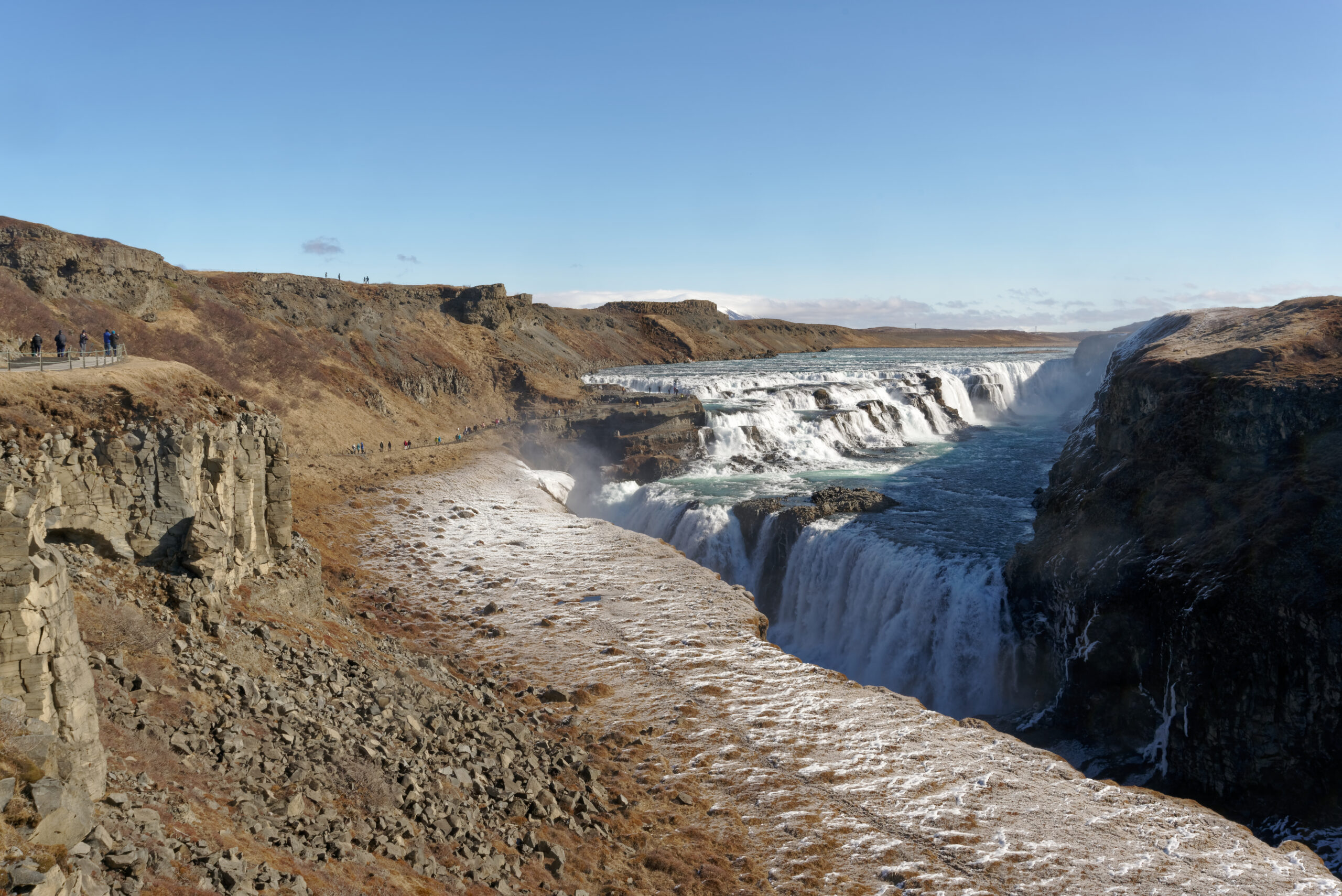
Geologists still argue about exactly how the canyon formed, and the protected-area management describes two theories. According to the first, it was carved out by huge glacial floods (jökulhlaup in Icelandic) at the end of the Ice Age, when a glacial lake on the Kjölur highlands burst some 9,000 to 10,000 years ago. A single day of such a flood would, by the agency’s reckoning, equal the amount of water that passes through Gullfoss in five years today. The second theory, which the agency considers more likely, is that the river cut the canyon gradually once the glacier began to retreat. Either way, the layers of coarse gravel and conglomerate between the hard basalt sheets are the reason the waterfall is eating its way upstream relatively quickly.
Sigríður Tómasdóttir, the woman who saved Gullfoss
At the start of the 20th century, foreign investors wanted to use Gullfoss to generate electricity. According to the protected-area management, in 1907 an Englishman offered the owner of the waterfall, farmer Tómas Tómasson of Brattholt, 50,000 krónur for Gullfoss. Tómas turned him down with a line Icelanders still remember: “I will not sell my friend.” Later that same year, however, the landowners along the river, Tómas included, leased the waterfall to foreign buyers after all.
Tómas’s daughter Sigríður, born at Brattholt on 24 February 1871, refused to accept it. She paid a lawyer in Reykjavik out of her own savings and, so the story goes, walked to the capital several times, more than a hundred kilometres on the tracks of the day, to follow the case. Her legal adviser was Sveinn Björnsson, who later became Iceland’s first president. She is even said to have threatened to throw herself into the waterfall the moment construction began. In the end she lost in court. What saved the waterfall was something far more mundane: in 1928 the lease payments stopped and the contract lapsed.
In 1945 the Icelandic state bought Gullfoss, and in 1979 it became a protected area. Sigríður died in 1957 in Hafnarfjörður at the age of 87 and is buried at nearby Haukadalur, by the geysers. Today she is remembered as Iceland’s first environmentalist.
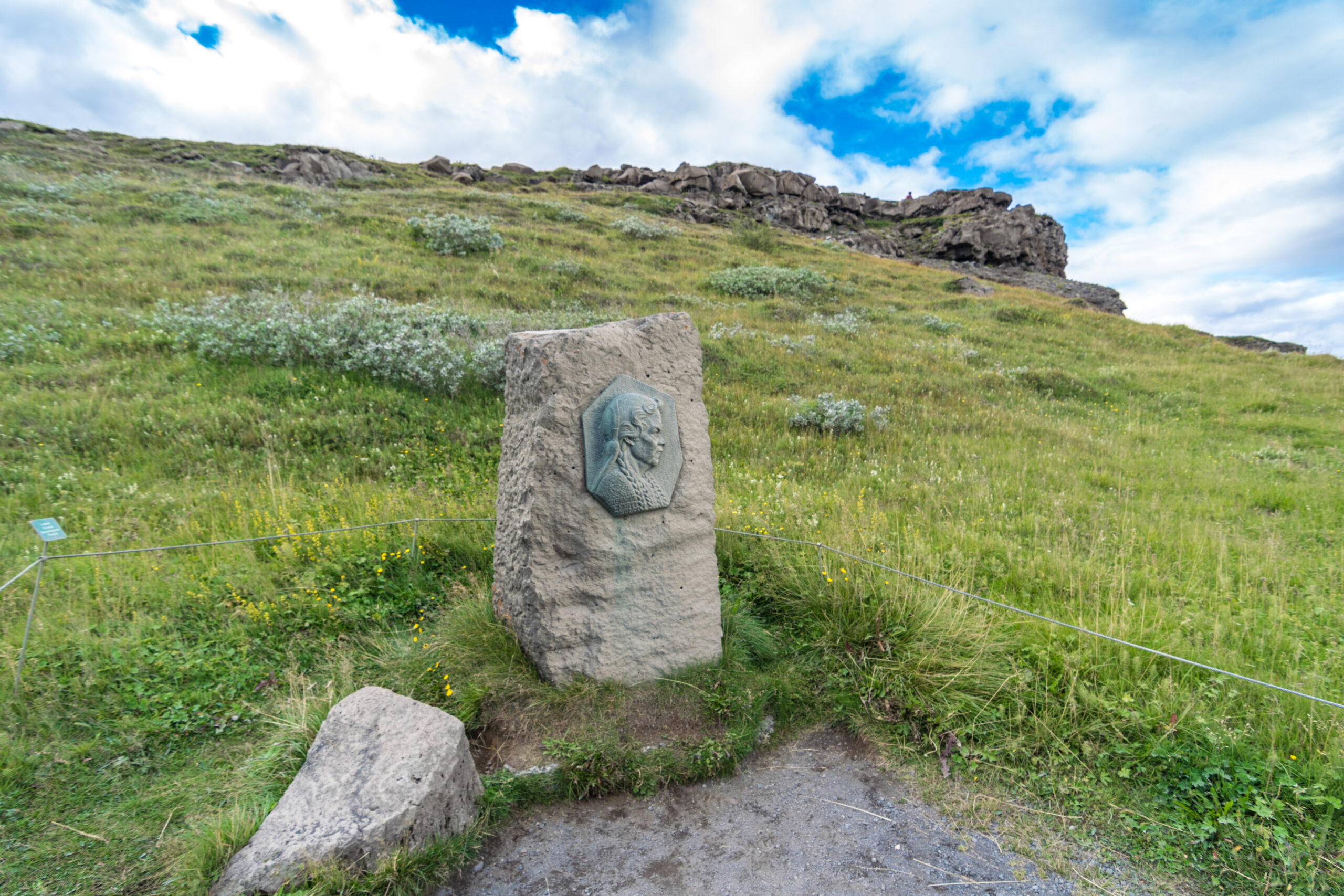
The memorial stone with her relief has stood beside the path since 1978. It’s small, and most people walk straight past it without stopping. We always stop, because without that stubborn farmer’s daughter there would most likely be a dam here today instead of a waterfall.
When to visit Gullfoss
Gullfoss is open all year, and every season shows you a different waterfall. It’s less about when it’s “at its best” and more about what you want from the trip.
Summer (June to August). The glacier is melting, so the most water is pouring over the falls, both viewpoints are open and on sunny days the spray throws up rainbows. It’s also the busiest time. According to Guide to Iceland, tour coaches arrive mainly between 10:00 and 15:00, and we’d avoid that window. Thanks to the light nights you can easily turn up at eight in the evening and have the place almost to yourself.
Spring and autumn (May, September and October). Fewer people, low sun that brings out the golden colour of the water best, and in September and October the first chance of the northern lights. If we had to pick one time of year for the Golden Circle, it would be September.
Winter (November to March). Shells of ice build up around the falls, the canyon walls freeze into white curtains and the water beneath runs turquoise. It’s a completely different Gullfoss, and we like it almost more in winter than in summer. It does come with conditions, though. In December, south Iceland gets only four to five hours of daylight, the lower path is often closed, the paths are slippery and the wind on the open plain can be so strong you can hardly stand. The waterfall never freezes over completely, but its edges and the surrounding rocks do.
💡 Pack microspikes in winter. These spiked over-shoe grips take up almost no space in your luggage, and at Gullfoss they’re the difference between a relaxed walk and a balancing act on ice. The paths from the car park are usually maintained, but by the viewpoint the spray freezes the instant it lands. Before you go, check the forecast at vedur.is and the alerts at safetravel.is, which also lists road closures due to high winds.
Staying safe at the falls
Gullfoss has better safety measures than most natural sites in Iceland, but it’s still a wild river in a deep canyon. A few things worth sticking to:
- Don’t climb over ropes or railings. The barriers aren’t there for decoration: the canyon edges are made of crumbly rock, and the grass near the drop is slippery even in summer.
- Hold children by the hand, especially on the lower path and the rock platform. A fall into the canyon would almost certainly be fatal.
- Respect closures. If the lower path is shut, it’s because of ice or wind, not maintenance.
- Expect to get wet. On the lower path the spray will soak you even on a sunny day. A waterproof jacket and shoes with a good grip are essential kit at Gullfoss, not a luxury.
- Watch the wind when opening your car door in the car park. A gust can bend the door back, and basic hire car insurance often doesn’t cover that kind of damage.
Gullfoss waterfall and the Golden Circle
Gullfoss is the third of the three main stops on the Golden Circle, Iceland’s best-known sightseeing route. The other two are the Haukadalur geothermal area with the Geysir and Strokkur geysers, just ten minutes’ drive from the falls, and Þingvellir National Park, where the North American and Eurasian plates are pulling apart and where Iceland’s ancient parliament once met. You can drive the whole loop from Reykjavik in a day, but we find it works better spread over two days, with a night somewhere around Laugarvatn or Flúðir.
While you’re at Gullfoss, it’s worth adding a few smaller stops nearby. Kerið, a volcanic crater with a lake at the bottom, sits by Route 35 on the way to Selfoss. In Reykholt you’ll find the Friðheimar greenhouse, where tomatoes are grown with geothermal energy and turned into soup served right among the plants. Efstidalur farm near Laugarvatn makes its own ice cream from the milk of the cows you can watch through a glass wall. And the Secret Lagoon hot spring pool in Flúðir is a lovely place to soak away the chill after a day in the wind.
What we’d do differently
Gullfoss is one of the few places in Iceland where the tourist-crowd experience and genuine wilderness sit side by side within a hundred metres. From the upper viewpoint it looks like a coach stop with a café; a few steps further down you’re standing in the spray, feeling the rock shake. Most people get off the coach, take a photo from the top platform and are gone within twenty minutes. Don’t do that. Walk down, let yourself get soaked, then sit on a bench and just watch the water breaking into the canyon for a while.
Don’t try to tick off the Golden Circle in a single afternoon. You can fit all three main sights into one day, but you’ll only get about half an hour at each. Better to drop something from the list and be at Gullfoss in peace early in the morning or late in the evening, when it’s quiet.
And try things. Taste that famous soup in the café, even if it seems expensive, have an ice cream at the farm where the cows are milked, and pull over at the turn-off that looks like nothing much. In Iceland, “nothing much” often turns out to be the best part of the day. And if the northern lights flare up over Gullfoss in winter, leave your phone in your pocket for at least a few minutes. The photos will never be as good as the memory.
Frequently asked questions
Is there an entrance fee for Gullfoss waterfall?
No. Gullfoss is a public protected area open 24 hours a day all year round, and there is no entrance fee. However, the Icelandic government has proposed an annual pass for Geysir, Gullfoss and Þingvellir from 1 May 2027, costing around 4,500 ISK (about £27) in the main season and 3,000 ISK (about £18) in winter, for adults who aren’t tax-resident in Iceland. For now it’s only a draft bill.
Do you have to pay for parking at Gullfoss?
According to the guidebooks, both car parks, the upper one by the visitor centre and the lower one closer to the canyon, were free at the time of writing. In the autumn there were reports that the café operators had started charging for parking, but we couldn’t find official confirmation. Check the signs at the entrance when you arrive.
How far is Gullfoss from Reykjavik?
Between 115 and 125 kilometres (roughly 70 to 80 miles) depending on the route, which takes about 1 hour 45 minutes to 2 hours by car. The fastest way is east on Route 1 and then along Route 35 past the geyser area. From Geysir and Strokkur, the waterfall is only 10 kilometres away.
Can you get to Gullfoss by bus?
No public bus runs to Gullfoss. Without a car, the only way to get here is on an organised Golden Circle tour from Reykjavik, which usually takes seven to eight hours and also stops at Geysir and Þingvellir National Park.
How long do you need at Gullfoss?
Half an hour is enough for the upper viewpoint; with the lower path down to the water, allow about an hour. Add the café and a walk between the two car parks and it’s around an hour and three quarters. A trip to the quiet east bank takes roughly two and a half hours, including the drive.
How tall is Gullfoss waterfall?
Gullfoss has two drops. The upper one is 11 metres and the lower one 20 metres (some sources say 21), with the total usually given as around 32 metres. The water plunges into the Gullfossgljúfur canyon, which is about 2.5 kilometres long with walls up to 70 metres high.
Why is Gullfoss called the Golden Falls?
The Hvítá river carries fine sediment from the Langjökull glacier. When the sun shines through the spray and the cloudy water, it turns a golden brown. The effect is strongest when the sun is low in spring and autumn; on an overcast day the water looks greyish white.
Is Gullfoss open in winter?
Yes. The waterfall is accessible all year, and the upper viewpoint stays open in winter. The lower path down to the water, however, is often closed because of ice and wind. The road is paved and maintained, but check the weather at vedur.is and road conditions at umferdin.is before you set off, and take microspikes for your shoes.
Where next
- Things to do in Reykjavik: the capital, where most Golden Circle tours start.
- Blue Lagoon Iceland: the country’s most famous geothermal spa, and how it compares with cheaper alternatives.
- Geysir and Strokkur: a geyser that erupts every few minutes, ten minutes’ drive from Gullfoss.
- Þingvellir and Silfra: a national park on the rift between two continents, with snorkelling in crystal-clear glacial water; the third stop on the Golden Circle.
- Skógafoss: another big waterfall, this time on the south coast right by Route 1.
- Landmannalaugar: colourful mountains and hot springs in the highlands, reachable in summer.
Potřebujete pomoct s cestováním?
-
Ubytování 🏨
Vyberte si to nejlepší ubytování, ať už jste kdekoliv, přes Booking.com. -
Půjčení auta 🚗
Auto si snadno najdete přes Booking.com, kde máte často slevu díky ubytování, nebo Rentalcars.com, kde porovnáte nabídky většiny půjčoven. -
Zážitky 🎟️
Přes GetYourGuide.com si vyberete z nejrůznějších výletů i zážitků po celém světě, navíc se zrušením zdarma do 24 h předem.