Last updated 27.11.2026
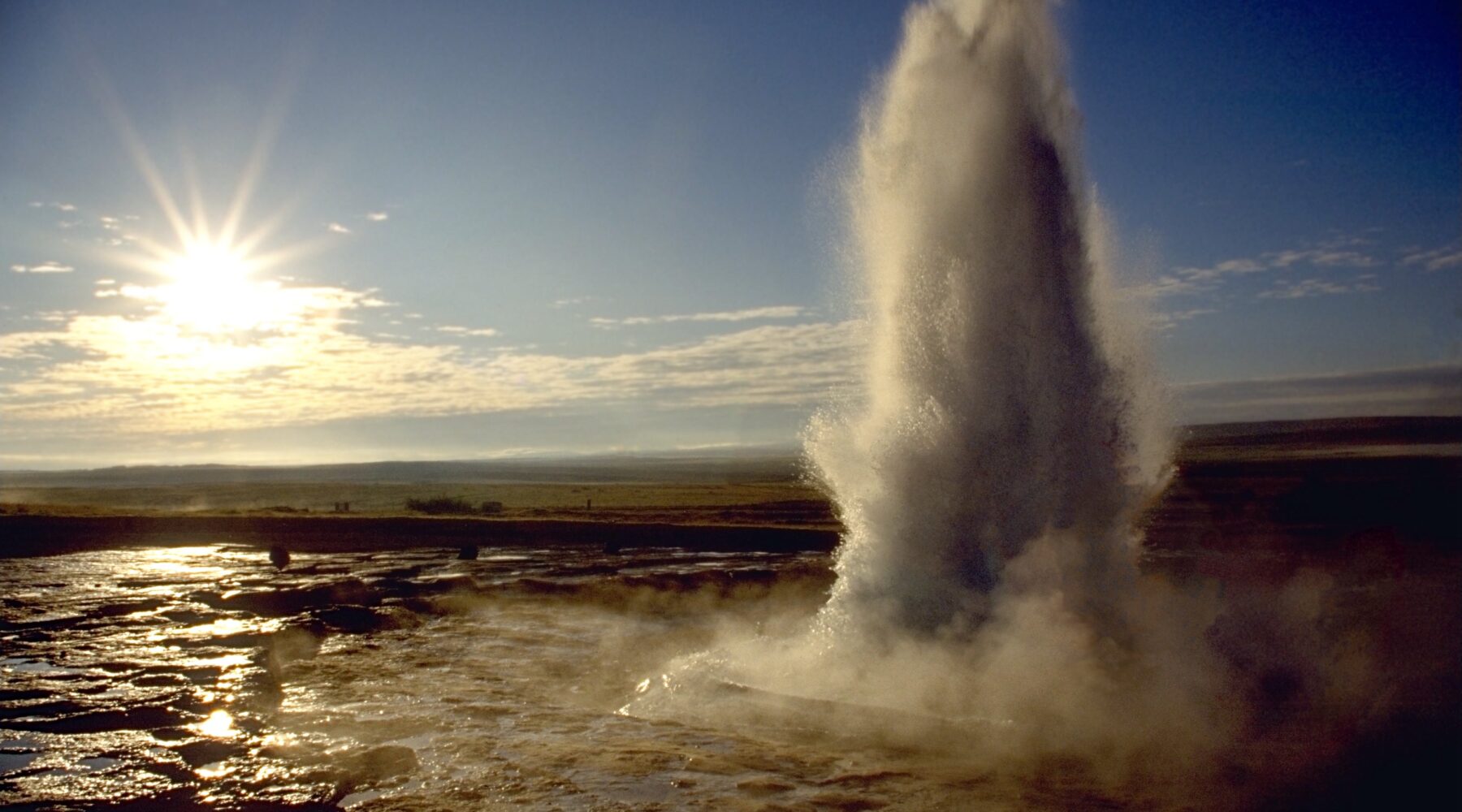
Every geyser on the planet, from Old Faithful in Yellowstone to the ones in New Zealand, is named after a single hot spring in a quiet Icelandic valley. The original Geysir sits in Haukadalur, and its name comes from the Icelandic for “the gusher”. The irony is that it hardly gushes at all these days. The show is run by its next-door neighbour, the Strokkur geyser, which fires a column of boiling water into the sky roughly every five to ten minutes and reliably gets a round of applause even from people who only got off the coach to find the toilets.
The Geysir geothermal area is one of the three classic stops on the Golden Circle and probably the most entertaining of them. The waterfall and the rift between the continents are beautiful, but here something happens every few minutes, and you find yourself standing with your phone up, waiting for the next one. Below we cover how to get to Haukadalur, what parking costs, what else there is to see on the geothermal field besides Strokkur, why the Great Geysir went to sleep, how to stay safe and where to spend the night nearby.
Strokkur geyser and Geysir at a glance
- Where it is: the Haukadalur valley in south-west Iceland, on Route 35. It’s 107 to 115 km (66 to 71 miles) from Reykjavik depending on the route, about an hour and a half’s drive. Gullfoss is only 10 km away, Þingvellir about 60 km.
- Strokkur erupts every 5 to 10 minutes, usually to a height of 15 to 20 metres and occasionally up to around 40 metres. You never have to wait long.
- The Great Geysir is asleep. Earthquakes in 2000 briefly woke it up and its last eruption was in 2016. Today it’s mostly a calm, steaming pool you can walk around.
- The geothermal area is free to enter and open around the clock. Parking is not: around 1,100 ISK (about £7) for a car for 8 hours, paid through Parka.
- You must pay within 24 hours of leaving. Forget, and you’ll be charged roughly 1,500 ISK (about £9) on top, billed to the owner of the car, which for a hire car means via the rental company.
- The water is around 100 °C at the surface. Stay behind the ropes, don’t throw anything into the springs and watch the wind during an eruption, because the spray can carry a long way.
- Since 17 June 2020 the whole field has been a protected natural monument (1.2 km²). It belongs to the state and rangers patrol it all year.
- From May 2027 there may be an entry fee. The government has proposed an annual pass covering Geysir, Gullfoss and Þingvellir for about 4,500 ISK (around £27). For now it’s only a bill, not law.
Where the Strokkur geyser is and how to get there
Strokkur and the Great Geysir lie in the Haukadalur valley, at the foot of a low hill called Laugarfjall, in the south-west of Iceland. Flying in from the UK, you’ll land at Keflavík, and most people either spend a night or two in Reykjavik first or collect a hire car at the airport and drive straight out. From Reykjavik there are two paved routes and both take about an hour and a half. The northern one runs through Þingvellir National Park on Route 36 and is about 107 km long. The southern one follows the Ring Road (Route 1) via Hveragerði and turns onto Route 35 near Selfoss, around 115 km in total. If you’re doing the Golden Circle, it makes sense to take one route out and the other back.
From Geysir it’s 10 km (6 miles) to Gullfoss waterfall, about 60 km back to Þingvellir, 30 km to the Kerið crater and about 65 km to Selfoss. There’s a petrol station by the geothermal area, and it’s the last one before the Kjölur highland road, so if you’re heading on into the interior, fill up here.
By car
Driving is the easiest option and gives you the most freedom. In summer an ordinary car is fine: both routes are paved and well signposted. In winter Route 35 can be icy and, in strong wind, properly slippery, so before you set off check umferdin.is (road conditions) and safetravel.is (warnings and closures). In winter we’d leave Reykjavik in daylight and bear in mind that around the winter solstice Iceland only gets a few hours of light a day.
On an organised tour
Geysir is on practically every Golden Circle day trip from Reykjavik. The coaches usually stop at all three main sights and hotel pick-up is often included. The catch is that your time at the geysers is fixed, and it’s usually enough for a few Strokkur eruptions and a quick walk around the field. Prices vary with group size and with what’s bundled in (a swim, snorkelling in Silfra, snowmobiling), so compare them directly with the operators.
By public transport
This is the weak spot. There’s no regular scheduled bus that runs all the way to the geysers as standard, and Strætó’s rural routes in south Iceland stop in the surrounding villages. They’re also being cut back further because of low use. Without a car or a tour, getting here is awkward, and you risk having no way back in the evening.
Geysir parking and entrance fee
The geothermal area itself is free and open 24 hours a day. Nobody charges you to watch Strokkur. You do pay for the car park, through the Parka system, and the price includes the toilets. Older guidebooks often say parking at Geysir is free; that’s no longer the case.
There’s no barrier and no ticket machine. You pay online at parka.is or in the Parka app: enter your number plate, the vehicle size and an email address for the receipt. You have 24 hours after leaving to pay. Vehicle size is based on the number of registered seats, so a motorhome with eight or more seats already counts as a minibus.
| Parking at Geysir | Price in ISK (approx.) | Roughly in £ |
|---|---|---|
| Motorbike | around 400 ISK | £2.50 |
| Car, up to 7 seats | around 1,100 ISK | £7 |
| Minibus, 8 to 21 seats | around 2,500 ISK | £15 |
| Transaction fee | around 100 ISK | 60p |
| Surcharge if not paid within 24 hours | roughly 1,500 ISK | £9 |
Prices change, so check them on parka.is before you go. The fee applies to every eight hours in the car park. You can’t stay the night here: the car park is open around the clock, but sleeping in a car or campervan is explicitly banned.
💡 Pay as soon as you’ve parked. The most common mistake at Icelandic car parks that use Parka is simply forgetting to pay and only remembering when the surcharge of around 1,500 ISK arrives, which with a hire car comes through the rental company and on its terms. Paying takes a minute and you can do it standing next to the car.
The planned entry fee from 2027
The Icelandic government recently published a bill for a nature and infrastructure fee that would cover Geysir, Gullfoss and Þingvellir National Park. Adults aged 18 and over who aren’t tax-resident in Iceland would buy an electronic pass with a QR code for about 4,500 ISK (around £27) a year, or about 3,000 ISK (around £18) between 1 November and 31 May. Parking charges at the state-run sites covered by the new fee would be scrapped. The proposed start date is 1 May 2027, but this is still a proposal, not an approved law (Iceland Review). If you’re travelling to Iceland in 2027, check whether it applies before you go.
Where to stay near the Strokkur geyser
Geysir is at the far end of the Golden Circle, about an hour and a half from Reykjavik, so staying here or close by makes sense if you want to see the geysers without the crowds and carry on to Gullfoss or further south the next morning. Two hotels stand right opposite the geothermal area.
Hotel Geysir is a four-star hotel that opened in August 2019, with 77 rooms and 6 suites. It’s the most comfortable and the most expensive option in the area, and its Geysir restaurant also has a rooftop section, Geysir Rooftop. Smaller and cheaper is Litli Geysir Hotel, with 22 rooms, some of them looking straight out over the geothermal field. Both are a few minutes’ walk from Strokkur, so you can catch an eruption before breakfast.
Below the southern slope of Laugarfjall there’s a campsite run by Hotel Geysir. It’s seasonal, open roughly from mid-May to mid-September, and outside those months you shouldn’t count on it. This matters most if you’re in a campervan, because you’re not allowed to sleep in the geyser car park.
About 15 minutes’ drive away is Farmhotel Efstidalur, with a restaurant and home-made ice cream. If you don’t mind a bit of driving, the surrounding villages have more choice: places to stay in Laugarvatn sit between Geysir and Þingvellir, places to stay in Flúðir suit you if you fancy the Secret Lagoon in the evening, and places to stay in Selfoss make the best base if you’re carrying on to the south coast after the Golden Circle.
When to visit Geysir
Strokkur erupts all year round, in July just as in January, so the season mainly matters for the roads, the daylight and the crowds. The busiest time is June to August, especially in the afternoon, when the coaches from Reykjavik all converge. Mornings and evenings are much quieter.
Our favourite time here is early morning or late evening in summer, when it’s still light but the tours are already back in town. Instead of two hundred people around Strokkur there are a handful, and you can hear the water bubbling in the vent before it goes. Winter has its own appeal: in frost the steam is much thicker, the column of water disappears into it and the whole field looks as if it’s on fire. Just expect ice on the paths, so microspikes or at least boots with a good grip come in handy.
| Season | What to expect at Geysir |
|---|---|
| June to August | Biggest crowds, long days, a full car park in the afternoon. The campsite and most services are open. |
| September and October | Fewer coaches, autumn colours in the nearby forest, the first chance of seeing the northern lights in the evening. |
| November to March | Short days, icy paths, thick steam. Route 35 can be icy, so check umferdin.is. |
| April and May | Daylight increases fast and there are still fewer people. The weather can change within an hour. |
How long should you allow? For Strokkur, a walk up to the Great Geysir and the colourful springs, an hour is enough. If you want to climb Laugarfjall and have lunch, plan on two hours. We wouldn’t rush it, though: every eruption looks a little different, and the best one always comes just after you’ve put your phone away.
What to see in the Geysir geothermal area
The protected area covers 1.2 km² and is only a small part of Haukadalur’s hot zone, which measures about 3 km². Easy paths and roped-off trails run through it, so you can walk the whole thing in an hour. Besides the two famous geysers, steam hisses out of the ground, mud pots bubble and pools of boiling blue water sit between white crusts of geyserite. In places the ground is stained orange and ochre, and when the wind blows the right way, you can smell sulphur.
Strokkur, the geyser that never lets you down
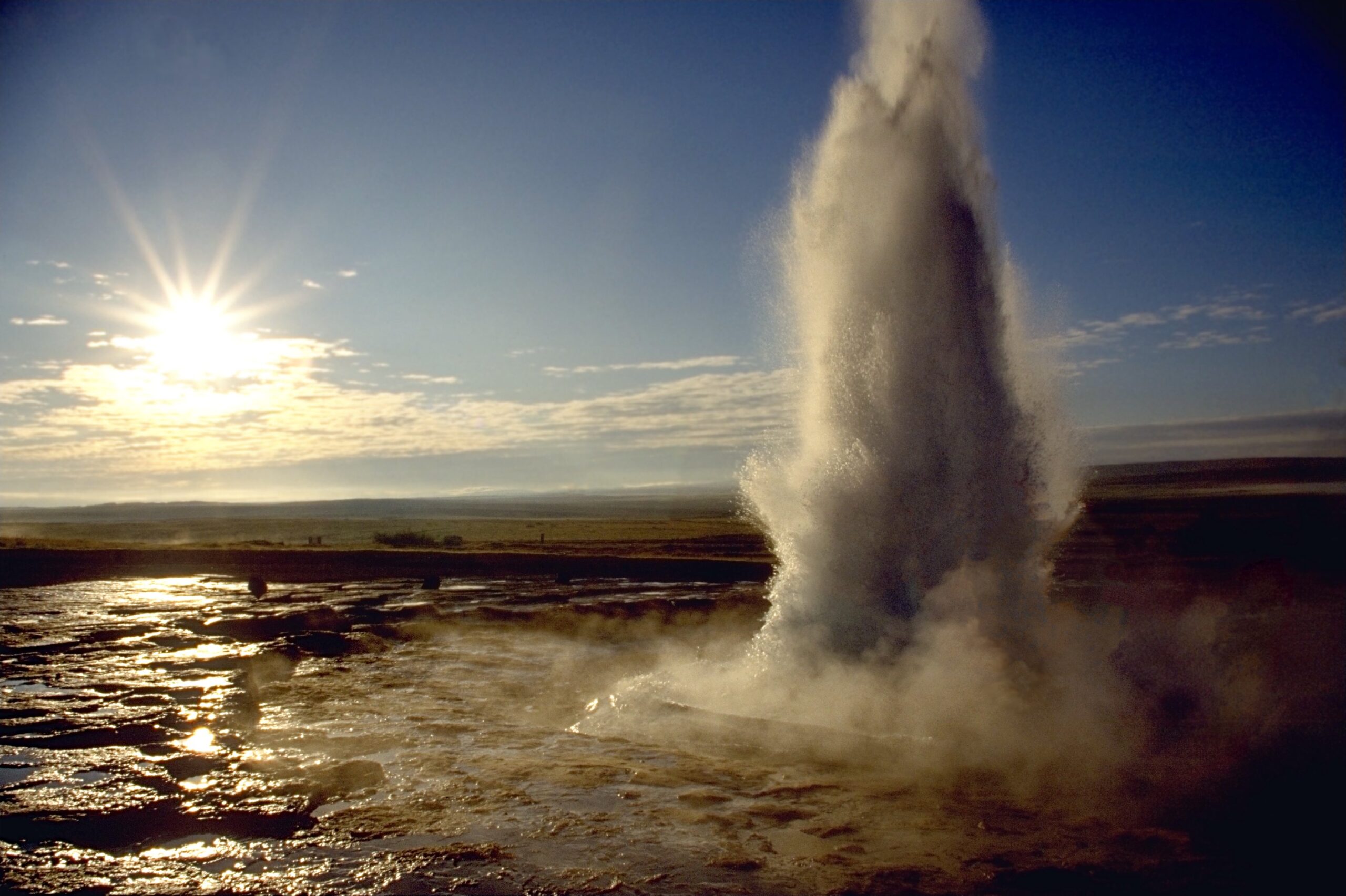
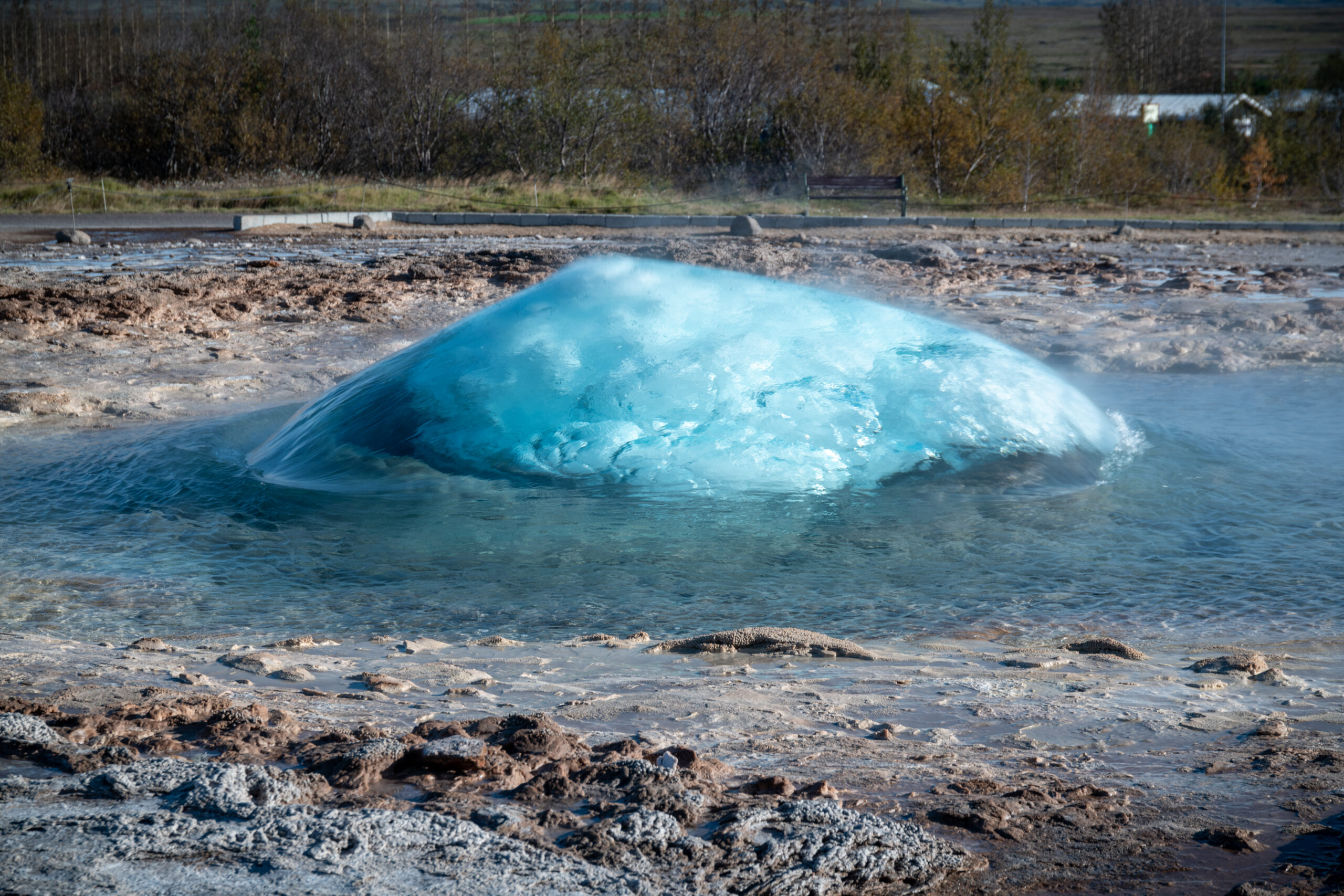
Strokkur means “the churn” in Icelandic, and once you’ve watched it build up to an eruption you’ll see why. The water in the vent rises and falls, boils, and then suddenly swells into a turquoise dome that for a split second looks like a glass bubble. Straight after that, a column of water and steam shoots up, usually 15 to 20 metres high and occasionally close to 40 metres. Sometimes there’s a single eruption, sometimes two or three in quick succession.
The gap between eruptions of the Strokkur geyser is usually five to ten minutes. There’s no predicting it exactly, so a semicircle of people with phones forms along the rope, and the moment the water starts to rise everyone goes quiet. We like to watch one eruption just with our eyes first and only then start taking pictures. The first time, you’ll press the shutter either too early or too late anyway.
Strokkur hasn’t always been this reliable. It was first described in 1789, after an earthquake opened up its feeder channel. Around the turn of the 20th century another earthquake blocked it again and the geyser fell silent. In 1963 locals cleared out its vent on the recommendation of Iceland’s Geysir committee, and it has erupted regularly ever since.
The Great Geysir, the grandfather of all geysers
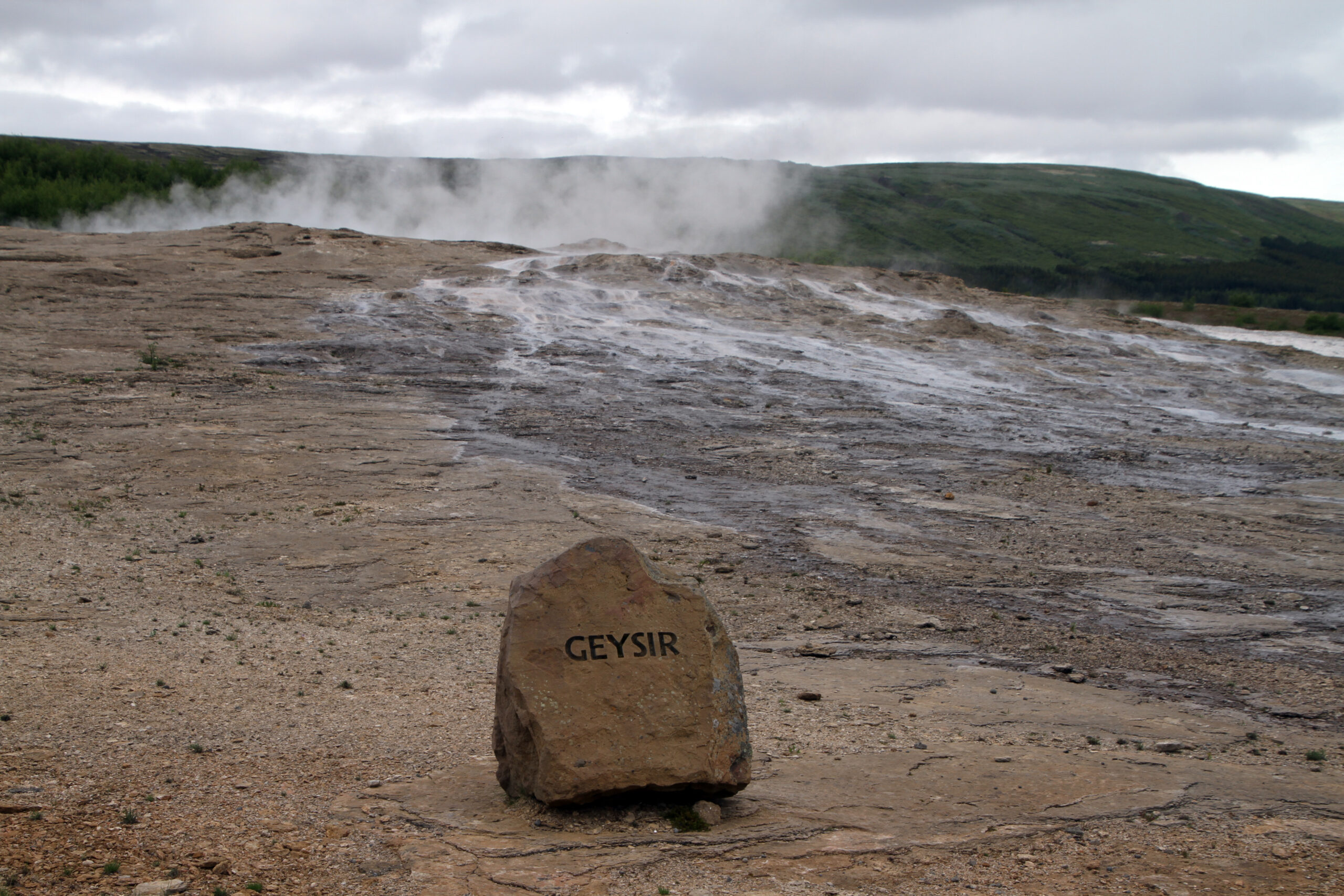
The Great Geysir (Stóri-Geysir in Icelandic, or just Geysir) lies only a few dozen metres north of Strokkur, on a gentle rise below Laugarfjall. Most of the time it’s a calm, round pool of hot water with steam drifting off it and water trickling over its rim across a white crust. If you don’t know what it is, you could easily walk straight past. Yet this is the spring that gave its name to every geyser in the world.
The vent is shaped like a funnel that narrows to a depth of about 23 metres. In the top ten metres the water is 85 to 95 °C, further down around 120 °C. Unlike Strokkur, Geysir empties between eruptions, so it needed much longer to “recharge”. Its last eruption was in 2016 and it has been asleep ever since.
Blesi, Konungshver and the other springs
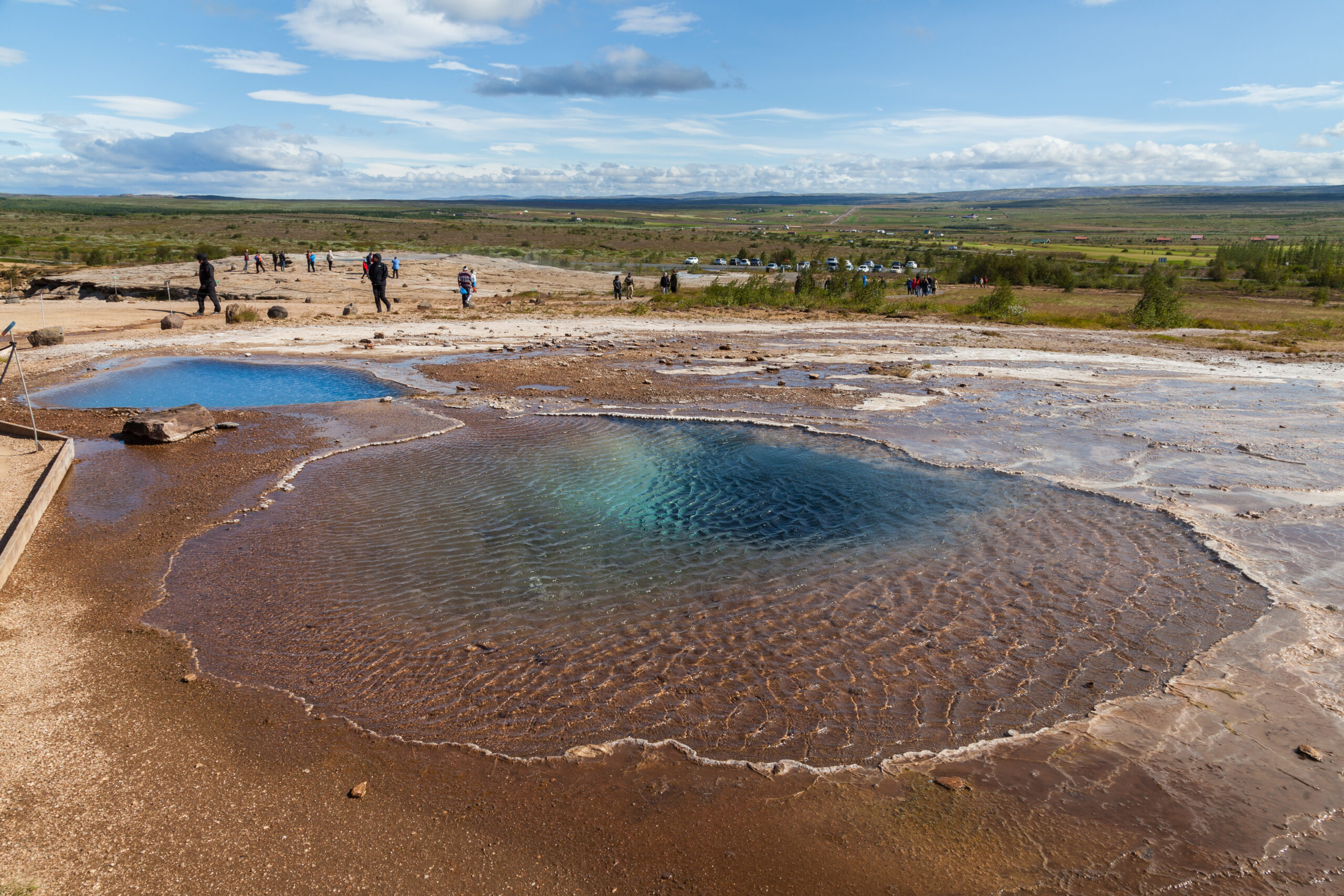
On the way from Strokkur to the Great Geysir you pass Blesi, a double spring made up of two pools. One is crystal clear and a luminous blue, the other opaque and boiling. It’s the most photogenic spot on the whole field, and on a still day the sky is reflected in it. Konungshver, the King’s Spring, was named after a royal visit and has a striking blue colour. Further across the field you’ll find Litli Geysir (Little Geysir), which bubbles constantly, plus smaller geysers and springs such as Smiður, Fata, Óþerrishola and Litli Strokkur. Most of them don’t erupt, but they boil, hiss and gurgle, which is arguably even stranger to watch.
At the southern end of the valley are the Þykkvuhverir springs with their bubbling mud pots, and a few minutes’ walk north of the geysers there are fumaroles surrounded by sulphur-stained ground. Water speedwell, a plant on Iceland’s list of endangered species, also grows between the springs. One more reason not to step off the paths.
Laugarfjall and the King’s Stones
Above the field rises Laugarfjall, a rhyolite hill 187 metres above the level of the springs. An easy circular trail with two viewpoints leads up it. From one you can see the entire geothermal area with the forest behind it, from the other the Helludalur valley and Bjarnarfell mountain. It’s exactly the view you don’t get from the paths below: suddenly you can see how the whole field fits together. If you fancy a longer walk, you can loop round Laugarfjall on the trail to the north and come back along the road.
At the foot of the hill are the Konungssteinar, the King’s Stones. They commemorate visits by three Danish kings: Christian IX in 1874, Frederick VIII in 1907 and Christian X in 1921. For the 1907 visit a so-called King’s Road was even built to carry the royal party to Geysir.
How Geysir gave us the word “geyser”: a short history
Geologists date the formation of today’s Geysir to around 1150. The first reliable record of hot springs in Haukadalur comes from a chronicle of 1294, when an earthquake created new ones. The name Geysir first appears in writing in 1647 and comes from the verb geysa, to gush. From Icelandic it passed into English as “geyser” and from there into many other languages.
The height of the eruptions changed a lot over the centuries. In the early 19th century Geysir erupted roughly every 30 hours, up to 30 metres high, and in 1846 the German chemist Robert Bunsen measured eruptions of 45 to 54 metres. After an earthquake in 1896 it reached 70 to 80 metres. The figure of 170 metres in 1845 that turns up in some guidebooks isn’t reliably documented.
Around 1916 Geysir fell almost completely silent. In 1935 a channel was dug into its rim to lower the water level, and the geyser woke up again for a while. Later, soap was poured into the vent to trigger eruptions, because it lowers the surface tension of the water, but the practice was dropped because of its impact on the environment. According to local information, the stones and objects that tourists threw in for decades also played their part in quietening it down.
The most recent big awakening came after the earthquakes in south Iceland in 2000. Geysir erupted again, according to some sources briefly to more than 100 metres, and then gradually weakened. Its last eruption was in 2016.
The story of who owned it is just as curious. In 1894 a Briton, James Craig, bought part of the field and charged admission. The very next year he gave it to a friend, who scrapped the fee. In 1935 the film-maker Sigurður Jónasson bought the field and donated it to the Icelandic nation. The state only bought the whole area, including the surrounding land, in 2016, and on 17 June 2020, Iceland’s National Day, it was declared a protected natural monument.
Staying safe at the geysers
Geysir looks like a park with neat little paths, and that’s exactly why people underestimate it. The water in the springs is around 100 °C at the surface and even hotter further down, and a scalding here can mean serious injury or death. Low ropes and signs around the springs are all the protection there is. The rest is up to you.
- Don’t cross the ropes or leave the paths. The crust around the springs can be thin, with boiling water or hot mud underneath. Protected plants also grow here and are destroyed when trampled.
- Don’t touch the springs or throw anything into them. Not coins, not pebbles. According to local information, the objects people threw in helped silence the Great Geysir.
- Watch the wind. When Strokkur erupts, the spray of hot water and steam drifts downwind. Stand so the wind is at your back rather than blowing from the geyser towards you. A wet camera lens is the first sign you’ve got it wrong.
- No bathing, and don’t drink the water from the springs. If you want a soak, there are natural pools and lagoons in the area.
- Watch out for ice in winter. The paths around the springs freeze over because steam and spray from the geyser keep wetting them.
- Hold on to children. The rope is low and kids can easily duck under it.
The whole area is a protected natural monument, managed and patrolled all year by Iceland’s state nature conservation agency. The rangers aren’t there for decoration, so if they tell you something, listen.
The Strokkur geyser and the Golden Circle
The Golden Circle is the best-known day trip from Reykjavik: a loop of roughly 300 km (about 190 miles) taking in three sights that you can cover in a single day. Geysir is its furthest point, and most people combine it with Gullfoss waterfall, just ten kilometres away, and with Þingvellir National Park and Silfra, where you can walk through the rift between two tectonic plates and snorkel in icy, crystal-clear water. We’d drive from Þingvellir via Geysir to Gullfoss and come back along the southern route through Selfoss, but the other way round works just as well. The main thing is not to arrive at Geysir right at midday.
What to see near Geysir
If you have time, there’s no need to leave straight after the last eruption. Right above the geysers begins Haukadalsskógur, one of the largest forests in south Iceland, planted as part of a reforestation project. Waymarked trails run through it, some of them step-free. The most popular follows the Svartagil gorge, where the forest’s tallest tree grows, and right next to it starts a loop to Gunnarslundur with a picnic spot by a stream. In a country where woodland is rare, it makes a pleasant change.
On the southern route along Route 35, the Faxi waterfall is worth a stop, and a little further on is the Kerið crater, about 30 km from Geysir. Flúðir has the Secret Lagoon hot springs, and Laugarás has the new Laugarás Lagoon, where it’s best to book your ticket in advance. And at Efstidalur farm you can stop for an ice cream.
What we’d do differently
Geysir is a place where it’s easy to get swept along by the crowd: park, walk over to Strokkur, film one eruption, back to the car and off to Gullfoss. That’s exactly what most tours do, and exactly what we wouldn’t do next time. In our view the best view of Strokkur isn’t from the front row at the rope but from a bit further back, at the edge of the field, where you can see the eruption over everyone’s heads and nobody’s elbow is digging into your back.
We’d climb Laugarfjall. The ascent is short and at the top there’s a calm you won’t find down below. From up there Strokkur looks like a small white cloud that puffs up every few minutes and then collapses again, and only from above can you see how the field connects with the surrounding meadows and forest.
We’d leave time for a meal and not rush off to the next stop. A bowl of Icelandic meat soup at the Geysir Center or an ice cream at one of the farms nearby is exactly the kind of stop that’s missing from most itineraries and that you end up remembering most.
And we’d watch at least one eruption without a phone. The moment the water swells into a blue dome lasts a split second, and on video it never looks the way it does when you’re just watching with your own eyes. Strokkur will go again in five minutes; the photo can wait.
Frequently asked questions
How often does the Strokkur geyser erupt?
Usually every five to ten minutes. You can’t predict an eruption exactly: sometimes it comes sooner, sometimes later, and now and then there are two or three in quick succession. If you stand by Strokkur for a quarter of an hour, you’re almost certain to see at least one eruption, more likely two.
How high does Strokkur erupt?
Most eruptions reach 15 to 20 metres, and some shoot up to around 40 metres. The height varies from one eruption to the next and also depends on the wind, which blows the column of water and steam apart.
Is the Great Geysir still active?
The Great Geysir is asleep. Its last eruption was in 2016; before that, the earthquakes of 2000 woke it up for a few years. In Iceland, though, geysers can come back to life after an earthquake, so it isn’t completely extinct. In the meantime its neighbour Strokkur, which erupts regularly, puts on the show.
Is there an entrance fee at Geysir?
Entry to the geothermal area is free and it’s open around the clock. You only pay for parking: roughly 1,100 ISK (about £7) for a car for 8 hours, around 400 ISK for a motorbike, plus a small transaction fee. You have to pay online through Parka within 24 hours, otherwise roughly 1,500 ISK is added. From May 2027 there may also be an entry fee for Geysir, Gullfoss and Þingvellir, but so far it’s only a proposed law.
How far is the Strokkur geyser from Reykjavik?
107 to 115 km (66 to 71 miles) depending on the route, about an hour and a half by car. The northern route goes through Þingvellir on Route 36, the southern one along Route 1 via Hveragerði and Selfoss and then on Route 35. From Geysir it’s 10 km to Gullfoss.
Can you get to Geysir without a car?
The easiest way is an organised Golden Circle tour from Reykjavik, which almost always includes Geysir. There’s no regular scheduled bus all the way to the geysers as standard, and rural buses in south Iceland are being cut back further.
How much time do you need at Geysir?
An hour is enough for Strokkur, the Great Geysir and a walk to the Blesi and Konungshver springs. With a meal stop and a climb up Laugarfjall, allow two hours.
Is it worth visiting Geysir in winter?
Yes. Strokkur erupts all year and in frost the steam is much thicker. Expect short days and icy paths, though, and bear in mind that Route 35 can be slippery. Before you set off, check road conditions on umferdin.is and warnings on safetravel.is.
Where next
- Gullfoss waterfall: the two-tiered falls ten kilometres from Geysir, the second stop on the Golden Circle.
- Þingvellir and Silfra: the UNESCO-listed national park where you can walk between continents and snorkel in crystal-clear glacial water.
- Things to do in Reykjavik: where Golden Circle trips start, and what to fit in around them in the city.
- Blue Lagoon Iceland: tickets, prices and how it compares with Iceland’s other lagoons, in case the geysers leave you craving hot water you’re actually allowed into.
- Fagradalsfjall and Iceland’s volcanoes: lava fields from the eruptions on the Reykjanes peninsula, close to the airport.
- Landmannalaugar: colourful rhyolite mountains and hot springs in the highlands, if you want the wildest of Iceland’s geothermal areas.
Potřebujete pomoct s cestováním?
-
Ubytování 🏨
Vyberte si to nejlepší ubytování, ať už jste kdekoliv, přes Booking.com. -
Půjčení auta 🚗
Auto si snadno najdete přes Booking.com, kde máte často slevu díky ubytování, nebo Rentalcars.com, kde porovnáte nabídky většiny půjčoven. -
Zážitky 🎟️
Přes GetYourGuide.com si vyberete z nejrůznějších výletů i zážitků po celém světě, navíc se zrušením zdarma do 24 h předem.