Last updated 30.8.2026
Montserrat monastery at a glance
- What it is: the Benedictine abbey of Santa Maria de Montserrat, a pilgrimage site and the most visited sanctuary in Catalonia.
- Where: on Montserrat mountain, 48 km (30 miles) north-west of Barcelona.
- Founded: in 1025. Napoleon’s troops destroyed the monastery in 1811 and 1812, so most of what you see today is a later rebuild.
- Black Madonna: a wooden statue from the end of the 12th century, 95 cm tall, co-patron of Catalonia. She sits in the camarín above the high altar.
- Boys’ choir: the Escolania sings in the basilica Monday to Friday, 1 p.m. to 1.15 p.m. and 7.15 p.m. to 7.30 p.m. Booking is required.
- Basilica: open 7 a.m. to 8 p.m.; access to the statue in the camarín 8 a.m. to 10.30 a.m. and 12 noon to 6.25 p.m.
- Last leg up: the Cremallera rack railway from Monistrol de Montserrat (5 km, 15 minutes) or the Aeri cable car from the Montserrat-Aeri stop (five minutes).
- On the mountain itself: two funiculars. Sant Joan goes up to the viewpoints and the trailheads, Santa Cova goes down towards the holy cave.
- Best viewpoints: Creu de Sant Miquel, Pla de les Taràntules at the top of the Sant Joan funicular, and the easy Camí dels Degotalls walk.
- Highest point: Sant Jeroni, 1,236 m (4,055 ft), reached on a marked and stepped path.
Is Montserrat worth it — and worth a day trip from Barcelona?
Short answer, the way you would want it answered on a forum thread: yes, and it is the single best day trip from Barcelona if you want mountains, art and something older than the Eixample in one go. It is not worth it if you arrive at 2 p.m. with two hours to spare, walk into the basilica, take a photo of the queue and leave. Montserrat rewards a plan.
What actually makes it good is the combination. The mountain is a genuine natural park with marked trails, 1,250 plant species and peregrine falcons over your head. The abbey is a living monastic community of around seventy monks, not a museum piece. The art collection holds a Caravaggio, an El Greco and three impressionists, which almost nobody expects. And the Escolania, one of Europe’s oldest boys’ choirs, sings for fifteen minutes at lunchtime and turns a crowded church silent.
Is it worth it with kids? Yes, with two caveats: the queue to the Black Madonna is slow and boring for small children, and the rack railway is the part they will actually remember. Take the train up, do the Camí dels Degotalls rather than Sant Jeroni, and buy them a slice of fig bread at the market by the entrance.
The one thing that genuinely disappoints people is arriving expecting solitude. Between roughly 11 a.m. and 3 p.m. the square in front of the basilica belongs to coach groups. Come before ten, or stay until the last departures, and it is a different mountain.
If you only have one day in Barcelona, do not try to squeeze Montserrat into it. The mountain needs five to six hours door to door as an absolute minimum, and that is before you have queued for anything. Give it its own day.
What is Montserrat monastery, and why Catalonia treats it as more than a church
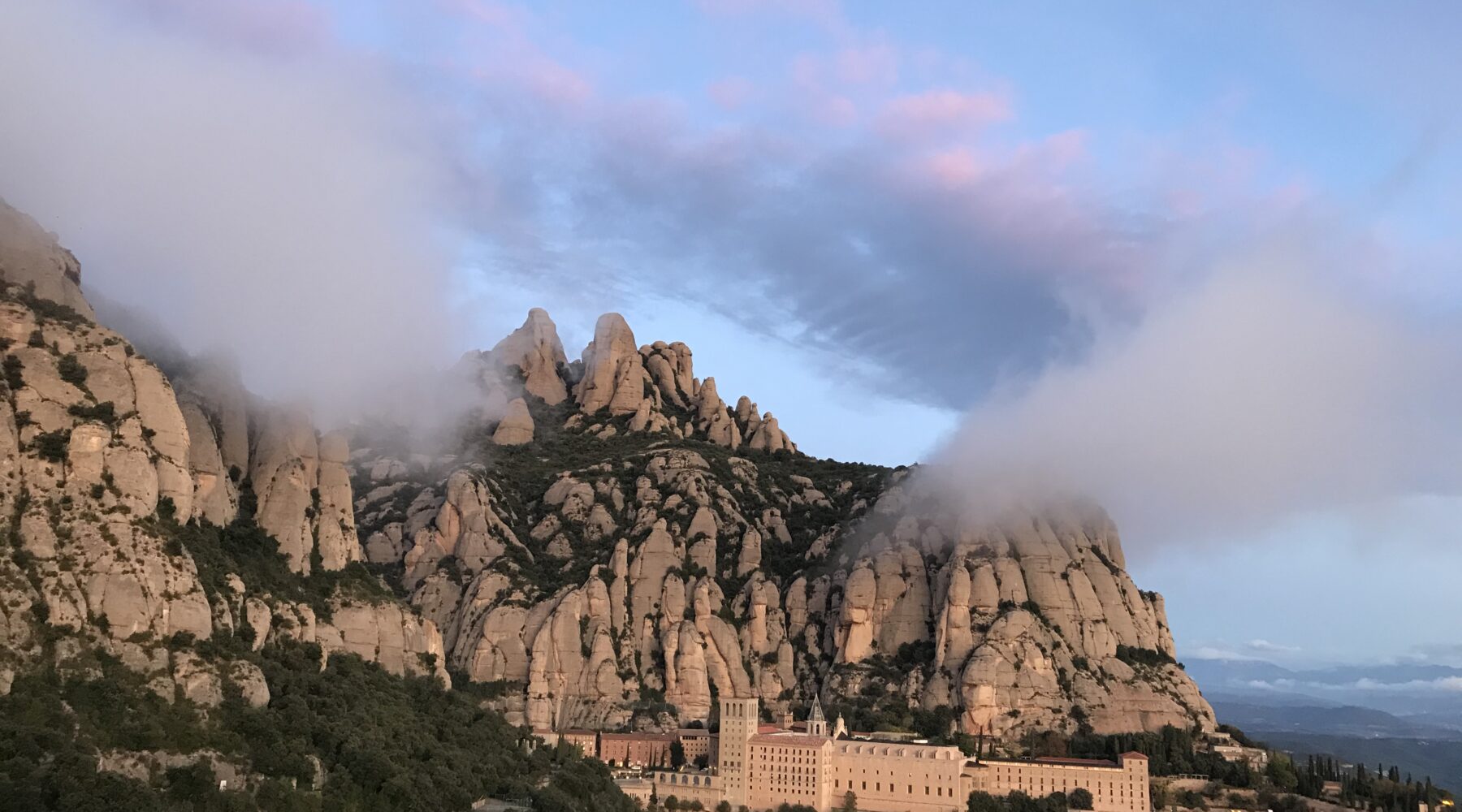
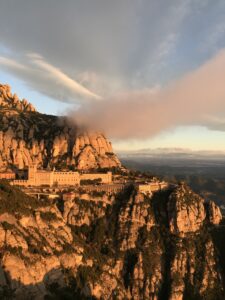
Montserrat mountain looks as though somebody stacked it out of giant stone fingers. In Catalan the name means “serrated mountain”, and it fits: the conglomerate rock the whole massif is made of has weathered over millions of years into towers, cones and ridges with pines and scrub growing between them. The monastery sits about halfway up the slope, on a ledge where a sensible builder would not have put a shed.
A community of Benedictine monks lives here, around seventy of them today. It is not an open-air museum but a functioning abbey with its own rhythm of lauds, mass and vespers. Visitors move through it as guests who have arrived between two services, and you can feel that in the atmosphere. One minute a tour group with a raised umbrella flows past you, five minutes later a bell empties the place and the basilica goes quiet enough that you hear your own footsteps.
For Catalans the mountain and its abbey are more than a church. The Virgin of Montserrat is co-patron of Catalonia alongside Saint George, and throughout the 20th century the monastery was one of the places where Catalan identity survived periods when the regime had no time for it. When a Catalan family comes up here to baptise a child or walks up on a pilgrimage, it is not folklore staged for visitors.
Inside the Basilica of Santa Maria: what to look for
You enter the basilica through a rectangular courtyard called the Atri, closed on three sides by arcades. It sounds like a detail, but it is the best place to stop for a moment before the flow of people pulls you inside: look up at the rock above the rooftops and let the group that has just arrived go past.
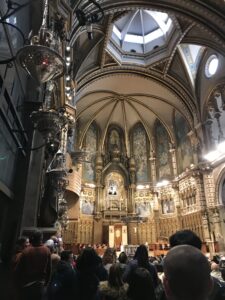
The church itself is late Gothic at its core and heavily over-decorated in the 19th and 20th centuries, because after Napoleon it had to be put back together almost from scratch. There is a single nave, long and dark, with side chapels and a vault worth a few minutes of staring. The strongest view is straight ahead: the high altar, a glazed niche above it, and inside the niche a lit statue that the entire space points towards. She is small, and still all the tension in the church comes from her.
Worth noticing on the way: the side chapels most visitors sprint past on their way to the statue, the beaten metal lamps hung along the axis of the nave, and the organ, which is played at services. Above all, it is worth sitting down in a pew and letting three or four minutes of traffic pass around you. The basilica behaves like a railway station and a cathedral at the same time, and that contradiction is probably its most honest quality.
Tip: the first couple of hours after opening are the calmest. Around midday the basilica fills with people waiting for the Escolania, and in the afternoon the coaches arrive. Anyone who wants to see the space properly should be inside before 10 a.m.
The Black Madonna of Montserrat: history and miracles
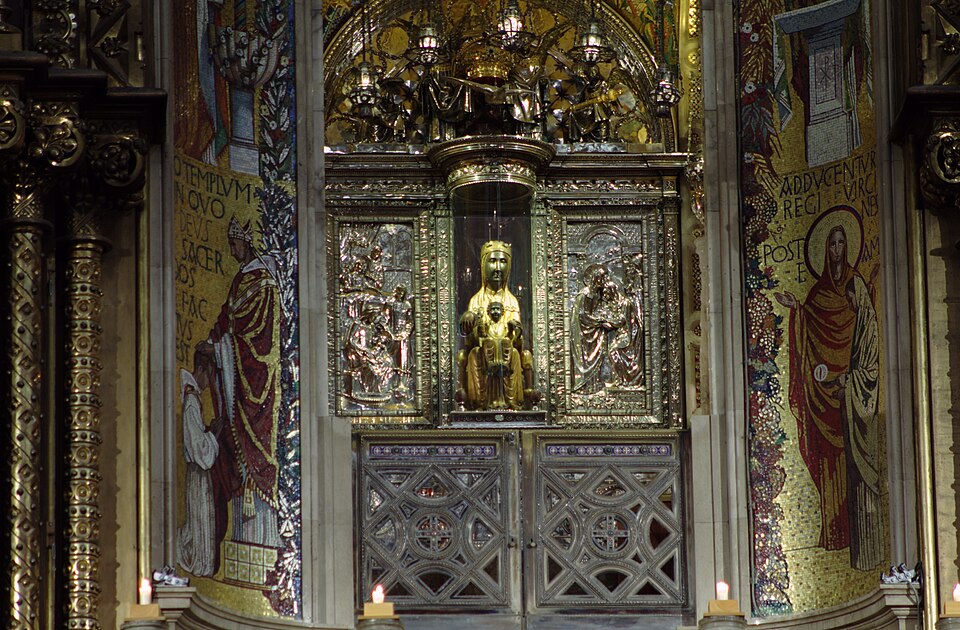
Most people come for her, even if few say so out loud. La Moreneta, “the little dark one”, is a wooden statue of the Virgin with the infant Christ on her lap, 95 cm tall and dated to the end of the 12th century. She sits enthroned in a gilded niche high above the high altar, her right hand stretched forward, holding an orb.
The history of the statue and what we actually know
The carving is Romanesque and was most likely made in a Catalan workshop late in the 12th century, which is well after 1025, when the abbey was founded. Centuries of intervention then shaped it into what you see: it was repaired, repainted and added to repeatedly. Pope Leo XIII granted it a decree of canonical coronation on 11 September 1881, and the Virgin of Montserrat became co-patron of Catalonia alongside Saint George, Sant Jordi in Catalan.
The legend every guide up here will tell you puts the finding of the statue in a cave on the slope below the monastery, where shepherds are said to have discovered it after being drawn to the rock by light and singing. It does not square with the dating of the wood, but pilgrimage sites are not governed by dendrochronology, and the Santa Cova cave is still the destination of a walk in its own right.
The miracles: what is claimed and what is documented
Search for the Black Madonna and you will find pages promising miracles, cures and answered prayers, so it is worth being straight about it. Miracles have been attributed to the statue, and that attribution is centuries old, but there is no published register of authenticated cases the way there is at Lourdes or Fátima. What the Church has formally done here is the 1881 coronation, which is an act of honour rather than a verdict on any individual event.
What you will genuinely see is devotion in practice: people who have walked up rather than taken the train, candles at the side of the basilica, families bringing children to be baptised, and couples who have come to ask for something specific. Nobody at the abbey will ask you why you are in the queue, and nobody will tell you what happens next.
Why she is black
The answer is duller than you would like, and more interesting for it. The statue was not originally black. It darkened over time, either from centuries of candle smoke burning in front of it or from a chemical reaction and the ageing of the varnish on the wood. Once it was dark, restorers and craftsmen deliberately repainted it black during later repairs, most recently around the turn of the 20th century, because by then a black face was what people expected of Montserrat.
To put it another way: the dark colour started as an accident and ended as a trademark. There are more black Madonnas around Europe and for most of them the story repeats.
The queue to the camarín, where the statue sits
You do not reach the statue through the main nave but through a side entrance to the right of the façade. From there a staircase and a corridor decorated with mosaics and stone lead up to the camarín, the small chamber behind the altar where the statue is accessible from the back. The queue crawls, and it is a strange experience: people in technical clothing with rucksacks stand between women with rosaries and school groups, everyone quiet, because a floor below them mass is going on.
At the top you get a few seconds. Visitors touch the orb the Madonna holds in her right hand, the only part of her that protrudes through the protective glass, pause for a moment and move on. The corridor then brings you out onto a balcony above the nave, which is the best view into the basilica in the whole complex. You can sit in a pew if you want, but the statue is reached separately and queued for separately.
Mind the times: access to the statue in the camarín runs from 8 a.m. to 10.30 a.m. and from 12 noon to 6.25 p.m., with a midday break around the conventual mass. The basilica itself is open longer, 7 a.m. to 8 p.m. Turn up at eleven and you can look, but you will not get up to the statue at that moment.
Montserrat boys’ choir (Escolania): times, booking and how long it lasts
The Escolania de Montserrat is the boys’ choir attached to the abbey and one of the oldest in Europe. The boys live and study here, so it is not an after-school club but a boarding school with music as the main subject. The weekday performance lasts about fifteen minutes, and it is worth the whole trip.
They sing in the basilica itself, usually the Salve Regina and the Virolai, the hymn of the Virgin of Montserrat and a piece Catalans stand up for. As many people cram into the nave as will fit, and when the first few notes come off the vault the tourist noise switches off within a second. You hear children’s voices and nothing else.
When the boys’ choir sings
Always check the times before you travel, because they shift with the liturgical calendar. This is the current schedule:
| When | Time | What is sung |
|---|---|---|
| Monday to Friday | 1 p.m. to 1.15 p.m. | Salve Regina and Virolai |
| Monday to Friday | 7.15 p.m. to 7.30 p.m. | after vespers |
| Sunday | 11 a.m. to 12 noon | conventual mass |
| Sunday | 6.45 p.m. to 7.30 p.m. | vespers |
The most common mistake: half the internet repeats that the choir sings at eleven in the morning. That is the Sunday conventual mass. On a weekday the boys sing at one in the afternoon, not at eleven, and anyone who gets that wrong arrives on the mountain two hours earlier than they needed to.
Booking and the choir’s holidays
Booking is required. Without it you cannot count on getting into either the weekday Salve Regina and Virolai or the Sunday conventual mass. You book through the choir’s own website and it is free, but capacity is limited, so at weekends and in peak season the places go early. Sort it out at home, not on the train.
The choir also takes holidays, and that is the other way people miss it. In 2026 the Escolania is away from 1 to 26 August and returns on 27 August, which is exactly the fortnight when most visitors from northern Europe are in Catalonia. If the choir is the reason you are going, check the calendar before you book flights.
Montserrat monastery dress code: what to wear
This is the question English-speaking visitors ask more than any other, and the answer is reassuring: the abbey does not publish a dress code and there is nobody at the basilica door measuring hemlines the way there is at St Peter’s in Rome. Nobody will be turned away for wearing shorts.
That said, it is an active place of worship with mass going on while you are queuing, so the sensible default is the same one you would use at any working church: shoulders and knees covered if you can manage it, swimwear and beachwear obviously not, and hats off inside. If you are coming up from a Barcelona beach day, throw a light layer in the bag.
The clothing question that actually matters at Montserrat is not modesty but mountain weather:
- A light jacket, even in August. The mountain is cooler and a great deal windier than Barcelona, and the difference is bigger than people expect. On a day when the city hits 40 °C the terrace by the funicular station can be breezy and cold in shade.
- Proper shoes. The paths are stony and the final section up Sant Jeroni climbs rock-cut steps. People do it in sandals. We would not.
- Something over your shoulders in summer. There is barely any shade on the ridge walks, and sunburn at 1,000 m arrives faster than at sea level.
- Layers rather than one warm thing. The basilica is cold, the square is hot, the ridge is windy, and you will move between all three inside an hour.
The abbey’s history: 1025, Napoleon and the rebuild
Hermits lived in caves on the slope long before anything was built here in stone. The Benedictine abbey of Santa Maria de Montserrat itself was founded in 1025, and it grew into a pilgrimage site with its own gravity: in the Middle Ages processions came from all over Catalonia, the abbey grew rich on donations and built up a library and a musical tradition that later produced the Escolania.
The break came with the Peninsular War. Napoleon’s troops sacked and destroyed the monastery in 1811 and 1812, the monks scattered and the complex was left in ruins. Shortly afterwards came the dissolution of the religious orders in Spain, so for decades nobody lived here at all. Most of what you see at Montserrat today is therefore younger than the architecture suggests: the rebuilding dragged on through the whole of the 19th century and some parts of the complex date from the 20th.
That is exactly why Gothic masonry stands next to modern extensions here and the whole thing reads more like a small mountain town than a monastery built in one piece. There is a basilica, a museum, pilgrim accommodation, a shop selling liqueur and cheese, restaurants and an information office. The monks live in the part nobody visits.
How to get to Montserrat monastery: the short version
Wherever you start, the last stretch is always the same problem: the monastery is on a mountainside and you are down in the Llobregat valley. There are four ways to solve it, and each has a different audience. This is the summary; the timetables, combined tickets and hour-by-hour planning live in our separate article on getting to Montserrat from Barcelona.
- Rack railway (the cog wheel train). The Cremallera de Montserrat climbs from Monistrol de Montserrat, or rather from the Monistrol-Vila platform just outside the town. The line is 5 kilometres long, gains more than 600 metres and the ride takes 15 minutes, with departures from Monistrol-Vila every 20 minutes. Cremallera is simply the Catalan word for it. Service on the line was once abandoned and only restored in 2003, so the carriages are modern, glazed and air-conditioned. It does not sway, it does not care about wind, and it takes pushchairs, large rucksacks and grandparents who dislike heights.
- Cable car. The Aeri de Montserrat is an aerial cable car with its own railway stop, Montserrat-Aeri, and it gets you up in five minutes. It is the fastest option and by far the most dramatic: the cabin peels away from the rock and all that is left below you is pine forest and the river. Two catches. The cabins are small, so at peak times you wait for the next one, and the service is weather-sensitive. In strong wind or a thunderstorm it is restricted and you stand at the bottom holding a ticket.
- Car. You can drive all the way up to the monastery, where there is paid parking. In high season it fills by late morning, the last few kilometres are hairpins, and when it is full you drive back down and start again. The better plan is to leave the car at the station in Monistrol, where there is a free car park with 900 spaces for cars and coaches, and take the rack railway up.
- Bus and organised tours. A bus connection exists, but the times change more often than the trains, so do not build a whole day around it without checking with the operator. If you would rather not deal with any of it, an organised trip from Barcelona works, but you pay for the convenience and lose the freedom to leave when you want.
The best combination: cable car up and rack railway down, or the other way round. You see the mountain from two completely different angles and you do not travel the same way twice. Buy single tickets for that, not returns.
Walking up from the valley is the fourth option and a genuinely good one, if you have the legs and the morning for it.
The two funiculars: Sant Joan and Santa Cova
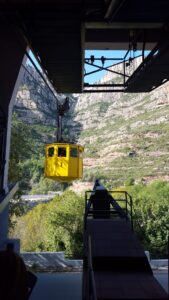
Most visitors have no idea that getting up to the monastery is not the end of the journey. Two funiculars leave from the square by the abbey itself, and they go in opposite directions. They have nothing to do with the journey from Barcelona: these are short mountain funiculars inside the site, and they are the only things on this mountain the word funicular applies to. The rack railway and the cable car are different machines entirely.
The Sant Joan funicular climbs steeply above the monastery to an upper station that the operator puts at almost a thousand metres. The ride takes seven minutes and at its steepest the track has a gradient of up to 65.5%, so you really do sit as if in a chair tipped backwards. The upper station is called Pla de les Taràntules, there is a viewing platform beside it from which you look down onto the abbey roofs as if from a plane, and above all it is the trailhead for routes of every difficulty, including Sant Jeroni. The station building also houses the Centre de Natura, a small exhibition on the geology, climate, plants and animals of the mountain. If you do not want to walk anywhere at all, ride up, do the short loop around the station and come back down. That alone justifies the ticket.
The Santa Cova funicular runs the other way, down the slope to the point where you continue on foot to the holy cave. It drops steeply and the ride is short. Its upper station stands on a small terrace where the Monumental Rosary begins, the line of sculpture groups along the path to the cave. The line has been running since 1929, although the original had to be replaced after storms in June 2000.
Check this one the day before: the Santa Cova funicular is repeatedly out of service, and at the time of writing the official website listed it as suspended until further notice. Whether it is running when you arrive is not something to assume either way. You can walk down to the cave and back, just remember the return is uphill the whole way, which most people appreciate far too late in the day.
Best viewpoints on Montserrat mountain
The most common mistake visitors make is to walk through the monastery, look at the inside of it and leave. The best thing the mountain has to offer is the view of the abbey from outside, from below or from above, which is the moment you understand how improbably the whole thing clings to the rock. There are several viewpoints and what mainly separates them is how much time you have to invest.
Creu de Sant Miquel, the cross of Saint Michael
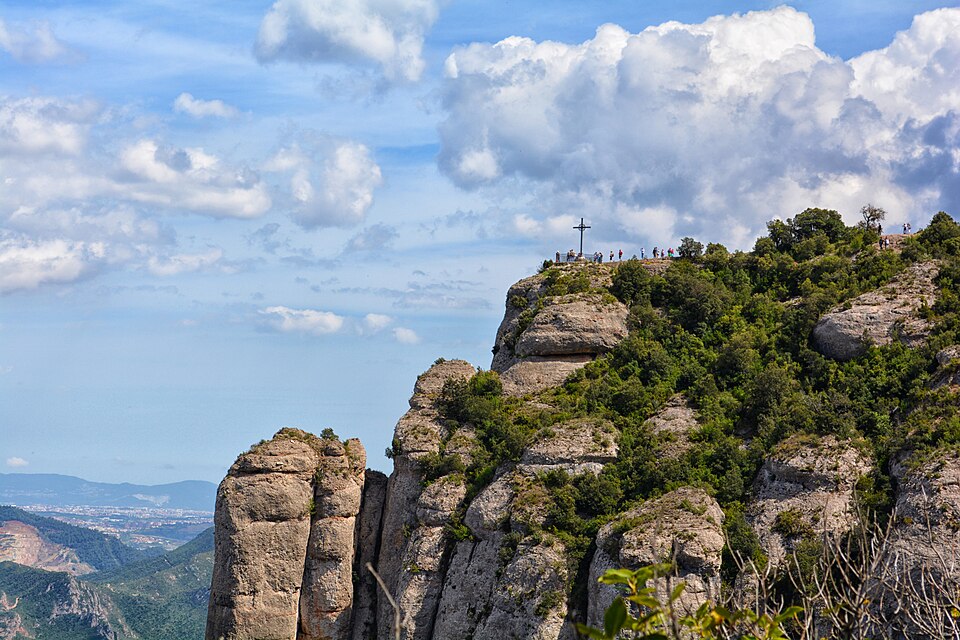
The classic, and by a distance the best effort-to-reward ratio on the mountain. Creu de Sant Miquel is a wrought-iron cross on a stepped stone plinth, standing on a small platform above a drop not far from the Sant Miquel chapel. The present cross was raised during jubilee celebrations in 1931 and replaced an earlier, plainer one.
The path to it runs below the monastery and has almost no ascent, so you can do it in the shoes you arrived in. The reward is the postcard: the entire monastery laid out beneath you with the rock towers around it, and in good visibility a view stretching from the Pyrenees to the Llobregat delta. If you have two hours on the mountain and want one walk, walk this one.
Pla de les Taràntules and the top of the Sant Joan funicular
If you would rather not exert yourself and do not mind buying a ticket, ride the Sant Joan funicular up to Pla de les Taràntules. The upper station is at almost a thousand metres and there is a platform right beside it looking over the abbey, the Catalan plain and, on a clear day, the Pyrenees. It is the only viewpoint on the mountain you reach with no walking at all.
Short loops also run from the station to the hermitages and to further viewpoints, and you can do those in an hour without going anywhere near the summit.
Camí dels Degotalls, the easy walk with sculptures
Camí dels Degotalls is the gentlest route on the whole mountain. The official itinerary gives it 50 minutes and 3.2 kilometres, it is almost flat and it runs beneath rock walls that seep water, which is where the name comes from.
What makes it interesting is what lines it: a series of monuments and ceramic panels dedicated to Catalan figures, among them the poets Jacint Verdaguer and Joan Maragall and the linguist Pompeu Fabra. It is part walk and part gallery, and it is the one route at Montserrat you can take somebody on who does not like mountains.
Sant Jeroni, the highest point
The highest and hardest viewpoint is the summit of Sant Jeroni at 1,236 m (4,055 ft). It gets its own section below, because it is a half-day undertaking and not a detour between lunch and the train home.
Santa Cova: the path to the cave where the statue was said to lie
Santa Cova, the Holy Cave, is the spot where legend says La Moreneta was found. A cut path leads to it along the edge of the slope, partly hacked into the rock, with views down into the Llobregat valley. On the way you pass the sculpture groups of the rosary mysteries, made by Catalan sculptors and architects around the turn of the 20th century, so the walk doubles as a small open-air gallery.
The chapel itself is built into a rock overhang and is smaller than people expect. The path is the better part: wide, well maintained, with almost no ascent on the way down, and fine with children. After the noise on the monastery square you suddenly hear wind and crows instead. The Holy Cave is usually open from about 10.30 a.m. to 5 p.m., which is worth knowing if you are heading down there late in the afternoon.
Sant Jeroni hike: difficulty, length and time
Sant Jeroni is 1,236 m (4,055 ft) and the highest point of the whole massif. It is also the only part of a visit where Montserrat stops being a pilgrimage site with a gift shop and turns into an actual mountain.
The usual version starts at the upper station of the Sant Joan funicular. From there a marked path follows the ridge, alternating wooded stretches with open passages between the rock towers, and finishes on a staircase cut into the rock that delivers you onto a small platform at the summit. If you would rather skip the funicular you can walk up from the monastery itself, but you are adding a solid climb to the day.
At the top there is a railing, an orientation panel and a view nothing else near Barcelona can match. In good visibility you see across the whole Catalan plain to the sea and, in the other direction, to the Pyrenees. In poor visibility you stand in cloud and listen to wind in the gullies below you, which has something going for it too.
How hard is it and how long does it take
It is a hike, not a scramble. There is no exposure that needs hands, no chains and no via ferrata section, and families with older children do it regularly. What it does have is stone underfoot the whole way, a long flight of rock steps at the end, and no shade or water on the route. Call it moderate: the difficulty is in the heat and the distance rather than the terrain.
- From the monastery, as a loop: the official itinerary gives it 7 km and 2 hours 30 minutes. That is walking time at a brisk pace, without photographs and without lunch.
- From the top of the Sant Joan funicular: shorter, and the version most day visitors take. Riding up removes the steepest early climb.
- Realistically, for a day trip: set aside half a day for the ascent and the return. If you arrive at midday, listen to the Escolania and then set off for the summit, you will be coming back down in the early evening.
The route is well signposted on the ground and there are GPS tracks for it on Wikiloc if you want the profile in advance, but the signage on the mountain is good enough that most people never open the phone.
What to watch on the trails
- Time. Allow half a day for the ascent and the way back, and check the last departure of the rack railway or cable car before you set off.
- Water. There is nowhere to buy anything on the route. Stock up down at the monastery, and in summer take more than seems reasonable.
- Shoes. The path is stony and the upper section climbs rock steps. Sandals happen. They should not.
- Weather. The mountain is cooler and much windier than Barcelona, even in summer. A light jacket is worth carrying on a day the city is at 40 °C.
- Shorter options. Loops to the hermitages and viewpoints also start from the Sant Joan station and take about an hour, so you do not have to commit to the summit to get a walk in.
Montserrat Natural Park and the marked trails
The whole mountain is protected. Parc Natural de la Muntanya de Montserrat was created by a decree of 29 January 1987, covers 3,630 hectares, of which 1,981 hectares form a stricter nature reserve, and around that sits a buffer zone of a further 4,039 hectares. The park reaches into four municipalities: El Bruc, Collbató, Monistrol de Montserrat and Marganell.
It is not a rubber stamp on a map. 1,250 plant species grow here, from oak and pine woodland through yews to species that cling to bare rock, and the wildlife includes wood pigeons, thrushes, falcons, squirrels, wild goats, boar and salamanders. A bird of prey circling overhead is perfectly normal up here while, two hundred metres below, a coach party is photographing the abbey.
The trails are well waymarked and the official itineraries give them these times:
| Route | Length | Time |
|---|---|---|
| Camí dels Degotalls, the easy walk with sculptures | 3.2 km | 50 minutes |
| Camí de les Ermites, the path to the hermitages | 7 km | 2 hours |
| Monastery to Sant Jeroni, the summit loop | 7 km | 2 hours 30 minutes |
Treat those as pure walking at a brisk pace, without photographs and without a snack stop. With children or a camera, add half as much again.
Watch for closures: after heavy rain and when there is a rockfall risk, individual paths are closed and the signs on the ground may not match the map on your phone. The park authority and the information office by the monastery post the current state of the trails.
Museu de Montserrat: is the museum worth it?
The museum is usually the first thing people cut from the plan, and that is a mistake. Museu de Montserrat is not a monastic display case of vestments but a full picture gallery that would hold its own in Barcelona. The collections are split into seven parts: ancient archaeology, old master painting, modern painting, the avant-garde, sculpture, drawings and a section called Phos Hilaron.
The old master rooms hold a Caravaggio, plus El Greco, Pedro Berruguete, Sassoferrato and Giambattista Tiepolo. The modern section is Catalan canon: Ramon Casas, Santiago Rusiñol, Isidre Nonell, Joaquim Mir, Anglada-Camarasa, Joaquim Torres-Garcia and Picasso. Add the impressionists Claude Monet, Alfred Sisley and Camille Pissarro, and a separate Egyptian collection.
So, worth it? Yes, if you allow an hour to an hour and a half and treat it as a gallery rather than a monastery annexe. No, if you are on the mountain for three hours and have not yet seen the basilica or a single viewpoint.
Admission is listed by the museum at €12 (about £10) for adults, €10 (about £8.40) for students, over-65s and groups of twenty or more, and €6 (about £5) for children aged 8 to 16. A ticket for the temporary exhibitions alone is €3.50 (about £2.95), and on 27 April, the feast of the Virgin of Montserrat, entry is free.
A warning about the opening hours: the visitor centre lists the museum as open 10 a.m. to 6.45 p.m., but the museum’s own website gives different hours depending on the season and on whether a temporary exhibition is running, and the two do not always agree. Check the museum’s own page on the day you travel rather than trusting either number here.
When to go in: ideally around midday, when the basilica is impassable and it is hottest outside. An hour or so indoors fills exactly the part of the day that is otherwise the least pleasant.
Monistrol de Montserrat: the town at the bottom
Below the mountain, in the Llobregat valley, sits Monistrol de Montserrat, a town of about 3,250 people at 161 m above sea level. Most visitors know it only as a name on a ticket, because this is where the Cremallera rack railway starts. And most visitors therefore ride straight through it and see nothing, which is a waste when you are about to spend two hours waiting for the Escolania anyway.
What is there? Above all the bridge over the Llobregat, completed in the 14th century under prior Jaume de Vivers, which makes it older than most of what you will see up at the monastery, because Napoleon flattened that and it had to be rebuilt. Next to the bridge stands the Palau Prioral, the prior’s palace from the same period, and above the town the parish church of Sant Pere. The streets are narrow, steep and completely untouristed.
There are three practical reasons to stop:
- Free parking. There is a free car park with 900 spaces at the rack railway station for cars and coaches. Up at the monastery you pay, and in season the spaces sell out by late morning.
- Food at normal prices. Down here you eat in ordinary Catalan places rather than in an operation with a monopoly on an entire mountain. If you are making a full day of it, have breakfast here or dinner after you come back down.
- Quiet. Up top you are competing for a seat in a pew; down here you can sit on the square and look up at the mountain, which is incidentally the only angle from which you grasp how high that monastery actually is.
Tip for drivers: leave the car in Monistrol and take the rack railway up. You skip the hairpins, the fight for a parking space and the descent in the dark, and you still have the car for the rest of the day. Anybody who has once circled a full car park at Montserrat does this without being told the second time.
Opening hours and tickets at Montserrat monastery
The monastery site is not one building with one ticket desk but several operations, each with its own hours. These are the ones you are most likely to care about:
| What | Opening hours |
|---|---|
| Basilica | 7 a.m. to 8 p.m. |
| Throne of the Virgin, the camarín with the statue | 8 a.m. to 10.30 a.m. and 12 noon to 6.25 p.m. |
| Santa Cova, the Holy Cave | 10.30 a.m. to 5 p.m. |
| Museu de Montserrat | 10 a.m. to 6.45 p.m. |
| Audiovisual exhibition | 9 a.m. to 8 p.m. |
| Information office | 9 a.m. to 7.30 p.m. |
These are the times as published when this article was written. They change with the season and with the liturgical calendar, so click through to the official site, linked in the sources at the bottom, before you travel. Yes, Montserrat is open on Sunday — it is a working shrine and Sunday is its busiest day of the week, with the conventual mass at 11 a.m. The one thing that changes is that the mountain is fuller and the queue to the camarín longer.
Admission works item by item: the basilica, the museum, the audiovisual exhibition, the funiculars and the guided tours are all paid for separately, and the prices change seasonally, which is why we deliberately do not quote them here. You buy them on the spot at the information office or in advance in the official online shop. Buying from the official site rather than a reseller matters more here than at most attractions, because the resale market around Montserrat is crowded. If you are staying all day and plan to use several things up top, look at a combined ticket, which our article on getting here from Barcelona goes through in detail.
One practical note: you can sleep up here. The abbey runs a hotel and apartments for pilgrims, and the reward is Montserrat after dark and early in the morning, when the square is empty and there are stars over the rock. Capacity is small and it books up a long way ahead.
Where to eat at Montserrat monastery
The complex around the basilica works like a small town, so you will not go hungry. Prices reflect that, because the competition is zero and everything has to be driven up here.
Restaurants, buffet and cafeterias
Up top you will find the restaurant of the Hostal Abat Cisneros, which does traditional Catalan cooking and serves dinner as a buffet. It has two rooms, Sala de Pedra and Sala Rosa, and for lunch it is worth booking a table in advance. Faster and cheaper options are the Restaurant Montserrat, the self-service Buffet Montserrat, La Cafeteria and the Bar de la Plaça right on the square.
Do not expect a normal grocery shop; this is not a village with a supermarket. If you want to save money, bring food up from Barcelona or Monistrol. That goes double if you are heading out on the trails, because there is nothing to buy on the way to Sant Jeroni or down to Santa Cova.
The local produce market by the entrance
The best food up here is not bought in a restaurant but outside. By the entrance to the site there is a daily market run by people from the villages below the mountain, selling the typical products of the area: honey, mató or fresh curd cheese, cheeses and fig bread. Mató with honey is the Catalan dessert to try, and you will not have it better anywhere else.
The monastery shops add herbal liqueurs and coques, the flat cakes the monks historically made themselves, along with ceramics, Escolania recordings and books from the abbey’s own publishing house.
Where to stay at Montserrat monastery
This is the most underrated tip on the whole mountain. Stay the night up here and you have Montserrat almost to yourself, because the day visitors leave on the last services and the next lot do not arrive until around ten. In between you can walk the site in peace, watch mist settle in the gullies and go to the morning service without a queue.
The abbey runs three options, each for a different budget:
- Hostal Abat Cisneros Montserrat, a three-star hotel in a historic building right beside the monastery. Mind the name: people constantly call it the “Hotel Abat Cisneros”, but officially it is a hostal, and searching for the wrong one is how bookings go missing.
- Cel·les Abat Marcet, fully equipped apartments with a kitchenette, which is the sensible choice for families and for anyone who would rather cook than pay for three restaurant meals a day.
- Alberg Abat Oliba, a hostel for solo travellers, families and groups, and the cheapest option.
Book a long way ahead: for such a visited place the capacity is small, and at weekends, on public holidays and around 27 April, the feast of the Virgin of Montserrat, it is full months in advance. Book directly through the abbey’s official website.
Compare current prices and availability through accommodation options in Barcelona and nearby.
How long to spend at Montserrat monastery
The honest ranges, before travel time from Barcelona:
- Two to three hours. Enough for the basilica, the queue to the Black Madonna and a short walk around the site. This is the bare minimum and it will feel like one.
- Half a day, about four hours. Add the Escolania at 1 p.m. and either the Creu de Sant Miquel walk or the museum. This is the sweet spot for most visitors.
- A full day, six to eight hours. Basilica, choir, museum, the walk down to Santa Cova and lunch. Nothing rushed.
- Dawn to dusk. Anything that includes Sant Jeroni. Take the first train up and plan the last one down before you set off.
A half-day itinerary that works
Arrive by 9.30 a.m. and go straight into the basilica while it is still quiet. Join the camarín queue before 10.30 a.m., when access closes for the midday break. Walk out to Creu de Sant Miquel, which takes about an hour there and back with photographs. Be back in the nave by 12.45 p.m. for the Escolania at 1 p.m., with your booking already made. Eat afterwards, at the market rather than sitting down if you are short of time, and take the museum from about 2.30 p.m. while the square is at its worst. You will be on a train back down by four with the day intact.
If you are coming off a cruise ship
Barcelona’s cruise terminals are at the port below Montjuïc, and the constraint is not distance but your all-aboard time. Montserrat is realistically a five- to six-hour excursion from the port and back, which fits a full day in Barcelona and does not fit a short call. If your ship leaves in the early afternoon, do not attempt it. If you have a full day, go early: the mountain at nine in the morning is a different place from the mountain at noon, and the cable car and rack railway both get slow once the coaches arrive.
Planning it from the UK or the US
Barcelona is served from all five London airports — Gatwick, Heathrow, Stansted, Luton and City — which makes Montserrat easy to bolt onto a long weekend. Give it a full day in the middle of the trip rather than the morning you land or the day you fly home, because the last leg up the mountain is weather-dependent and you do not want that on a tight schedule. Visitors flying in from further afield tend to arrive jet-lagged and go to Montserrat on day one, which is actually a good instinct: it is an outdoor day with a fixed lunchtime event in it, which is exactly what a body on the wrong clock can handle.
What else to see nearby if you have a car
Montserrat works as a day trip with a return to Barcelona. With a car you can stretch the day and pair the mountain with places that are awkward on public transport. The distances below are by road from the monastery:
| Where | Distance by car | Driving time |
|---|---|---|
| Monistrol de Montserrat, the town below the mountain | about 9 km | about 15 minutes |
| Manresa, historic town with the La Seu basilica | about 25 km | about 35 minutes |
| Colònia Güell, Gaudí’s workers’ colony and crypt | about 45 km | about 50 minutes |
| Vilafranca del Penedès, heart of the Penedès wine region | about 53 km | about 50 minutes |
| Cardona, medieval castle and salt mountain | about 58 km | about an hour |
Manresa is the closest and the most logical, because it sits on the road continuing north from Montserrat. It is dominated by the collegiate basilica of Santa Maria de la Seu, begun in 1328, and it also has the medieval Pont Vell bridge and the cave of Saint Ignatius, where Ignatius of Loyola is said to have written his Spiritual Exercises.
Colònia Güell is for anybody who fell for Gaudí in Barcelona. The crypt he built in the workers’ colony at Santa Coloma de Cervelló served as his testing ground for the structural solutions he later used on the Sagrada Família. It has been on the UNESCO list since 2005 and sees a fraction of the crowds.
Penedès is the classic pairing: after a day on the rock, a winery visit with a cava tasting is exactly what the body asks for. Not behind the wheel, obviously. If you are heading further north, add Cardona, with its castle and the underground galleries in the salt mountain the Romans were already mining.
FAQ: Montserrat monastery
Yes, and it is the best day trip from the city if you give it a proper day rather than a spare afternoon. You get a working Benedictine abbey, a mountain with marked trails, a picture gallery holding a Caravaggio and an El Greco, and a fifteen-minute performance by one of the oldest boys’ choirs in Europe. It disappoints only people who arrive between 11 a.m. and 3 p.m. expecting quiet.What is Montserrat monastery and where is it?
It is the Benedictine abbey of Santa Maria de Montserrat, a pilgrimage site and the most important shrine in Catalonia. It stands on a rock ledge on Montserrat mountain about 48 km (30 miles) north-west of Barcelona, in Spain, and a community of around seventy monks still lives there.Why is the Black Madonna of Montserrat black?
She was not black originally. The wooden statue from the end of the 12th century darkened over time, either from the smoke of candles burning in front of it for centuries or from a chemical reaction and the ageing of the varnish. Restorers then deliberately repainted it black during later repairs, most recently around the turn of the 20th century.What time does the Montserrat boys’ choir sing?
Monday to Friday the Escolania sings in the basilica from 1 p.m. to 1.15 p.m. and again from 7.15 p.m. to 7.30 p.m. after vespers. On Sunday it sings at the conventual mass from 11 a.m. to 12 noon and at vespers from 6.45 p.m. to 7.30 p.m. The weekday performance lasts about fifteen minutes. Times shift with the liturgical calendar, so check before you travel.
Do you need to book for the Escolania boys’ choir?
Yes, booking is required, both for the weekday Salve Regina and Virolai and for the Sunday conventual mass. You book through the choir’s website and it is free, but capacity is limited and places go early in peak season. In 2026 the choir is also on holiday from 1 to 26 August and returns on 27 August.
Is there a dress code at Montserrat monastery?
The abbey does not publish a dress code and nobody is turned away at the basilica door, but it is an active place of worship, so shoulders and knees covered is the sensible default and beachwear is not. The clothing that matters more is practical: the mountain is cooler and much windier than Barcelona even in August, so carry a light jacket, and wear proper shoes if you plan to walk.
Is Montserrat open on Sunday, and what are the basilica opening hours?
Yes. It is a working shrine and Sunday is its busiest day, with the conventual mass at 11 a.m. The basilica is normally open from 7 a.m. to 8 p.m. Access to the statue in the camarín above the altar is separate and runs from 8 a.m. to 10.30 a.m. and from 12 noon to 6.25 p.m., with a midday break around the conventual mass.
How long is the Sant Jeroni hike and how hard is it?
Sant Jeroni is 1,236 m (4,055 ft) and the highest point of the massif. The official loop from the monastery is 7 km and 2 hours 30 minutes of walking; most day visitors shorten it by riding the Sant Joan funicular to the trailhead. It is a moderate hike rather than a scramble, with stony ground throughout and rock-cut steps at the top. Allow half a day for the ascent and the return, carry water and wear firm shoes.
What are the Sant Joan and Santa Cova funiculars for?
They are two short mountain funiculars at the monastery itself and have nothing to do with getting there from Barcelona. Sant Joan carries you up above the abbey to a viewpoint and the trailheads, with an upper station at almost a thousand metres. Santa Cova runs down towards the path to the holy cave, though it is repeatedly out of service and was listed as suspended until further notice when this article was written.
How long should you spend at Montserrat monastery?
Two to three hours cover the basilica, the statue and a short walk around the site. Add the choir, the path to Santa Cova and the museum and it becomes a full day. If you want the summit of Sant Jeroni as well, plan to be on the mountain from morning until early evening.
Is there a rack railway to Montserrat monastery?
Yes. The Cremallera de Montserrat cog wheel train climbs from Monistrol de Montserrat, covers 5 kilometres, gains more than 600 metres and takes 15 minutes, with departures from the Monistrol-Vila platform every 20 minutes. The alternative is the Aeri de Montserrat cable car, which takes five minutes but is sensitive to wind.
Is Museu de Montserrat worth it?
Yes, if you have an hour and a half to give it. It is a full picture gallery rather than a monastic display case, with a Caravaggio, El Greco and Tiepolo, the Catalan modern painters Casas, Rusiñol, Nonell and Mir, the impressionists Monet, Sisley and Pissarro, and a separate Egyptian collection. Standard admission is €12, about £10, children aged 8 to 16 pay €6 and entry is free on 27 April.
Where can you eat at Montserrat monastery?
There is the restaurant of the Hostal Abat Cisneros for traditional Catalan cooking, plus the Restaurant Montserrat, the self-service Buffet Montserrat, La Cafeteria and the Bar de la Plaça on the square. The best value is the daily market by the entrance, where villagers from below the mountain sell honey, cheeses, fig bread and mató curd cheese. There is no grocery shop, and nothing at all to buy on the trails.
Can you stay overnight at Montserrat monastery?
Yes. The abbey runs the three-star Hostal Abat Cisneros, the Cel·les Abat Marcet apartments with kitchenettes and the Alberg Abat Oliba hostel. It is worth it, because the day visitors leave on the last services and the mountain is nearly empty in the evening and early morning. Capacity is small, so book several months ahead.
Where are the best viewpoints at Montserrat?
The easiest to reach is Creu de Sant Miquel, a wrought-iron cross above a drop with the monastery laid out below you and, in clear weather, a view from the Pyrenees to the Llobregat delta. Pla de les Taràntules at the top of the Sant Joan funicular needs no walking at all. The Camí dels Degotalls is an easy 3.2 km in 50 minutes, and the highest viewpoint of all is the summit of Sant Jeroni.
Is it worth stopping in Monistrol de Montserrat?
It is a town of about 3,250 people in the Llobregat valley where the rack railway starts. It is worth a stop for the 14th-century bridge, the Palau Prioral beside it and the church of Sant Pere, but the main practical reasons are the free car park with 900 spaces at the station and food at normal prices rather than monastery prices.
Where to next
- How to Get to Montserrat from Barcelona: train, rack railway and cable car — timetables, the R5 line, combined tickets and the day planned hour by hour.
- Valencia: what to see and how many days to give it — the obvious second stop on a Spanish trip.
Potřebujete pomoct s cestováním?
-
Ubytování 🏨
Vyberte si to nejlepší ubytování, ať už jste kdekoliv, přes Booking.com. -
Půjčení auta 🚗
Auto si snadno najdete přes Booking.com, kde máte často slevu díky ubytování, nebo Rentalcars.com, kde porovnáte nabídky většiny půjčoven. -
Zážitky 🎟️
Přes GetYourGuide.com si vyberete z nejrůznějších výletů i zážitků po celém světě, navíc se zrušením zdarma do 24 h předem.