Last updated 23.8.2026
Nusa Penida is so close to Bali that many people see it as part of it. Even though tourism has boomed in recent years, you can still find wild cliffs, beaches hidden beneath rock faces, cave temples, rough roads, and above all the sea—which can be unbelievably beautiful and unpredictable. The most popular activities here are diving with manta rays and sunfish (mola-mola) or snorkeling. And when you’re not in the water? You can surf, explore the island by scooter, or simply relax. Nusa Penida Island—what to see?
Why visit Nusa Penida
Nusa Penida, Nusa Lembongan, and Nusa Ceningan are especially popular with divers and travelers who want a quieter vacation away from Bali’s main island. These islands offer excellent dive sites, great snorkeling conditions, and other water sports—plus a coastline as stunning as you rarely see.
The best plan is to rent a scooter, find accommodation in a small bungalow, and take your time exploring the island. Many tour agencies run day trips to this island, but you should definitely come on your own for at least a few days—you won’t regret it.
Nusa Penida as a place for criminals
Nusa Penida also has a very interesting history. In the past, it served as a penal colony for Balinese criminals, and for locals it is also the home of the legendary demon I Macalinga. This is connected to the significance of one of the island’s most important temples, Pura Dalem Penataran Ped, which to this day remains a pilgrimage site for Hindus from all over Bali.
Nusa Penida and where to stay
When choosing accommodation on Nusa Penida, it’s best to think practically. The island is relatively small, but roads are slow and often in poor condition, so location matters more than saving a few crowns. The best compromise is in the areas around Toyapakeh and Sampalan, from where you can reasonably reach both the west of the island (Kelingking, Broken Beach, Crystal Bay) and the east (Diamond Beach, Atuh, Raja Lima).
- MĀUA Nusa Penida: A slightly nicer place for those who want peace and quiet, a modern setting, and good services. Best for couples or travelers who want to relax on Penida—not just chase viewpoints.
- Adiwana Warnakali Resort: A very popular resort with beautiful sea views.
- Semabu Hills Hotel Nusa Penida: Great value for money and a practical inland location.
- Semaya Beach Resort: Seafront accommodation for those who want a beach vibe and a slower pace.

Nusa Penida: what to see and do
If you love viewpoints, you’ll see some of the most beautiful on the planet here. Whether you come for one day or longer, you’ll see a lot. The island has beautiful beaches and nature, great restaurants and accommodation—but it’s also true that the nicest places often mean worse roads. The ideal way is to explore the island by scooter—just be careful: the asphalt turns into potholes faster than you can say “where’s the brake?”
Raja Lima and the “Thousand Islands” viewpoint near Atuh Beach
The east of the island is pure joy for viewpoint lovers. The Thousand Islands viewpoint (Raja Lima) near Atuh Beach offers a look at a coastline that seems like it was carved for a movie. Rock formations rise out of the ocean like sculptures, and the whole scene feels very dramatic—especially in the morning, when the light is softer and the sea calmer.
Angel’s Billabong, Broken Beach, and Pasih Uug
One of the island’s iconic duos is Angel’s Billabong and Broken Beach (also known as Pasih Uug). Angel’s Billabong is a natural rock pool, where—under the right conditions—you can admire emerald water in a “lagoon” framed by cliffs. Right next to it you’ll find Broken Beach: a cove surrounded by cliffs that looks like a natural amphitheater, where water flows in through a single opening: a huge rock archway. The rock above forms a “bridge” you can walk across and capture photos from different angles.
Kelingking Beach: the most famous photos from Nusa Penida
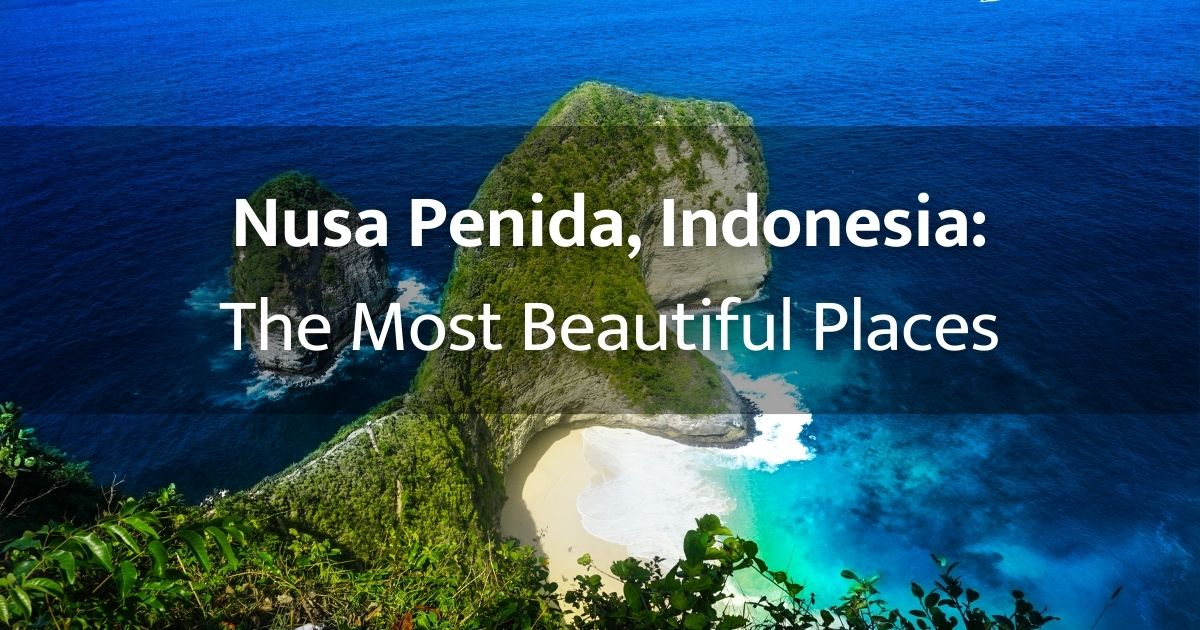
When you say Bali, many people immediately picture the iconic Kelingking Beach (also known as T-Rex Beach), which actually lies on Nusa Penida. The 150-meter-high white limestone cliffs and the beach below are the island’s biggest symbol, drawing crowds of travelers every day. All the day trips come here too—no surprise. The view is undeniably breathtaking, and it’s also fun to watch people pose here… and how local monkeys try to snatch bottles from tourists’ backpacks and then skillfully drink from them.
Besides the viewpoint, you can also walk down the path a bit lower to see the gorgeous coastline. The brave can go all the way down to the beach, but the route isn’t always exactly friendly.
TIP: If you want to swim on that beautiful beach below, be very careful—there are strong sea currents in this area, so swimming is not really recommended.

Diamond Beach, Atuh Beach, and more coastal beauty
Two of the most photogenic places are Diamond Beach and Atuh Beach, which are often visited on the same day because they’re relatively close to each other. The text also mentions Pasih Uug Beach (a name used for the Broken Beach area) and a coastline full of dramatic limestone walls and bright beaches. In this sense, Nusa Penida is very “straightforward”—the best views are often from above, and the best beaches are often tucked beneath cliffs.

Temples: Pura Dalem Penataran Ped and the cave temple Pura Goa Giri (Goa Giri Putri)
I’ll start with the place Penida takes seriously—Pura Dalem Penataran Ped, often referred to as Pura Dalem Ped or the Temple of Death. People come here to ask for protection from illness and demons, and every Balinese person is said to visit at least once in their lifetime. At the temple you’ll encounter a very strict dress code—signs at the entrance clearly show what is allowed for men and women. The atmosphere is enhanced by bold red fabric stripes, intricate decorations made of bamboo and palm leaves, and the typical mix of traditional craftsmanship with whatever happens to be available (yes, even an office stapler).
A completely different world is the cave temple Pura Goa Giri (often also listed as Goa Giri Putri). You don’t enter through a “door,” but through a narrow crack in the rock—just wide enough for one slim person to squeeze through. At first you’ll wonder if it’s a good idea at all, but then the cave opens up and you find yourself in a space that feels almost unreal. The cave is over 260 meters long, and during ceremonies it fills with chanting, the tinkling of bells, and the scent of incense so intense it can feel almost stifling.

Crystal Bay: snorkeling, swimming, and the reality after the years
Crystal Bay is a beach and bay that for a long time was one of the island’s biggest draws—mainly for shore snorkeling. Today it’s no longer as pristine as in old photos: part of the beach is blocked by rows of loungers, umbrellas, and warungs, many of the palms are gone, and the corals that used to be exceptional here were damaged years ago by large waves.
Even so, Crystal Bay is still one of the places where you can spend a wonderful time in the water, and snorkeling remains popular. If you’re not coming here on a snorkeling tour, we recommend renting fins and a mask and snorkeling here on your own. We saw lots of beautiful fish and turtles.
TIP: If you come here independently, expect that the beach will be taken over by paid loungers almost all the way to the water, and there’s very little space left for towels.

Manta Point and Manta Bay: snorkeling with giant manta rays
This is the reason divers—and even those who normally only snorkel “recreationally”—come back here. Manta Point is the most popular spot for diving and snorkeling with giant manta rays, and off the island’s southern shores you have a strong chance of seeing a manta with a wingspan of up to 6 meters. From the sea they look like elegant underwater aircraft—silent, gliding, completely calm, while you up top are huffing into your snorkel like a steam engine.
You’ll often see offers like “manta trip tomorrow” at every dive center. And it makes sense, because you can encounter mantas here year-round. Spots like Manta Bay are also mentioned in connection with boat tours, which typically combine several stops—for example Crystal Bay and then the manta area. You can’t swim to these spots from the beach—you have to go by boat, most often as part of an organized trip.
TIP: If you want to see mantas, we recommend booking via GetYourGuide, where it’s clear what you’re paying for and you can cancel up to 24 hours in advance.

Peguyangan waterfall and stairs: an adventurous route with views
Peguyangan is “the experience of the day” for many people. It’s not just the destination, but mainly the journey: an adventurous route to Peguyangan (more precisely, to a site with water and sacred elements) leads down stairs with stunning views of the surroundings. If you like places that combine a wild coastline with a bit of adrenaline, you’ll be happy here.
Diving on Nusa Penida: mantas, mola-mola, and drift diving
The coastal reefs around the islands of Penida and Lembongan attract a large number of divers. They’re drawn by the combination of strong currents and rich marine life. In these waters you can encounter manta rays and also the famous ocean sunfish (mola-mola), which usually stays in deep water and comes closer to the coast mainly during the period when the water cools.
Diving for ocean sunfish (mola-mola)
If you’re interested in mola-mola, it’s worth following the season: the water temperature around Bali usually drops from late July to early November, and that’s when there’s a higher chance of seeing sunfish closer to the coast, where they get “cleaned” of parasites by other fish. It’s a fascinating creature—the heaviest bony fish in the world, whose weight can reach up to 2,000 kilograms. And as if that weren’t enough, it also holds a peculiar record: it can lay up to 300 million eggs at once. On Penida, the sunfish is protected, and in the island’s main town of Sampalan there was even a large concrete monument built for it.
Action lovers can also enjoy drift diving on Lembongan—diving in sea currents. One recommended site is Mangrove Corner.

Nusa Penida weather: when to go and why not to fear the rain
The islands lie in a tropical equatorial zone, so expect stable year-round temperatures around 26–32 °C. Monsoons affect the area every year, bringing heavy rainfall and humidity up to 90%. Two seasons alternate on the islands: the dry season (roughly late March to late October) and the rainy season (roughly late October to late March).
The good news is that even in the rainy season you don’t have to worry about all-day downpours. It often rains at night, or you’ll get surprised by a short tropical shower—and then it clears up again. Peak season is roughly from mid-June to mid-September and then around Christmas and New Year.
TIP: Ubud – Bali: Find Peace in Bali’s Spiritual Center + 14 Most Beautifuls Places
How to get to Nusa Penida and how to travel between the islands
A ferry from Padangbai harbor runs to Nusa Penida in the morning and late morning. Its advantage is that the price is significantly lower than fast boats. If you want comfort, however, it can be worth paying extra for a speedboat.
For Nusa Lembongan (and likewise for Penida), we recommend speedboats from Sanur or Padangbai. The speedboat trip from Sanur takes about 45 minutes. Between Lembongan and Penida, you can travel by smaller speedboats. You can reach Nusa Ceningan easily on foot or by scooter via the Yellow Bridge from Lembongan.
You can get around the islands by scooter, but especially on Penida and Ceningan, keep in mind: roads are often in very poor condition. If you’re not confident, there’s no shame in hiring a professional driver—there are also one-day boat trips along the coast or island tours with a driver.
TIP: Lombok Island + 22 Tips for the Most Beautiful Places
Nusa Lembongan: a small island, Dream Beach, and mangroves
Nusa Lembongan lies southeast of Bali and is truly tiny: about 4 km long and 3 km wide. That’s why you’ll find only two villages, yet accommodation is surprisingly varied—from luxury spa hotels to simple huts. The island’s most beautiful beach is Dream Beach, set in a small bay with white sand. Just be careful: currents can be strong here.
Lembongan is protected by reefs, and thanks to them, seaweed and algae cultivation thrives here. You’ll see seaweed farms all over the island, and today almost the entire production is exported for the international cosmetics industry. And besides the ocean, you’ll also enjoy getting around the island—on foot or by scooter, which you can rent right at the harbor for just a few coins.

What to see on Nusa Lembongan
The northeast coast hides the Mangrove Forest, where you can take a ride in a traditional boat among the mangroves. The boat is pushed along with a bamboo pole, and the whole experience is surprisingly calm and meditative. Also worth a visit is Devil’s Tears, an interesting natural phenomenon, and Mashroom Bay—a bay with a nice beach where boats anchor and where you’ll find plenty of restaurants. If you’re interested in temples, stop by Pura Empuaji, a small but most revered temple on the island. And if you want something simply beautiful without crowds, go to Sunset Beach.
OUR TIP: In the evening, don’t miss sunset at Sunset Beach. The sun sets here behind Mount Gunung Agung on Bali, and it’s a beautiful sight that suits Lembongan perfectly.
Lembongan is also great for surfers and stand-up paddle board fans. And if you dive, try Mangrove Corner—precisely because of drift diving in currents.
Nusa Ceningan: a tiny island for views and adrenaline
Nusa Ceningan is even smaller and quieter than Lembongan: about 4 km long and 1 km wide. Its roads are often unmarked and in very poor condition, which is why many people visit it more as an add-on to Lembongan. The easiest way is to cross on foot or by scooter via the Yellow Bridge, the popular yellow bridge connecting both islands and one of the most popular photo spots.
What to see on Nusa Ceningan
Surfers will appreciate the waves at Ceningan Point. From the hilltop of Puncak Bogor, you’ll get a beautiful view of the sea, Nusa Lembongan, and Bali’s southeast coast. If you like adrenaline, head to Mahana Point, where for a small fee you can jump off a cliff into the water. Divers also know the Ceningan Wall site.
OUR TIP: On Penida, Lembongan, and Ceningan you can also take one-day boat trips along the coastline or tour the islands with professional drivers—it makes sense especially if you don’t want to deal with the local road conditions.
TIP: Langkawi Sky Bridge – The highest point in the jungle of Langkawi Island
Water temperature, water sports, and being mindful of coral reefs
The sea around Bali and the surrounding islands is pleasant practically all year. During the rainy season the water is warmest, but in general it stays at around 28 °C, so swimming and snorkeling are very comfortable. Thanks to the reefs, Nusa Penida, Lembongan, and Ceningan have excellent conditions for diving and snorkeling—you’ll see colorful marine life and often large seaweed plantations.
Besides diving, snorkeling, surfing, and paddle boarding, fishing is also popular. You can rent a small boat that will take you to good spots. But since we’re talking about the water, it’s fair to mention one thing: sunscreens can have a negative impact on coral reefs, and some ingredients, including UV filters, may contribute to coral die-off. If you snorkel or dive, try to be as considerate to nature as possible.
OUR TIP: Helpful options include sunscreens made for sensitive skin (for example with natural buriti oil), or bio sunscreens and lotions where manufacturers guarantee they are reef-safe. Another option is to check ingredients, and an even simpler solution is to avoid direct sun exposure or protect yourself with a wetsuit.

Bali vaccinations: what you need when traveling to Nusa Penida
When traveling to Bali and the surrounding islands (including Nusa Penida, Lembongan, and Ceningan), there are no mandatory vaccinations. Some travelers choose, for extra peace of mind, to get vaccinated against typhoid fever, hepatitis A, and sometimes rabies. It’s up to you whether you visit a doctor or a specialized travel clinic before departure—you can also go without vaccines.
Frequently asked questions (FAQ)
How far is Nusa Penida from Bali?
Nusa Penida (together with Nusa Lembongan and Nusa Ceningan) is separated from Bali by roughly 20 km of sea. Thanks to that, it feels like a different world even though it’s still just around the corner.
What should I see on Nusa Penida if I’m short on time?
The top highlights include Kelingking Beach, Broken Beach (Pasih Uug), Angel’s Billabong, and Crystal Bay. If you want the best water experience, try Manta Point and snorkeling with giant mantas (a boat is practically a must).
When is the best time to visit Nusa Penida?
Temperatures are stable year-round (about 26–32 °C). People usually distinguish the dry season (late March to late October) and the rainy season (late October to late March). Peak season is typically from mid-June to mid-September and around Christmas and New Year. Rain often comes at night or as short tropical showers.
Can you see manta rays and mola-mola on Nusa Penida?
Yes. Manta rays appear in the area year-round, and the best-known sites are Manta Point and Manta Bay. Mola-mola (ocean sunfish) are more often spotted when the water cools—typically from late July to early November.
How do I get to Nusa Penida and Lembongan?
A cheaper option is the ferry from Padangbai (morning and late morning). More comfortable are speedboats from Sanur or Padangbai; from Sanur the trip takes about 45 minutes. Smaller speedboats run between Lembongan and Penida, and you can reach Ceningan by crossing the Yellow Bridge.
Do I need vaccinations for Bali and Nusa Penida?
There are no mandatory vaccinations. Some travelers do get vaccinated against typhoid fever, hepatitis A, and sometimes rabies—mainly for personal peace of mind.
Potřebujete pomoct s cestováním?
-
Ubytování 🏨
Vyberte si to nejlepší ubytování, ať už jste kdekoliv, přes Booking.com. -
Půjčení auta 🚗
Auto si snadno najdete přes Booking.com, kde máte často slevu díky ubytování, nebo Rentalcars.com, kde porovnáte nabídky většiny půjčoven. -
Zážitky 🎟️
Přes GetYourGuide.com si vyberete z nejrůznějších výletů i zážitků po celém světě, navíc se zrušením zdarma do 24 h předem.