Last updated 23.10.2026
A volcano that has been erupting every half hour for thousands of years, with people living quietly at its foot. Stromboli is the most active volcano in Europe and also an island of five hundred people with no roads and no ATM. We came here on our honeymoon, because… we just love volcanoes. Here is how to get to Stromboli, how far up you are allowed to hike today and where the line is drawn, where to watch the eruptions from a boat, and what the island offers beyond the volcano.
In short: Stromboli island and how to visit it
- Where: the northernmost of the Aeolian Islands, north of Sicily. Reached by ferry from Milazzo, Naples or the other Aeolian islands.
- Height: 926 metres above sea level, but the volcano measures over 2,700 metres from the seabed.
- Activity: continuously active for roughly 2,000 to 5,000 years, with blasts every few minutes to a few tens of minutes.
- Hiking: up to 290 metres on your own, 290 to 400 metres only with a certified guide, and the summit is closed because of the activity.
- Best experience: an evening boat trip below the Sciara del Fuoco, where the eruptions are visible with no restrictions at all.
- On the island: no cars, no ATM, barely any shops. Sort out cash and bookings before you arrive.
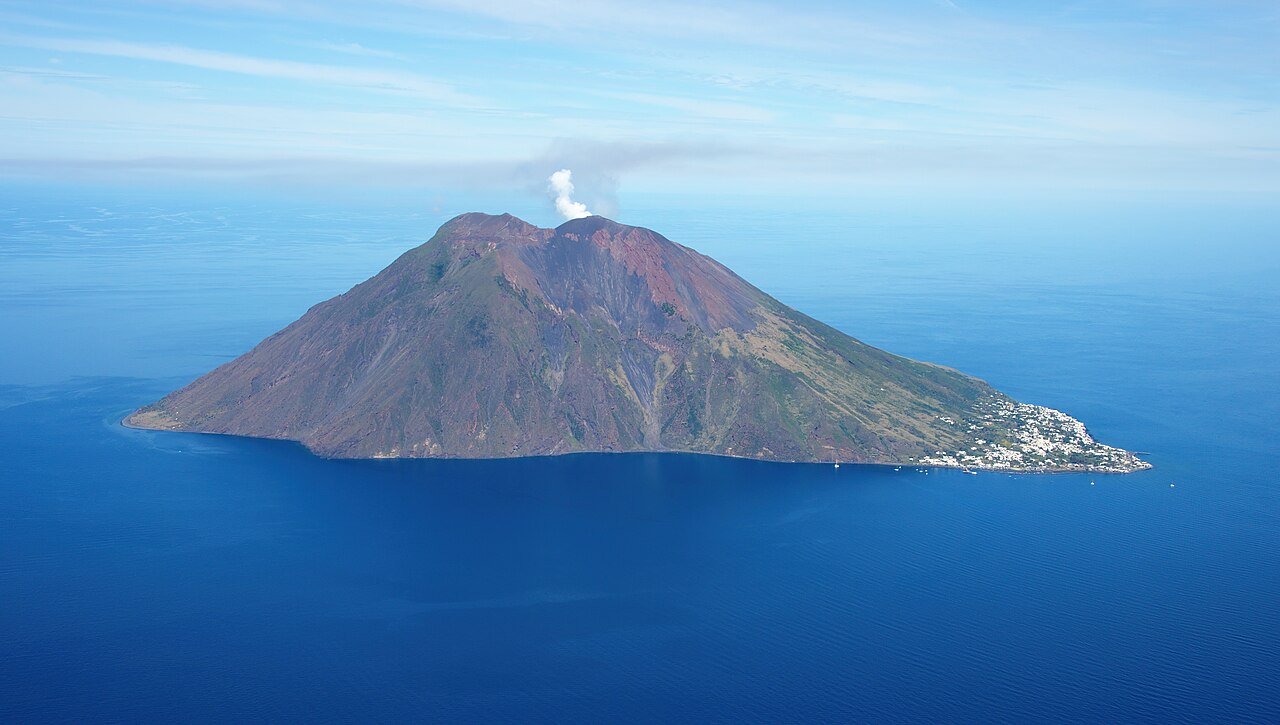
What Stromboli is and why it never stops erupting
Stromboli is the tip of a submarine volcano, and only the top 926 metres rise above the waterline. From the seabed the mountain measures over 2,700 metres, so the vast majority of it sits underwater. The island has around five hundred permanent residents and two settlements: the main village of San Vincenzo with the harbour, and remote Ginostra on the opposite side, reachable only by a footpath and home to a few dozen people.
The volcano has been essentially non-stop active for the last two to five thousand years, which is why it has long been called the lighthouse of the Mediterranean. Sailors navigated at night by the flashes above the crater long before actual lighthouses existed.
The style of activity took its name from the island: a Strombolian eruption. It is not one big blast but the regular ejection of incandescent lava and gas, usually every few minutes to a few tens of minutes. Material is thrown tens of metres into the air and falls back, or slides down the northwestern flank.
That flank is the key to the whole thing. The Sciara del Fuoco, literally the trail of fire, is a huge horseshoe-shaped scar carved by repeated collapses over roughly the last 13,000 years. Volcanic material runs straight down it into the sea, so from the water the eruptions are visible along their entire length. That is exactly why an evening boat trip is the best way to experience Stromboli.
Calm, but not always. The routine activity is predictable and poses no threat to the villages. A few times a decade, though, a stronger blast arrives. On 3 July 2019 two major explosive events hit the island, killing a hiker struck by falling material and leaving six more people with minor injuries. Access rules tend to change after events like these, so there is no point following a blog post written three years ago.
How far up Stromboli you are allowed to go today
This is the most important part of the article and also the part that goes out of date fastest. The rules change with the current level of volcanic activity and are issued by the municipality of Lipari based on assessments by the INGV institute and civil protection. The current situation looks like this:
- Up to 290 metres you can walk freely, no guide needed. The path climbs from the village and ends at a viewpoint with a side-on view of the Sciara del Fuoco.
- Between 290 and 400 metres you may go only with a certified volcanological guide. Groups are run by local agencies and set off in the afternoon so they reach the turnaround point at dusk.
- The summit and crater area are closed because of the high activity. The full summit climb that used to be a standard offer is not permitted today.
Checks do happen, and the fine for hiking above 400 metres unaccompanied is quoted at around 500 euros. Beyond that, it is a risk carried by the rescuer who would have to come and find you.
Check on the day of your trip. Ask the local guides at the harbour or the tourist office rather than the internet. The limit moves both ways: after a quieter spell the permitted zone widens, and after a stronger blast even yesterday’s open ground gets closed off.
The hike step by step
If the hike is the reason you are coming, here is roughly how it goes:
- Book in advance. Groups have a capped number of places and in summer they fill up several days ahead. Booking goes through the websites of the local guiding agencies.
- Afternoon meeting point. Usually between three and five o’clock depending on the season, so the group catches dusk at the top and descends in the dark.
- Gear check. The guide inspects your footwear and normally lends out a helmet and a head torch. Turn up in flip-flops and you are not going.
- The climb follows a path over volcanic sand and low scrub, with a few hundred metres of ascent. It is not technical, but it is relentless uphill walking in the heat.
- Watching at dusk. The best moment comes when you can still make out the landscape but the flashes are already visible. It lasts roughly half an hour to an hour.
- The descent in the dark with head torches, usually quicker than the way up.
Concrete numbers worth knowing beforehand:
- Meeting point about three hours before sunset, so the group is up there when the eruptions show best.
- The ascent takes an hour and a half to two hours depending on the pace of the group.
- You spend about an hour at the top, then head down in the dark with head torches.
- Blasts come roughly every fifteen to twenty minutes, so you will see several during that hour.
- A group tour costs up to around 30 euros per person, depending on the agency and the length of the trip.
- The season for organised hikes runs roughly from mid-March to the end of October.
The whole programme takes about three to four hours. Bring two bottles of water, a windbreaker, a scarf for your face because of the ash, and cash to pay with, because the card terminal may not work.
Eruptions from a boat: the best option for most people
When the hike is restricted or you are not fit enough for it, there is an alternative that we think works better for most visitors. The evening boat trip below the Sciara del Fuoco leaves the harbour before sunset, sails around the island and stops out at sea directly beneath the slope where the glowing material pours down.
- It lasts roughly two to three hours depending on the type of boat.
- It needs no fitness at all and works for children and older travellers alike.
- You see the eruptions in full, including the material sliding into the sea, which you cannot see from land.
- It tends to be cheaper than the guided hike.
The only thing that ruins the trip is the sea. In stronger wind it gets cancelled, or the boat only goes as far as the edge. Book it for the first possible evening after you arrive so you have a spare night to try again.
Watch out for maritime restrictions. When activity increases, the harbour master bans boats from approaching the coast below the Sciara del Fuoco. Boats then stop further out and the experience is weaker. This too only gets decided on the day.
How to get to Stromboli
There is no airport on the island and there never will be. Everything arrives by sea:
- The two useful airports are Catania and Naples. Catania makes sense if you want to combine Stromboli with Sicily, Naples if you only have a few days for the islands themselves. Both are served by low-cost carriers from most of Europe.
- The last departure from Stromboli is usually between 5 and 6 pm, which is why the hike cannot be squeezed into a day trip from anywhere else. If you want to see the evening eruptions, you have to sleep on the island.
- From Milazzo in Sicily is the standard route. Roughly an hour and a half to two and a half hours by hydrofoil depending on the number of stops, considerably longer by ferry. You reach Milazzo by car or bus from Catania or Messina.
- From Naples hydrofoils run direct in season, taking about four hours, which is a comfortable option if you fly into Naples airport.
- From the other Aeolian Islands, mainly Lipari and Salina, there are several connections a day, and this is the most natural way to fit Stromboli into an island-hopping loop.
- Operators. Hydrofoils are run mainly by Liberty Lines, and the vehicle-carrying ferries by Siremar. Buy tickets at official counters, from machines or in the operator’s app, not from touts at the harbour.
- Do not bring a car. Cars are not allowed on Stromboli and only a handful of locals have vehicles. Leave yours in the car park in Milazzo.
Sailings depend on the weather. When the sea is rough, the boats do not run, and that happens in summer too. If you have a flight the next day, leave Stromboli with a spare day in hand or you risk missing it.
The island beyond the volcano
Stromboli is not just the hike. The island has an atmosphere of its own, and it is mostly made of what is missing here: cars, noise and large hotels.
- The village of San Vincenzo. White houses with blue doors, narrow car-free lanes and a church on a rise looking out to sea. You get around on foot or in small electric buggies.
- Black beaches. The sand is volcanic, so dark grey to black, and it burns the soles of your feet in the midday sun. The best one is Ficogrande, north of the harbour.
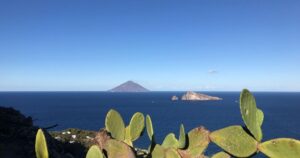
- Strombolicchio. A rock tower rising out of the sea just off the island, the remnant of an older volcanic conduit. A lighthouse stands on top and you can reach its base by boat.
- Ginostra. A hamlet on the far side of the island with the smallest harbour in Europe, reachable only by boat. A few dozen people live there and the electricity comes from solar panels.
- The house from Rossellini’s film. The film Stromboli with Ingrid Bergman was shot here in 1949, and the affair between them during filming became a global scandal. The house where they stayed is still pointed out in the village today.
When to go to Stromboli
- May, June and September: the best window. Warm but not baking, boats run at full frequency, and the hike is less crowded.
- July and August: the most people and the fiercest heat. The hike starts late in the afternoon and is still hard work. Accommodation is at its most expensive and gets booked months ahead.
- October: still workable, but the weather turns and the number of days with no sailings goes up.
- November to April: off season. Most accommodation and restaurants close, connections are reduced and the tours do not run. The island is beautiful and empty, but planning a three-day trip here is a gamble with the weather.
Where to sleep and eat on Stromboli
Accommodation is concentrated in San Vincenzo, all within walking distance of the harbour. There is not much of it and it fills up in season, so booking months ahead is not excessive caution.
- Backpackers: a room in a simple guesthouse or with locals from around 50 to 80 euros a night. Classic hostels barely exist here.
- Mid-range: a small hotel or an apartment with a terrace from around 100 to 160 euros for a double room with breakfast.
- Upmarket: a hotel with a pool and a sea view from around 200 to 350 euros a night, and more in August.
Restaurants are expensive because everything has to be shipped in. The best value is in the smaller trattorias off the main street leading up from the harbour. Compare current prices and availability through accommodation options on Stromboli.
Bring cash. There is no ATM on the island you can rely on, and some places do not take cards. Withdraw your money in Sicily or on Lipari before you board the boat.
Vulcano as the easier alternative
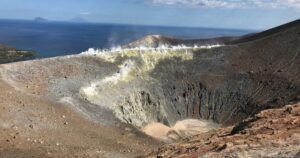
If the Stromboli hike is closed or you are not fit enough for it, the neighbouring island of Vulcano offers a compromise. It has no ongoing eruptions, but you can walk up to its crater in about an hour and without a guide. From the top you look down into a steaming crater with sulphurous fumes and out across the whole archipelago. If you want a bigger volcano on top of that, add Mount Etna in Sicily, which is a single day’s travel from Stromboli.
Vulcano also comes with the sulphurous mud pool by the harbour, where people bathe for its supposed healing properties. The recommended time in the water is about twenty minutes, the sulphur smell stays in your swimwear and hair for days, and gold jewellery turns black in it. Treat it as an experience rather than relaxation.
How many days to set aside for Stromboli
For the volcano alone, one night is enough: arrive in the morning, boat trip or hike in the evening, leave the next day. The island itself, though, deserves two to three nights, because the pace slows down here and that is really why people come.
First-time visitors to the Aeolian Islands usually combine Stromboli with Lipari and Vulcano into a five to seven day loop. Stromboli is always the high point of that loop, and it is worth saving for the end, because the other islands feel like an add-on once you have seen it.
Frequently asked questions about Stromboli volcano
How tall is Stromboli volcano?It rises 926 metres above sea level, but measured from the seabed it is over 2,700 metres. Only about a third of the whole mountain is above water.
Can you hike to the summit of Stromboli?Not at the moment. The summit and crater area is closed because of high volcanic activity. You can walk freely up to 290 metres, and between 290 and 400 metres only with a certified guide. The limits do change, so check them on the day of your trip.
How often does Stromboli erupt?Practically non-stop, at intervals of minutes to a few tens of minutes. This pattern of regular smaller blasts is named after the island and known as a Strombolian eruption, and it has been going on for roughly two to five thousand years.
Is visiting Stromboli safe?Yes, if you follow the rules. The island is monitored and access is restricted whenever activity rises. Stronger blasts do arrive without warning, though: the one on 3 July 2019 killed a hiker struck by falling material.
How do I get to Stromboli?By boat only. A hydrofoil from Milazzo in Sicily takes about an hour and a half to two and a half hours, in season there are direct hydrofoils from Naples in around four hours, or you can come from the other Aeolian Islands. When the sea is rough the boats stay in port, even in summer.
Can you see an eruption without hiking?Yes, and for most people it is the better option. The evening boat trip stops below the Sciara del Fuoco slope, where you see both the blasts and the glowing material sliding into the sea in full. It needs no fitness and tends to be cheaper than the hike.
Are there cars on Stromboli?Effectively none. The island has no normal roads, only a handful of locals own motor vehicles, and you get around on foot or in small electric buggies. Leave your car on the mainland.
Is there an ATM on Stromboli?Not one you can count on, and some businesses do not accept cards. Withdraw cash in Sicily or on Lipari before you board.
How many days do I need on Stromboli?One night is enough for the volcano itself. For the island as a whole, plan on two or three, because its main asset is the slow pace, and twelve hours is not enough to feel it.
Potřebujete pomoct s cestováním?
-
Ubytování 🏨
Vyberte si to nejlepší ubytování, ať už jste kdekoliv, přes Booking.com. -
Půjčení auta 🚗
Auto si snadno najdete přes Booking.com, kde máte často slevu díky ubytování, nebo Rentalcars.com, kde porovnáte nabídky většiny půjčoven. -
Zážitky 🎟️
Přes GetYourGuide.com si vyberete z nejrůznějších výletů i zážitků po celém světě, navíc se zrušením zdarma do 24 h předem.