Last updated 23.10.2026
A steel cable bolted into rock, a few iron rungs, and suddenly you are somewhere you would never have reached without climbing experience. Via ferrata in the Czech Republic is no longer a couple of routes near Děčín: over the past fifteen years protected routes have appeared in disused quarries, on crags above towns and below castles right across the country, and they range from lines children can manage to ones that will work a strong climber hard. Below are 24 via ferratas in the Czech Republic by region and grade, plus the kit list, how the A to F scale works, and one thing that catches out a lot of visitors: Czech routes are usually graded a notch softer than Austrian ones.
In short: via ferrata in the Czech Republic
- The biggest ferrata area is Pastýřská stěna in Děčín, with sixteen routes of varying difficulty on one crag.
- Do not set off without a via ferrata set with an energy absorber, a harness and a helmet. The set has to conform to EN 958.
- Grades run from A to F. Almost anyone can manage an A after a short briefing; from C upwards you need arm strength and a steady head.
- Watch the Czech grading. Czech routes are often assessed a grade softer than Austrian ones, so a Czech “C” can feel like a “D” in the Alps.
- Most Czech routes are short, tens to a few hundred metres of cable. This is a morning out, not a full mountain day.
- Prague is a good base. Děčín and Liberec are both about an hour and a half away and reachable by train; the Moravian Karst is easiest from Brno.
- Kit can be hired at the larger sites and from outdoor rental shops, so you can try a route without buying anything.
What a via ferrata is and who it is for
Via ferrata, Italian for iron road, is a route through rocky terrain equipped with a steel safety cable and often with ladders, rungs and grab handles as well. The idea is simple: to let people without climbing experience move through terrain they could not otherwise reach, while keeping them protected against a fall.
The concept is not new. Protected routes were appearing in the Alps as early as the 19th century, and the first documented improvement dates from 1843 on the Dachstein, where iron pegs, handles and ropes were fixed into the rock. The big wave came during the First World War in the Dolomites, where armies built protected routes to move troops around; those lines were later restored for tourism.
The Czech Republic is a different case. There are no high mountains here, so Czech ferratas were mostly built artificially, in abandoned quarries, on rock faces above towns and in the sandstone regions. That has two consequences for a visitor. The routes are short and very easy to reach, usually a short walk from a car park or a railway station, and there are enough of them to spend a whole week working through the grades. If you are heading to the Dolomites later in the summer, this is a cheap place to build the technique first.
Grades A to F explained
The most widely used system is the Schall scale, with six grades from A to F:
| Grade | What it means | Who it suits |
|---|---|---|
| A | easy, mostly walking through protected terrain, plenty of rungs and handles | complete beginners, children from around eight with an adult |
| B | moderate, steeper sections but still plenty of aids | anyone who has done one ferrata already |
| C | difficult, vertical passages where you pull on your arms | physically fit, comfortable with exposure |
| D | very difficult, long vertical sections with few rungs | experienced climbers with arm strength |
| E | extremely difficult, overhangs | climbers |
| F | vertical to overhanging sections with minimal rungs | experienced climbers only |
The single most important note in this article: Czech ferratas are often graded one notch softer than the same terrain would be in Austria. It comes down to their short length and to local habit. So if you are happy on a Czech C, that does not automatically mean you will be happy on an Austrian C. If you are planning via ferrata in Austria, drop a grade, at least for the first route.
What to take on a via ferrata
- A via ferrata set with an energy absorber and two carabiners. In Europe it falls under EN 958, revised in 2017 after older systems failed in testing. Do not use improvised rigs made from rope and slings: they do not absorb the energy of a fall and they can kill you.
- A sit harness. For children and lighter adults, combine it with a chest harness or use a full-body harness instead, so that a fall cannot tip you upside down.
- A helmet. The most common injury on a ferrata is not caused by falling, but by a stone knocked loose by the person above you.
- Fingerless gloves. Steel cable frays and the broken strands cut into your hands.
- Boots with a stiff sole, ideally over the ankle.
- A rucksack on your back, not slung over one shoulder. On vertical sections you need both hands.
Check the weight range of your set. Absorbers are built for a defined span of climber weight including equipment, and outside that span they may not perform as intended. For children and very light adults this matters, and so does the upper end of the range for very heavy climbers. Read the label on the specific set you are using.
24 via ferratas in the Czech Republic by region
For each route we give the grade on the A to F scale and the length of the cabled section, which are the two numbers that decide whether the trip is worth making. The regions run from the densest area in the north down to Moravia, and we have added rough driving times from Prague, since that is where most visitors start.
Ústí Region: the densest ferrata area
Northern Bohemia on the Saxon border is around 90 minutes from Prague by car, and Děčín also has direct trains from the capital. Nowhere else in the country packs this many protected routes into such a small area, so it is worth basing yourself here for a couple of days and linking several together.
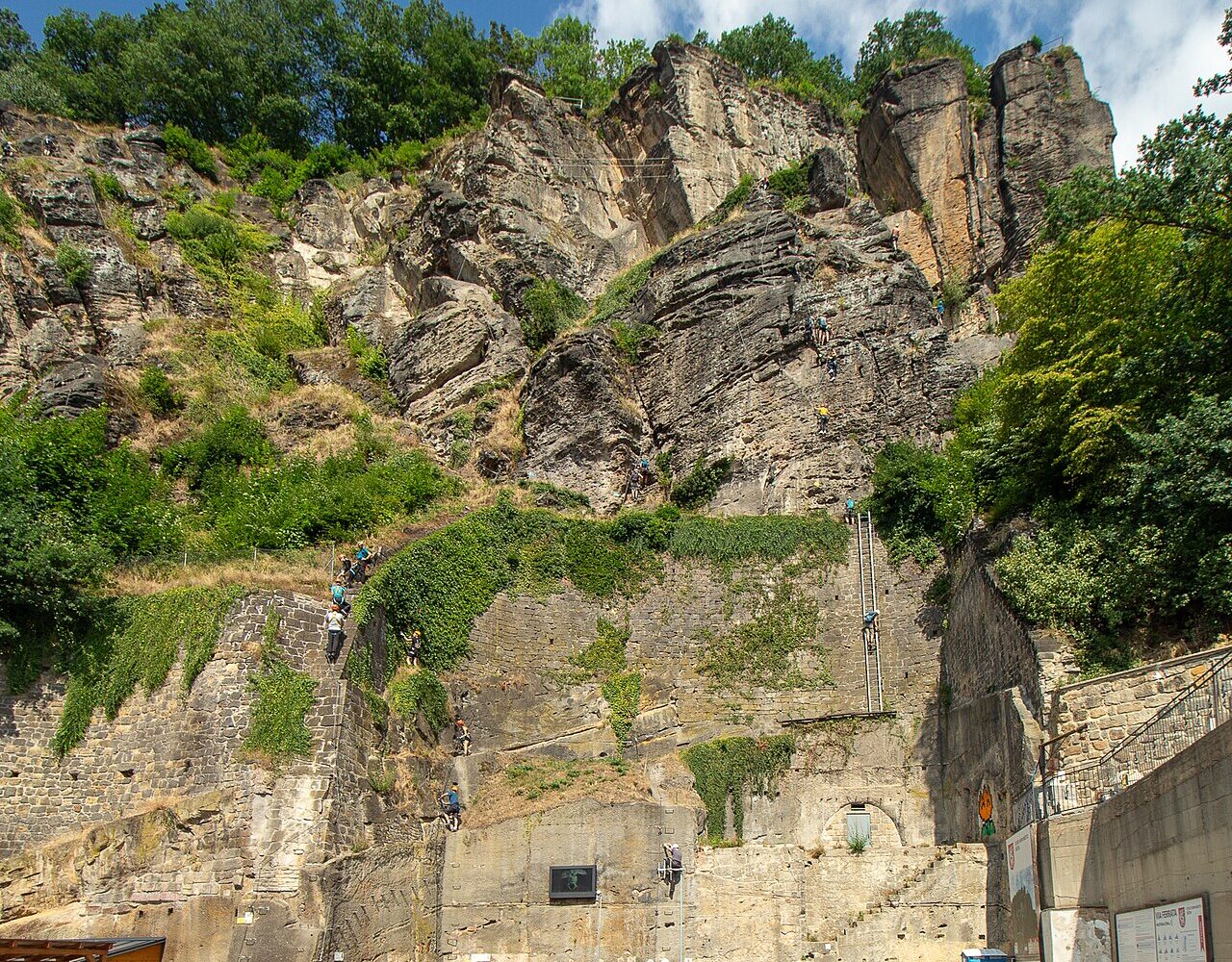
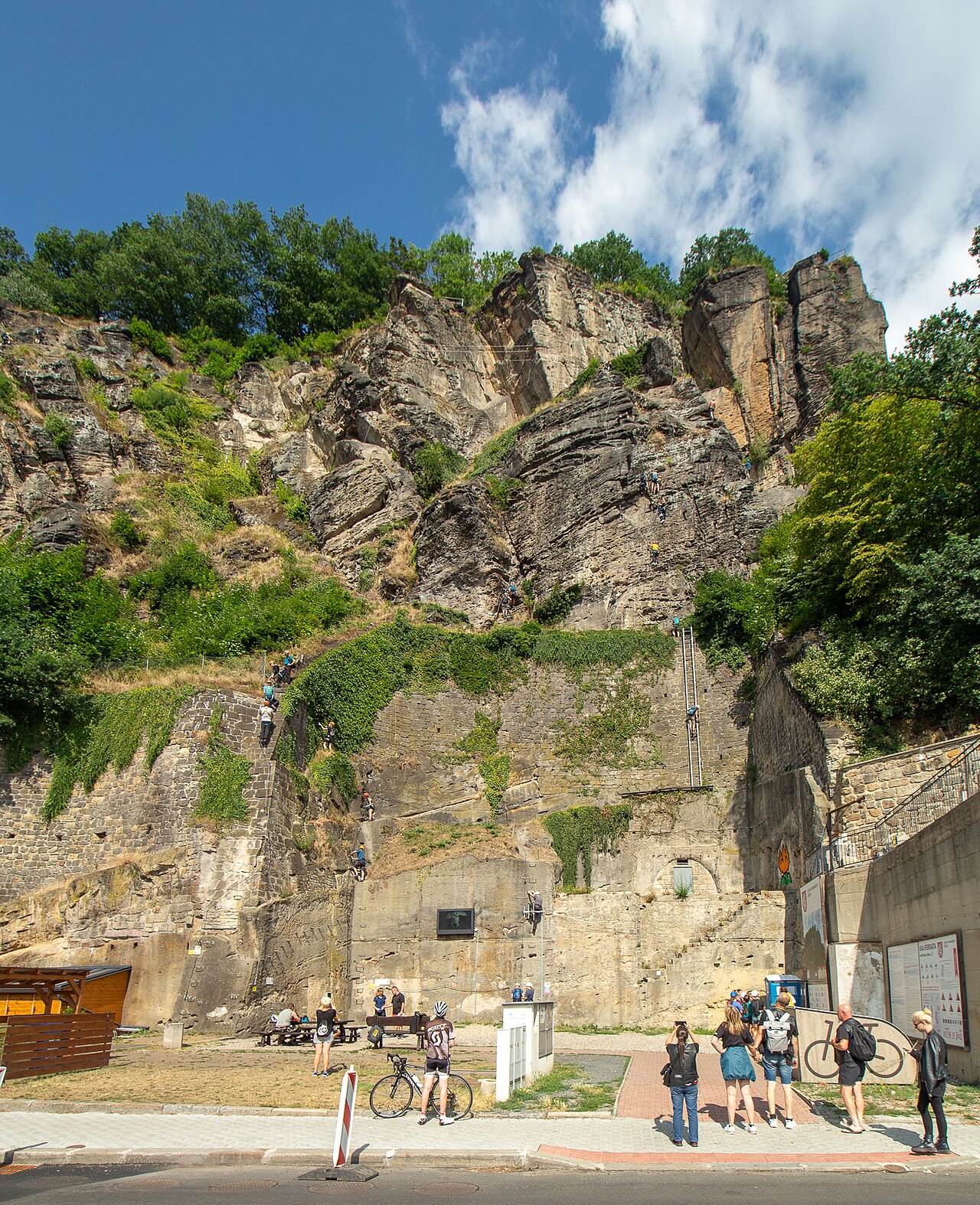
1. Pastýřská stěna, Děčín. Grade A/B to D, up to 170 metres. The largest ferrata area in the country: sixteen routes of different grades on the crag above the town, so it works both as a first ferrata and as a training day. You can walk to it from the centre of Děčín, which makes it the obvious choice if you are travelling without a car. The sandstone is slippery when wet and the routes are off-limits after rain.
2. Via ferrata Kavárnička, Srbská Kamenice. Grade B to D, just 12 metres. The shortest in the country, popular as a first taste or as a stop on the way somewhere else.
3. Via ferrata Uchem jehly, Česká Kamenice. Grade B/C, 50 metres. It threads a cleft in the rock, which is where the name, “through the eye of the needle”, comes from.
4. Ferrata Poustevna. Grade C, 50 metres. A route in the Bohemian Switzerland area.
5. Lužická spojka, Vaňov. Grade C, 60 metres. Harder than Kavárnička, above the Elbe valley.
6. Miniferrata Vinařská, Ústí nad Labem. Grade B, 30 metres. A short line inside the city, good as a warm-up.
7. Ferrata Hněvín, Most. Grade B, 75 metres. Below Hněvín castle above the town of Most.
8. Ferrata below Blansko castle and Kolem jalovce. Grade B, 20 to 30 metres. Two short routes in the Central Bohemian Uplands, suited to children and beginners.
Liberec Region
Roughly 80 to 90 minutes from Prague, and Liberec and Semily are both on the rail network, so this region works without a car too.
9. Kočičí kameny, Jizera Mountains. Grade B, 70 metres. On a rock formation in the Jizera Mountains, and easy to combine with a ridge walk.
10. Vodní brána, Semily. Grade B, C and D, 120 metres. One of the prettiest in the country, because it runs directly above the Jizera river.
11. Horolezecká aréna Liberec. Grade A/B to D/E, 100 metres. In a former quarry on the edge of the city, ideal for training because the whole spread of grades sits side by side.
Vysočina: the ferrata cluster around Vír
About two and a half hours from Prague, but only an hour from Brno, so pair it with a couple of days in Moravia rather than driving out and back from the capital.
12. The Vír area. Grade B/C, up to 100 metres on the individual routes. The surroundings of the Vír reservoir make up the largest ferrata locality in Moravia, with several lines above the water and in quarries, and enough to fill a day.
Karlovy Vary Region
Two hours west of Prague, in the spa country near the German border. Easiest to justify if you are already visiting Karlovy Vary.
13. Seifertova ferrata, Nové Hamry. Grade A to D, up to 60 metres. A route in the Ore Mountains, reachable from Karlovy Vary, with every grade in one place.
14. Bioferata, Bečov nad Teplou. Grade C/D, 30 metres. It runs through natural terrain inside the botanical garden below the castle, so you pay the garden admission. Combine it with seeing the Reliquary of St Maurus, one of the country’s great treasures.
15. Hausberg, Kraslice. Grade A/B to C/D, 80 metres. A lesser known route in western Bohemia.
16. Via ferrata Beduín, Stříbrná. Grade C to D/E, 250 metres. One of the longest and hardest lines in Bohemia, and not one for a first attempt.
South Bohemia
Between 90 minutes and two hours from Prague, and the region holds the longest protected routes in the country as well as its most photographed castles.
17. Ferrata Hluboká. Grade B and C/D, 550 metres. A protected route in a former quarry near Hluboká nad Vltavou castle, and one of the longest here. The best combination of a ferrata and a family day out, because everyone else can tour the castle while you climb.
18. Ferrata Tábor. Grade B/C, 80 metres. Inside the town itself, a good call for an afternoon.
19. Ferrata Bechyně. Grade D/E, 400 metres. The hardest protected route in the country, above the Lužnice river. Do not come here without experience.
20. Ferrata Havranka, Český Krumlov. Grade C, 110 metres. It has the longest rope bridge in the country, which is the main reason people make the trip, and it sits beside one of the best-known towns in Central Europe.
21. Václavské skály, Písek. Grade B to B/C, 80 metres. A gentle route that works well for families.
Central Bohemia
22. Slánská hora, Slaný. Grade B/C to D/E, 70 metres, with six routes in total. The closest protected route to Prague, only about 40 minutes away on a basalt cone above the town. Short, but plenty for a first go, and the easiest of the lot to squeeze into a city trip.
South Moravia
Around two and a half hours from Prague, but half an hour from Brno, which is the sensible base for both routes below.
23. Velká Dohoda, Moravian Karst. Grade A to E, 836 metres, making it the longest ferrata site in the country. Set in the walls of a former quarry, with proper facilities on site. Admission runs from roughly €8 to €21 depending on the variant, payable in Czech crowns (200 to 500 CZK).
24. Speleoferrata, Moravian Karst. Grade C/D, 40 metres. A genuine oddity: a protected route run underground, inside a cave. It costs around €57 (1,390 CZK), because it is a guided programme with equipment included.
Pardubice Region
Bonus: Via ferrata Cakle, Oldřichovice near Ústí nad Orlicí. Grade A to C, 60 metres, above the valley of the Tichá Orlice river, about two hours east of Prague and a reasonable stop if you are driving between Bohemia and Moravia.
How to move on a via ferrata
- Both carabiners on the cable at all times, except in the moment you are moving past an anchor.
- Move them one at a time. Never unclip both at once.
- Only one person between two anchors. If the climber above you falls, they take you with them and the force on the anchor is enormous.
- Do not haul on the cable like a handrail if you can avoid it. The cable is there for protection; you climb on the rock and the rungs.
- Keep your distance from the person below you, so you are not dropping stones onto their helmet.
When to go and when to stay away
The season on Czech ferratas runs roughly from April to October. Two limits matter more than anything else:
- Do not climb in the rain or straight after it. Both the steel and the rock turn slippery, and wet sandstone loses a significant amount of its strength.
- In a thunderstorm you on a steel cable are the worst thing for miles around. If a storm is coming in, get off the route immediately.
- In winter the routes ice up, and without winter experience and crampons you have no business being on them.
- Nesting season. Some routes in the sandstone areas close in spring because peregrine falcons are nesting. The closures are announced in advance and they are respected.
Via ferrata with children
Most Czech grade A routes can be done with children from roughly eight years old, though temperament matters more than age. What you need:
- A children’s set and a full-body harness, so that a child cannot tip head down in a fall.
- An adult above the child and one below, ideally three adults per child.
- A short route that you can leave at any point.
- No pressure. A child panicking halfway up a vertical wall is a problem for everybody.
The best options with children are Hluboká, Slánská hora, Velká Dohoda and the easy variants on Pastýřská stěna. If this is all new, read our guide to via ferrata for beginners first, where we go through the grading scale and the first moves on a cable.
What it costs
A large share of Czech ferratas are free and openly accessible, because municipalities or local clubs built them. A few charge a token entry fee or parking. Budget also for the Czech electronic motorway vignette if you are driving, which is registered to the vehicle’s number plate and comes in short-term versions. More importantly, check before you travel whether your insurance covers via ferrata, because standard travel policies often exclude it as a high-risk activity. The main cost is the kit:
- Hiring a complete set for a day costs in the region of €10 to €20, and rental points are usually right at the larger sites.
- Your own set, harness and helmet come to a few hundred euros, but they last for years.
- A course with an instructor is worth it if you plan to climb ferratas regularly or you are heading for the Alps.
Frequently asked questions about via ferrata in the Czech Republic
Where are the most via ferratas in one place in the Czech Republic?On Pastýřská stěna in Děčín, where sixteen routes of different grades share a single crag above the town. The second largest area is around the Vír reservoir in the Vysočina highlands, which also has several routes side by side.
Which via ferrata is closest to Prague?Slánská hora at Slaný, about 40 minutes north-west of the city, with six short routes on a basalt hill above the town. Děčín and Liberec are both around an hour and a half away and are reachable by train, which makes Pastýřská stěna the best option if you are not driving.
What kit do I need for a via ferrata?A via ferrata set with an energy absorber conforming to EN 958, a sit harness, a helmet, gloves and boots with a stiff sole. Children and light adults should use a full-body harness. Sets can be hired, so you can try your first route without buying anything.
What do the grades A to F mean?They are the Schall difficulty scale. A is an easy route, mostly walking through protected terrain; C already means vertical passages where you pull on your arms; and F means vertical to overhanging sections with almost no rungs. Czech routes tend to be graded a notch softer than Austrian ones.
From what age can children do a via ferrata?Easy grade A routes from around eight years old, though a child’s temperament matters more than their age. A children’s set and a full-body harness are essential so a fall cannot tip them upside down, with one adult above and one below.
Can you climb a via ferrata in the rain?You should not. The steel cable and the rock both turn slippery, and on the sandstone routes wet rock loses strength as well. If a thunderstorm is approaching, get off immediately: on a steel cable you are the most exposed point anywhere nearby.
Are via ferratas in the Czech Republic free?Many of them are, because municipalities and local clubs built them and left them openly accessible. A few charge a token entry fee or parking, for instance Velká Dohoda at roughly €8 to €21. The main cost is equipment, and hiring a set for the day runs about €10 to €20.
Where should I do my first via ferrata in the Czech Republic?Pastýřská stěna in Děčín, because the easiest and the harder variants sit next to each other and you can step up or back off on the spot. Ferrata Hluboká, Slánská hora near Prague and Velká Dohoda in the Moravian Karst are also good first choices.
Potřebujete pomoct s cestováním?
-
Ubytování 🏨
Vyberte si to nejlepší ubytování, ať už jste kdekoliv, přes Booking.com. -
Půjčení auta 🚗
Auto si snadno najdete přes Booking.com, kde máte často slevu díky ubytování, nebo Rentalcars.com, kde porovnáte nabídky většiny půjčoven. -
Zážitky 🎟️
Přes GetYourGuide.com si vyberete z nejrůznějších výletů i zážitků po celém světě, navíc se zrušením zdarma do 24 h předem.