Last updated 29.8.2026
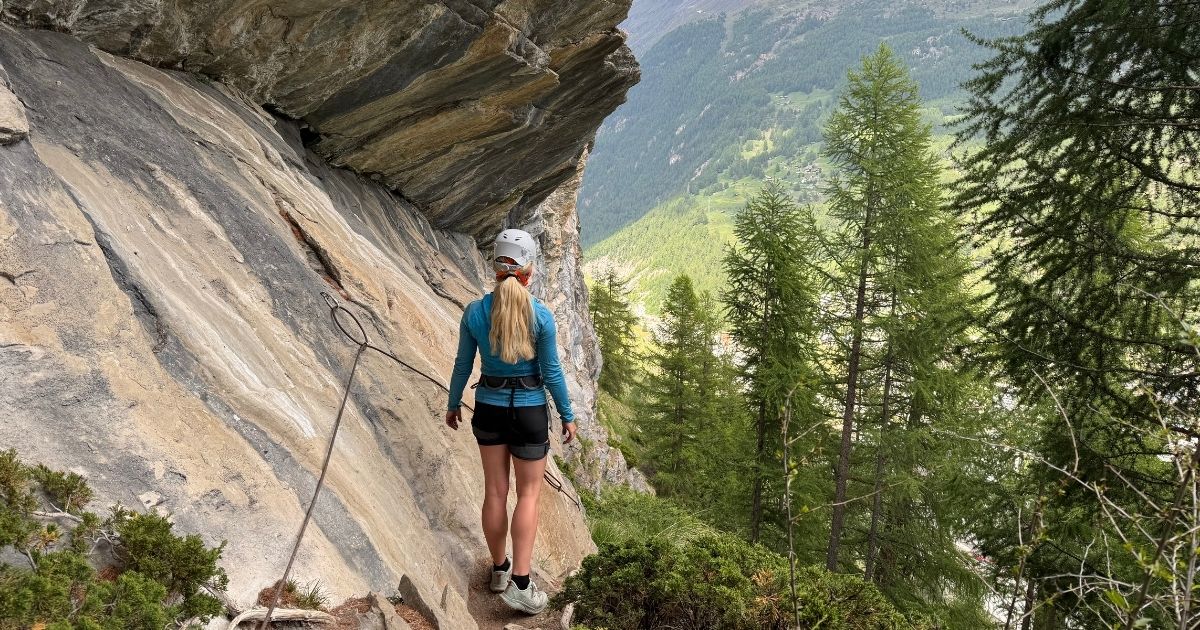
In photos a via ferrata looks like something halfway between hiking and rock climbing, and that is exactly what it is. The good news: via ferrata for beginners is genuinely doable for almost anyone with reasonable fitness who does not panic at heights. The bad news: there are a handful of mistakes on a protected route that you do not get to make twice. This guide is written for complete first timers: what kit you need, how to move on the cable, the five mistakes beginners make most often and 8 easy via ferrata routes you can realistically go and do on your first weekend.
Via ferrata for beginners in brief
- Start on grade A, A/B at the very most. The scale runs from A to F and the gap between A and C is enormous.
- A via ferrata set with an energy absorber is compulsory, not a suggestion. It has to meet the EN 958 standard as revised in 2017.
- Hire the set, harness and helmet for your first route. A day’s hire costs a few hundred Czech crowns, roughly 10 to 20 € (about 9 to 17 £), and you find out whether the sport is for you before spending anything serious.
- Climb with your legs, not your arms. Hauling yourself up on your arms is the classic beginner error: they are gone within ten metres and then you are stuck.
- Only one person between two anchors. This is the rule that lives depend on.
- No via ferrata in the wet or in a thunderstorm. Steel gets slippery, and in a storm you are the most exposed thing on the hillside, clipped to a lightning conductor.
- The easiest routes to start on sit in Czechia and Slovakia: Hluboká, Slánská hora, the easy lines on the Pastýřská stěna in Děčín and Velká Dohoda in the Moravian Karst.
What is a via ferrata, and is it for you
Via ferrata is Italian for iron path: a route up a rock face fitted with a continuous steel cable that you clip into, usually plus ladders, footpegs and handholds bolted into the rock. The whole point is to let people who are not climbers move safely through terrain that would otherwise need a rope and a partner.
A via ferrata is for you if:
- You are not terrified of heights. Healthy respect is fine. Full blown panic halfway up a face is a problem for everyone in the group, not just for you.
- You have basic fitness and can hold your own body weight on your arms for at least a short while.
- You can follow a procedure. Ferratas are not about strength. They are about clipping correctly, and clipping every single time.
- You can handle a long day. Getting to the bottom of the route and walking off the top are part of the outing, not an afterthought.
It is not a good idea for anyone with a serious heart condition, with vertigo or dizzy spells, with a fresh hand or shoulder injury, or for anyone who is only there because a friend talked them into it.
Via ferrata grades explained: where to start
Nearly every bad first ferrata story starts the same way. Someone tags along with more experienced friends, is told it will be fine, and then spends the day fighting a route two grades above their level, with a long approach, not enough food and water, and a descent that drags on until dark. The route itself is rarely the problem. Choosing it badly is. Grades exist precisely so you do not have to guess, so read them before you commit.
| Grade | What it feels like | Who it suits |
|---|---|---|
| A | mostly walking through protected terrain, plenty of footholds and handrails | your very first via ferrata |
| B | steeper sections, but still plenty of fixed aids | your second or third route |
| C | vertical passages where you pull on your arms | only after several routes under your belt |
| D to F | long vertical and overhanging sections with barely any footholds | experienced ferratists and climbers |
Grades are not identical from country to country. Czech ferratas are often graded one grade softer than Austrian ones, because they are short. Coping with a Czech C does not mean you will cope with an Austrian C. On your first trip to the Alps, always drop a grade compared with what you have done at home.
Via ferrata kit for beginners: what is compulsory and what helps
Whether you are a beginner heading for an easy line or an old hand on a grade D, the hardware is the same. There is no lightweight beginner version of a via ferrata set, because the forces in a fall do not care how new you are.
The compulsory three
- A via ferrata set with an energy absorber. Two arms with carabiners and, between them, an absorber that soaks up the energy of a fall. In Europe it is covered by the EN 958 standard, revised in 2017 after older systems failed in testing. Never improvise with slings and bits of rope. Without an absorber, a fall onto a steel cable will kill or badly injure you.
- A sit harness. For children and light adults, combine it with a chest harness, or use a full body harness, so that nobody flips upside down in a fall.
- A climbing helmet. The commonest injury on a ferrata is not caused by falling. It is caused by a stone knocked loose by the person above you.
Nice to have
- Fingerless gloves. Steel cable grows broken strands that cut. Thirty metres of hauling on bare hands and they are bleeding.
- Boots with a stiff sole, ideally over the ankle. Sandals and running shoes have no place on a ferrata: you need to stand on a peg a centimetre wide.
- A rucksack worn on your back, not slung over one shoulder. On vertical ground you need both hands, and a shoulder bag pulls you off balance.
- Water and a head torch, scaled to the length of the route.
Hire or buy
For a first via ferrata, hire, without hesitation. A full set for the day costs a few hundred Czech crowns, roughly 10 to 20 € (about 9 to 17 £), and hire points sit right at the bigger ferrata areas as well as in outdoor shops in the nearest towns. Buying makes sense once you know you enjoy it: your own set, harness and helmet run to several thousand crowns, so a couple of hundred euros (a couple of hundred pounds), but they last for years.
Whether you hire or buy, ask about the weight range of the set. Absorbers are built for a specified range of climber weight including kit, and outside that range they may not perform as intended. That applies at both ends of the scale, to children and very light adults as much as to heavier climbers.
Try the set on before you leave the shop. Clipping and unclipping the carabiners with one hand, and finding out how the absorber hangs, is much easier at ground level than at the first anchor of the day.
How to move on a via ferrata
Looking up easy via ferrata routes is the fun part, but wherever you end up going, the technique is identical. Learn it once and it works on every cable in Europe.
Clipping
- Both carabiners on the cable at all times, except for the moment you move them past an anchor.
- Move them one at a time. First one carabiner past the anchor, then the other. Never both at once.
- Check that the gate has snapped shut. Listen for it and look at it, every single time.
- Let the absorber hang free. Do not knot it, do not shorten it, do not clip it back to your harness. It needs room to work when it is needed.
Climbing
- Climb with your legs, not your arms. This is the single most important sentence in this guide. Your legs are many times stronger and will keep going all day. Your arms will be finished ten metres in if you haul yourself up on them.
- Do not treat the cable as a handrail if you can avoid it. The cable is there to catch you, and you should be climbing on the rock and the footpegs. On harder ground there is no choice, but on easy routes there is.
- Keep your body close to the rock, though not glued to it. Leaning out drains your strength and hides the footholds under your feet.
- Look ahead. Before you start a section, work out where it goes and where the feet are.
Moving as a group
- Only one person between two anchors. If there are several of you and the top one falls, they sweep everyone below them off the rock and the load on the anchor becomes enormous.
- Keep your distance, so you are not raining stones onto the head of whoever is below you.
- Put the weakest member in the middle, with experienced people front and back.
- Do not overtake unless it is safe and everyone has agreed to it.
5 mistakes beginners make most often
- Picking a route that is too hard. “It looked good in the photos” is not a criterion. Start on grade A even if it sounds too easy.
- Hauling on your arms. It empties the tank in the first third of the route, and running out of arms in the middle of a vertical wall is a serious situation.
- Unclipping both carabiners at once. One lapse of attention at an anchor and you are attached to nothing at all.
- Setting off in unsettled weather. You cannot leave a ferrata quickly, and storms arrive faster than you expect.
- Underestimating the way down. Most people plan the climb and forget that topping out is followed by an hour of walking down a marked path, tired, late in the afternoon.
8 easy via ferrata routes for beginners
If you are picking a first route, central Europe is a friendlier place to learn than the high Alps. The routes below sit in Czechia, Slovakia and Austria, they are short, low and mostly built into old quarries and small isolated hills rather than big mountains, and hire kit is easy to find nearby. There are no glaciers, no all day approaches and no altitude to deal with, and as the grading note above explains, Czech routes tend to be graded a touch more gently than Alpine ones. The nearest airports are Prague for the Czech routes, Bratislava or Vienna for Slovakia and Salzburg for the Austrian one. A hire car makes all of them a comfortable day out, since most sit outside the reach of city public transport.
Czechia
1. Ferrata Hluboká. A protected route in a disused quarry below Hluboká nad Vltavou chateau in southern Bohemia, a couple of hours’ drive south of Prague. Short, easy to read from the ground and with proper facilities at the bottom. The rest of the family can tour the chateau while you climb.
2. Slánská hora. The closest ferrata to Prague, on a basalt dome above the town of Slaný, well within a day trip from the capital. It is short, but for a first taste of moving on a cable it is entirely enough.
3. Pastýřská stěna, Děčín, the easy lines. The largest ferrata area in Czechia, with sixteen routes side by side on a sandstone cliff above the Elbe in the north of the country, close to the German border. The advantage for a beginner is that you can add or drop difficulty on the spot instead of committing to a grade in advance.
4. Velká Dohoda, Moravian Karst. A ferrata on the walls of a former limestone quarry north of Brno, with several variants and good facilities. The best choice if you are based in Moravia or arriving from the Vienna side.
5. Ferrata Tábor. A route inside the town of Tábor in southern Bohemia, which makes it an afternoon rather than a whole day of planning. Useful as a warm up or as a plan B if the weather closes in elsewhere.
Slovakia
6. HZS Martinské hole. Sensible difficulty, a straightforward approach and a view over the Turiec basin, on the hills above Martin in northern Slovakia. The classic pick for a first Slovak ferrata.
7. Zobor above Nitra. The most accessible Slovak ferrata if you are coming from the west, an easy drive from Bratislava or across the border from Vienna, with several difficulty variants on the same hill.
Austria
8. Cable car routes in the Salzkammergut. If you want a first Alpine ferrata, choose a route served by a cable car, for example the Katrin Klettersteig above Bad Ischl, easily reached from Salzburg. You save an hour of climbing on the approach and keep your strength for the part where you need it. And remember to drop one grade compared with what you have done in Czechia.
Check the route is open before you drive out. Ferratas close for rockfall, repairs and nesting birds, and the notice usually appears only on the operator’s or the local town’s website. Five minutes of checking saves a wasted day.
Is a course with an instructor worth it?
If you plan to do ferratas regularly, or you are heading to the Alps, then yes, without question. On a course you learn to clip properly, to manage your strength over a long route and, most valuably, you get feedback on what you are doing wrong, which is precisely the thing you cannot spot on your own. Courses are run by mountain guides and outdoor agencies and usually last a single day.
For one easy grade A route you do not need a course. Read the rules, go with somebody who has done a ferrata before, and pick a short line where you can back off if it is not for you.
Insurance and mountain rescue
Check what your policy actually covers. Standard travel insurance frequently files via ferrata under hazardous sports and excludes it, so you need an add on. That matters most in Slovakia and Austria:
- In Slovakia, a law in force since 1 July 2006 makes the person in the mountain area liable for the cost of the rescue operation. The mountain rescue emergency number is 18 300.
- In Austria, a mountain rescue callout is also charged for, and the sums run into tens of thousands of Czech crowns, so from roughly 800 € upwards (about 700 £). The emergency number is 140.
- The European 112 works everywhere.
Via ferrata for beginners: frequently asked questions
Can I do a via ferrata as a complete beginner?On an easy grade A route, yes, provided you are not gripped by heights and have basic fitness. A ferrata is not about strength, it is about following the procedure and clipping correctly every single time. Start on an A even if it sounds too easy for you.
What kit do I need for a via ferrata, and can I hire it?Three items are compulsory: a via ferrata set with an energy absorber meeting the EN 958 standard, a sit harness and a helmet. For a first route, hire all of it. A day costs a few hundred Czech crowns, roughly 10 to 20 € (about 9 to 17 £). Buying only makes sense once you know you enjoy the sport.
What is the most common mistake on a via ferrata?Hauling yourself up on your arms instead of climbing with your legs. Your arms are finished within the first ten metres, and in the middle of a vertical wall that is a serious problem. Your legs are many times stronger and will keep going all day.
Can I do a via ferrata without a via ferrata set?No. Without a set with an energy absorber you are not protected against a fall at all, and improvising with rope and slings is life threatening, because it absorbs none of the energy. Do not use old sets that fail to meet the EN 958 standard as revised in 2017 either.
How many people can be between two anchors?One. If there are several of you between anchors and the top person falls, they sweep everyone below them off the rock and the load on the anchor is enormous. This is the rule that lives depend on, and it is worth waiting your turn for.
Which via ferrata should I do first?In Czechia, Hluboká, Slánská hora, the easy lines on the Pastýřská stěna in Děčín or Velká Dohoda in the Moravian Karst. In Slovakia, HZS Martinské hole or Zobor above Nitra. Areas with several routes side by side, Děčín in particular, have the advantage that you can adjust the difficulty once you are there.
Do I need a course with an instructor?For one easy grade A route in Czechia, no. Read the rules and go with somebody more experienced. If you plan to go regularly or to head for the Alps, a course pays for itself, because you get feedback on the mistakes you cannot see yourself.
Does travel insurance cover via ferrata?Often it does not, because policies class it as a hazardous sport. Slovakia has required people to pay the cost of a rescue operation since 2006, and an Austrian mountain rescue callout is charged for too. Check that protected routes are explicitly covered in your policy wording, or buy the add on.
Potřebujete pomoct s cestováním?
-
Ubytování 🏨
Vyberte si to nejlepší ubytování, ať už jste kdekoliv, přes Booking.com. -
Půjčení auta 🚗
Auto si snadno najdete přes Booking.com, kde máte často slevu díky ubytování, nebo Rentalcars.com, kde porovnáte nabídky většiny půjčoven. -
Zážitky 🎟️
Přes GetYourGuide.com si vyberete z nejrůznějších výletů i zážitků po celém světě, navíc se zrušením zdarma do 24 h předem.