
Last updated 16.11.2026
The Beskydy Mountains are our idea of an easy escape into the wild. We come back again and again, whether for a quick walk after work or a long weekend on the ridges. Tucked into the far east of the Czech Republic, they are barely half an hour from the city of Ostrava, yet feel a world away — unlike the busier Krkonoše, here you can still reach a summit having passed more roe deer than people. In this guide we take the range as a whole: where the Beskydy actually lie and how they break down, which peaks are worth the climb, where the finest ridge walks run, and what to do here in winter on downhill skis and cross-country trails.
The Beskydy Mountains at a glance
- Highest peak: Lysá hora, 1,324 m — the queen of the Beskids, with a mountain hut and a transmitter mast on top.
- How they divide: the Moravian-Silesian Beskids (the highest and most visited), the Silesian Beskids and the Jablunkov Furrow — all part of the Outer Western Carpathians.
- Best ridge walk: Pustevny → Radhošť, easy and with wonderful views; the traverse to Lysá hora is the tougher option.
- For beginners: Velký Javorník, Pustevny, Radhošť. For the fit: Smrk, Kněhyně, Ropice, the great ridge traverse.
- Winter: ski slopes at Pustevny and Bílá, plus more than 70 km of cross-country trails around Pustevny.
- When to go: all year — summer and early autumn for hiking, January and February for skiing.
Where the Beskydy Mountains lie and how they divide
You’ll find the Beskydy Mountains in the far east of the Czech Republic, along the border with Slovakia and, in part, Poland — roughly in the triangle between the towns of Frýdek-Místek, Frenštát pod Radhoštěm and Jablunkov. Geologically they belong to the Outer Western Carpathians, which is why you get long, forested ridges, deep valleys and summits topping 1,200 metres.
When people say “the Beskydy Mountains”, they almost always mean the highest and most visited part. In fact the range breaks down into three sub-units:
- The Moravian-Silesian Beskids — the heart of the range and the reason most people come. This is where you’ll find Lysá hora (1,324 m), Smrk, Kněhyně, Radhošť and Pustevny. It further splits into the Lysá hora and Radhošť highlands.
- The Silesian Beskids — a smaller, more northerly part beyond the Jablunkov Pass, largely on the Polish side. On the Czech side the main feature is the ridge around Velká Čantoryje on the Polish border.
- The Jablunkov Furrow — a lower, hilly transition around the town of Jablunkov that separates the Moravian-Silesian and Silesian Beskids from Slovakia’s Kysuce region.
Almost the whole area falls within the Beskydy Protected Landscape Area — the largest protected landscape in the Czech Republic. You’ll come across old-growth forest reserves, and this is lynx country with the occasional trace of wolf, so behave accordingly: stick to the marked trails and keep your dog on a lead.
💡 Tip: If you’re wondering exactly where to head for specific sights, take a look at our separate guides What to See in the Beskids and The Most Beautiful Places in the Beskids — here we stay focused on the mountains and the walking.
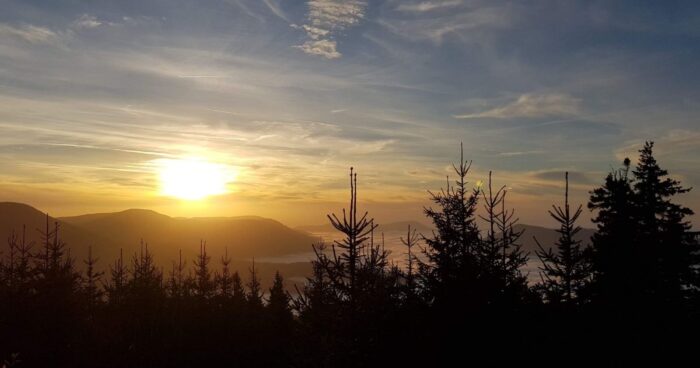
17 things to experience in the Beskydy Mountains
We’ve ordered these from the best-known peaks and ridges through to the activities. For each one you’ll find the difficulty and what to expect from the view, so you can pick something to match your mood and fitness.
1. Lysá hora (1,324 m) — the queen of the Beskids
The highest and most popular mountain in the range. You’ll spot Lysá hora from miles off by its transmitter mast and the white building of the weather station. On the summit sits the modern Bezruč mountain hut with a snack bar, so you can enjoy a beer and a bowl of goulash right at the top. On a clear day the view is superb — from the Tatras all the way to the Jeseníky.
Difficulty: moderate, whichever way you go. The classic ascents start from Ostravice (via Lukšinec) or from Krásná — reckon on roughly 700 m of ascent and 2.5 to 3 hours to the top. The path is busy all year, and on a weekend the summit can feel like a promenade.
💡 Tip: Set off first thing in the morning, or leave it until late afternoon. Around midday half of Moravia pours onto the summit and the queue for goulash gets longer than the view.

2. Smrk (1,277 m) — the second-highest and far quieter
The second-highest peak of the Moravian-Silesian Beskids, but noticeably quieter than Lysá hora. On top there’s a wooden lookout tower that lifts you above the treetops for a view across to Lysá hora and the Slovak mountains. The route up runs mostly through forest, so you’ll appreciate the shade on a hot day.
Difficulty: moderate. The classic ascent follows the red trail from Ostravice — around 7.5 km and some 850 m of ascent one way, so a little longer and less crowded than Lysá hora. Ideal when you want a peak over 1,200 m without the crowds.

3. Kněhyně (1,257 m) — the wilder side of the Beskids
The third-highest peak in the range and a proper slice of wilderness. The summit is wooded, so the views come more from spots along the way, but the atmosphere is raw and genuine. Right next door lies Čertův mlýn (1,206 m) with its pseudokarst cave and boulder fields — together they make a great full-day loop.
Difficulty: moderate to fairly demanding. The usual approach is from Pustevny via Tanečnice and Čertův mlýn — roughly 5 km along the ridge with one steeper climb. It links easily with Radhošť into a longer ridge walk.
4. Radhošť (1,129 m) — the legendary mountain with the statue of Radegast
Probably the most photogenic peak in the Beskids. Here you’ll find the wooden chapel of Saints Cyril and Methodius and, just below the summit, the famous statue of the pagan god Radegast — a compulsory photo. Steeped in legend, Radhošť is one of the spiritual hearts of the Wallachia region.
Difficulty: easy. From Pustevny you can walk here along a comfortable ridge path in under an hour, and it’s manageable even with a pushchair.
5. Pustevny — the trailhead and Jurkovič’s Art Nouveau architecture
A mountain saddle and one of the most visited places in the Beskids, second only to Lysá hora. Here you’ll find the beautiful wooden Art Nouveau buildings of Dušan Jurkovič (Libušín and Maměnka), a restaurant, and the starting point for Radhošť and Kněhyně. A great base when you don’t want to spend the whole day trudging uphill.
Difficulty: none at all if you take the cable car up from Ráztoka near Trojanovice. On foot it’s a brisk walk up.
6. The Valaška Trail — a walk among the treetops
A treetop walkway right at Pustevny. A gently rising path of around 660 metres (about 440 m leads through the forest to the tower, with a further 220 m or so making up the walkway on the tower itself) takes you among the crowns of the trees up to a 22-metre lookout tower, from which you can take in the Beskid ridges. A brilliant tip if you’re here with children or with someone who isn’t in the mood for a proper hike.
Difficulty: easy and step-free. There’s an entry fee — roughly 350 CZK for an adult and around 270 CZK for children, seniors or disabled visitors (do check the current price). The trail is open year-round except in extreme weather.
7. Velký Javorník (918 m) — a lookout for beginners
A lower peak above Frenštát, but with a splendid lookout tower and mountain hut on top. That’s exactly why it’s one of the most popular “first” Beskid hills — the climb is short and the reward is big. On a clear day you can see the whole Radhošť ridge and Lysá hora from here.
Difficulty: easy, ideal with children and for the untrained. The usual starting points are Frenštát or Veřovice.
8. Ropice (1,082 m) — a quiet peak above Třinec
A wooded peak in the north-eastern part of the range, far from the crowds. The views come more from the meadows and clearings along the way, but the peace and quiet is absolute. A lovely choice when you want a “thousander” without meeting half of Ostrava.
Difficulty: moderate, with longer approaches. The usual start is the village of Řeka, south-west of Třinec — following the waymarks past the Ropička hut and on along the ridge over Velký Lipový (999 m) to the summit. It’s well worth combining with the surrounding ridges into a longer loop.
9. Travný (1,204 m) — steep and the real thing
One of the steepest and wildest peaks in the Beskids, rising above the Morávka valley. A word of warning, though: the waymarked route to the summit itself has been closed to protect the western capercaillie, so today no marked trail leads up Travný and the summit deliberately stays free of hikers. Respect that and enjoy Travný instead as a striking backdrop on walks around the Morávka valley.
Difficulty: a summit with no marked access — count on views from below and on the surrounding ridges rather than an ascent to the top itself.
10. Ondřejník (964 m) — a lone ridge with a view of Lysá hora
A distinctive lone ridge between Kunčice pod Ondřejníkem and Frýdlant nad Ostravicí, a stone’s throw from Lysá hora and Frenštát. It has two summits: the southern Skalka (964 m) and the northern Solárka (890 m). From the mountain meadows along the ridge there’s a beautiful view of Lysá hora, Smrk and Radhošť, which is exactly why Ondřejník is such a popular, easy-going family destination that still gives you a sense of “real mountains”.
Difficulty: easy to moderate. The classic route is the blue trail from Frýdlant nad Ostravicí (around 3 km to Solárka), then a further 3.5 km or so along the ridge to Skalka. Note that the historic little Solárka hotel burned down in 2002 and the mountain hut on Ondřejník is often closed, so don’t count on refreshments at the top — bring your own.

11. Prašivá (706 m) — the oldest Beskid hut and a wooden church
Malá Prašivá is no giant, but it’s one of the most endearing family destinations in the western part of the Moravian-Silesian Beskids. On the summit stands the wooden church of St Anthony of Padua, dating from 1640 — one of the oldest timber buildings in the range — and right beside it the Prašivá mountain hut, which has been in service since 1921 and ranks among the oldest Beskid huts of all.
Difficulty: easy, ideal with children. The usual start is Vyšní Lhoty, and the climb is short and runs mostly through forest. The hut serves hot food and offers beds for the night, so Prašivá also works well as a gentle first overnight stay in the mountains.
💡 Tip: Prašivá is popular with paragliders, so in fine weather you’ll often see colourful canopies above the ridge. Do check the hut’s opening hours and those of the little church before you set out.
12. Kozubová (981 m) — a stone chapel with a view of three countries
The most easterly tip in our selection, a peak above the Jablunkov area close to the Slovak and Polish borders. On top stands the stone chapel of St Anne from the 1930s, with a lookout tower from which, on a clear day, you can see across the Czech-Slovak-Polish borderlands, and just below it the Kozubová mountain hut with a snack bar. A great choice when you want to discover the quieter, eastern corner of the Beskids too.
Difficulty: moderate, mostly because of the length of the approach. The shortest route is around 5 km from Košařiska, while a more comfortable and slightly longer one (around 6 km) leads from Dolní Lomná. Access to the tower is usually by a key you collect at the hut, so it’s best to check ahead.
13. The great ridge traverse — from Pustevny over Radhošť and beyond
The classic backbone route of the Beskids. Along the ridge you can walk from Pustevny over Radhošť and carry on westwards to Soláň and Velké Karlovice, or go the other way over Kněhyně. Most of the time you’re on a soft ridge with repeated views to both sides.
Difficulty: you can set it to suit yourself — from an easy half-day stretch (Pustevny–Radhošť, around 8 km) to a full-day traverse to Soláň and down to Velké Karlovice, which comes to more than 25 km. The return is easy to plan by bus.
14. The ridge up Lysá hora from Ostravice via Lukšinec
Unlike tip 1, where we treat Lysá hora as a goal from any direction, this is a specific ridge variant via Lukšinec for those who want to reach the highest peak “under their own steam”. The climb is long — roughly 6 to 7 km and around 700 m of ascent one way — but it gradually opens up, and the final few hundred metres run along a bare ridge with a view down into the Ostravice valley. The finest way to bag Lysá hora away from the busiest paths.
Difficulty: moderate, with around 700 m of ascent.

15. The cable car to Pustevny — a climb without the sweat
One of the oldest cable cars in Europe (running with breaks since 1940, the current one since 1987) carries you up from Ráztoka near Trojanovice straight to Pustevny. It runs daily, roughly from 9 a.m. to 5 p.m., with departures usually every half-hour; an adult fare comes to around 240 CZK one way and about 290 CZK return, with cheaper tickets for children and a surcharge for a bike or pushchair (do check the price and timetable on the website before you travel). Ideal if you’re with small children or older parents, or you simply want to save your knees for the descent. Up by cable car, down on foot via Radhošť — a tried-and-tested combination.
16. The ski slopes at Pustevny and Bílá
The range’s two main ski resorts. Pustevny draws people with its atmosphere and the chance to combine skiing with a visit to Jurkovič’s buildings — there are around nine runs of every difficulty here, totalling about 8 km. Bílá is a family resort, likewise with nine runs of varying difficulty (more than 5 km in all), a children’s park and good facilities; an adult day pass comes to roughly 650 CZK in high season (do check the price). It’s no Alps, but for a long weekend or as the basis of a family winter break it’s more than enough.
17. Cross-country skiing on the ridges around Pustevny
The Beskids are a cross-country paradise. Around Pustevny alone there are more than 70 km of groomed trails of varying difficulty. The finest are the ridge trails with views towards Radhošť or Martiňák. In good conditions you can enjoy full-day tours here with panoramas you’d more usually associate with Šumava.
The finest walks and ridge routes in the Beskids
If you like a walk that hangs together — a climb, a ridge, a descent by a different way — here are the combinations that have worked best for us:
- Pustevny → Radhošť → back (about 8 km, easy): the ideal first Beskid walk. An easy ridge, the statue of Radegast, the chapel and the views. Manageable even with a pushchair.
- Pustevny → Tanečnice → Kněhyně → Čertův mlýn (about 12 km, moderate): a wilder loop with a pseudokarst cave and boulder fields. Peace and quiet right next to the busiest spot in the Beskids.
- Ostravice → Lukšinec → Lysá hora → Malchor → back (about 16 km, demanding): the highest peak under your own steam, with refreshments at the Bezruč hut on top.
- The great ridge traverse Pustevny → Soláň → Velké Karlovice (full day, demanding): the classic traverse for those who want to spend the whole day in the mountains. Easy to plan with a return by bus.
💡 Tip: Many Beskid summits are wooded, so “bank” the views whenever they open up — don’t wait for the very top. And always pack a rain jacket: the weather on the ridge can turn in half an hour.
A day in the mountains pairs beautifully with a night or two down in the valley. Guesthouses and cottages in the Beskids start from just a few hundred crowns per bed — compare accommodation in the Beskids here →. We also have a detailed rundown in our article Accommodation in the Beskids.
The Beskydy Mountains in winter (downhill and cross-country skiing)
In winter the Beskydy Mountains turn into one of the best terrains in the Czech Republic for downhill and cross-country skiing — and at a fraction of the cost of the Alps. Thanks to their altitude and position, the snow here often lasts longer than in other Czech ranges.
Ski slopes
- Ski resort Pustevny — an atmospheric resort in the saddle below Radhošť, a great way to combine skiing with a visit to Jurkovič’s buildings.
- Bílá — the largest and most family-friendly resort in the Beskids, with runs of every difficulty and a children’s park.
- Smaller resorts such as Razula (Velké Karlovice) or Mosty u Jablunkova round out the offering for quieter skiing.
Cross-country skiing
This is where the Beskids really shine. The backbone is the Bílá stopa trail system and the trails around Pustevny — more than 70 km of groomed routes of varying difficulty in all. The finest are the ridge sections with their views, and the classic is the tour from Pustevny to Martiňák and back. For the full set of tips on where to head with your skis, see our article Where to Go Cross-Country Skiing.
💡 Tip: Check the snow cover and trail grooming before you set off — the lower parts of the Beskids can be gorgeous in January, or completely snow-free. The ridges around Pustevny and Lysá hora hold snow the longest.
For experiences and tickets (the cable car, the Valaška Trail tower, rental shops) it pays to buy in advance during the season — activities and experiences in the Beskids →.
Where to next
- What to See in the Beskids (2026)
- The Most Beautiful Places in the Beskids (2026)
- Accommodation in the Beskids (2026)
- Where to Go Cross-Country Skiing (2026)
Frequently asked questions
What is the highest mountain in the Beskids? The highest mountain in the Beskids is Lysá hora, at 1,324 m above sea level (older sources give 1,323 m). It’s also the most visited peak in the range — on the summit stand the Bezruč mountain hut and a weather station with a transmitter mast.
Where are the Beskydy Mountains? You’ll find the Beskids in the far east of the Czech Republic, along the border with Slovakia and, in part, Poland, roughly between the towns of Frýdek-Místek, Frenštát pod Radhoštěm and Jablunkov. Geologically they belong to the Outer Western Carpathians.
How do the Beskids divide? Into three sub-units: the Moravian-Silesian Beskids (the highest and most visited, home to Lysá hora and Pustevny), the Silesian Beskids (further north beyond the Jablunkov Pass, largely in Poland) and the Jablunkov Furrow (a lower transition around the town of Jablunkov).
Which peaks in the Beskids are the highest? After Lysá hora (1,324 m) come Smrk (1,277 m), Kněhyně (1,257 m), Čertův mlýn (1,206 m), Travný (1,204 m), Radhošť (1,129 m) and Ropice (1,082 m). In all there are several dozen peaks over a thousand metres in the Beskids.
Which Beskid walk is best for beginners? The easy ridge walk from Pustevny to Radhošť (manageable even with a pushchair) or the climb up Velký Javorník with its lookout tower. Both are short, have good views and decent facilities. On top of that, you can take the cable car up to Pustevny from Ráztoka.
How do you get to Lysá hora? Most often on foot from Ostravice (via Lukšinec) or from Krásná — reckon on roughly 2.5 to 3 hours of climbing and around 700 m of ascent. You leave the car in a valley car park; no cable car runs directly up Lysá hora. The path is waymarked and busy all year round.
Are the Beskids worth it in winter? Absolutely. You’ll find ski slopes at Pustevny and Bílá as well as more than 70 km of cross-country trails around Pustevny (the Bílá stopa system). The snow lasts longest on the ridges around Pustevny and Lysá hora — best to check conditions before you set off.
Where to go cross-country skiing in the Beskids? The best conditions are around Pustevny and on the ridges towards Martiňák, where the groomed Bílá stopa trail runs. The routes vary in difficulty and the finest sections offer views of Radhošť. We have more tips in our article Where to Go Cross-Country Skiing.
Are the Beskids demanding to hike? It depends on the route. You’ll find easy-going ridge walks for families (Pustevny–Radhošť) as well as steep, long climbs for the fit (Smrk, Kněhyně, the traverse to Lysá hora). Peaks over 1,200 m mean real ascent, so pick your route to match your fitness.
When is the best time to visit the Beskids? For hiking, summer and early autumn (September and October, with the colours of the forests and plenty of quiet). For downhill and cross-country skiing, January and February. The ridges are at their finest on clear days, when you can see all the way to the Tatras — and you avoid the weekend crowds on Lysá hora and at Pustevny.
Potřebujete pomoct s cestováním?
-
Ubytování 🏨
Vyberte si to nejlepší ubytování, ať už jste kdekoliv, přes Booking.com. -
Půjčení auta 🚗
Auto si snadno najdete přes Booking.com, kde máte často slevu díky ubytování, nebo Rentalcars.com, kde porovnáte nabídky většiny půjčoven. -
Zážitky 🎟️
Přes GetYourGuide.com si vyberete z nejrůznějších výletů i zážitků po celém světě, navíc se zrušením zdarma do 24 h předem.