Last updated 23.10.2026
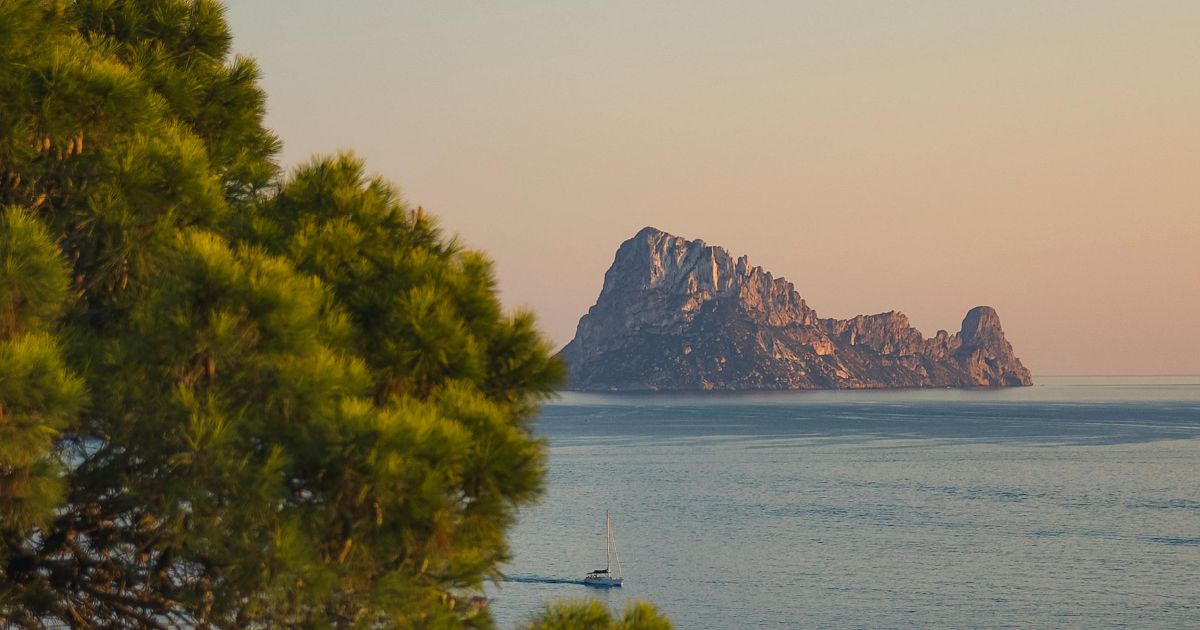
Es Vedra in short
- Where: off the south-west coast of Ibiza, roughly 2.5 kilometres from Cala d’Hort beach.
- Height: 413 metres above the sea, which is a lot more than photos suggest.
- Uninhabited and protected, part of the Cala d’Hort nature reserve. Landing and climbing are banned.
- Best viewpoint: Cala d’Hort beach and the road above it. The famous terrace by the Torre des Savinar watchtower has been fenced off since the 2025 season and entry is not allowed.
- How close you get: a boat or a guided jet ski can circle the rock, but nobody lands on it.
- The magnetic anomaly: a popular legend that geology does not support.
What Es Vedra actually is
Es Vedra is a limestone rock rising 413 metres straight out of the sea, which makes it taller than the roof of the Empire State Building. It is made of Mesozoic limestone that was pushed up as the Betic mountain range formed roughly 155 million years ago, and it belongs to the same system that continues into mainland Andalusia.
The islet is uninhabited and, together with neighbouring Es Vedranell and the water around them, forms the Cala d’Hort nature reserve, protected since 2002. Eleonora’s falcons nest here and an endemic subspecies of the Ibiza wall lizard lives on the rock. The wild goats that used to graze the vegetation were removed in 2016, precisely to protect the native plants.
The practical consequence of that protection is simple: you cannot set foot on Es Vedra. There is no landing place anyway, and the walls drop straight into the water. You can see it from close up from a boat, but you cannot explore it on foot.
Where to see Es Vedra from
Planning to see Es Vedra on Ibiza? Then it is worth knowing where you can actually stand today, and where you are no longer allowed to go.
1. Torre des Savinar: the famous viewpoint you can no longer visit
The 18th-century stone watchtower, also known as Torre del Pirata, stands on the cliff directly opposite Es Vedra, with a view of both the rock and neighbouring Es Vedranell. For years it was the most photographed spot on the whole island, and it is the angle behind most of the Es Vedra pictures you have seen.
Since the 2025 season it has been closed. The track to the tower and the terrace itself sit on private land, and after years of overload the owners fenced it off: sunset crowds, litter, speakers and vendors selling mojitos finally tipped the balance. The improvised car park is gone, and police now fine drivers who stop on the verge nearby. The fence still gets cut open regularly, because people keep trying to get in following guides posted on social media.
A handful of licensed guides hold permits and run walks up to the tower. Going on your own means trespassing on private land inside a protected area. Do not try it: you will be turned back, and the photo is not worth it. The good news is that Es Vedra looks superb from lower down, where nobody will bother you.
2. Cala d’Hort beach
Today this is the best freely accessible viewpoint. The pebble beach, about 150 metres long, sits directly opposite the rock and Es Vedra is in view all day. There are sunbeds, a lifeguard and several seafood restaurants, and it is the only place where you can look at the rock with your feet in the water. For families with small children it is the easiest option, because you drive right up and there is no climbing. Parking is limited and in high season it fills up before noon.
3. Cala Carbo and Cala Moli
Two smaller coves north of Cala d’Hort, where the view is slightly side-on and there is usually more space. Cala Carbo is the quieter one and has a good restaurant, Cala Moli is a local favourite.
4. The road above Cala d’Hort
There are several pull-ins on the road between Sant Josep and Cala d’Hort with a high view of Es Vedra and the whole coastline. None of them are signposted and you will spot them by the cars parked on the verge. For a quick stop on the way it is enough, but only pull over where there is a hard surface off the carriageway. On the final stretch towards the closed viewpoint, stopping on the verge means a fine.
5. From the sea
The strongest impression by far. Only when the boat stops right under the wall do you understand the scale of the rock. Boat trips run from Ibiza Town and Sant Antoni, usually half-day with a swim stop, and guided jet skis come out here too.
When to shoot. Es Vedra lies west of Ibiza, so the sun sets behind it. In the afternoon and at sunset you are shooting into the light and you get the postcard silhouette. If you want the rock lit from the front, with detail and colour, you have to come in the morning, which almost nobody does.
The legends around Es Vedra and what holds up
More has been said about this rock than about the rest of the Balearics put together. The stories are worth knowing, because every guide will tell you at least one of them, but it is equally worth knowing where the story ends and the measurement begins.
The magnetic anomaly and the “third most magnetic place on Earth”
The most widespread claim is that Es Vedra is, after the Bermuda Triangle and the North Pole, the third most magnetic point on the planet, scrambling compasses and instruments. It sounds good and it gets repeated everywhere.
Geologically it does not hold up. The rock is limestone, a stone with no concentration of magnetic metals, and no measurement has ever confirmed an anomaly. The supposed ranking of the world’s most magnetic places does not exist in the first place; it is an internet legend. A compass at Es Vedra points north exactly as it does anywhere else.
The sirens of the Odyssey
One local tradition makes Es Vedra the island of the sirens who tried to lure Odysseus. Homer names no specific place, and several other spots around the Mediterranean claim the same legend, mostly along the Italian coast. A lovely story with nothing under it.
A leftover piece of Atlantis
Another favourite version says Es Vedra is the peak of sunken Atlantis. It comes from the fact that the old quarry on the coast nearby is called Atlantis, properly Sa Pedrera. Stone for the city walls of Ibiza was cut here in antiquity, and today it is a stepped formation covered in carvings and inscriptions left by visitors over the years. The way down is not officially marked and does not appear on maps, it follows a steep path down the slope, and the descent plus the climb back take roughly an hour in total. In the heat it is unpleasant, it is no place for flip-flops or small children, and you need to carry water.
The hermit who really was here
The one documented part of the story. In 1855 the Carmelite friar Francisco Palau, exiled from Barcelona, arrived on Ibiza and began rowing out to Es Vedra, where he prayed and meditated in a cave, sometimes for weeks at a time. He drank rainwater dripping down the rock. He also described visions and light phenomena that took on a life of their own and gradually grew into the island’s whole mystical tradition, UFO stories included. The Church beatified him in 1988.
Why it works on people. Es Vedra needs neither magnetism nor Atlantis. It is a four-hundred-metre rock growing out of empty sea a few kilometres offshore, and at sunset it looks like stage scenery. That alone explains why people react so strongly to it, and why they have been inventing stories about it for two hundred years.
Boat trips and jet skis
The usual way to get close to the rock leaves from Sant Antoni on the west coast:
- The half-day cruise to Es Vedra and Atlantis takes about three hours and normally includes one or two stops for swimming and snorkelling, plus drinks on board.
- Different times of day. Morning departures get calmer water and better light on the rock; evening ones cost more and exist for the sunset.
- Guided jet skis also set off from Sant Antoni. They get you close, but the protected zone is off limits, so expect to see the last stretch from a distance.
- A private charter makes sense for a group, because you can plan your own route and avoid the hours when the water under the rock is busiest.
Rules inside the reserve: you may not land on Es Vedra or climb it, and loud music, drones and litter are all banned. Swimming is only allowed in designated spots outside the most sensitive zone. Boat operators usually enforce this themselves, because it is their licence on the line.
How to get to Es Vedra
- By car. The simplest option. Cala d’Hort is about 30 to 40 minutes from Ibiza Town and roughly the same from Sant Antoni. The last kilometres drop to the beach on a narrow winding road, and the car park is full before noon in season. Skip the turn-off to the closed viewpoint at Torre des Savinar: parking on the verge there ends in a fine.
- By scooter. Popular and practical, because parking at Cala d’Hort is a problem in season. The roads are narrow and twisty.
- By bus. In season a line runs to Cala d’Hort from Ibiza Town and Sant Antoni, but infrequently, and the last departure leaves before sunset. So it does not work for the main event.
- By boat. Trips leave from Ibiza Town, Sant Antoni and Cala d’Hort itself. A half-day loop around Es Vedra with a swim stop is the best way to see the rock up close.
- On foot. Along the coastal path from Cala d’Hort to Cala Carbo and on above the coves. That is one to two hours depending on the variant, with no shade and some climbing. The path to Torre des Savinar is closed.
Ibiza airport has direct summer flights from most of Europe, including daily services from London, Manchester and Dublin, and connections through Barcelona or Palma de Mallorca out of season. From the airport, Cala d’Hort is about half an hour by car.
When to go
- May, June and September: the best mix of weather and calm. The viewpoints are not packed and the sea is warm enough.
- July and August: Ibiza at full tilt. Hundreds of people gather at Cala d’Hort before sunset, the car park fills hours in advance, and at midday there is heat with no shade.
- October and April: pleasant for walking and quiet, but some of the beach restaurants are already or not yet open.
- Winter: Ibiza out of season is a different island, quiet and cheap. Es Vedra looks just as good and you get it to yourself. Boat trips, however, do not run.
Where to stay nearby
The most logical base is Sant Josep de sa Talaia, an inland town about twenty minutes from the coastal coves. It is close to Es Vedra and to the beaches of Cala Vadella and Cala Tarida, while staying out of the noise of the big resorts. If you want to be right on the water, look at Cala Vadella or Cala Carbo.
- Backpackers: a hostel bed in Sant Antoni or Ibiza Town from roughly 35 to 60 euros a night in season. Cheap accommodation directly at the south-west coves basically does not exist.
- Mid-range: an apartment or a three-star hotel in Sant Josep or Cala Vadella from roughly 110 to 180 euros for a double room.
- Upmarket: a hotel or villa with a view of Es Vedra from roughly 250 to 450 euros a night. On Ibiza, a view of this rock is a separate line in the price list.
These are high-season prices; in May and October they drop by about half. Compare current prices and availability through accommodation options on Ibiza.
Frequently asked questions about Es Vedra
What is Es Vedra?An uninhabited limestone island off the south-west coast of Ibiza, 413 metres high and about 2.5 kilometres from Cala d’Hort beach. It is part of the Cala d’Hort nature reserve.
Can you go on Es Vedra?No. The island is protected and landing on it is banned. It has no harbour and its walls drop straight into the sea. A boat can circle it and take you close, but nobody sets foot on it.
Where is the best view of Es Vedra?Among freely accessible places, Cala d’Hort beach directly opposite the rock and the pull-ins on the road above it. The famous terrace by the Torre des Savinar watchtower has been fenced off since the 2025 season, sits on private land and entry is banned. The strongest impression comes from a boat anyway.
Is Es Vedra really magnetic?It is not. The claim that it is the third most magnetic place on Earth is an internet legend. The rock is limestone with no concentration of magnetic metals, and no measurement has ever confirmed an anomaly.
What time should I go to Es Vedra for sunset?Arrive at least an hour and a half early, because the sun sets directly behind the rock and in season the whole island comes down to the beach. If you want the rock lit from the front and in colour, do the opposite and come in the morning.
How do I get to Es Vedra without a car?In season a bus runs to Cala d’Hort from Ibiza Town and Sant Antoni, but rarely, and the last one leaves before sunset. A scooter, a taxi or a boat trip is more practical.
What is Atlantis at Es Vedra?Sa Pedrera, an ancient quarry on the coast near the viewpoint, where stone for the city walls of Ibiza was cut. Today it is a stepped formation covered in carvings and inscriptions. An unmarked steep path leads down to it and the round trip takes about an hour. Do not attempt it in flip-flops or without water.
Does anything live on Es Vedra?No people, but Eleonora’s falcons nest there and an endemic subspecies of the Ibiza wall lizard lives on the rock. The wild goats that grazed the vegetation were removed in 2016 to protect the native plants.
Has anyone ever lived on Es Vedra?From 1855 onwards the Carmelite friar Francisco Palau, exiled from Barcelona, rowed out regularly to meditate in a cave on the rock and lived on rainwater. His accounts of visions stand at the beginning of the island’s whole mystical reputation.
Read next
- What to see in Ibiza: a full guide to the island beyond the clubs.
- A weekend in Ibiza: a three-day itinerary including sunset at Es Vedra.
- Ibiza parties: when and where, if you are coming for the nightlife too.
Potřebujete pomoct s cestováním?
-
Ubytování 🏨
Vyberte si to nejlepší ubytování, ať už jste kdekoliv, přes Booking.com. -
Půjčení auta 🚗
Auto si snadno najdete přes Booking.com, kde máte často slevu díky ubytování, nebo Rentalcars.com, kde porovnáte nabídky většiny půjčoven. -
Zážitky 🎟️
Přes GetYourGuide.com si vyberete z nejrůznějších výletů i zážitků po celém světě, navíc se zrušením zdarma do 24 h předem.