Last updated 23.10.2026
Ask about the highest mountains in Poland and you will usually get one answer: Rysy. Fair enough — its north-western summit, 2,499 m, is the highest point in the country. But the story behind it is far more interesting. The seven highest Polish peaks all sit in a single range, the Tatras, and only then do the famous names appear: Babia Góra, Śnieżka, Tarnica, Turbacz.
This guide is an honest list with numbers. First the seven highest Tatra summits with verified elevations, then the highest peak of every other Polish range — what Poles call the Crown of Polish Mountains — and finally the part that matters most: which of these you can climb yourself on a marked trail, without a rope or crampons. Planning an actual trip to the mountains? Our separate guide The Polish Tatras: 17 Most Beautiful Places to See covers the region; this one is about peaks and elevations.
The highest mountains in Poland at a glance
- Highest mountain in Poland: Rysy — 2,499 m (the north-western summit, on the Slovak border).
- Highest summit entirely inside Poland: Kozi Wierch — 2,291 m, in the Tatras.
- The seven highest Polish peaks are all in the Tatras; number eight (Babia Góra, 1,725 m) is elsewhere.
- Highest outside the Tatras: Babia Góra, then Śnieżka 1,603 m and Śnieżnik 1,424 m.
- Doable for hikers: Rysy (marked but demanding), Babia Góra, Śnieżka and Giewont — no climbing gear needed.
- Base for the Tatras: Zakopane — about 106 km from Kraków, two hours by car or bus.
The 18 highest mountains in Poland
The list is ordered by elevation. The first seven are Tatra summits, and the gap is striking: between number seven (Giewont) and number eight (Babia Góra) there are almost 170 metres and a change of range altogether. From eighth place down, each entry is the highest peak of another Polish range. For every summit you get elevation, range and how accessible it really is. A note on the figures: for several peaks sources differ by a metre or two because they come from surveys made in different years — we flag that at the mountains where it matters.
1. Rysy — 2,499 m (Tatras)
The highest point in Poland. Rysy has three summits, and the Polish–Slovak border runs across the north-western one at 2,499 m — that is the Polish record. The tallest of the three (2,503 m, or around 2,501 m by newer geodetic surveys) lies entirely in Slovakia. From the Polish side you climb from Morskie Oko past Czarny Staw and the Rysy hut, with nearly 300 metres of fixed chains near the top. Access: marked trail, but a full-day effort — not in the wet and not in winter without proper gear.
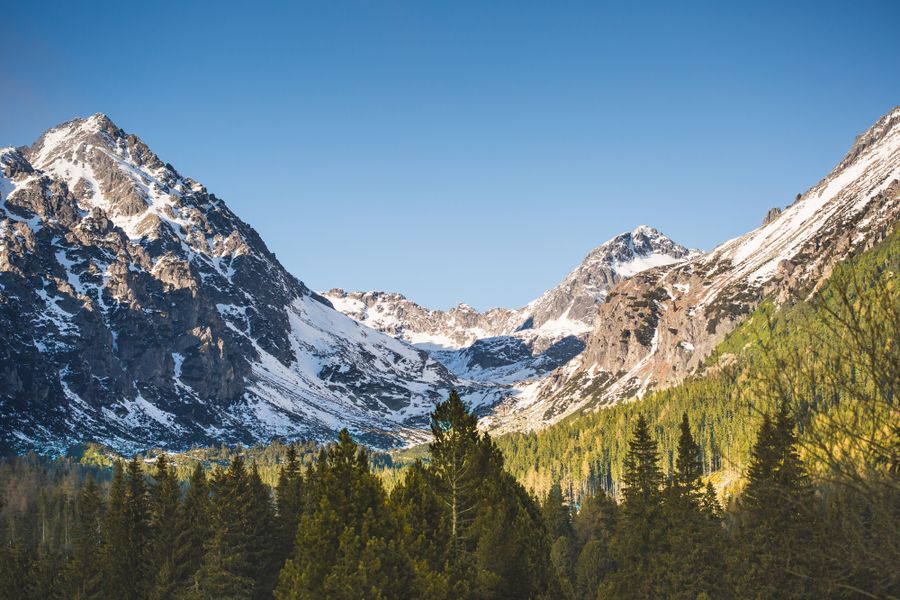
2. Mięguszowiecki Szczyt Wielki — 2,438 m (Tatras)
The second-highest Polish summit, rising straight above Morskie Oko. It sits on the border and only unmarked climbing routes lead to the top — out of reach for ordinary hikers. Access: alpine climbing experience and equipment required.
3. Niżnie Rysy — 2,430 m (Tatras)
The “Lower Rysy” on the ridge running north from Rysy — after Rysy and Mięguszowiecki, this is the third-highest point on Polish soil. Its north-western face drops more than 600 metres to Czarny Staw and ranks among the biggest walls around Morskie Oko. No marked trail. Access: climbing terrain.
4. Świnica — 2,301 m (Tatras)
A striking rock pyramid on the main ridge above Hala Gąsienicowa. A marked but exposed trail runs to the top from Kasprowy Wierch via the Świnicka Pass, chained in places. Access: experienced hikers with a head for heights.
5. Kozi Wierch — 2,291 m (Tatras)
A record worth knowing: Kozi Wierch is the highest mountain lying entirely within Poland — Rysy and every taller summit stand on the border. It is reached by Orla Perć, one of the most exposed marked routes in the Tatras, one-way only on part of its length. Access: experienced hikers only; chains and iron rungs throughout.
6. Kasprowy Wierch — 1,987 m (Tatras)
The most visited Tatra summit, thanks to the cable car from Kuźnice just above Zakopane. There is a weather observatory on top and a view along the whole main ridge. Access: anyone can ride up — book the cable car online in advance; on foot it is a moderately demanding day hike.
7. Giewont — 1,894 m (Tatras)
Zakopane’s emblem — the silhouette of a sleeping knight, crowned by a large iron cross from 1901. A marked trail with chains in the summit section leads up, and traffic is one-way: up from Kondratowa, down towards Strążyska. It is hugely popular, so queues form at the chains in high season. Watch the storms — the metal cross makes the summit genuinely dangerous in lightning. Access: fit general hiker.
💡 Tip: Between the seventh and eighth highest mountains in Poland there is a gap of almost 170 metres and a complete change of range. Every Polish peak above 1,894 m is in the Tatras — which is exactly why Poles treat the Tatras as their one true high-mountain range.
8. Babia Góra (Diablak) — 1,725 m (Beskid Żywiecki)
Queen of the Beskids and the highest Polish mountain outside the Tatras. The classic figure is 1,725 m, though recent laser surveys give 1,723.8 m; Polish peak-bagging lists still use 1,725. The Diablak summit sits on the Polish–Slovak border. Several marked trails lead up: the shortest is the red one from the Krowiarki Pass (about 2.5 hours), the most spectacular is Perć Akademików, chained and one-way. Access: general hiker — but weather here turns in fifteen minutes and the wind on the ridge is notorious.
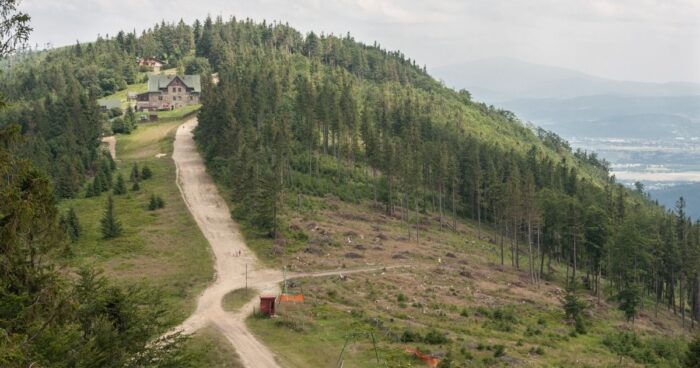
9. Śnieżka — 1,603 m (Karkonosze / Giant Mountains)
The highest peak of the Karkonosze and of the whole Sudetes, right on the Czech–Polish border. Plenty of marked paths climb it from the Polish side and it draws crowds. On top stand St Lawrence’s chapel and the flying-saucer discs of the Czech weather observatory. Access: general hiker; the easiest routes start in Karpacz, past the Samotnia hut. More ideas in Karkonosze Mountains, Poland: 15 Things to See and Do.
10. Śnieżnik — 1,424 m (Śnieżnik Massif)
A summit on the Czech–Polish border and the high point of its own massif. Czech sources give 1,423–1,424 m, Polish ones 1,425 m — the result of separate surveys on either side of the border rather than an error. From Poland the usual start is the village of Międzygórze; since 2022 a lookout tower stands on the summit dome again, rebuilt where the old one was blown up in 1973. Access: general hiker, and far quieter than the Karkonosze.
11. Tarnica — 1,346 m (Bieszczady)
The highest mountain of the Bieszczady in Poland’s wild south-eastern corner — a region that feels more like the Carpathians than a holiday resort. The grassy ridges known as połoniny give some of the finest views in the country. Most people start from Wołosate (about 2 hours) or Ustrzyki Górne. Access: general hiker; a classic sunrise walk.
12. Turbacz — 1,310 m (Gorce)
The highest summit of the Gorce, a forested range between the Tatras and the Beskids. Below the top stands the largest mountain hut in the Polish Beskids (over a hundred beds), and five marked trails converge there — it is the main crossroads of the whole Gorce. From the meadows the view runs across the Podhale basin all the way to the Tatra ridge. Access: easy-going hiker, good with kids; the shortest approach starts at Kowaniec in Nowy Targ.
13. Radziejowa — 1,266 m (Beskid Sądecki)
The highest mountain of the Beskid Sądecki in southern Lesser Poland. Two numbers circulate: older lists say 1,262 m, current surveys and the signs on site say 1,266 m (1,266.5 to be exact). The summit itself is wooded, which is why it carries a 22-metre lookout tower with a platform at 17 metres — the previous one burned down after a lightning strike, the present one opened in 2020. From the top you see the Tatras, the Pieniny, Babia Góra, the Gorce and the Slovak ranges. Access: easy-going hiker, best from Obidza or Rytro.
14. Skrzyczne — 1,257 m (Silesian Beskids)
The highest mountain of the Silesian Beskids and the home hill of the Szczyrk ski resort. Both a gondola and a chairlift run up from the valley, so you can get to the top without much effort. There is a small lookout tower by the upper station, and on a clear day you can see the Żywiec basin and the distant Tatras. Access: general hiker, about 2 hours on foot from Szczyrk, or ride up.
15. Mogielica — 1,171 m (Beskid Wyspowy)
The highest summit of the Beskid Wyspowy, a range built of lone “island” hills south of Kraków. A wooden lookout tower on the forested top gives a full circle of views over the Tatras, the Gorce and the neighbouring Beskid ridges. The area is one of Poland’s best capercaillie habitats. Access: easy-going hiker, a favourite family outing.
16. Wielka Sowa — 1,015 m (Owl Mountains / Góry Sowie)
The high point of the Owl Mountains in Lower Silesia, close to the Czech border. The summit carries a lookout tower from 1906, roughly 25 metres tall — reopened in July 2023 after a multi-year restoration. From the platform you look across much of the Sudetes, from the Karkonosze to the Śnieżnik massif. Access: easy-going hiker on good trails; the tower charges a small entry fee.
17. Szczeliniec Wielki — 919 m (Stołowe / Table Mountains)
The most famous summit of the Table Mountains, near the Czech border. A stone stairway cut into the rock in 1814 climbs from the village of Karłów to the plateau; guidebooks quote anywhere from 665 to 682 steps depending on where they start counting. Up top waits a labyrinth of rock corridors with viewing terraces and bizarre sandstone formations. The elevation has two versions too: 919 m is the survey marker below the terrace, while the summit itself reaches 922 m. Access: general hiker — expect stairs, a national park entry fee and weekend queues.
18. Ślęża — 718 m (Ślęża Massif)
A lone cone south of Wrocław that rises straight out of the plain, which makes it look far higher than it is. It has been considered a sacred mountain since prehistory: enigmatic stone cult sculptures still stand on its slopes, and the top holds a church and a lookout tower. The walk up from Sobótka takes a little over an hour. Access: easy-going hiker; a year-round ritual for the people of Wrocław.
💡 Tip: Wielka Sowa, Szczeliniec Wielki and Śnieżnik all sit close together in the Sudetes. Three peaks from this list fit into one long weekend based in the Kłodzko valley — and it is a natural start to the Crown of the Polish Sudetes, the younger sibling of the Crown of Polish Mountains.
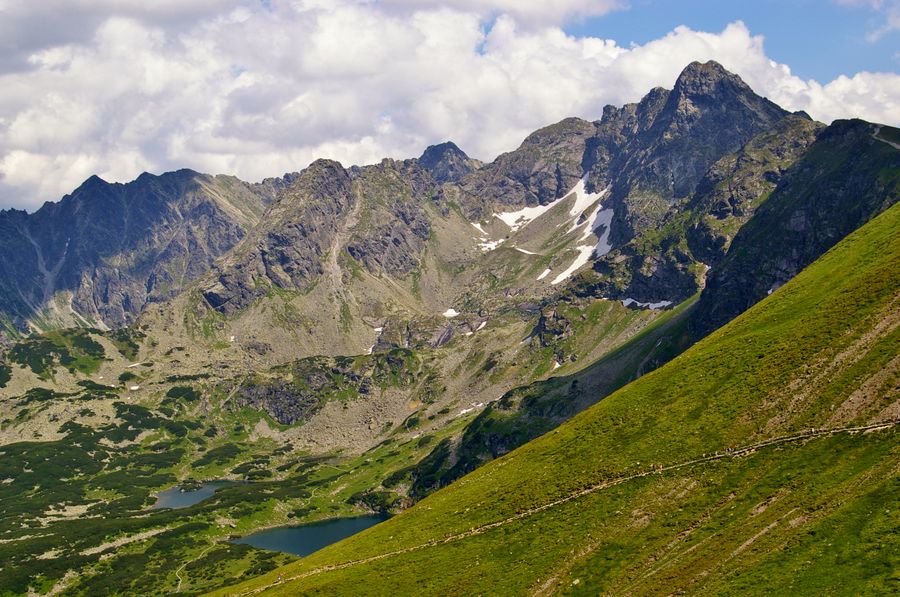
The highest peak of every Polish range
Poles have a neat concept for this: the Crown of Polish Mountains (Korona Gór Polski) — a set of 28 summits, each the highest point of one range. The list was announced in 1997 by Marek Więckowski and Wojciech Lewandowski and has since become one of the country’s most popular hiking challenges, complete with a stamp booklet and a badge. We picked the most significant ranges so you can see how varied Polish mountains are, from genuine high alpine terrain to gentle wooded ridges.
| Range | Highest peak | Elevation |
|---|---|---|
| Tatras | Rysy | 2,499 m |
| Beskid Żywiecki | Babia Góra | 1,725 m |
| Karkonosze (Giant Mountains) | Śnieżka | 1,603 m |
| Śnieżnik Massif | Śnieżnik | 1,424 m |
| Bieszczady | Tarnica | 1,346 m |
| Gorce | Turbacz | 1,310 m |
| Beskid Sądecki | Radziejowa | 1,266 m |
| Silesian Beskids | Skrzyczne | 1,257 m |
| Beskid Wyspowy | Mogielica | 1,171 m |
| Izera Mountains | Wysoka Kopa | 1,126 m |
| Pieniny | Wysokie Skałki | 1,050 m |
| Owl Mountains (Góry Sowie) | Wielka Sowa | 1,015 m |
| Table Mountains (Góry Stołowe) | Szczeliniec Wielki | 919 m |
| Ślęża Massif | Ślęża | 718 m |
| Holy Cross Mountains | Łysica | 614 m |
The full Crown has 28 summits; the table above shows the most important ones. A few entries are quietly disputed: recent surveys suggest that in the Bystrzyckie Mountains an unnamed 985 m point beats Jagodna, and that on Łysica the neighbouring Agata summit wins by a few centimetres. The list stays as it is, though — it is about ranges, not about survey records.
Which peaks can a hiker climb (Rysy, Babia Góra, Śnieżka)
This is the most common question, and the answer needs splitting. Most of the highest Polish Tatra summits are for climbers only (Mięguszowiecki, Niżnie Rysy), and others demand real confidence on exposed, chained routes (Kozi Wierch on Orla Perć, Świnica). But the three most famous ones are within reach of any reasonably fit hiker — with respect and in good weather.
| Peak | Elevation | Difficulty for hikers |
|---|---|---|
| Śnieżka | 1,603 m | Easy to moderate — marked trails, fine with children. |
| Babia Góra | 1,725 m | Moderate — shortest is the red trail from Krowiarki; Perć Akademików is harder. |
| Giewont | 1,894 m | Moderate to hard — chains, one-way traffic, queues, storm risk. |
| Rysy | 2,499 m | Hard — full-day hike, chains, only dry and snow-free. |
Śnieżka is the easiest — if you can manage a full day of walking uphill, you will get there. Babia Góra is a step up but still within the range of an ordinary hiker. Rysy is the ceiling of what you can reach in Poland without climbing gear: budget 8–10 hours round trip from Morskie Oko, with chains for the final stretch.
💡 Tip: Start early for Rysy and check the thunderstorm forecast. Storms break out in the Tatras regularly in the afternoon, and an exposed chained ridge is the last place you want to be. The route is realistically passable from late June to October. Entry to Poland’s Tatra National Park costs 11 zł (about €2.50) per day, free for children under 7.
If you are planning several peaks, the best base for the Tatras is Zakopane — the Kasprowy Wierch cable car starts here, so do the Giewont trails and the minibuses to Morskie Oko below Rysy. It is about 106 km from Kraków, two hours by car, and buses run all day. Find accommodation in Zakopane here →
And if you would rather go up with a guide or book a ready-made trip, it is worth browsing guided hikes and experiences around Zakopane →.
Where to next
- The Polish Tatras: 17 Most Beautiful Places to See
- Karkonosze Mountains, Poland: 15 Things to See and Do
- The Highest Mountains in Slovakia: 17 Peaks
- The Highest Mountains in the Czech Republic: Top 15 Peaks
Frequently asked questions
What is the highest mountain in Poland? Rysy — specifically its north-western summit at 2,499 m, which the Polish–Slovak border runs across. The tallest of the three Rysy summits (2,503 m, or roughly 2,501 m by newer surveys) lies entirely on the Slovak side.
Which is the highest peak lying entirely within Poland? Kozi Wierch in the Tatras, 2,291 m. Every taller Polish summit — Rysy, Mięguszowiecki Szczyt Wielki, Niżnie Rysy, Świnica — stands on the state border.
How many of Poland’s highest mountains are in the Tatras? The first seven. Rysy, Mięguszowiecki Szczyt Wielki, Niżnie Rysy, Świnica, Kozi Wierch, Kasprowy Wierch and Giewont are all Tatra summits. Only number eight, Babia Góra (1,725 m), belongs to the Beskids.
What is the highest mountain in Poland outside the Tatras? Babia Góra in the Beskid Żywiecki, 1,725 m. It is followed by Śnieżka in the Karkonosze (1,603 m) and Śnieżnik (1,424 m).
Can you climb Rysy without climbing equipment? Yes. From the Polish side a marked hiking trail leads up from Morskie Oko, secured near the top with almost 300 metres of chains. It is long and demanding (8–10 hours round trip) and safe only when dry and free of snow, roughly from late June to October.
How high is Śnieżka and is it in Poland or the Czech Republic? Śnieżka is 1,603 m and its summit sits exactly on the Czech–Polish border, shared by both countries. It is the highest peak of the Karkonosze and of the entire Sudetes.
What is the Crown of Polish Mountains? Korona Gór Polski is a set of 28 summits, each the highest point of one Polish range — from Rysy (Tatras, 2,499 m) down to Łysica (Holy Cross Mountains, 614 m). It was announced in 1997 by Marek Więckowski and Wojciech Lewandowski, and collecting all 28 is one of the country’s most popular long-term hiking challenges.
Which Tatra peak can a beginner reach? Kasprowy Wierch (1,987 m) — a cable car runs up from Kuźnice near Zakopane, so anyone can get to the top. On foot it is also one of the gentler ways to reach a Tatra two-thousander.
Where should I stay to climb Poland’s highest peaks? Zakopane is the best base for the Tatras — the Giewont trails, the Kasprowy Wierch cable car and the buses to Morskie Oko all start there. For the Karkonosze pick Karpacz, for the Bieszczady Ustrzyki Górne, and for Babia Góra the village of Zawoja.
When is the best time to climb the highest Polish mountains? For the demanding Tatra routes (Rysy, Świnica, Orla Perć), late June to October, when the ridges are snow-free. Śnieżka, Babia Góra and Tarnica work from spring to autumn; in winter they become serious outings that need crampons and an ice axe.
How do I get to the Polish mountains without a car? Kraków is the gateway to the Tatras: buses and minibuses run to Zakopane all day, taking about two hours. For the Karkonosze fly or take a train to Wrocław and continue to Karpacz, and for the Bieszczady the nearest hub is Rzeszów, with buses on to Ustrzyki Górne.
Potřebujete pomoct s cestováním?
-
Ubytování 🏨
Vyberte si to nejlepší ubytování, ať už jste kdekoliv, přes Booking.com. -
Půjčení auta 🚗
Auto si snadno najdete přes Booking.com, kde máte často slevu díky ubytování, nebo Rentalcars.com, kde porovnáte nabídky většiny půjčoven. -
Zážitky 🎟️
Přes GetYourGuide.com si vyberete z nejrůznějších výletů i zážitků po celém světě, navíc se zrušením zdarma do 24 h předem.