Last updated 30.8.2026
Most people who fly into the Czech Republic see Prague, take a photo of the astronomical clock and go home. The southern third of the country is where the postcards actually come from: a region of fishponds, forests and towers called South Bohemia (Jižní Čechy in Czech), roughly two to three hours by road from the capital. Line up the most beautiful places in South Bohemia and you run out of fingers long before you run out of region: Český Krumlov, the white chateau at Hluboká, the UNESCO village of Holašovice, the fairy tale water castle of Červená Lhota, the wilderness of Šumava and the quiet mirrored ponds of Třeboňsko. It is a corner of Europe where a castle reflected in water is not a special occasion but the normal view from the road.
The most beautiful places in South Bohemia in short
- The star of the region: Český Krumlov, a UNESCO town wrapped in two bends of the Vltava river, with a castle tower above it. Come early in the morning, before the coaches.
- Castles worth the memory card: Hluboká nad Vltavou (neo-Gothic, Windsor inspired), Červená Lhota (a red chateau on an island) and Kratochvíle (a Renaissance summer palace).
- A UNESCO village: Holašovice, a green with folk Baroque farmhouses around it.
- Water and quiet: Třeboňsko and its fishponds (Rožmberk, Svět), plus Lipno lake with the Treetop Walkway.
- Wilderness: Šumava, known in English as the Bohemian Forest, with the Boubín primeval forest, peat bogs and the source of the Vltava.
- When: May to June and September for the best light and the smallest crowds; castle season runs roughly April to October.
- Money: the Czech Republic does not use the euro. You pay in Czech crowns (CZK), and a main castle tour costs roughly 150 to 300 CZK, about £5 to £10.
When to go and how to get around South Bohemia
South Bohemia is worth a trip in any season, but if you want the scenery at its best, aim for May and June, then again for September. In late spring the ponds are full, the meadows are flowering and there are far fewer visitors than at the height of summer. September brings warm, low light and the first autumn colours, and it is also when the traditional pond harvests begin around Třeboň, an event that belongs to this landscape as much as the water itself.
Most castles and chateaux keep a main season from about April to October. Outside those months they are usually shut, or open at weekends only, so always check the opening hours on the monument’s own website before you set off. High summer, July and August, means everything is running, but it also means queues in Český Krumlov and a full car park at Hluboká.
The honest answer on transport is that a car makes the biggest difference. Distances between the castles are short, but public transport to the smaller places, Holašovice and Červená Lhota above all, is thin. If you are travelling without a car, base yourself somewhere on the rail network: České Budějovice, Český Krumlov, Třeboň and Jindřichův Hradec are all reachable by train or coach, and trains from Prague run to České Budějovice several times a day. Note that Czech place names carry accents that change the sound, so it helps to have the written form on your phone when buying tickets.
💡 Tip: Save Český Krumlov for early morning or late afternoon. Between ten and four the historic centre fills with day trippers and a photograph of the lanes without people in it is close to impossible. Accommodation in Český Krumlov →
23 of the most beautiful places in South Bohemia, one by one
We have ordered them so that they lead you across the region, starting with world famous Krumlov, moving through the storybook castles and ending in the wilderness of the Bohemian Forest and the silence of the fishponds. For each of the 23 places you get what makes it worth the detour, where in the region it sits, how to reach it, and a photo tip telling you where to stand.
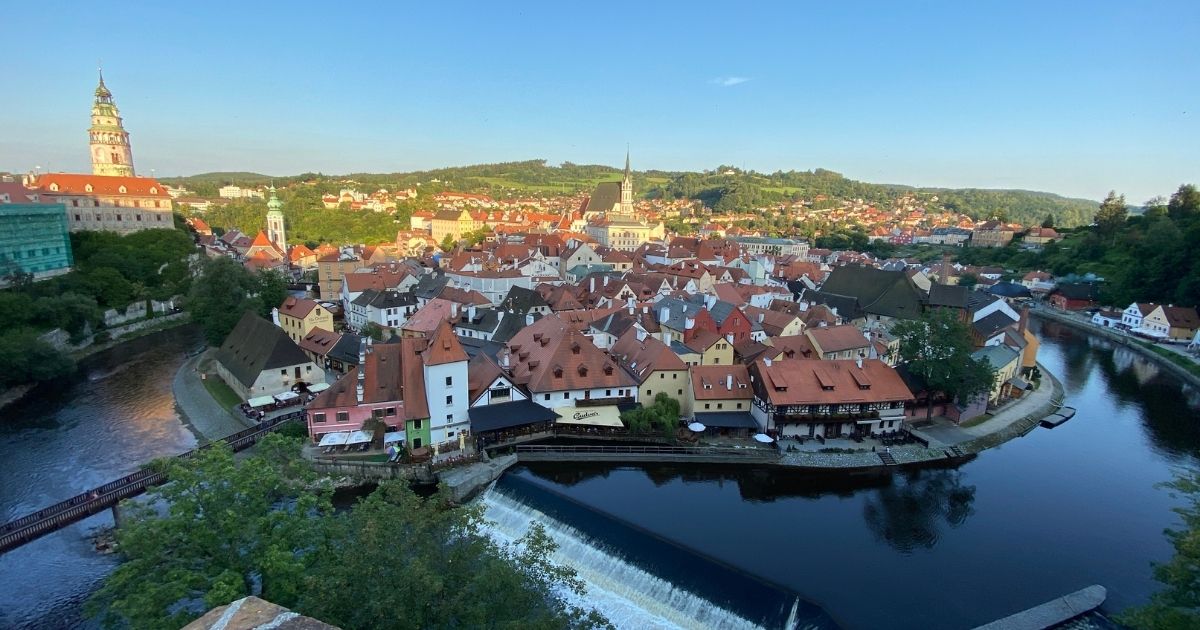
1. Český Krumlov: a bend in the Vltava and a painted tower
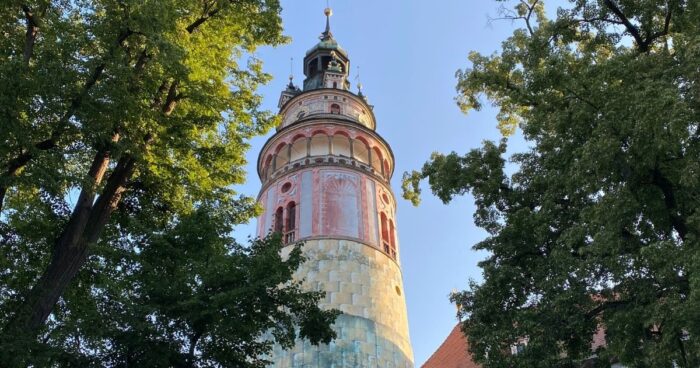
No other Czech town looks like this. The Vltava river doubles back on itself in two tight bends and loops around the old town, and above it stands the second largest castle complex in the country. Krumlov is UNESCO listed and you walk through it as though through a stage set: painted gables, stone bridges and a revolving open air auditorium in the castle gardens. If you only add one South Bohemian town to a Prague trip, make it this one.
Where it is: the south of the region, below the Šumava mountains. By train or bus from České Budějovice, or about two and a half hours by car from Prague.
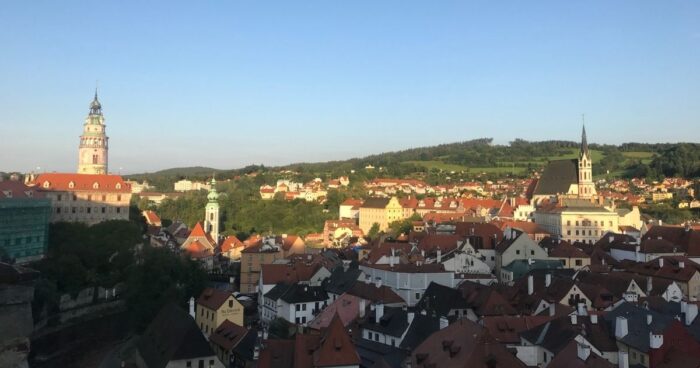
Photo tip: the classic shot of the river bend and the castle tower is taken from the viewpoint by the church of St Vitus, or from the bridges on the Na Plášti walkway. The light is best at dawn, when mist still hangs over the water.
2. Hluboká nad Vltavou: the white chateau that looks like Windsor
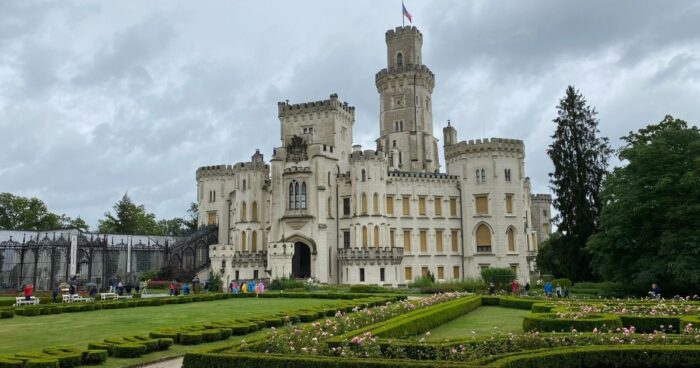
Snow white and turreted, this neo-Gothic chateau was modelled on Windsor Castle and is one of the most photographed buildings in the country. There is the walk through the English landscape park, the tour of the state rooms, and next door the Aleš South Bohemian Gallery in the former riding hall. Hluboká will take up a whole morning, and it deserves one.
Where it is: about 10 km north of České Budějovice. Bus or train from Budějovice, or by car as an easy pairing with Krumlov.
Photo tip: for the whole building from slightly above, stand in the park to the south west. It looks best on a sunny morning, when the white facade sits against a blue sky.
3. Holašovice: folk Baroque on a UNESCO village green
This small village near Budějovice is on the UNESCO World Heritage list as an exceptionally complete example of South Bohemian folk Baroque, a rural style sometimes called peasant Baroque. Around a wide green with a pond stand symmetrical farmsteads with ornate 19th century gables. It has the look of an open air museum, except that people simply live here.
Where it is: a small village roughly 15 km west of České Budějovice. Public transport is poor, so a car is by far the easiest way in.
Photo tip: stand by the pond in the middle of the green and catch the row of gables reflected in the water. Nearby you will also find the “Holašovice Stonehenge”, a modern stone circle.
4. Třeboň and its fishponds: water, dykes and the autumn harvest
A Renaissance town ringed by the largest system of fishponds in the Czech Republic. Třeboň itself offers a chateau, a spa and the Regent brewery, but the real beauty is outside the walls: oak lined dykes, bird reserves and the Svět pond right behind the town. In autumn come the traditional pond harvests, when the water is drained and the carp are netted in front of a crowd.
Where it is: the north east of the region. By train via Veselí nad Lužnicí, or roughly two hours by car from Prague. The Svět pond starts where the town ends.
Photo tip: walk the dyke of the Svět pond at dusk. The sun sets directly over the water and the old oaks turn into silhouettes.
5. Červená Lhota: the red water castle from a fairy tale
Probably the most romantic castle in the region. A bright red Renaissance building sits on a rocky island in the middle of a pond, joined to the shore by a single stone bridge. Small wonder that Czech film makers have shot dozens of fairy tales here. In season you can also row around it by boat.
Where it is: between Jindřichův Hradec and Soběslav. Public transport is weak, so in practice you need a car.
Photo tip: the best angle is from the far bank of the pond, where the whole red building doubles in the water. On a still morning the reflection is flawless.
6. Rožmberk nad Vltavou: a Gothic castle above the river
One of the oldest strongholds of the Vítkovci, the family that later became the powerful Rosenberg dynasty, stands on a spur above a bend of the Vltava in the southern tip of the region. Expect romantic historic interiors, the Jakobínka lookout tower and the legend of the White Lady, Perchta. Rožmberk holds its atmosphere even outside the main season.
Where it is: the far south, on the upper Vltava, about 20 km south of Krumlov. Best by car, or by bus via Vyšší Brod.
Photo tip: walk down to the river and shoot the castle from below, near the bridge. From there it looks as though it is growing straight out of the rock.
7. Zlatá Koruna: a monastery in a loop of the Vltava
One of the best preserved Cistercian monasteries in central Europe, founded by King Přemysl Otakar II. The Gothic complex, with its cloister and church, stands in a bend of the Vltava between Krumlov and Budějovice. It is a rare combination: monumental architecture and genuine calm in the same place.
Where it is: in the Vltava valley between Krumlov and Budějovice. There is a train stop called Zlatá Koruna, it is a few minutes by car from Krumlov, and you can also cycle in on the riverside trail.
Photo tip: the complex reads best from the opposite slope above the river. Coming by bike along the Vltava cycle route from Krumlov is a lovely way to arrive.
8. Jindřichův Hradec: the third largest chateau in the country
A sprawling castle and chateau complex above the Vajgar pond, and one of the biggest in the Czech Republic. The historic core of the town is charming in its own right: a long square, arcades and narrow lanes. Jindřichův Hradec is also home to the Krýza nativity scene, an enormous mechanical crib that is a local institution.
Where it is: the east of the region, on the border with the Vysočina highlands. Well served by train and coach, and about two hours by car from Prague.
Photo tip: the chateau shows best from the dyke of the Vajgar pond, where the whole town skyline with its towers is mirrored in the water.
9. Lipno and the Treetop Walkway: a view over the Bohemian Forest
The Lipno reservoir is the largest body of water in the Czech Republic, a summer playground for swimming and sailing with a popular cycle route around it. Above the woods at Lipno nad Vltavou runs the Treetop Walkway, a raised wooden path through the canopy that ends in a lookout tower with a slide spiralling back down. From the top you see the lake and the ridges of Šumava at once.
Where it is: the south west of the region, in Šumava. The Treetop Walkway is at Lipno nad Vltavou, reachable by car, about two and a half hours from Prague, or on the local railway line.
Photo tip: from the top of the tower the whole lake lies below you. On a clear day you can see as far as the Austrian Alps.
💡 Tip: Lipno opens up for swimming from late June and the water in the shallow bays gets surprisingly warm in summer. Rooms by the lake do go early in the season, though. Accommodation by Lipno lake →
10. Šumava: the Boubín primeval forest, peat bogs and the source of the Vltava
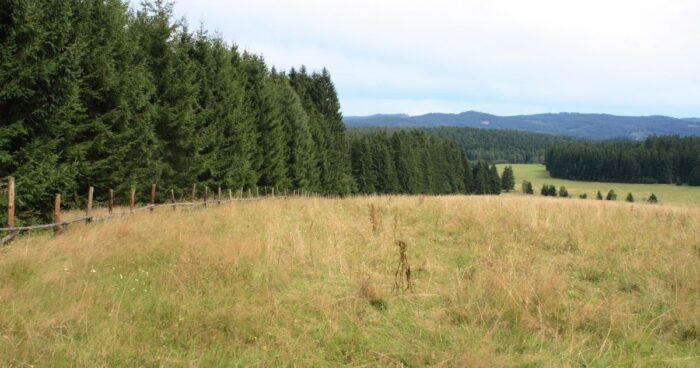
The largest national park in the country, known in English as the Bohemian Forest, is wilderness of a kind you will not find elsewhere in the Czech Republic. The Boubín primeval forest with its ancient giants, mysterious peat bogs such as Chalupská and Jezerní, glacial lakes and the source of the Vltava river near the village of Kvilda. Nobody comes here for monuments. They come for silence and for trees.
Where it is: along the south western border of the region, running up against Bavaria and Austria. The individual sights, Kvilda, Boubín, the bogs, are scattered across the mountains, so you want a car and then your own feet on the waymarked trails.
Photo tip: the wooden boardwalk across the Chalupská bog in morning mist is as raw and atmospheric as this landscape gets. If you are looking for a base in the mountains, see our guide to Kašperské Hory accommodation in Šumava.
11. Vyšší Brod: a monastery where the Vltava paddling starts
The Cistercian monastery at Vyšší Brod, founded in the 13th century, is one of the most important in the country: a Gothic church, a cloister and a postal museum in the same complex. The little town is also the favourite starting point for canoe trips down the upper Vltava towards Rožmberk and Český Krumlov, a Czech summer tradition in its own right.
Where it is: the far south of the region on the upper Vltava, close to the Austrian border. Easiest by car, or simply as a stop on the river if you are paddling.
Photo tip: the monastery opens up as you approach from the south. If you are on the river, it comes to you as a bonus on the route.
12. Landštejn: a giant ruin in Czech Canada
One of the best preserved Romanesque and Gothic castle ruins in the country stands in the wooded landscape of Česká Kanada, “Czech Canada”, a nickname the locals gave this cool, lake dotted borderland. Massive stone walls, a lookout tower and nothing but ponds and deep forest around it. Landštejn is for anyone who prefers their romance a little rough edged.
Where it is: Czech Canada near the Austrian border, about 25 km south west of Jindřichův Hradec. Realistically only by car.
Photo tip: climb the castle tower. The view over the rolling country of Czech Canada, with its ponds and dark woods, pays for the steps.
13. Dívčí Kámen: a mossy ruin above the confluence
A large castle ruin on a rocky spur above the meeting of the Vltava and the Křemežský brook. The path in leads through woodland, so the visit comes with a proper walk attached. Quiet, green, stone walls furred with moss: this is one of those places the coach parties never reach.
Where it is: between Krumlov and Budějovice. Conveniently by train to the Třísov stop and then on foot through the forest, or by car to the car park at Třísov.
Photo tip: the best view is from the path leading up from Třísov railway stop, where the castle gradually rises above the treetops.
14. Orlík and Zvíkov: two castles above a reservoir
In the north of the region two heavyweights face each other across the Orlík reservoir. Orlík chateau, seat of the Schwarzenberg family, stands directly above the water and can be reached by boat in season. A short way along the lake rises Zvíkov castle, nicknamed “the king of Czech castles”, on a spur above the confluence of the Vltava and the Otava.
Where it is: the north of the region on the Orlík reservoir, on the boundary with the Central Bohemian region. Best by car, with a sightseeing boat linking the two in season.
Photo tip: take the sightseeing boat along the reservoir. You get both buildings from the water, rising above a flooded valley.
15. České Budějovice: a giant square and the Black Tower
The regional capital, known in German as Budweis, has one of the largest town squares in the country. Přemysl Otakar II Square is lined with arcades and Baroque houses, with Samson’s Fountain in the middle. The best overview of the town and the countryside around it is from the gallery of the Black Tower, and yes, this is where Budvar beer comes from, the original Budweiser.
Where it is: in the middle of the region. Excellent train and coach connections, which makes it the natural base for exploring everything else on this list.
Photo tip: climb the Black Tower, about 225 steps, in the late afternoon, when low light rakes across the square below. There are more ideas in our guide to things to see in České Budějovice.
16. The Novohradské hory: quiet wilderness on the border
A little known and all the calmer range of hills in the south east of the region, right on the Austrian border. Deep forests, waterfalls on the Stříbrný brook, and the romantic Terčino údolí, Theresa’s Valley, near the town of Nové Hrady, with an artificial waterfall and a small Empire style pavilion called Lázničky. Ideal walking country if you want trails without other walkers.
Where it is: the south east of the region by the Austrian border. The starting point is Nové Hrady, where Terčino údolí begins, and you will mostly need a car to get here.
Photo tip: Terčino údolí with its waterfall and the old Hamr building is at its most photogenic after rain, when the falls are at full strength.
17. Kratochvíle: a Renaissance jewel between the ponds
Small but exceptionally well preserved, this Renaissance summer palace near the town of Netolice is surrounded by a moat and an Italian style garden. The stucco work inside is among the finest of the Czech Renaissance, and because the place is intimate rather than vast, you are not shuffling through it behind a crowd.
Where it is: near Netolice, roughly 25 km north west of České Budějovice. Best by car, and it pairs neatly with Hluboká and Holašovice in one day.
Photo tip: the symmetry of the garden and the palace comes together from the entrance gate, straight down the axis of the main avenue.
18. Tábor: a Hussite town with tunnels underneath
The birthplace of the Hussite movement, the 15th century religious rebellion that shaped Czech history, still keeps its tangle of crooked lanes, laid out that way on purpose to confuse attackers. The heart of it is Žižka Square, with Renaissance and Gothic houses and a fountain, and above the town stand the remains of Kotnov castle with the Bechyně Gate. Beneath the square runs an extensive medieval tunnel system you can walk through with a guide.
Where it is: the north of the region, above the river Lužnice. Very well connected by train and coach, and about an hour and a half by car from Prague.
Photo tip: the best panorama of the town with the Kotnov tower opens up from the river Lužnice and the Jordán reservoir, the oldest dam reservoir in central Europe.
19. Písek: the oldest stone bridge in the Czech Republic
The oldest surviving stone bridge in the country crosses the river Otava here, built around the 13th century, which makes it older than Charles Bridge in Prague. Around it lies a good looking historic town with the remains of a royal castle and a pleasant riverside promenade. Between the water and the greenery, Písek is one of the nicest towns in the region simply to walk around.
Where it is: the north west of the region on the river Otava. Well served by train and coach, and about an hour and a half by car from Prague.
Photo tip: the old bridge with its stone statues shows best from the bank of the Otava, where low sun throws its reflection onto the water.
20. Blatná chateau: a water castle with a herd of deer
One of the best preserved water chateaux in the Czech Republic stands in the middle of a pond, surrounded by a large English park. Its greatest charm, though, is alive: a herd of fallow deer roams the park freely and will take food from your hand. The combination of a mirrored facade, old trees and animals makes Blatná unusually rewarding for photographers.
Where it is: the north west of the region, not far from Strakonice. Best by car, and easy to combine with Písek.
Photo tip: catch the reflection of the chateau in the moat from the park on a windless day. The deer photograph best in the early morning and at dusk.
21. Slavonice: Renaissance sgraffito in Czech Canada
A small town on the very edge of the region surprises visitors with two squares lined by Renaissance houses covered in sgraffito, the scratched plaster decoration that spread here from Italy in the 16th century. Slavonice is among the best preserved Renaissance townscapes in the country, and together with the forests and ponds of Czech Canada around it, the place feels genuinely out of time. Good for history, better still for quiet.
Where it is: the eastern tip of the region by the Austrian border, a short hop from Landštejn. Best by car.
Photo tip: the detail in the sgraffito comes out in raking afternoon light. Walk both squares, the upper and the lower one.
22. Vítkův Kámen: the highest castle in the country, with the Alps on the horizon
The highest lying castle ruin in the Czech Republic, at roughly 1,035 m above sea level, stands over the surface of Lipno near the hamlet of Svatý Tomáš. From the lookout tower you get a full circle: the ridges of Šumava, Lipno lake, the Novohradské hory and, when the air is clear, the Austrian Alps. The path up runs through forest, so the trip combines a decent walk with a genuinely big view at the end.
Where it is: the south west of the region above Lipno, by the hamlet of Svatý Tomáš. Drive to the car park and walk uphill from there, or cross Lipno by boat and climb up on foot.
Photo tip: from the tower gallery you get Lipno spread out below you. Visibility towards the Alps is usually best after rain or on bright autumn days.
23. Čertova stěna: a sea of boulders above the Vltava
A national nature reserve above the upper Vltava near Vyšší Brod, where the hillside breaks apart into an enormous field of granite boulders. The name means the Devil’s Wall, after a legend about a devil who tried to dam the river. Below it the Vltava forces its way through a rocky channel in a series of rapids. Wild, raw scenery with no crowds, and a short nature trail is enough to see it properly.
Where it is: the southern tip of the region above the Vltava between Loučovice and Vyšší Brod. Drive to the car park and continue on foot, or walk up from Loučovice.
Photo tip: the best frames of the boulder field and the rapids are from the nature trail above the river. The surrounding greenery gives the strongest contrast in summer.
The finest castles and viewpoints in South Bohemia
South Bohemia is quite literally a region of castles. You barely leave one before the next appears on the horizon. If you would rather choose by the kind of scenery you are after than by opening hours, here is our shortlist:
- Castles reflected in water: Červená Lhota (a water castle on an island), Blatná (a water chateau with a herd of fallow deer), Hluboká nad Vltavou (white neo-Gothic) and Orlík (above the reservoir).
- Castles above a river: Zvíkov, Rožmberk and Dívčí Kámen, all of them on rocky spurs above river bends.
- Renaissance and monastic treasures: Kratochvíle, Zlatá Koruna and Vyšší Brod.
- Viewpoints: the Treetop Walkway at Lipno, Vítkův Kámen (the highest castle in the country, with a view of the Alps), the Black Tower in Budějovice, the Kleť lookout tower above Krumlov, which is the oldest stone lookout tower in the country, and the castle tower at Landštejn.
At the castles, check the opening hours and the type of tour in advance. Many of them run several different routes through the building, and in season the popular time slots sell out. A main tour usually costs somewhere between 150 and 300 CZK per adult, roughly £5 to £10 (indicative, 2026 season), with reductions for children and seniors. Remember that the Czech Republic keeps its own currency, the Czech crown, so bring a card or change euros before you arrive; many smaller monuments still prefer cash.
💡 Tip: Book guided tours and tickets for the busiest castles, Krumlov and Hluboká, online in advance during the main season. Tours and experiences around Krumlov →
Nature and the fishponds of Třeboňsko
Třeboňsko, the Třeboň fishpond basin, is a protected landscape area and a UNESCO biosphere reserve. It is a landscape that was engineered rather than found: for centuries pond builders shaped it, linking water bodies with canals and dykes from the Middle Ages onwards. Today it is home to hundreds of bird species, and it is one of the few places in Europe where a fully man made water system has become a nature reserve.
- Rožmberk pond: the largest fishpond in the country at about 489 hectares, built by the engineer Jakub Krčín in the 16th century. A nature trail lined with centuries old oaks runs along its dyke.
- Svět pond: immediately behind Třeboň, perfect for a walk right around it and for a swim in season.
- Autumn pond harvests: from October onwards the ponds are drained and netted in a series of ceremonial events, with fresh carp sold on the spot.
- Bird hides and peat bogs: the wetlands around the ponds are a paradise for birdwatching, and at the edges of the region they connect to the peat bogs of Šumava.
Třeboňsko is superb country for cycling. The landscape is flat, the cycle routes run along the dykes and link one pond to the next, and you can hire a bike directly in Třeboň. For anyone arriving from abroad without a car, this is the easiest part of South Bohemia to explore under your own steam.
💡 Tip: If you want water and quiet, make Třeboň your base for a few days and drive out to the surrounding castles from there. Accommodation in Třeboň →
Where to go next
- 17 Beautiful Things to See in České Budějovice (Budweis), a guide to the regional capital and the best base in South Bohemia.
- Kašperské Hory Accommodation: 11 Places to Stay in Šumava, where to sleep inside the Bohemian Forest.
- 30 Most Beautiful Places in the Czech Republic Beyond Prague, the best of the whole country in one list.
- The Highest Mountains in the Czech Republic, the top 15 peaks and how to climb them.
Frequently asked questions
What are the most beautiful places in South Bohemia? The obvious highlights are Český Krumlov, the chateau at Hluboká nad Vltavou, the UNESCO village of Holašovice, the fairy tale water castle of Červená Lhota, Třeboň with its fishponds, Lipno lake with the Treetop Walkway and the wild Šumava mountains. The castles of Rožmberk, Zvíkov and Dívčí Kámen are worth the detour too.
When is the best time to visit South Bohemia? Go from May to June or in September: fewer people, beautiful light, and the traditional pond harvests around Třeboň in autumn. Most castles run a season from roughly April to October, and outside those months they are closed or open at weekends only.
Is Český Krumlov worth visiting? Yes, and it is the single easiest way to see why the Czech Republic is worth exploring beyond Prague. The old town sits inside two bends of the Vltava under a UNESCO listed castle complex. Come early in the morning or in the late afternoon, because between ten and four the lanes are packed with day trippers.
Do you need a car in South Bohemia? For touring the castles and smaller places such as Holašovice or Červená Lhota, definitely: public transport there is weak. Český Krumlov, Třeboň, Jindřichův Hradec and České Budějovice, on the other hand, are all easy to reach by train and coach from Prague.
How many days do you need in South Bohemia? Allow at least three to four days for the main highlights, Krumlov, Hluboká, Holašovice and Třeboň. If you want to add Šumava, Lipno and more castles, count on a week. The region is dense and the distances between sights are short.
Which is the prettiest town in South Bohemia? Český Krumlov, without much argument, thanks to its river bend and the UNESCO listed castle complex. Třeboň, Jindřichův Hradec, historic České Budějovice with its enormous square and Renaissance Slavonice in Czech Canada are all charming in their own right.
Which UNESCO World Heritage sites are in South Bohemia? Three: the historic centre of Český Krumlov, the village of Holašovice with its folk Baroque farmhouses, and Třeboňsko as a biosphere reserve. That makes South Bohemia one of the most heavily protected regions in the country.
What is there to do in South Bohemia with children? The favourites are Hluboká chateau with the nearby zoo, the Treetop Walkway at Lipno with its slide, the fairy tale castle of Červená Lhota and cycling around the Třeboň fishponds. Children also enjoy the castles of Zvíkov and Rožmberk, and swimming in Lipno lake in summer.
Potřebujete pomoct s cestováním?
-
Ubytování 🏨
Vyberte si to nejlepší ubytování, ať už jste kdekoliv, přes Booking.com. -
Půjčení auta 🚗
Auto si snadno najdete přes Booking.com, kde máte často slevu díky ubytování, nebo Rentalcars.com, kde porovnáte nabídky většiny půjčoven. -
Zážitky 🎟️
Přes GetYourGuide.com si vyberete z nejrůznějších výletů i zážitků po celém světě, navíc se zrušením zdarma do 24 h předem.