Šumava National Park, Czech Republic: 22 Things to Do
Last updated 23.10.2026
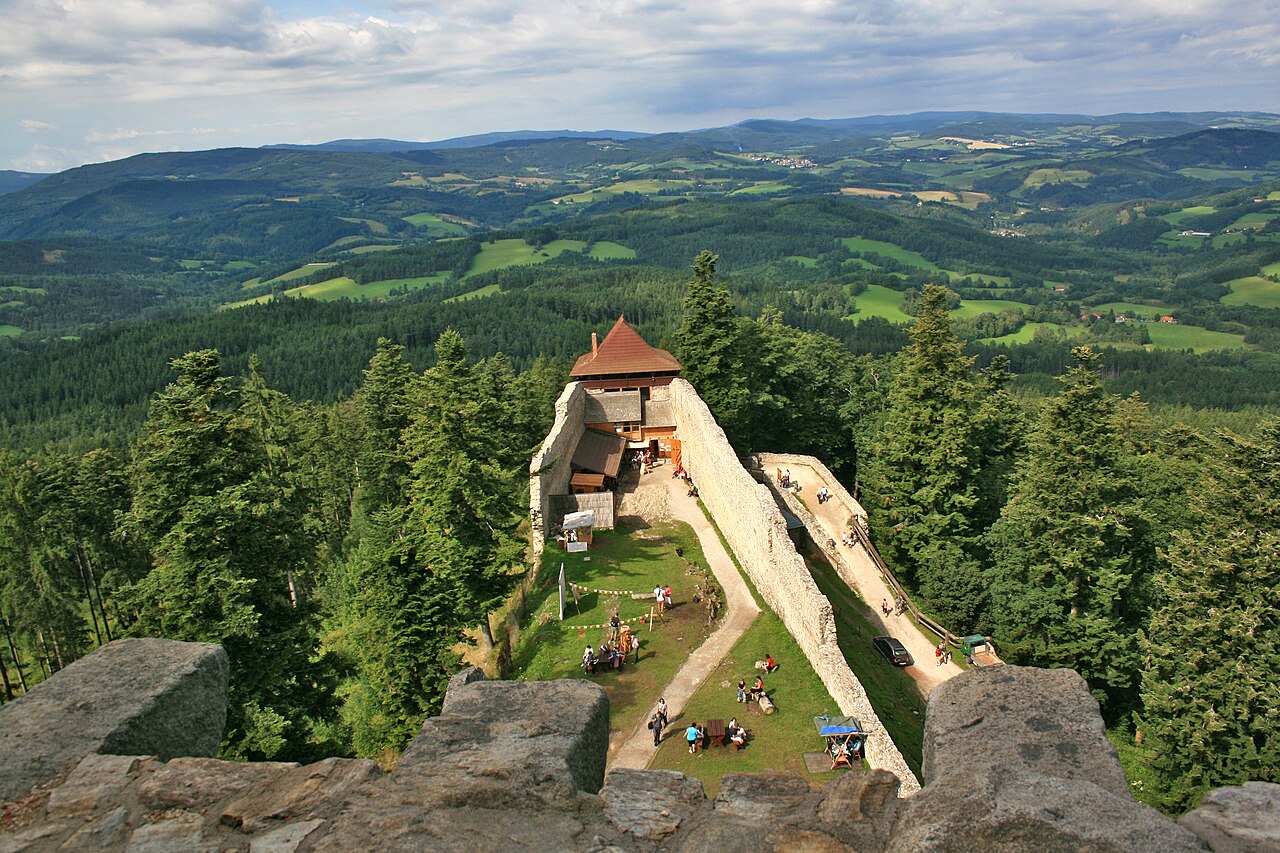
Šumava does not impress with altitude. It impresses with quiet. This is a landscape of deep, secretive forest, glacial lakes hidden under sheer rock walls, peat bogs where time stopped and villages at the end of every road. Much of it survived precisely because it was off limits: for forty years the Iron Curtain ran along this ridge and almost nobody was allowed in, so the wilderness was left alone. Today Šumava National Park and the Bavarian Forest National Park across the border form the largest protected forest area in Central Europe — and if someone asks where to go in Šumava first, that is not an easy question at all, because there is a great deal worth seeing.The view from the tower of Kašperk over the hills of Šumava. Photo: Ondřej Kořínek, Wikimedia Commons, CC BY-SA 3.0, resized
Šumava National Park in short
For the lakes: Černé and Čertovo, Plešné, Prášilské and tiny Laka — glacial jewels under rock walls.
For the views: the Poledník tower, Špičák with its chairlift, the Lipno Treetop Walkway.
For nature without crowds: the Boubín primeval forest, the source of the Vltava, the Vydra river gorge and the Jezerní slať bog.
With kids and pushchairs: the bogs on wooden boardwalks, Lipno lake, Kašperk Castle.
Best time: June to September for hiking, January to March for cross-country skiing; in summer go for the views early in the morning.
Getting there: a car is easiest — about two to two and a half hours from Prague, or two and a half from Munich to the Bavarian side.
When to go and how to get to Šumava
Šumava is beautiful all year, just differently each time. The main hiking season is June to September — the lakes are accessible, the bogs smell of pine and the days are long. July and August also mean full car parks and queues at the best known spots, so if you can, aim for late June or September, when it is quiet and accommodation is cheaper. From January to March the high plateaus turn into a cross-country skiing paradise — Kvilda, Modrava and Horská Kvilda are among the best areas in the country for it.The easiest way in is by car. From Prague it is roughly 160 km and just over two hours to central Šumava (Kvilda, Modrava), about 170 km to Železná Ruda in the west and 210 km to Lipno in the south. Coming from Germany, Munich to Železná Ruda is about 200 km, two and a half hours. Be aware, though, that some roads in the core of the national park are closed to cars (the road on from Modrava deeper into the mountains, for instance), and the car parks at Černé jezero, in Kvilda or at Povydří fill up by mid-morning in summer. Note that Šumava is not on any usual Prague day-trip circuit — it deserves at least an overnight stay.
💡 Tip: In season, use the green buses (Šumava Bus / GreenBus) and the trains — on the Železná Ruda–Špičák line or up to Modrava, for example. You save yourself the parking stress, and you have to walk the last stretch to most of the lakes anyway.
22 things to do in Šumava National Park
We have ordered them so you can build your own trip — from the glacial lakes through springs and peat bogs to lookout towers and castles. For each place you get what you will see there and how demanding the walk is.
1. Černé and Čertovo lakes
This pair of glacial lakes above Železná Ruda is the most famous image of Šumava. Černé jezero (Black Lake) is the largest and deepest lake in Czechia — 18.4 hectares and over 40 metres deep. Its surface really is dark, hemmed in below a steep rock face. Just above it lies the smaller, wilder Čertovo jezero (Devil’s Lake), which the main European watershed runs straight through. Černé jezero is an easy walk of just under an hour from the car park at Špičácké sedlo, and you can join both lakes into a pleasant loop.Difficulty: easy (to Černé) to moderate (the loop over both lakes, around 10 km).
2. The Boubín primeval forest
One of the oldest surviving primeval forests in Central Europe — protected since 1858, which makes it one of the earliest nature reserves anywhere in Europe. A nature trail runs between huge spruces and beeches, some of them centuries old, past the Boubín pond and up to the summit of Boubín (1,362 m) with its lookout tower. This is where you realise what forest looked like before people started shaping it. Most walkers set off from Kubova Huť, the highest railway station in the Czech Republic.Difficulty: moderate (loop of 8–9 km, steady climbing to the summit).
3. The source of the Vltava
This is where it all begins — the longest Czech river rises in the peat bogs below the hill Černá hora at around 1,172 m, and flows on through Český Krumlov and Prague. The spring is landscaped, edged with a wooden boardwalk and equipped with a visitors’ book that people from all over the world sign. A comfortable asphalt path leads here from Kvilda (about 6 km there and back) and you can manage it with a pushchair or on a bike.Difficulty: easy, fine with children.
4. Modrava and Filipova Huť
Modrava is something like the heart of central Šumava — timber cottages, a mountain stream and the starting point of dozens of trails. Nearby lies Filipova Huť (part of the municipality of Modrava), the highest permanently inhabited place in the Czech Republic at 1,093 m. From here people set out for the springs, the Roklanská chata hut and Březník. Sitting by the historic Rechle bridge in Modrava with something warm is part of the deal on any visit.Difficulty: depends on the route; the village and its surroundings are undemanding.
5. Laka and Prášilské lakes
A pair of quieter lakes near the village of Prášily. Laka is the smallest and highest glacial lake in Šumava, famous for its floating islets of peat. Nearby Prášilské jezero lies below the rock wall of Poledník, closed in by dark forest. The two can be linked into a longer loop, with the Poledník tower added on (see below).Difficulty: moderate (easy to each lake separately, longer as a loop).
6. Plešné jezero
The southernmost of the big Šumava lakes lies below the highest summit on the Czech side — Plechý (1,378 m). A dramatic rock face rises above the water, with a monument to the writer Adalbert Stifter, who was born nearby and made this landscape the setting of his novels. The starting point is Nová Pec; you can add the steeper climb to the top of Plechý, and the view down onto the lake is worth it.Difficulty: moderate (to the lake) to demanding (the climb up Plechý).
7. Povydří and the Vchynice-Tetov canal
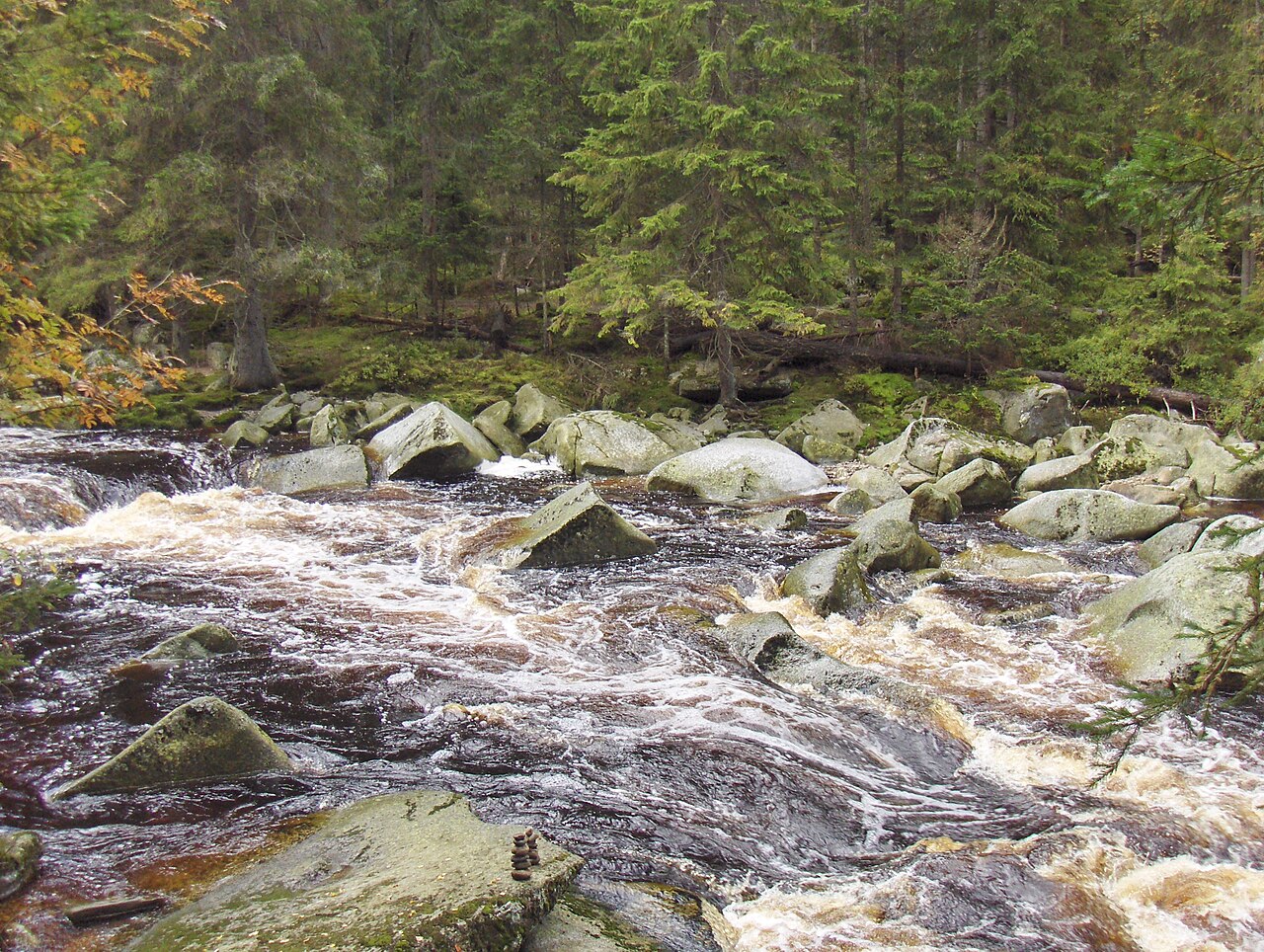
The Povydří nature trail between Čeňkova Pila and Antýgl is one of the loveliest walks in Šumava. The river Vydra tumbles over giant boulders and through huge potholes ground out of the rock. Right alongside runs the remarkable Vchynice-Tetov log-driving canal from the end of the 18th century, whose bank gives you an almost level walk. A great combination of wild and calm water on one route.Difficulty: easy to moderate (about 7 km along the river).
8. The Poledník lookout tower
A former military listening post on the summit of Poledník (1,315 m) is now a 37-metre lookout tower with a full circle view over central Šumava and the Bavarian Forest. The route here crosses the old border zone and wilderness that nobody managed for decades — during the Cold War this was one of the most closely guarded stretches of the Iron Curtain. Most people walk up from Prášily or from Prášilské jezero.Difficulty: moderate to demanding (long climb, around 13 km there and back).
9. The Lipno Treetop Walkway
A walk at the level of the treetops, ending on a nine-sided viewing tower 40 metres high with a slide back down. The walkway is 675 metres long and completely step-free — you can take it with a pushchair or a wheelchair. From the tower you look out over Lipno lake, the Šumava ridges and, on a clear day, as far as the Alps. Admission starts at around €16 (390 CZK) for adults and €13 (320 CZK) for children; pricing is dynamic by season, and you pay in Czech crowns on site.Difficulty: very easy, step-free.
💡 Tip: Accommodation around Lipno fills up fast in summer. Have a look at the places to stay around Lipno → and book well ahead.
10. Lipno lake
The largest body of water in the Czech Republic, nicknamed the “Šumava sea”. In summer it is a paradise for swimming, paddleboarding and sailing, a popular cycle path runs around it, and in winter skaters take over the frozen surface — the maintained ice track here is among the longest in Europe. The hub is Lipno nad Vltavou, with a ski area, a bobsleigh track and an aquapark, which makes it the obvious base for families.Difficulty: easy, attractions for the whole family.
11. Kvilda and the Jezerní slať bog
Kvilda is the highest village in Šumava — and in winter regularly the coldest place in the country. Right by the road between Kvilda and Horská Kvilda lies Jezerní slať, a large peat bog with a wooden boardwalk and a viewing tower from which you look out over the moss and the stunted pines. It is the most accessible bog in Šumava, doable in half an hour even with small children.Difficulty: very easy, on a boardwalk.
12. Bílá strž waterfall
The highest waterfall in Šumava — the water drops in several steps totalling roughly 13 metres, the tallest of them 7 metres. It hides in a deep ravine in a national nature reserve above Hamry. A wooden walkway leads to a viewing platform above the falls, and you can combine the trip with Čertovo and Černé lakes.Difficulty: moderate (short to the waterfall, longer as a loop over the lakes).
13. Železná Ruda and Špičák
Železná Ruda is the main gateway to western Šumava — with a museum, a border crossing into Bavaria and a chairlift up Špičák (1,202 m). On the summit stands a 26.5-metre lookout tower with views over Großer Arber and the Šumava lakes. From here it is a short hop to Černé and Čertovo lakes, so the obvious plan is to combine the lift with a hike.Difficulty: easy (with the chairlift) to moderate.
14. Kašperk Castle
The highest-lying royal castle in Bohemia (886 m), built on the orders of Charles IV to guard the gold trade route through these mountains. It stands on a wooded ridge above Kašperské Hory and offers two guided routes plus a separate climb up the tower. Entry to the courtyard is free, the tower viewpoint costs roughly €5 (120 CZK) for adults and €4 (90 CZK) for children. From the car park it is a pleasant walk through the forest.Difficulty: easy (about 1.5 km from the car park).
15. The Bavarian Forest Treetop Walk (Neuschönau)
On the German side, in the Bavarian Forest National Park — Germany’s first national park, founded in 1970 — you will find the very first treetop walkway in the world. The route is over 1,300 metres long and culminates in an egg-shaped tower 44 metres up. The complex also includes a large animal enclosure with lynx, wolves and bison. An ideal full-day trip across the border, and you do not need a passport, the border is open.Difficulty: very easy, step-free.
16. Großer Arber (from the German side)
The highest mountain of the whole Šumava–Bavarian Forest range (1,456 m, Velký Javor in Czech) sits just over the border. From the German side a cable car takes you up from the lake Großer Arbersee, and the panorama from the top is superb — as far as the Alps in good visibility. Below the summit lie two small glacial lakes, Großer and Kleiner Arbersee, with beautiful loops around them.Difficulty: easy (with the cable car) to moderate (on foot).
17. Chalupská slať and Tříjezerní slať
If the bogs win you over, add these two. Chalupská slať near Borová Lada hides the largest bog pool in Šumava, reached on a comfortable wooden boardwalk. Tříjezerní slať above Modrava tempts with three pools mirroring the sky. Both are undemanding, lovely in early light and great for families.Difficulty: very easy, on boardwalks.
18. The Schwarzenberg canal
A remarkable piece of 18th-century engineering, built for Prince Schwarzenberg to the design of the engineer Josef Rosenauer. The canal floated firewood out of the remote Šumava forests, down the Danube and all the way to Vienna, and it stayed in service for almost a hundred years. A pleasant nature trail (about 9 km) follows its southern section past preserved stone culverts and a tunnel; most people start from Jelení Vrchy.Difficulty: easy to moderate, on forest tracks that barely change altitude.
19. The Soumarské rašeliniště bog near Volary
A large peat bog not far from Volary, crossed by a short nature trail on a wooden boardwalk (about 1.5 km). It ends at a viewing tower of almost ten metres, from which you take in the whole expanse of the bog, the Boubín ridge and distant Stožec. After years of peat extraction, the landscape here is slowly coming back to life.
💡 Tip: To protect nesting black grouse, the boardwalk across the bog is only open from June to October. Plan something else outside that window.
Difficulty: very easy, on a boardwalk.
20. The Klostermann viewpoint and the wolf enclosure at Srní
Above the village of Srní opens one of the finest views in central Šumava: over the confluence of the wild Vydra and Křemelná rivers and the deep canyons below. The viewpoint sits at around 913 m and you can reach it on the nature trail along the Vchynice-Tetov canal. A short way from Srní there is also a wolf enclosure, where a raised wooden walkway lets you watch a pack of European wolves almost at treetop level.Difficulty: easy.
21. Vítkův Hrádek above Lipno
The highest castle ruin in the Czech Republic (1,035 m) stands on a hill above the southern end of Lipno, a short distance from the Austrian border. From the restored viewing platform you look out over the whole of Lipno lake, the Šumava ridges and, in clear weather, as far as the Alps. Access to the gallery costs roughly €4 (100 CZK) for adults and €2 (50 CZK) for children, students and seniors.Difficulty: easy to moderate (walk up from the car park).
22. Třístoličník (Dreisessel)
A border summit (1,311 m) on the Czech–German–Austrian tripoint, named after the three bizarre granite outcrops on its crown. From the rocks and from the nearby lookout you see deep into Bavaria and, in good visibility, to the Alps. A comfortable path leads up from the German side, where there is a car park by the mountain inn; stronger walkers can also come along the ridge from the Trojmezí tripoint.Difficulty: easy (from the German side) to demanding (the longer ridge hike).
Hikes and lookout towers
Šumava is not about one big summit but about relaxed walks with a reward at the end. If you want views, go for the towers: Poledník (37 m, the wilderness of central Šumava), Špičák (with the chairlift, fine for less confident walkers), Churáňov near Zadov and, on the Bavarian side, Großer Arber with its view to the Alps.Among the longer hikes, these stand out:
The Černé + Čertovo lakes loop from Špičácké sedlo — around 10 km, the classic of western Šumava.
Povydří from Antýgl to Čeňkova Pila — about 7 km along the wild Vydra, one of the prettiest trails here.
Modrava–Březník–Luzenské údolí — a tougher trek into the heart of the wilderness.
Plechý and Plešné jezero from Nová Pec — the highest summit on the Czech side.
💡 Tip: Set off for the best known lakes early in the morning. After ten the buses and cars arrive in summer and the magic of a still surface is gone — along with the parking space.
Šumava with children and in any weather
Šumava is surprisingly family-friendly — many of the loveliest places are reachable on the level or even with a pushchair. For trips with children we would suggest:
Jezerní slať and Chalupská slať — short wooden boardwalks, a viewing tower, passable with a pushchair.
The source of the Vltava from Kvilda — asphalt path, doable on a scooter too.
The Lipno Treetop Walkway — step-free, with a slide at the end.
Povydří to the Turner hut — a wild river, boulders and hot food at the end.
Kašperk Castle — knights and a view from the tower.
And when it starts to rain? Šumava has an indoor programme too. Try the Museum of Šumava in Sušice or Kašperské Hory, the aquapark and spa at the Lipno resorts, the national park visitor centres with their wolf and lynx enclosures at Srní or in the Bavarian Forest, or one of the local glassworks — glassmaking has been the industry of these mountains since the Middle Ages. Rain need not spoil anything, either: the bogs and waterfalls are even more atmospheric in mist.The boulder-strewn bed of the Vydra in Povydří, a classic Šumava route that works with kids too. Photo: Leila82, Wikimedia Commons, CC BY-SA 3.0, resized
💡 Tip: As a base for exploring central Šumava we liked the guesthouses around Kvilda and Modrava — you are close to the lakes, the bogs and the source of the Vltava. Find a place to stay in Šumava →
Where should you go in Šumava on a first visit?
For a first trip we would pick the classics: Černé and Čertovo lakes near Železná Ruda, the Povydří nature trail along the wild Vydra and the source of the Vltava from Kvilda. Add one of the peat bogs (Jezerní slať) and either the Poledník tower or Špičák. That combination shows you Šumava across its whole range — lakes, rivers, bogs and views.Which is the most beautiful lake in Šumava?
The best known and most visited is Černé jezero, the largest and deepest lake in the Czech Republic. Plešné jezero below the highest peak Plechý is usually called the most mysterious, and Prášilské the wildest. Tiny Laka charms with its floating islets of peat. It depends what you are after — each has its own appeal.How do you get to Šumava from Prague?
By car it is around 160 km and just over two hours to central Šumava (Kvilda, Modrava), 170 km to Železná Ruda and 210 km to Lipno. There are trains to Železná Ruda and buses on from the main hubs, and in season the green Šumava Bus network connects the trailheads. Šumava is not a realistic day trip from Prague — plan at least one night.Is Šumava accessible with a pushchair or wheelchair?
Several of the best spots are. Jezerní slať and Chalupská slať have wooden boardwalks, the source of the Vltava from Kvilda is on asphalt, and the Lipno Treetop Walkway is entirely step-free. Part of the Povydří nature trail and the cycle path around Lipno work well too.When is the best time to visit Šumava?
June to September for hiking and the lakes. If you want quiet and lower prices, aim for late June or September. From January to March Šumava is a cross-country skiing paradise — the terrain around Kvilda and Modrava is among the best in the country.What is there to do in Šumava when it rains?
Try the Museum of Šumava in Sušice or Kašperské Hory, the aquapark and spa at the Lipno resorts, or the national park visitor centres with their wolf and lynx enclosures at Srní and in the Bavarian Forest. The bogs and waterfalls are more atmospheric in mist anyway, so rain does not have to ruin the day.Is it worth crossing to the Bavarian side?
Definitely. The cable car from the German side takes you up Großer Arber (Velký Javor, 1,456 m), the highest summit of the whole range, with views to the Alps on a clear day. At Neuschönau in the Bavarian Forest National Park you will find the world’s first treetop walkway with a large animal enclosure. The border is open and you do not need a passport.How many days do you need for Šumava?
A long weekend is enough for a taste — two or three lakes, one bog and a lookout tower. If you want the remoter corners as well (Modrava, Plešné jezero, the Bavarian Forest) and time to alternate hiking with rest, count on a week.Where is the best place to stay in Šumava?
For central Šumava (the lakes, the bogs, the source of the Vltava), the area around Kvilda and Modrava is the ideal base. For the western part, Železná Ruda; for the south and for families, Lipno nad Vltavou with all its attractions. Book ahead in season — the best guesthouses go early.
Potřebujete pomoct s cestováním?
Ubytování 🏨
Vyberte si to nejlepší ubytování, ať už jste kdekoliv, přes Booking.com.
Půjčení auta 🚗
Auto si snadno najdete přes Booking.com, kde máte často slevu díky ubytování, nebo Rentalcars.com, kde porovnáte nabídky většiny půjčoven.
Zážitky 🎟️
Přes GetYourGuide.com si vyberete z nejrůznějších výletů i zážitků po celém světě, navíc se zrušením zdarma do 24 h předem.
Abychom poskytli co nejlepší služby, používáme k ukládání a/nebo přístupu k informacím o zařízení, technologie jako jsou soubory cookies. Souhlas s těmito technologiemi nám umožní zpracovávat údaje, jako je chování při procházení nebo jedinečná ID na tomto webu. Nesouhlas nebo odvolání souhlasu může nepříznivě ovlivnit určité vlastnosti a funkce.
Funkční
Always active
Technické uložení nebo přístup je nezbytně nutný pro legitimní účel umožnění použití konkrétní služby, kterou si odběratel nebo uživatel výslovně vyžádal, nebo pouze za účelem provedení přenosu sdělení prostřednictvím sítě elektronických komunikací.
Předvolby
Technické uložení nebo přístup je nezbytný pro legitimní účel ukládání preferencí, které nejsou požadovány odběratelem nebo uživatelem.
Statistiky
Technické uložení nebo přístup, který se používá výhradně pro statistické účely.Technické uložení nebo přístup, který se používá výhradně pro anonymní statistické účely. Bez předvolání, dobrovolného plnění ze strany vašeho Poskytovatele internetových služeb nebo dalších záznamů od třetí strany nelze informace, uložené nebo získané pouze pro tento účel, obvykle použít k vaší identifikaci.
Marketing
Technické uložení nebo přístup je nutný k vytvoření uživatelských profilů za účelem zasílání reklamy nebo sledování uživatele na webových stránkách nebo několika webových stránkách pro podobné marketingové účely.