Last updated 23.10.2026
A city built across twelve islands, with one of Europe’s largest medieval market squares, a concrete dome on the UNESCO list and more than a thousand bronze dwarfs hiding on the pavements. Wrocław (pronounced roughly VROTS-wahf) is Poland’s third-largest city, yet it still gets a fraction of the visitors Kraków does. We rounded up 32 things to do in Wrocław, plus how to get there, what to do with kids, a plan for a rainy day and where to park.
Things to do in Wrocław: the short version
- Two days is enough for the old town and Hala Stulecia. Add the zoo and Hydropolis and you need three.
- The Rynek is one of Europe’s largest medieval market squares and the natural starting point for everything.
- Hala Stulecia, built 1911–1913, joined the UNESCO list in 2006. The dome’s internal diameter is 69 metres.
- There are roughly 1,040 dwarfs around the city. The first appeared in 2001 as a monument to the Orange Alternative movement.
- Wrocław Zoo is the oldest in Poland, and its Afrykarium is one of the country’s most visited attractions.
- The Racławice Panorama is a painting 15 by 114 metres, viewed from inside a purpose-built rotunda.
- Ryanair and Wizz Air fly here from London, Dublin and Manchester, and the airport is only 10 km from the centre.
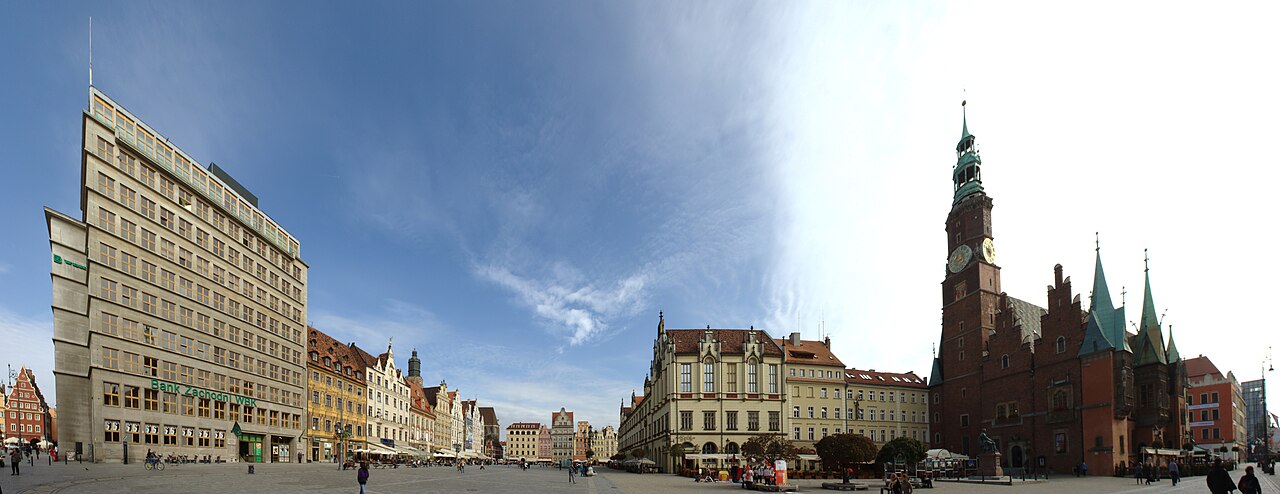
Wrocław, Breslau, Vratislav: why the city has three names
Wrocław sits on the Oder and four of its tributaries in the Silesian Lowland, and more than 670,000 people live here, making it Poland’s third-largest city. There are so many channels and branches that the city is nicknamed Miasto Stu Mostów, the city of a hundred bridges.
Three names, because there were three eras. The oldest records point to an original form, Wrocisław, which gave Polish Wrocław and Czech Vratislav. The German Breslau came later, through a sound shift. Until 1945 this was a German city; after the war it was resettled largely by Poles displaced from Lwów, now Lviv, who brought part of the Ossolineum collections with them. That is why the Racławice Panorama hangs here rather than in Ukraine. The canvas measures 114 by 15 metres and is hung in a full circle, so the viewer stands in the middle of the battle.
One thing worth knowing when you plan: the centre is compact. The Rynek, Ostrów Tumski and the university are a single morning’s walk, while Hala Stulecia, the zoo and Hydropolis sit further east and you take a tram to reach them.
32 things to do in Wrocław
The list is ordered so you can build a long weekend out of it: the tight old town first, then Ostrów Tumski, and finally the eastern side of the city with Hala Stulecia and the zoo.
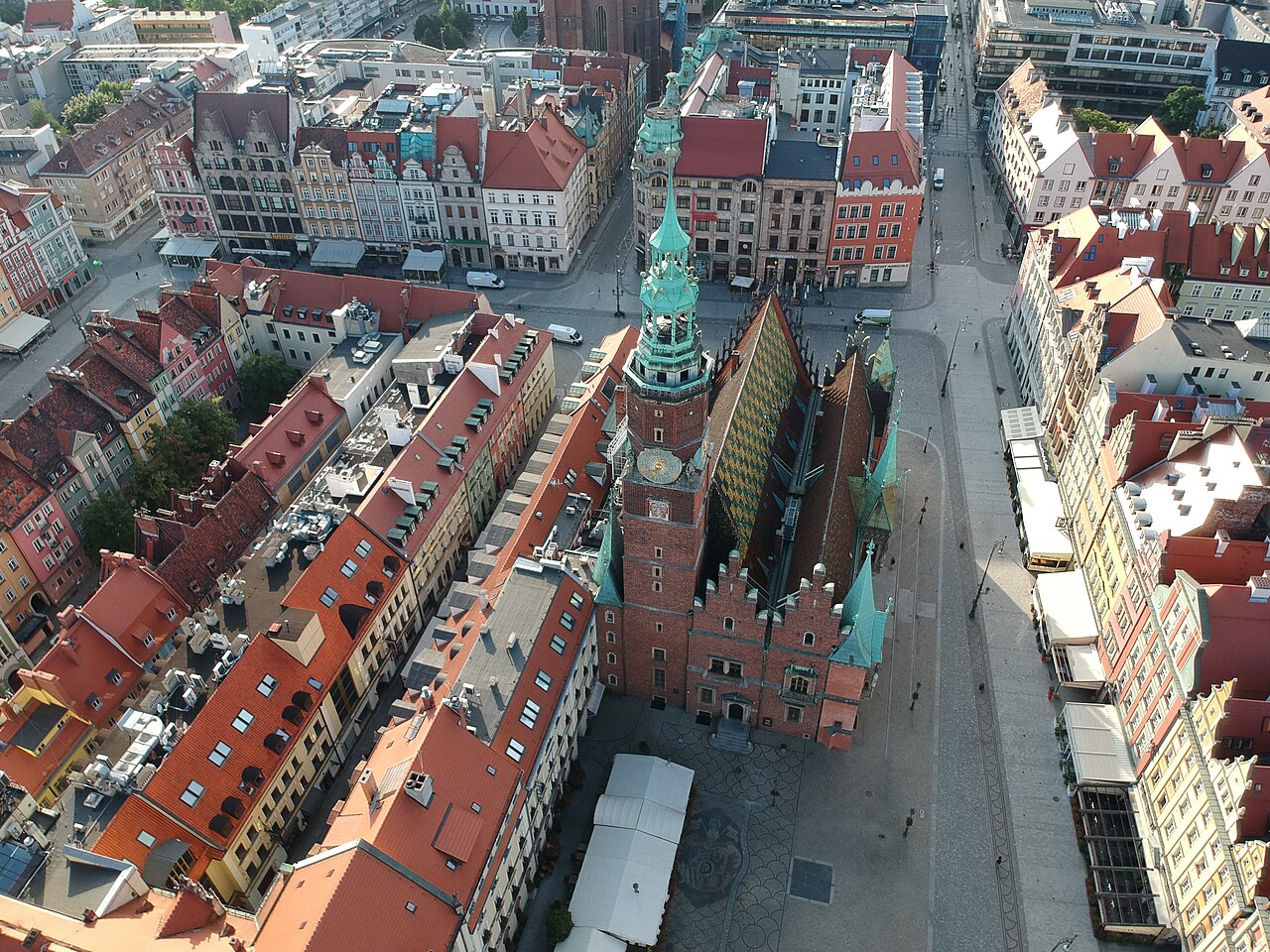
1. The Rynek (Market Square)
One of the largest medieval market squares in Europe. What makes it unusual is that the middle holds not just the town hall but an entire block of buildings, so you circle it rather than cross it. The colourful townhouses around the edges are largely post-war reconstructions, but the effect is still remarkable.
2. The Old Town Hall
A Gothic town hall in the middle of the Rynek, with an elaborately decorated eastern gable and an astronomical clock. Inside is the Museum of Bourgeois Art, and in the cellar sits Piwnica Świdnicka, one of the oldest drinking establishments in Europe.
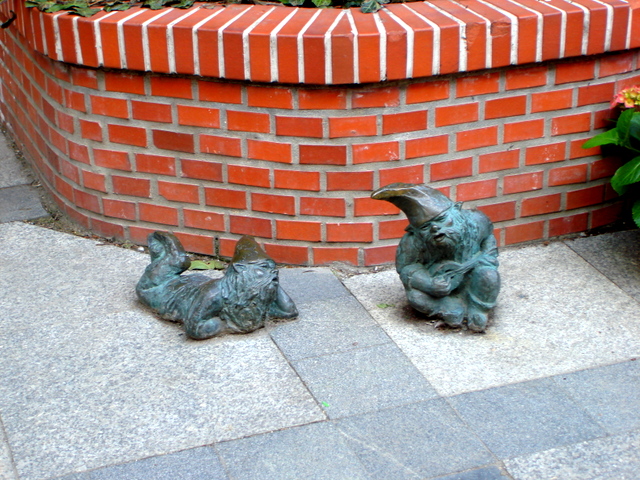
3. The dwarfs
Wrocław’s best-known game. Small bronze figures, twenty to thirty centimetres tall, are scattered across pavements, doorways and window ledges. The first, Papa Krasnal, appeared in 2001 as a monument to the Orange Alternative, the 1980s anti-communist movement that used a dwarf as its symbol of peaceful resistance. The first five figures, designed by Tomasz Moczek, were installed in August 2005, and the count has since grown to around 1,040.
Hunting for them is the best thing you can do with children here. Maps are sold at tourist information points, and there is an app with locations.
4. Plac Solny (Salt Square)
The square next to the Rynek, where flowers are sold around the clock. The stalls stay lit after dark, and it is one of the few places in the centre where anything happens after midnight.
5. St Elizabeth’s Basilica and its viewing terrace
A Gothic church a short walk from the Rynek. The tower is 91 metres tall and the viewing terrace sits at about 75 metres, reached by more than three hundred steps. There is no lift. The view takes in the old town roofs, the Rynek from above and the Oder, and on a clear day it reaches Śnieżka, the highest peak of the Karkonosze.
6. Jaś i Małgosia
Two small houses linked by a Baroque archway beside St Elizabeth’s, named after Hansel and Gretel. After the Rynek, this is the most photographed corner in the city.
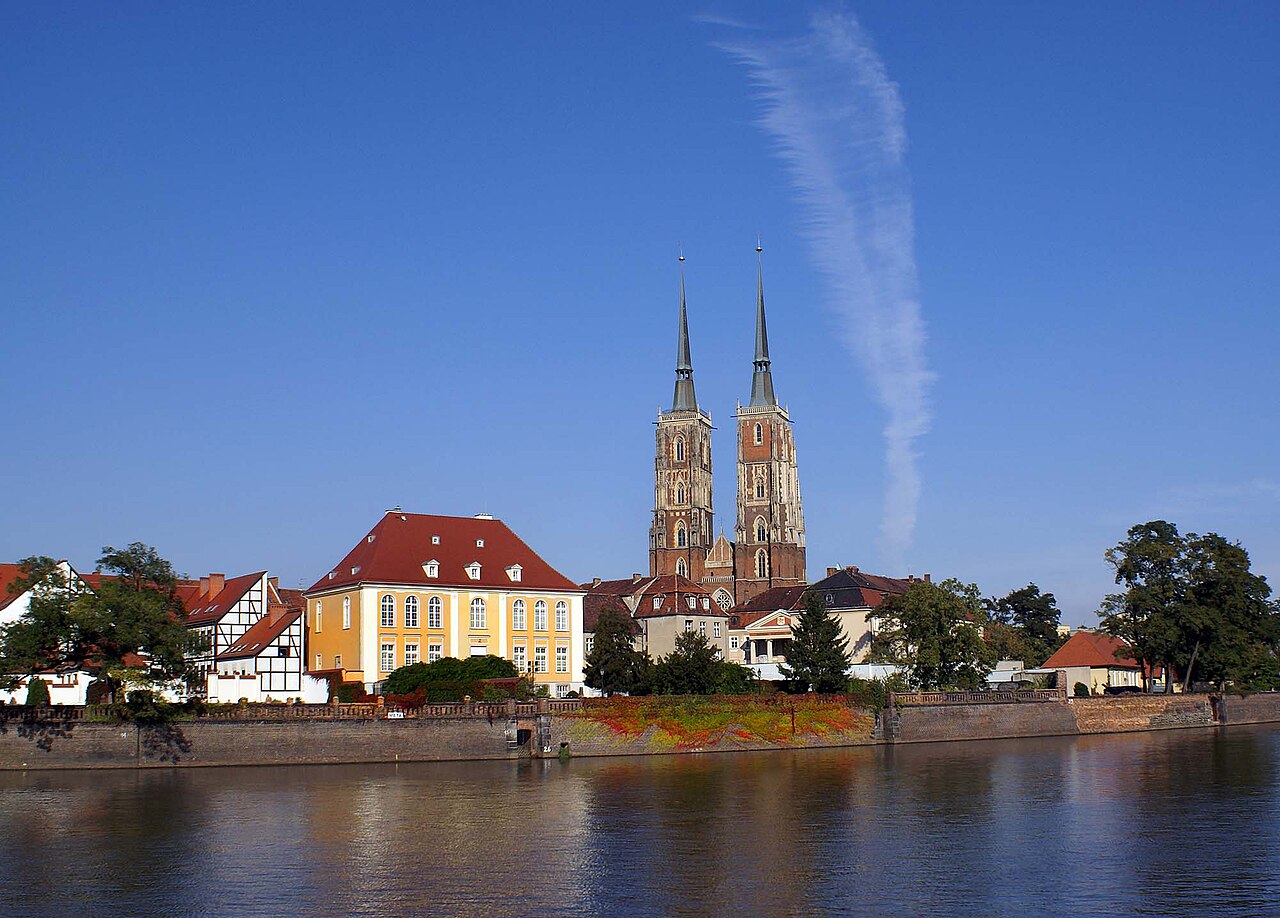
7. Ostrów Tumski (Cathedral Island)
The oldest part of Wrocław and its religious centre, protected as a Polish historic monument since 1994. Churches, seminaries, brick Gothic façades and an atmosphere completely unlike the Rynek. It is at its best in the evening, once the crowds have gone.
8. St John the Baptist Cathedral
The landmark of Ostrów Tumski, with two towers you can reach by lift. The view is different from St Elizabeth’s: more river and green, fewer rooftops.
9. Tumski Bridge and the lamplighter
The bridge linking Ostrów Tumski to the rest of the city, hung with love padlocks. The real curiosity is that the island is still lit by gas lamps, lit by hand every evening by a lamplighter — one of the last places in Europe where this survives. He starts at dusk, so check sunset times before you go.
10. The University and Aula Leopoldina
The main university building on the bank of the Oder hides Aula Leopoldina, a Baroque hall of frescoes, sculpture and stucco that ranks among the finest interiors in Poland. The ticket usually also covers Oratorium Marianum and the Mathematical Tower with its viewing terrace.
11. The Racławice Panorama
An enormous circular painting measuring 15 by 114 metres, painted between 1893 and 1894 by Jan Styka and Wojciech Kossak with a team of other artists. It depicts the Battle of Racławice on 4 April 1794, during the Kościuszko Uprising. It originally hung in Lwów and came to Wrocław after the war with part of the Ossolineum collections. It reopened to the public on 14 June 1985 and now draws around 400,000 visitors a year.
You stand on a platform in the middle, surrounded by the painting, which merges into a sculpted foreground so the line between paint and reality disappears. Book ahead — entry is in timed groups.
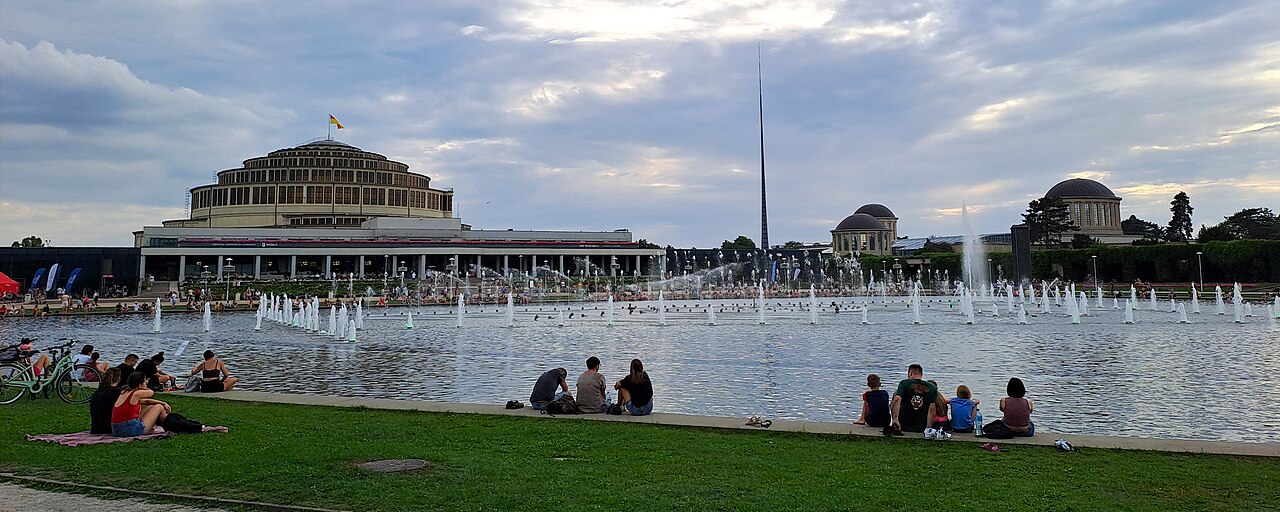
12. Hala Stulecia (Centennial Hall)
A concrete dome built between 1911 and 1913 by the architect Max Berg to his own design. When it went up it was the largest reinforced concrete dome in the world: 69 metres internal diameter and 42 metres high. It was added to the UNESCO list in 2006 as a breakthrough work of modern architecture. After restoration it holds ten thousand people and still hosts concerts, sport and conferences.
13. The multimedia fountain and the Pergola
Right beside Hala Stulecia. In season the water, light and music show runs several times a day, and the evening version with a light projection is free — the best way to end a summer day. The fountain is ringed by the Pergola, a semicircular structure covered in climbing greenery.
14. The Japanese Garden
A short walk from Hala Stulecia, laid out for the 1913 world exhibition and later restored with help from Japanese gardeners. Ponds, bridges, maples and quiet. Entry is paid, there is a queue in season, and the garden only opens from April to October.
15. Wrocław Zoo
The oldest zoo in Poland and one of the largest. It is sprawling, well kept and a full day out on its own.
16. Afrykarium
Part of the zoo and the single biggest family draw in the city. A complex devoted to African ecosystems: huge tanks with sharks and rays, an underwater tunnel, hippos seen from below the surface, penguins and a coral reef. Allow at least two hours and buy your ticket in advance, because in season and at weekends the daily allocation sells out.
17. Hydropolis
An interactive museum of water inside a 19th-century underground water reservoir. Large-format projections, a replica of the bathyscaphe Trieste and exhibits on the oceans and on water in the city. The best rainy-day option, and it works for adults too.
18. Wyspa Słodowa
An island in the Oder just off the centre, where people sit on the grass and on the steps down to the water. It is not an attraction so much as the place where you see how the city actually lives, best in the early evening.
19. The District of Four Denominations
A few streets where a Catholic church, a Lutheran church, an Orthodox cathedral and the White Stork Synagogue stand within a couple of blocks of each other. It is also the liveliest food and drink quarter in the centre, with bars hidden in the courtyards.
20. The White Stork Synagogue
A restored 19th-century synagogue that survived the war, now a cultural centre with exhibitions and concerts. You enter from the courtyard, and most visitors walk straight past it.
21. The Old Jewish Cemetery
An overgrown cemetery of 19th-century headstones on ulica Ślężna, run as an open-air Museum of Cemetery Art. A quiet, powerful place a few tram stops from the centre.
22. Nadodrze
A former working-class district across the river that has gone from run-down to a quarter of studios, workshops and murals. Somewhere to head on day two, once you have the Rynek out of the way.
23. Sky Tower
Wrocław’s tallest building at 212 metres, with a glazed observation point on the 49th floor. You can see the whole city from up there and, in good weather, the Sudetes on the horizon. Half an hour is plenty.
24. The Polinka cable car
A small gondola across the Oder, built by the technical university to connect its two campuses. The ride takes two minutes, you pay a standard city transport fare, and it is the cheapest view in town.
25. The city moat and Promenada Staromiejska
A ribbon of parkland follows the line of the old fortifications around the old town, with the moat, benches and a bandstand. It is the pleasantest way to walk from the Rynek to the university or the station, and in summer you can hire a pedalo on the moat.
26. Wrocław Główny railway station
A neo-Gothic building from 1857 that looks more like a castle than a station. Restored before the Euro 2012 football championship, it is one of the handsomest stations in Poland, so it is worth a look even if you are not catching a train.
27. The National Museum
The city’s main gallery, with Silesian medieval art, Gothic sculpture and Polish painting. A combined ticket with the Racławice Panorama costs less than buying the two separately.
28. St Mary Magdalene’s Church and the Penitents’ Bridge
A Gothic church with a walkway slung between its two towers, known as the Penitents’ Bridge. You climb a spiral staircase to reach it, and the view is tight and framed between the towers — quite unlike the other lookouts.
29. The WuWa estate
A modernist model housing estate from 1929, built for the Wohnung und Werkraum exhibition as a demonstration of how people would live in the future. For anyone interested in architecture it is one of the most interesting corners of the city; everyone else can safely skip it.
30. The Christmas market
Wrocław’s market on the Rynek and Plac Solny is regularly named the prettiest in Poland, and the lit-up square full of wooden huts is the main reason to come here in winter. It usually runs from mid-November to the end of December.
31. Cafés, milk bars and Polish food
Wrocław has a strong specialty coffee scene and, at the same time, still keeps its bar mleczny, or milk bar: the cheap communist-era canteens where you can still get pierogi, żurek and breaded pork cutlet for a few złoty. Try both — the contrast is part of the experience.
32. Hala Targowa and the flea market
A brick market hall from 1908 with concrete parabolic arches, a few steps from Ostrów Tumski, selling food, flowers and odds and ends, with a floor of places to eat. A flea market sets up next to it at weekends.
How to split Wrocław up: day one is the centre on foot — the Rynek, St Elizabeth’s tower, the university, Ostrów Tumski at dusk and an evening on Wyspa Słodowa. Day two is the tram east to Hala Stulecia, the Japanese Garden and the zoo. Slot the Racławice Panorama and Hydropolis in around the weather; both are indoors.
How to get to Wrocław
Most visitors arrive by air. Ryanair flies from London Stansted, London Luton, Dublin and Manchester, and Wizz Air from London Luton, among many other European cities. Wrocław Airport lies 10 km west of the centre; bus 106 (206 at night) runs to the main railway station and takes about 45 minutes.
If you are combining Wrocław with other cities, these are the approximate road distances:
| From | Distance | Driving time |
|---|---|---|
| Dresden | 270 km | about 3 hours |
| Kraków | 274 km | just under 3 hours |
| Prague | 285 km | just under 4 hours |
| Berlin | 344 km | about 4 hours |
| Warsaw | 356 km | about 4 hours |
By train is easier than driving. PKP Intercity runs direct services from Warsaw, Kraków, Poznań, Łódź, Szczecin and the Tricity, and Wrocław Główny is a ten-minute walk from the Rynek. A car in the city is mostly a liability.
Getting around means trams and buses; tickets come from machines on board or from an app. The old town is walkable, and you mainly need a tram for Hala Stulecia, the zoo and Hydropolis.
Parking in Wrocław
The centre is a paid parking zone, and around the Rynek spaces are expensive and simply not there. The sensible move is to leave the car in an underground car park at a shopping centre or in a car park on the edge of the centre and walk from there. If you are staying outside the centre, use the Park & Ride car parks at the tram termini, where the parking ticket doubles as a public transport ticket.
When to go to Wrocław, and for how long
- May to September: the best weather, the fountain running, life on Wyspa Słodowa, terraces on the Rynek.
- Advent: the Christmas market is a reason to come in its own right, but expect full hotels at weekends.
- Spring and autumn: the best balance of price and calm, with museums open as usual.
- January and February: the cheapest time, but outdoor attractions drop away. Hydropolis, the Panorama and Afrykarium will save the day.
Two days covers the centre and Hala Stulecia. With children, if you want to fit in the zoo with Afrykarium and Hydropolis, allow three. For a long weekend Wrocław is the ideal size: big enough not to run out, small enough to walk.
Where to stay in Wrocław
The best choice is Stare Miasto, meaning the streets around the Rynek and ulica Świdnicka. Everything important is walkable from there, trams reach Hala Stulecia in twenty minutes, and there is somewhere to eat in the evening. Nadodrze north of the river, or the area around the main station, works out cheaper and is ten minutes from the Rynek by tram.
- Backpackers: a bed in a shared hostel room in the centre from roughly €16 to €26 (70–110 zł) a night. Wrocław is a student city, so there are plenty of hostels and most have a kitchen.
- Mid-range: a three-star hotel or an apartment near the Rynek from roughly €63 to €97 (270–420 zł) for a double room with breakfast. Your money goes a long way here.
- Upmarket: a four-star hotel on the Rynek itself or a design hotel in a historic townhouse from roughly €116 to €185 (500–800 zł) a night.
These prices are for an ordinary weekend outside Advent. During the Christmas market and big conferences rates can double, and that is when it pays to stay one tram stop further out. Compare current prices and availability through accommodation in Wrocław.
Wrocław with kids
- Dwarf hunting with a map, which keeps going even the children who have no interest in monuments.
- Afrykarium and the zoo as a full-day plan.
- Hydropolis, because there are things to touch and watch.
- The multimedia fountain at Hala Stulecia.
- The Polinka cable car for a short ride over the river.
- Wyspa Słodowa to run around by the water.
What to do in Wrocław when it rains
Wrocław is well set up for rain: the Racławice Panorama, Hydropolis, Afrykarium, Aula Leopoldina, the National Museum and Hala Targowa, plus the cafés and milk bars. You can fill a whole day without getting wet.
Day trips from Wrocław
- Książ, the third-largest castle in Poland, about an hour to the south-west.
- Świdnica, with its timber-framed Church of Peace on the UNESCO list.
- Krzeszów, with a Baroque monastery complex.
- Kotlina Kłodzka, with the Szczeliniec rock labyrinth and a string of spa towns.
- The Karkonosze, about two hours from Wrocław.
If you are planning a longer trip, our round-up of what to see in Poland and the list of the most beautiful places in Poland will help. Heading into the mountains afterwards? We have a separate guide to the Karkonosze Mountains.
Frequently asked questions about Wrocław
Is Wrocław worth visiting?Yes, and it is still noticeably less crowded than Kraków. You get one of Europe’s biggest market squares, a UNESCO-listed modernist landmark in Hala Stulecia, the Racławice Panorama, the best zoo in Poland and around 1,040 bronze dwarfs to hunt down. Two days is enough to see the city properly.
How do you get to Wrocław?By air is easiest: Ryanair flies from London Stansted, London Luton, Dublin and Manchester, and Wizz Air from London Luton. The airport is 10 km west of the centre and bus 106 reaches the main station in about 45 minutes. By train, PKP Intercity runs direct services from Warsaw, Kraków, Poznań and Szczecin.
How many dwarfs are there in Wrocław?Around 1,040. The first, Papa Krasnal, appeared in 2001 as a monument to the anti-communist Orange Alternative movement, five more were added in August 2005, and the number keeps growing. Maps are sold at tourist information points and there is an app.
Why is Hala Stulecia a UNESCO site?Max Berg built it between 1911 and 1913, and at the time it had the largest reinforced concrete dome in the world, with an internal diameter of 69 metres. It was added to the UNESCO list in 2006 as a breakthrough work of modern architecture.
How many days do you need in Wrocław?Two days covers the centre, Ostrów Tumski and Hala Stulecia. If you are travelling with children and want to fit in the zoo with Afrykarium as well as Hydropolis, allow three days.
What is the Racławice Panorama?A circular painting 15 by 114 metres, made between 1893 and 1894 by Jan Styka and Wojciech Kossak. It shows the Battle of Racławice of 1794, and you stand in the middle surrounded by the canvas and a sculpted foreground. It came to Wrocław from Lwów and has been on display since 1985.
What can you do in Wrocław with kids?Hunt for dwarfs with a map, visit the zoo and Afrykarium, go to Hydropolis, ride the Polinka cable car over the river and watch the multimedia fountain at Hala Stulecia in the evening. Book Afrykarium in advance, because it sells out in season.
Do you need a car in Wrocław?No. The centre is walkable and trams take you comfortably to Hala Stulecia, the zoo and Hydropolis. Parking in the centre is expensive and oversubscribed, so if you do arrive by car, leave it in a garage or at a Park & Ride site.
Potřebujete pomoct s cestováním?
-
Ubytování 🏨
Vyberte si to nejlepší ubytování, ať už jste kdekoliv, přes Booking.com. -
Půjčení auta 🚗
Auto si snadno najdete přes Booking.com, kde máte často slevu díky ubytování, nebo Rentalcars.com, kde porovnáte nabídky většiny půjčoven. -
Zážitky 🎟️
Přes GetYourGuide.com si vyberete z nejrůznějších výletů i zážitků po celém světě, navíc se zrušením zdarma do 24 h předem.