Last updated 26.7.2026
For years we treated Poland as little more than a place to nip across the border for cheap shopping. What a mistake that turned out to be. Poland is so beautiful that we honestly wish we’d discovered it far sooner. It has not only gorgeous sandy beaches along the Baltic, but also majestic mountains, cities steeped in history and glorious national parks. It’s also wonderfully easy on the wallet, and the food — from creamy krówki fudge to plates of Polish pierogi — is worth the trip on its own. So, what is there to see in Poland? Here are our 45 favourite places to add to your list.
What to See in Poland at a Glance
- Poland’s most beautiful historic cities: Krakow with Wawel Castle, Warsaw with its reconstructed Old Town, Gdańsk with its colourful townhouses, and Wrocław with its 900 dwarfs dotted around the streets.
- Nature destinations: the Polish Tatras with Lake Morskie Oko, Białowieża National Park with its wild bison, the Masurian Lakes for watersports, and Słowiński National Park with its shifting dunes.
- For the seaside: Świnoujście with the loveliest beaches, Sopot with the longest wooden pier in Europe, Gdynia for a family holiday, and Hel for watersports lovers.
- Remarkable landmarks: Malbork, the largest Gothic castle; the Wieliczka salt mine; the Auschwitz memorial as a reminder of history; and the world’s tallest statue of Christ the King.
- Practical tips: the best time to visit is May to September, weekend train tickets are valid right across Poland, and admission to the sights is refreshingly affordable. For accommodation in Poland we always book through Booking, where you’ll find every kind of place to stay.
45 of the Most Beautiful Places to See in Poland
We won’t keep you in suspense any longer. What is there to see in Poland? Honestly, so much that a single holiday will never cover it all. That’s why we’ve picked a real mix of places to visit in Poland — a bit of everything, so there’s something here whatever you’re into.
Gdańsk and the Baltic Coast
These days it feels as if half of Central Europe has swapped the Adriatic for the Polish city of Gdańsk, and it’s easy to see why. You’ll fall for it fast. Colourful merchants’ houses line the Long Market, Neptune’s Fountain stands as the city’s emblem, and St Mary’s Church is one of the largest brick churches in the world. Add lovely beaches and campsites nearby, and you can pair a city break with a proper seaside holiday in Poland.
TIP: We love camping on the Polish coast, and we’ve rounded up 15 of the best Polish seaside campsites

Krakow
Krakow is without doubt one of Poland’s best-loved cities, and not only because it survived the Second World War with its old centre intact. The main square, Rynek Główny, is one of the largest medieval market squares in Europe. At its heart stands the Sukiennice (the Cloth Hall), today lined with craft stalls. Wawel Castle, with its legend of the Kraków dragon, is a must (the courtyard is free to enter). Just don’t confuse Krakow with nearby Katowice — an easy mistake to make.
Book your accommodation in Krakow well ahead, as it’s a hugely popular spot for a long weekend.
Białowieża National Park and Europe’s Last Primeval Forest
The last surviving fragment of the lowland forest that once blanketed the whole of Central Europe lies in this Polish national park. It’s the last place in Europe where European bison — the continent’s largest land mammals — still roam free, in the largest herd anywhere (around 800 animals). You might also spot wolves, lynx and elk. So if you’re wondering what to see in Poland, put this near the top of the list.
TIP: There are all sorts of unusual places to stay around the park, so make your time in nature as special as you can.
Łeba and Lake Łebsko
Łeba is a small harbour town right beside Słowiński National Park. Thanks to reliable winds it’s a favourite for kitesurfing and windsurfing. And if you’re after Poland’s most beautiful lakes, Lake Łebsko is certainly one of them — it’s also the largest coastal lake in the country.
TIP: 23 brilliant places for an April seaside escape in Europe

Jelenia Góra – Gateway to the Giant Mountains
The Giant Mountains (Karkonosze, or Krkonoše on the Czech side) are famous, yet far fewer visitors explore the Polish flank. Jelenia Góra, at the foot of the range, makes an ideal base for hiking and for discovering the mountains from the other side. In the town itself you’ll find a square with a Baroque town hall and arcaded houses, plus the Gothic Basilica of St Erasmus and St Pancras, dating from the turn of the 15th century. It’s a lovely way to combine a wander through an old town with mountains and nature.
The Masurian Lakes
Masuria is a region of some 4,000 lakes linked by rivers and canals across around 1,700 km². It’s perfect for sailing, canoeing and fishing. The largest lakes, Śniardwy and Mamry, offer superb conditions for watersports, while the smaller ones are ideal for families with children.
The Polish Maldives and Gródek Park
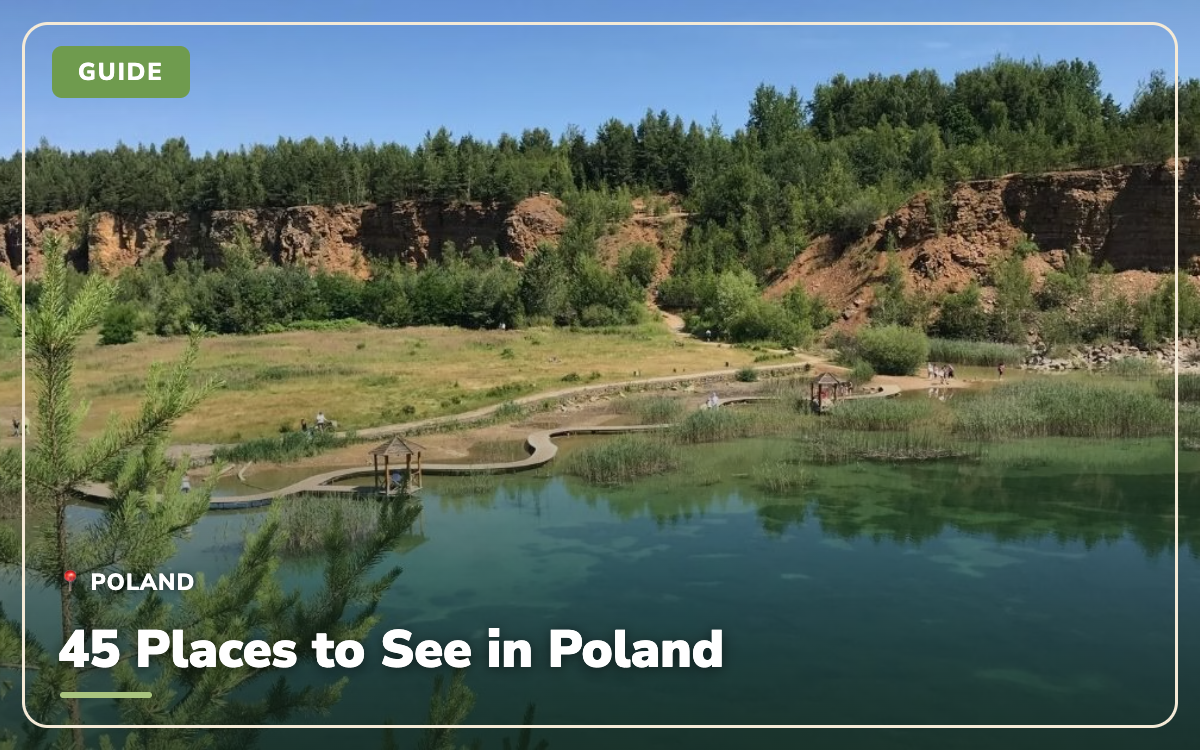
You may already have heard of the so-called Polish Maldives — Gródek Park in Jaworzno, a former limestone quarry that has turned into a turquoise lake ringed by rocks and greenery. There’s a beautiful walk and a wooden boardwalk running across the flooded quarry — a great day out for families.
A word of warning, though: there are actually two “Polish Maldives”. The other is the Zakrzówek quarry, a stunning swimming spot in Krakow.
TIP: Where are the Polish Maldives, how to make the most of them + 12 places nearby

Świnoujście and Poland’s Finest Beaches
Fancy the seaside in Poland? Wide, soft-sand beaches stretch along the border with Germany here. The town is home to the Świnoujście lighthouse, one of the tallest in Europe. Add Fort Gerharda and the Baltic Park Molo Aquapark and you have plenty to do in this seaside spa resort.
Sopot
The longest wooden pier in Europe (515 metres) is right here in Poland and is the town’s great symbol. Sopot is known for its smart hotels, spas and lively nightlife. Its history and handsome architecture — including the Crooked House (Krzywy Domek) — give the town real character. Sopot is a favourite with tourists, so you certainly won’t have it to yourself.
The Hel Peninsula – Some of Poland’s Loveliest Beaches
The name may raise a smile in English, but the Hel Peninsula is genuinely exceptional and beautiful. The Hel spit has beaches on both sides — calm sea on one, waves ideal for windsurfing and kitesurfing on the other. A grey seal sanctuary, a fishing museum and Second World War fortifications are all worth your time. And here too you can camp cheaply by the sea.

The Capital, Warsaw
After the Second World War the city was razed to the ground, yet its Old Town was so brilliantly rebuilt that it’s now a UNESCO World Heritage Site. The Royal Castle, the Palace of Culture and Science with its viewing terrace over the city, and Łazienki Park with its palace all belong on any list of what to see in Poland.
TIP: The ultimate holiday packing list: what you need, wherever you’re headed
Wrocław and the City of Dwarfs
How about a Polish city break? The Old Town Hall is one of the finest in Central Europe, but the real quirk is the bronze dwarfs scattered around the city — there are now nearly 900 of them. A little bonkers, isn’t it? Beyond the dwarfs, don’t miss Ostrów Tumski (Cathedral Island) with its Gothic cathedral, so you catch Wrocław’s grander sights too.
The Polish Tatras and Lake Morskie Oko
Finding the Slovak Tatras a little too crowded? The Polish Tatras are every bit as beautiful. Morskie Oko is the most visited spot in the Polish Tatras. A comfortable paved path leads to the glacial lake, easy enough even with a pushchair. The Giewont massif is another favourite. The obvious base for the Polish Tatras is Zakopane, the highest town in Poland, but there are plenty of other lovely spots where you’ll find far fewer people.
TIP: The Polish Tatras are full of gorgeous wellness hotels, so after a hike you can treat yourself to a swim or a sauna.

TIP: Sri Lanka travelogue: what a month in Sri Lanka cost us and what we got up to
The Wieliczka Salt Mine
A fan of going underground? Poland is home to one of the world’s most famous salt mines, a UNESCO site just 30 minutes from Krakow. Deep inside you’ll find the underground St Kinga’s Chapel, carved entirely from salt — an architectural marvel. The tourist routes lead far below the surface and tell the 700-year story of salt mining. And if you’re visiting Poland in summer and the heat gets much, it stays wonderfully cool down in the mine.
Słowiński National Park – Poland’s Sahara
What to see in Poland? Sand dunes where you’ll feel as if you’re in the desert. It really does seem Poland has it all, right down to shifting sand dunes nicknamed the Łeba Sahara. The tallest, Łącka Góra, stands 42 metres high and moves 3.5 to 10 metres a year. The park pairs its dunes with pine forests, small lakes and peat bogs. It sits in northern Poland just a short hop from the sea, so if a seaside holiday in Poland appeals, be sure to stop here.
TIP: 27 destinations for a May seaside break in Europe
Częstochowa and Jasna Góra Monastery
Poland’s most important pilgrimage site, with a monastery dating from 1382, is the city of Częstochowa. The miraculous icon of the Black Madonna of Częstochowa draws millions of pilgrims every year. The complex also includes mighty fortifications and a rich museum.
Malbork Castle – the World’s Largest Gothic Castle
Did you know the world’s largest Gothic castle by area is in Poland? Malbork Castle is the biggest brick castle on earth and, at the same time, the largest brick building in the world. Once the seat of the Grand Master of the Teutonic Order, it is genuinely monumental — allow at least two hours for a visit.

Auschwitz
Almost everyone knows the story of Auschwitz and the concentration camps, and many of us visited on a school trip (we did). The Auschwitz-Birkenau camp is now a vast museum and memorial, and the place where more than a million people were murdered. If you’re interested in history and want to see it with your own eyes, it’s without question one of the most affecting places you can go. Be prepared, though: it is deeply sombre and, for some, hard to bear. Even so, it’s somewhere everyone should see.
TIP: You can visit the camp on a guided tour, which really brings the history to life. This is one place we’d strongly recommend taking a guide. Through GetYourGuide you can book a guided visit or even a full-day trip.
The Seaside Town of Kołobrzeg
A spa town with 150 years of tradition, where mineral springs and a maritime climate create ideal conditions for a restorative break. Kołobrzeg has wide sandy beaches, a historic lighthouse and wellness treatments at a fraction of Western European prices.
TIP: 35 of the most interesting places to see in Albania and what you really must try
Toruń – Copernicus’s Birthplace
Drawn to beautiful old towns? Toruń is the birthplace of Nicolaus Copernicus and a UNESCO site thanks to its medieval web of historic streets. There’s also a Gothic town hall on the Old Town square, and a real sense of calm, with large parts of the centre closed to traffic.

Energylandia – the Biggest Theme Park
Looking for a bit of thrill on your Polish holiday? This is Poland’s largest theme park, spread across 70 hectares in the south of the country. Energylandia has 17 rollercoasters, which puts it third in the world rankings. It’s ideal for a day out and family fun.
TIP: 20 seaside destinations for September, and not only in Europe
The Coastal City of Gdynia
Smaller but clean beaches with a gentle, shallow entry into the sea make Gdynia especially popular with families. You can visit the maritime museum, a modern aquarium and the Kościuszko Seaside Boulevard with its sea views.
The Old City of Lublin
Lublin is an ancient city with an Old Town, its town hall on the market square and the Kraków Gate as its emblem. It’s packed with historic sights and beautiful lanes to wander. The Dominican church, dating from 1342, is the loveliest religious building and a landmark of the city.


Zamość
A Renaissance jewel on the UNESCO list, the town of Zamość has a distinctly Tuscan feel. Its main square, with original architecture, ranks among the best-preserved historic towns in Europe. To us it’s a little reminiscent of the Italian hill towns — so if you’re passing this way, do take a look.
TIP: Fuerteventura: what to see + 30 of the most beautiful spots
Biebrza National Park and Its Vast Wetlands
Poland’s largest national park, with the most extensive complex of peat bogs, is Biebrza NP, home to 253 bird species and the biggest elk population in Central Europe (around 350 animals). So if you’re after a little peace and quiet away from the city, out in nature, this could be just the place.
Ojców National Park
The smallest national park, 40 minutes from Krakow, offers limestone cliffs and more than 400 caves. Nearby stand the Renaissance castle of Pieskowa Skała and Ojców Castle, adding historic landmarks to the natural beauty.
Międzyzdroje
The Walk of Stars — a Polish take on the Hollywood Walk of Fame. There’s an annual film festival, a beautiful wooden pier and Woliński National Park nearby, with sand dunes and a bison enclosure.
The Resort of Ustka
After a friendly Polish resort for a family break? Ustka has two main beaches separated by the mouth of the River Słupia. The eastern beach is busier, with restaurants, while the western one offers more privacy and calm. You can also visit and climb the 19th-century lighthouse.
TIP: What to see in Cyprus? 39 of the most beautiful places to visit
The Fairytale Moszna Castle
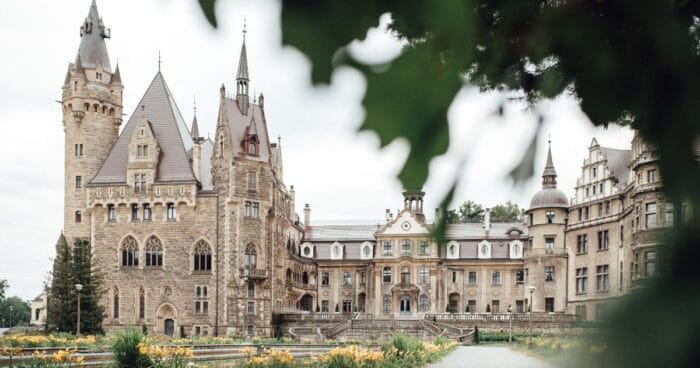
99 towers turn Moszna Castle into a real spectacle. It never served any defensive purpose, which is why it came through the wars unscathed. A cocktail of architectural styles — Baroque, neo-Gothic and neo-Renaissance all in one building.
The Fishing Town of Władysławowo
On both sides of the 35 km-long Hel spit you’ll find beautiful beaches. And where is the sea warmest in Poland? Right here — the water is noticeably warmer than at other spots along the Polish coast. Surfing, bungee jumping, paragliding and an oceanarium keep both travellers and families entertained.
The Kalwaria Zebrzydowska Pilgrimage Complex
A 17th-century UNESCO site, it comprises a monastery, a church and 40 chapels scattered across the hills. Together they symbolically retrace the road to Golgotha. Its Easter processions draw tens of thousands of pilgrims, making Kalwaria Zebrzydowska one of Poland’s most significant sacred places.
TIP: Salento, Colombia: the tallest palms, coffee and rainforest as far as you can see
The Mountain Spa Town of Świeradów-Zdrój
A spa town in the Jizera Mountains with mineral springs, it’s a wonderful place to rest and recharge in nature. There’s a beautiful 19th-century colonnade and a historic pavilion with healing springs. In winter come the modern ski resorts; in summer, the hiking trails.
The Resort of Pobierowo
Wondering what to see in Poland if you’re heading to a resort? Pobierowo has wide sandy beaches fringed by pine forests, along with cycle paths, hiking trails and sports facilities. There’s a good crop of cafés and plenty of restaurants serving traditional Polish cuisine.
Karkonosze National Park – Granite Crags
Want to explore the Polish side of the Giant Mountains more fully? They’re home to striking granite crags in all sorts of shapes, such as the Pilgrims, the Midday Stone and the Swine Stones. There’s also the Úpa peat bog with its rare plants, and the Kamieńczyk Waterfall — the tallest in the Polish Giant Mountains, near Szklarska Poręba.
TIP: One of the most beautiful national parks anywhere is Tayrona National Park in Colombia.
The Village of Trzęsacz and Poland’s Prettiest Beaches
The village of Trzęsacz is famous for the ruins of the 14th-century Gothic Church of St Nicholas, which once stood 2 km from the shore before coastal erosion brought the sea to its door. Today the area has cycle paths and what many call Poland’s most beautiful beaches (Trzęsacz beach).

The World’s Tallest Statue of Christ the King
The 36-metre statue in Świebodzin is the tallest statue of Christ in the world. Before it was unveiled in 2010, that record belonged to the famous statue in Rio de Janeiro. It’s clearly visible from the motorway as you approach the town, so if this kind of curiosity appeals, it’s an easy stop along the way.
Poznań, Cradle of the Polish State
Looking for a Polish city the crowds haven’t found yet? Poznań will charm you with its 13th-century Old Market Square, its colourful merchant houses and its Renaissance town hall. Every day at noon, above the town hall clock, two mechanical goats appear and butt heads three times, to the sound of a trumpet. Head over to Cathedral Island too, where the Polish state was born more than a thousand years ago.
Kazimierz Dolny on the Vistula
Longing for a quiet little town with a romantic feel? Kazimierz Dolny sits on the bank of the Vistula, about 50 km from Lublin, and is one of the most picturesque spots in eastern Poland. Its Renaissance square is lined with merchant houses and galleries, as painters and artists have been coming here for over a century. Above the town rise the ruins of a 14th-century Gothic castle, with lovely views over the river.
Rafting the Dunajec in the Pieniny
What to see in Poland if you love water and mountains in equal measure? Take a rafting trip on the River Dunajec, which flows through a spectacular gorge in Pieniny National Park on the Slovak border. On traditional wooden rafts, experienced raftsmen guide you through the narrow canyon between steep limestone cliffs. It’s a relaxed ride, suitable for families too.
The Wild Bieszczady Mountains
After genuine wilderness? The Bieszczady, in Poland’s south-east, are the country’s wildest mountains, still home to wolves, lynx and bears. The finest sights are the so-called połoniny, sweeping mountain meadows above the treeline with views for miles. You can climb the highest peak, Tarnica (1,346 m), or unwind by Lake Solina.
TIP: The best bases for trips into the Bieszczady are the villages of Wetlina and Ustrzyki Górne. You’ll find accommodation in the area on Booking.
Książ Castle
Did you know Poland’s third-largest castle sits close to the Czech border? Książ Castle, above Wałbrzych, is the biggest castle building in the country after Malbork and Wawel, and the largest in Silesia. It stands on a rocky spur ringed by forest, and its tower is 47 metres high. During the Second World War the Germans dug mysterious tunnels beneath it, whose purpose is still not fully understood.
The Wang Church in Karpacz
Fancy a piece of Norway in the Polish Giant Mountains? The wooden Wang Church in Karpacz originally comes from Vang in Norway, where it stood as early as around 1175. In the 19th century the Prussian king had it moved to the mountains, where it was reconsecrated in 1844. It’s a stave church (stavkirke): its roof is carried not by walls but by mighty wooden posts, and a stone tower was added to shelter it from the mountain gales.
The Wolf’s Lair (Wilczy Szaniec)
Interested in the history of the Second World War? At the Wolf’s Lair, near the village of Gierłoż in Masuria, Adolf Hitler had his main wartime headquarters from 1941 to 1944. The sprawling forest complex still holds massive concrete bunkers. It was here, on 20 July 1944, that the failed assassination attempt on Hitler was carried out by Claus von Stauffenberg.
The Trail of the Eagles’ Nests and Ogrodzieniec Castle
What to see in Poland between Krakow and Częstochowa? Follow the Trail of the Eagles’ Nests, which links around 25 castles and watchtowers over nearly 164 km, all built atop limestone crags. King Casimir the Great had them raised to guard the trade routes. The most famous and largest is the 14th-century Gothic Ogrodzieniec Castle, whose romantic ruins crown a rocky summit.
Kazimierz, Krakow’s Jewish Quarter
Love places with a story? For centuries Kazimierz was the Jewish quarter of Krakow and it still has a unique atmosphere. You’ll find old synagogues, cosy cafés and bars and lively flea markets. Just across the river lies Oskar Schindler’s former factory, now a powerful museum recalling the years of occupation.
Why Take a Holiday in Poland
Plenty of visitors come to Poland mainly to shop, which is rather a shame. Poland is a genuinely varied country with something for everyone. There are beautiful ancient forests and nature parks, a Baltic coast lined with lovely beaches, and old cities where you can lose yourself in the lanes. On top of that, it’s within easy reach of Central Europe and won’t cost you a fortune. It’s also an easy place to get by, even if your Polish is non-existent.
When and Where to Go in Poland
When should you visit Poland? Much like anywhere in Central Europe, it depends on what you’re after. In winter you can head to the mountains to ski; in summer, to the sea. Spring and autumn bring great conditions for trips into nature or the cities. Over the summer holidays the best-known spots can get busy. If you’d rather avoid the crowds, aim for May or the second half of September.
Poland is well worth a trip in winter too, when you can hit the slopes or the Christmas markets. There’s no better way to end the day than a soak in a hot thermal pool. To get around, look into weekend train tickets — from Friday evening to Monday morning you can travel anywhere in Poland for a single flat fare.
TIP: Find yourself a great place to stay on Booking and set off to discover somewhere new.
A Seaside Holiday in Poland – and Why the Polish Coast Is Worth It
Poland’s Baltic coast has 500 kilometres of beautiful sandy beaches with soft sand and a gentle slope into the water. Unlike many other European destinations, there’s plenty of room on the beach here — no jostling for space between the sunloungers.
The sea isn’t as icy as its reputation suggests; in summer it reaches a pleasant 18–22°C. Clean sea air scented with pine forests, wide beaches perfect for long walks and prices noticeably lower than Spain or Turkey make it a real winner.
When to Go to the Polish Seaside
If you’re planning a beach trip to Poland, the main season runs from June to August, when you’ll get the warmest air (20–25°C) and water (18–22°C). July and August are the busiest months, with the most sunshine and the least rain. Before or after the peak, expect a cooler sea but far fewer tourists.

Where to Stay in Poland
Accommodation in Poland offers slightly better value than you’ll find in much of the region. Often, for the price of a modest guesthouse elsewhere, you’ll get a luxury wellness hotel with mountain or sea views. Newly built hotels with modern spa centres are concentrated in the seaside spa towns and mountain resorts.
In historic cities such as Krakow or Gdańsk choose accommodation in the centre and most of the sights will be within walking distance.
On the Polish coast, hotels with direct beach access in Świnoujście, Sopot or Kołobrzeg are popular. Family guesthouses and apartments can be found in smaller resorts like Ustka or Pobierowo.
In the mountains, opt for a wellness hotel with Tatra views in Zakopane or a spa hotel in the Giant Mountains. Book ahead, especially in high season — good-value places fill up fast.
Experiences and Tickets in Poland
traveller-approved · GetYourGuide


Prices and ratings are indicative (source: GetYourGuide); you’ll see the latest once you click.
Frequently Asked Questions (FAQ)
What is there to see in Poland?
Krakow – a historic city with Wawel Castle, its cathedral and the magnificent Rynek Główny main square.
Warsaw – the capital, with a perfectly reconstructed Old Town (UNESCO), the Royal Castle and Łazienki Park.
Gdańsk – a Baltic gem with colourful houses, Neptune’s Fountain and lovely beaches nearby.
Wrocław – the city of dwarfs, with a Gothic cathedral on Ostrów Tumski and a magnificent town hall on the main square.
Białowieża National Park – Europe’s last primeval forest, home to wild bison, wolves and lynx.
The Polish Tatras and Morskie Oko – majestic mountains with a glacial lake, a favourite day trip from Zakopane.
The Masurian Lakes – a paradise for watersports, fishing and sailing.
Słowiński National Park – shifting sand dunes nicknamed the Polish Sahara.
The Wieliczka Salt Mine – a unique underground complex with St Kinga’s Chapel carved from salt.
Malbork Castle – the world’s largest Gothic castle and the monumental seat of the Teutonic Order.
The Hel Peninsula – beaches for families and surfers alike, a seal sanctuary and a fishing heritage.
Sopot – a spa town with the longest wooden pier in Europe and a lively nightlife.
Świnoujście – wide beaches, a lighthouse and a spa-town feel on the coast.
Auschwitz – a memorial and museum commemorating the tragedy of the Holocaust.
Zamość – a Renaissance town on the UNESCO list, nicknamed the “pearl of the Renaissance”.
Toruń – the birthplace of Nicolaus Copernicus and a beautifully preserved medieval city (UNESCO).
Energylandia – Poland’s largest amusement park, with rollercoasters, ideal for families.
Moszna – a fairytale castle with 99 towers and a unique mix of architectural styles.
Częstochowa – Jasna Góra – Poland’s most important pilgrimage site, with the icon of the Black Madonna.
The statue of Christ the King in Świebodzin – the world’s tallest statue of Jesus Christ.
What should you eat in Poland?
Polish cuisine is superb. As you probably know, the classic dish is pierogi – dumplings filled with meat, potato, cheese or sauerkraut and mushrooms. Sweet versions with fruit are popular too. Other specialities include pyzy (stuffed potato dumplings), flaczki (a hearty tripe soup) and bigos, a traditional “hunter’s stew” of cabbage, meat and spices simmered for hours. In the mountains you can also try oscypek, a smoked sheep’s cheese regarded as a regional delicacy.
How is it best to pay in Poland?
The easiest option is to pay by card. Visa, Mastercard and Maestro are widely accepted in Poland – not only in large shops but also at petrol stations and with smaller traders. You can comfortably pay by card in restaurants and on public transport too. Cash is handy mainly at markets, in smaller villages or for little purchases, but on the whole a card will get you through just fine.
What are the must-sees in Poland?
Poland is a country of rich history and varied nature. If you make the trip, don’t miss the Wieliczka Salt Mine with its beautiful St Kinga’s Chapel, carved entirely from salt. Nature lovers will be enthralled by Słowiński National Park, with its shifting sand dunes and lakes. An architectural gem is the Baroque Wilanów Palace in Warsaw, while in Wrocław the Gothic Cathedral of St John the Baptist awaits. Other draws include the mountain resort of Zakopane beneath the Tatras, the unique Białowieża Forest, romantic Łazienki Park in the heart of Warsaw and the picturesque historic centre of Zamość, a UNESCO World Heritage Site.
Potřebujete pomoct s cestováním?
-
Ubytování 🏨
Vyberte si to nejlepší ubytování, ať už jste kdekoliv, přes Booking.com. -
Půjčení auta 🚗
Auto si snadno najdete přes Booking.com, kde máte často slevu díky ubytování, nebo Rentalcars.com, kde porovnáte nabídky většiny půjčoven. -
Zážitky 🎟️
Přes GetYourGuide.com si vyberete z nejrůznějších výletů i zážitků po celém světě, navíc se zrušením zdarma do 24 h předem.