What to See in Budapest: 27 Best Things to Do (2026)
Last updated 5.11.2026
Budapest is one of the most rewarding city breaks in Central Europe. It is easy to reach, still noticeably cheaper than Vienna, and it packs a monumental parliament, a castle hill full of views and a string of thermal baths where you can dissolve a long day on your feet into steaming hot water — all within a compact, walkable centre. When people ask us what to see in Budapest, the only real problem is that there is so much of it, and it is all too easy to spend half the day rushing and the other half sitting in a café because you never made a plan.That is why we have kept this guide as broad as possible. We have gathered all the main sights and the best things to see in Budapest, from the parliament and Fisherman’s Bastion to the thermal baths, the ruin bars and a few lesser-known corners, with a rough price and a practical tip for each. If you only have a single day, take a look at our ready-made One Day in Budapest itinerary instead — here we go wide, so you can build a two-, three-day or longer trip exactly the way you like it.
How many days: ideally 2–3 days; a quick loop fits into a single day.
Don’t miss: the Parliament, Fisherman’s Bastion + Buda Castle, St Stephen’s Basilica, the Chain Bridge, the Széchenyi Baths.
Thermal baths: Széchenyi is the best; the Gellért Baths are closed for renovation (scheduled until 2028).
Currency: the forint (HUF). Roughly £1 ≈ 470 HUF — budget in round numbers, not to the penny.
Transport: Budapest is well connected by rail across the region; around town the metro, trams and a 72-hour travel pass work brilliantly.
Free: Castle Hill, the Chain Bridge, the Shoes on the Danube Bank, Gellért Hill, the Central Market Hall, Margaret Island.
When to go and how to get around the city
Budapest is a year-round city, but it is at its most pleasant in spring (April–June) and autumn (September–October) — the weather is kind and it never gets as scorching as in July and August, when the city really heats up. The Christmas markets on Vörösmarty Square and by St Stephen’s Basilica are among the loveliest in Central Europe, so December is a fine choice too. The thermal baths run all year, and in winter the outdoor Széchenyi pools, with steam drifting over the surface, are arguably at their most magical.Budapest is well connected by rail across Central Europe — it is roughly two and a half hours from Vienna or Bratislava — and there are direct flights from across the UK and Europe into Ferenc Liszt Airport. If you arrive by car, sort out parking first: the centre is metered and narrow, so it is better to leave the car at your accommodation and use public transport.Getting around town, public transport is excellent and cheap: the metro (four lines, including the historic yellow M1 running under Andrássy Avenue), trams and buses. A time-based pass pays off — a 24-hour ticket costs around 2,500 HUF (≈ £5.30) and a 72-hour pass about 5,500 HUF (≈ £12). A single ride is 450 HUF (≈ £1). Buy from machines or the app rather than from the driver.
💡 Tip:Validate your ticket as soon as you board the metro, and expect the occasional plain-clothes inspection by the escalators — inspectors deal with fare-dodgers fairly firmly on the way out.
Budapest was formed from two once-separate banks — hilly Buda (the castle, Fisherman’s Bastion, Gellért Hill) and flat Pest (the Parliament, the Basilica, Andrássy Avenue, the ruin bars). A series of bridges spans the Danube between them, and you will be crossing from one side to the other constantly — which is why it pays to stay somewhere central, ideally in Pest near the middle of town. Find accommodation in Budapest here →What to see in Budapest
27 things to see in Budapest
We have roughly ordered them from the biggest crowd-pullers down to the smaller gems. Most of them link up into logical loops — the castle hill in Buda, the “promenade” along Andrássy Avenue in Pest, and save the baths for the evening, when you will be ready to put your feet up.
1. Hungarian Parliament (Országház)
This neo-Gothic building above the Danube is the largest structure in Hungary and one of the most beautiful parliament buildings in the world. You can walk around the outside for free, and from the opposite Buda bank you get that picture-postcard shot. The only way inside is on a guided tour (about 45 minutes) — you will see the grand staircase and the Hungarian crown jewels.Admission is around 14,300 HUF (≈ £30) for an adult, and roughly 7,530 HUF (≈ £16) for EU/EEA citizens — bring your ID. Buy tickets online in advance, as they sell out on the spot in high season.
💡 Tip: The Parliament looks its best after dark, when it lights up and mirrors in the Danube. The finest view is from the embankment on the Buda side or from a boat on an evening cruise.
2. Buda Castle (Budavári Palota)
The former royal palace on the castle hill is part of a UNESCO World Heritage Site and home to the Hungarian National Gallery and the Budapest History Museum. The courtyards and viewing terraces are freely accessible and free of charge — even if you skip the museums, it is worth coming up here for the view over Pest and the Danube. Museum entry starts at around 3,200 HUF (≈ £7).
3. Fisherman’s Bastion (Halászbástya)
These fairytale white turrets with their arcades are the most photogenic spot in all of Buda, and the view from here across to the Parliament is unforgettable. The lower terraces are free; access to the upper viewing galleries costs around 1,700 HUF (≈ £3.60) in season. Come early in the morning (before nine) and you will beat both the crowds and the fee.What to see in Budapest
4. Matthias Church (Mátyás-templom)
Right next to Fisherman’s Bastion stands a church with an unmistakable, colourful roof of glazed tiles, where the Hungarian kings were crowned. The interior with its painted walls is worth the entry — tickets are around 2,500–3,400 HUF (≈ £5–7), with the tower charged separately.
5. Budavári Sikló funicular
This historic cabin funicular dating from 1870 carries you from the Chain Bridge up to the castle. It is more of an experience and a nice view than a must — you can also walk up the steps for free. A return ticket costs around 4,500 HUF (≈ £9.50), one-way cheaper.
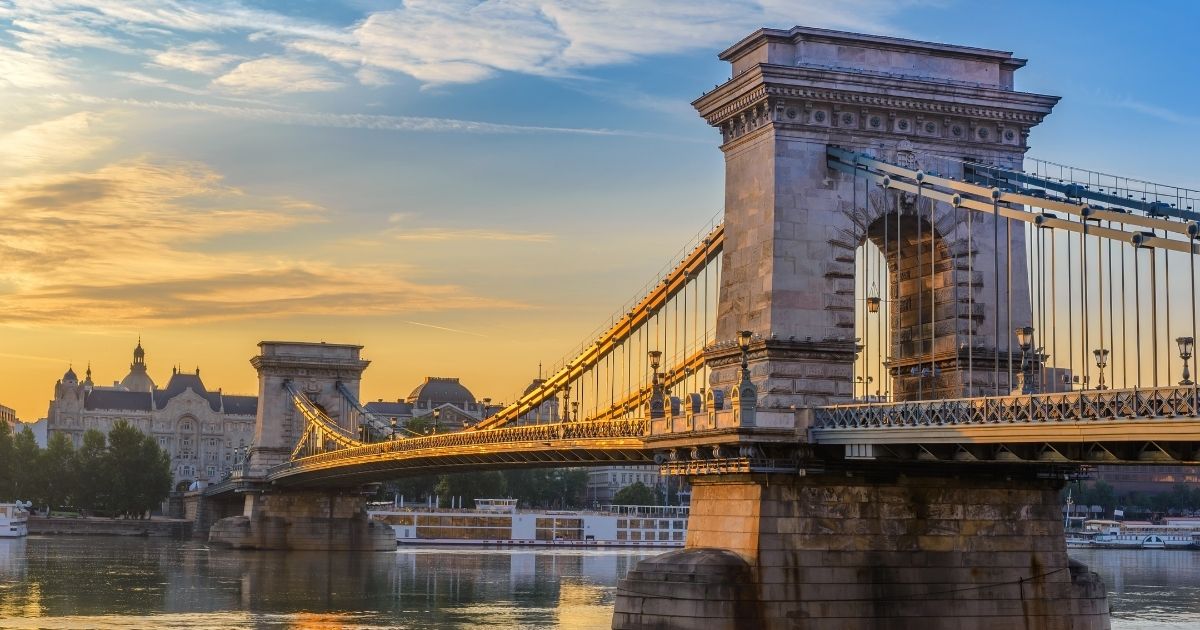
6. Chain Bridge (Széchenyi lánchíd)
Budapest’s oldest and most famous bridge, with its lions at either end, links Buda and Pest, and walking across it is practically compulsory. It is free, and floodlit in the evening it looks enchanting. At the Buda end you will find the “kilometre zero” marker and the Sikló funicular station.What to see in Budapest
7. St Stephen’s Basilica (Szent István-bazilika)
The largest church in the city, home to the mummified right hand of St Stephen, Hungary’s first king. Entry to the nave is by a voluntary donation of around 2,600 HUF (≈ £5.50), but the main draw is the view from the dome (around 3,200 HUF / ≈ £7) — the 360° panorama over the rooftops of Pest is well worth the climb, whether by lift or on foot.
8. Andrássy Avenue and the State Opera
The grand boulevard Andrássy út (also UNESCO-listed) is lined with palaces, cafés and designer shops, running from the centre all the way to Heroes’ Square. Along the way you will pass the Hungarian State Opera, one of the most beautiful in Europe (you can buy tickets for a tour or a performance). Beneath the avenue runs the oldest metro on the continent, the yellow M1 line, dating from 1896.
9. Heroes’ Square (Hősök tere)
A monumental square at the end of Andrássy Avenue, with a colonnade of statues of Hungarian leaders and a column topped by the Archangel Gabriel. It is freely accessible, and flanked by the Museum of Fine Arts and the Műcsarnok exhibition hall. The city park begins right behind the square.
10. Vajdahunyad Castle and City Park (Városliget)
In City Park (Városliget) you will find the romantic “castle” of Vajdahunyad — a mash-up of architectural styles from across Hungary, originally built as a backdrop for an exhibition. The park is free, with a lake (an ice rink in winter), a zoo and, right next door, the Széchenyi Baths. The ideal breather between sights.
11. Széchenyi Thermal Baths
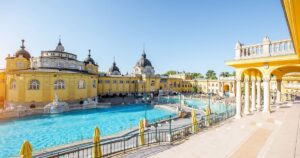
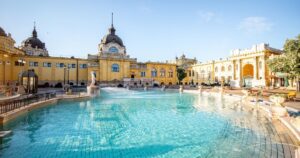
These yellow neo-Baroque baths in the city park are the largest medicinal baths in Europe — three outdoor pools and plenty of indoor ones, with water around 38 °C. The outdoor pools, where old-timers play chess in the steam, are an iconic Budapest image. A full-day ticket costs roughly 10,000–15,000 HUF (≈ £21–32) depending on the day of the week, more at weekends. More on the baths below.What to see in Budapest
12. Gellért Hill and the Citadella
Gellért Hill above the Danube offers what we reckon is the finest panoramic view of the whole city — you can see the Parliament, the bridges, the castle and Pest all at once. At the top stand the Citadella and the Liberty Statue. The climb takes 20–30 minutes on foot and is free. On the way you will pass the Cave Church (Sziklatemplom) set into the rock.
💡 Tip: Head up Gellért Hill for sunset — the city gradually lights up and it is the best free experience of the day.
13. Central Market Hall (Nagyvásárcsarnok)
This covered market by the Liberty Bridge is the oldest and largest in Budapest — vegetables, meat, paprika and salami downstairs, with stalls selling street food and lángos on the upper floor. Entry is free; just keep an eye on the prices upstairs (a touch touristy). A great spot for a lunch break and for souvenirs such as paprika and Tokaj wine.
14. The Great Synagogue and the Jewish Quarter
The synagogue on Dohány Street is the largest in Europe and the second largest in the world. Entry is on the pricier side (around 9,000–14,500 HUF / ≈ £19–31) and includes the museum and the Holocaust memorial. Even if you don’t go inside, the Jewish Quarter (Erzsébetváros) itself is the liveliest part of town today — street art, cafés and ruin bars.
15. Shoes on the Danube Bank
A stark, powerful memorial — dozens of iron shoes cast onto the embankment in memory of the Jews shot into the Danube during the war. It is accessible around the clock and free, a short walk from the Parliament. Stop and give it a moment; it is one of the most moving places in the city.
16. Margaret Island (Margit-sziget)
This green island in the middle of the Danube is Budapest’s Central Park — a running track, a musical fountain, a water tower, monastery ruins and the Palatinus lido. Cars are banned, making it the perfect place for a picnic, a stroll or a bike hire. Entry is free, and you get there by tram across Margaret Bridge.
17. Memento Park
An open-air museum of Communist statues on the edge of town, where after 1989 Budapest gathered up its giant monuments to Lenin, Marx and the rest. For fans of 20th-century history it is a one-off — entry around 3,000 HUF (≈ £6.40). It is a fair way out of the centre, so plan for a bus ride or an organised transfer.
18. House of Terror (Terror Háza)
A museum in the former secret-police headquarters on Andrássy Avenue, charting both the Nazi and Communist terror in Hungary. A powerful, emotional experience, entry around 4,000 HUF (≈ £8.50). It pairs well with a walk along Andrássy.
19. Ruin bars (Szimpla Kert and around)
A Budapest phenomenon — bars set in crumbling buildings and courtyards, filled with cast-off furniture, fairy lights and art. The most famous is Szimpla Kert in the Jewish Quarter, quiet and café-like by day, heaving by night. A beer costs around 1,500–2,000 HUF (≈ £3.20–4.30). More on these in the food section.
20. New York Café
Often billed as “the most beautiful café in the world” — gilding, frescoed ceilings and chandeliers like an opera house. Coffee and cake here are not cheap (reckon on over 4,000 HUF / ≈ £8.50 for a coffee with dessert) and there is usually a queue, but the interior is worth seeing at least once.
21. Danube cruise
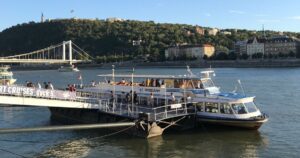
An hour-long sightseeing cruise shows off the Parliament, the castle and the bridges from the water — best of all after dark. Basic cruises start at around 5,000–6,000 HUF (≈ £11–13), with drinks or dinner options costing more. You can easily book cruises and tickets for the Parliament or the baths through GetYourGuide →
22. Aquincum
For lovers of antiquity — the excavations of a Roman town in the north of Budapest, with an amphitheatre and a museum. It is away from the tourist centre and less visited, so it tends to be peaceful. Entry around 2,000 HUF (≈ £4.30).
23. Budapest Eye (observation wheel)
The Ferris wheel on Erzsébet tér in central Pest offers a ride with a view over the rooftops. It is not a must-see, but with children or in the evening it is a nice bit of fun. A ride costs around 3,500 HUF (≈ £7.50).
24. Várkert Bazár and the riverside promenades
The restored gardens and colonnade below Buda Castle by the Danube are a lovely place for a walk — terraces, fountains and river views. Entry to the gardens is free. Together with the Danube promenade on the Pest side (with its Little Princess statue), it makes a pleasant, undemanding way to round off a loop.
25. Hospital in the Rock (Sziklakórház)
A secret hospital and nuclear bunker hidden in the cave tunnels directly beneath Buda Castle. A guided tour leads you among wax figures, period equipment and sets from both the Second World War and the Cold War — a powerful, eye-opening experience. Admission is roughly 9,500 HUF (≈ £20) for an adult, and photography is not allowed inside. Capacity is limited, so buy your ticket online in advance.
26. János Hill, the Elizabeth Lookout and the Libegő chairlift
Budapest’s highest point (527 m), amid the greenery of the Buda Hills, is crowned by the neo-Romanesque Elizabeth Lookout (Erzsébet-kilátó); the climb up its 134 steps is free, and from the top you can see far beyond the city. You get up there on the Libegő chairlift from Zugliget (a return ticket is roughly 3,500 HUF / ≈ £7.50) or on the Children’s Railway (Gyermekvasút), run by children under adult supervision. A brilliant half-day escape into nature, especially with kids.
💡 Tip: Combine the chairlift up with the Children’s Railway back so you get to enjoy both. Railway tickets are paid in cash, in forints.
27. Budapest caves (Pálvölgyi and Szemlő-hegyi)
Beneath Buda lies an extensive cave system, and two of the caves are open to the public: Pálvölgyi with its stalactites and narrow passages, and Szemlő-hegyi with its snow-white formations, nicknamed the “underground flower garden”. You go with a guide, it is around 10 °C inside, so bring a jacket. Entry is roughly 2,500 HUF (≈ £5). An off-the-beaten-track tip away from the main crowds.
Budapest’s thermal baths
Budapest is Europe’s greatest spa city — thermal springs bubble up beneath the streets, and bathing in them here is an institution centuries old. Save the baths for the evening after a demanding day, or for the morning when there are fewer people. Bring your swimwear, a towel and flip-flops (renting on site is expensive), and expect a locker to be included in the price.
Széchenyi — the largest and best-known, a neo-Baroque palace with big outdoor pools. The best choice if you only visit one. Entry roughly 10,000–15,000 HUF (≈ £21–32), more at weekends.
Gellért Baths — an Art Nouveau jewel below Gellért Hill. Note: closed for renovation since autumn 2025, scheduled until 2028 — don’t plan for them.
Rudas — historic Turkish baths from the 16th century with an Ottoman dome and a rooftop hot tub overlooking the Danube. Some days are men- or women-only, so check the schedule.
Lukács — popular with locals, cheaper and calmer than Széchenyi (entry around 7,000 HUF / ≈ £15).
Veli Bej — small, authentic Turkish baths, among the cheapest.
💡 Tip: The famous SPArty nights at Széchenyi (Friday and Saturday evenings) are a great experience, but they are a party with music and drinks, not a classic relaxing soak — for peace and quiet, go during the day.
Food and ruin bars
Hungarian cuisine is hearty and cheaper than back home in restaurants aimed at locals. Try goulash (gulyás — more of a soup), lángos (fried dough with soured cream and cheese), paprika in all its forms, and the dessert kürtőskalács (chimney cake). Lunch in an ordinary restaurant away from the tourist centre costs around 3,500–5,500 HUF (≈ £7.50–12).
Central Market Hall — lángos and Hungarian specialities upstairs, plus ingredients to take home.
Karaván — a courtyard of food trucks in the Jewish Quarter, right next to Szimpla.
Mazel Tov — a stylish Israeli restaurant in a ruin-bar space; book ahead for the evening.
Retró Lángos — a snack bar serving the best lángos in the city.
New York Café — for the interior and the coffee (pricey).
And then the ruin bars — the heart of Budapest’s nightlife in the Jewish Quarter. Szimpla Kert is the most famous (a quiet café by day, packed at night), but Instant-Fogas and the courtyards around Gozsdu Street are excellent too. A beer costs around 1,500–2,000 HUF (≈ £3.20–4.30).
How much it costs (budget)
Budapest is still cheaper than Vienna or central Prague, but admission to the Parliament and the baths can catch you out. A rough daily budget per person (at £1 ≈ 470 HUF):
Item
Roughly / person / day
Accommodation (hostel / guesthouse, per person)
6,000–16,000 HUF (≈ £13–34)
Food (breakfast, lunch, dinner outside the centre)
6,000–10,000 HUF (≈ £13–21)
Transport (72-hour pass ≈ 5,500 HUF over 3 days)
about 1,800 HUF (≈ £4)
Admission (1 baths + 1 sight)
12,000–20,000 HUF (≈ £26–43)
Total (sensible middle)
about 26,000–50,000 HUF (≈ £55–105) / day
You save a lot by leaning on the free spots (Castle Hill, Gellért, the bridges, the Shoes on the Danube Bank, Margaret Island), eating outside the tourist centre and visiting the baths just once. Compare accommodation prices in Budapest →
Prices and ratings are indicative (source GetYourGuide); you’ll see the latest after clicking through.
What to see in Budapest first?
If you are short on time, prioritise the castle hill in Buda (Fisherman’s Bastion, Matthias Church, the views), the Parliament and St Stephen’s Basilica in Pest, and treat yourself to the Széchenyi Baths in the evening. These five are the absolute essentials.How many days should you set aside for Budapest?
Two to three days is ideal — you’ll fit in the sights and a relaxed soak in the baths without rushing. A single day is enough for a quick loop, and for that we have a separate One Day in Budapest itinerary.Which thermal baths in Budapest are the best?
For a first visit, Széchenyi without question — the largest, with big outdoor pools. Lukács is calmer and cheaper, while Rudas and Veli Bej are more authentic Turkish baths. Note: the Gellért Baths are closed for renovation, scheduled until 2028.How much does entry to the Hungarian Parliament cost?
A guided tour costs around 14,300 HUF (≈ £30) for an adult, and roughly 7,530 HUF (≈ £16) for EU/EEA citizens on presentation of ID. Buy tickets online in advance, as they sell out in high season.What can you see in Budapest for free?
Plenty: the courtyards and views of Buda Castle, the Chain Bridge, Gellért Hill and the Citadella, the Shoes on the Danube Bank, the Central Market Hall, Margaret Island, Heroes’ Square and Andrássy Avenue. You can easily fill a whole day with free places alone.What currency is used in Budapest?
The Hungarian forint (HUF), roughly £1 ≈ 470 HUF. Euros are sometimes accepted at tourist spots, but at a poor rate. You can pay by card almost everywhere; change money in town rather than at the station or airport.How do you get to Budapest?
There are direct flights from across the UK and Europe into Ferenc Liszt Airport, and Budapest is well connected by rail — around two and a half hours from Vienna or Bratislava. If you are touring Central Europe by car, it is easy to fold in as one stop on a longer route.Is the Budapest Card worth it?
If you plan to use public transport a lot and visit several paid attractions and baths, the card can pay off. If you mostly want to walk and enjoy the free spots, a plain 72-hour public transport pass will do.What to see in Budapest with kids?
Margaret Island, the baths and water parks (Aquaworld), the zoo in the city park, the Budapest Eye observation wheel, the funicular up to the castle and the historic yellow metro line. Children also love lángos at the market and the musical fountain on the island.Is Budapest expensive?
Not really — accommodation and food outside the tourist centre are cheaper than in Prague or Vienna. Your biggest outlay is admission to the Parliament and the baths. Combine free places with a single trip to the baths and a day works out reasonably.What to see in Budapest at night?
The floodlit Parliament and Chain Bridge from the embankment, an evening cruise on the Danube, the ruin bars in the Jewish Quarter (Szimpla Kert) and sunset from Gellért Hill. Széchenyi hosts SPArty nights at weekends.
Potřebujete pomoct s cestováním?
Ubytování 🏨
Vyberte si to nejlepší ubytování, ať už jste kdekoliv, přes Booking.com.
Půjčení auta 🚗
Auto si snadno najdete přes Booking.com, kde máte často slevu díky ubytování, nebo Rentalcars.com, kde porovnáte nabídky většiny půjčoven.
Zážitky 🎟️
Přes GetYourGuide.com si vyberete z nejrůznějších výletů i zážitků po celém světě, navíc se zrušením zdarma do 24 h předem.
Abychom poskytli co nejlepší služby, používáme k ukládání a/nebo přístupu k informacím o zařízení, technologie jako jsou soubory cookies. Souhlas s těmito technologiemi nám umožní zpracovávat údaje, jako je chování při procházení nebo jedinečná ID na tomto webu. Nesouhlas nebo odvolání souhlasu může nepříznivě ovlivnit určité vlastnosti a funkce.
Funkční
Always active
Technické uložení nebo přístup je nezbytně nutný pro legitimní účel umožnění použití konkrétní služby, kterou si odběratel nebo uživatel výslovně vyžádal, nebo pouze za účelem provedení přenosu sdělení prostřednictvím sítě elektronických komunikací.
Předvolby
Technické uložení nebo přístup je nezbytný pro legitimní účel ukládání preferencí, které nejsou požadovány odběratelem nebo uživatelem.
Statistiky
Technické uložení nebo přístup, který se používá výhradně pro statistické účely.Technické uložení nebo přístup, který se používá výhradně pro anonymní statistické účely. Bez předvolání, dobrovolného plnění ze strany vašeho Poskytovatele internetových služeb nebo dalších záznamů od třetí strany nelze informace, uložené nebo získané pouze pro tento účel, obvykle použít k vaší identifikaci.
Marketing
Technické uložení nebo přístup je nutný k vytvoření uživatelských profilů za účelem zasílání reklamy nebo sledování uživatele na webových stránkách nebo několika webových stránkách pro podobné marketingové účely.