Last updated 5.11.2026
You know that feeling when you step off the train, the coach or the plane, breathe in the smell of a brand-new city, look around and realise you simply have to explore this place? That is exactly how Budapest gets you. The pearl of the Danube, the Paris of the East, a capital of thermal springs and fiery red paprika. We come back again and again, so we’ve gathered our favourite tips on what to see in Budapest in one day, for those times when a single day is all you’ve got.
Budapest in One Day: The Short Version
Before you dive into the detailed planning, here’s a quick overview of the highlights to tick off if you only have one day in Budapest.
Landmarks and history
Among the most rewarding historic sights in Budapest are:
- Buda Castle (UNESCO) – A vast palace complex with views over the whole city.
- Fisherman’s Bastion – White turrets and one of the loveliest views of Parliament.
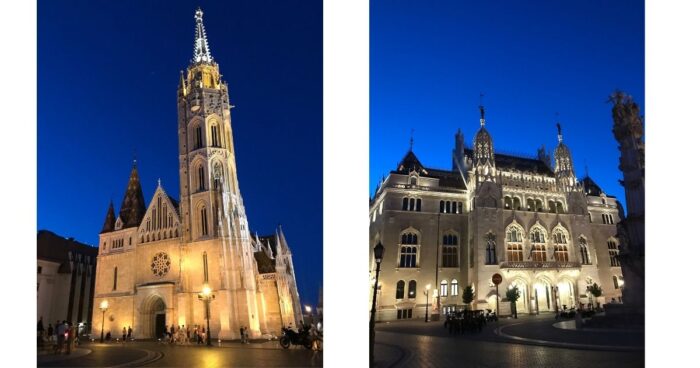
- Matthias Church – A Gothic church with its trademark colourful roof.
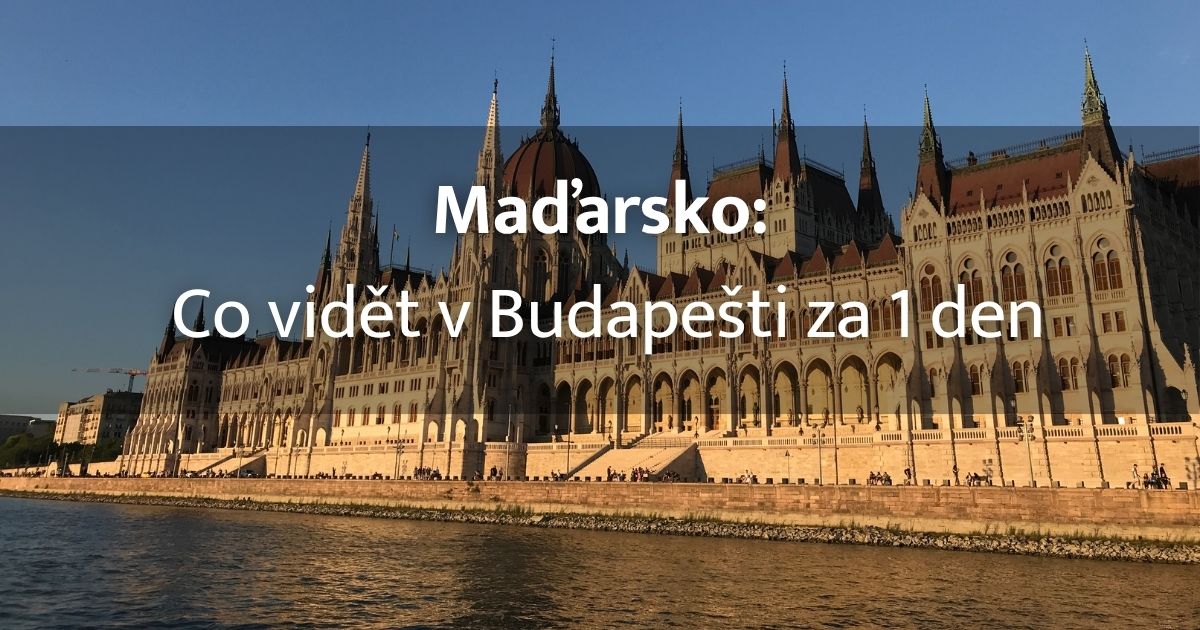
- The Hungarian Parliament – A monumental, richly decorated building on the Danube.
- St Stephen’s Basilica – The largest church in the city, with a view from the dome.
- Heroes’ Square – A grand historic plaza lined with statues of Hungary’s rulers.
Along the Danube
The city’s most famous scenes line the river:
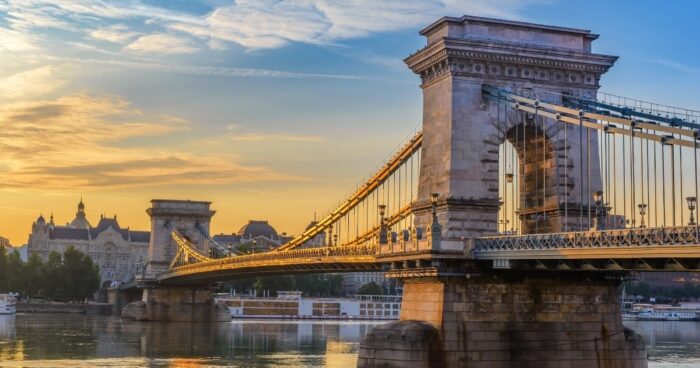
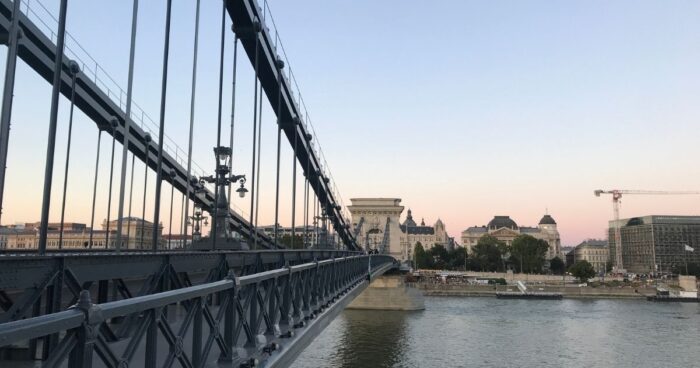
- Chain Bridge – The iconic link between Buda and Pest.
- Shoes on the Danube Bank – A powerful memorial to the victims of the Second World War.
- The Danube promenade – Perfect for a stroll with Parliament in view.
- A Danube cruise – The finest way to see the floodlit city after dark.
Experiences and atmosphere
Beyond the landmarks, it’s well worth soaking up everyday life in the city:
- The M1 metro – A historic line and one of the oldest in the world.
- The Great Market Hall – The place for food, souvenirs and local produce.
- The Jewish Quarter – An area brimming with history, bars and life.
- Szimpla Kert – The most famous ruin bar, with an alternative vibe all its own.
Food and local specialities
What to taste during your visit to Budapest:
- Goulash (gulyás) – A traditional soup with meat and paprika.
- Pörkölt – A thicker meat stew with a bold paprika kick.
- Lángos – Deep-fried dough with cheese and soured cream.
- Tokaji wine – Hungary’s signature wine.
- Rose-shaped ice cream – A beloved sweet treat in the city centre.

Where to Stay in Budapest and the Best Areas
Your best bet is to stay in the centre on the Pest side – ideally around Deák Ferenc tér, the Basilica or towards Parliament (bear in mind it will be pricier here). Everything important is within walking distance. A good alternative is a place to stay near the main railway station, from where you can still walk into the centre, there’s a lovely park close by, and above all you can get absolutely everywhere with ease (Nyugati, Keleti).
TIP: The simplest thing of all is to book your accommodation through Booking and have it sorted and reserved in no time.
Is It Even Possible to See Budapest in a Single Day?
Let’s be honest with each other. Budapest is a huge, sprawling capital. The Danube splits it into two utterly different halves, like two sides of the same coin. On the left bank rises hilly, historic, aristocratic Buda, together with Óbuda; on the right bank spreads flat, buzzing, modern Pest.
Seeing absolutely everything in one day is physically impossible, especially if you fancy half a day soaking in the famous thermal baths or wandering through dozens of museums. But here’s the thing: if you plan the day well and skip the endless back-and-forth across town, you can still take in the biggest and most iconic landmarks. Our one-day itinerary is built so that each stop flows naturally into the next.
TIP: 23 brilliant spots for a seaside break in Europe in April
Budapest in One Day: Our Top Spots
You don’t have to see it all. Chances are you wouldn’t want to anyway. Just pick out what appeals to you most and give it your full attention. If you’ve only got one day in Budapest, perhaps you’re here for a long weekend, or you’re flying off on holiday somewhere the next day. Either way, here are our favourite places to see in Budapest in one day.
TIP: If a particular sight or attraction really grabs you and you want to go inside, we recommend buying your tickets online in advance HERE, so you can skip the queues and plan things nicely.
Early morning and a city waking up in the clouds
It’s early morning. The city is only lazily stirring, café owners are opening up and a light ribbon of mist may still be drifting over the river. This is exactly the moment to be up and about. Why? Because the early bird in Budapest gets far more done than the one who sleeps until noon. We start our day on the Buda side, high above the river, where you’ll find Buda Castle.
TIP: The ultimate holiday packing list: what you need wherever you’re headed
7:30 – Fisherman’s Bastion (Halászbástya)
Close your eyes and picture the fairy-tale castle from the Walt Disney logo. That’s exactly the effect Fisherman’s Bastion has. This is no grim defensive fortress but rather a romantic, ornate, terraced structure from the turn of the 20th century, built in a neo-Romanesque and neo-Gothic style. It has seven snow-white turrets that symbolise the seven original Magyar tribes that settled this basin.
TIP: Entry to the main part of Fisherman’s Bastion is completely free. There’s only a charge (around 1,200 HUF) to go up to the highest upper viewing terraces and turrets. The fee is collected from 9:00 am, so if you arrive around half past seven, you’ll walk straight through the open turnstiles and enjoy those exclusive views for nothing.
8:30 – Matthias Church: a Gothic gem with dragon-scale tiles on its roof
Right beside Fisherman’s Bastion, the Church of the Assumption rises majestically, known to everyone locally simply as Matthias Church (Mátyás-templom). Together with the Bastion it makes such a perfect photogenic pairing your jaw will drop. What hits you first about this Gothic building? The roof! It’s covered in colourful glazed ceramic tiles from the famous Zsolnay workshop, which glint in the sun like giant dragon scales.
This church has witnessed the coronations of Hungary’s great kings. If you have time, you can pay the entry fee (around 3,100 HUF for the church, plus an extra charge to climb the tower) and take a peek inside.
TIP: Ksamil, Albania: are these really the Maldives of Europe?
9:30 – Buda Castle
A comfortable ten-minute walk across Castle Hill brings you to the crowning landmark of Buda – Buda Castle (Budavári Palota), also known as the Royal Palace. It sprawls across the hill as majestically as a lion watching over its territory. Today this stunning UNESCO-listed palace complex houses the Hungarian National Gallery and the Budapest History Museum.
- Access to the grounds: Even if you don’t go into the museum interiors, the castle grounds are freely accessible and completely free.
- Don’t miss: Stop by the beautiful Matthias Fountain, be wowed by the Habsburg Gate and the statue of the mythical Turul bird.
- Changing of the guard: In front of the Presidential Palace (Sándor Palace), don’t miss the changing of the castle guard, which takes place on the hour, every hour.
Late morning: down to Pest and a chilling reminder of history
Time to leave the royal hilltop and head down to the river. You can ride down on the historic funicular (the Budavári Sikló, dating from 1870), or – if you’d rather save the money and enjoy the greenery – walk down through the pretty landscaped gardens of the Várkert Bazár. They’re full of benches and make a perfect oasis of calm.
11:00 – Chain Bridge and the stone lions guarding the blue Danube
We’re standing on the bank, and before us is the Chain Bridge (Széchenyi Lánchíd). The first permanent link between Buda and Pest, built in 1849 thanks to Count Széchenyi. This bridge acts like a giant stone zip that joined two towns into one mighty city. At its entrance, two enormous lion statues greet you. (Legend has it the sculptor forgot to carve the lions’ tongues and, mocked for it, threw himself into the Danube. The truth is the lions do have tongues – you just can’t see them from below.)
TIP: Pico del Teide on Tenerife: entry, permits and practical tips to make the most of it
11:30 – A walk to the legendary Parliament
Once you’ve crossed to the Pest side, turn left and follow the embankment towards Parliament. Along the way you’ll come across a memorial that is sure to hit you deep in the heart. Shoes on the Danube Bank (Cipők a Duna-parton). It looks unassuming – 60 pairs of iron shoes scattered at the edge of the embankment. Men’s brogues, elegant ladies’ court shoes and tiny children’s shoes.
This memorial recalls the atrocities of the fascist Hungarian Arrow Cross Party, which in the winter of 1944–1945 forced Budapest’s Jews to take off their shoes, stand at the river’s edge and then shot them without mercy, letting the strong Danube current carry the bodies away.
Midday and afternoon: monumental sights and an explosion of flavour
Don’t worry, our route is nowhere near finished, so there’s still plenty to see in Budapest in one day.
12:00 – The Hungarian Parliament
When it comes to the very best of what to see in Budapest in one day, you simply cannot leave out the Hungarian Parliament building (Országház). It’s the third-largest parliament building in the world. Its neo-Gothic architecture, topped with a neo-Renaissance dome, looks like a gigantic lace pattern carved from stone. The building is 268 metres long, has 691 rooms and 29 staircases, and its interior decoration swallowed up more than 40 kilograms of real gold!
Here’s a fun fact: the central dome is exactly 96 metres tall. That nods to the year 896, when the Magyars arrived in their present homeland. A city ordinance even forbids putting up any building in Budapest taller than those 96 metres. A tour of the interior takes about 45 minutes, but you’ll struggle to find time for it in a single day, and besides, tickets (around 6,000 HUF for EU citizens) tend to be hopelessly sold out. At the very least, walk around this monumental building from the outside!
TIP: The Hungarian Parliament really is worth a proper tour. We recommend buying your tickets online HERE, so you have a reservation in advance and don’t have to wait.

Lunchtime: where to taste proper Hungarian pörkölt and lángos?
Feet aching and stomach rumbling? Welcome to culinary heaven! Hungarian cooking doesn’t do compromises. It’s honest, hearty fare made with lard, meat and tonnes of paprika. The national dishes here are pörkölt and the classic beef goulash (gulyás), which in Hungary is more of a rich, filling soup.
- For the classics: If you want proper pörkölt with live music, head to Hungarikum Bisztró near Parliament (booking essential).
- Street-food king: Love a quick bite on the go? Make for Retró Lángos. Their lángos is crisp on the outside, fluffy inside and generously loaded with cheese and soured cream.
- A sweet finish: Stop off at Gelarto Rosa for their legendary ice cream, scooped with spatulas into the shape of a beautifully blooming rose.
14:00 – St Stephen’s Basilica
With a full stomach, we make our way to St Stephen’s Basilica (Szent István Bazilika), which shares that maximum height of 96 metres with Parliament and is the largest Roman Catholic church in the country. Inside lies a sacred relic – the Holy Right Hand, the mummified hand of the first king, St Stephen.
If you’ve still got the energy, buy a ticket (around 4,300 HUF for the viewpoint, or 6,000 HUF for a combined ticket) and climb the 364 steps (or take the lift) up to the panoramic rooftop terrace around the dome. The view over central Pest from up here is breathtaking.
TIP: The Polish Beskids and 12 beautiful spots for a day out
15:30 – The historic M1 metro and iconic Heroes’ Square
What’s the quickest way to move on? Try a ride in a time machine! Hop on the yellow M1 metro line beneath Andrássy Avenue. It’s the second-oldest underground railway in the world, from 1896 (UNESCO-listed). The little, noisy, historic carriages and the stations trimmed with ceramic tiles have an incredible charm.
The metro will carry you to Heroes’ Square (Hősök tere). This monumental plaza is dominated by the Millennium Monument, with its 36-metre column topped by the Archangel Gabriel. Around it, in a semicircular colonnade, you’ll find statues of important Hungarian kings and national heroes. You feel tiny here, with history breathing on you from every side.
Late afternoon and evening: the Jewish Quarter, the market hall and a cruise under the stars
16:30 – The Great Market Hall (Nagy Vásárcsarnok): a feast for all the senses
Take a historic tram to Liberty Bridge (Szabadság híd), beside which stands a huge brick building with a magnificent roof. This is the Great Market Hall, from 1896. The moment you step inside, a heady aroma hits you. Mountains of red dried paprika, endless stalls of famous sausages and csabai, Tokaji wine and fresh fruit. This is where you’ll find the best and most meaningful souvenirs.
Note: the market hall is closed on Sundays and shuts at 6:00 pm on weekdays (and already at 3:00 pm on Saturdays), so make sure you arrive in good time!
17:30 – The Great Synagogue and the one-of-a-kind magic of the ruin bars (Szimpla Kert)
From the market hall, move on to the nearby historic Jewish Quarter. The Great Synagogue (Dohány Street Synagogue), in Moorish-Spanish style, seats 3,000 people and is the largest in Europe and the second-largest in the world! And once dusk falls, dive into the nightlife. Budapest is famous for its “ruin bars” (romkocsma). Picture half-derelict old tenement houses transformed into alternative bars full of antique furniture, graffiti and greenery as far as the eye can see. By day they’re a lovely place to sit; by night the party gets going.
TIP: We’d suggest coming around 7 pm, because later on you may not get in so easily.
The most legendary of all is the pioneering Szimpla Kert. Sitting in a cut-open old Trabant with a beer in hand while fairy lights twinkle overhead is an absolute must. Right next door you’ll find the Street Food Karavan, where you can grab a burger or yet another lángos to go.
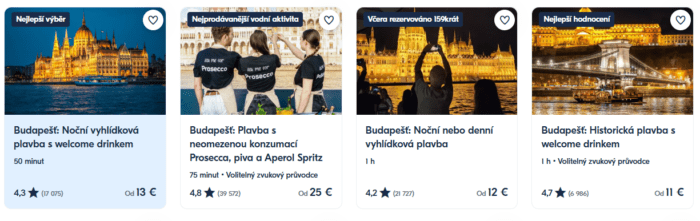
20:00 – An evening Danube cruise: the golden finale
If you haven’t collapsed over a beer at the bar, a wonderful way to round off the day is an evening cruise on the Danube. Book (ideally ahead) an hour-long evening boat cruise along the Danube. Once darkness falls, the whole city lights up in golden floodlight. You’ll see Buda Castle, Parliament and the Chain Bridge glittering like enormous jewels reflected in the surface of the river. With a welcome drink in hand, you’ll realise this day was absolutely perfect.
PS: You can cruise during the day too, even on a Prosecco boat – although after that you probably won’t be in any state to carry on exploring the city, because all-you-can-drink boats are a bit of a trap 😀
What to See in Budapest If You Stay Longer (a 2, 3 and More-Day Itinerary)
Budapest offers so many temptations you could spend a month here and never be bored. What to see in Budapest in 2 days and in 3 days? If your trip lasts several days, don’t limit yourself to the best-known landmarks – dive far deeper into the city. Here’s an in-depth guide to the finest places and activities you won’t have time for in a one-day itinerary.
Panoramic views, parks and nature
Do you love nature more than buildings and the city centre?
Gellért Hill, the Citadella and the mysterious Cave Church
It rises 235 metres straight above the river. At its summit you’ll find a mighty military fortress called the Citadella and the iconic 14-metre Liberty Statue. The climb up takes 20–30 minutes, but the bird’s-eye view over the whole city is worth every drop of sweat. On the way down, don’t miss the Cave Church. Most of this fascinating, still-functioning church is carved deep into the rock, and entry is just around 1,200 HUF.
TIP: Are there venomous snakes on Mallorca, and what should you watch out for?
Margaret Island and adventures on János-hegy
Margaret Island (Margit-sziget) is an oasis of calm in the middle of the Danube. No cars allowed. It’s the perfect place to hire a bike. Here you’ll find the ruins of a Dominican convent, a gorgeous Japanese garden, a small zoo, a water tower (UNESCO-listed) and the famous Musical Fountain, which after dark puts on a spectacular music and light show.
If you want to go higher still, head for János-hegy (János Hill) in the Buda Hills. You can get there on the unique Children’s Railway (staffed by real children) and then ride the chairlift (Libegő). Right at the top stands the stone Elizabeth Lookout Tower.
Thermal baths: where to find both relaxation and a wild night-time party
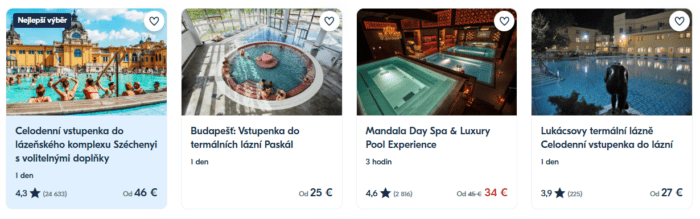
The nickname “the Spa Capital of Europe” is no exaggeration for Budapest. It sits on 125 natural thermal springs, so there’s no shortage of thermal pools and wellness here. Forget swimming only in summer – sitting in hot, healing water while snow falls on your head is the greatest bliss of all!
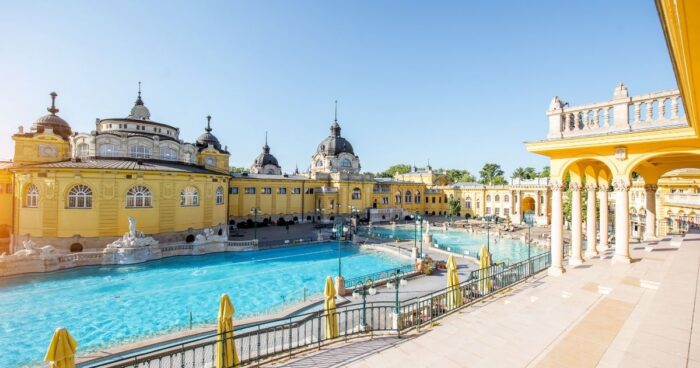
- Széchenyi Baths (Széchenyi fürdő): The largest and most famous. A huge yellow neo-Baroque palace in the City Park. Every Saturday night the legendary Sparties (Spa Parties) take place here – massive parties with electronic music, lasers and drinks right in the thermal water!
- Gellért Baths: If you’re after Art Nouveau luxury, this is the place. The interiors, with their colourful mosaics and columns, feel like a palace.
- Rudas Baths: Authentic Turkish baths from the 16th century, complete with a giant stone dome. The biggest hit here is the modern rooftop hot tub, looking straight out over the Danube.
- What to bring: Don’t forget your own towel and flip-flops (you’ll save on the hire fee), and remember that a swimming cap is compulsory in the (cooler) lap pools.
Architecture, museums and shopping with soul
Do you love art, architecture and museums?
Andrássy Avenue, the Opera, museums and a vintage paradise
The famous Andrássy Avenue (Andrássy út) is a long, elegant boulevard connecting the centre with the City Park. Walk its length and stop at the sumptuous neo-Renaissance Hungarian State Opera. On the same street sits the chilling House of Terror (Terror Háza) museum, which explores Hungary’s harrowing history under Nazi and Communist dictatorship. If fashion is more your thing, explore the second-hand and vintage shops! Hits like Szputnyik Shop, LoveBug Vintage and Antifactory offer incredible designer finds at a fraction of the price.
Vajdahunyad Castle, the City Park and Aquaworld
Beyond Heroes’ Square begins the vast Városliget park. Beside its lake (which in winter turns into the most romantic giant public ice rink) lies Vajdahunyad Castle. This structure was originally built from paper and wood for the millennium celebrations and combines as many as 25 different Hungarian architectural styles. Today it stands in stone. Travelling with children? Not far from the centre is Aquaworld Budapest, one of the largest indoor water parks in Central Europe.
TIP: Lanzarote: what to see + the 20 most beautiful spots on the island
Off-the-beaten-track experiences: a SUP tour on the Danube and underground caves
Try a SUP tour (stand-up paddleboarding) right on the surface of the Danube. Gliding in from the edge of the city with that iconic view of Parliament from your board is an experience no printed guidebook can give you. Love a bit of mystery? Budapest sits on a massive fault system. Set out to explore the Pálvölgyi stalactite cave system or the Szemlőhegyi cave, where you’ll breathe the cleanest air in the city.
TIP: 36 places to see in Poland, and not just by the sea
Frequently Asked Questions (FAQ)
Do I need cash in Budapest, or is a card enough everywhere?
Although these days you can pay by card almost everywhere in Hungary (in restaurants, museums, for public transport tickets), we recommend always carrying a small amount of Hungarian forints (HUF) in cash. It comes in handy at markets, at street-food stalls (for a chimney cake, say), as a deposit for towel hire at the baths, or for tipping. Paying in euros usually isn’t worth it because of the poor exchange rates traders offer.
What’s the fastest and cheapest way to get from the airport into the city centre?
The ideal option from Ferenc Liszt Airport is the 100E airport express bus. It runs straight to the central Deák Ferenc tér square, takes about 40 minutes and requires a special airport ticket (around 2,200 HUF). If you want to save money and have time, take the 200E bus, which drops you at the terminus of the blue M3 metro line (Kőbánya-Kispest), and from there you continue by metro into the centre. For that you only need an ordinary transfer ticket.
Is it safe to walk around Budapest at night?
Yes, Budapest is one of the very safe European capitals. Getting around the tourist centre, along the embankment and in the lively Jewish Quarter is trouble-free even late into the night, because the streets are full of people. As in any big city, though, keep an eye out for pickpockets in crowded spots, tourist traps and on late-night public transport.
Which thermal baths should I choose if I only have time for one?
It depends on what you’re after. For the classic photogenic experience, plenty of space and outdoor pools (where people even play chess), choose the neo-Baroque Széchenyi. If you long for Art Nouveau splendour, colour and elegance, head for the Gellért Baths (but check whether they’re currently under renovation). And if you want a rooftop hot tub looking out over the Danube and an authentic Turkish feel, go for Rudas.
Do I have to buy tickets to the sights online in advance?
For a short stay of one or two days it’s an absolute must. Tickets to the Hungarian Parliament and for the evening Danube cruise are often sold out well ahead of time. If you wait on the spot, you’ll lose precious hours in queues, or you may not get in at all. It’s much the same for the dome of St Stephen’s Basilica or the popular Sparties.
What is a Sparty, and who is it for?
A Sparty (Spa Party) is a globally unique event held at the Széchenyi Baths (usually on a Saturday night). It’s a massive party with DJs, electronic dance music, lasers and plenty of alcohol, all in a huge outdoor thermal pool. It’s aimed mainly at adults looking for wild nightlife rather than a classic relaxing soak. Tickets should be bought well in advance.
Where will I take the most beautiful photo in Budapest?
There are loads of spots! The most classic is the view from Fisherman’s Bastion straight across to Parliament early in the morning at sunrise. You’ll get gorgeous photos from the top of Gellért Hill at sunset, in the evening straight from a cruise boat looking at the floodlit landmarks, or with a colourful rose-shaped ice cream cone from Gelarto Rosa in front of the Basilica.
What should I absolutely taste from Hungarian cuisine?
On your trip you must try hearty beef gulyás (served as a rich soup), traditional pörkölt (meat braised in paprika and served with little dumplings), and halászlé (a traditional spicy fish soup). For fast food, go for fluffy fried lángos with garlic and cheese, and for a sweet finish track down a good old kürtőskalács (the forerunner of the Czech chimney cake).
Is the tourist Budapest Card worth buying?
It depends on how packed your programme is. The Budapest Card gives you free public transport, entry to selected museums and free entry to the Lukács Baths. If you know you’ll spend the day mostly walking around the city and admiring the landmarks from the outside, it probably won’t pay for itself. An ordinary 24-hour or 72-hour public-transport ticket will do you just fine.
What’s getting around the city itself like — is it hard to find your way?
Budapest has a fantastically well-developed and easy-to-follow public transport network. The “BKK FUTÁR” app (or Google Maps) works perfectly. The metro has four lines (including the historic yellow M1), and there’s an extensive network of trams and trolleybuses. Pest itself is perfectly flat, ideal for hiring shared bikes. Just bear in mind that over in Buda you’ll work up a proper sweat on the climbs up the hills.
Potřebujete pomoct s cestováním?
-
Ubytování 🏨
Vyberte si to nejlepší ubytování, ať už jste kdekoliv, přes Booking.com. -
Půjčení auta 🚗
Auto si snadno najdete přes Booking.com, kde máte často slevu díky ubytování, nebo Rentalcars.com, kde porovnáte nabídky většiny půjčoven. -
Zážitky 🎟️
Přes GetYourGuide.com si vyberete z nejrůznějších výletů i zážitků po celém světě, navíc se zrušením zdarma do 24 h předem.