Last updated 10.11.2026
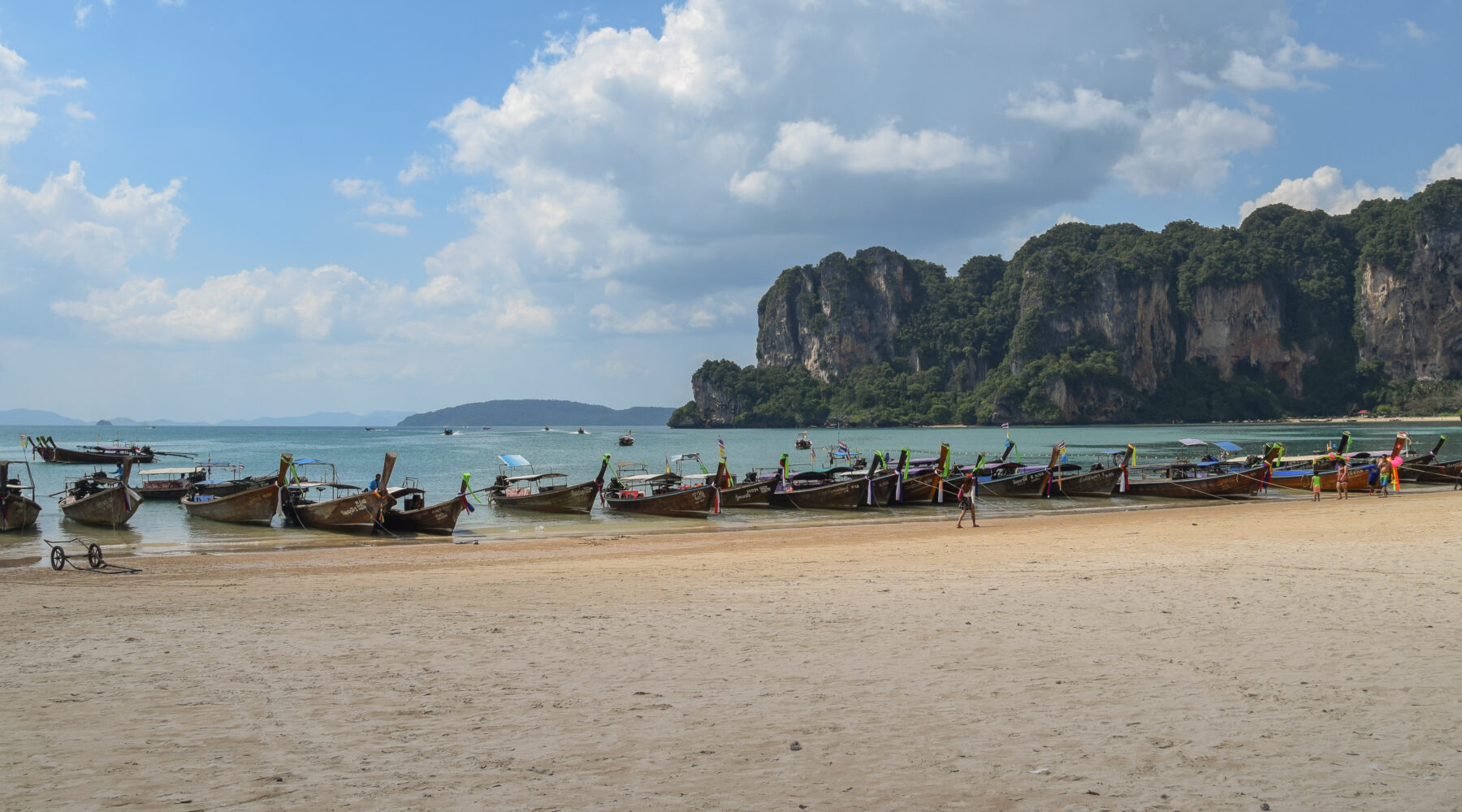
Picture limestone towers wrapped in jungle, rising straight out of the sea and out of the rice paddies. That is Krabi, a province in southern Thailand where some beaches can only be reached by boat, and where the interior hides emerald pools, hot springs and a hilltop temple at the top of more than twelve hundred steps. Most people who look up things to do in Krabi picture Ao Nang and a boat to Railay. That is the right place to start, but it is only a corner of the map. Krabi takes in more than a hundred islands, Phi Phi and Ko Lanta among them, and the province covers over 4,700 km², roughly three times the size of Greater London.
We have put together 21 places we think are worth your time, plus everything practical around them: getting in from the airport or from Phuket, what the boats and national park fees cost, when to go and where to sleep. Some of these will take two days, others an afternoon. There are deliberately more than you can fit into a week, so you can pick what suits you.
Things to do in Krabi at a glance
- Krabi is both a province and a town. Most visitors stay in the resort of Ao Nang, on the Railay peninsula or in Krabi Town itself. The quieter resorts line the beaches of Klong Muang and Tubkaek.
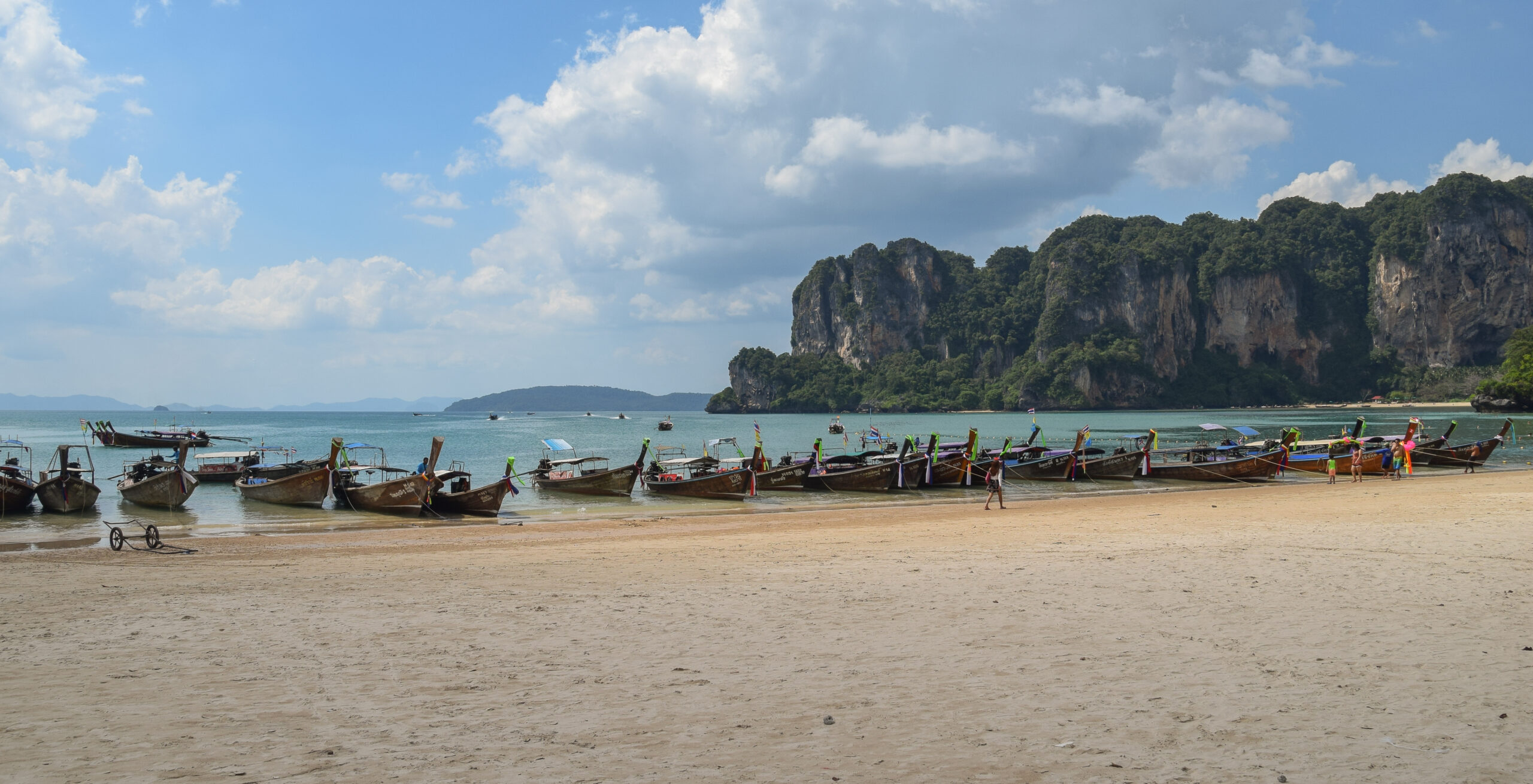
- You can only reach Railay by water. A shared long-tail boat from Ao Nang beach costs 100 THB (about £2) per seat one way and leaves once it is full. After 6 pm only private boats run.
- National park fees are paid in cash on the spot: Four Islands and Phi Phi 400 THB (about £9), Hong Islands 300 THB (about £7), Emerald Pool 400 THB, Khlong Thom hot springs 100 THB. Organised tours often leave them out of the price.
- Tiger Cave Temple has 1,237 steps according to TAT, leading up to a large Buddha on the summit. Go early in the morning, take water and cover your shoulders and knees.
- The main season runs from November to April. From May to October the Andaman Sea has its rainy season, the water is often rough and some boat routes stop.
- Krabi Airport (KBV) is about 9 km from Krabi Town. From the UK you will need at least one change, usually in Bangkok (a 90-minute domestic flight) or at a hub in the Gulf or Istanbul.
- Ferries and speedboats run from Krabi to Phi Phi and Ko Lanta, and Phuket is roughly three hours away by road.
- Smoking and dropping cigarette ends on the beaches is banned, with fines of up to 100,000 THB. Vapes and e-cigarettes are illegal everywhere in Thailand (GOV.UK).
Krabi, Thailand: how the province fits together
Krabi sits on the Andaman coast, facing Phuket across Phang Nga Bay. For a traveller it breaks down into five areas, and which one you pick decides what your holiday will feel like.
Ao Nang is the biggest resort, around 20 km west of Krabi Town. It has the most hotels, restaurants, bars and tour desks and, above all, the boats that leave for Railay and the islands. The beach itself works more like a car park for long-tails than a place to swim, but as a base it is hard to beat.
Railay is a peninsula south of Ao Nang, cut off from the mainland by limestone cliffs. With no road there are no cars, and boats are the only way in or out. It has four beaches: Railay West, Railay East, Phra Nang and Tonsai.
Krabi Town is the provincial capital at the mouth of the Krabi River. It has no beach, but it does have a weekend night market, the Chao Fah pier and the cheapest rooms in the province. It is the closest base for Tiger Cave Temple, and ferries to Phi Phi and Ko Lanta leave from Klong Jilad pier just outside town.
Klong Muang and Tubkaek are two long beaches north of Ao Nang lined with large resorts. You get peace, island views and very little else.
The islands: Phi Phi, Ko Lanta, Ko Jum, the Hong group and dozens of smaller ones. Most can be visited on a day trip, and on Phi Phi and Ko Lanta you can also stay.
If you want bars and an evening stroll along the seafront, Ao Nang will suit you. If you want to step out of your bungalow straight under the cliffs, head for Railay. What works best for us is a mix: a few nights on Railay for the mornings and evenings without the day-trippers, and the rest in Ao Nang for the boats and the food.
How to get to Krabi from the UK
Since 15 September 2026, according to the UK Foreign Office, British passport holders entering Thailand without a visa can stay for up to 30 days as tourists. Every foreign visitor also has to fill in the online Thailand Digital Arrival Card (TDAC), no earlier than three days before arrival. Entry rules have changed several times in recent years, so check the current position on GOV.UK and on the official Thai e-Visa site before you book. If you hold a different passport, your own government’s travel advice applies.
By air. There is no non-stop flight from the UK to Krabi, so plan on at least one change. The most common route is a long-haul flight from London or Manchester to Bangkok and then a domestic hop to Krabi Airport (KBV), which takes around an hour and a half. Domestic flights leave from both Bangkok airports, Suvarnabhumi (BKK) and Don Mueang (DMK). The other option is to change in the Gulf, Istanbul or another Southeast Asian hub and fly straight on to Krabi. Door to door, a journey with one change typically takes 13 to 16 hours.
From the airport. Krabi Airport is about 9 km from Krabi Town and around 30 km from Ao Nang. A shared shuttle bus leaves from the arrivals hall and drops passengers off at hotels around Ao Nang. Operators quote 150 THB per person (about £3); it sets off once it fills up and then does the hotel rounds, so allow about an hour. A taxi booked at the airport counter costs around 600 THB per car to Ao Nang (about £13) according to travel guides, and Grab works too. For Railay, take a car to Ao Nang or to Ao Nam Mao pier and continue by boat.
From Phuket. The road journey through Phang Nga province takes about three hours, and every travel agent sells minibus seats. In season there are also boats from Phuket to Ao Nang and Railay via the Ko Yao islands, but timetables and prices change with the season, so confirm them with the operator. Phuket has more flights and more deals, which is why plenty of people fly in there and carry on to Krabi. Our guide to Phuket covers the island in detail.
From Phi Phi and Ko Lanta. Ferries and speedboats dock at Klong Jilad pier near Krabi Town, and some also call at Ao Nang or Railay. From Phi Phi it is roughly 90 minutes to two hours by ferry. Minibuses run to Ko Lanta all year, with two short ferry crossings on the way, and the trip takes about two and a half hours. For more on the islands, see our guide to Ko Phi Phi.
Getting around Krabi
Long-tail boats are Krabi’s public transport. These wooden boats, with the propeller on a long shaft behind the engine, run from Ao Nang beach to Railay and Tonsai, to the Four Islands and to the Hong group. Tickets are sold at the boatmen’s cooperative booths at the southern end of Ao Nang beach, where the price list is posted. A shared boat to Railay West costs 100 THB per seat one way (about £2). The ride takes about 15 minutes and the boat leaves when around eight people have turned up. They run from morning until about 6 pm; after that it is private boats only, at a higher price. Boats to Railay East leave from Chao Fah pier in Krabi Town or from Ao Nam Mao pier. Long-tails land directly on the beach, so you wade in and out. Bag above your head, shoes in your hand.
Songthaews are pick-up trucks with benches in the back. They shuttle between Krabi Town, Ao Nang and Nopparat Thara, and you flag them down by waving. Agree the fare before you get in.
Grab and Bolt both work in Ao Nang and Krabi Town and are the easiest way to reach Tiger Cave Temple or the airport. Emerald Pool and the hot springs are more than an hour’s drive away, though, and finding a car back from there is hard, so a tour with transport or a driver for the day makes more sense.
Scooters are what almost everyone rents in Krabi, and outside Ao Nang the roads are fairly quiet. The UK Foreign Office warns that many travel insurance policies will not pay out after an accident unless you hold the right UK licence for the vehicle, and you need to carry the 1968 International Driving Permit along with your UK licence. Helmets are compulsory by law. Rental shops in Krabi are also known for demanding compensation for damage you did not cause, so photograph or film the scooter when you pick it up, and never leave your passport as a deposit (GOV.UK warns about this too).
💡 Go to Railay in the morning and come back in good time. The first boats from Ao Nang leave as soon as enough people are waiting on the beach, and between nine and ten Railay is still quiet. Do not leave the return trip until the last minute: after 6 pm you pay for a whole private boat, and at low tide it is a long wade out to the boats.
Best time to visit Krabi
Krabi is on the Andaman side of Thailand, where the weather follows the south-west monsoon. For planning, two seasons are all you need to know.
November to April is the dry season and the high season. The sea is calm, the water clearer and boats run to every island. The busiest and most expensive stretch is December to February: around Christmas and Chinese New Year Ao Nang is full and cheap rooms disappear weeks ahead. March and April are the hottest months, with daytime highs around 33 °C.
May to October is the rainy season. It rarely rains all day, more often in heavy bursts, but the sea is frequently rough, red flags go up on the beaches and some boat trips and services to the smaller islands are cancelled. Accommodation, on the other hand, is much cheaper. Local flooding during the monsoon can also disrupt transport.
Temperatures barely change through the year: 29 to 33 °C by day, 23 to 26 °C at night. What really matters is the rain and the state of the sea. We would go in November or early December, when the rains are over but the crowds have not yet arrived, or in March. It helps to know that the Gulf of Thailand islands (Ko Samui, Ko Pha Ngan) have a different rainy season, which is worth remembering if you are combining both coasts in one trip.
| When | Weather and sea | Best for |
|---|---|---|
| November | End of the rains, the sea settles, everything is green | High season without the crowds |
| December to February | Dry, calm sea, best visibility | Reliable weather, higher prices |
| March and April | Hottest months, calm sea, Songkran festival in April | Climbers in the morning, beach time in the afternoon |
| May to October | Showers, waves, some boats not running | Cheap rooms, the interior and Railay |
Where to stay in Krabi
Choose your base by what you want to do in the evening. In Krabi you can sleep in a hostel for a few pounds a night or in one of the most expensive resorts in Asia.
Ao Nang is the most practical base: boats to Railay and the islands, dozens of restaurants, tour desks and transport for trips inland. Hotels right on the beach cost more, and two or three streets back you will save. Evenings are lively.
Railay is the most beautiful place to sleep, but also the most expensive, and there are no cars. Someone will help carry your luggage off the boat, but expect to wade. Railay West is pricier, Railay East and Tonsai cheaper. After six in the evening the day-trippers leave and the peninsula belongs to the guests.
Krabi Town is the cheapest option and the closest to the airport, Tiger Cave Temple and Klong Jilad pier. The sea is half an hour away, though, so it works best for a first or last night, or for anyone who wants more of everyday Thailand and fewer tourists.
Klong Muang and Tubkaek are for a quiet resort holiday where you spend most of your time between the pool and the beach.
- Rayavadee is a luxury resort of pavilions set in gardens at the tip of the Railay peninsula, between Phra Nang beach and Railay East. It is one of the most expensive places to stay in Krabi, and the guests have Phra Nang almost to themselves in the morning.
- Sand Sea Resort Railay Beach sits right on Railay West. Step off the boat and you are at reception.
- Railay Bay Resort & Spa stretches through a garden from Railay West all the way to Railay East, so you are close to the beach and to the boats from Krabi Town.
- Centara Ao Nang Beach Resort & Spa is a large resort with pools on the hillside above Ao Nang. A good pick for families who want a resort without being cut off from town.
- Aonang Villa Resort is right on the beach in Ao Nang, a short walk from the Railay boats and the restaurants.
- Holiday Inn Express Krabi Ao Nang is a modern mid-range hotel in Ao Nang with predictable quality at a sensible price.
- Dusit Thani Krabi Beach Resort is a resort on Klong Muang beach for anyone who wants peace and a long stretch of sand.
- The Tubkaak Krabi Boutique Resort is a smaller resort on Tubkaek beach looking out to the islands, popular with couples.
- Pak-Up Hostel is a hostel in central Krabi Town with a bar and a tour desk. The cheapest bed on this list, a few minutes’ walk from the night market.
We checked all of these hotels on Booking.com, but prices swing a lot with the season and peak from December to February. For more options, browse places to stay in Ao Nang, on Railay and in Krabi Town.
21 things to do in Krabi, Thailand
We have grouped them by area: Ao Nang and the coast first, then Railay, the islands, Krabi Town and finally the interior. Entry fees come from the official website of the Tourism Authority of Thailand (TAT) and are the rates for foreigners; Thai nationals pay less.
1. Ao Nang beach and seafront
Ao Nang is the hub of tourist Krabi, and it looks the part. The main road along the sea is lined with restaurants, bars, massage shops, pharmacies and travel agents selling trips in every direction. The beach is about a kilometre long, but its middle section doubles as a landing for long-tail boats and the water there is often murky. The southern end, towards the rock, is better for a relaxed swim.
For us, Ao Nang is at its best in the evening, when the sun sets behind the islands directly opposite the beach and the boats come back from their trips. For swimming, though, we would go elsewhere: Railay, Phra Nang or the islands.
2. Monkey Trail and Pai Plong beach
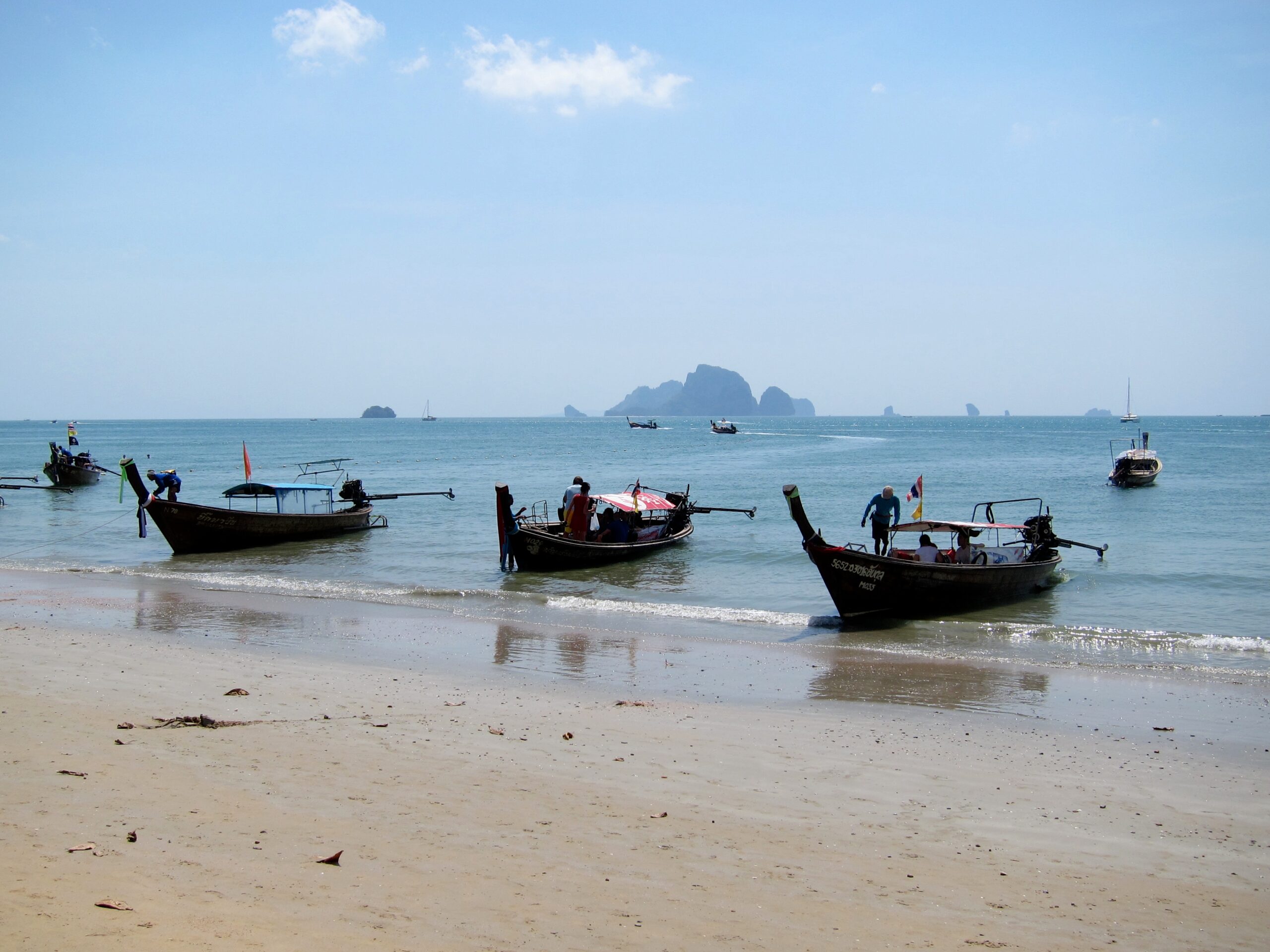
From the southern end of Ao Nang beach, a short path known as the Monkey Trail climbs over the rocks with views of the sea. At the end is Pai Plong bay, otherwise reachable only by boat. It is smaller and calmer than Ao Nang and backed by a single large resort. The monkeys on the trail are not there for decoration: they grab bottles, bags and food, so keep nothing loose in your hands and do not feed them.
3. Nopparat Thara beach
A beach several kilometres long just north of Ao Nang, separated from it only by a road. It belongs to Hat Noppharat Thara–Mu Ko Phi Phi National Park, so there are no big hotels on the sand itself. It is the best place for a walk at dusk, and local families come here for picnics. At the far end is a pier where boats leave for Phi Phi and the islands.
4. Klong Muang and Tubkaek
Two long sandy beaches further north, about half an hour’s drive from Ao Nang. Expect big resorts, views of the islands in Phang Nga Bay and a calm you will not find in Ao Nang. Without a scooter or a taxi, though, you are tied to your hotel. For families with children or honeymooners we think this is the best beach on the Krabi mainland; for anyone who wants to head off somewhere new every day, less so.
5. Railay West
The main beach on the Railay peninsula and where the boat from Ao Nang drops you off. Fine sand, shallow water, limestone walls on both sides and resorts in gardens behind you. Moored boats take up part of the beach, but there is still plenty of room to swim. In the evening, once the last day-trippers have gone, it is one of the finest sunset spots in the whole of Thailand.
Railay East, on the other side of the peninsula, is a five-minute walk away. It is not really a beach: the shore is lined with mangroves and at low tide turns to mud. What it does have is cheaper rooms, bars and a floating pier for the boats from Krabi Town.
6. Phra Nang beach and Princess Cave
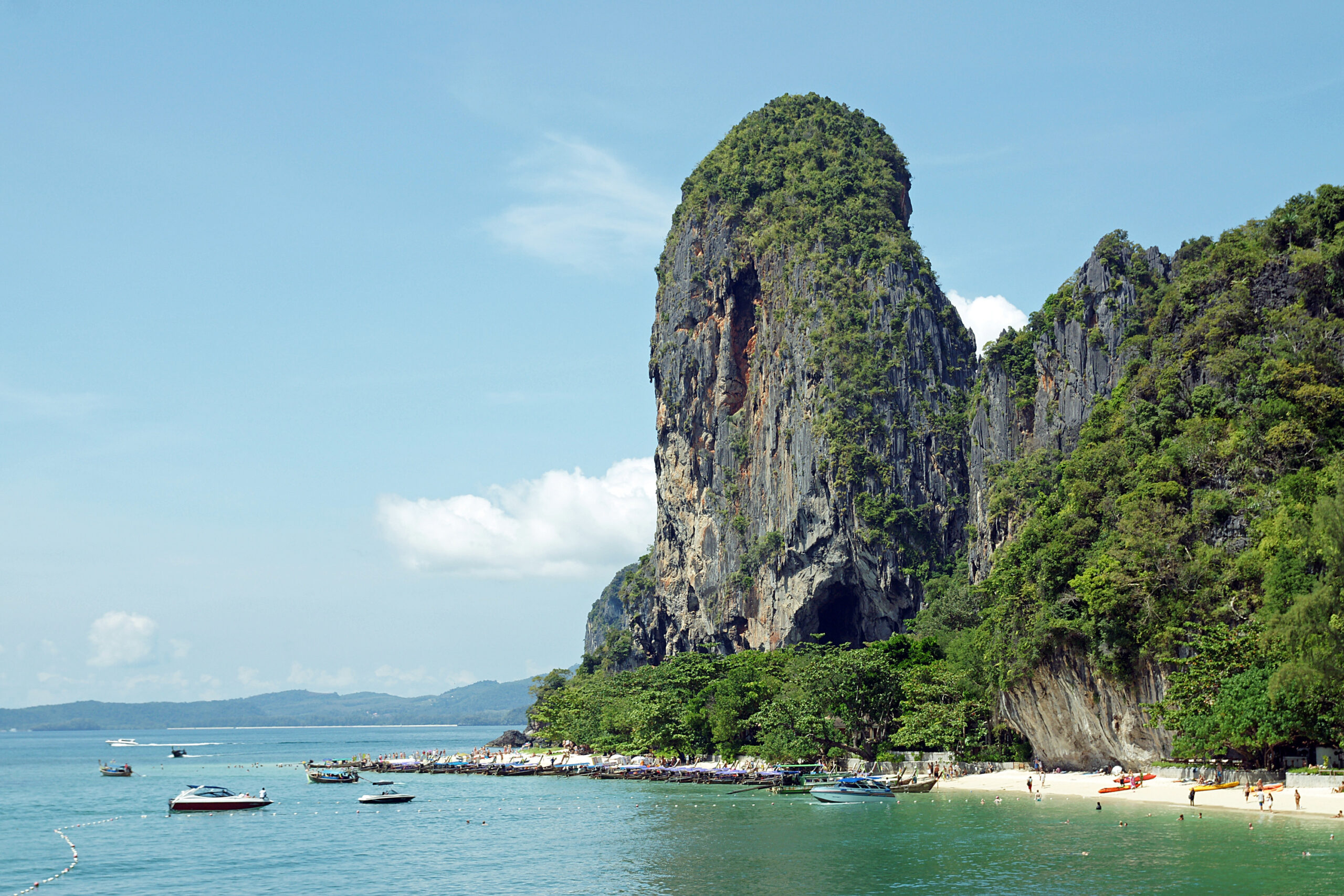
If we could only see one beach in Krabi, it would be this one. From Railay East a path runs under an overhanging cliff and gets you there in ten minutes. The beach is ringed by cliffs hung with stalactites and climbers, and just offshore rises the rocky islet of Happy Island. The water is clearer than at Railay West, and even in high season there is more space at the far end.
At the near end of the beach is Phra Nang Cave, dedicated to a sea princess who, according to legend, protects fishermen. Fishermen bring her offerings, and the cave is full of carved wooden phallic fertility symbols. It looks bizarre, but it is a living sacred site, so treat it with respect.
7. Railay viewpoint and lagoon
Off the path to Phra Nang, a steep trail climbs to a viewpoint above Railay and on to a lagoon enclosed by rock. Calling it a trail is generous: you scramble over red clay, roots and rock steps with fixed ropes, and the descent into the lagoon is close to climbing. The viewpoint is the easier of the two and shows Railay West and East at once. Only go down to the lagoon when it is dry, in proper shoes and if you trust yourself. Most people who try it in flip-flops or after rain turn back halfway.
8. Tonsai and rock climbing on Railay
Tonsai is the beach just past the rocky headland north of Railay West. At low tide you can walk there over the rocks; otherwise you need a boat. It is rougher and cheaper, with bungalows in the jungle and bars for climbers, because Railay and Tonsai are among the best-known climbing areas in Asia. There are hundreds of bolted routes, from easy beginner lines to overhangs above the sea. Climbing schools on Railay and Tonsai run half-day and full-day courses with gear included, so you do not need to bring anything of your own.
Deep water soloing, climbing without a rope above the sea, is also tempting, and you get there by boat. It is a great experience, but only with a local guide and in a calm sea.
9. Four Islands: Ko Poda, Chicken Island, Ko Tup and Phra Nang
The best-selling trip from Ao Nang. A long-tail or speedboat covers four stops in half a day: Ko Poda, with a beach and a view of a rock spire rising out of the water; Chicken Island (Ko Kai), whose rock is shaped like a chicken’s head; Ko Tup, where at low tide you can walk across a sandbar to the next islet; and finally Phra Nang beach. There is snorkelling between the stops.
The islands are part of Hat Noppharat Thara–Mu Ko Phi Phi National Park, and entry costs 400 THB per adult and 200 THB per child (about £9 and £4, TAT). It is paid in cash and is usually not included in cheaper tours, so ask before you buy. You can book the trip through an agent, or hire a whole long-tail with its boatman from the cooperative booth on Ao Nang beach and go at your own pace. For a group of four or more, we think that makes more sense than a big boat with fifty other people.
10. Hong Islands
The Hong archipelago lies in Phang Nga Bay north of Ao Nang, about an hour away by boat. The main island, Ko Hong, hides a lagoon enclosed by rock walls, entered through a narrow channel and best explored by kayak. Around it are white-sand beaches with shallow water and coral reefs for snorkelling. We find Hong prettier and quieter than the Four Islands, and it is worth a full day.
The islands belong to Than Bok Khorani National Park, and entry is 300 THB per adult and 100 THB per child (about £7 and £2, TAT), paid in cash when you land.
11. Ko Phi Phi for a day or a few nights
Thailand’s most famous islands belong to Krabi province, and boats leave for them from Ao Nang, Klong Jilad pier and Railay. On a speedboat day trip you can fit in Maya Bay, Pileh Lagoon, Bamboo Island and some snorkelling, but you will spend most of the day on the boat and in a crowd of other day-trippers. You can also stay overnight on Phi Phi Don, and then the island feels completely different. The rules for Maya Bay, fees, ferries and where to stay are all in our separate guide to Ko Phi Phi.
12. Ko Lanta
Ko Lanta is the province’s other big island and a world away from Phi Phi: long beaches on the west coast, quiet resorts, Lanta Old Town with its wooden houses on stilts, and the south of the island protected as Mu Ko Lanta National Park. It is also home to the Urak Lawoi, one of the groups known as “sea nomads”. Ko Lanta is better as a stay of a few days than as a day trip, and from there boats go snorkelling at the coral islands of Ko Rok and Ko Ha.
13. Ko Jum
A small island between Krabi and Ko Lanta that people with big suitcases tend to skip. It has long, wide beaches, a few dozen bungalows, fishing villages and next to no nightlife. In season, boats between Krabi and Ko Lanta stop here. Our tip for three days when you want to do nothing but read, swim and eat.
14. Krabi Town and the weekend night market
Krabi Town deserves an evening even if you are staying in Ao Nang. It hardly feels touristy at all. The streets have statues of black crabs (which lead people to the wrong idea about where the town’s name comes from, see the history section below), and the riverfront has stops for boats into the mangroves. The main reason to come is the weekend night market (Walking Street), held on Friday, Saturday and Sunday from early evening. There are stalls selling food, clothes and souvenirs, and there is usually something on the stage later in the evening. Another evening food market sets up by Chao Fah pier.
What we like about Krabi Town is exactly that tourists are not the main customers here. Food at the market costs a fraction of Ao Nang prices.
15. Khao Khanap Nam
Two limestone hills about a hundred metres high that stand on either side of the Krabi River and serve as the town’s emblem. A long-tail from Chao Fah pier gets you there in about a quarter of an hour. Inside are caves with stalactites where, legend says, the skeletons of people killed in an ancient flood were found. The trip combines well with a ride through the mangroves.
16. Tiger Cave Temple (Wat Tham Suea)
A temple complex about ten kilometres north-east of Krabi Town, named after the tigers said to have lived in its cave and after a rock shaped like a tiger’s paw print. Most visitors head straight for the staircase up Khao Kaeo hill, where a large golden Buddha sits beside a chedi with a replica of the Buddha’s footprint. According to TAT there are 1,237 steps (some visitors count more), and they are tall and uneven. In the heat the climb takes about an hour.
Your reward is a view in every direction: palm plantations, limestone towers, Krabi Town and, when visibility is good, the sea. According to TAT, from September to January there is a chance of seeing the valley wrapped in morning mist. There is a water tap at the top. On the way you will meet macaques that snatch bottles and bags.
This is a working monastery. Keep your shoulders and knees covered (a scarf in your bag is handy) and take your shoes off in the temple rooms.
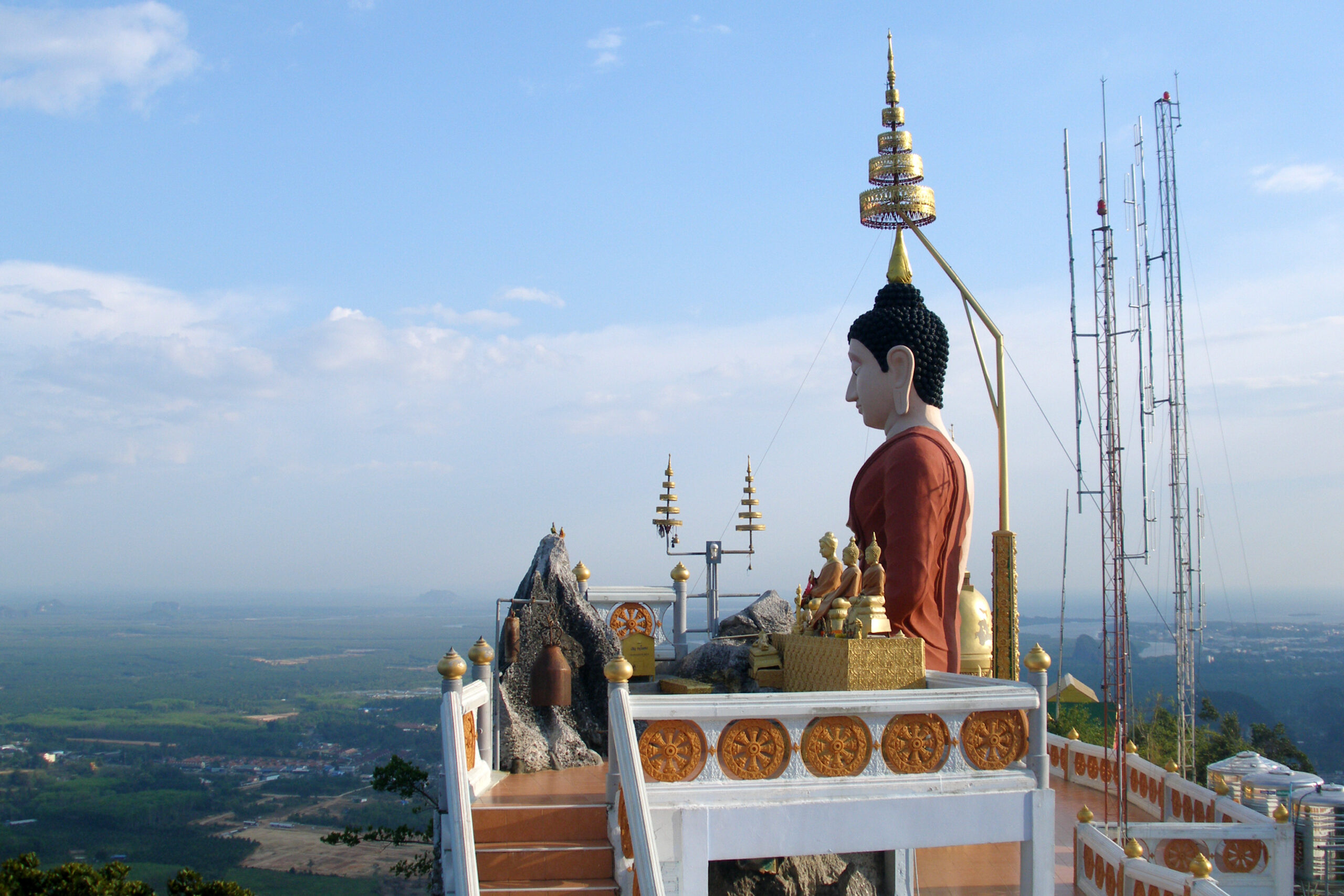
💡 Be at Tiger Cave by seven in the morning. The staircase is in full sun, and after ten the climb turns into a sauna. Early on it is cooler, quieter and the light is better for photos. Take at least a litre of water per person and shoes you can manage tall steps in.
17. Dragon’s Crest (Khao Ngon Nak)
A hike up to a rocky ridge above the coast, not far from Klong Muang beach. The trail climbs through the rainforest of the national park and ends at a rock ledge with views over Ao Nang, Railay and the islands in the bay. It is a proper climb, not a stroll, and in the heat and humidity it is hard work. Allow half a day, set off early and carry plenty of water. We think it gives the best view of the whole Krabi coast, and you will meet a fraction of the people you see at Tiger Cave Temple.
18. Su San Hoi, the Shell Cemetery
On the coast between Ao Nang and Krabi Town, a layer of fossilised shells emerges from the sea like slabs of concrete. Sources disagree on how old it is, with estimates from 40 to 75 million years. It is not much to look at, but anyone who likes geology will appreciate that there are only a handful of places like it in the world. It is a short stop on the way somewhere else, not a destination for a whole day.
19. Emerald Pool and Blue Pool
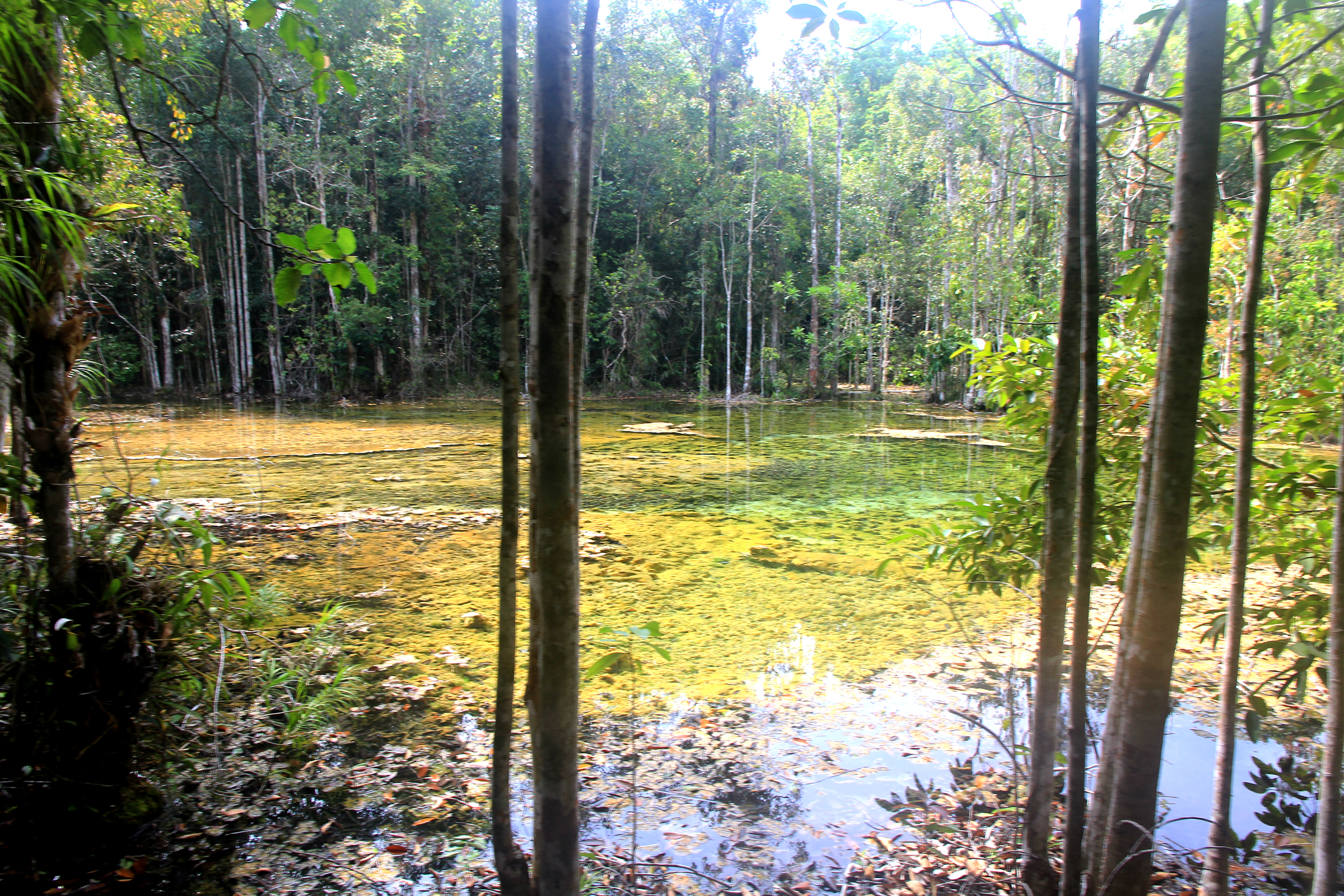
The emerald pool, Sa Morakot, lies in the Khao Phra-Bang Khram nature reserve in Khlong Thom district, about an hour and a quarter by car from Ao Nang. From the entrance, a 1.4 km nature trail runs through lowland rainforest, partly on boardwalks above crystal-clear pools. The pool is fed by warm springs, and depending on the light its water ranges from turquoise to emerald. Swimming is allowed.
600 metres further on is the Blue Pool (Sa Nam Phut), the spring that feeds the whole pool. It is a vivid blue, but swimming is not allowed. According to TAT, the area is home to a rare and endangered species, which is why it is protected as a reserve.
It is open daily from 8:30 am to 5 pm, and entry costs 400 THB per adult and 200 THB per child (about £9 and £4, TAT). Tour coaches arrive around midday, so if you want to swim without a crowd, be at the gate when it opens.
20. Khlong Thom hot springs
A few kilometres from Emerald Pool, so the two are almost always combined. Here warm water flows down limestone terraces in the forest and forms natural tubs a metre to a metre and a half deep. The cascade is only about five metres high, with three tiers and several pools on each. According to the Thai tourism register, the water is 40 to 50 °C at the source; in the pools it is pleasantly warm and slightly sulphurous. Entry is 100 THB (about £2, TAT). The advice is to arrive around 8:30 am or after 4 pm, when it is less busy.
Every travel agent in Ao Nang sells a full-day “Emerald Pool, Hot Springs and Tiger Cave” tour. Park fees are often not included, so check before you pay.
21. Than Bok Khorani, mangroves and kayaking at Ao Thalane
In the north of the province, around the small town of Ao Luk, the landscape is a maze of mangroves, channels and limestone rocks that is best explored by kayak. Than Bok Khorani National Park has a park with crystal-clear pools beneath a cliff at its entrance, and nearby there are caves you reach from the water. Tham Phi Hua To cave holds around seventy prehistoric paintings of people and animals in red and black. Travel agents in Ao Nang run kayak trips here.
Closer to Ao Nang is the bay of Ao Thalane, where you paddle along a mangrove channel between rock walls. At low tide you will spot mudskippers and small crabs on the mud, and sometimes monkeys in the branches. For us it is the best way to spend a day when the sea is too rough for a boat trip.
| Krabi entry fees and boats | Adult | Child |
|---|---|---|
| Hat Noppharat Thara–Mu Ko Phi Phi NP (Four Islands, Phi Phi) | 400 THB (about £9) | 200 THB |
| Than Bok Khorani NP (Hong Islands) | 300 THB (about £7) | 100 THB |
| Emerald Pool (Sa Morakot) | 400 THB (about £9) | 200 THB |
| Khlong Thom hot springs | 100 THB (about £2) | 100 THB |
| Shared long-tail Ao Nang–Railay West, one way | 100 THB (about £2) | see the price list at the booth |
Park fees are taken from the TAT website and the boat fare from the Ao Nang boatmen’s cooperative price list. Pound amounts are a rough guide at 1 THB ≈ £0.022, and national park fees are paid in cash.
Food and evenings in Krabi
Southern Thailand cooks differently from Bangkok. Krabi has a large Muslim community, so alongside pad thai and green curry you will find Muslim-style chicken rice, roti fresh off the griddle and, in Muslim-run places, no pork and no alcohol. Dishes here are spicier and use more turmeric. And since this is the coast, seafood is everywhere: grilled fish, prawns, squid and crab.
Food in Ao Nang costs more, and many places cook “for tourists”, which means milder spice and a Western menu. The best food for the least money is at the markets: the weekend night market in Krabi Town, the food market by Chao Fah pier and the smaller evening markets in Ao Nang. Our favourite meals came from stalls where locals eat and the menu has not been translated into five languages.
Nightlife in Krabi is more low-key than in Phuket. Ao Nang has bars and music until late, and Railay and Tonsai have a few beach bars with fire shows. Shops and restaurants may only sell alcohol between 11 am and midnight, with exceptions for licensed venues and hotels, and the legal drinking age in Thailand is 20.
Is Krabi safe? Rules worth knowing
Krabi is a relaxed province, but a few things deserve your attention. Most of them are covered in the UK Foreign Office travel advice for Thailand:
- No smoking on the beaches. On tourist beaches, Krabi’s explicitly included, you may not smoke or drop litter. The fine can reach 100,000 THB (about £2,200) and the case goes to court, which can mean being barred from leaving the country for months.
- E-cigarettes are illegal. Importing, possessing or using vapes and e-cigarettes, as well as shisha, is banned in Thailand, and police do check tourists.
- Scooter and jet-ski rentals. Krabi and the nearby islands are known for rental shops demanding compensation for damage when you return the vehicle. Photograph the equipment when you collect it and never hand over your passport as a deposit.
- Drinks. Krabi is among the places where drink spiking has been reported. Never leave your drink unattended. Thailand does not joke about drugs, and the penalties are very severe.
- The sea in monsoon season. From May to October there are often strong currents off the west-facing beaches. A red flag means no swimming.
- Monkeys. At Tiger Cave Temple, on the Monkey Trail and on Railay. Do not feed them, do not look them in the eye and keep food in your bag. If you are bitten, see a doctor because of the risk of rabies.
- Coral and shells. Taking shells or coral out of Thailand without a permit is prohibited. When snorkelling, do not stand on the coral.
Do not travel to Thailand without travel insurance. Treatment in a private hospital, an evacuation from an island or a flight home can easily run into thousands of pounds.
How many days in Krabi, and how to plan them
We would set aside at least five days for Krabi, ideally a week. You can do it in less, but half the time goes on getting from place to place and you are left with Railay and one boat trip.
Day 1: Arrive, settle into Ao Nang, sunset on the beach in the evening.
Day 2: Morning boat to Railay: Railay West, Phra Nang and the viewpoint, swimming in the afternoon. If you like, stay the night on Railay and give it two days.
Day 3: A full day on the Hong Islands, or half a day on the Four Islands.
Day 4: Tiger Cave Temple first thing, then Emerald Pool and the Khlong Thom hot springs. In the evening, the weekend night market in Krabi Town if it falls on a Friday to Sunday.
Day 5: Dragon’s Crest or kayaking in the Ao Thalane mangroves, afternoon free.
Days 6 and 7: Move on to Phi Phi or Ko Lanta, or take a climbing course on Railay.
Krabi pairs well with Phuket, Phi Phi and Ko Lanta on a single trip along the Andaman coast. For an overview of the whole country, from Bangkok to the Gulf islands, see our guide to places to visit in Thailand.
A little history
Krabi is one of the longest-inhabited places in Thailand. In the Lang Rongrien rock shelter, archaeologists found traces of people from 37,000 to 27,000 years ago, and more than twenty rock art sites have been recorded on the cliffs and in the caves of Krabi and neighbouring Phang Nga. Shell dating puts the paintings in Phang Nga Bay at roughly three to five thousand years old. A bronze seal engraved with a two-masted ship, dating from the 2nd century AD, has also been found on the coast.
For centuries the area was governed from Nakhon Si Thammarat on the other side of the peninsula. King Chulalongkorn raised Krabi to the status of a town in 1872, and in 1875 it came directly under Bangkok, which made it a province in its own right. The governor’s seat was first in the settlement of Ban Talad Kao and moved to the mouth of the Krabi River, where the town stands today, in 1900.
And the name? It has nothing to do with crabs, whatever the crab statues in the streets would have you believe. In Thai, krabi means an ancient sword, and the provincial seal shows two crossed swords in front of Khao Phanom Bencha (1,397 m), the highest mountain in the province.
Today the province is a mix of Buddhists (about 65%), Muslims (about 34%), Thai Chinese and sea peoples, the largest group of whom are the Urak Lawoi on Ko Lanta. People here used to make a living mainly from rubber, palm oil and fishing. Tourism only arrived in the last few decades, and it was hit hard by the tsunami of December 2004, which struck Phi Phi and the coast at Ao Nang.
What we would do differently
Krabi tempts you to get on a boat every day and tick off another island. After the third day, though, the island trips start to blur together: minibus in the morning, then the boat, snorkel, lunch in a box, photo by a rock, back again. We would do fewer of them, and instead of one more island we would spend a whole afternoon on Phra Nang, staying until the last tour boat has left and the beach goes quiet.
The best moments in Krabi are not in any itinerary. A morning coffee on Railay East as the tide goes out and uncovers the mangroves. A bowl of soup at a stall in Krabi Town you know nothing about, except that locals are queuing for it. Try dishes you do not recognise and ask what they are. You will usually learn more than from any guidebook.
You do not need to see all 21 places. Someone who comes for a week and fits in Railay, one day on the islands and Tiger Cave has seen Krabi better than someone who rushed through everything in the same time. And when you reach the viewpoint above Railay or the Buddha at the top of the steps, leave your phone in your pocket for a while. The photo of the cliffs will always come out fine; the feeling of standing up there you will only remember without a screen in front of your eyes.
Frequently asked questions
When is the best time to visit Krabi?
From November to April, when the Andaman side of Thailand has its dry season and the sea is calm. The busiest and most expensive months are December to February. May to October is the rainy season: the sea is often rough and some boat trips are cancelled, but accommodation is cheaper.
Krabi or Phuket: which is better?
Phuket is bigger, with more beaches, more nightlife and more flights. Krabi is quieter, its limestone scenery is more dramatic and there is nowhere quite like Railay. If you want parties and a wide choice of hotels, go for Phuket; if you want nature and boat trips around the islands, choose Krabi. You can easily combine them, as they are about three hours apart by road.
How do you get to Railay Beach from Ao Nang?
Only by water, as no road leads there. A shared long-tail boat from Ao Nang beach costs 100 THB per seat one way, the ride takes about 15 minutes and the boat leaves once it is full. Boats to Railay East leave from Chao Fah pier in Krabi Town and from Ao Nam Mao pier. After 6 pm only private boats run.
How much is the Krabi national park entrance fee?
The Four Islands and Phi Phi belong to Hat Noppharat Thara–Mu Ko Phi Phi National Park, where entry costs 400 THB per adult. The Hong Islands in Than Bok Khorani National Park cost 300 THB, Emerald Pool 400 THB and the Khlong Thom hot springs 100 THB. Fees are paid in cash on site and are often not included in tour prices.
How do I get from Krabi Airport to Ao Nang?
The cheapest option is the shared shuttle bus from the arrivals hall, which drops passengers at their hotels. Operators quote 150 THB per person, and with all the hotel stops the journey takes about an hour. A taxi from the airport counter or a Grab is faster but costs more. The airport is about 30 km from Ao Nang.
How many days in Krabi is enough?
Five days is a sensible minimum and a week is ideal. That covers the main things to do in Krabi: Railay and Phra Nang, a full day on the islands, Tiger Cave Temple, Emerald Pool with the hot springs and an evening in Krabi Town. With extra days you can add Phi Phi or Ko Lanta.
How many steps are there at Tiger Cave Temple in Krabi?
According to the Tourism Authority of Thailand (TAT), 1,237, although some visitors count around 1,260. The steps are tall and in full sun, and the climb takes about an hour. Go early in the morning, take water and keep your shoulders and knees covered, as the summit is part of a temple.
What is the best beach in Krabi?
For us, Phra Nang on the Railay peninsula, ringed by cliffs and home to the Princess Cave, with Railay West close behind. The beach at Ao Nang is more of a boat landing, while Klong Muang and Tubkaek are the quiet, long beaches with resorts. For white sand and clear water, head mainly to the Hong Islands, Ko Poda and Phi Phi.
Where to next
- Thailand holiday guide: when to go, entry rules, flights, budget and routes for two or three weeks.
- Places to visit in Thailand: an overview of the whole country, from Bangkok to the islands in the Gulf of Thailand.
- Ko Phi Phi: Maya Bay, the viewpoint, ferries from Krabi and where to stay on the island.
- Phuket: beaches all along the coast, Old Phuket Town and trips into Phang Nga Bay.
- Bangkok: where most trips to Thailand begin, with the Grand Palace, temples, markets and getting around the city.
- Langkawi: a Malaysian island just across the Thai border, where you can continue south along the Andaman coast.
Potřebujete pomoct s cestováním?
-
Ubytování 🏨
Vyberte si to nejlepší ubytování, ať už jste kdekoliv, přes Booking.com. -
Půjčení auta 🚗
Auto si snadno najdete přes Booking.com, kde máte často slevu díky ubytování, nebo Rentalcars.com, kde porovnáte nabídky většiny půjčoven. -
Zážitky 🎟️
Přes GetYourGuide.com si vyberete z nejrůznějších výletů i zážitků po celém světě, navíc se zrušením zdarma do 24 h předem.